FlowRAG: Synergizing Explicit Reasoning via Frequency-Aware Multi-Granularity Graph Flow
Pith reviewed 2026-06-27 00:29 UTC · model grok-4.3
The pith
FlowRAG weights entity connections by term frequency in a multi-granularity graph to extract reliable reasoning paths.
A machine-rendered reading of the paper's core claim, the machinery that carries it, and where it could break.
Core claim
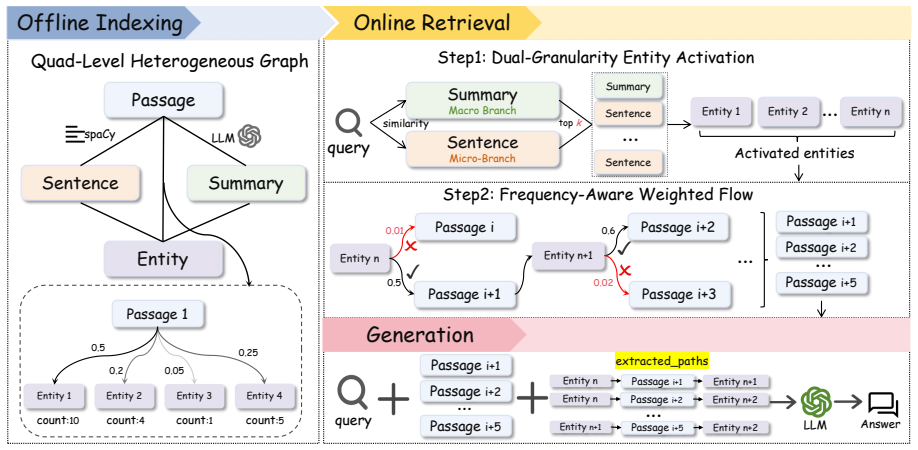
By constructing a quad-level heterogeneous graph and routing relevance through a frequency-aware weighted flow module on entity-passage links, FlowRAG prunes noisy connections and extracts high-confidence reasoning paths as an explicit logic skeleton for generation.
What carries the argument
The frequency-aware weighted flow module that weights entity-passage links by within-passage term frequency to prune noise and highlight reliable multi-hop paths.
If this is right
- Improved semantic recall for abstract or entity-sparse queries.
- More robust entity-to-entity transitions in multi-hop reasoning.
- Explicit logic skeletons that support more reliable generation.
- State-of-the-art performance on complex reasoning benchmarks.
Where Pith is reading between the lines
- Similar frequency-based pruning could apply to other knowledge graph tasks outside RAG.
- Combining term frequency with other signals like co-occurrence might further refine the paths.
- The multi-granularity approach suggests benefits for queries at different levels of abstraction.
Load-bearing premise
Term frequency inside passages indicates the most trustworthy entity connections for building correct multi-hop reasoning chains.
What would settle it
Finding a set of queries where high term-frequency paths lead to wrong answers while low-frequency paths are required for the correct multi-hop inference.
Figures
read the original abstract
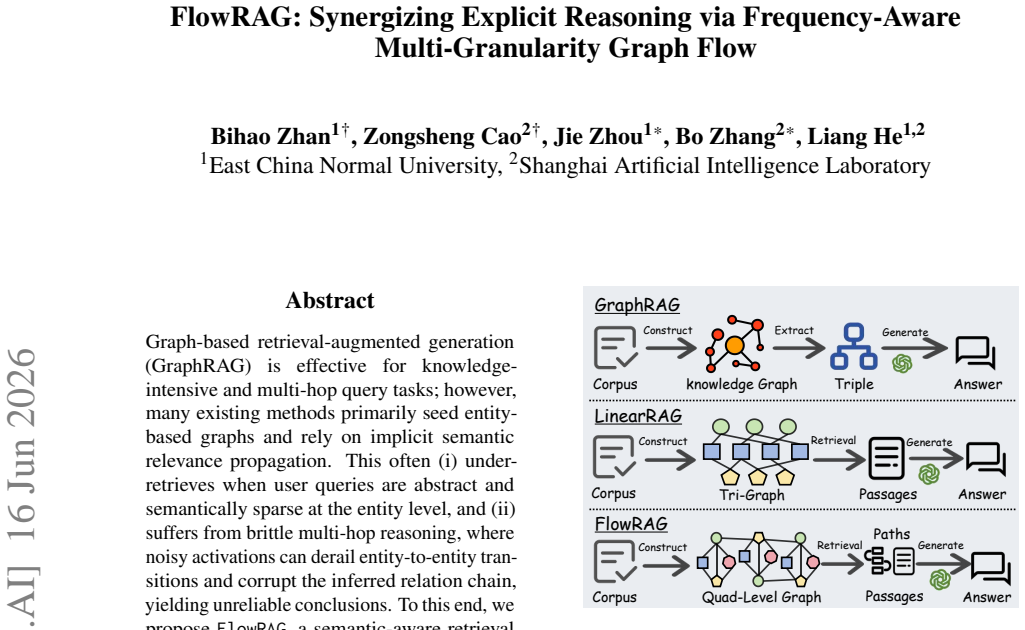
Graph-based retrieval-augmented generation (GraphRAG) is effective for knowledge-intensive and multi-hop query tasks; however, many existing methods primarily seed entity-based graphs and rely on implicit semantic relevance propagation. This often (i) under-retrieves when user queries are abstract and semantically sparse at the entity level, and (ii) suffers from brittle multi-hop reasoning, where noisy activations can derail entity-to-entity transitions and corrupt the inferred relation chain, yielding unreliable conclusions. To this end, we propose \texttt{FlowRAG}, a semantic-aware retrieval framework that improves both semantic recall and explicit reasoning. Specifically, \texttt{FlowRAG} constructs a quad-level heterogeneous graph over passages, summaries, sentences, and entities, where summary nodes serve as a coarse semantic hub. At retrieval time, a dual-granularity activation module combines summary--query alignment with sentence-level matching to activate relevant entities under paraphrase and abstraction robustly. We then introduce a frequency-aware weighted flow module that routes relevance through entity--passage links weighted by within-passage term frequency, pruning noisy connections and extracting high-confidence reasoning paths as an explicit logic skeleton for generation. Extensive experiments show that \texttt{FlowRAG} obtains state-of-the-art performance on complex reasoning benchmarks.
Editorial analysis
A structured set of objections, weighed in public.
Referee Report
Summary. The paper proposes FlowRAG, a GraphRAG framework that builds a quad-level heterogeneous graph over passages, summaries, sentences, and entities. It introduces a dual-granularity activation module combining summary-query alignment and sentence-level matching, followed by a frequency-aware weighted flow module that weights entity-passage links by within-passage term frequency to prune noisy connections and extract explicit reasoning paths as logic skeletons for generation. The central claim is that this yields state-of-the-art performance on complex reasoning benchmarks by improving semantic recall and multi-hop reasoning reliability.
Significance. If the frequency-aware pruning reliably extracts high-confidence paths without discarding critical low-frequency entities in multi-hop chains, the approach could meaningfully advance explicit reasoning in retrieval-augmented generation beyond implicit semantic propagation methods. The quad-level graph and dual activation address documented limitations in entity-seeded graphs for abstract queries.
major comments (2)
- [Abstract] Abstract (frequency-aware weighted flow module): the assumption that within-passage term frequency reliably marks high-confidence reasoning links for pruning is load-bearing for the explicit logic skeleton claim, yet the manuscript provides no frequency-distribution statistics, counter-example analysis, or ablation on benchmark queries where central multi-hop entities appear at low frequency while noise appears at high frequency; this directly risks breaking the multi-hop chains the method aims to preserve.
- [Abstract] Abstract (experiments): the SOTA claim on complex reasoning benchmarks rests on 'extensive experiments' but the provided text supplies no tables, ablation results, error bars, or baseline comparisons, making it impossible to verify whether the reported gains are attributable to the frequency-aware module or other components.
Simulated Author's Rebuttal
We thank the referee for the constructive feedback. We address each major comment below and indicate the revisions we will make.
read point-by-point responses
-
Referee: [Abstract] Abstract (frequency-aware weighted flow module): the assumption that within-passage term frequency reliably marks high-confidence reasoning links for pruning is load-bearing for the explicit logic skeleton claim, yet the manuscript provides no frequency-distribution statistics, counter-example analysis, or ablation on benchmark queries where central multi-hop entities appear at low frequency while noise appears at high frequency; this directly risks breaking the multi-hop chains the method aims to preserve.
Authors: We agree that empirical validation of the frequency assumption is necessary to support the explicit logic skeleton claim. The current version does not include frequency-distribution statistics, counter-example analysis, or targeted ablations on low-frequency central entities. We will add these elements in the revised manuscript, including frequency statistics across benchmarks and ablations that test preservation of multi-hop chains when key entities have low within-passage frequency. revision: yes
-
Referee: [Abstract] Abstract (experiments): the SOTA claim on complex reasoning benchmarks rests on 'extensive experiments' but the provided text supplies no tables, ablation results, error bars, or baseline comparisons, making it impossible to verify whether the reported gains are attributable to the frequency-aware module or other components.
Authors: The abstract is a concise summary and does not contain tables or detailed results, which appear in the experimental section of the full manuscript. To strengthen attribution of gains to the frequency-aware module, we will add or expand component-wise ablations in the revision and update the abstract to reflect any new findings on module contributions. revision: partial
Circularity Check
No circularity: method is a descriptive proposal validated empirically
full rationale
The provided abstract and description outline a new graph-based RAG architecture with modules for heterogeneous graph construction, dual-granularity activation, and frequency-aware flow weighting. No equations, fitted parameters, or predictions are shown that reduce by construction to the inputs. No self-citations are referenced as load-bearing for theorems, uniqueness, or ansatzes. The SOTA claim rests on external experiments rather than internal derivation, making the chain self-contained against benchmarks.
Axiom & Free-Parameter Ledger
Reference graph
Works this paper leans on
-
[1]
Advances in neural information processing systems , volume=
Retrieval-augmented generation for knowledge-intensive nlp tasks , author=. Advances in neural information processing systems , volume=
-
[2]
2025 , eprint=
From Local to Global: A Graph RAG Approach to Query-Focused Summarization , author=. 2025 , eprint=
2025
-
[3]
arXiv preprint arXiv:2501.00309 , year=
Retrieval-augmented generation with graphs (graphrag) , author=. arXiv preprint arXiv:2501.00309 , year=
-
[4]
arXiv preprint arXiv:2606.13669 , year=
Agents-K1: Towards Agent-native Knowledge Orchestration , author=. arXiv preprint arXiv:2606.13669 , year=
-
[5]
Proceedings of the 33rd ACM International Conference on Multimedia , pages=
Tv-rag: A temporal-aware and semantic entropy-weighted framework for long video retrieval and understanding , author=. Proceedings of the 33rd ACM International Conference on Multimedia , pages=
-
[6]
Proceedings of the AAAI Conference on Artificial Intelligence , volume=
ViG-RAG: Video-aware Graph Retrieval-Augmented Generation via Temporal and Semantic Hybrid Reasoning , author=. Proceedings of the AAAI Conference on Artificial Intelligence , volume=
-
[7]
2025 , eprint=
LinearRAG: Linear Graph Retrieval Augmented Generation on Large-scale Corpora , author=. 2025 , eprint=
2025
-
[8]
arXiv preprint arXiv:2506.05690 , year=
When to use Graphs in RAG: A Comprehensive Analysis for Graph Retrieval-Augmented Generation , author=. arXiv preprint arXiv:2506.05690 , year=
-
[9]
Advances in Neural Information Processing Systems , volume=
Hipporag: Neurobiologically inspired long-term memory for large language models , author=. Advances in Neural Information Processing Systems , volume=
-
[10]
arXiv preprint arXiv:2410.05779 , year=
Lightrag: Simple and fast retrieval-augmented generation , author=. arXiv preprint arXiv:2410.05779 , year=
-
[11]
2024 , eprint=
G-Retriever: Retrieval-Augmented Generation for Textual Graph Understanding and Question Answering , author=. 2024 , eprint=
2024
-
[12]
The Twelfth International Conference on Learning Representations , year=
Raptor: Recursive abstractive processing for tree-organized retrieval , author=. The Twelfth International Conference on Learning Representations , year=
-
[13]
graphrag: A systematic evaluation and key insights , author=
Rag vs. graphrag: A systematic evaluation and key insights , author=. arXiv preprint arXiv:2502.11371 , year=
-
[14]
Expert Systems with Applications , volume=
Openie-based approach for knowledge graph construction from text , author=. Expert Systems with Applications , volume=. 2018 , publisher=
2018
-
[15]
Proceedings of the AAAI conference on artificial intelligence , volume=
Knowledge graph prompting for multi-document question answering , author=. Proceedings of the AAAI conference on artificial intelligence , volume=
-
[16]
arXiv preprint arXiv:2502.01113 , year=
GFM-RAG: graph foundation model for retrieval augmented generation , author=. arXiv preprint arXiv:2502.01113 , year=
-
[17]
2025 , eprint=
From RAG to Memory: Non-Parametric Continual Learning for Large Language Models , author=. 2025 , eprint=
2025
-
[18]
arXiv preprint arXiv:1006.2880 , year=
Fast incremental and personalized pagerank , author=. arXiv preprint arXiv:1006.2880 , year=
-
[19]
Proceedings of the 2018 conference on empirical methods in natural language processing , pages=
HotpotQA: A dataset for diverse, explainable multi-hop question answering , author=. Proceedings of the 2018 conference on empirical methods in natural language processing , pages=
2018
-
[20]
arXiv preprint arXiv:2011.01060 , year=
Constructing a multi-hop qa dataset for comprehensive evaluation of reasoning steps , author=. arXiv preprint arXiv:2011.01060 , year=
Pith/arXiv arXiv 2011
-
[21]
Transactions of the Association for Computational Linguistics , volume=
MuSiQue: Multihop Questions via Single-hop Question Composition , author=. Transactions of the Association for Computational Linguistics , volume=. 2022 , publisher=
2022
-
[22]
Advances in neural information processing systems , volume=
Mpnet: Masked and permuted pre-training for language understanding , author=. Advances in neural information processing systems , volume=
-
[23]
Advances in neural information processing systems , volume=
Minilm: Deep self-attention distillation for task-agnostic compression of pre-trained transformers , author=. Advances in neural information processing systems , volume=
-
[24]
Proceedings of the 47th international ACM SIGIR conference on research and development in information retrieval , pages=
C-pack: Packed resources for general chinese embeddings , author=. Proceedings of the 47th international ACM SIGIR conference on research and development in information retrieval , pages=
-
[25]
arXiv preprint arXiv:2212.03533 , year=
Text embeddings by weakly-supervised contrastive pre-training , author=. arXiv preprint arXiv:2212.03533 , year=
-
[26]
Yibo Zhao and Jiapeng Zhu and Ye Guo and Kangkang He and Xiang Li , year=. 2505.24226 , archivePrefix=
-
[27]
2025 , eprint=
PathRAG: Pruning Graph-based Retrieval Augmented Generation with Relational Paths , author=. 2025 , eprint=
2025
-
[28]
, author=
Dense Passage Retrieval for Open-Domain Question Answering. , author=. EMNLP (1) , pages=
-
[29]
arXiv preprint arXiv:2305.15294 , year=
Enhancing retrieval-augmented large language models with iterative retrieval-generation synergy , author=. arXiv preprint arXiv:2305.15294 , year=
-
[30]
2024 , journal=
Self-rag: Learning to retrieve, generate, and critique through self-reflection , author=. 2024 , journal=
2024
-
[31]
2020 , eprint=
Passage Re-ranking with BERT , author=. 2020 , eprint=
2020
-
[32]
2022 , eprint=
Precise Zero-Shot Dense Retrieval without Relevance Labels , author=. 2022 , eprint=
2022
-
[33]
2024 , eprint=
Corrective Retrieval Augmented Generation , author=. 2024 , eprint=
2024
discussion (0)
Sign in with ORCID, Apple, or X to comment. Anyone can read and Pith papers without signing in.