REVIEW 4 major objections 5 minor 62 references
Network constraints on the mixing patterns of binary node metadata
T0 review · 4 major / 5 minor · reviewed 2026-08-14 · deepseek-v4-flash
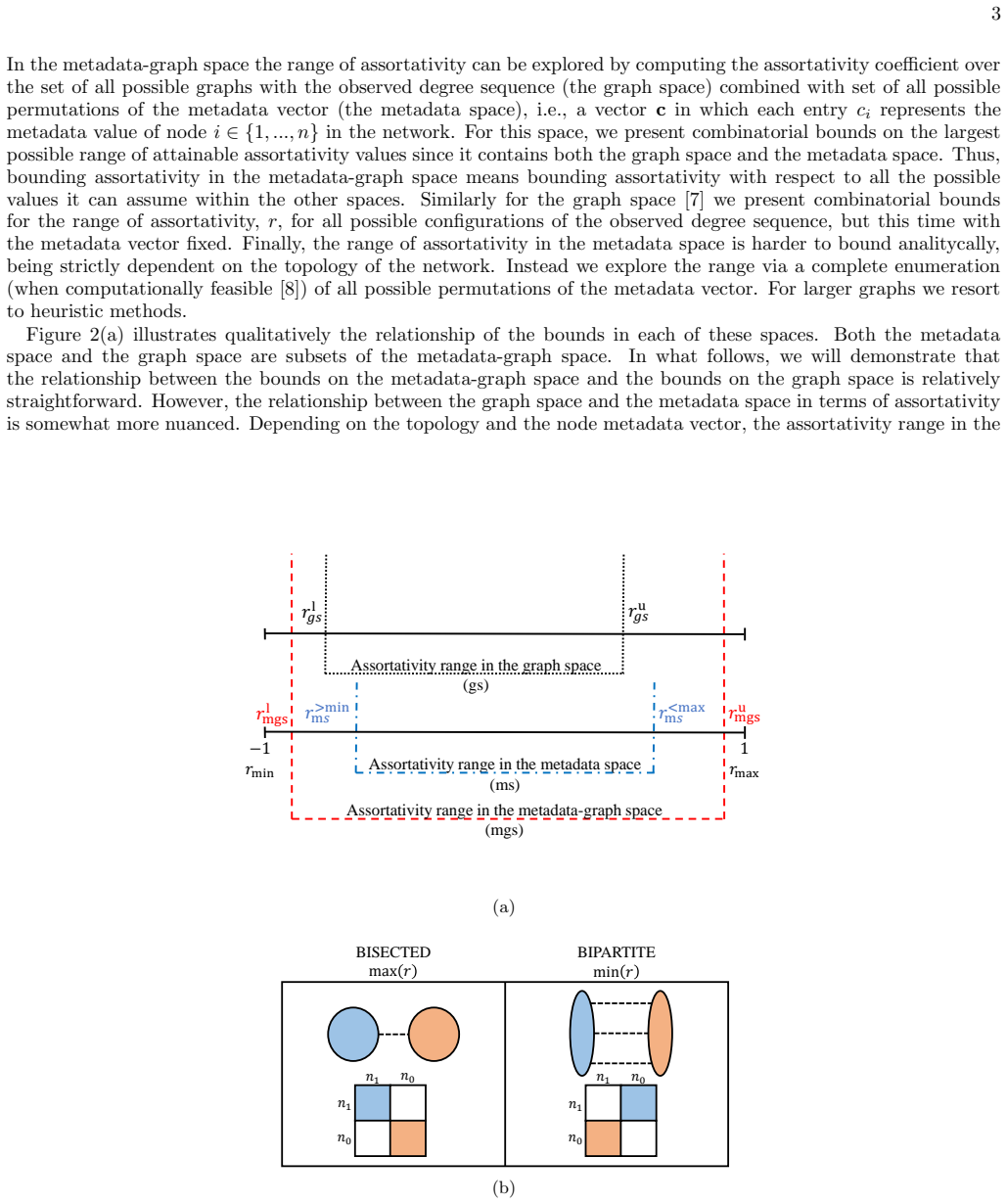
Pith's one-line read For binary node metadata, Newman's assortativity coefficient cannot usually hit -1 or 1: the degree sequence and class sizes impose narrower bounds, and the paper derives them.
desk verdict Useful interpretability paper with a solid upper bound; the lower-bound claims are unproven and the headline Wolf example leans on that gap. read the letter →
The pith
A machine-rendered reading of the paper's core claim, the machinery that carries it, and where it could break.
The reading
What carries the argument
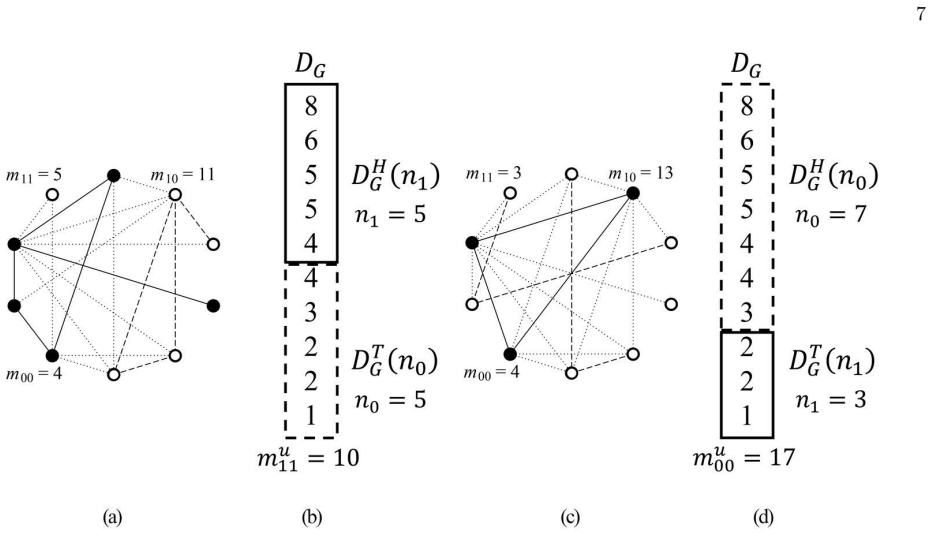
The load-bearing object is the decomposition of edges into three counts: $m_{11}$ (edges between two nodes of type 1), $m_{00}$ (type 0-type 0), and $m_{10}$ (cross-type), with $m = m_{11} + m_{00} + m_{10}$. Assortativity is rewritten as $r = 1 - 2 m_{10} m / (m^2 - (m_{00} - m_{11})^2)$, so extremal $r$ is driven by the smallest possible $m_{10}$ and by the imbalance $m_{00} - m_{11}$. To bound those counts from the degree sequence, the paper partitions the ordered degree sequence into a head (highest degrees) and a tail, producing upper and lower bounds on $m_{11}$, $m_{10}$, and $m_{00}$; the same partition logic, applied to the fixed degree partition induced by the metadata assignment, yields graph-space bounds. The formulas then pick the edge-count combination that maximizes or minimizes $r$ under those bounds.
What would settle it
Enumerate all simple graphs and metadata assignments for a small degree sequence and check whether $r^u_{mgs} = 1 - 2 m^l_{10}/m$ is actually attained; a single counterexample where the maximum attainable $r$ falls below the formula's value would show the bounds are not tight.
Extended reading notes
Core claim
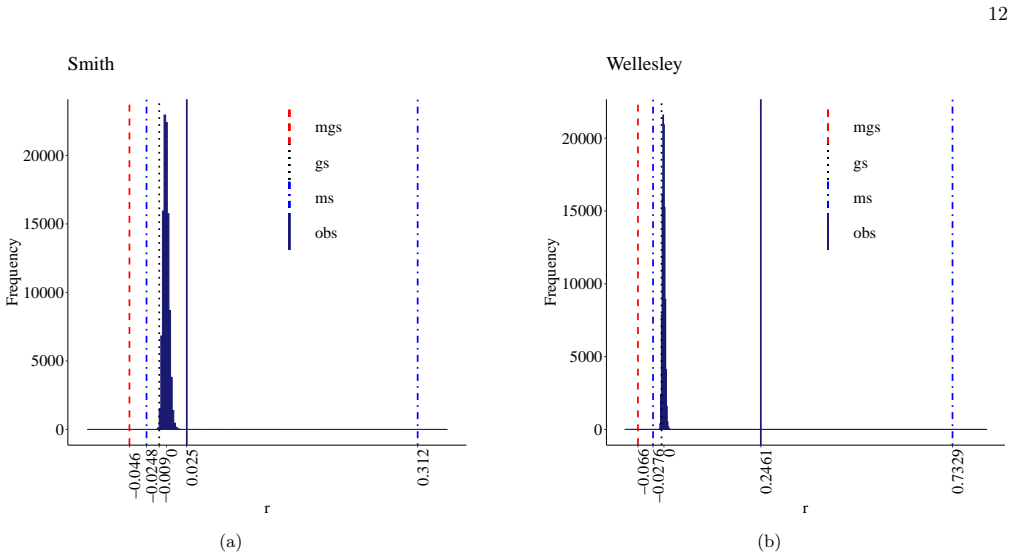
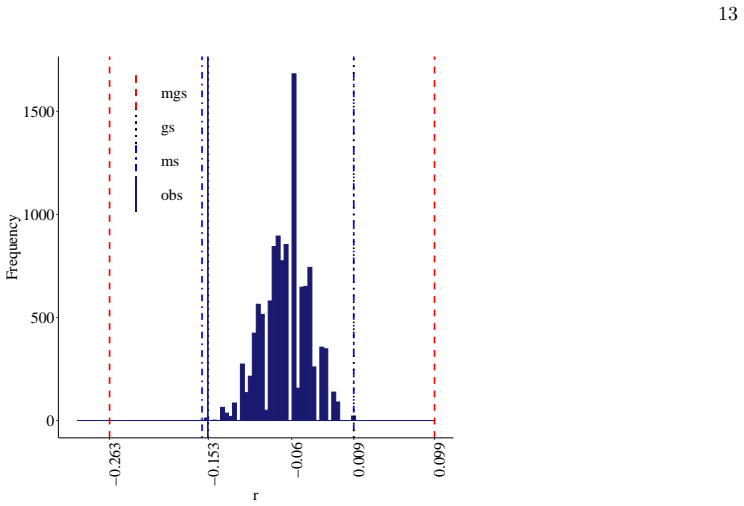
The central claim is that in the metadata-graph space, the ensemble of graphs with a fixed degree sequence and fixed numbers of nodes of each of two metadata values, the maximum assortativity is $r^u_{mgs} = 1 - 2 m^l_{10}/m$, where $m^l_{10}$ is the minimum possible number of cross-type edges forced by the degree sequence; the minimum is obtained by one of three edge-count combinations that come closest to a bipartite split. In the graph space, where the metadata assignment is also fixed, the same formulas apply with degree-sequence bounds recomputed for the fixed partition. For the metadata space, no comparable analytic bound is given; the paper uses complete enumeration on small networks and a swap heuristic on large ones. The paper further shows on real social networks (Smith, Wellesley, wolf dominance) that the attainable ranges can be far narrower than [-1, 1], and that in the wolf network the observed assortativity coincides with the graph-space lower bound.
Load-bearing premise
The derivation assumes that the extremal cross-type and same-type edge counts selected by the bounds can all be achieved at once by some graph with the stated degree sequence and node classes, but joint feasibility is not proven.
Editorial extensions
If this is right
- An observed assortativity value can be the maximum or minimum attainable in its graph space, so calling it mild relative to [-1, 1] misreads it; the Wolf network's $r = -0.153$ is the graph-space minimum.
- Comparing assortativity across networks with different degree sequences or class proportions is not meaningful without first computing each network's attainable range; the paper proposes a normalization $r / r^u_{gs}$ or $r / r^l_{gs}$ as one remedy.
- Under some conditions random metadata permutations have a nonzero expected assortativity, so significance testing against zero needs to be replaced by testing against the ensemble distribution.
- The upper bound $r^u_{mgs} = 1 - 2 m^l_{10}/m$ gives a direct topological reason why maximum homophily is unattainable whenever the degree sequence forces at least one cross-type edge.
- Bounds in the graph and metadata spaces are not ordered against each other: either can be wider, which matters when choosing which null ensemble to use.
Reading between the lines
- A natural stress test is to check joint feasibility: the extremal edge counts used in Eqs. (13)-(15) may not be simultaneously realizable by any simple graph, so on some degree sequences the true bounds could be even tighter than the formulas give; exhaustively checking small random degree sequences would settle how often this happens.
- The same head-tail bounding logic should extend to categorical metadata with more than two values, where the contingency table has more cells and the extremal problem becomes one of choosing several edge counts; the paper notes the issue exists for any categorical metadata but does not derive those bounds.
- For weighted or directed networks the edge-count identity would need replacement by weighted sums or ordered pairs; the binary formula's dependence on $m_{10}$ suggests the bounds will shift predictably, giving a testable route for generalization.
- A practical use of these bounds is a normalized assortativity that reports where $r$ sits inside its attainable interval; this could change cross-sectional comparisons in gender-homophily studies, where imbalanced class sizes are common.
Signed reviews
Editorial analysis
A structured set of objections, weighed in public.
Referee Report
Summary. The paper studies how graph structure and binary node metadata constrain the attainable values of Newman's assortativity coefficient r. It defines three configuration spaces (metadata-graph, graph, and metadata spaces), imports edge-count bounds from the authors' earlier work, and derives combinatorial upper and lower bounds for r in the metadata-graph and graph spaces. For the metadata space, it uses heuristic search or complete enumeration. The empirical section applies these bounds to Facebook college networks and a wolf dominance network, and the discussion argues that an observed value such as r=-0.153 in the wolf network may actually be the most disassortative value attainable under the graph-space constraints.
Significance. If the bounds are correct, the paper makes a practically useful point: nominal r values in [-1,1] are often unattainable once the degree sequence and class sizes are fixed, and interpretations of r should account for this. The upper-bound derivation around Eq. (15) is simple and robust, the use of complete enumeration for small networks is a strength, and the authors provide code for reproducibility. The central weakness is the lower-bound construction, whose validity is not established; since the paper's most striking interpretive claim (the wolf network as 'as disassortative as can be') rests on that construction, the contribution is currently only partially supported.
major comments (4)
- [Section IV.A.2, Eqs. (18)-(21)] The lower-bound formulas for rl_mgs and rl_gs are not proven to be genuine bounds. The three candidate triples in Eq. (21) combine per-count bounds (ml11, ml00, mu10) taken from Appendix A.2, but the paper never shows that any of these triples is jointly realizable as the edge counts m00, m10, m11 of a simple graph with degree sequence DG and some admissible binary metadata assignment (or with the fixed assignment, for the graph space). The condition stated in the text, e.g. mu10+ml11<=m, only ensures that the residual count m-mu10-ml11 is nonnegative; it does not check the full interval constraints, parity, or the graphical constraints expressed by conditions such as Erdos-Gallai with a prescribed metadata partition. Consequently, Eq. (21) may evaluate r on an infeasible configuration, in which case rl_mgs and rl_gs can lie below the true minima and the Section VI claim that the wolf network is 'as disassortative as can be' is unsupported. The upper bound Eq. (15) is safer, since it follows from m10>=ml10 and m^2-(m00-m11)^2<=m^2, but the accompanying statement that the maximum is attained when m00=m11 should be qualified as a relaxation unless feasibility of that configuration is proved.
- [Section IV.B, Eq. (23), and Section IV.C, Eq. (25)] The displayed inclusion relations have the wrong ordering. Since the metadata-graph space contains both the graph space and the metadata space, the true minima satisfy min_mgs<=min_gs and min_mgs<=min_ms, so the corresponding lower bounds should satisfy rl_mgs<=rl_gs and rl_mgs<=r>min_ms, not the reverse as written in Eqs. (23) and (25). The contradiction is visible in Fig. 5, which reports rl_mgs=-0.905 and rl_gs=-0.8; this is incompatible with Eq. (23). The same issue affects the text around Eqs. (22)-(25), where the subset relations are described correctly but the inequalities are not.
- [Section VI / Figure 7 / Appendix A.6] The wolf dominance network is described with two different edge counts: Fig. 7 and the main text use m=111, while Appendix A.6 states that the network has m=148 links. Since the bounds (e.g., ru_mgs=1-2ml10/m and all lower-bound formulas) depend on m, the reported bounds and the conclusion that r=-0.153 is the graph-space minimum cannot both be correct. The authors should reconcile the count and recompute the affected numbers.
- [Section IV.A.2, Eq. (21)] The three candidate cases in Eq. (21) are labeled 'ml_ii', 'Delta max', and 'Delta max'; based on the preceding text, the second case should be the 'Delta min' case and the third the 'Delta max' case. The notation also omits commas between the set elements, which makes the intended triples difficult to parse. This is a presentation issue, but it compounds the difficulty of verifying the lower-bound argument.
minor comments (5)
- [Section IV.C] The notation r<max_ms and r>min_ms is confusing: the symbols suggest 'less than max' and 'greater than min', although the quantities are intended as algorithmic lower and upper estimates of the metadata-space extrema. Please rename them or explain the notation explicitly.
- [Reference [7]] Reference [7] is missing the final author's surname ('Johan'); it should be completed as 'Fosdick, Larremore, Nishimura, and Ugander'.
- [Appendix A.2] The notation DG(n1) and DG(n0) is used for both arbitrary partitions and the specific fixed partition induced by the metadata assignment; the distinction between the two usages should be made clearer, especially when comparing the metadata-graph-space bounds with the graph-space bounds.
- [Section VI, Eq. (26)] The proposed normalized assortativity rgs divides by rlgs when r is negative; the manuscript should state how to handle the case rlgs=0 or when rlgs is extremely close to zero, since this can occur for dense or perfectly mixed graphs.
- [Figure 6] The caption says the upper bounds for gs and mgs are not reported in the panel and gives ru_gs=0.976 and ru_mgs=1, but the text refers to these values as if they were visible. Either add them to the figure or adjust the wording.
Circularity Check
No significant circularity: the assortativity bounds are derived algebraically from Eq. (11) and independent edge-count lemmas; no fitted parameter is renamed as a prediction.
full rationale
The paper's central derivation chain is not circular. The assortativity formula is rewritten in terms of edge counts as Eq. (11), r = 1 - 2m10 m / (m^2 - (m00 - m11)^2), which is an algebraic identity. The upper and lower bounds on r in the metadata-graph and graph spaces are then obtained by combining this identity with independent combinatorial bounds on m00, m11, and m10 that depend only on the degree sequence and the class sizes n0, n1 (Appendix A2, A3). These edge-count bounds are not fitted to observed assortativity values; they are parameter-free constraints restated in the appendix and credited to prior work [14,15]. Although those prior papers share authors with this one, the cited results do not include the target assortativity bounds and are externally checkable, so the self-citation is real evidence rather than a circularity. The paper does not fit any parameter to the real-world examples before computing the bounds; the Smith, Wellesley, and Wolf bounds are computed from degree sequence and metadata proportions (or the fixed metadata assignment) alone, without using the observed r. The Wolf case, where the observed r equals rl_gs, is an example of the bound being tight, not an input to the bound. Possible concerns about joint realizability of the extremal triples in Eqs. (18)-(21) and the reversed inequalities in Eqs. (23)/(25) are mathematical correctness issues, not circularity: the derivations proceed by inequalities from stated edge-count bounds and do not reduce to the quantities they are supposed to bound. Overall, no prediction is equivalent to its inputs by construction, so the circularity score is 0.
Assumptions & free parameters
assumptions (4)
- standard math Pearson correlation and the phi coefficient formula, including the marginal bounds phi_min and phi_max of Guilford (1965), are valid for binary variables.
- domain assumption The networks considered are simple undirected graphs (no self-loops or multiedges) with binary node metadata and 0 < n1 < n.
- domain assumption The edge-count bounds m^u_11, m^u_10, m^l_11, m^l_10 from Refs. [14,15] (Appendix A.2) are valid for every simple graph realizing the given degree sequence.
- domain assumption The swap heuristic in Appendix A.4 (acceptance probability p = 0.001) explores the metadata space well enough that its extrema approximate the true bounds.
Cite this review
Pith. "Pith review of Network constraints on the mixing patterns of binary node metadata." pith.science (2026). https://pith.science/paper/4PU6IVEC
@misc{pith2026190804588,
  author       = {Pith},
  title        = {Pith review of: Network constraints on the mixing patterns of binary node metadata},
  year         = {2026},
  howpublished = {\url{https://pith.science/paper/4PU6IVEC}},
  note         = {Machine review of arXiv:1908.04588}
}
read the original abstract
We consider the network constraints on the bounds of the assortativity coefficient, which measures the tendency of nodes with the same attribute values to be interconnected. The assortativity coefficient is the Pearson's correlation coefficient of node attribute values across network edges and ranges between -1 and 1. We focus here on the assortativity of binary node attributes and show that properties of the network, such as degree distribution and the number of nodes with each attribute value place constraints upon the attainable values of the assortativity coefficient. We explore the assortativity in three different spaces, that is, ensembles of graph configurations and node-attribute assignments that are valid for a given set of network constraints. We provide means for obtaining bounds on the extremal values of assortativity for each of these spaces. Finally, we demonstrate that under certain conditions the network constraints severely limit the maximum and minimum values of assortativity, which may present issues in how we interpret the assortativity coefficient.
Figures

Figures from the paper (5 more)



Reference graph
Works this paper leans on
-
[1]
the metadata-graph space (mgs) – the ensemble of configurations with a given degree sequence and proportion of metadata values
-
[2]
the graph space (gs) – the ensemble of configurations with a given degree sequence and specific node metadata assignment
-
[3]
the metadata space (ms) – the ensemble of configurations with a specific topology and proportion of metadata values. 3 In the metadata-graph space the range of assortativity can be explored by computing the assortativity coefficient over the set of all possible graphs with the observed degree sequence (the graph space) combined with set of all possible permut...
-
[4]
(3), √ a1a0b1b0 =a1a0 =a1(1−a1) =a1−a2 1
Now we can simplify the denominator of Eq. (3), √ a1a0b1b0 =a1a0 =a1(1−a1) =a1−a2 1 . Then by making these substitutions and summing over categories (since we do not assume that a0 =a1) we recover Newman’s assortativity [1]: r = ∑ ieii−a2 i 1−∑ ia2 i . (6) The fact that the minimum value of assortativityrmin may be greater than−1 was previously indicated ...
-
[5]
(4) when ai =bi and assuming that a0≤a1
A more informative bound is that of the φ-coefficient [13], φmin =−a0 a1 ≥− 1 , (8) which we obtain from Eq. (4) when ai =bi and assuming that a0≤a1. When the marginals of the metadata values are balanced a0 = a1 the metadata can potentially form a bipartite partition of the network such that the bound given in Eq. (8) is saturated. However, we will show th...
-
[6]
Homophily and minority-group size explain perception biases in social networks,
Eun Lee, Fariba Karimi, Claudia Wagner, Hang-Hyun Jo, Markus Strohmaier, and Mirta Galesic, “Homophily and minority-group size explain perception biases in social networks,” Nature Human Behaviour (2019)
work page 2019
-
[7]
and (ml 11, ml 10 and ml
-
[8]
are given in Appendix A 2. The obtained bounds require only the degree sequence and the proportion of metadata to be set and so are suitable for the metadata-graph space. However, they can be trivially extended to the graph space by considering the case of a fixed partition of the degree sequence as explained in Appendix A 3. IV. BOUNDS ON BINARY ASSORTATI...
Show all 62 references
-
[9]
Therefore we define our upper bound ru mgs by setting m10 =ml
Upper bound The maximum value of rmgs, for connected networks, occurs when as few edges as possible link nodes of different types. Therefore we define our upper bound ru mgs by setting m10 =ml
-
[10]
This constraint implies that when the lower bound ml 10 is greater than zero, then the maximum possible value of assortativity is less than 1
The maximum value of assortativity r = 1 can only be attained if the graph can be partitioned into disconnected components that contain only a single type of node. This constraint implies that when the lower bound ml 10 is greater than zero, then the maximum possible value of ...
-
[11]
In a graph with n nodes that have a binary metadata assignment, we have n0 nodes with metadata value ci = 0 and n1 nodes with metadata value ci = 1
and the lower bounds with a superscript l (e.g., ml 11). In a graph with n nodes that have a binary metadata assignment, we have n0 nodes with metadata value ci = 0 and n1 nodes with metadata value ci = 1. We define bounds on the edge counts by partitioning the ordered degree s...
-
[12]
Lower bound The minimum value of rmgs, for connected networks, occurs when the partition of the node metadata forms a bipartite split of the graph. When ml 11 +ml 00 > 0 for a given degree sequence DG and group sizes n0 andn1 it means that a certain number of intra-group links...
-
[13]
When m10 = mu 10 then m11 +m00 = m−mu
-
[14]
For a fixed value of m10, binary assortativity is a concave function and ml 00 can be different from ml
-
[15]
FuturICT 2.0
When m11 +m00 > 0 the minimum assortativity can be obtained when the absolute difference |∆| =|m11−m00| is maximized (as shown in Figure 4). We then have two further options to determine the lower bound. In the first case we set m10 =mu 10, m11 =ml 11 and if mu 10 +ml 11≤m then ...
-
[16]
Mixing patterns in networks,
Mark EJ Newman, “Mixing patterns in networks,” Physical Review E 67, 026126 (2003)
2003
-
[17]
Sur les tableaux dont les marges et des bornes sont donn´ ees,
Maurice Fr´ echet, “Sur les tableaux dont les marges et des bornes sont donn´ ees,” Revue de l’Institut international de statistique , 10–32 (1960)
1960
-
[18]
Scale—invariant correlation theory,
Wassily Hoeffding, “Scale—invariant correlation theory,” in The collected works of Wassily Hoeffding (Springer, 1994) pp. 57–107
1994
-
[19]
Gender disparities in science? dropout, productivity, collaborations and success of male and female computer scientists,
Mohsen Jadidi, Fariba Karimi, Haiko Lietz, and Claudia Wagner, “Gender disparities in science? dropout, productivity, collaborations and success of male and female computer scientists,” Advances in Complex Systems , 1750011 (2017)
2017
-
[20]
The” majority illusion
Kristina Lerman, Xiaoran Yan, and Xin-Zeng Wu, “The” majority illusion” in social networks,” PloS one 11, e0147617 (2016)
2016
-
[21]
Configuring random graph models with fixed degree sequences,
Bailey K Fosdick, Daniel B Larremore, Joel Nishimura, and Johan , “Configuring random graph models with fixed degree sequences,” SIAM Review 60, 315–355 (2018)
2018
-
[22]
Distribution of node characteristics in complex networks,
Juyong Park and Albert-L´ aszl´ o Barab´ asi, “Distribution of node characteristics in complex networks,” Proceedings of the National Academy of Sciences 104, 17916–17920 (2007)
2007
-
[23]
On the methods of measuring association between two attributes,
G. Udny Yule, “On the methods of measuring association between two attributes,” Journal of the Royal Statistical Society 75, 579–652 (1912)
1912
-
[24]
Graphs in statistical analysis,
Francis J Anscombe, “Graphs in statistical analysis,” The American Statistician 27, 17–21 (1973)
1973
-
[25]
Multiscale mixing patterns in networks,
Leto Peel, Jean-Charles Delvenne, and Renaud Lambiotte, “Multiscale mixing patterns in networks,” Proceedings of the National Academy of Sciences 115, 4057–4062 (2018)
2018
-
[26]
Note on φ/φmax,
Edward E. Cureton, “Note on φ/φmax,” Psychometrika 24, 89–91 (1959)
1959
-
[27]
The minimal phi coefficient and the maximal phi,
Joy Paul Guilford, “The minimal phi coefficient and the maximal phi,” Educational and psychological measurement 25, 3–8 (1965)
1965
-
[28]
Structural bounds on the dyadic effect,
Matteo Cinelli, Giovanna Ferraro, and Antonio Iovanella, “Structural bounds on the dyadic effect,” Journal of Complex Networks 5, 694–711 (2017)
2017
-
[29]
Evaluating relevance and redundancy to quantify how binary node metadata interplay with the network structure,
Matteo Cinelli, Giovanna Ferraro, and Antonio Iovanella, “Evaluating relevance and redundancy to quantify how binary node metadata interplay with the network structure,” Scientific reports 9 (2019)
2019
-
[30]
Protein contact networks: an emerging paradigm in chemistry,
Luisa Di Paola, Micol De Ruvo, Paola Paci, Daniele Santoni, and Alessandro Giuliani, “Protein contact networks: an emerging paradigm in chemistry,” Chemical Reviews 113, 1598–1613 (2012)
2012
-
[31]
Identifying the role that animals play in their social networks,
David Lusseau and Mark EJ Newman, “Identifying the role that animals play in their social networks,” Proceedings of the Royal Society of London B: Biological Sciences 271, S477–S481 (2004)
2004
-
[32]
Birds of a feather: Homophily in social networks,
Miller McPherson, Lynn Smith-Lovin, and James M Cook, “Birds of a feather: Homophily in social networks,” Annual review of sociology 27, 415–444 (2001)
2001
-
[33]
Gender homophily in online dyadic and triadic relationships,
David Laniado, Yana Volkovich, Karolin Kappler, and Andreas Kaltenbrunner, “Gender homophily in online dyadic and triadic relationships,” EPJ Data Science 5, 19 (2016)
2016
-
[34]
An experimental study of homophily in the adoption of health behavior,
Damon Centola, “An experimental study of homophily in the adoption of health behavior,” Science 334, 1269–1272 (2011), http://science.sciencemag.org/content/334/6060/1269.full.pdf
2011
-
[35]
Is there evidence that friends influence body weight? a systematic review of empirical research,
Solveig A. Cunningham, Elizabeth Vaquera, Claire C. Maturo, and K.M. Venkat Narayan, “Is there evidence that friends influence body weight? a systematic review of empirical research,” Social Science & Medicine 75, 1175–1183 (2012)
2012
-
[36]
The spread of alcohol consumption behavior in a large social network,
J Niels Rosenquist, Joanne Murabito, James H Fowler, and Nicholas A Christakis, “The spread of alcohol consumption behavior in a large social network,” Annals of internal medicine 152, 426–433 (2010)
2010
-
[37]
Monophily in social networks introduces similarity among friends-of-friends,
Kristen M Altenburger and Johan Ugander, “Monophily in social networks introduces similarity among friends-of-friends,” Nature human behaviour 2, 284 (2018)
2018
-
[38]
Social structure of facebook networks,
Amanda L Traud, Peter J Mucha, and Mason A Porter, “Social structure of facebook networks,” Physica A: Statistical Mechanics and its Applications 391, 4165–4180 (2012)
2012
-
[39]
The ground truth about metadata and community detection in networks,
Leto Peel, Daniel B Larremore, and Aaron Clauset, “The ground truth about metadata and community detection in networks,” Science advances 3, e1602548 (2017)
2017
-
[40]
Dominance and its behavioral measures in a captive wolf pack
Jan A.R.A.M. van Hooff and Joep A.B. Wensing, “Dominance and its behavioral measures in a captive wolf pack.” in Man and Wolf: Advances, Issues, and Problems in Captive Wolf Research , edited by H. Frank (Dr W Junk Publishers, 1987) pp. 219–252
1987
-
[41]
A coefficient of agreement for nominal scales,
Jacob Cohen, “A coefficient of agreement for nominal scales,” Educational and psychological measurement 20, 37–46 (1960)
1960
-
[42]
The anatomy of the facebook social graph,
Johan Ugander, Brian Karrer, Lars Backstrom, and Cameron Marlow, “The anatomy of the facebook social graph,” arXiv preprint arXiv:1111.4503 (2011)
2011 arXiv
-
[43]
Assembling thefacebook: Using heterogeneity to understand online social network assembly,
Abigail Z Jacobs, Samuel F Way, Johan Ugander, and Aaron Clauset, “Assembling thefacebook: Using heterogeneity to understand online social network assembly,” in Proceedings of the ACM Web Science Conference (ACM, 2015) p. 18. 15
2015
-
[44]
Zero pearson coefficient for strongly correlated growing trees,
SN Dorogovtsev, AL Ferreira, AV Goltsev, and JFF Mendes, “Zero pearson coefficient for strongly correlated growing trees,” Physical Review E 81, 031135 (2010)
2010
-
[45]
Mark EJ Newman, Networks: An Introduction (Oxford University Press, New York, 2010)
2010
-
[46]
Assessing the relevance of node features for network structure,
Ginestra Bianconi, Paolo Pin, and Matteo Marsili, “Assessing the relevance of node features for network structure,” Proceedings of the National Academy of Sciences 106, 11433–11438 (2009)
2009
-
[47]
Lower bound of assortativity coefficient in scale-free networks,
Dan Yang, Liming Pan, and Tao Zhou, “Lower bound of assortativity coefficient in scale-free networks,” Chaos: An Interdisciplinary Journal of Nonlinear Science 27, 033113 (2017), https://doi.org/10.1063/1.4976030
2017 doi
-
[48]
Segregation in social networks,
Linton C Freeman, “Segregation in social networks,” Sociological Methods & Research 6, 411–429 (1978)
1978
-
[49]
Combinatorial study of degree assortativity in networks,
Ernesto Estrada, “Combinatorial study of degree assortativity in networks,” Phys. Rev. E 84, 047101 (2011)
2011
-
[50]
Submission: its features and function in the wolf and dog,
Rudolf Schenkel, “Submission: its features and function in the wolf and dog,” American Zoologist 7, 319–329 (1967). Appendix A: Methods
1967
-
[51]
(2) [13]
Bounds for the φ-coefficient The bounds for the φ-coefficient depend on the marginals a0,a 1,b 0,b 1 of the contingency table in Eq. (2) [13]. We start by deriving an alternative expression for the numerator of the φ-coefficient. e11−a1b1 =e11− (e11 +e01)(e11 +e10) =e11− (e2 11 +e11...
-
[52]
Bounding the edge counts in the metadata-graph space Here we summarize the bounds introduced in [14]. Given a degree sequence DG, by using the quantities n1 and n0 which identify the amount of nodes with features 1 and 0 respectively, it is possible to define its head DH G (n1)...
-
[53]
This term keeps the bound low especially in the case of unbalanced partitions and in the case of heavy tailed and sparse networks (i.e
It can be initially improved by correcting the term∑ i∈DH G (n0)di. This term keeps the bound low especially in the case of unbalanced partitions and in the case of heavy tailed and sparse networks (i.e. when the degree sum of DH G (n0) has a high value because of the presence...
-
[54]
The first extension consists in making the bound symmetrical by adding the term ∑ i∈DT G(n0)di−n0(n0− 1) and in noticing that such term can be written in a more efficient way as∑ i∈DT G(n0) max(0,di− (n0− 1)). As shown in [14], the current bound works better in the case of dense ...
-
[55]
In such a case, we say that DG = DG(n1)∪DG(n0) which represents the current partition of the considered degree sequence, given the node metadata assignment
Bounding the edge counts in the graph space We consider the graph space into which the degree sequence DG and the vector of binary node metadata are both fixed. In such a case, we say that DG = DG(n1)∪DG(n0) which represents the current partition of the considered degree sequen...
-
[56]
Swap of node metadata In order to approximate the maximum and minimum values of binary assortativity in the metadata space we use the following heuristic procedure which provides admissible solutions to the graph bisection problem also in the case of unbalanced partitions
-
[57]
Take into account the network, the metadata vector c and compute rcurrent
-
[58]
Take into account two randomly chosen entries of c, called ci andcj, such that ci = 1 and cj = 0 (or viceversa)
-
[59]
Swap the values of ci and cj and compute rswap • In the case of assortativity maximization: if rswap >r current then the switch is accepted and rcurrent =rswap if rswap≤rcurrent then with probability p = 0.001 the swap is accepted, and rcurrent =rswap • In the case of assortat...
-
[60]
m10) and E(e∗) is the first moment of e∗
Freeman’s Segregation By using the notation of [34], segregation S can be expressed starting from the relation: s = { E(e∗)−e∗ if and only if E(e∗)≥e∗ 0 otherwise (A17) in such a formula e∗ is the number of cross-class edges (i.e. m10) and E(e∗) is the first moment of e∗. There...
-
[61]
Facebook100 The Facebook100 dataset [24] contains an anonymized snapshot of the friendship connections among 1208316 users affiliated with the first 100 colleges admitted to Facebook
Dataset Description a. Facebook100 The Facebook100 dataset [24] contains an anonymized snapshot of the friendship connections among 1208316 users affiliated with the first 100 colleges admitted to Facebook. The dataset contains a total of 93969074 friend- ship links between users...
-
[62]
Bounds for scale-free networks Given a certain degree sequence DG with n elements that follows a power law distribution with exponent γ, the fraction of nodes holding a certain degree value d isp(d) =ad−γ wherea is chosen so that the sum overp(d) equals 1. In order to obtain t...
Reviewed August 14, 2026 · model on record in the stance chip above.
Discussion (0). Continue with ORCID to comment.