REVIEW 2 major objections 2 minor
At the whole-state level, Neural Cellular Automata learn simple behavioural manifolds; cell-level analysis reveals much more complex structure.
Reviewed by Pith at T0; open to challenge. T0 means a machine referee read the full paper against a public rubric. the ladder, T0–T4 →
T0 review · grok-4.5
2026-07-12 22:25 UTC pith:4PV4OE5Q
load-bearing objection Abstract-only NCA interpretability note: useful macro/micro framing, but the attractor claim is unvalidated and the paper is not yet ready for a serious referee. the 2 major comments →
Visualising the Attractor Landscape of Neural Cellular Automata
The pith
A machine-rendered reading of the paper's core claim, the machinery that carries it, and where it could break.
Core claim
When NCA analysis is performed at the macroscopic level (entire state as one data point), the underlying behavioural manifold is often simple and can be captured well by PCA, dense and sparse autoencoders, and persistent homology; at the microscopic (per-cell) level the manifold is highly complex and requires more sophisticated techniques.
What carries the argument
The behavioural manifold recovered by manifold learning (PCA, dense and sparse autoencoders) and topological data analysis (persistent homology) applied to NCA state trajectories, used to visualise the attractor landscape the NCA has learnt.
Load-bearing premise
That the chosen manifold-learning and topological tools applied to NCA states recover the true attractor landscape of what the model learnt, rather than artefacts of representation, sampling, or training dynamics.
What would settle it
For a trained NCA with a known simple target attractor, check whether macroscopic PCA or autoencoder embeddings recover that attractor topology while microscopic embeddings remain irreducibly complex; failure of the macroscopic recovery would falsify the claim.
If this is right
- Macroscopic manifold analysis can serve as a practical interpretability tool for NCAs deployed outside toy models.
- Designers can first inspect whole-state trajectories with simple linear methods before escalating to cell-level analysis.
- Sparse autoencoders and persistent homology become the natural next tools when cell-level complexity must be resolved.
- Training regimes that keep macroscopic manifolds simple may be preferred when post-hoc interpretation is required.
Where Pith is reading between the lines
- The macro-simplicity result suggests NCAs may be compressing global dynamics into low-dimensional attractors even when local rules remain opaque, analogous to other emergent collective systems.
- A natural follow-up is to test whether deliberately regularising the macroscopic manifold during training improves generalisation or controllability.
- If the macro-micro gap holds across architectures, it could guide hybrid analysis pipelines that route global questions to cheap methods and local questions to heavy ones.
Editorial analysis
A structured set of objections, weighed in public.
Referee Report
Summary. This paper applies manifold-learning methods (PCA, dense and sparse autoencoders) and topological data analysis (persistent homology) to Neural Cellular Automata in order to recover and visualise their behavioural attractor landscapes. The central empirical claim is that, when the entire NCA state is treated as a single data point (macroscopic analysis), the underlying manifold is often relatively simple and can be captured well, whereas when individual cell states are treated as data points (microscopic analysis) the manifold is highly complex and requires more sophisticated techniques. The work is motivated by the growing use of NCAs beyond toy Artificial Life settings and the corresponding need for interpretability of what trained NCAs have learnt.
Significance. If the macro-simplicity versus micro-complexity distinction is rigorously established, the paper would supply a practical guide for NCA interpretability: global behavioural questions may often be answerable with comparatively simple embeddings, while cell-level questions demand heavier machinery. The multi-technique pipeline and the explicit framing of NCAs as systems whose learnt dynamics should be opened rather than left opaque are strengths in principle. Significance remains provisional until quantitative metrics, controls, and full experimental detail are available to confirm that the pipelines recover genuine attractors rather than artefacts.
major comments (2)
- [Abstract (central empirical claim)] The load-bearing claim that macroscopic behavioural manifolds are 'often quite simple' while microscopic ones are 'highly complex' rests on the unvalidated premise that PCA, dense/sparse autoencoders and persistent homology recover the true attractor landscape of the trained NCA rather than sampling, representation or training artefacts. The abstract supplies no validation criteria, ground-truth comparisons or controls (e.g. untrained/randomised NCAs, or known simple dynamical systems). Without those, the reported distinction could equally reflect global state correlations versus local cell variability, embedding-dimension choices, or trajectory sampling.
- [Abstract (results phrasing)] Results are characterised only as 'with varying success' and 'often quite simple,' with no quantitative metrics, error bars, baselines, technique ablations or dataset description. For a central claim about manifold simplicity versus complexity, the absence of stated success criteria or comparative measures renders the claim non-falsifiable from the available text and prevents assessment of whether the pipelines actually support the macro/micro contrast.
minor comments (2)
- [Abstract] Phrases such as 'with varying success' and 'often' are too vague for a results summary; once full results are present they should be replaced by concrete reconstruction errors, persistence statistics or success rates.
- [Abstract] The abstract does not name the NCA tasks, architectures or training regimes studied; even a brief indication would help readers judge the scope of the claimed macro/micro distinction.
Circularity Check
No significant circularity: observational analysis of NCA dynamics with no derivation that reduces predictions to fitted inputs by construction.
full rationale
Only the abstract is available. It describes applying manifold-learning (PCA, dense/sparse autoencoders) and TDA (persistent homology) to trained NCA states and reporting that whole-state manifolds are often simple while cell-level manifolds are complex. There are no equations, no fitted parameters re-used as predictions, no uniqueness theorems, and no load-bearing self-citations that define the claimed result. The work is observational visualisation rather than a first-principles derivation; success is not equated by construction to the inputs of the analysis pipeline. Residual concerns about whether the pipelines recover true attractors versus artefacts are correctness/validation risks, not circularity. Score 0 with empty steps is the honest finding for this abstract-only review.
Axiom & Free-Parameter Ledger
free parameters (2)
- NCA training and architecture hyperparameters
- Manifold-analysis hyperparameters (PCA rank, AE latent dim, persistence thresholds)
axioms (3)
- domain assumption Trained NCA dynamics admit a meaningful low-dimensional behavioural manifold that manifold-learning and TDA tools can recover from sampled states.
- domain assumption Treating the full grid state vs individual cell states as data points is a valid macroscopic vs microscopic decomposition of NCA behaviour.
- standard math Standard constructions of PCA, dense/sparse autoencoders, and persistent homology apply without domain-specific modification.
read the original abstract
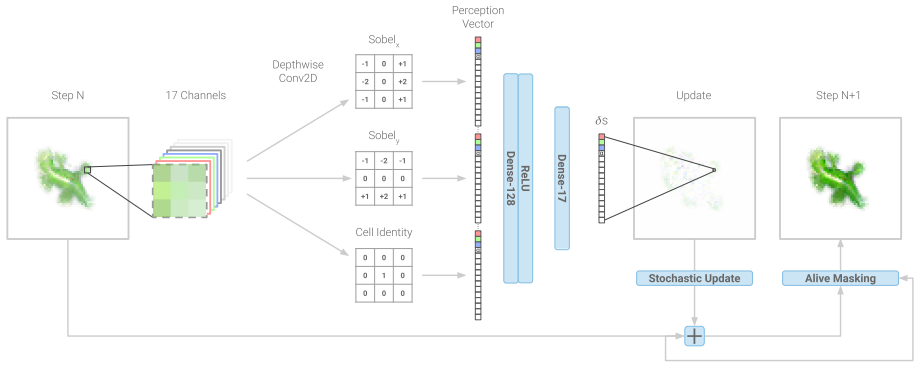
As Neural Cellular Automata (NCAs) are increasingly applied outside of the toy models in Artificial Life, there is a pressing need to understand how they behave and to build appropriate routes to interpret what they have learnt. By their very nature, the benefits of training NCAs are balanced with a lack of interpretability: we can engineer emergent behaviour, but have limited ability to understand what has been learnt. In this paper, we apply a variety of techniques to pry open the NCA black box and glean some understanding of what it has learnt to do. We apply techniques from manifold learning (principal components analysis and both dense and sparse autoencoders) along with techniques from topological data analysis (persistent homology) to capture the NCA's underlying behavioural manifold, with varying success. Results show that when analysis is performed at a macroscopic level (i.e. taking the entire NCA state as a single data point), the underlying manifold is often quite simple and can be captured and analysed quite well. When analysis is performed at a microscopic level (i.e. taking the state of individual cells as a single data point), the manifold is highly complex and more complicated techniques are required in order to make sense of it.
Figures


discussion (0)
Sign in with ORCID, Apple, or X to comment. Anyone can read and Pith papers without signing in.