REVIEW 5 major objections 3 minor 35 references
Lightweight Federated Learning over Wireless Edge Networks
T0 review · 5 major / 3 minor · reviewed 2026-08-06 · deepseek-v4-flash
Pith's one-line read The paper proposes a lightweight FL framework that jointly tunes model pruning, gradient quantization, and transmit power, guided by a single closed-form convergence-gap expression that makes the joint optimization tractable.
desk verdict A serviceable joint pruning-quantization-power control framework for wireless FL, but the headline delay/energy gains rest on an unverified sparse-compute assumption and a lopsided baseline comparison. read the letter →
The pith
A machine-rendered reading of the paper's core claim, the machinery that carries it, and where it could break.
The reading
What carries the argument
The central object is the per-round convergence gap $\Gamma^n$ of Theorem 1: a closed-form sum of a stochastic-quantization error term, a magnitude-based pruning error term, and a packet-loss error term. The argument's engine is the decomposition of the joint optimization into subproblems with closed-form solutions — Theorem 2 pins each device's pruning ratio $\rho_u^n = \min\{\rho_{\max}, (1-\min\{\Phi_1,\Phi_2\})^+\}$ from the delay and energy constraints, and Theorem 3 pins the quantization level $\delta_u^n$ as the ceiling of the bit budget those same constraints allow. The one piece without a closed form, the transmission-power subproblem, is solved by Bayesian optimization with a Gaussian-process surrogate and a probability-of-improvement acquisition function, and Algorithm 1 iterates the three updates until the gap stops changing.
What would settle it
Measure wall-clock local training time on a real edge-class device (e.g., a phone CPU) for the same CIFAR-10 model at several pruning ratios, holding batch size and epochs fixed; if per-round delay does not fall roughly as $(1-\rho)$ times the unpruned delay, the constraint in Eq. (31) fails on that hardware. A second check is to run LTFL and FedSGD on a small wireless testbed to a fixed test accuracy and compare predicted versus measured cumulative delay and energy.
Extended reading notes
Core claim
The paper's central result is Theorem 1: under Lipschitz smoothness, a bound on the norm of the model parameters, and a bound on gradient variance, the average squared gradient norm over $\Omega$ iterations is at most the initial optimality gap $2L\,\mathbb{E}[F(w^0)-F(w^*)]/((1-12\upsilon_2)(\Omega+1))$ plus the average of per-round gaps $\Gamma^n$. Each $\Gamma^n$ is a closed-form sum of three error terms: quantization error $\sum_u \sum_v (\bar{g}^n_{u,v}-\underline{g}^n_{u,v})^2/(4(2^{\delta_u^n}-1)^2)$, pruning error $L^2 D^2 \sum_u \rho_u^n$, and transmission error $(12\upsilon_1/N)\sum_u N_u q_u^n$, scaled by $1/(1-12\upsilon_2)$. The authors take $\Gamma^n$ as the objective to minimize subject to per-round delay and energy constraints, and this minimization — not the raw bound — is what produces the reported delay and energy savings. The resulting LTFL algorithm picks a pruning ratio, quantization level, and transmit power for each device in each round, and the experiments show it converges to about the same accuracy as uncompressed FedSGD while cutting training cost.
Load-bearing premise
The load-bearing premise is that pruning a fraction $\rho$ of the model's parameters cuts local training time by the same fraction, as assumed by the training-delay formula; the paper prunes by magnitude with no structure guarantees, and on ordinary hardware unstructured sparsity does not speed up training, so if that scaling fails the delay and energy constraints — and the reported savings — do not hold.
Editorial extensions
If this is right
- If Theorem 1's bound is valid, then any policy that shrinks $\Gamma^n$ — more quantization bits, a smaller pruning ratio, or higher transmit power — lowers the convergence floor the federated process reaches, so the gap is the right single target to optimize.
- The closed-form rules in Theorems 2 and 3 let each device's pruning ratio and quantization level be computed directly from its own delay and energy budgets, giving per-round decisions that cost $O(U)$ time on the edge server.
- With power control isolated as the only non-convex subproblem, the two-stage algorithm turns a mixed integer-continuous optimization into two closed-form updates plus a low-dimensional search, which is why it can re-run cheaply when channels change.
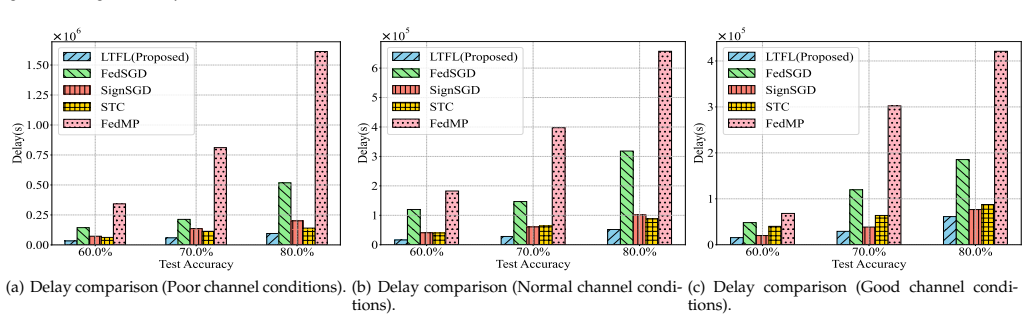
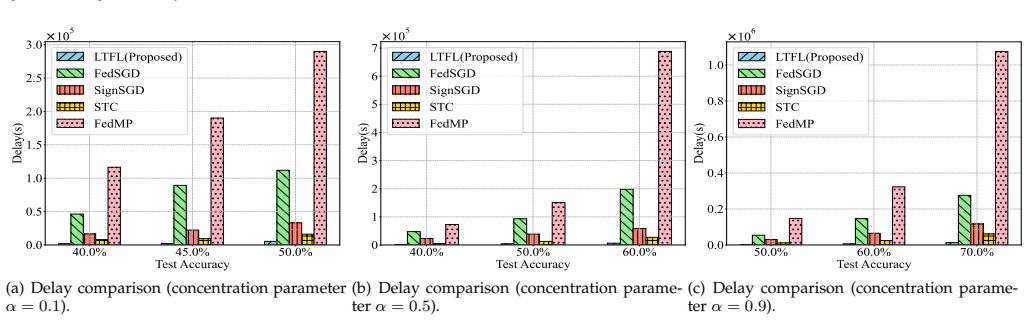
- The benchmark results against FedSGD, SignSGD, FedMP, and STC imply that compression schemes which ignore wireless packet losses trade away accuracy and then spend more total delay and energy to reach the target accuracy.
Reading between the lines
- The same proof skeleton should carry over to other compression mechanisms — top-k sparsification with error feedback, ternary gradients, or over-the-air aggregation — by substituting their error bounds for the quantization term in $\Gamma^n$, leaving the constraint-solving recipe intact.
- A test that isolates the theory from the delay model is to compare the number of rounds LTFL and the baselines need to reach a fixed accuracy; if gap-minimizing schedules also minimize round count, the bound is doing the work the paper claims.
- Because the training-delay formula assumes pruned computation scales with the kept parameter fraction, a structured-pruning variant (filter or channel pruning) would preserve the convergence theory while making the delay constraint realistic on hardware without sparse-computation support.
Editorial analysis
A structured set of objections, weighed in public.
Referee Report
Summary. The paper proposes LTFL, a wireless federated learning framework that jointly selects per-device model pruning ratios, gradient quantization levels, and uplink transmission powers. It derives an upper bound on the average squared gradient norm (Theorem 1) under smoothness and bounded-gradient assumptions, identifies a per-round convergence gap Γn in Eq. (29), and minimizes this gap subject to per-iteration delay and energy constraints. The authors provide closed-form pruning and quantization rules (Theorems 2 and 3) and a Bayesian optimization procedure for powers, then compare against FedSGD, SignSGD, FedMP, and STC on CIFAR-10. The central claim is that LTFL maintains convergence accuracy while substantially reducing delay and energy relative to these baselines.
Significance. If the underlying compute model were physically valid, this paper would offer a useful integration of three techniques—pruning, quantization, and power control—under a single convergence-gap objective, with closed-form solutions for two of the three subproblems and an O(U) control algorithm. A strength is that the convergence bound is derived from explicit assumptions rather than fitted to the experimental outcomes, and the closed-form rules follow from monotonicity of that bound. However, the headline delay and energy gains depend on an unstructured-pruning compute scaling that is not supported by the paper's own pruning criterion, and the experimental evidence is weakened by fixed-power baselines and the absence of error bars or multiple-seed statistics. The contribution is potentially publishable after substantial revision, but the central cost claims are not currently established.
major comments (5)
- [4.1.1, Eq. (31)] Eq. (31) sets T_u,lt = N_u c0 (1-ρ_u)/f_u, i.e., local training delay is assumed to scale linearly with the fraction of retained parameters. The pruning criterion in Eq. (12) is magnitude-based unstructured pruning: zeroed weights do not reduce dense matrix-multiplication time on conventional hardware, so the linear scaling is not valid without structured pruning (channels/filters) or dedicated sparse-computation support. This assumption propagates into the energy model Eq. (35), the constraints (38b)-(38c), the closed-form rules in Theorems 2 and 3, and the reported delay/energy reductions in Figs. 3, 5, and 6. The conclusion (Section 7) also concedes that no real-world validation was performed. The paper should either switch to structured pruning or provide a measured compute-time-versus-ρ curve for the target hardware; without this, the framework's main claimed benefits are unsupported.
- [3.2, Eq. (28)] Theorem 1 states the bound with a denominator 1-12υ2, but Assumptions 1-4 do not guarantee that 1-12υ2 > 0. If 12υ2 ≥ 1, the right-hand side of Eq. (28) is negative or undefined, so the stated convergence guarantee does not hold. The paper should add this positivity condition as an explicit assumption and either justify it theoretically or verify it numerically for the experimental settings.
- [2.4 and 4.1.2, Eqs. (18) and (32)] Eq. (18) defines the bit count as \tildeδ = Vδ + ξ, where ξ is the overhead for encoding the gradient bounds and sign. Eq. (32) then multiplies \tildeδ by (1-ρ) when computing upload delay. This implicitly assumes that the overhead ξ also shrinks with the pruning ratio, but ξ is a fixed per-gradient overhead, not a per-pruned-parameter cost. The correct upload bit count should be V(1-ρ)δ + ξ rather than (Vδ+ξ)(1-ρ). This error affects the delay and energy constraints and therefore the formulas for Φ1-Φ4 in Theorems 2 and 3 and the resulting cost comparisons.
- [6.1, experimental setup] All baselines (FedSGD, SignSGD, FedMP, STC) are evaluated with transmission power fixed at pmax/2, while LTFL optimizes power. This handicaps the baselines and makes the delay/energy gains in Figs. 3(b)-3(c) and Figs. 5-6 difficult to interpret. The experiments also report no error bars, confidence intervals, or multiple seeds, and the ablation study in Fig. 2 lacks statistical variability. At minimum, the authors should add multiple-seed results with error bars and include a baseline with optimized power (or a fixed-power LTFL variant) to isolate the benefit of power control.
- [5.1, Theorem 2 / Appendix B] The proposed optimal pruning formula in Eq. (40) is (ρ_u)* = min{ρmax, (1 - min{Φ1,Φ2})^+}. However, the constraints in Eqs. (B.2) and (B.4) require ρ_u to be at least (1 - min{Φ1,Φ2})^+, so when this lower bound exceeds ρmax, the problem is infeasible; returning ρmax then violates the delay/energy constraints. The paper should explicitly handle the infeasible case (e.g., by declaring infeasibility or by relaxing a constraint) rather than presenting the formula as always optimal.
minor comments (3)
- [Appendix C, Eq. (C.2)] The derivative in Eq. (C.2) is miscomputed: the derivative of 1/(4(2^δ-1)^2) with respect to δ is proportional to -2^δ ln2 / (2(2^δ-1)^3), not -2 ln2 / (2^δ-1)^2. The sign is still negative, so the monotonicity conclusion of Lemma 3 is unaffected, but the displayed derivative should be corrected.
- [Theorem 3, Eq. (44)] The text states that ⌈x⌉ represents 'the minimum positive integer that is less than or equal to x'; this is the definition of a floor, not a ceiling. The ceiling should be described as the least integer greater than or equal to x.
- [Throughout] There are several typographical issues, including 'funciton' in Section 5.3.1 and inconsistent use of g({w_hat}) versus \bar g({w_hat}) in Appendix A. A careful proofreading pass is needed.
Circularity Check
No significant circularity: the convergence bound, the Γn gap objective, and the closed-form pruning/quantization rules are derived from explicit assumptions and external lemmas, not from the reported results.
full rationale
Theorem 1's bound (Eq. 28) follows from Assumptions 1-4, Lipschitz smoothness, and external Lemmas 1-2 (citations [29] and [30]), with the Appendix A proof expanding the transmission, pruning, and quantization error terms; no term is fitted to the experimental outcomes. The optimization objective Γn (Eq. 29) is the algebraic upper bound from that theorem, and Remark 3's minimization of Γn is a standard majorization step rather than a definition of success. Theorems 2 and 3 are obtained by monotonicity of Γn in ρ and δ (Eqs. 40 and 44) and by solving the delay/energy constraints (Eqs. 41-42 and 45-46), so the pruning and quantization rules are not fitted to the delay/energy results they later produce. Power control is solved by Bayesian optimization on Γn(p), again using the same model; this is optimization, not circular prediction. The self-citations ([13] and [31]) appear in related-work context and in the standard CPU energy model (Eq. 35); neither carries the convergence derivation, so they do not make the argument circular. The delay scaling in Eq. (31), which assumes compute time is linear in the retained parameter count, is a modeling assumption whose violation on dense hardware would invalidate the reported cost gains, but this is a correctness and validation risk, not a circularity, because the paper does not define the convergence result in terms of that assumption. The paper's own conclusion also concedes the lack of real-world validation, which is a limitation rather than a circular step.
Assumptions & free parameters
free parameters (4)
- L
- D
- υ1
- υ2
assumptions (9)
- domain assumption ∇F is uniformly L-Lipschitz (Assumption 1, Eq. 21)
- domain assumption ∇F twice continuously differentiable with ∇^2F ⪯ LI (Assumption 2, Eq. 22)
- domain assumption E||w||^2 ≤ D^2 (Assumption 3, Eq. 23)
- domain assumption ||∇f||^2 ≤ υ1 + υ2 ||∇F||^2 (Assumption 4, Eq. 24)
- ad hoc to paper Hidden positivity condition 1-12υ2 > 0
- domain assumption Local training time scales linearly with parameter count (Eq. 31)
- domain assumption Gradient is transmitted as one packet with CRC; whole gradient lost on error (Eq. 3-4)
- domain assumption Pruning importance approximated by parameter magnitude (Eq. 12)
- domain assumption Energy model E_lt = k f^σ T_lt (Eq. 35)
Cite this review
Pith. "Pith review of Lightweight Federated Learning over Wireless Edge Networks." pith.science (2026). https://pith.science/paper/4QAI3KCN
@misc{pith2026250709546,
  author       = {Pith},
  title        = {Pith review of: Lightweight Federated Learning over Wireless Edge Networks},
  year         = {2026},
  howpublished = {\url{https://pith.science/paper/4QAI3KCN}},
  note         = {Machine review of arXiv:2507.09546}
}
read the original abstract
With the exponential growth of smart devices connected to wireless networks, data production is increasing rapidly, requiring machine learning (ML) techniques to unlock its value. However, the centralized ML paradigm raises concerns over communication overhead and privacy. Federated learning (FL) offers an alternative at the network edge, but practical deployment in wireless networks remains challenging. This paper proposes a lightweight FL (LTFL) framework integrating wireless transmission power control, model pruning, and gradient quantization. We derive a closed-form expression of the FL convergence gap, considering transmission error, model pruning error, and gradient quantization error. Based on these insights, we formulate an optimization problem to minimize the convergence gap while meeting delay and energy constraints. To solve the non-convex problem efficiently, we derive closed-form solutions for the optimal model pruning ratio and gradient quantization level, and employ Bayesian optimization for transmission power control. Extensive experiments on real-world datasets show that LTFL outperforms state-of-the-art schemes.
Figures


Figures from the paper (7 more)




Reference graph
Works this paper leans on
-
[1]
Federated learning in mobile edge networks: A comprehensive survey,
W. Y. B. Lim, N. C. Luong, D. T. Hoang, Y. Jiao, Y.-C. Liang, Q. Yang, D. Niyato, and C. Miao, “Federated learning in mobile edge networks: A comprehensive survey,” IEEE Communications Surveys & Tutorials, vol. 22, no. 3, pp. 2031–2063, 2020
work page 2020
-
[2]
Edge intelligence: Paving the last mile of artificial intelligence with edge computing,
Z. Zhou, X. Chen, E. Li, L. Zeng, K. Luo, and J. Zhang, “Edge intelligence: Paving the last mile of artificial intelligence with edge computing,” Proceedings of the IEEE, vol. 107, no. 8, pp. 1738–1762, 2019
2019
-
[3]
M. Xu, D. Niyato, H. Zhang, J. Kang, Z. Xiong, S. Mao, and Z. Han, “Sparks of generative pretrained transformers in edge intelligence for the metaverse: Caching and inference for mobile artificial intelligence-generated content services,” IEEE Vehicular Technology Magazine, vol. 18, no. 4, pp. 35–44, 2023
work page 2023
-
[4]
Communication-efficient learning of deep networks from de- centralized data,
B. McMahan, E. Moore, D. Ramage, S. Hampson, and B. A. y Ar- cas, “Communication-efficient learning of deep networks from de- centralized data,” in International Conference on Artificial Intelligence and Statistics (AISTATS), Ft. Lauderdale, FL, USA, April, 2017, pp. 1273–1282
work page 2017
-
[5]
J. Du, B. Jiang, C. Jiang, Y. Shi, and Z. Han, “Gradient and channel aware dynamic scheduling for over-the-air computation in federated edge learning systems,” IEEE Journal on Selected Areas in Communications, vol. 41, no. 4, pp. 1035–1050, 2023
work page 2023
-
[6]
Adaptive control of local updating and model compression for efficient federated learning,
Y. Xu, Y. Liao, H. Xu, Z. Ma, L. Wang, and J. Liu, “Adaptive control of local updating and model compression for efficient federated learning,” IEEE Transactions on Mobile Computing , vol. 22, no. 10, pp. 5675–5689, 2023
work page 2023
-
[7]
Mergesfl: Split federated learning with feature merging and batch size regulation,
Y. Liao, Y. Xu, H. Xu, L. Wang, Z. Yao, and C. Qiao, “Mergesfl: Split federated learning with feature merging and batch size regulation,” in IEEE International Conference on Data Engineering (ICDE), Utrecht, Netherlands, May, 2024, pp. 2054–2067
work page 2024
-
[8]
A joint learning and communications framework for federated learning over wireless networks,
M. Chen, Z. Yang, W. Saad, C. Yin, H. V . Poor, and S. Cui, “A joint learning and communications framework for federated learning over wireless networks,” IEEE Transactions on Wireless Communications, vol. 20, no. 1, pp. 269–283, 2021
work page 2021
Show all 35 references
-
[9]
Cell-free massive mimo for wireless federated learning,
T. T. Vu, D. T. Ngo, N. H. Tran, H. Q. Ngo, M. N. Dao, and R. H. Middleton, “Cell-free massive mimo for wireless federated learning,” IEEE Transactions on Wireless Communications , vol. 19, no. 10, pp. 6377–6392, 2020
2020
-
[10]
Client selection and bandwidth allocation in wireless federated learning networks: A long-term perspective,
J. Xu and H. Wang, “Client selection and bandwidth allocation in wireless federated learning networks: A long-term perspective,” IEEE Transactions on Wireless Communications , vol. 20, no. 2, pp. 1188–1200, 2021. 12 /uni00000013/uni00000018/uni00000013/uni00000013/uni00000014/...
2021
-
[11]
To talk or to work: Flexible communication compression for energy efficient federated learning over heterogeneous mobile edge devices,
L. Li, D. Shi, R. Hou, H. Li, M. Pan, and Z. Han, “To talk or to work: Flexible communication compression for energy efficient federated learning over heterogeneous mobile edge devices,” in IEEE Conference on Computer Communications (INFOCOM), Vancou- ver, BC, Canada, May, 202...
2021
-
[12]
An exact quantized decentralized gradient descent algorithm,
A. Reisizadeh, A. Mokhtari, H. Hassani, and R. Pedarsani, “An exact quantized decentralized gradient descent algorithm,” IEEE Transactions on Signal Processing , vol. 67, no. 19, pp. 4934–4947, 2019
2019
-
[13]
Effi- cient federated learning for metaverse via dynamic user selection, gradient quantization and resource allocation,
X. Hou, J. Wang, C. Jiang, Z. Meng, J. Chen, and Y. Ren, “Effi- cient federated learning for metaverse via dynamic user selection, gradient quantization and resource allocation,” IEEE Journal on Selected Areas in Communications, vol. 42, no. 4, pp. 850–866, 2024
2024
-
[14]
1-bit compressive sensing for efficient federated learning over the air,
X. Fan, Y. Wang, Y. Huo, and Z. Tian, “1-bit compressive sensing for efficient federated learning over the air,” IEEE Transactions on Wireless Communications, vol. 22, no. 3, pp. 2139–2155, 2023
2023
-
[15]
Robust and communication-efficient federated learning from non-i.i.d. data,
F. Sattler, S. Wiedemann, K.-R. M ¨uller, and W. Samek, “Robust and communication-efficient federated learning from non-i.i.d. data,” IEEE Transactions on Neural Networks and Learning Systems , vol. 31, no. 9, pp. 3400–3413, 2020
2020
-
[16]
Dynamic model pruning with feedback,
T. Lin, S. U. Stich, L. F. Barba Flores, D. Dmitriev, and M. Jaggi, “Dynamic model pruning with feedback,” in International Con- ference on Learning Representations (ICLR) , Addis Ababa, Ethiopia, April, 2020
2020
-
[17]
Joint model pruning and device selection for communication-efficient feder- ated edge learning,
S. Liu, G. Yu, R. Yin, J. Yuan, L. Shen, and C. Liu, “Joint model pruning and device selection for communication-efficient feder- ated edge learning,” IEEE Transactions on Communications, vol. 70, no. 1, pp. 231–244, 2022
2022
-
[18]
Computation and communication efficient federated learning with adaptive model pruning,
Z. Jiang, Y. Xu, H. Xu, Z. Wang, J. Liu, Q. Chen, and C. Qiao, “Computation and communication efficient federated learning with adaptive model pruning,” IEEE Transactions on Mobile Com- puting, pp. 1–18, 2023
2023
-
[19]
IoT device friendly and communication-efficient federated learning via joint model pruning and quantization,
P . Prakash, J. Ding, R. Chen, X. Qin, M. Shu, Q. Cui, Y. Guo, and M. Pan, “IoT device friendly and communication-efficient federated learning via joint model pruning and quantization,” IEEE Internet of Things Journal , vol. 9, no. 15, pp. 13 638–13 650, 2022
2022
-
[20]
Generative ai based secure wireless sensing for isac networks,
J. Wang, H. Du, Y. Liu, G. Sun, D. Niyato, S. Mao, D. I. Kim, and X. Shen, “Generative ai based secure wireless sensing for isac networks,” arXiv preprint arXiv:2408.11398, 2024. 13
2024 arXiv
-
[21]
Convergence time optimization for federated learning over wireless networks,
M. Chen, H. V . Poor, W. Saad, and S. Cui, “Convergence time optimization for federated learning over wireless networks,” IEEE Transactions on Wireless Communications , vol. 20, no. 4, pp. 2457– 2471, 2021
2021
-
[22]
Age of information based URLLC transmission for UAVs on pylon turn,
J. Wang, L. Bai, Z. Fang, R. Han, J. Wang, and J. Choi, “Age of information based URLLC transmission for UAVs on pylon turn,” IEEE Transactions on Vehicular Technology, pp. 1–14, 2024
2024
-
[23]
Secure and latency-aware digital twin assisted re- source scheduling for 5G edge computing-empowered distribu- tion grids,
Z. Zhou, Z. Jia, H. Liao, W. Lu, S. Mumtaz, M. Guizani, and M. Tariq, “Secure and latency-aware digital twin assisted re- source scheduling for 5G edge computing-empowered distribu- tion grids,” IEEE Transactions on Industrial Informatics, vol. 18, no. 7, pp. 4933–4943, 2022
2022
-
[24]
Im- portance estimation for neural network pruning,
P . Molchanov, A. Mallya, S. Tyree, I. Frosio, and J. Kautz, “Im- portance estimation for neural network pruning,” in IEEE/CVF Conference on Computer Vision and Pattern Recognition (CVPR), Long Beach, CA, USA, June, 2019, pp. 11 264–11 272
2019
-
[26]
Accelerating federated learning with data and model parallelism in edge com- puting,
Y. Liao, Y. Xu, H. Xu, Z. Yao, L. Wang, and C. Qiao, “Accelerating federated learning with data and model parallelism in edge com- puting,” IEEE/ACM Transactions on Networking , vol. 32, no. 1, pp. 904–918, 2024
2024
-
[27]
Quantized federated learning under transmission delay and outage constraints,
Y. Wang, Y. Xu, Q. Shi, and T.-H. Chang, “Quantized federated learning under transmission delay and outage constraints,” IEEE Journal on Selected Areas in Communications , vol. 40, no. 1, pp. 323– 341, 2022
2022
-
[28]
Fed- erated learning with quantized global model updates,
M. M. Amiri, D. Gunduz, S. R. Kulkarni, and H. V . Poor, “Fed- erated learning with quantized global model updates,” arXiv preprint arXiv:2006.10672, 2020
2006 arXiv
-
[29]
Design and analysis of uplink and downlink communications for federated learning,
S. Zheng, C. Shen, and X. Chen, “Design and analysis of uplink and downlink communications for federated learning,” IEEE Jour- nal on Selected Areas in Communications , vol. 39, no. 7, pp. 2150– 2167, 2021
2021
-
[30]
Sparsified sgd with memory,
S. U. Stich, J.-B. Cordonnier, and M. Jaggi, “Sparsified sgd with memory,” in Advances in Neural Information Processing Systems (NeurIPS), vol. 31, Red Hook, NY, USA, 2018
2018
-
[31]
UAV- enabled covert federated learning,
X. Hou, J. Wang, C. Jiang, X. Zhang, Y. Ren, and M. Debbah, “UAV- enabled covert federated learning,” IEEE Transactions on Wireless Communications, vol. 22, no. 10, pp. 6793–6809, 2023
2023
-
[32]
S. P . Boyd and L. Vandenberghe, Convex optimization. Cambridge university press, 2004
2004
-
[33]
Taking the human out of the loop: A review of bayesian optimization,
B. Shahriari, K. Swersky, Z. Wang, R. P . Adams, and N. de Fre- itas, “Taking the human out of the loop: A review of bayesian optimization,” Proceedings of the IEEE, vol. 104, no. 1, pp. 148–175, 2016
2016
-
[34]
Learning multiple layers of features from tiny images,
A. Krizhevsky, G. Hinton et al. , “Learning multiple layers of features from tiny images,” 2009
2009
-
[35]
SignSGD: Compressed optimisation for non-convex problems,
J. Bernstein, Y.-X. Wang, K. Azizzadenesheli, and A. Anandkumar, “SignSGD: Compressed optimisation for non-convex problems,” in International conference on machine learning (ICML) , vol. 80, Stockholm, Sweden, July, 2018, pp. 560–569. 14 APPENDIX A PROOF OF THEOREM 1 Proof: Fo...
2018
-
[36]
Therefore, substituting Eq
Thirdly, the upper bound of E n ∥g({ ˆwn u}) − g({ ˆwn u})∥2 o can be represented as E n ∥g({ ˆwn u }) − g({ ˆwn u })∥2 o = E ( PU u=1 Nuαn u (gu ( ˆwn u ) − Q(gu ( ˆwn u )))PU u=1 Nuαnu 2) (j) ≤ E UP u=1 ∥Nuαn u∥2 UP u=1 ∥gu ( ˆwn u ) − Q(gu ( ˆwn u ))∥2 PU u=1 Nuαn...
Reviewed August 6, 2026 · model on record in the stance chip above.
Discussion (0). Continue with ORCID to comment.