Fully-implicit Particle-in-Cell model of a Magnetic Nozzle with electromagnetic power deposition
Pith reviewed 2026-06-27 14:22 UTC · model grok-4.3
The pith
Electromagnetic waves heat electrons near resonance to drive stronger ion acceleration in magnetic nozzles than electrostatic models alone.
A machine-rendered reading of the paper's core claim, the machinery that carries it, and where it could break.
Core claim
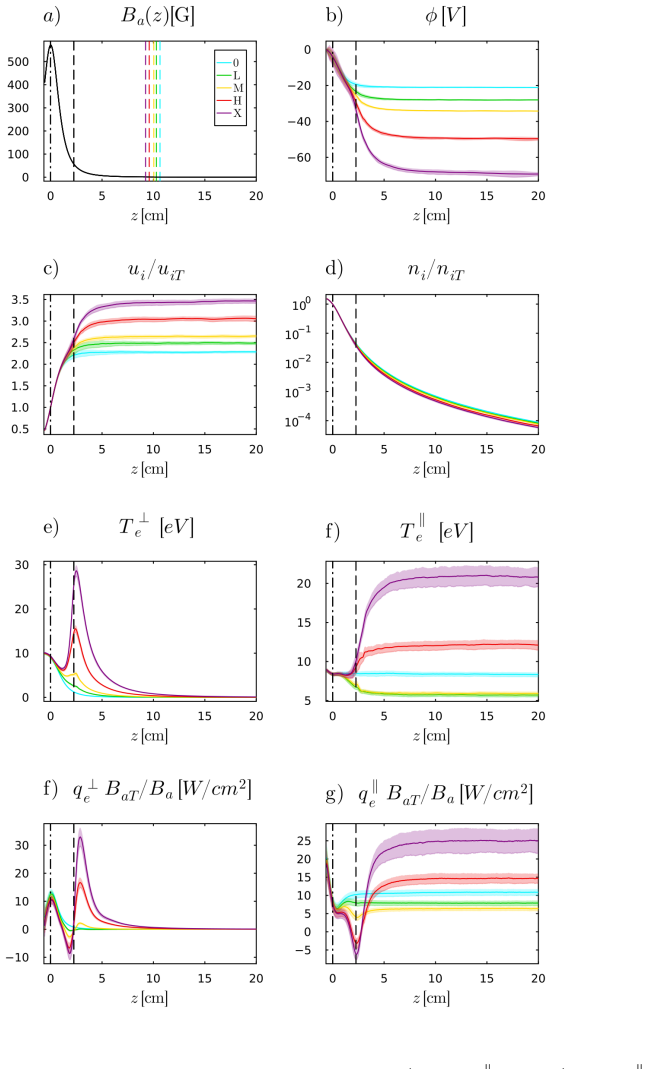
Wave heating increases the electron perpendicular temperature, especially near an electron cyclotron resonance surface, driving a more pronounced potential drop and higher ion acceleration than in the purely electrostatic case. The energized electrons become anisotropic and modify the trapped population, with wave power contributing directly to ion kinetic energy.
What carries the argument
The 1D3V fully-implicit Vlasov-Darwin particle-in-cell model on a nonuniform grid with substepping and closed-loop boundary controllers that enforce current-free expansion.
If this is right
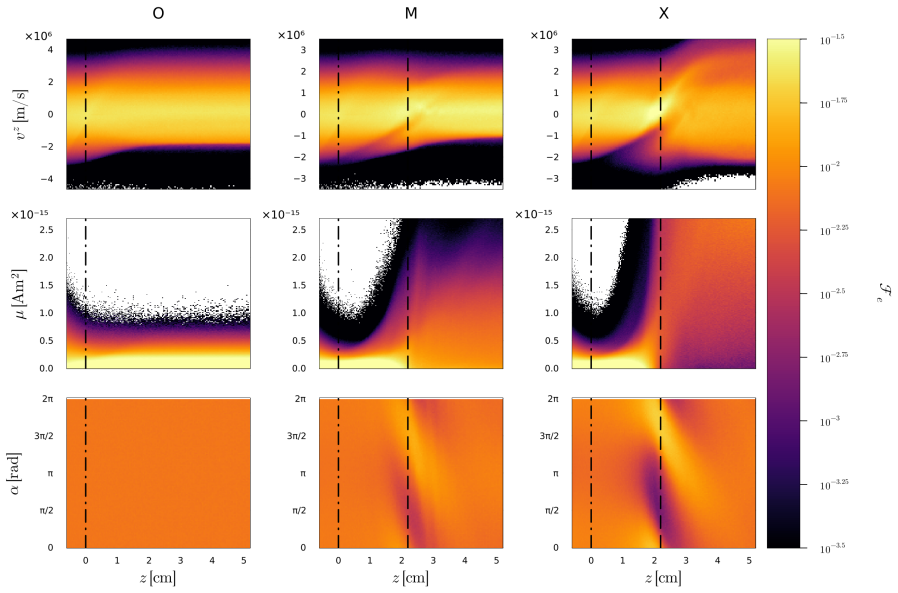
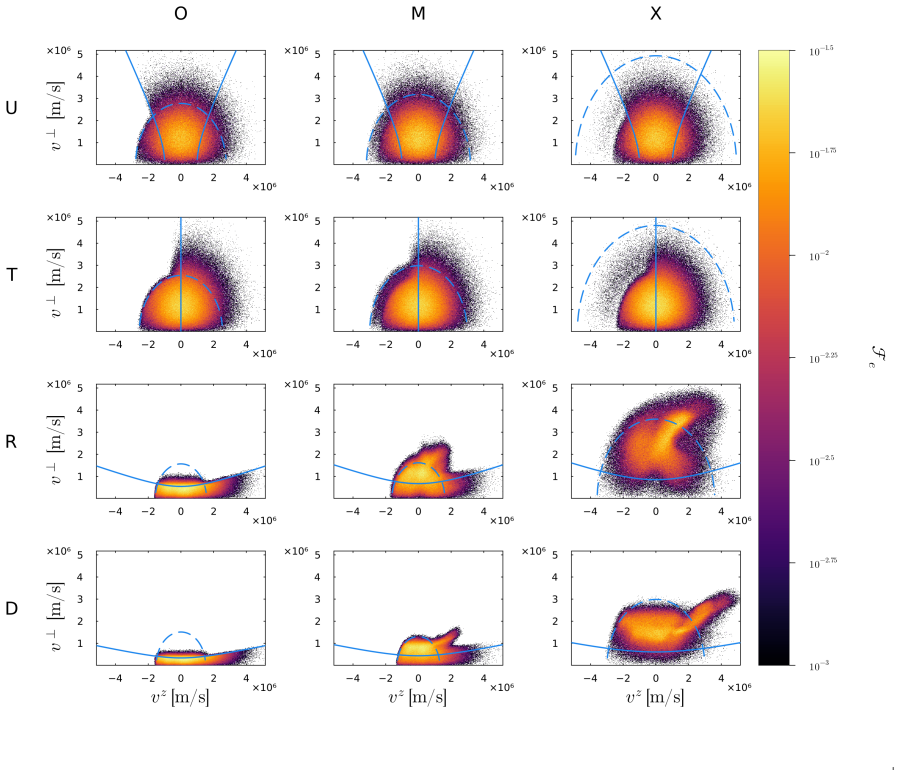
- Electron phase-space regions that remain inaccessible in the electrostatic case become populated once waves are present.
- The doubly-trapped electron population is altered by the wave-driven perpendicular heating.
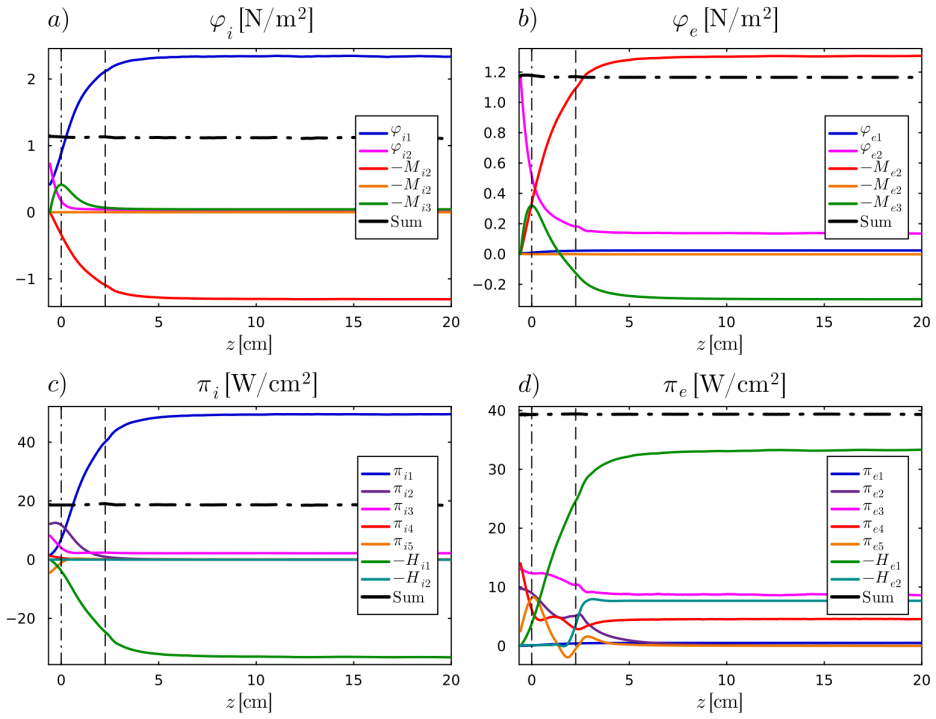
- Momentum and energy equation balances shift to include explicit contributions from wave power alongside electron thermal pressure and ion inertia.
- Ion acceleration gains come directly at the expense of electromagnetic wave energy.
Where Pith is reading between the lines
- Optimizing the fraction of source power that leaks into the nozzle could raise overall thruster specific impulse without added propellant.
- The resonance location inside the nozzle suggests that nozzle shape and magnetic field profile can be tuned to place the heating zone where it most efficiently couples to the potential drop.
- Extending the model to allow finite collision rates would test how robust the anisotropy-driven acceleration remains when some wave energy dissipates through collisions.
- Similar wave effects may appear in other expanding magnetic geometries used for plasma propulsion or fusion divertor concepts.
Load-bearing premise
The plasma stays collisionless and the chosen Darwin approximation plus boundary controllers reproduce the wave interaction without dominant numerical artifacts.
What would settle it
A laboratory measurement showing whether ion exhaust velocity increases measurably when controlled right-hand polarized wave power is injected into the nozzle region of a helicon device, compared with the no-wave case at identical mass flow.
Figures
read the original abstract
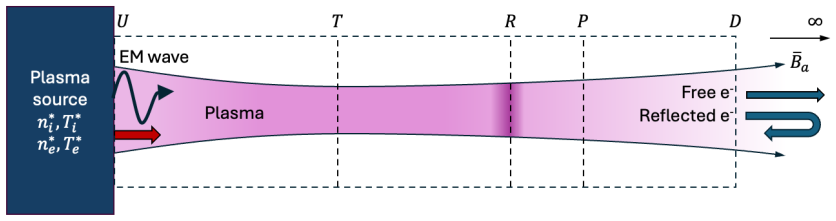
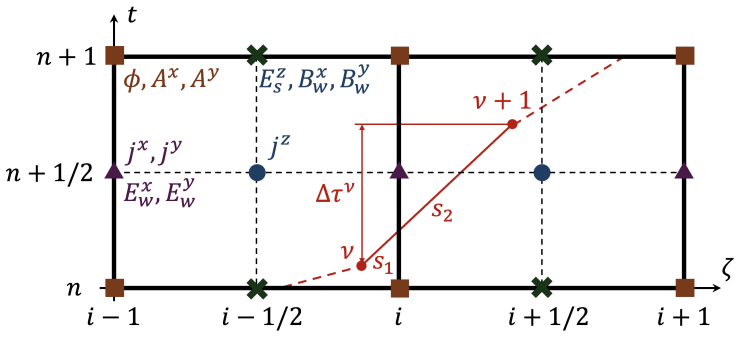
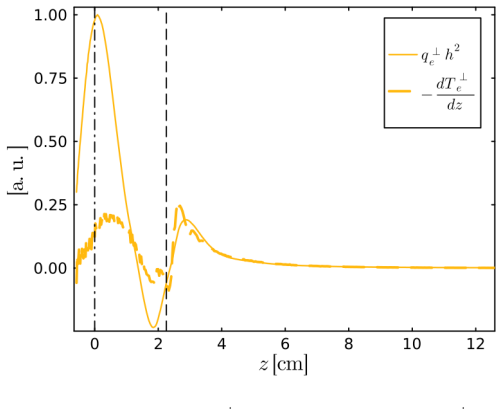
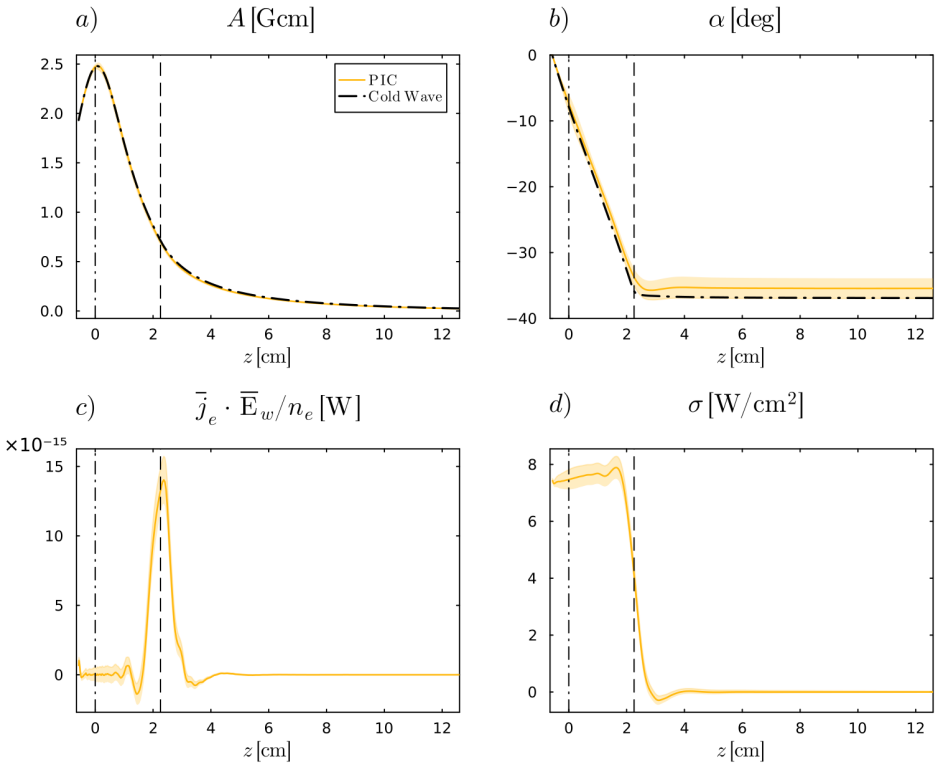
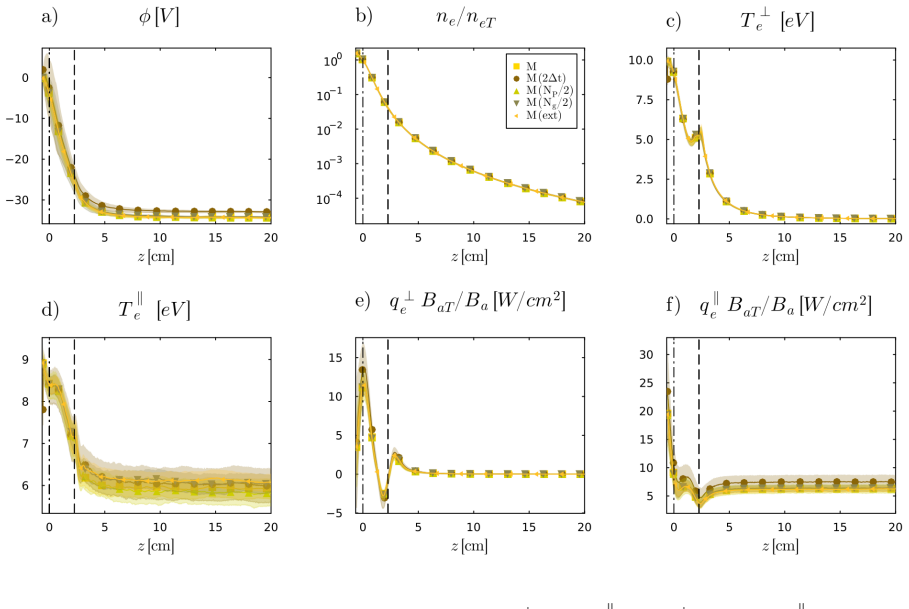
A fraction of the electromagnetic power used to generate and heat the plasma in helicon sources and electrodeless plasma thrusters can leak into the outer expansion region, interacting with the plasma in the magnetic nozzle and affecting the performance of the device. This work analyzes the properties of the plasma in a convergent-divergent magnetic nozzle when right-hand polarized waves of varying amplitude propagate into it. This is accomplished with a 1D3V fully-implicit, Vlasov-Darwin particle-in-cell model of the collisionless ion and electron plasma in a magnetic tube. The code exactly conserves charge locally and energy globally. It features a nonuniform grid and an enhanced substepping routine for the particle trajectories. The requirement that the expansion be current-free is satisfied thanks to linear closed-loop controllers on the injection and downstream boundary conditions. Wave heating increases the electron perpendicular temperature, especially in the vicinity of an electron cyclotron resonance surface, always present inside the magnetic nozzle of a helicon device. The energized electrons become anisotropic, and drive a more pronounced potential drop and a higher ion acceleration than in the absence of waves, at the expense of the wave power. The computed moments of the ion and electron distributions reveal the dominant balance of the electron thermal terms, electrostatic terms, and ion inertial terms in the momentum and energy equations. Wave heating helps populate otherwise-inaccessible regions of the electrons phase space and modifies the doubly-trapped electron population found in the purely electrostatic case...
Editorial analysis
A structured set of objections, weighed in public.
Referee Report
Summary. The manuscript presents a 1D3V fully-implicit Vlasov-Darwin particle-in-cell simulation of a collisionless plasma in a convergent-divergent magnetic nozzle. Right-hand polarized waves are injected and the model shows that heating near the electron cyclotron resonance increases electron perpendicular temperature and anisotropy, producing a stronger ambipolar potential drop and higher ion acceleration than the purely electrostatic case, at the expense of wave power. The code is stated to conserve local charge exactly and global energy, employs a nonuniform grid with substepping, and uses linear boundary controllers to enforce current-free expansion. Moments of the distributions are used to identify dominant balances in the momentum and energy equations.
Significance. If the reported trends hold under the model's approximations, the work would be significant for helicon and electrodeless thruster modeling by quantifying how leaked electromagnetic power modifies nozzle acceleration. Strengths include the exact local charge and global energy conservation properties, the fully-implicit time-stepping, and the parameter-free boundary controllers that enforce the current-free condition without algebraic forcing of the target result.
major comments (2)
- [Numerical method and results sections] The central claim that wave heating near the ECR drives a more pronounced potential drop and ion acceleration rests on the fidelity of the R-mode dispersion and absorption in the 1D3V Darwin model. Because the Darwin approximation omits the displacement current, the cold-plasma R-mode dispersion (cutoff and resonance locations) differs from the full Maxwell system; this directly affects the computed T_perp anisotropy and downstream potential. No test of dispersion fidelity (e.g., comparison of simulated phase speed or absorption rate against analytic R-mode solutions) is reported.
- [Abstract and results] The abstract and results state qualitative trends and conservation properties but supply no quantitative validation, error bars, grid-convergence data, or direct comparison against the electrostatic limit or known analytic heating rates. Without these, the magnitude of the reported increase in ion acceleration cannot be assessed for numerical artifact versus physical effect.
minor comments (2)
- [Boundary conditions] The description of the linear closed-loop boundary controllers would benefit from an explicit statement of the target current (zero) and the gain values used, to allow reproduction.
- [Results] Notation for the electron distribution function moments (e.g., which velocity components define T_perp) should be defined once in the text rather than only in figure captions.
Simulated Author's Rebuttal
We thank the referee for the careful and constructive review of our manuscript. We address each major comment below and have revised the manuscript to strengthen the validation of the numerical results.
read point-by-point responses
-
Referee: [Numerical method and results sections] The central claim that wave heating near the ECR drives a more pronounced potential drop and ion acceleration rests on the fidelity of the R-mode dispersion and absorption in the 1D3V Darwin model. Because the Darwin approximation omits the displacement current, the cold-plasma R-mode dispersion (cutoff and resonance locations) differs from the full Maxwell system; this directly affects the computed T_perp anisotropy and downstream potential. No test of dispersion fidelity (e.g., comparison of simulated phase speed or absorption rate against analytic R-mode solutions) is reported.
Authors: We agree that the Darwin approximation modifies the electromagnetic wave dispersion relative to the full Maxwell equations by omitting the displacement current. The model was selected specifically for its exact local charge conservation and global energy conservation, which are central to the study. In the revised manuscript we have added a dedicated validation subsection that compares the simulated R-mode phase speed and absorption rate directly to the analytic cold-plasma dispersion relation derived for the Darwin system. This comparison confirms that the resonance location and heating occur at the expected position within the model's approximations. revision: yes
-
Referee: [Abstract and results] The abstract and results state qualitative trends and conservation properties but supply no quantitative validation, error bars, grid-convergence data, or direct comparison against the electrostatic limit or known analytic heating rates. Without these, the magnitude of the reported increase in ion acceleration cannot be assessed for numerical artifact versus physical effect.
Authors: We acknowledge that the original submission presented primarily qualitative trends. The revised manuscript now includes grid-convergence studies for the ambipolar potential and ion velocity, demonstrating that the reported increase in ion acceleration remains consistent under refinement. We also provide quantitative comparisons of the potential drop and downstream ion speed between the wave-heated and purely electrostatic cases, together with uncertainty estimates obtained from multiple realizations. Where analytic expressions for cyclotron heating rates are available, direct comparisons have been added. revision: yes
Circularity Check
No circularity: forward simulation outputs emerge from model integration, not by construction
full rationale
The paper presents results from a 1D3V fully-implicit Vlasov-Darwin PIC simulation of wave-plasma interaction in a magnetic nozzle. Central claims (wave-driven T_perp increase near ECR, stronger ambipolar potential, higher ion acceleration) are outputs of the numerical evolution under the stated equations, boundary controllers, and initial conditions. No load-bearing step reduces a prediction to a fitted parameter, self-definition, or self-citation chain; the conservation properties and controller descriptions do not algebraically force the reported anisotropy or acceleration differences. The work is self-contained as a forward computation whose results can be compared to external physical benchmarks.
Axiom & Free-Parameter Ledger
axioms (2)
- domain assumption Plasma is collisionless
- domain assumption 1D3V geometry with magnetic tube approximation
Reference graph
Works this paper leans on
-
[1]
suggest the following scaling of the CPU wall time: CP Uexp CP Uimp ∼ ∆zimp ∆zexp d ∆timp ∆texp Cexp Cimp ,(60) where ∆zimp, ∆zexp, ∆timp, ∆texp represents the characteristic cell size and timestep in each code,dis the physical space dimensionality of the problem, andC exp/Cimp is the ratio of computational complexities of each solver. If the implicit cod...
-
[2]
Plasmas for space propulsion,
E. Ahedo, “Plasmas for space propulsion,”Plasma Physics and Controlled Fusion, vol. 53, no. 12, p. 124037, 2011
2011
-
[3]
Electric propulsion for satellites and spacecraft: established technologies and novel approaches,
S. Mazouffre, “Electric propulsion for satellites and spacecraft: established technologies and novel approaches,”Plasma Sources Science and Technology, vol. 25, no. 3, p. 033002, 2016
2016
-
[4]
Performance improvement of a perma- nent magnet helicon plasma thruster,
K. Takahashi, C. Charles, R. Boswell, and A. Ando, “Performance improvement of a perma- nent magnet helicon plasma thruster,”Journal of Physics D: Applied Physics, vol. 46, no. 35, p. 352001, 2013
2013
-
[5]
Experimental characterization of a 1 kW helicon plasma thruster,
J. Navarro-Cavall´ e, M. Wijnen, P. Fajardo, and E. Ahedo, “Experimental characterization of a 1 kW helicon plasma thruster,”Vacuum, vol. 149, pp. 69–73, 2018. 50
2018
-
[6]
Development of electrodeless plasma thrusters with high-density helicon plasma sources,
S. Shinohara, H. Nishida, T. Tanikawa, T. Hada, I. Funaki, and K. P. Shamrai, “Development of electrodeless plasma thrusters with high-density helicon plasma sources,”IEEE Transac- tions on Plasma Science, vol. 42, no. 5, pp. 1245–1254, 2014
2014
-
[7]
Cyclotron resonance thruster design techniques.,
D. B. Miller and G. W. Bethke, “Cyclotron resonance thruster design techniques.,”AIAA Journal, vol. 4, no. 5, pp. 835–840, 1966
1966
-
[8]
Sercel,An experimental and theoretical study of the ECR plasma engine
J. Sercel,An experimental and theoretical study of the ECR plasma engine. PhD thesis, California Institute of Technology, 1993
1993
-
[9]
Design and plume characterization of a low-power circular waveguide coupled ecr thruster,
M. Inchingolo, J. Navarro-Cavall´ e, and M. Merino, “Design and plume characterization of a low-power circular waveguide coupled ecr thruster,” in5 th International Workshop on Micro- propulsion and CubeSats, (Toulouse (online)), 2021
2021
-
[10]
ECRA thruster advances: 30w and 200w prototypes latest performances,
V. D´ esangles, D. Packan, J. Jarrige, S. Peterschmitt, P. Dietz, S. Scharmann, K. Holste, and P. J. Klar, “ECRA thruster advances: 30w and 200w prototypes latest performances,”Journal of Electric Propulsion, vol. 2, no. 1, p. 10, 2023
2023
-
[11]
Electrodeless plasma thrusters for spacecraft: a review,
S. Bathgate, M. Bilek, and D. Mckenzie, “Electrodeless plasma thrusters for spacecraft: a review,”Plasma Science and Technology, vol. 19, no. 8, p. 083001, 2017
2017
-
[12]
Helicon–type radiofrequency plasma thrusters and magnetic plasma nozzles,
K. Takahashi, “Helicon–type radiofrequency plasma thrusters and magnetic plasma nozzles,” Reviews of Modern Plasma Physics, vol. 3, p. 3, 2019
2019
-
[13]
Experimental study of a plasma flow in a magnetic nozzle,
K. Kuriki and O. Okada, “Experimental study of a plasma flow in a magnetic nozzle,”Physics of Fluids, vol. 13, no. 9, p. 2262, 1970
1970
-
[14]
Two-dimensional supersonic plasma acceleration in a magnetic nozzle,
E. Ahedo and M. Merino, “Two-dimensional supersonic plasma acceleration in a magnetic nozzle,”Physics of Plasmas, vol. 17, no. 7, p. 073501, 2010
2010
-
[15]
Axial force im- parted by a current-free magnetically expanding plasma,
K. Takahashi, T. Lafleur, C. Charles, P. Alexander, and R. W. Boswell, “Axial force im- parted by a current-free magnetically expanding plasma,”Physics of Plasmas, vol. 19, no. 8, p. 083509, 2012
2012
-
[16]
Magnetic nozzles for space plasma thrusters,
M. Merino and E. Ahedo, “Magnetic nozzles for space plasma thrusters,” inEncyclopedia of Plasma Technology(J. L. Shohet, ed.), vol. 2, pp. 1329–1351, Taylor and Francis, 2016
2016
-
[17]
Electron demagnetization in a magnetically expanding plasma,
J. M. Little and E. Y. Choueiri, “Electron demagnetization in a magnetically expanding plasma,”Physical review letters, vol. 123, no. 14, p. 145001, 2019
2019
-
[18]
Two-dimensional plasma-wave interaction in an helicon plasma thruster with magnetic nozzle,
B. Tian, M. Merino, and E. Ahedo, “Two-dimensional plasma-wave interaction in an helicon plasma thruster with magnetic nozzle,”Plasma Sources Science and Technology, vol. 27, no. 11, p. 114003, 2018. 51
2018
-
[19]
Coupled plasma transport and elec- tromagnetic wave simulation of an ECR thruster,
A. S´ anchez-Villar, J. Zhou, M. Merino, and E. Ahedo, “Coupled plasma transport and elec- tromagnetic wave simulation of an ECR thruster,”Plasma Sources Science and Technology, vol. 30, no. 4, p. 045005, 2021
2021
-
[20]
Analysis of a cusped helicon plasma thruster discharge,
P. Jim´ enez, J. Zhou, J. Navarro-Cavall´ e, P. Fajardo, M. Merino, and E. Ahedo, “Analysis of a cusped helicon plasma thruster discharge,”Plasma Sources Science and Technology, vol. 32, no. 10, p. 105013, 2023
2023
-
[21]
Simulation of the discharge and microwave-plasma coupling in a waveguide ECR thruster,
M. R. Inchingolo, P. Jim´ enez, J. Zhou, M. Merino, and J. Navarro-Cavall´ e, “Simulation of the discharge and microwave-plasma coupling in a waveguide ECR thruster,” in 38th International Electric Propulsion Conference, no. IEPC-2024-592, (Toulouse, France, June 23-28), Electric Rocket Propulsion Society, 2024
2024
-
[22]
Parametric instabilities in a magnetic field and possible applications to heating of plasmas,
M. Porkolab, “Parametric instabilities in a magnetic field and possible applications to heating of plasmas,”Nuclear fusion, vol. 12, no. 3, p. 329, 1972
1972
-
[23]
Low frequency electrostatic instability in a helicon plasma,
M. Light, F. F. Chen, and P. Colestock, “Low frequency electrostatic instability in a helicon plasma,”Physics of Plasmas, vol. 8, no. 10, pp. 4675–4689, 2001
2001
-
[24]
Low-frequency oscil- lations in the magnetic nozzle of a helicon plasma thruster,
D. Maddaloni, B. Bay´ on-Buj´ an, J. Navarro-Cavall´ e, and M. Merino, “Low-frequency oscil- lations in the magnetic nozzle of a helicon plasma thruster,”Plasma Sources Scinece and Technology, vol. 34, no. 4, 2025
2025
-
[26]
Kinetic features and non-stationary electron trapping in paraxial magnetic nozzles,
G. S´ anchez-Arriaga, J. Zhou, E. Ahedo, M. Mart´ ınez-S´ anchez, and J. J. Ramos, “Kinetic features and non-stationary electron trapping in paraxial magnetic nozzles,”Plasma Sources Science and Technology, vol. 27, no. 3, p. 035002, 2018
2018
-
[27]
Time-dependent expansion of a weakly- collisional plasma beam in a paraxial magnetic nozzle,
J. Zhou, G. S´ anchez-Arriaga, and E. Ahedo, “Time-dependent expansion of a weakly- collisional plasma beam in a paraxial magnetic nozzle,”Plasma Sources Science and Technol- ogy, vol. 30, no. 4, p. 045009, 2021
2021
-
[28]
Three dimensional fluid-kinetic model of a magnetically guided plasma jet,
J. Ramos, M. Merino, and E. Ahedo, “Three dimensional fluid-kinetic model of a magnetically guided plasma jet,”Physics of Plasmas, vol. 25, no. 6, p. 061206, 2018
2018
-
[29]
Fluid-kinetic model of a propulsive magnetic nozzle,
M. Merino, J. Nuez, and E. Ahedo, “Fluid-kinetic model of a propulsive magnetic nozzle,” Plasma Sources Science and Technology, vol. 30, no. 11, p. 115006, 2021
2021
-
[30]
Fully kinetic simulations of collisionless, mesothermal plasma emission: macroscopic plume structure and microscopic electron characteristics,
Y. Hu and J. Wang, “Fully kinetic simulations of collisionless, mesothermal plasma emission: macroscopic plume structure and microscopic electron characteristics,”Physics of Plasmas, 52 vol. 24, no. 3, p. 033510, 2017
2017
-
[31]
Particle- in-cell simulations of anomalous transport in a Penning discharge,
J. Carlsson, I. Kaganovich, A. Powis, Y. Raitses, I. Romadanov, and A. Smolyakov, “Particle- in-cell simulations of anomalous transport in a Penning discharge,”Physics of Plasmas, vol. 25, no. 6, 2018
2018
-
[32]
Magnetic nozzle and rpa simulations vs. experiments for a helicon plasma thruster plume,
F. Cichocki, J. Navarro-Cavall´ e, A. Modesti, and G. Ram´ ırez V´ azquez, “Magnetic nozzle and rpa simulations vs. experiments for a helicon plasma thruster plume,”Frontiers in Physics, vol. 10, 2022
2022
-
[33]
Fully kinetic model of plasma expansion in a magnetic nozzle,
S. Andrews, S. Di Fede, and M. Magarotto, “Fully kinetic model of plasma expansion in a magnetic nozzle,”Plasma Sources Science and Technology, 2022
2022
-
[34]
Macroscopic response of a Hall thruster discharge from an axial-radial PIC model,
A. Mar´ ın-Cebri´ an, E. Bello-Ben´ ıtez, A. Dom´ ınguez-V´ azquez, and E. Ahedo, “Macroscopic response of a Hall thruster discharge from an axial-radial PIC model,” in 76 th Gaseous Elec- tronics Conference, (Ann Arbor, MI, October 9-13), 2023
2023
-
[35]
On electron boundary conditions in PIC plasma thruster plume simulations,
M. Li, M. Merino, E. Ahedo, and H. Tang, “On electron boundary conditions in PIC plasma thruster plume simulations,”Plasma Sources Science and Technology, vol. 28, no. 03, p. 034004, 2019
2019
-
[36]
Implicit conservative particle-in-cell kinetic simula- tions of magnetic nozzles,
P. Jim´ enez, L. Chac´ on, and M. Merino, “Implicit conservative particle-in-cell kinetic simula- tions of magnetic nozzles,” inIEEE International Conference on Plasma Science, (Santa Fe, New Mexico (US), May 21–25), 2023
2023
-
[37]
Anisotropic electron heating in an electron cyclotron resonance thruster with magnetic nozzle,
J. Porto, P.-Q. Elias, and A. Ciardi, “Anisotropic electron heating in an electron cyclotron resonance thruster with magnetic nozzle,”Physics of Plasmas, vol. 30, no. 2, 2023
2023
-
[38]
Birdsall and A
C. Birdsall and A. Langdon,Plasma Physics via Computer Simulation. Bristol: Institute of Physics Publishing, 1991
1991
-
[39]
An energy-and charge-conserving, implicit, electro- static particle-in-cell algorithm,
G. Chen, L. Chac´ on, and D. C. Barnes, “An energy-and charge-conserving, implicit, electro- static particle-in-cell algorithm,”Journal of Computational Physics, vol. 230, no. 18, pp. 7018– 7036, 2011
2011
-
[40]
Exactly energy conserving semi-implicit particle in cell formulation,
G. Lapenta, “Exactly energy conserving semi-implicit particle in cell formulation,”Journal of Computational Physics, vol. 334, pp. 349–366, 2017
2017
-
[41]
An energy-and charge-conserving electrostatic implicit particle-in-cell algorithm for simulations of collisional bounded plasmas,
D. Eremin, “An energy-and charge-conserving electrostatic implicit particle-in-cell algorithm for simulations of collisional bounded plasmas,”Journal of Computational Physics, vol. 452, p. 110934, 2022. 53
2022
-
[42]
An implicit, conservative electrostatic particle-in- cell algorithm for paraxial magnetic nozzles,
P. Jim´ enez, L. Chac´ on, and M. Merino, “An implicit, conservative electrostatic particle-in- cell algorithm for paraxial magnetic nozzles,”Journal of Computational Physics, vol. 502, p. 112826, 2024
2024
-
[43]
Finite grid insta- bility and spectral fidelity of the electrostatic Particle-In-Cell algorithm,
C. K. Huang, Y. Zeng, Y. Wang, M. D. Meyers, S. Yi, and B. J. Albright, “Finite grid insta- bility and spectral fidelity of the electrostatic Particle-In-Cell algorithm,”Computer Physics Communications, vol. 207, pp. 123–135, Oct. 2016. 15 citations (Crossref/DOI) [2025-01-07] TLDR: It is shown that the lack of spectral fidelity relative to the physical s...
2016
-
[44]
Finite spatial-grid effects in energy-conserving particle-in-cell algorithms,
D. Barnes and L. Chac´ on, “Finite spatial-grid effects in energy-conserving particle-in-cell algorithms,”Computer Physics Communications, vol. 258, p. 107560, 2021
2021
-
[45]
An implicit, conservative and asymptotic-preserving electrostatic particle-in-cell algorithm for arbitrarily magnetized plasmas in uniform magnetic fields,
G. Chen and L. Chac´ on, “An implicit, conservative and asymptotic-preserving electrostatic particle-in-cell algorithm for arbitrarily magnetized plasmas in uniform magnetic fields,”Jour- nal of Computational Physics, vol. 487, p. 112160, 2023
2023
-
[46]
Plasma propulsion modeling with particle-based algorithms,
F. Taccogna, F. Cichocki, D. Eremin, G. Fubiani, and L. Garrigues, “Plasma propulsion modeling with particle-based algorithms,”Journal of Applied Physics, vol. 134, p. 150901, 10 2023
2023
-
[47]
Fluid preconditioning for newton–krylov-based, fully implicit, electrostatic particle-in-cell simulations,
G. Chen, L. Chac´ on, C. A. Leibs, D. A. Knoll, and W. Taitano, “Fluid preconditioning for newton–krylov-based, fully implicit, electrostatic particle-in-cell simulations,”Journal of computational physics, vol. 258, pp. 555–567, 2014
2014
-
[48]
A multi-dimensional, energy-and charge-conserving, nonlinearly implicit, electromagnetic Vlasov–Darwin particle-in-cell algorithm,
G. Chen and L. Chacon, “A multi-dimensional, energy-and charge-conserving, nonlinearly implicit, electromagnetic Vlasov–Darwin particle-in-cell algorithm,”Computer Physics Com- munications, vol. 197, pp. 73–87, 2015
2015
-
[49]
Elimination of electromagnetic radiation in plasma simulation: The Darwin or magneto inductive approximation,
D. W. Hewett, “Elimination of electromagnetic radiation in plasma simulation: The Darwin or magneto inductive approximation,” inSpace Plasma Simulations: Proceedings of the Second International School for Space Simulations, Kapaa, Hawaii, February 4–15, 1985, pp. 29–40, Springer, 1985
1985
-
[50]
A unified approach to the darwin approximation,
T. B. Krause, A. Apte, and P. Morrison, “A unified approach to the darwin approximation,” Physics of Plasmas, vol. 14, no. 10, 2007
2007
-
[51]
Local conservation of energy in fully implicit pic algorithms,
L. Chac´ on and G. Chen, “Local conservation of energy in fully implicit pic algorithms,” Journal of Computational Physics, vol. 529, p. 113862, 2025. 54
2025
-
[52]
Electron cooling and finite potential drop in a magnetized plasma expansion,
M. Mart´ ınez-S´ anchez, J. Navarro-Cavall´ e, and E. Ahedo, “Electron cooling and finite potential drop in a magnetized plasma expansion,”Physics of Plasmas, vol. 22, no. 5, p. 053501, 2015
2015
-
[53]
Macroscopic and parametric study of a kinetic plasma expansion in a paraxial magnetic nozzle,
E. Ahedo, S. Correyero, J. Navarro, and M. Merino, “Macroscopic and parametric study of a kinetic plasma expansion in a paraxial magnetic nozzle,”Plasma Sources Science and Technology, vol. 29, no. 4, p. 045017, 2020
2020
-
[54]
An energy-and charge-conserving, nonlinearly implicit, electromag- netic 1d-3v Vlasov–Darwin particle-in-cell algorithm,
G. Chen and L. Chac´ on, “An energy-and charge-conserving, nonlinearly implicit, electromag- netic 1d-3v Vlasov–Darwin particle-in-cell algorithm,”Computer Physics Communications, vol. 185, no. 10, pp. 2391–2402, 2014
2014
-
[55]
A unified approach to the darwin approximation,
T. B. Krause, A. Apte, and P. Morrison, “A unified approach to the darwin approximation,” Physics of Plasmas, vol. 14, no. 10, 2007. Cited by: 32
2007
-
[56]
Hockney and J
R. Hockney and J. Eastwood,Computer simulation using particles. CRC Press, Boca Rat´ on, FL, 1988
1988
-
[57]
Fully magnetized plasma flow in a magnetic nozzle,
M. Merino and E. Ahedo, “Fully magnetized plasma flow in a magnetic nozzle,”Physics of Plasmas, vol. 23, no. 2, p. 023506, 2016
2016
-
[58]
A charge-and energy-conserving implicit, electro- static particle-in-cell algorithm on mapped computational meshes,
L. Chac´ on, G. Chen, and D. C. Barnes, “A charge-and energy-conserving implicit, electro- static particle-in-cell algorithm on mapped computational meshes,”Journal of Computational Physics, vol. 233, pp. 1–9, 2013
2013
-
[59]
A curvilinear, fully implicit, conservative electromagnetic PIC al- gorithm in multiple dimensions,
L. Chac´ on and G. Chen, “A curvilinear, fully implicit, conservative electromagnetic PIC al- gorithm in multiple dimensions,”Journal of Computational Physics, vol. 316, pp. 578–597, July 2016. 39 citations (Crossref/DOI) [2024-12-18] 39 citations (Crossref/DOI) [2024-12-18] 39 citations (Crossref/DOI) [2024-12-15] TLDR: This work extends a recently propo...
2016
-
[60]
A curvilinear, fully implicit, conservative electromagnetic pic al- gorithm in multiple dimensions,
L. Chac´ on and G. Chen, “A curvilinear, fully implicit, conservative electromagnetic pic al- gorithm in multiple dimensions,”Journal of computational physics, vol. 316, pp. 578–597, 2016
2016
-
[61]
Enhanced electron heating in the magnetic nozzle of a radio- frequency plasma via electron cyclotron resonance,
A. E. Vinci and S. Mazouffre, “Enhanced electron heating in the magnetic nozzle of a radio- frequency plasma via electron cyclotron resonance,”Europhysics Letters, vol. 141, no. 4, p. 44002, 2023
2023
-
[62]
T. H. Stix,Waves in plasmas. Springer Science & Business Media, 1992. 55
1992
-
[63]
Comparison of a hybrid model and experimental measurements for a dielectric-coated coaxial ECR thruster,
A. S´ anchez-Villar, F. Boni, V. D´ esangles, J. Jarrige, D. Packan, E. Ahedo, and M. Merino, “Comparison of a hybrid model and experimental measurements for a dielectric-coated coaxial ECR thruster,”Plasma Sources Science and Technology, vol. 32, no. 1, p. 014002, 2023
2023
-
[64]
An implicit energy- and charge-conserving electro- magnetic pic algorithm for paraxial magnetic nozzles,
P. Jim´ enez, M. Merino, and L. Chac´ on, “An implicit energy- and charge-conserving electro- magnetic pic algorithm for paraxial magnetic nozzles,” in 38 th International Electric Propul- sion Conference, no. IEPC-2024-378, (Toulouse, France, June 23-28), Electric Rocket Propul- sion Society, 2024. 56
2024
discussion (0)
Sign in with ORCID, Apple, or X to comment. Anyone can read and Pith papers without signing in.