Spectral clustering of time-evolving networks using spatio-temporal random walks
Pith reviewed 2026-06-29 02:25 UTC · model grok-4.3
The pith
Multi-view canonical correlation analysis on temporal networks maps exactly to spectral analysis of a time-reversible random walk on an augmented space-time graph.
A machine-rendered reading of the paper's core claim, the machinery that carries it, and where it could break.
Core claim
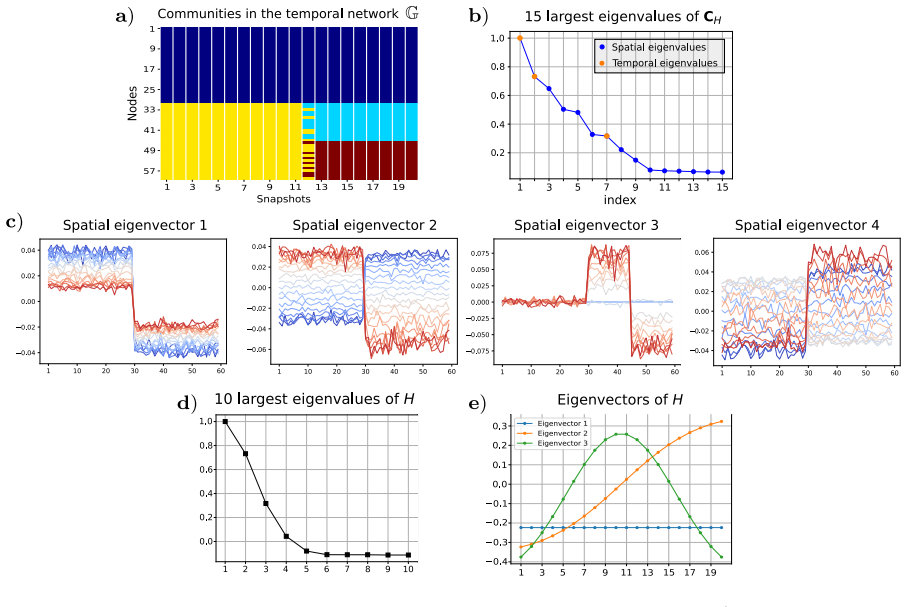
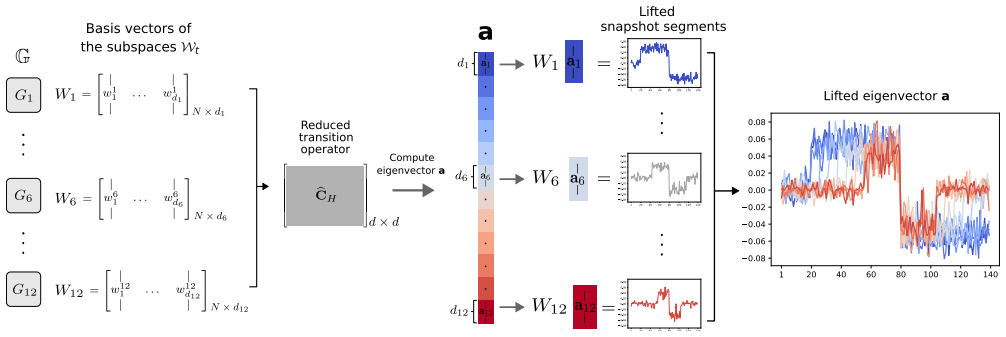
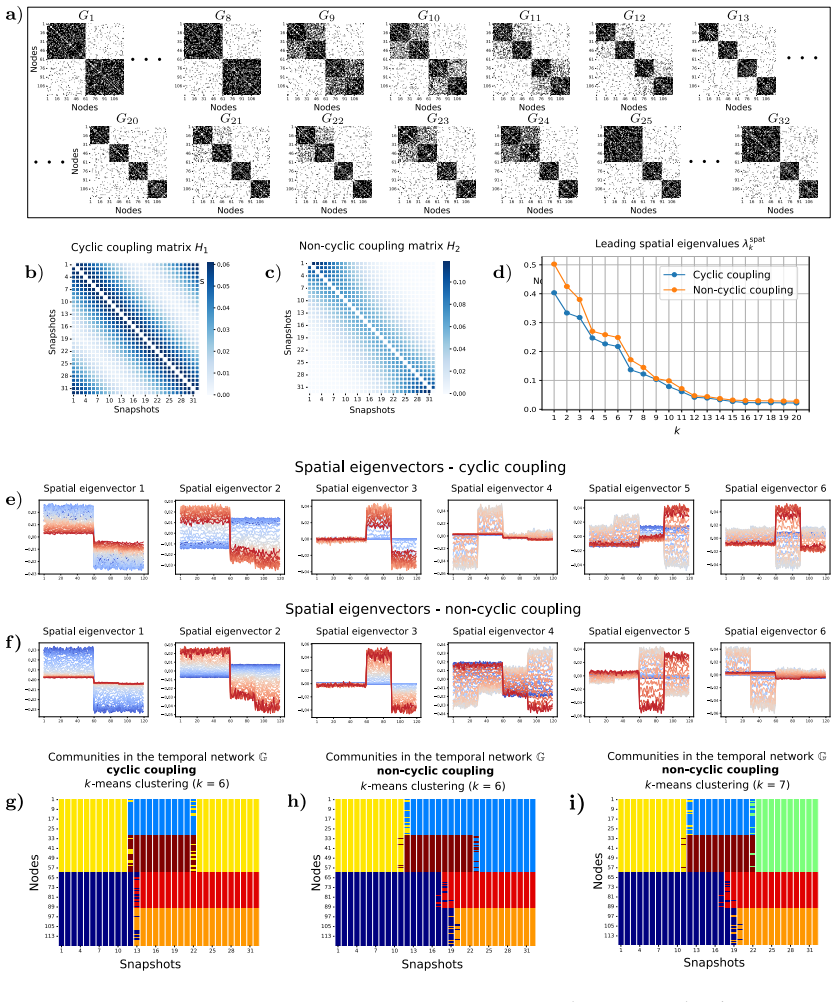
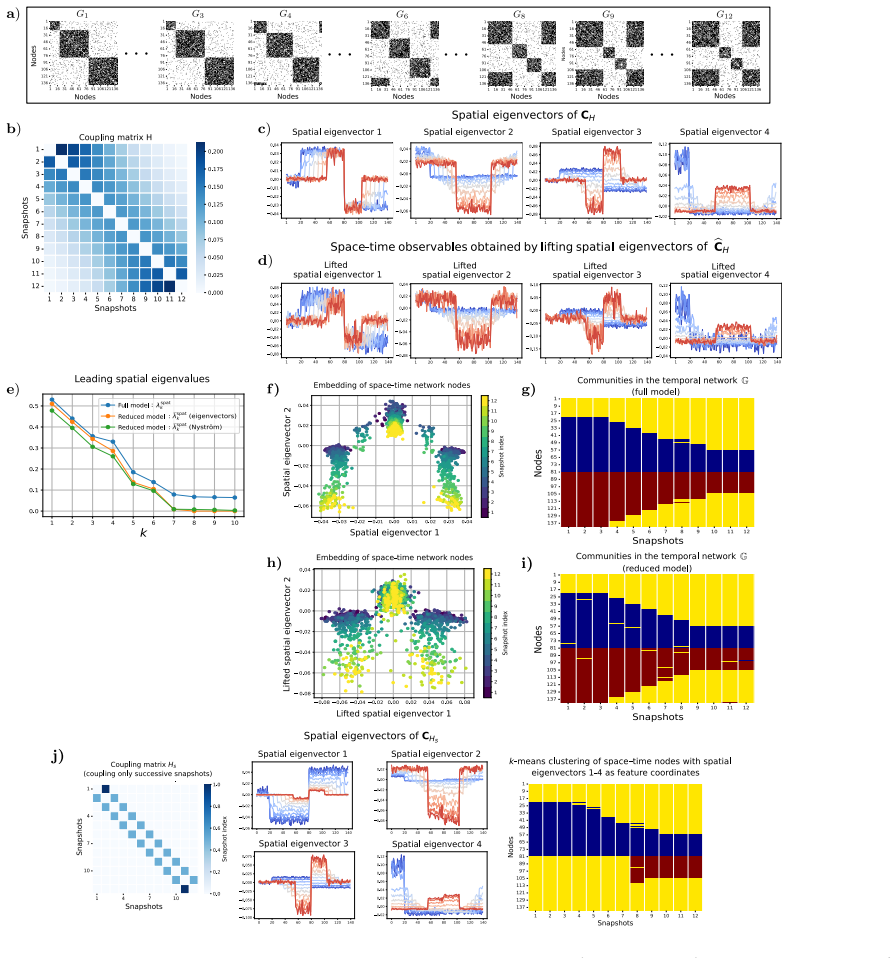
The mCCA formulation for community detection in temporal networks admits a spectral characterization via a time-reversible random walk on an augmented space-time network, providing a clear dynamical interpretation of temporal communities as metastable structures of the process. The transfer operators exhibit an interplay between spatial and temporal effects that distinguishes structural features from snapshot-coupling artifacts, and a reduced-order model preserves the essential spectral properties at lower cost.
What carries the argument
multi-view canonical correlation analysis mapped to the transfer operator of a time-reversible random walk on an augmented space-time network
If this is right
- Temporal communities receive a direct interpretation as metastable sets of an underlying Markov process.
- Spectral properties of the augmented transfer operator separate spatial structure from temporal coupling artifacts.
- A reduced-order model derived from the same operator yields community assignments at substantially lower computational expense while retaining the same leading eigenvalues.
- The framework extends the classical random-walk justification of spectral clustering from static to time-dependent networks.
Where Pith is reading between the lines
- The same space-time augmentation technique could be applied to other multi-view objectives beyond CCA, such as co-regularized spectral clustering.
- Because the walk is time-reversible, standard mixing-time bounds become available for quantifying how quickly communities merge or split.
- The reduced-order model may be combined with existing fast eigensolvers for static networks to handle very long time series.
- The distinction between structural and coupling-induced features offers a diagnostic that could be retrofitted to existing temporal community methods.
Load-bearing premise
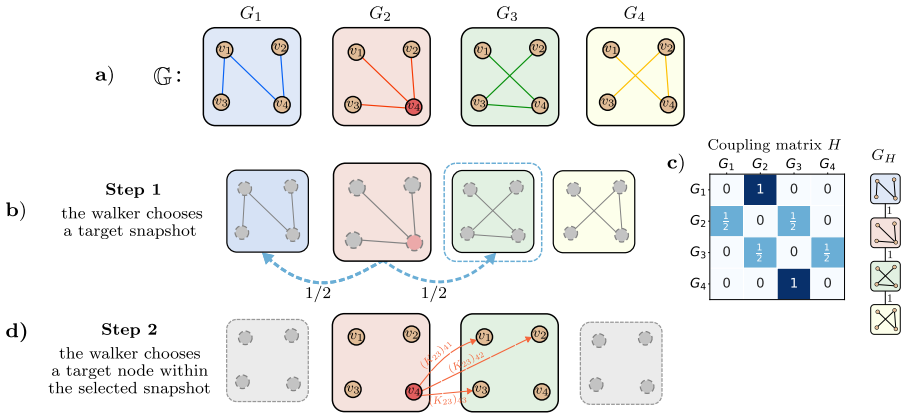
The multi-view CCA objective on successive network snapshots can be rewritten without approximation or artifact as the generator of a single time-reversible random walk on the product space-time graph.
What would settle it
Compute the leading eigenvectors of the mCCA operator on a small temporal network and compare them directly to the eigenvectors of the random-walk transfer matrix on the corresponding space-time graph; mismatch in the spectra or in the recovered partitions would refute the claimed equivalence.
Figures
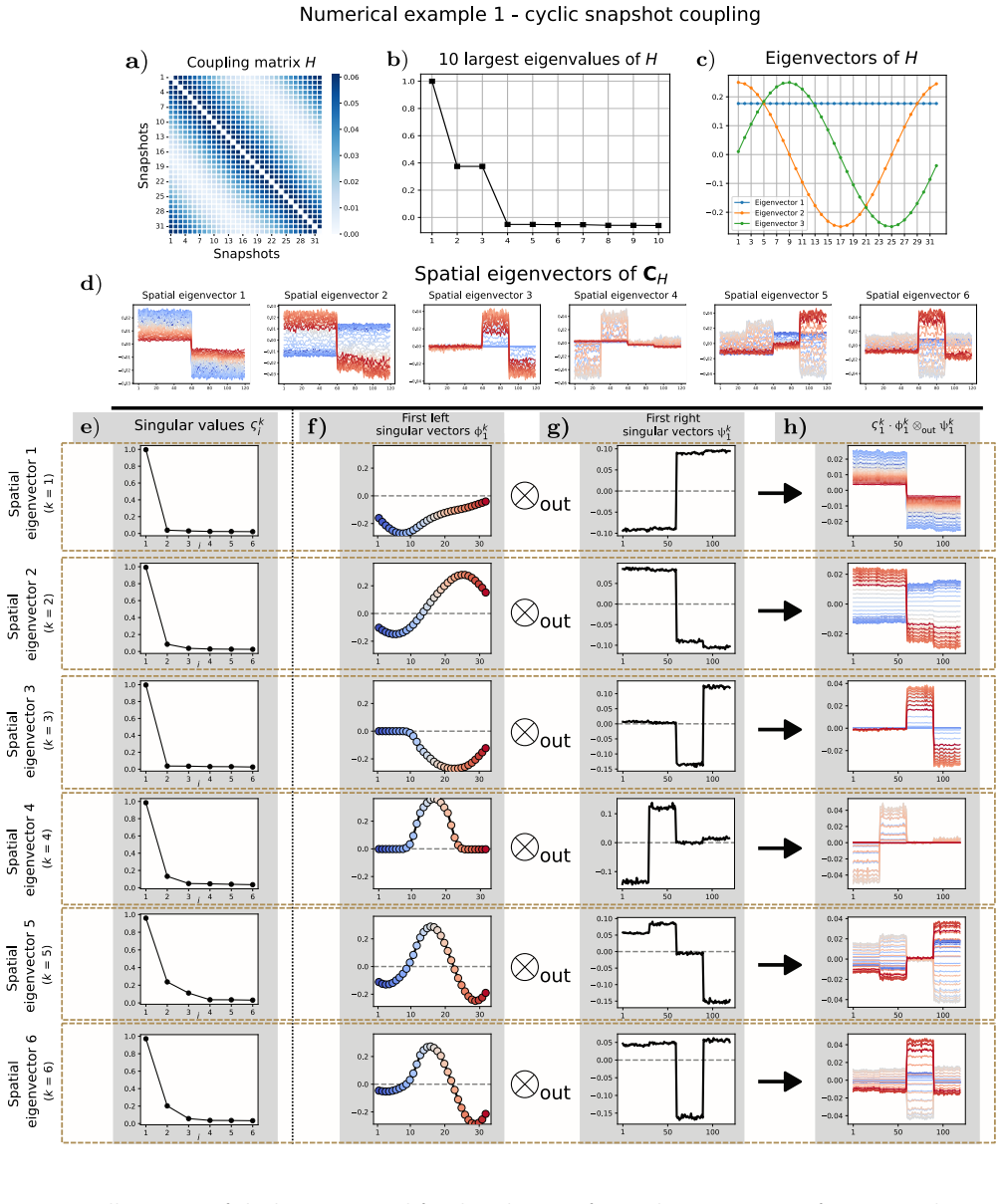
read the original abstract
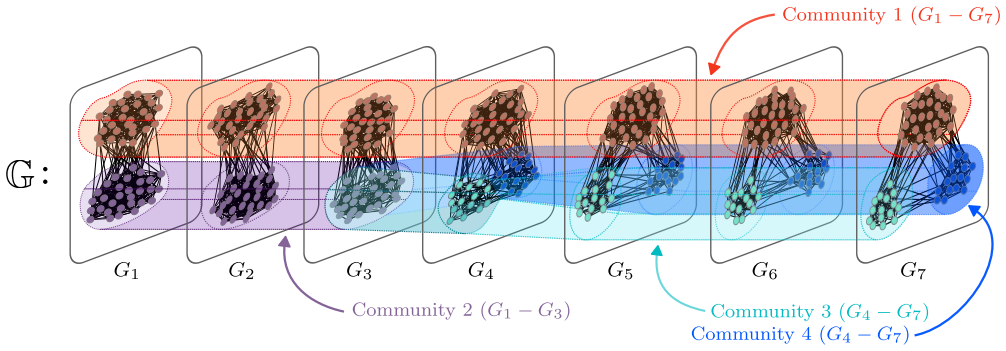
Temporal (or time-evolving) networks provide a natural framework for modeling complex systems with time-dependent interactions, where understanding the evolution of community structures is a central challenge. While random walk-based approaches to community detection in static networks are well established through the spectral analysis of associated transfer operators, extending these ideas to temporal networks is nontrivial due to the inherent time-dependence of the underlying dynamics. In this work, we develop a general framework for community detection in temporal networks that is based on multi-view canonical correlation analysis (mCCA). We show that the proposed formulation admits a spectral characterization via a time-reversible random walk on an augmented space-time network, providing a clear dynamical interpretation of temporal communities as metastable structures of the process. Furthermore, we analyze key spectral properties of the resulting transfer operators and the interplay between spatial and temporal effects, which allows us to distinguish between structural features and artifacts induced by the snapshot coupling. Finally, we derive a reduced-order model, which preserves the essential spectral properties while significantly improving computational efficiency. We show that the proposed approach effectively detects communities in temporal networks and captures their evolution.
Editorial analysis
A structured set of objections, weighed in public.
Referee Report
Summary. The manuscript develops a framework for community detection in temporal networks based on multi-view canonical correlation analysis (mCCA). It claims that this formulation admits an exact spectral characterization as the transfer operator of a time-reversible random walk on an augmented space-time network, allowing temporal communities to be interpreted as metastable structures. The work further analyzes the spectral properties of the resulting operators, separates structural features from snapshot-coupling artifacts, derives a reduced-order model that preserves essential spectral properties, and demonstrates the approach on temporal networks.
Significance. If the claimed exact equivalence to a time-reversible space-time random walk holds without approximation, the work would provide a rigorous dynamical foundation linking mCCA to established random-walk spectral clustering methods. This offers a clear metastability interpretation for temporal communities and a principled way to isolate coupling artifacts, which would be a substantive advance for dynamic network analysis. The reduced-order model is noted as a practical efficiency contribution.
major comments (1)
- [theoretical mapping from mCCA to space-time random walk (abstract and main theoretical sections)] The central claim (abstract and theoretical development) that the mCCA objective on temporal snapshots exactly equals the transfer operator of a time-reversible random walk on the augmented space-time graph requires the inter-snapshot coupling to produce a transition kernel satisfying detailed balance with respect to a stationary measure on the product space. The manuscript must explicitly derive or verify the conditions on the coupling terms that guarantee reversibility; if the coupling is asymmetric or the normalization fails to preserve detailed balance, the spectral characterization and metastability interpretation become approximate, undermining the dynamical interpretation.
minor comments (2)
- Clarify the precise definition of the augmented space-time network construction and the normalization used for the coupling terms to make the reversibility argument fully self-contained.
- The abstract states that the approach 'distinguishes between structural features and artifacts induced by the snapshot coupling'; provide a concrete example or theorem showing how this separation is achieved in the spectrum.
Simulated Author's Rebuttal
We thank the referee for the careful reading and for identifying the need for greater explicitness in the theoretical mapping. We address the single major comment below and will incorporate the requested derivation in the revised manuscript.
read point-by-point responses
-
Referee: [theoretical mapping from mCCA to space-time random walk (abstract and main theoretical sections)] The central claim (abstract and theoretical development) that the mCCA objective on temporal snapshots exactly equals the transfer operator of a time-reversible random walk on the augmented space-time graph requires the inter-snapshot coupling to produce a transition kernel satisfying detailed balance with respect to a stationary measure on the product space. The manuscript must explicitly derive or verify the conditions on the coupling terms that guarantee reversibility; if the coupling is asymmetric or the normalization fails to preserve detailed balance, the spectral characterization and metastability interpretation become approximate, undermining the dynamical interpretation.
Authors: We agree that an explicit derivation of the reversibility conditions strengthens the central claim. In the original formulation the inter-snapshot coupling is defined symmetrically (via a normalized, undirected space-time adjacency structure) so that the resulting transition kernel satisfies detailed balance with respect to the product stationary measure π ⊗ π_t; this is what permits the exact identification with the transfer operator of a time-reversible random walk. Nevertheless, the manuscript presents this fact at a high level rather than spelling out the algebraic verification. In the revised version we will insert a dedicated subsection (immediately following the definition of the augmented space-time graph) that (i) states the precise normalization chosen for the coupling blocks, (ii) writes the detailed-balance equations, and (iii) verifies that they hold identically under the chosen normalization. This addition will make the metastability interpretation fully rigorous without changing any of the stated results or the reduced-order model. revision: yes
Circularity Check
No significant circularity; derivation extends mCCA and random-walk spectral methods independently
full rationale
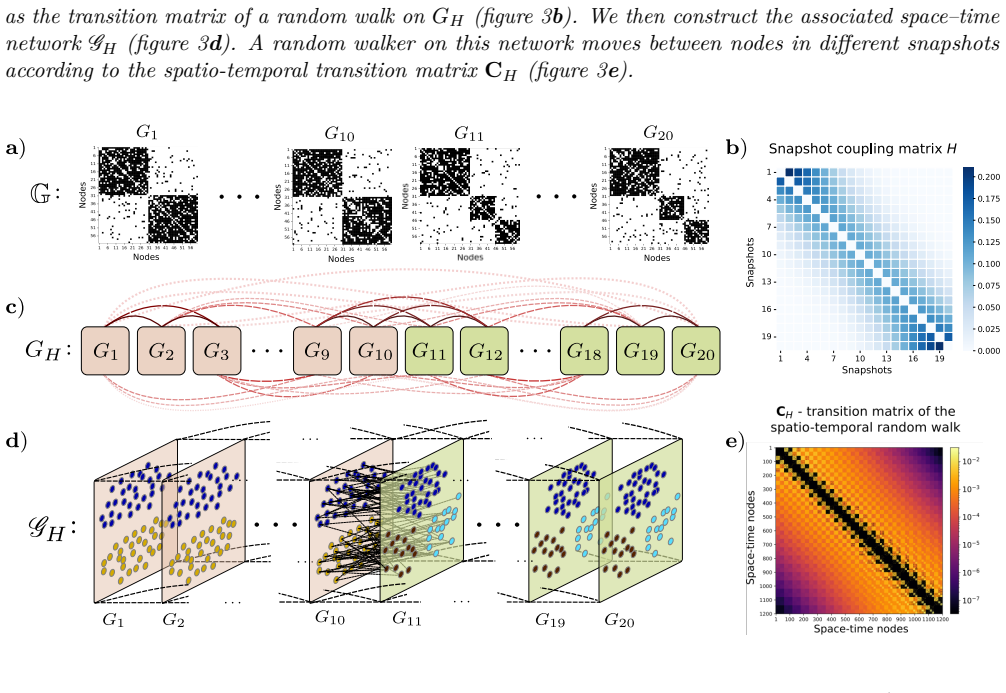
The paper's central step is to formulate temporal community detection via mCCA and then establish that this formulation admits an exact spectral characterization as the transfer operator of a time-reversible random walk on an augmented space-time graph. This equivalence is presented as a derived mathematical property rather than a definitional identity or a fit to the target quantity. No equations in the abstract or context reduce a prediction to a fitted parameter by construction, no uniqueness theorem is imported from self-citations, and no ansatz is smuggled via prior work. The derivation therefore remains self-contained against the external benchmarks of standard mCCA and reversible random-walk spectral clustering; the reader's preliminary score of 2 reflects only routine citation of those foundations, not load-bearing circularity.
Axiom & Free-Parameter Ledger
Reference graph
Works this paper leans on
-
[1]
Aslak, M
U. Aslak, M. Rosvall, and S. Lehmann. Constrained information flows in temporal networks reveal intermittent communities.Phys. Rev. E, 97:062312, Jun 2018
2018
-
[2]
F. V. Atkinson.Multiparameter Eigenvalue Problems. Volume I: Matrices and Compact Operators, volume 82 ofMathematics in Science and Engineering. Academic Press, New York and London, 1972
1972
-
[3]
Aynaud, E
T. Aynaud, E. Fleury, J.-L. Guillaume, and Q. Wang. Communities in evolving networks: Definitions, detection, and analysis techniques. In A. Mukherjee, M. Choudhury, F. Peruani, N. Ganguly, and B. Mitra, editors,Dynamics On and Of Complex Networks, Volume 2, Modeling and Simulation in Science, Engineering and Technology, pages 159–200. Birkhäuser, New Yor...
2013
-
[4]
Aynaud and J.-L
T. Aynaud and J.-L. Guillaume. Static community detection algorithms for evolving networks. In WiOpt’10: Modeling and Optimization in Mobile, Ad Hoc, and Wireless Networks, pages 508–514, Avignon, France, May 2010
2010
-
[5]
Bazzi, M
M. Bazzi, M. A. Porter, S. Williams, M. McDonald, D. J. Fenn, and S. D. Howison. Community detection in temporal multilayer networks, with an application to correlation networks.Multiscale Modeling & Simulation, 14(1):1–41, 2016
2016
-
[6]
Blašković, T
F. Blašković, T. O. F. Conrad, S. Klus, and N. Djurdjevac Conrad. Random walk based snapshot clustering for detecting community dynamics in temporal networks.Scientific Reports, 15(1):24414, 2025
2025
-
[7]
Budišić and I
M. Budišić and I. Mezić. Geometry of the ergodic quotient reveals coherent structures in flows. Physica D: Nonlinear Phenomena, 241(15):1255–1269, 2012
2012
-
[8]
D. M. Busiello, S. Suweis, J. Hidalgo, and A. Maritan. Explorability and the origin of network sparsity in living systems.Scientific Reports, 7(1):12323, 2017
2017
-
[9]
Cahill and G
P. Cahill and G. A. Gottwald. A modified Hegselmann–Krause model for interacting voters and political parties.Physica A: Statistical Mechanics and its Applications, 665:130490, 2025
2025
-
[10]
De Domenico, A
M. De Domenico, A. Solé-Ribalta, E. Cozzo, M. Kivelä, Y. Moreno, M. A. Porter, S. Gómez, and A. Arenas. Mathematical formulation of multilayer networks.Phys. Rev. X, 3:041022, Dec 2013
2013
-
[11]
E. D. Demaine, F. Reidl, P. Rossmanith, F. Sánchez Villaamil, S. Sikdar, and B. D. Sullivan. Structural sparsity of complex networks: Bounded expansion in random models and real-world graphs. Journal of Computer and System Sciences, 105:199–241, 2019. 29
2019
-
[12]
Djurdjevac.Methods for analyzing complex networks using random walker approaches
N. Djurdjevac.Methods for analyzing complex networks using random walker approaches. Dissertation, Freie Universität Berlin, 2012
2012
-
[13]
Djurdjevac, M
N. Djurdjevac, M. Sarich, and C. Schütte. Estimating the eigenvalue error of Markov state models. Multiscale Modeling & Simulation, 10(1):61–81, 2012
2012
-
[14]
Djurdjevac, M
N. Djurdjevac, M. Sarich, and C. Schütte.On Markov State Models for Metastable Processes, pages 3105–3131. Proceedings of the International Congress of Mathematicians, 2010
2010
-
[15]
Eisenmann
H. Eisenmann. A Newton method for solving locally definite multiparameter eigenvalue problems by multi-index.SIAM Journal on Matrix Analysis and Applications, 46(2):906–933, 2025
2025
-
[16]
Fackeldey, P
K. Fackeldey, P. Koltai, P. Névir, H. Rust, A. Schild, and M. Weber. From metastable to coherent sets— time-discretization schemes.Chaos: An Interdisciplinary Journal of Nonlinear Science, 29(1):012101, 01 2019
2019
-
[17]
Fowlkes, S
C. Fowlkes, S. Belongie, F. Chung, and J. Malik. Spectral grouping using the Nyström method.IEEE Transactions on Pattern Analysis and Machine Intelligence, 26(2):214–225, 2004
2004
-
[18]
G. Froyland, M. Kalia, and P. Koltai. Spectral clustering of time-evolving networks using the inflated dynamic Laplacian for graphs, 2024. Available at:https://arxiv.org/abs/2409.11984
-
[19]
Froyland, N
G. Froyland, N. Santitissadeekorn, and A. Monahan. Transport in time-dependent dynamical systems: Finite-time coherent sets.Chaos: An Interdisciplinary Journal of Nonlinear Science, 20(4):043116, 11 2010
2010
-
[20]
G. H. Golub and C. F. Van Loan.Matrix Computations - 4th Edition. Johns Hopkins University Press, Philadelphia, PA, 2013
2013
-
[21]
Hegselmann and U
R. Hegselmann and U. Krause. Opinion dynamics and bounded confidence models, analysis and simulation.Journal of Artificial Societies and Social Simulation, 5(3):1–2, None 2002
2002
-
[22]
Holme and J
P. Holme and J. Saramäki. Temporal networks.Physics Reports, 519(3):97–125, 2012. Temporal Networks
2012
-
[23]
Hotelling
H. Hotelling. Relations between two sets of variates.Biometrika, 28(3/4):321–377, 1936
1936
-
[24]
Huisinga and B
W. Huisinga and B. Schmidt.Metastability and Dominant Eigenvalues of Transfer Operators, pages 167–182. Springer Berlin Heidelberg, Berlin, Heidelberg, 2006
2006
-
[25]
Kivelä, A
M. Kivelä, A. Arenas, M. Barthelemy, J. P. Gleeson, Y. Moreno, and M. A. Porter. Multilayer networks.Journal of Complex Networks, 2(3):203–271, 07 2014
2014
-
[26]
Klus and N
S. Klus and N. Djurdjevac Conrad. Koopman-based spectral clustering of directed and time-evolving graphs.Journal of Nonlinear Science, 33(8), 2023
2023
-
[27]
Klus and N
S. Klus and N. Djurdjevac Conrad. Dynamical systems and complex networks: a Koopman operator perspective.Journal of Physics: Complexity, 5(4):041001, dec 2024
2024
-
[28]
S. Klus, P. Koltai, and C. Schütte. On the numerical approximation of the Perron–Frobenius and Koopman operator.Journal of Computational Dynamics, 3(1):51–79, 2016
2016
-
[29]
Klus and M
S. Klus and M. Trower. Transfer operators on graphs: spectral clustering and beyond.Journal of Physics: Complexity, 5(1):015014, feb 2024
2024
-
[30]
A. V. Knyazev and M. E. Argentati. Rayleigh–Ritz majorization error bounds with applications to FEM.SIAM Journal on Matrix Analysis and Applications, 31(3):1521–1537, 2010. 30
2010
-
[31]
Mancastroppa, R
M. Mancastroppa, R. Burioni, V. Colizza, and A. Vezzani. Active and inactive quarantine in epidemic spreading on adaptive activity-driven networks.Phys. Rev. E, 102:020301(R), Aug 2020
2020
-
[32]
Masuda and P
N. Masuda and P. Holme. Predicting and controlling infectious disease epidemics using temporal networks.F1000Prime Reports, 5:6, 2013
2013
-
[33]
S. E. Otto and C. W. Rowley. Koopman operators for estimation and control of dynamical systems. Annual Review of Control, Robotics, and Autonomous Systems, 4:59–87, 2021
2021
-
[34]
Padberg-Gehle and C
K. Padberg-Gehle and C. Schneide. Network-based study of Lagrangian transport and mixing. Nonlinear Processes in Geophysics, 24(4):661–671, 2017
2017
-
[35]
Rossetti and R
G. Rossetti and R. Cazabet. Community discovery in dynamic networks: A survey.ACM Comput. Surv., 51(2), Feb. 2018
2018
-
[36]
Sarich, N
M. Sarich, N. Djurdjevac Conrad, S. Bruckner, T. O. F. Conrad, and C. Schütte. Modularity revisited: A novel dynamics-based concept for decomposing complex networks.Journal of Computational Dynamics, 1(1):191–212, 2014
2014
-
[37]
Schütte and M
C. Schütte and M. Sarich.Metastability and Markov State Models in Molecular Dynamics: Modeling, Analysis, Algorithmic Approaches, volume 24 ofCourant Lecture Notes in Mathematics. American Mathematical Society, Providence, RI, 2013
2013
-
[38]
Shawe-Taylor and N
J. Shawe-Taylor and N. Cristianini.Kernel Methods for Pattern Analysis. Cambridge University Press, Cambridge, United Kingdom, 2004
2004
-
[39]
Taylor, S
D. Taylor, S. A. Myers, A. Clauset, M. A. Porter, and P. J. Mucha. Eigenvector-based centrality measures for temporal networks.Multiscale Modeling & Simulation, 15(1):537–574, 2017
2017
-
[40]
Trower, N
M. Trower, N. Djurdjevac Conrad, and S. Klus. Clustering time-evolving networks using the spa- tiotemporal graph Laplacian.Chaos: An Interdisciplinary Journal of Nonlinear Science, 35(1):013126, 01 2025
2025
-
[41]
von Luxburg
U. von Luxburg. A tutorial on spectral clustering.Statistics and Computing, 17(4):395–416, 2007
2007
-
[42]
Data-driven Reduction of Transfer Operators for Particle Clustering Dynamics
N. Wehlitz, G. A. Pavliotis, C. Schütte, and S. Winkelmann. Data-driven reduction of transfer operators for particle clustering dynamics, 2026. Available at:https://arxiv.org/abs/2601.02932. A Proofs of lemmas from sections 3.2 and 4.1 Proof of lemma 3.3.Defineπ= [π1,...,πM]⊤∈RM by πt = rt R >0, R= M∑ t=1 rt. Then∑M t=1πt = 1, soπis a probability distribu...
work page internal anchor Pith review Pith/arXiv arXiv 2026
discussion (0)
Sign in with ORCID, Apple, or X to comment. Anyone can read and Pith papers without signing in.