REVIEW 4 major objections 6 minor 23 references
MVAT: Multi-View Aware Teacher for Weakly Supervised 3D Object Detection
T0 review · 4 major / 6 minor · reviewed 2026-08-04 · deepseek-v4-flash
Pith's one-line read MVAT is the first weakly supervised 3D detection framework to use temporal multi-view data, reaching 47.6 mAP on nuScenes with only 2D box annotations — 81% of the fully supervised oracle — and reporting the first weakly supervised results
desk verdict MVAT is a genuinely novel and strong weak-supervision result—first to use temporal multi-view cues for 3D detection from 2D boxes only—but the moving-object handling needs scrutiny before the details can be trusted. read the letter →
The pith
A machine-rendered reading of the paper's core claim, the machinery that carries it, and where it could break.
The reading
What carries the argument
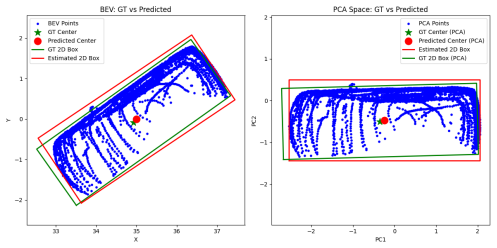
Temporal point-cloud aggregation restricted to static objects, feeding a Teacher–Student distillation. For each static instance, point clouds from every visible frame (isolated by SAM 2 masks derived from the 2D boxes) merge in a global frame; DBSCAN removes noise, and PCA over the bird's-eye view fits the coarse 3D box used as training target. The Teacher learns these targets from single-frame inputs — per Section 3.2, an object's point-cloud appearance is independent of its motion state — and then pseudo-labels static objects from aggregated inputs and moving ones from single frames. The Student learns to reproduce those boxes from single frames alone; a multi-view 2D projection loss (aver
What would settle it
Train the Student on static objects only and evaluate on moving objects only: if the static-to-moving AP gap grows far beyond the paper's 0.7 points, the appearance-invariance claim fails. A cheaper probe is to train a classifier to tell single-frame static from moving point clouds — above-chance accuracy means the two distributions are separable and the Teacher's transfer is biased. A third check: sweep the static/moving threshold τ_static (paper uses 0.5 m) and watch whether final mAP shifts, which would expose slow movers mislabeled as static poisoning the aggregated labels.
Extended reading notes
Core claim
One 2D box maps to many possible 3D boxes; this projection ambiguity, the paper claims, can be resolved with geometry rather than priors, using the multiple viewpoints of static objects that sequential driving data provides for free. MVAT aggregates each static object's point clouds across its visible frames, cleans them with DBSCAN, fits a coarse box with PCA, and trains a Teacher to predict these boxes from single-frame partial clouds. The Teacher then pseudo-labels the whole dataset — static objects from aggregated clouds, moving objects from single frames — and a Student learns to reproduce its boxes from single-frame inputs, supervised by a multi-view 2D projection loss. Reported result
Load-bearing premise
The load-bearing premise is that a single frame's point cloud of an object looks the same whether the object is stationary or moving, so a Teacher trained only on static objects can safely label moving ones; if motion distorts, occludes, or samples the cloud differently, the moving-object labels carry a bias the Student cannot correct.
Editorial extensions
If this is right
- On nuScenes the pseudo-labeled detector reaches 47.6 mAP from 2D boxes alone — 81% of the 58.8 mAP fully supervised oracle and 5.8 mAP over the previous weakly supervised state of the art.
- On Waymo, MVAT reports the first weakly supervised results: Vehicle L1 AP 72.1 (91% of the oracle) without any dataset-specific tuning.
- Temporal aggregation helps most where priors fail — sparse and often-occluded classes gain the most (Barrier +15.8, Traffic Cone +8.6 mAP over ALPI).
- The static-to-moving transfer works: the Student scores 67.4 AP on static and 66.7 AP on moving objects, a gap of only 0.7 points.
- The same pipeline scales with stronger supervision: adding 5% of 3D boxes raises mAP to 54.1, or 92% of the oracle.
Reading between the lines
- The appearance-invariance assumption (Section 3.2) is validated only through end-to-end results; a direct probe — training the Student exclusively on static pseudo-labels and testing on moving objects — would isolate the transfer mechanism and reveal any motion-specific bias.
- Slow-moving objects under the 0.5 m centroid threshold are pooled into 'static' aggregated clouds; if such cases are common in dense traffic, the coarse labels carry a systematic small-motion distortion that the pipeline cannot detect without motion ground truth.
- Because the coarse boxes come from SAM 2 masks + DBSCAN + PCA with no learned component, mask quality sets the pipeline's ceiling; improvements in instance segmentation should translate nearly linearly into better 3D pseudo-labels.
- The multi-view 2D projection loss is a general pseudo-label validator: any candidate 3D box can be accepted or rejected by how consistently it projects onto all available 2D boxes, suggesting use as a filter in other auto-labeling pipelines.
Editorial analysis
A structured set of objections, weighed in public.
Referee Report
Summary. The paper proposes MVAT, a weakly supervised 3D object detection pipeline that uses only 2D box annotations and exploits temporal multi-view cues. Static objects are identified by centroid displacement and their per-frame LiDAR crops (from SAM2 masks) are aggregated over time; DBSCAN/PCA then produce coarse 3D boxes. A Teacher detector is trained on isolated static clouds with a 3D loss plus a multi-view 2D GIoU projection loss, and later pseudo-labels both aggregated static and single-frame moving objects. A Student detector is trained on single-frame inputs for all objects with the same two losses. CenterPoint trained on the Student pseudo-labels reaches 47.6 mAP on nuScenes validation (vs 41.8 for ALPI, 81% of the 58.8 fully supervised oracle) and the paper reports the first weakly supervised Waymo results. Ablations attribute +5.3 AP to temporal aggregation and +4.6 to +4.9 AP to distillation.
Significance. If the results hold, MVAT is a meaningful advance: it replaces category-specific priors with geometric evidence from temporal multi-view data, is architecture-agnostic, and extends weakly supervised 3D detection to Waymo. The paper ships code, reports per-class gains, and includes ablations supporting its two main mechanisms. The central weakness is that the headline numbers depend on validation-set tuning and on an unvalidated static-to-moving invariance premise; these issues must be addressed before the claims are fully supported.
major comments (4)
- [Section 3.5, Eq. (2)] The multi-view projection loss is computed over all frames i in F_j, but the Teacher/Student input is a single frame t. For a moving object, a 3D box at time t does not correspond to the object's position at i != t; directly projecting it into camera i is geometrically invalid unless the box is transformed by ego-motion and object displacement. No such transformation is described. This affects the Student's moving-object training and the claim that the 2D loss enforces consistency with all available 2D annotations. Please specify whether the loss is restricted to same-timestamp cameras or describe the motion-compensation procedure and evaluate its impact.
- [Section 3.2, Table 4] The premise that single-frame point-cloud appearance is independent of motion state is load-bearing for the Teacher-to-moving pseudo-label transfer, but the only support is Table 4, with no repeated runs or error bars (62.1 vs 62.5 AP for moving vs static Teacher; 66.7 vs 67.4 for Student). AP can also hide systematic box biases such as consistent length over-estimation. Single-frame moving sweeps may differ from static sweeps due to motion distortion or self-occlusion during the sweep. Please validate the premise directly: compare Teacher predictions on held-out moving vs static instances using GT velocity labels, report localization error metrics as well as AP, and provide multi-seed results.
- [Supplementary, 'Pseudo-Label Filtering for Student Training'] Class-specific confidence thresholds are 'set based on the validation set', while Section 4 reports final mAP on the same nuScenes validation split (Table 1). Threshold selection on the evaluation split inflates the reported state-of-the-art numbers and makes the comparison to ALPI unfair unless ALPI also tuned on the same validation split. Please fix thresholds on a held-out portion of the training set (or report a sensitivity sweep) and re-report the headline numbers, or clearly disclose the selection procedure and its effect.
- [Supplementary, Eq. (5)] Static/moving classification uses max centroid displacement with tau_static = 0.5 m. A slow-moving object can satisfy this inequality and be aggregated into P_s_agg, smearing the PCA coarse box and contaminating Teacher targets. No classification error rate is reported against nuScenes GT velocities, which are available but unused. Since this step gates all Teacher targets, please report precision/recall of the static/moving split against GT velocities, quantify the effect of excluding borderline tracks, and discuss slow-mover contamination in the limitation section rather than only qualitatively.
minor comments (6)
- [Section 3.5] The main text says objects 'wrongly classified by the Teacher using the ground truth annotation' are filtered; the supplementary clarifies this means the 2D box class label. Please use unambiguous wording in the main text to avoid implying 3D ground truth is used.
- [Section 4.3, Table 1] The table caption and text alternate between 'SPNDS' and 'NDS'; align the terminology consistently.
- [Figure 4] The figure is referenced in Section 4.4 but appears without axis labels in the submitted text; add labels and quantify the trade-off between IoU and retained objects.
- [Section 3.4, Eq. (2)] The definition of F_j as a set of frames is reused from Section 3.1; state explicitly that Eq. (2) averages over temporal views, which is relevant to the motion-compensation concern raised above.
- [Table 4] The caption excludes Traffic Cone and Barrier; state this in the table body or main text so readers do not interpret the aggregate as covering all classes.
- [Table 2] No weakly supervised baseline is available for Waymo, but reporting a fully supervised CenterPoint oracle trained on the same training data and detector configuration would strengthen the comparison.
Circularity Check
No significant circularity: supervision flows one-way from 2D boxes + LiDAR geometry to 3D pseudo-labels, with final evaluation against external 3D ground truth.
full rationale
The paper's supervision chain is a one-way pipeline. 2D boxes select LiDAR points (Eq. 1) and provide a projection consistency loss (Eq. 2); the 3D coarse boxes are estimated from temporally aggregated LiDAR geometry via DBSCAN/PCA (Sec. 3.3), which is independent of the final 3D evaluation. The Teacher is trained on static isolated views with coarse aggregated targets, then generates pseudo-labels for both static and moving objects; the Student is trained on single-frame inputs to mimic those pseudo-labels; CenterPoint is then trained on the student re-annotations and evaluated against nuScenes/Waymo 3D ground truth. No equation reduces to itself: the 2D projection loss is a supervision signal, not a prediction of the evaluation metric, and the pseudo-labels are not derived from the final 3D labels. The only self-citation (ALPI [5]) is used as a baseline and as a supporting confirmation of the authors' own finding that 3D guidance stabilizes training; it is not load-bearing because the paper reports its own ablation. The supplementary's statement that confidence thresholds are 'set based on the validation set' is an evaluation-leakage/correctness risk, not a circularity, since the thresholds do not define the reported mAP by construction. The motion-state-independence premise (Sec. 3.2) is an empirical assumption tested by the static-to-moving ablation (Table 4), not an equivalence. Overall, the central derivation is self-contained against external 3D benchmarks; score 2 reflects only the minor non-load-bearing self-citation and validation-set tuning, not circular dependency.
Assumptions & free parameters
free parameters (9)
- lambda (Teacher L2D weight) =
0.5
- gamma (Student L2D weight) =
0.5
- tau_static (centroid displacement threshold) =
0.5 m
- DBSCAN epsilon =
0.5 m
- DBSCAN min samples =
10
- SAM2 mask confidence threshold =
0.6
- tau_IoU (geometric consistency) =
0.6
- min point threshold for Teacher training samples =
10 per instance
- class-specific pseudo-label confidence thresholds =
Car=0.5, Pedestrian=0.4, others unlisted
assumptions (7)
- domain assumption Ego-pose data from nuScenes/Waymo is accurate enough for global-frame alignment of object-centric point clouds.
- domain assumption The LiDAR-to-camera projection pi is calibrated so that points within the 2D mask correspond to the object.
- domain assumption SAM 2 segmentation masks from 2D box prompts are reliable enough to isolate foreground object points.
- domain assumption Static objects constitute a large majority of instances and are trackable via centroid displacement.
- ad hoc to paper The point cloud appearance of an object at a single timestamp is independent of its motion state.
- domain assumption PCA on the dominant BEV point cluster yields a box whose axes align with the object's orientation and extent.
- standard math The GIoU loss between projected 3D box and 2D annotation provides a smooth, informative gradient for box refinement.
Cite this review
Pith. "Pith review of MVAT: Multi-View Aware Teacher for Weakly Supervised 3D Object Detection." pith.science (2026). https://pith.science/paper/4QOTGJJK
@misc{pith2026250907507,
  author       = {Pith},
  title        = {Pith review of: MVAT: Multi-View Aware Teacher for Weakly Supervised 3D Object Detection},
  year         = {2026},
  howpublished = {\url{https://pith.science/paper/4QOTGJJK}},
  note         = {Machine review of arXiv:2509.07507}
}
read the original abstract
Annotating 3D data remains a costly bottleneck for 3D object detection, motivating the development of weakly supervised annotation methods that rely on more accessible 2D box annotations. However, relying solely on 2D boxes introduces projection ambiguities since a single 2D box can correspond to multiple valid 3D poses. Furthermore, partial object visibility under a single viewpoint setting makes accurate 3D box estimation difficult. We propose MVAT, a novel framework that leverages temporal multi-view present in sequential data to address these challenges. Our approach aggregates object-centric point clouds across time to build 3D object representations as dense and complete as possible. A Teacher-Student distillation paradigm is employed: The Teacher network learns from single viewpoints but targets are derived from temporally aggregated static objects. Then the Teacher generates high quality pseudo-labels that the Student learns to predict from a single viewpoint for both static and moving objects. The whole framework incorporates a multi-view 2D projection loss to enforce consistency between predicted 3D boxes and all available 2D annotations. Experiments on the nuScenes and Waymo Open datasets demonstrate that MVAT achieves state-of-the-art performance for weakly supervised 3D object detection, significantly narrowing the gap with fully supervised methods without requiring any 3D box annotations. % \footnote{Code available upon acceptance} Our code is available in our public repository (\href{https://github.com/CEA-LIST/MVAT}{code}).
Figures


Figures from the paper (7 more)




Reference graph
Works this paper leans on
-
[1]
nuscenes: A multi- modal dataset for autonomous driving
Holger Caesar, Varun Bankiti, Alex H Lang, Sourabh V ora, Venice Erin Liong, Qiang Xu, Anush Krishnan, Yu Pan, Gi- ancarlo Baldan, and Oscar Beijbom. nuscenes: A multi- modal dataset for autonomous driving. In Proceedings of the IEEE/CVF conference on computer vision and pattern recognition, pages 11621–11631, 2020. 5
work page 2020
-
[2]
A density-based algorithm for discovering clusters in large spatial databases with noise
Martin Ester, Hans-Peter Kriegel, J ¨org Sander, Xiaowei Xu, et al. A density-based algorithm for discovering clusters in large spatial databases with noise. In kdd, pages 226–231,
-
[3]
Leveraging imagery data with spatial point prior for weakly semi-supervised 3d object detection
Hongzhi Gao, Zheng Chen, Zehui Chen, Lin Chen, Jiaming Liu, Shanghang Zhang, and Feng Zhao. Leveraging imagery data with spatial point prior for weakly semi-supervised 3d object detection. In Proceedings of the AAAI Conference on Artificial Intelligence, pages 1797–1805, 2024. 3, 5, 6
work page 2024
-
[4]
Weakly supervised 3d object detection via multi-level vi- sual guidance
Kuan-Chih Huang, Yi-Hsuan Tsai, and Ming-Hsuan Yang. Weakly supervised 3d object detection via multi-level vi- sual guidance. In European Conference on Computer Vision, pages 175–191. Springer, 2024. 2
work page 2024
-
[5]
Alpi: Auto-labeller with proxy injection for 3d object detection using 2d labels only
Saad Lahlali, Nicolas Granger, Herve Le Borgne, and Quoc- Cuong Pham. Alpi: Auto-labeller with proxy injection for 3d object detection using 2d labels only. In Proceedings of the Winter Conference on Applications of Computer Vision (W ACV), pages 2185–2194, 2025. 1, 2, 6, 8
work page 2025
-
[6]
Lam, Siew-Chong Tan, and Ngai Wong
Chang Liu, Xiaoyan Qian, Binxiao Huang, Xiaojuan Qi, Edmund Y . Lam, Siew-Chong Tan, and Ngai Wong. Mul- timodal transformer for automatic 3d annotation and ob- ject detection. In Computer Vision - ECCV 2022 - 17th European Conference, Tel Aviv,Israel, October 23-27, 2022, Proceedings, Part XXXVIII, pages 657–673. Springer, 2022. 3
work page 2022
-
[7]
Lam, Siew-Chong Tan, and Ngai Wong
Chang Liu, Xiaoyan Qian, Xiaojuan Qi, Edmund Y . Lam, Siew-Chong Tan, and Ngai Wong. Map-gen: An auto- mated 3d-box annotation flow with multimodal attention point generator. In 26th International Conference on Pattern Recognition, ICPR 2022, Montreal, QC, Canada, August 21-25, 2022, pages 1148–1155. IEEE, 2022. 3
work page 2022
-
[8]
Principal components analysis (pca)
Andrzej Ma ´ckiewicz and Waldemar Ratajczak. Principal components analysis (pca). Computers & Geosciences, 19 (3):303–342, 1993. 5
work page 1993
Show all 23 references
-
[9]
Towards a weakly supervised framework for 3d point cloud object detection and annotation
Qinghao Meng, Wenguan Wang, Tianfei Zhou, Jianbing Shen, Yunde Jia, and Luc Van Gool. Towards a weakly supervised framework for 3d point cloud object detection and annotation. IEEE Transactions on Pattern Analysis and Machine Intelligence, 44(8):4454–4468, 2021. 3
2021
-
[10]
Extreme clicking for efficient object anno- tation
Dim P Papadopoulos, Jasper RR Uijlings, Frank Keller, and Vittorio Ferrari. Extreme clicking for efficient object anno- tation. In ICCV, pages 4930–4939, 2017. 1
2017
-
[11]
Time will tell: New outlooks and a baseline for temporal multi-view 3d object detection
Jinhyung Park, Chenfeng Xu, Shijia Yang, Kurt Keutzer, Kris Kitani, Masayoshi Tomizuka, and Wei Zhan. Time will tell: New outlooks and a baseline for temporal multi-view 3d object detection. arXiv preprint arXiv:2210.02443, 2022. 2, 3
2022 arXiv
-
[12]
Lam, and Ngai Wong
Xiaoyan Qian, Chang Liu, Xiaojuan Qi, Siew-Chong Tan, Edmund Y . Lam, and Ngai Wong. Context- aware transformer for 3d point cloud automatic annota- tion. In Thirty-Seventh AAAI Conference on Artificial Intelligence, AAAI 2023, Thirty-Fifth Conference on Innovative Application...
2023
-
[13]
Sam 2: Segment anything in images and videos
Nikhila Ravi, Valentin Gabeur, Yuan-Ting Hu, Ronghang Hu, Chaitanya Ryali, Tengyu Ma, Haitham Khedr, Roman R¨adle, Chloe Rolland, Laura Gustafson, et al. Sam 2: Segment anything in images and videos. arXiv preprint arXiv:2408.00714, 2024. 3
2024 arXiv
-
[14]
Pv-rcnn: Point-voxel feature set abstraction for 3d object detection
Shaoshuai Shi, Chaoxu Guo, Li Jiang, Zhe Wang, Jian- ping Shi, Xiaogang Wang, and Hongsheng Li. Pv-rcnn: Point-voxel feature set abstraction for 3d object detection. In Proceedings of the IEEE/CVF conference on computer vision and pattern recognition, pages 10529–10538, 2020. 6
2020
-
[15]
Sun rgb-d: A rgb-d scene understanding benchmark suite
Shuran Song, Samuel P Lichtenberg, and Jianxiong Xiao. Sun rgb-d: A rgb-d scene understanding benchmark suite. In CVPR, pages 567–576, 2015. 1
2015
-
[16]
Semi-supervised 3d object detection via temporal graph neural networks
Jianren Wang, Haiming Gang, Siddarth Ancha, Yi-Ting Chen, and David Held. Semi-supervised 3d object detection via temporal graph neural networks. In 2021 International conference on 3D Vision (3DV), pages 413–422. IEEE,
2021
-
[17]
Exploring object-centric temporal modeling for efficient multi-view 3d object detection
Shihao Wang, Yingfei Liu, Tiancai Wang, Ying Li, and Xi- angyu Zhang. Exploring object-centric temporal modeling for efficient multi-view 3d object detection. In Proceedings of the IEEE/CVF International Conference on Computer Vision, pages 3621–3631, 2023. 2, 3
2023
-
[18]
Fgr: Frustum- aware geometric reasoning for weakly supervised 3d vehi- cle detection
Yi Wei, Shang Su, Jiwen Lu, and Jie Zhou. Fgr: Frustum- aware geometric reasoning for weakly supervised 3d vehi- cle detection. In 2021 IEEE International Conference on Robotics and Automation (ICRA), pages 4348–4354. IEEE,
2021
-
[19]
Gal: Graph-induced adaptive learning for weakly super- vised 3d object detection
Dongshuo Yin, Hongfeng Yu, Nayu Liu, Fanglong Yao, Qibin He, Jihao Li, Yiran Yang, Shiyao Yan, and Xian Sun. Gal: Graph-induced adaptive learning for weakly super- vised 3d object detection. IEEE Transactions on Intelligent Transportation Systems, 2023. 2
2023
-
[20]
Center- based 3d object detection and tracking
Tianwei Yin, Xingyi Zhou, and Philipp Krahenbuhl. Center- based 3d object detection and tracking. In Proceedings of the IEEE/CVF conference on computer vision and pattern recognition, pages 11784–11793, 2021. 6, 8, 5
2021
-
[21]
A sim- ple vision transformer for weakly semi-supervised 3d object detection
Dingyuan Zhang, Dingkang Liang, Zhikang Zou, Jingyu Li, Xiaoqing Ye, Zhe Liu, Xiao Tan, and Xiang Bai. A sim- ple vision transformer for weakly semi-supervised 3d object detection. In Proceedings of the IEEE/CVF International Conference on Computer Vision, pages 8373–8383, 2023. 3
2023
-
[22]
General geometry-aware weakly 9 supervised 3d object detection
Guowen Zhang, Junsong Fan, Liyi Chen, Zhaoxiang Zhang, Zhen Lei, and Lei Zhang. General geometry-aware weakly 9 supervised 3d object detection. In European Conference on Computer Vision, pages 290–309. Springer, 2024. 1, 2
2024
-
[23]
Temporal enhanced training of multi-view 3d object detector via historical object prediction
Zhuofan Zong, Dongzhi Jiang, Guanglu Song, Zeyue Xue, Jingyong Su, Hongsheng Li, and Yu Liu. Temporal enhanced training of multi-view 3d object detector via historical object prediction. In Proceedings of the IEEE/CVF International Conference on Computer Vision, pages 3781–379...
2023
Reviewed August 4, 2026 · model on record in the stance chip above.
Discussion (0). Continue with ORCID to comment.