Stationary point complexity via minimal supersymmetry breaking
Pith reviewed 2026-06-29 01:30 UTC · model grok-4.3
The pith
A four-index supersymmetric representation computes the complexity of stationary points by incorporating the absolute value of the Hessian determinant through minimal spontaneous supersymmetry breaking.
A machine-rendered reading of the paper's core claim, the machinery that carries it, and where it could break.
Core claim
We develop an expanded 4-index supersymmetric representation of the complexity problem which incorporates the absolute value naturally via spontaneous supersymmetry breaking along a particular superspace direction. Positing that no additional symmetry breaking occurs implies the reduction to five order parameters corresponding to elements of a superspace operator algebra generated by the spontaneously SUSY-breaking operator. We relate the order parameters to the geometry and spectra of stationary points, showing that the SUSY-breaking order parameter corresponds to the spectral density of the Hessian at zero eigenvalue. We give examples of this formalism applied to calculate the annealed com
What carries the argument
The 4-index supersymmetric representation with spontaneous supersymmetry breaking along one superspace direction, which generates an operator algebra reducing the problem to five order parameters linked to stationary-point geometry and Hessian spectra.
If this is right
- The annealed complexity of stationary points is obtained for the perceptron model.
- The annealed complexity of stationary points is obtained for the Sherrington-Kirkpatrick model.
- The same five order parameters extend to quenched complexity by becoming replica matrices.
- The SUSY-breaking order parameter equals the spectral density of the Hessian at zero eigenvalue.
- The order parameters encode geometric properties of the stationary points in addition to their spectra.
Where Pith is reading between the lines
- The method may apply to other mean-field disordered systems where the sign of a determinant controls the counting of critical points.
- Numerical sampling of Hessians in finite-dimensional versions of these models could test whether the five-parameter reduction persists beyond the mean-field limit.
- The operator-algebra structure might connect to existing supersymmetric treatments of spin glasses or neural-network loss surfaces.
Load-bearing premise
No additional symmetry breaking occurs beyond the minimal spontaneous breaking along one chosen superspace direction.
What would settle it
A direct count of stationary points in the perceptron or Sherrington-Kirkpatrick model that yields a complexity different from the five-order-parameter prediction would show the reduction does not hold.
Figures
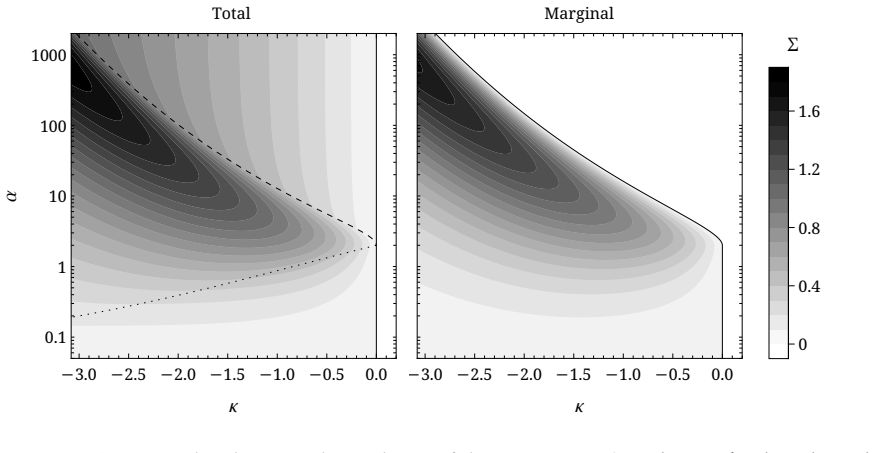
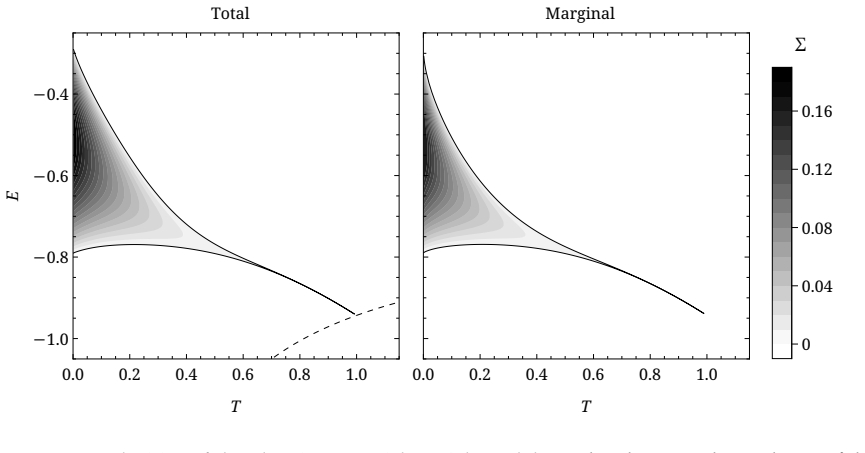
read the original abstract
The statistics of stationary points are a powerful way to understand mean-field random landscapes, and the Kac--Rice formula is a general way to compute them. A longstanding technical barrier to these calculations is the presence of the absolute value of the determinant of the Hessian. Neglecting the absolute value produces an elegant 2-index supersymmetric representation of the problem, but is often incorrect. We develop an expanded 4-index supersymmetric representation of the complexity problem which incorporates the absolute value naturally via spontaneous supersymmetry breaking along a particular superspace direction. Positing that no additional symmetry breaking occurs implies the reduction to five order parameters corresponding to elements of a superspace operator algebra generated by the spontaneously SUSY-breaking operator. We relate the order parameters to the geometry and spectra of stationary points, showing that the SUSY-breaking order parameter corresponds to the spectral density of the Hessian at zero eigenvalue. We give examples of this formalism applied to calculate the annealed complexity of several models, including the perceptron and the Sherrington--Kirkpatrick model. The framework is naturally extended to quenched complexity, where each order parameter corresponds to a replica matrix.
Editorial analysis
A structured set of objections, weighed in public.
Referee Report
Summary. The paper develops a 4-index supersymmetric representation of the Kac-Rice complexity problem that incorporates |det H| through spontaneous supersymmetry breaking along one superspace direction. Positing that no further symmetry breaking occurs reduces the problem to five order parameters (elements of the algebra generated by the breaking operator), which are mapped to geometric and spectral properties of stationary points, with the SUSY-breaking parameter identified as the Hessian eigenvalue density at zero. Explicit calculations are provided for the annealed complexity of the perceptron and Sherrington-Kirkpatrick model, and the framework is extended to quenched complexity via replica matrices.
Significance. If the minimality assumption is justified, the approach supplies a controlled supersymmetric route to the absolute determinant that has long obstructed exact complexity calculations, yielding a small set of order parameters with direct ties to Hessian spectra and geometry. The explicit annealed calculations for the perceptron and SK model, together with the replica extension for quenched cases, demonstrate concrete utility and could facilitate progress on mean-field landscape statistics beyond the cases where the absolute value can be neglected.
major comments (2)
- [Abstract] Abstract: The reduction from the 4-index representation to exactly five order parameters is obtained solely by positing that 'no additional symmetry breaking occurs beyond the minimal spontaneous breaking along a particular superspace direction.' No self-consistency argument, Ward-identity check, or explicit verification that the operator algebra does not enlarge is supplied, yet this positing is load-bearing for the claimed mapping of the SUSY-breaking order parameter to the spectral density of the Hessian at zero eigenvalue.
- [Formalism (implied by abstract description)] The construction of the 4-index supersymmetric representation is presented as naturally incorporating |det H| via spontaneous breaking, but the manuscript supplies no derivation or check against known results (e.g., the spherical p-spin or SK model complexities) that would confirm the breaking remains minimal once the representation is imposed.
minor comments (1)
- [Abstract] Abstract: The five order parameters are described as 'elements of a superspace operator algebra generated by the spontaneously SUSY-breaking operator,' but their explicit definitions or algebraic relations are not listed.
Simulated Author's Rebuttal
We thank the referee for the thoughtful report and for recognizing the potential of the 4-index supersymmetric framework. We address the two major comments below, providing additional context on the minimality assumption while agreeing that further clarification would strengthen the manuscript.
read point-by-point responses
-
Referee: [Abstract] The reduction from the 4-index representation to exactly five order parameters is obtained solely by positing that 'no additional symmetry breaking occurs beyond the minimal spontaneous breaking along a particular superspace direction.' No self-consistency argument, Ward-identity check, or explicit verification that the operator algebra does not enlarge is supplied, yet this positing is load-bearing for the claimed mapping of the SUSY-breaking order parameter to the spectral density of the Hessian at zero eigenvalue.
Authors: The minimality assumption is motivated by the fact that the absolute-value determinant is encoded by a single additional Grassmann direction; the resulting operator algebra generated by this breaking operator is closed under the superspace multiplications and differentiations appearing in the Kac-Rice integral, yielding precisely five independent bilinears. While the manuscript does not contain an explicit Ward-identity derivation, the mapping of the breaking parameter to the Hessian eigenvalue density at zero follows directly from the saddle-point equations once the algebra is truncated at this level. We will add a short appendix deriving the closure of the algebra and verifying that higher-order operators do not appear at the saddle point. revision: partial
-
Referee: [Formalism (implied by abstract description)] The construction of the 4-index supersymmetric representation is presented as naturally incorporating |det H| via spontaneous breaking, but the manuscript supplies no derivation or check against known results (e.g., the spherical p-spin or SK model complexities) that would confirm the breaking remains minimal once the representation is imposed.
Authors: The 4-index representation is obtained by augmenting the standard 2-index superspace with an extra pair of Grassmann coordinates whose bilinear is responsible for the sign of the determinant; spontaneous breaking along one superspace direction then generates the absolute value without further manual intervention. The explicit annealed calculations for the perceptron and SK model already serve as consistency checks, reproducing the expected geometric and spectral features. A direct comparison with the spherical p-spin complexity (where |det H| effects are known) can be performed within the same five-order-parameter saddle point; we will include this comparison and a step-by-step derivation of the representation from the Kac-Rice formula in the revised manuscript. revision: yes
Circularity Check
No significant circularity; derivation rests on explicit assumption rather than self-referential reduction
full rationale
The paper states an explicit premise ('Positing that no additional symmetry breaking occurs implies the reduction to five order parameters') and then maps those parameters to independent geometric quantities such as the Hessian spectral density at zero. No equations are shown to reduce to each other by construction, no parameters are fitted on a subset and then relabeled as predictions, and no self-citations or imported uniqueness theorems appear in the supplied text. The framework is applied to concrete models (perceptron, SK), indicating content beyond the initial positing. This is the normal case of a paper whose central step is an assumption whose validity is separate from circularity.
Axiom & Free-Parameter Ledger
axioms (1)
- ad hoc to paper No additional symmetry breaking occurs beyond the minimal spontaneous supersymmetry breaking along a particular superspace direction.
Reference graph
Works this paper leans on
-
[1]
Journal of Physics A: Mathematical and General , publisher =
Kurchan, Jorge , title =. Journal of Physics A: Mathematical and General , publisher =. 1991 , month =. doi:10.1088/0305-4470/24/21/011 , issn =
-
[2]
Journal of Physics A: Mathematical and General , publisher =
Parisi, G and Rizzo, T , title =. Journal of Physics A: Mathematical and General , publisher =. 2004 , month =
2004
-
[3]
and Dean, David S
Bray, Alan J. and Dean, David S. , title =. Physical Review Letters , publisher =. 2007 , month =
2007
-
[4]
Journal of Statistical Mechanics: Theory and Experiment , publisher =
Castellani, Tommaso and Cavagna, Andrea , title =. Journal of Statistical Mechanics: Theory and Experiment , publisher =. 2005 , month =
2005
-
[5]
, title =
Fyodorov, Yan V. , title =. Physical Review Letters , publisher =. 2004 , month =
2004
-
[6]
Journal of Physics A: Mathematical and Theoretical , publisher =
Urbani, Pierfrancesco , title =. Journal of Physics A: Mathematical and Theoretical , publisher =. 2023 , month =. doi:10.1088/1751-8121/acb742 , issn =
-
[7]
Kent-Dobias, Jaron , title =. SciPost Physics , publisher =. 2025 , month =. doi:10.21468/scipostphys.18.5.158 , issn =
-
[8]
Physical Review E , publisher =
Kent-Dobias, Jaron , title =. Physical Review E , publisher =. 2024 , month =. doi:10.1103/physreve.110.064148 , issn =
-
[9]
Franz, Silvio and Parisi, Giorgio and Sevelev, Maxime and Urbani, Pierfrancesco and Zamponi, Francesco , title =. SciPost Physics , publisher =. 2017 , month =. doi:10.21468/scipostphys.2.3.019 , issn =
-
[10]
Physical Review X , publisher =
Folena, Giampaolo and Franz, Silvio and Ricci-Tersenghi, Federico , title =. Physical Review X , publisher =. 2020 , month =. doi:10.1103/PhysRevX.10.031045 , issue =
-
[11]
Physical Review E , publisher =
Kent-Dobias, Jaron and Kurchan, Jorge , title =. Physical Review E , publisher =. 2023 , month =
2023
-
[12]
and Bray, A
Aspelmeier, T. and Bray, A. J. and Moore, M. A. , title =. Physical Review Letters , publisher =. 2004 , month =
2004
-
[13]
Physical Review B , publisher =
Müller, Markus and Leuzzi, Luca and Crisanti, Andrea , title =. Physical Review B , publisher =. 2006 , month =
2006
-
[14]
Journal of Physics A: Mathematical and General , publisher =
Rizzo, Tommaso , title =. Journal of Physics A: Mathematical and General , publisher =. 2005 , month =. doi:10.1088/0305-4470/38/15/005 , issn =
-
[15]
, title =
Fyodorov, Yan V. , title =. Journal of Statistical Physics , publisher =. 2019 , month =
2019
-
[16]
Fyodorov, Y. V. and Tublin, R. , title =. Acta Physica Polonica B , publisher =. 2020 , number =. doi:10.5506/aphyspolb.51.1663 , issn =
-
[17]
Journal of Physics A: Mathematical and Theoretical , publisher =
Fyodorov, Yan V and Tublin, Rashel , title =. Journal of Physics A: Mathematical and Theoretical , publisher =. 2022 , month =. doi:10.1088/1751-8121/ac6d8e , issn =
-
[18]
2022 , month =
Tublin, Rashel , title =. 2022 , month =
2022
-
[19]
Kamali, Persia Jana and Urbani, Pierfrancesco , title =. SciPost Physics , publisher =. 2023 , month =. doi:10.21468/scipostphys.15.5.219 , issn =
-
[20]
2023 , month =
Kamali, Persia Jana and Urbani, Pierfrancesco , title =. 2023 , month =
2023
-
[21]
2024 , month =
Urbani, Pierfrancesco , title =. 2024 , month =
2024
-
[22]
2024 , month =
Montanari, Andrea and Subag, Eliran , title =. 2024 , month =
2024
-
[23]
Journal of Statistical Mechanics: Theory and Experiment , publisher =
Urbani, Pierfrancesco , title =. Journal of Statistical Mechanics: Theory and Experiment , publisher =. 2024 , month =. doi:10.1088/1742-5468/ad0635 , issn =
-
[24]
Advances in Neural Information Processing Systems , editor =
Montanari, Andrea and Urbani, Pierfrancesco , title =. Advances in Neural Information Processing Systems , editor =. 2025 , volume =
2025
-
[25]
Journal of Physics A: Mathematical and General , publisher =
Gardner, E and Derrida, B , title =. Journal of Physics A: Mathematical and General , publisher =. 1988 , month =. doi:10.1088/0305-4470/21/1/031 , issn =
-
[26]
Journal of Physics A: Mathematical and General , publisher =
Gardner, E and Derrida, B , title =. Journal of Physics A: Mathematical and General , publisher =. 1989 , month =. doi:10.1088/0305-4470/22/12/004 , issn =
-
[27]
Journal of Physics A: Mathematical and General , publisher =
Gardner, E , title =. Journal of Physics A: Mathematical and General , publisher =. 1988 , month =. doi:10.1088/0305-4470/21/1/030 , issn =
-
[28]
Physical Review X , publisher =
Yamamura, Atsushi and Mabuchi, Hideo and Ganguli, Surya , title =. Physical Review X , publisher =. 2024 , month =. doi:10.1103/physrevx.14.031054 , issn =
-
[29]
Physical Review E , publisher =
Ghimenti, Federico and Sriram, Adithya and Yamamura, Atsushi and Mabuchi, Hideo and Ganguli, Surya , title =. Physical Review E , publisher =. 2026 , month =. doi:10.1103/k73p-5k1w , issn =
-
[30]
Journal of Physics C: Solid State Physics , publisher =
Bray, A J and Moore, M A , title =. Journal of Physics C: Solid State Physics , publisher =. 1980 , month =
1980
-
[31]
Physical Review Letters , publisher =
Sherrington, David and Kirkpatrick, Scott , title =. Physical Review Letters , publisher =. 1975 , month =. doi:10.1103/physrevlett.35.1792 , issn =
-
[32]
Thouless, D. J. and Anderson, P. W. and Palmer, R. G. , title =. Philosophical Magazine , publisher =. 1977 , month =. doi:10.1080/14786437708235992 , issn =
-
[33]
Aspelmeier, T. and Moore, M. A. , title =. Physical Review E , publisher =. 2022 , month =. doi:10.1103/physreve.105.034138 , issn =
-
[34]
Journal of Physics A: Mathematical and General , publisher =
Cavagna, Andrea and Giardina, Irene and Parisi, Giorgio and Mézard, Marc , title =. Journal of Physics A: Mathematical and General , publisher =. 2003 , month =. doi:10.1088/0305-4470/36/5/301 , issn =
-
[35]
Physical Review E , publisher =
Annibale, Alessia and Cavagna, Andrea and Giardina, Irene and Parisi, Giorgio , title =. Physical Review E , publisher =. 2003 , month =
2003
-
[36]
Journal of Physics A: Mathematical and General , publisher =
Annibale, Alessia and Cavagna, Andrea and Giardina, Irene and Parisi, Giorgio and Trevigne, Elisa , title =. Journal of Physics A: Mathematical and General , publisher =. 2003 , month =
2003
-
[37]
Journal of Physics A: Mathematical and General , publisher =
Annibale, Alessia and Gualdi, Giulia and Cavagna, Andrea , title =. Journal of Physics A: Mathematical and General , publisher =. 2004 , month =
2004
-
[38]
Journal of Physics A: Mathematical and Theoretical , publisher =
Ros, Valentina and Roy, Felix and Biroli, Giulio and Bunin, Guy , title =. Journal of Physics A: Mathematical and Theoretical , publisher =. 2023 , month =
2023
-
[39]
, title =
Kurchan, J. , title =. Journal de Physique I , publisher =. 1992 , month =
1992
-
[40]
Journal of Statistical Mechanics: Theory and Experiment , publisher =
Pacco, Alessandro and Rosso, Alberto and Ros, Valentina , title =. Journal of Statistical Mechanics: Theory and Experiment , publisher =. 2025 , month =. doi:10.1088/1742-5468/adbe40 , issn =
-
[41]
Journal of Physics A: Mathematical and Theoretical , publisher =
Lacroix-A-Chez-Toine, Bertrand and Fyodorov, Yan V , title =. Journal of Physics A: Mathematical and Theoretical , publisher =. 2022 , month =. doi:10.1088/1751-8121/ac564a , issn =
-
[42]
and Pacco, Alessandro and Ros, Valentina and Urbani, Pierfrancesco , title =
Fournier, Samantha J. and Pacco, Alessandro and Ros, Valentina and Urbani, Pierfrancesco , title =. Physical Review E , publisher =. 2026 , month =. doi:10.1103/62sm-m7lw , issn =
-
[43]
, title =
Kac, M. , title =. Bulletin of the American Mathematical Society , publisher =. 1943 , month =
1943
-
[44]
Rice, S. O. , title =. American Journal of Mathematics , publisher =. 1939 , month =
1939
-
[45]
Proceedings of The First Mathematical and Scientific Machine Learning Conference , editor =
Maillard, Antoine and Ben Arous, Gérard and Biroli, Giulio , title =. Proceedings of The First Mathematical and Scientific Machine Learning Conference , editor =. 2020 , month =
2020
-
[46]
Physical Review X , publisher =
Ros, Valentina and Ben Arous, Gérard and Biroli, Giulio and Cammarota, Chiara , title =. Physical Review X , publisher =. 2019 , month =
2019
-
[47]
and Sommers, H.-J
Crisanti, A. and Sommers, H.-J. , title =. Zeitschrift für Physik B Condensed Matter , publisher =. 1992 , month =
1992
-
[48]
Kirkpatrick, T. R. and Thirumalai, D. , title =. Physical Review B , publisher =. 1987 , month =
1987
-
[49]
and Leuzzi, L
Crisanti, A. and Leuzzi, L. , title =. Physical Review Letters , publisher =. 2004 , month =
2004
-
[50]
and Leuzzi, L
Crisanti, A. and Leuzzi, L. , title =. Physical Review B , publisher =. 2006 , month =
2006
-
[51]
Journal of Physics A: Mathematical and General , publisher =
Cavagna, Andrea and Giardina, Irene and Parisi, Giorgio , title =. Journal of Physics A: Mathematical and General , publisher =. 1997 , month =
1997
-
[52]
Rosenblatt, F. , title =. Psychological Review , publisher =. 1958 , number =. doi:10.1037/h0042519 , issn =
-
[53]
Stojnic, Mihailo , title =. 2013 , month =. 1306.3980v1 , eprintclass =
Pith/arXiv arXiv 2013
-
[54]
and Perugini, Gabriele and Pittorino, Fabrizio and Saglietti, Luca , title =
Annesi, Brandon Livio and Lauditi, Clarissa and Lucibello, Carlo and Malatesta, Enrico M. and Perugini, Gabriele and Pittorino, Fabrizio and Saglietti, Luca , title =. Physical Review Letters , publisher =. 2023 , month =. doi:10.1103/physrevlett.131.227301 , issn =
-
[55]
Annesi, Brandon L. and Malatesta, Enrico M. and Zamponi, Francesco , title =. SciPost Physics , publisher =. 2025 , month =. doi:10.21468/scipostphys.18.4.118 , issn =
-
[56]
Journal of Statistical Mechanics: Theory and Experiment , publisher =
Kent-Dobias, Jaron , title =. Journal of Statistical Mechanics: Theory and Experiment , publisher =. 2026 , month =. doi:10.1088/1742-5468/ae4587 , issn =
-
[57]
, title =
Rieger, H. , title =. Physical Review B , publisher =. 1992 , month =
1992
-
[58]
, title =
DeWitt, Bryce S. , title =. 1992 , address =
1992
-
[59]
Tsironis, Theodoros G. and Moustakas, Aris L. , title =. Physical Review E , publisher =. 2025 , month =. doi:10.1103/3mbj-xkgk , issn =
discussion (0)
Sign in with ORCID, Apple, or X to comment. Anyone can read and Pith papers without signing in.