REVIEW 2 major objections 6 minor 31 references
Gravity as a Reference for Estimating a Person's Height from Video
T0 review · 2 major / 6 minor · reviewed 2026-08-14 · deepseek-v4-flash
Pith's one-line read The known acceleration of gravity can convert pixel measurements in ordinary video into a person's metric height, without calibrating the camera or ground plane.
desk verdict A clever and sound physics-based scale estimator for monocular video, but the headline accuracy is a median over selected on-spot jumps and the constant-depth precondition is understated. read the letter →
The pith
A machine-rendered reading of the paper's core claim, the machinery that carries it, and where it could break.
The reading
What carries the argument
The load-bearing identity is the ratio between the known gravitational acceleration and the measured image acceleration: $q = g / a_{px}$, obtained by matching the quadratic coefficient of the projected free-fall parabola (Eq. 4 and Eq. 5). The companion identity $h = h_{px} q$ (Eq. 7) then rescales any pixel measurement aligned with gravity into meters. The argument is carried through for people by replacing the body with its center of mass, whose projected trajectory must still follow the same parabola regardless of internal articulation.
What would settle it
A controlled video of a person of known height jumping at constant distance to a static camera should reproduce the paper's 3.9 cm MAE; the same person jumping while walking one meter toward the camera during the clip should produce a systematically biased estimate if the distance-consistency assumption breaks.
Extended reading notes
Core claim
Under scaled-orthographic projection, a rigid object in free fall traces a parabola on the image plane. Writing the projected trajectory as $p_{px}(t)=\frac{1}{2}a_{px}t^2 + v_{0,px}t + p_{0,px}$, the paper equates the measured image acceleration $a_{px}$ to the known gravitational constant $g$ through $q = g/a_{px}$ (Eq. 5). Because any pixel length aligned with gravity equals metric length times $1/q$, the standing person's head-to-heel pixel extent $h_{px}$ converts to height $h = h_{px} q$ (Eq. 7). This requires no knowledge of camera intrinsics, object distance, or gravity direction. For articulated people, the same derivation is carried out on the center of mass, using conservation of momentum so that internal body motions do not invalidate the projectile model.
Load-bearing premise
The scale ratio measured during free fall is applied to the standing height measured in a different set of frames; this only works when the person's distance to the camera is the same in both parts of the video and the camera does not move.
Editorial extensions
If this is right
- Metric height becomes recoverable from uncalibrated monocular video of a jump, without reference objects or camera/ground-plane calibration.
- Legacy video and consumer footage can be rescaled to meters, making forensic or surveillance height estimates possible on footage that existing calibrated methods cannot process.
- The recovered scale factor $q$ can be applied to the output of an off-the-shelf monocular 3D pose estimator to turn it into metric 3D pose, which the paper demonstrates in a qualitative experiment.
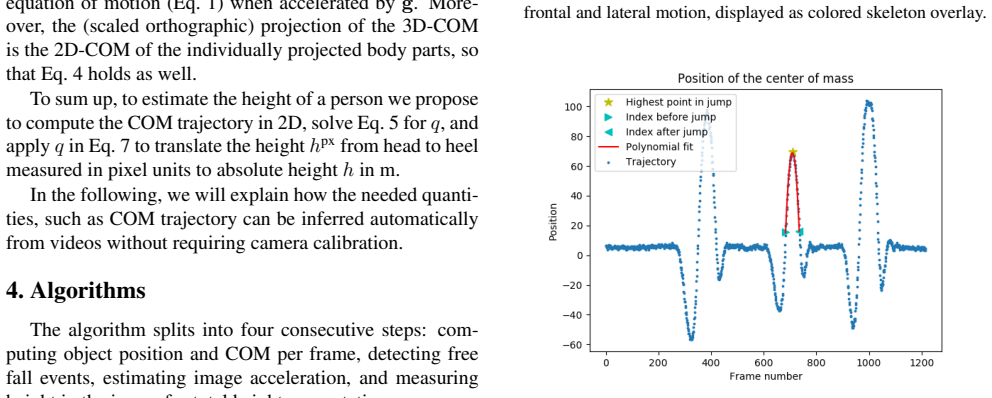
- Because $q$ is measured per jump, taking the median over several jumps reduces the effect of occasional pose-detection failures and improves accuracy.
Reading between the lines
- The same ratio-symmetric identity would apply to any scene containing a moving object whose only external acceleration is known (e.g., a dropped tool), not just to human jumpers.
- A practical self-check suggested by this reasoning: if the person moves toward or away from the camera between the jump and the standing measurement, the estimate degrades; errors of 12.3–18.9 cm in the running experiments indicate that distance consistency can serve as a quality control metric.
- One could extend the method to temporally varying scale by estimating $q$ continuously during the jump and rescaling each frame's height, rather than transferring a single $q$ to standing frames, which would avoid the distance-consistency assumption.
- For applications like person re-identification, the unbiased, per-person height estimate could serve as a geometric fingerprint complementary to appearance cues.
Signed reviews
Editorial analysis
A structured set of objections, weighed in public.
Referee Report
Summary. The paper proposes to estimate a person's metric height from monocular video by using the gravitational acceleration g as an absolute reference. Under a scaled-orthographic projection model, the pixel acceleration measured during a free-fall phase yields a conversion factor q = g / a_px, which is then applied to the pixel height of a standing person to recover metric height h = c * h_px * q. The method is validated on a falling tennis ball and on a new dataset of 12 subjects performing on-spot jumps, lateral runs, and lateral jumps at two distances, reporting a median MAE of 3.9 cm on on-spot jumps. The paper also demonstrates the use of the height estimate to rescale a monocular 3D pose estimator and makes code and data available.
Significance. The core idea is elegant and the derivation (Eqs. 1-7) is clean and internally consistent under scaled orthographic projection. A notable strength is that the scale factor q requires no camera intrinsics, extrinsics, ground-plane knowledge, or any reference object in the scene, making it a genuinely complementary cue to appearance-based or geometry-based height estimation. The appendix simulation, the ablation study, and the public release of the ArticulatedFreeFall dataset are valuable contributions. If the boundary conditions of the method are stated precisely and the headline claims are qualified, the paper would offer a useful new tool for forensic, surveillance, and monocular reconstruction applications.
major comments (2)
- [Section 3.1, Eq. (7), and Section 4.4] The derivation assumes a single constant scale q = d/f, but the algorithm estimates q from the free-fall segment and applies it to h_px measured 'at the first frames of the video' (Section 4.4). This is valid only if the person's distance to the camera is identical at the two times. The paper never states this constant-depth precondition; the limitation section names the static-camera assumption but not the depth-constancy requirement. The appendix simulation (Table 4) shows the magnitude of the resulting failure: for a jump straight toward the camera at d = 4 m, the error is 21 cm even in a noise-free simulation. This is a load-bearing boundary condition on the central claim, and it should be stated explicitly. The authors should either restrict the claim to on-spot/fronto-parallel motions or add an experiment in which the subject changes depth between the standing measurement and the jump, demonstrating the expected degradation.
- [Abstract and Section 5.2 (Tables 1 and 2)] The abstract and Section 5.2 state 'reaching a MAE of up to 3.9 cm on jumping motions.' According to Table 1, this number is the median over four on-spot jumps per subject. Table 2 shows that per-jump MAE is substantially higher: for example, low jumps have MAE of 13.1 cm at 4 m and 20.7 cm at 7 m, and even the best single-jump category remains above 5 cm. The headline therefore overstates the accuracy available from a single jump, which is the realistic operating condition for many applications. The abstract should be reworded to say 'a median over four on-spot jumps per subject yields 3.9 cm MAE,' and the per-jump variability should be highlighted more prominently in the discussion.
minor comments (6)
- [Section 1] There is a typo in 'demonstrates the success our our method'; 'our our' should be 'of our'.
- [Section 5.2] The sentence 'The naive Baseline-population-mean, predicting the population mean height of 168.9 m' should read '168.9 cm'.
- [Sections 5.2 and 8] Table references are inconsistent: the accuracy and ablation results are discussed as 'Table 4', but the relevant tables in the main text are Tables 1 and 3; the appendix also contains a Table 4, which is confusing.
- [Section 3.1] The word 'dominante' should be 'dominates'.
- [Section 8] The sentence 'the COM estimation generally decreases with the dirstance' contains a typo: 'dirstance' should be 'distance'.
- [Figure 7 caption] The caption line 'Distance d in [m] 400' appears malformed; the axis label and numeric tick should be formatted as a normal axis.
Circularity Check
No significant circularity: q is estimated directly from measured pixel acceleration and known g; the target height is never used to fit q, and the only self-citation is a non-load-bearing baseline comparison.
full rationale
The derivation is self-contained. The scale factor q is obtained by equating the quadratic coefficients of the projected Newton trajectory and the observed pixel parabola (Eqs. 2-5): q = g / a_px, where a_px is measured by a least-squares quadratic fit to the COM trajectory during free fall (Section 4.3). The height is then h = h_px q (Eq. 7), with h_px measured from AlphaPose keypoints in standing frames. The ground-truth person height never enters the estimation of q, a_px, or h_px at test time, so there is no fitted-input-called-prediction and no self-definitional reduction. The only fitted component, the nose-to-ankle correction c = 1.17 ± 0.03, is calibrated on 29 independent web images, not on the test subjects, and the paper reports its small SD. The self-cited work Gün el et al. [13] is used solely as an external baseline in Tables 1 and 4, not as an input to the derivation, so the self-citation is not load-bearing. The lateral-motion errors in Table 3 and the appendix's depth/perspective simulation concern an unstated precondition about constant person-camera depth, which is a boundary condition on validity rather than a circularity: the derivation would still be non-circular even in the regimes where its assumptions fail. Thus no step reduces, by construction or by self-citation, to the target quantity being estimated.
Assumptions & free parameters
free parameters (3)
- c (nose-ankle to full-height correction) =
1.17 ± 0.03
- flight-phase selection threshold =
15% of jump peak above floor for on-spot jumps; upper half of peak-to-minimum range for lateral motion
- floor-median window =
first 100 frames
assumptions (8)
- standard math Newton's equation of motion, p(t) = 1/2 g t^2 + v0 t + p0, describes the center-of-mass trajectory during free fall.
- domain assumption The gravitational acceleration is constant and known, g = 9.81 m/s^2.
- domain assumption The camera is static during the recorded video.
- domain assumption Scaled orthographic projection is an adequate model for the tested capture conditions.
- domain assumption During the selected flight-phase frames, gravity is the only external force (air friction is negligible).
- domain assumption The weighted sum of AlphaPose 2D keypoints, using Clauser et al. body-mass ratios, approximates the projected center of mass of the person.
- domain assumption The person is at the same distance from the camera when the standing height is measured as during the jump used to estimate q.
- domain assumption The nose-to-ankle pixel distance, scaled by c = 1.17, is a valid proxy for total body height across the test population.
Cite this review
Pith. "Pith review of Gravity as a Reference for Estimating a Person's Height from Video." pith.science (2026). https://pith.science/paper/4QUP3NF6
@misc{pith2026190902211,
  author       = {Pith},
  title        = {Pith review of: Gravity as a Reference for Estimating a Person's Height from Video},
  year         = {2026},
  howpublished = {\url{https://pith.science/paper/4QUP3NF6}},
  note         = {Machine review of arXiv:1909.02211}
}
read the original abstract
Estimating the metric height of a person from monocular imagery without additional assumptions is ill-posed. Existing solutions either require manual calibration of ground plane and camera geometry, special cameras, or reference objects of known size. We focus on motion cues and exploit gravity on earth as an omnipresent reference 'object' to translate acceleration, and subsequently height, measured in image-pixels to values in meters. We require videos of motion as input, where gravity is the only external force. This limitation is different to those of existing solutions that recover a person's height and, therefore, our method opens up new application fields. We show theoretically and empirically that a simple motion trajectory analysis suffices to translate from pixel measurements to the person's metric height, reaching a MAE of up to 3.9 cm on jumping motions, and that this works without camera and ground plane calibration.
Figures


Figures from the paper (6 more)



Reference graph
Works this paper leans on
-
[13]
What Face and Body Shapes Can Tell About Height
S. G ¨unel, H. Rhodin, and P. Fua. What Face and Body Shapes Can Tell About Height. In arXiv preprint arXiv:1805.10355, 2018
work page Pith review arXiv 2018
-
[1]
D. Adjeroh, D. Cao, M. Piccirilli, and A. Ross. Predictability and Correlation in Human Metrology. In IEEE International Workshop on Information Forensics and Security, 2010
work page 2010
-
[2]
A. Agarwala, K.C. Zheng, C. Pal, M. Agrawala, M. Cohen, B. Curless, D. Salesin, and R. Szeliski. Panoramic video tex- tures. In ACM Transactions on Graphics, volume 24, pages 821–827. ACM, 2005
work page 2005
-
[3]
C. BenAbdelkader and Y . Yacoob. Statistical Body Height Estimation from a Single Image. In Automated Face and Gesture Recognition, pages 1–7, 2008
work page 2008
-
[4]
C.E. Clauser, J.T. McConville, and J.W. Young. Weight, V ol- ume, and Center of Mass Segments of the Human Body. Journal of Occupational and Environmental Medicine , 13(5):270, 1971
work page 1971
-
[5]
A. Criminisi, I. Reid, and A. Zisserman. Single view metrol- ogy. International Journal of Computer Vision , 40(2):123– 148, 2000
work page 2000
-
[6]
Show me your face and i will tell you your height, weight and body mass index
Antitza Dantcheva, Francois Bremond, and Piotr Bilinski. Show me your face and i will tell you your height, weight and body mass index. pages 3555–3560, 08 2018
work page 2018
-
[7]
R. Dey, M. Nangia, W. Ross, W. Keith, and Y . Liu. Esti- mating Heights from Photo Collections: A Data-Driven Ap- proach. In ACM conference on Online social network, 2014
work page 2014
Show all 31 references
-
[8]
H.-S. Fang, S. Xie, Y .-W. Tai, and C. Lu. RMPE: Regional multi-person pose estimation. In ICCV, 2017
2017
-
[9]
M.A Fischler and R.C. Bolles. Random Sample Consen- sus: A Paradigm for Model Fitting with Applications to Im- age Analysis and Automated Cartography. Communications ACM, 24(6):381–395, 1981
1981
-
[10]
Georgiev, , Z
T. Georgiev, , Z. Yu, A. Lumsdaine, and S. Goma. Lytro Camera Technology: Theory, Algorithms, Performance Analysis. In Multimedia Content and Mobile Devices, 2013
2013
-
[11]
Gordon, T
C.C. Gordon, T. Churchil land C.E. Clauser, B. Bradtmiller, and J.T. McConville. Anthropometric Survey of US Army Personnel: Methods and Summary Statistics 1988. Technical report, Anthropology Research Project Inc Yellow Springs OH, 1989
1988
-
[12]
Y . Guan. Unsupervised Human Height Estimation from a Single Image. Journal of Biomedical Science and Engineer- ing, 2009
2009
-
[14]
Hartley and A
R. Hartley and A. Zisserman. Multiple View Geometry in Computer Vision. Cambridge University Press, 2000
2000
-
[15]
Kato and A
K. Kato and A. Higashiyama. Estimation of Height for Per- sons in Pictures. In Perception & psychophysics, 1998
1998
-
[16]
T. Kim, Y . Seo, and K.-S. Hong. Physics-based 3d position analysis of a soccer ball from monocular image sequences. In International Conference on Computer Vision, pages 721–
-
[17]
Kumar, P.S
A. Kumar, P.S. Chavan, V .K. Sharatchandra, S. David, P. Kelly, and N.E. O’Connor. 3d estimation and visualization of motion in a multicamera network for sports. In Irish Ma- chine Vision and Image Processing Conference , pages 15–
-
[18]
Li, V .H
S. Li, V .H. Nguyen, M. Ma, C. Jin, T.D. Do, and H. Kim. A Simplified Nonlinear Regression Method for Human Height Estimation in Video Surveillance. In EURASIP Journal on Image and Video Processing, 2011
2011
-
[19]
S. Liu, L. Yuan, P. Tan, and J. Sun. Steadyflow: Spatially smooth optical flow for video stabilization. In Conference on Computer Vision and Pattern Recognition , pages 4209– 4216, 2014
2014
-
[20]
Ljungberg and J
J. Ljungberg and J. S ¨onnerstam. Estimation of Human Height from Surveillance Camera Footage -A Reliability Study. Master’s thesis, KTH, 2008
2008
-
[21]
G. Mather. Image Blur as a Pictorial Depth Cue. In Proc. R. Soc. Lond. B, 1996
1996
-
[22]
The Mathematical Principles of Natural Phi- losophy
Isaac Newton. The Mathematical Principles of Natural Phi- losophy. 1729
-
[23]
Y . Ohno, J. Miura, and Y . Shirai. Tracking Players and Es- timation of the 3D Position of a Ball in Soccer Games. In International Conference on Pattern Recognition, 2000
2000
-
[24]
Ribnick, S
E. Ribnick, S. Atev, and N.P. Papanikolopoulos. Estimat- ing 3d positions and velocities of projectiles from monocular views. IEEE Transactions on Pattern Analysis and Machine Intelligence, 31(5):938–944, 2009
2009
-
[25]
Rogez, P
G. Rogez, P. Weinzaepfel, and C. Schmid. Lcr-Net++: Multi-Person 2D and 3D Pose Detection in Natural Images. In arXiv preprint arXiv:1803.00455, 2018
2018 arXiv
-
[26]
Schonberger and J.-M
J.L. Schonberger and J.-M. Frahm. Structure-from-motion revisited. In Conference on Computer Vision and Pattern Recognition, pages 4104–4113, 2016
2016
-
[27]
J. Shi, X. Tao, L. Xu, and J. Jia. Break ames room illu- sion: depth from general single images. ACM Transactions on Graphics, 34(6):225, 2015
2015
-
[28]
T.Y . Shiang. A Statistical Approach to Data Analysis and 3D Geometric Description of the Human Head and Face. InPro- ceedings of the National Science Council, Republic of China. Part B, Life sciences, 1999
1999
-
[29]
J. Sk ¨old. Estimating 3d-trajectories from monocular video sequences, 2015
2015
-
[30]
J. Vester. Estimating the Height of an Unknown Object in a 2D Image. Master’s thesis, KTH, 2012
2012
-
[31]
X. Zhou, P. Jiang, X. Zhang, B. Zhang, and F. Wang. The Measurement of Human Height Based on Coordinate Trans- formation. In ICIC. 2016
2016
Reviewed August 14, 2026 · model on record in the stance chip above.
Discussion (0). Continue with ORCID to comment.