REVIEW 3 major objections 5 minor 76 references
Coherent Ising Machines: The Good, The Bad, The Ugly
T0 review · 3 major / 5 minor · reviewed 2026-08-06 · deepseek-v4-flash
Pith's one-line read Coherent Ising machines are best understood as fast classical analog integrators of overdamped Langevin dynamics, with a real speed advantage only when all digital conversion is removed.
desk verdict A serious reframing of CIMs as analog Langevin integrators with solid qualitative evidence; treat the quantitative hardware claims as estimates until measured. read the letter →
The pith
A machine-rendered reading of the paper's core claim, the machinery that carries it, and where it could break.
The reading
What carries the argument
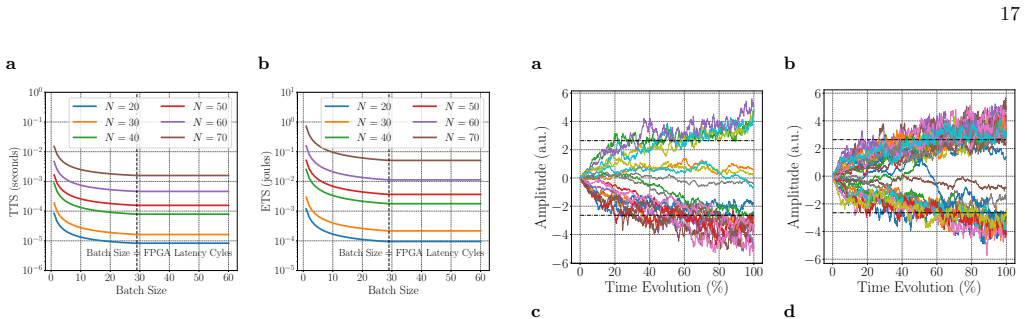
The central machinery is the pair of SDE models: Eq. (1) for the DL-CIM, derived in a positive-P/truncated-Wigner picture under the high-finesse-cavity limit, and Eq. (2) for the MF-CIM, derived under the assumption that DOPO pulses maintain a Gaussian distribution throughout the evolution. Both are Langevin equations of the form dx = b(x,t)dt - ∇f(x)dt + σ(x,t)dW, and the comparison baseline is overdamped Langevin dynamics (Eq. (5)), whose convergence to the Gibbs state is well studied. The pump parameter p and measurement strength j set the drift and diffusion balance; ablating the nonlinear crystal leaves a linear MF-CIM whose surviving noise is the second derivative of a Wiener process, which isolates the role of the crystal's nonlinearity in creating useful stochastic exploration. The benchmarking machinery consists of time-to-solution and energy-to-solution estimates built from FPGA latencies, optical pulse rates, and component power models, including the power consumed by DACs, ADCs, transceivers, and optical modulators.
What would settle it
Run the same BoxQP instances of size 70 on a physical DL-CIM and on an FPGA implementation of overdamped Langevin dynamics with the serial matrix-vector unit described in the paper: if the DL-CIM's time-to-solution is not about two orders of magnitude below the FPGA's, the paper's central quantitative claim fails. Independently, direct homodyne measurement of DOPO pulse statistics in the MF-CIM's operating regime that shows clearly non-Gaussian distributions would invalidate the model in Eq. (2) on which the OLD-equivalence argument rests.
Extended reading notes
Core claim
The paper establishes that both DL-CIM and MF-CIM dynamics are Langevin-type SDEs of the general form dx = b(x,t)dt - ∇f(x)dt + σ(x,t)dW, and that both behave like approximate, slightly biased integrators of overdamped Langevin dynamics when solving binary or continuous optimization problems. It finds no evidence of a fundamental computational advantage over OLD: the fully optical DL-CIM achieves an estimated speed advantage of about two orders of magnitude in time-to-solution over both an FPGA-based OLD and the MF-CIM, but only because it avoids digital-to-analog and analog-to-digital conversion, while the MF-CIM actually consumes more energy than an FPGA OLD because of its DAC, ADC, and transceiver circuitry. The paper also shows that a continuous-variable readout of CIM pulse amplitudes natively solves box-constrained quadratic programs without binary discretization, and that the pump rate can be scheduled to trade exploration against exploitation depending on the convexity of the landscape.
Load-bearing premise
The paper's conclusions rest on assuming that the optical pulses in the measurement-feedback machine keep a bell-shaped (Gaussian) amplitude distribution and that the fully optical cavity is lossy enough that the equations used match the real devices; if non-Gaussian statistics, saturation, or quantum correlations materially change the dynamics, the equivalence to overdamped Langevin dynamics and all performance and energy conclusions apply to the model rather than to the machines.
Editorial extensions
If this is right
- If the paper's picture is correct, present CIM hardware should be evaluated against well-tuned overdamped Langevin dynamics on the same hardware, not against quantum annealers or simulated annealing, when assessing speed and energy claims.
- CIMs operated below saturation threshold can natively solve continuous-variable optimization problems such as BoxQP without binary discretization or problem reformulation, which avoids the cost of large Ising encodings.
- The fully optical DL-CIM's estimated two-orders-of-magnitude time-to-solution advantage over FPGA OLD and MF-CIM comes from eliminating digital conversion; hybrid optical-digital designs cannot beat digital OLD and may consume more energy.
- Adjusting the pump schedule p0 gives a practical control knob for trading exploration against exploitation: negative pump values help hill-climb on concave landscapes whose solutions lie at box boundaries, while positive pump values encourage fast descent on convex landscapes.
- Fully optical CIMs, if equipped with reliable nonlinear optical elements, could serve as high-speed, low-energy integrators of stochastic differential equations in settings beyond quadratic optimization, such as generative inference and random number generation.
Reading between the lines
- Beyond the paper: the OLD-equivalence suggests CIMs could be adapted for sampling from Gibbs-type distributions by tuning drift and diffusion to satisfy detailed balance, a direction the paper mentions only as a broader application of SDE integration.
- Beyond the paper: the two-orders-of-magnitude TTS claim is based on estimated latencies for a DL-CIM; a direct experimental head-to-head with an optimized digital OLD at large problem sizes would sharpen or qualify that number.
- Beyond the paper: the pump-scheduling insight (exploration versus exploitation based on landscape convexity) could be transferred back to digital OLD solvers, which would create a stronger classical baseline and potentially reduce the apparent optical advantage.
- Beyond the paper: the argument implies that progress in fully analog nonlinear activation and constraint-enforcing optical components is the critical bottleneck for unlocking the technology's stated speed and energy benefits, more so than improving quantum coherence or squeezing.
Editorial analysis
A structured set of objections, weighed in public.
Referee Report
Summary. This paper presents a semi-classical analysis of coherent Ising machines (CIMs), arguing that both delay-line (DL-CIM) and measurement-feedback (MF-CIM) architectures are best understood as analog devices that approximately integrate overdamped Langevin dynamics (OLD), rather than as quantum optimizers that exploit superposition or entanglement. The authors introduce SDE models for both architectures (Eqs. 1 and 2), show that an MF-CIM without its nonlinear crystal (LMF-CIM) still exhibits stochastic dynamics driven by white noise and its derivative (Appendix A, treated via generalized stochastic processes), and compare CIM solvers against OLD and classical heuristics on 50 generated BoxQP instances up to N=70 using success-probability correlations and fitted TTS scaling. They further estimate time-to-solution (TTS) and energy-to-solution (ETS) for FPGA-based OLD, MF-CIM, and DL-CIM hardware, concluding that fully optical DL-CIMs achieve about two orders of magnitude faster TTS than serial FPGA-based solvers, that hybrid MF-CIMs consume more energy than digital-only FPGAs because of DAC/ADC/transceiver overhead, and that no fundamental algorithmic advantage over OLD is evident.
Significance. The paper makes three contributions that are valuable if the claims hold. First, the LMF-CIM analysis in Appendix A is a genuine analytic result: removing the optical nonlinearity from a measurement-feedback CIM does not remove its stochasticity, and the resulting derivative-of-white-noise term is handled rigorously in the framework of generalized stochastic processes. Second, the benchmark study is unusually careful: solver parameters are tabulated (Table I), iteration counts are tuned per problem size (Appendix F), and TTS/ETS results are reported as medians with IQR bands over 50 instances per size. Third, the ETS power breakdown in Section V gives concrete, falsifiable numbers to a debate on hybrid optical-digital bottlenecks that is usually conducted qualitatively. The paper also releases an open-source simulator, and its central predictions (high correlation between CIM and OLD success probabilities; the energy penalty of digital conversion in MF-CIM) are directly testable.
major comments (3)
- [Section VI; Eqs. (1)-(2), Section II] The central claim that CIMs present no fundamental computation advantage over OLD is established only at the level of the SDE models of Eqs. (1) and (2), and those models are not validated against physical CIM behavior. Equation (2) is derived under the explicit ansatz that the DOPO pulses maintain a Gaussian distribution throughout the evolution [22,29], and Eq. (1) is restricted to the high-finesse cavity limit; the manuscript does not test either assumption against measured dynamics or TTS data from existing machines (e.g., refs. [21,26]), nor does it bound the effect of non-Gaussianity or finite-finesse corrections on escape rates and stationary measures. The numerical experiments therefore establish equivalence between OLD and the authors' CIM simulators, not between OLD and the physical machines. I recommend either validating the SDE models against experiment or explicitly restricting the no-advantage claim to the model class, with the hardware conclusions softened accordingly.
- [Section IV and Section VI; Appendix C3, Fig. 10] The 'about two orders of magnitude' DL-CIM TTS advantage reported in Section IV (Fig. 6c) is computed against a serial FPGA baseline and a serial MF-CIM implementation. Appendix C3 and Fig. 10 show that a parallel FPGA design for OLD and for MF-CIM brings TTS and ETS into a range comparable with the DL-CIM, a point the body acknowledges ('comparable to the DL-CIM scheme'). Section VI nevertheless restates the two-orders claim without this caveat, and the abstract conveys the same impression. The claim should be qualified as holding against serial digital and hybrid baselines, with the parallel-baseline result presented in the same statement.
- [Section IV] The statement that DL-CIM is 'not statistically superior' to FPGA-based OLD is supported only by overlapping ranges of fitted exponential TTS slopes (DL-CIM 0.029-0.042, OLD 0.029-0.049). These ranges are taken across the four optimality-gap targets, not across instances: no confidence intervals on the fitted slopes are reported, and no paired test on the TTS distributions (50 instances per size) is performed. Since the asymptotic-equivalence claim is one of the paper's headline conclusions, I recommend reporting slope confidence intervals or a formal comparison (e.g., paired bootstrap over instances) for at least one gap target.
minor comments (5)
- [Figs. 7 and 10] The legends label the optical solvers 'MF-CCVM' and 'DL-CCVM'; these should be 'MF-CIM' and 'DL-CIM' for consistency with the text.
- [Author affiliations] The first affiliation reads 'Irrevresible Inc.', which appears to be a typo for 'Irreversible Inc.'.
- [Reference [40]] Reference [40], which supplies the continuous-variable readout framework that this paper builds on, is cited as a 2022 arXiv preprint; if a peer-reviewed version exists, it should be cited instead or as well.
- [Section I] The introduction promises a demonstration of 'on par asymptotic effectiveness' of the CIM and OLD dynamics, but the evidence covers N up to 70 with 50 instances and no formal asymptotic analysis; a phrase such as 'scaling for the studied problem sizes' would be more accurate.
- [Section V and Fig. 9] The MF-CIM power estimate is dominated by the DAC/ADC/transceiver term (10.45 W of 15.69 W), which is taken from device-family specifications; since this term drives the conclusion that MF-CIM is less energy-efficient than FPGA-only OLD, a brief statement of how robust that conclusion is to errors in this estimate would strengthen the presentation.
Circularity Check
No significant circularity: the OLD-equivalence and benchmarking claims are supported by independent numerical comparisons; the same-group citation [40] supplies the CV framework but is not load-bearing for the main conclusion.
full rationale
The paper's central claim—that CIMs are approximate integrators of overdamped Langevin dynamics and have no fundamental computation advantage over OLD—is derived from the explicit SDE models of Eqs. (1), (2), (5), and (6) and then tested by independent numerical experiments. The correlation studies in Section III compare MF-CIM, LMF-CIM, OLD, gradient descent, simulated annealing, and steepest descent on 50 generated BoxQP instances; the TTS scaling comparisons in Section IV and Appendix C compare OLD on FPGA, MF-CIM, and DL-CIM using documented hardware parameters. No fitted CIM parameter is reused as a predicted success rate or TTS value, so the 'prediction' is not statistically forced by a fit. The self-citation to [40] supplies the continuous-variable readout framework and BoxQP encoding (Appendix B), but the main 'no fundamental advantage' conclusion does not reduce to that citation: it rests on this paper's own open-source simulation results and slope comparisons. The claims about the two-orders-of-magnitude DL-CIM speed advantage are qualified by the parallel-FPGA results in Fig. 10 and Appendix C.3, and the Gaussian and high-finesse assumptions in Eqs. (1) and (2) are modeling limitations that affect external validity rather than circular reductions. Overall, no step in the derivation chain is equivalent to its inputs by construction; the only burden is a minor, non-load-bearing self-citation to the same group's earlier CV-CIM work.
Assumptions & free parameters
free parameters (10)
- saturation parameter s =
DL-CIM: 1.2*sqrt(p0-1); MF-CIM: 20.0 (Table I)
- pump field p0 =
p0=8.0 (DL-CIM), 0.0 (MF-CIM), varied -2 to 2 in Fig. 5
- iteration count niter =
500-1500 (OLD), 10^3-10^4 (DL-CIM), 300-4000 (MF-CIM)
- measurement strength parameters (j0, alpha) =
j0=5, alpha=3 (Table I)
- injected noise parameters (r0, beta) =
r0=10, beta=3 (Table I)
- gradient strength lambda =
1.0 (OLD), 50+t/Tmax*100 (DL-CIM), 4000 (MF-CIM)
- nonlinearity coefficients g and As =
g=0.001 (MF-CIM), As=10 (DL-CIM)
- DL-CIM power model terms =
Popt=1.2 mW, Pmod=10 mW, Psq=180 mW, POPA=222.2 mW
- FPGA and MF-CIM power and latency values =
FPGA 300 MHz; serial latencies 1.37-16.43 us for N=20-70; MF-CIM DAC/ADC power around 10.4 W
- instance generation parameters (c0, phi_max) =
c0 in {-50,...,50}, phi_max = pi/2 or 0.1 pi
assumptions (5)
- domain assumption High-finesse positive-P SDE (Eq. 1) is a faithful model of DL-CIM pulse amplitudes.
- domain assumption Gaussian-distribution ansatz for MF-CIM pulses (Eq. 2) is valid throughout evolution.
- standard math Generalized stochastic process calculus (testing against compactly supported smooth functions) makes W-double-dot well-defined.
- standard math Langevin dynamics converges to Gibbs or low-energy states for OLD.
- domain assumption Estimated hardware component values and benchmark instances represent realistic devices and problems.
Cite this review
Pith. "Pith review of Coherent Ising Machines: The Good, The Bad, The Ugly." pith.science (2026). https://pith.science/paper/4RJRRW6T
@misc{pith2026250714489,
  author       = {Pith},
  title        = {Pith review of: Coherent Ising Machines: The Good, The Bad, The Ugly},
  year         = {2026},
  howpublished = {\url{https://pith.science/paper/4RJRRW6T}},
  note         = {Machine review of arXiv:2507.14489}
}
read the original abstract
Analog computing using bosonic computational states is a leading approach to surpassing the computational speed and energy limitations of von Neumann architectures. But the challenges of manufacturing large-scale photonic integrated circuits (PIC) has led to hybrid solutions that integrate optical analog and electronic digital components. A notable example is the coherent Ising machine (CIM), that was primarily invented for solving quadratic binary optimization problems. In this paper, we focus on a mean-field interpretation of the dynamics of optical pulses in the CIM as solutions to Langevin dynamics, a stochastic differential equation (SDE) that plays a key role in non-convex optimization and generative AI. This interpretation establishes a computational framework for understanding the system's operation, the computational role of each component, and its performance, strengths, and limitations. We then infer that the CIM is inherently a continuous state machine, capable of integrating a broad range of SDEs, in particular for solving a continuous global (or mildly constrained) optimization problems. Nevertheless, we observe that the iterative digital-to-analog and analog-to-digital conversions within the protocol create a bottleneck for the low power and high speed of optics to shine. This observation underscores the need for major advances in PIC technologies as we envision that fully analog opto-electronic realizations of such experiments can open doors for broader applications, and orders of magnitude improvements in speed and energy consumption.
Figures


Figures from the paper (11 more)




Reference graph
Works this paper leans on
-
[40]
for solving continuous variable problems using the CIM. We introduce the box-constrained quadratic prob- lems (BoxQP) problem, our approach for implementing and solving them using CIMs, and a new method for generating random BoxQP instances
-
[1]
Box-constrained quadratic programming (BoxQP) problems The BoxQP problem can be formulated as follows: maximize f (x) = 1 2 NX i,j=1 Qijxixj + NX i=1 Vixi, subject to ℓi ≤ xi ≤ ui ∀i ∈ {1, . . . , N}, (B1) where Q ∈ RN ×N is a symmetric matrix, V ∈ RN is a real N -dimensional vector, and the lower and upper bounds ℓi ∈ R and ui ∈ R specify the box constra...
-
[2]
Mapping BoxQP problems on the CIM CIMs can be operated below the saturation threshold to solve CV optimization problems. In this case, the amplitude and phase of the pulses represent the value and the sign of the variables of the problem. By prop- erly pumping the optical pulses, the CV variables of the BoxQP problem are encoded into the analog pulse ampl...
-
[3]
Randomly generated BoxQP instances We have tested the performance of the various solvers introduced in this paper on randomly generated BoxQP problem instances. As opposed to the older meth- ods [40, 57], our new approach provides us control over the hardness of the problem instances and the number of fractional values in the corresponding optimal solutio...
-
[4]
8 shows the effectiveness of the noise when solving the randomly generated instances
Significance of CIM’s noise injection Fig. 8 shows the effectiveness of the noise when solving the randomly generated instances. We have compared the performance of the DL-CIM method (solid lines) against a simple Euler gradient descent method (with no noise) with constraint enforcement at each step. For the 0 .1% gap (blue curves), the Euler gradient des...
-
[5]
Z. Wang, A. Marandi, K. Wen, R. L. Byer, and Y. Ya- mamoto, Coherent Ising machine based on degenerate optical parametric oscillators, Phys. Rev. A 88, 063853 (2013)
work page 2013
-
[6]
Time-to-solution calculations Here, we provide more details for estimating the TTS of the optical devices with the dynamics introduced in Section II. TTS is a useful metric for comparing the performance of different hardware when solving a given optimization problem [ 40]. Table I shows the parameters of the solvers used for generating the results in Figs...
-
[7]
Energy consumption estimates In this section, we present our approach for estimating the ETS for three solvers implemented on five different hardware: OLD implemented on FPGA, CPU, and GPU; DL-CIM; and MF-CIM. ETS is a metric that quanti- fies the energy consumption of a given hardware device in implementing a specified solver for a given BoxQP instance. ...
Show all 76 references
-
[8]
compute unit
F urther benchmarking analysis In this section, DL-CIM and MF-CIM are treated as solvers that can be implemented on both standard dig- ital and analog optical devices. Fig. 10 shows further benchmarking comparison of the estimated physical TTS for the optics-based implementati...
-
[9]
Mohseni, P
N. Mohseni, P. L. McMahon, and T. Byrnes, Ising ma- chines as hardware solvers of combinatorial optimization problems, Nature Reviews Physics 4, 363 (2022)
2022
-
[10]
Stroev and N
N. Stroev and N. Berloff, Analog photonics computing for information processing, inference, and optimization, Advances in Quantum Technologies 6, 2300055 (2023)
2023
-
[11]
B. J. Shastri, A. N. Tait, T. Ferreira de Lima, W. H. P. Pernice, H. Bhaskaran, C. D. Wright, and P. R. Pruc- nal, Photonics for artificial intelligence and neuromorphic computing, Nature Photonics 15, 102 (2021)
2021
-
[12]
Inagaki, K
T. Inagaki, K. Inaba, Y. Yamada, T. Honjo, T. Ikuta, Y. Yonezu, T. Kazama, K. Enbutsu, T. Umeki, R. Kasa- hara, et al., Information processing with large-scale net- work of optical oscillators, inAI and Optical Data Sciences VI (SPIE, 2025) p. PC133751E
2025
-
[13]
Apolloni, C
B. Apolloni, C. Carvalho, and D. de Falco, Quantum stochastic optimization, Stochastic Processes and their Applications 33, 233 (1989)
1989
-
[14]
Yamamoto, K
Y. Yamamoto, K. Aihara, T. Leleu, K.-i. Kawarabayashi, S. Kako, M. Fejer, K. Inoue, and H. Takesue, Coherent Ising machines—optical neural networks operating at the quantum limit, npj Quantum Information 3, 49 (2017)
2017
-
[15]
Hamerly, L
R. Hamerly, L. Bernstein, A. Sludds, M. Soljaˇ ci´ c, and D. Englund, Large-scale optical neural networks based on photoelectric multiplication, Phys. Rev. X 9, 021032 (2019)
2019
-
[16]
X. Xiao, M. B. On, T. Van Vaerenbergh, D. Liang, R. G. Beausoleil, and S. J. B. Yoo, Large-scale and energy-efficient tensorized optical neural networks on III–V-on-silicon MOSCAP platform, APL Photonics 6, 126107 (2021), https://pubs.aip.org/aip/app/article- pdf/doi/10.1063/5...
2021 doi
-
[17]
Kalinin and N
K. Kalinin and N. Berloff, Networks of non-equilibrium condensates for global optimization, New Journal of Physics 20, 113023 (2018)
2018
-
[18]
Kirkpatric, Optimization by simulated annealing, Sci- ence 220, 671 (1983)
S. Kirkpatric, Optimization by simulated annealing, Sci- ence 220, 671 (1983)
1983
-
[19]
D. S. Johnson, C. R. Aragon, L. A. McGeoch, and C. Schevon, Optimization by simulated annealing: An experimental evaluation; part I, graph partitioning, Oper- ations Research 37, 865 (1989)
1989
-
[20]
de Falco, B
D. de Falco, B. Apolloni, and N. Cesa-Bianchi, A numeri- cal implementation of quantum annealing (1988)
1988
-
[21]
Hamerly, T
R. Hamerly, T. Inagaki, P. L. McMahon, D. Venturelli, A. Marandi, T. Onodera, E. Ng, C. Langrock, K. Inaba, T. Honjo, et al., Experimental investigation of perfor- mance differences between coherent Ising machines and a quantum annealer, Science Advances 5, eaau0823 (2019)
2019
-
[22]
Kadowaki and H
T. Kadowaki and H. Nishimori, Quantum annealing in the transverse Ising model, Phys. Rev. E 58, 5355 (1998)
1998
-
[23]
Brooke, D
J. Brooke, D. Bitko, G. Aeppli, et al., Quantum annealing of a disordered magnet, Science 284, 779 (1999)
1999
-
[24]
Benlic, E
U. Benlic, E. K. Burke, and J. R. Woodward, Breakout lo- cal search for the multi-objective gate allocation problem, Computers & Operations Research 78, 80 (2017)
2017
-
[25]
V. K. Prajapati, M. Jain, and L. Chouhan, Tabu search algorithm (TSA): A comprehensive survey, in 2020 3rd International Conference on Emerging Technologies in Computer Engineering: Machine Learning and Internet of Things (ICETCE)(IEEE, 2020) pp. 1–8
2020
-
[26]
H. G. Katzgraber, F. Hamze, Z. Zhu, A. J. Ochoa, and H. Munoz-Bauza, Seeking quantum speedup through spin glasses: The good, the bad, and the ugly, Physical Review X 5, 031026 (2015)
2015
-
[27]
Aramon, G
M. Aramon, G. Rosenberg, E. Valiante, T. Miyazawa, H. Tamura, and H. G. Katzgraber, Physics-inspired op- timization for quadratic unconstrained problems using a digital annealer, Frontiers in Physics 7, 48 (2019)
2019
-
[28]
Takemoto, M
T. Takemoto, M. Hayashi, C. Yoshimura, and M. Ya- maoka, 2.6 A 2 × 30k-spin Multichip Scalable Annealing Processor based on a Processing-In-Memory Approach for Solving Large-Scale Combinatorial Optimization Prob- lems, in 2019 IEEE International Solid-State Circuits Conference...
2019
-
[29]
S. Kako, T. Leleu, Y. Inui, F. Khoyratee, S. Reifenstein, and Y. Yamamoto, Coherent ising machines with error correction feedback, Advanced Quantum Technologies 3, 2000045 (2020)
2020
-
[30]
Leleu, Y
T. Leleu, Y. Yamamoto, P. L. McMahon, and K. Aihara, Destabilization of local minima in analog spin systems by correction of amplitude heterogeneity, Physical Review Letters 122, 040607 (2019)
2019
-
[31]
Leleu, F
T. Leleu, F. Khoyratee, T. Levi, R. Hamerly, T. Kohno, and K. Aihara, Scaling advantage of chaotic amplitude control for high-performance combinatorial optimization, Communications Physics 4, 266 (2021)
2021
-
[32]
Reifenstein, S
S. Reifenstein, S. Kako, F. Khoyratee, T. Leleu, and Y. Yamamoto, Coherent Ising Machines with optical Error Correction Circuits, Adv. Quantum Technol. 4, 2100077 (2021)
2021
-
[33]
Sankar, A
K. Sankar, A. Scherer, S. Kako, S. Reifenstein, N. Gha- dermarzy, W. B. Krayenhoff, Y. Inui, E. Ng, T. Onodera, P. Ronagh, et al., Benchmark study of quantum algo- rithms for combinatorial optimization: unitary versus dissipative, arXiv:2105.03528 (2021)
2021 arXiv
-
[34]
Honjo, T
T. Honjo, T. Sonobe, K. Inaba, T. Inagaki, T. Ikuta, Y. Yamada, T. Kazama, K. Enbutsu, T. Umeki, R. Kasahara, K. ichi Kawarabayashi, and H. Takesue, 100,000-spin coherent ising ma- chine, Science Advances 7, eabh0952 (2021), https://www.science.org/doi/pdf/10.1126/sciadv.abh0952
2021 doi
-
[35]
Takata, A
K. Takata, A. Marandi, and Y. Yamamoto, Quantum correlation in degenerate optical parametric oscillators with mutual injections, Phys. Rev. A 92, 043821 (2015)
2015
-
[36]
Maruo, S
D. Maruo, S. Utsunomiya, and Y. Yamamoto, Truncated Wigner theory of coherent Ising machines based on de- generate optical parametric oscillator network, Physica Scripta 91, 083010 (2016)
2016
-
[37]
Kurchan, Fluctuation theorem for stochastic dynamics, Journal of Physics A: Mathematical and General 31, 3719 (1998)
J. Kurchan, Fluctuation theorem for stochastic dynamics, Journal of Physics A: Mathematical and General 31, 3719 (1998)
1998
-
[38]
P. L. McMahon, A. Marandi, Y. Haribara, R. Hamerly, C. Langrock, S. Tamate, T. Inagaki, H. Takesue, S. Utsunomiya, K. Aihara, R. L. Byer, M. M. Fejer, H. Mabuchi, and Y. Yamamoto, A fully programmable 100-spin coherent Ising machine with all-to-all connections, Science 354, 61...
2016 doi
-
[39]
Yamamoto, T
Y. Yamamoto, T. Leleu, S. Ganguli, and H. Mabuchi, Coherent Ising machines—quantum optics and neural network perspectives, Applied Physics Letters117, 160501 20 (2020), https://doi.org/10.1063/5.0016140
2020 doi
-
[41]
Kiesewetter and P
S. Kiesewetter and P. D. Drummond, Coherent ising ma- chine with quantum feedback: The total and conditional master equation methods, Phys. Rev. A 106, 022409 (2022)
2022
-
[42]
Lax, Quantum noise
M. Lax, Quantum noise. iv. quantum theory of noise sources, Physical Review 145, 110 (1966)
1966
-
[43]
Lax and W
M. Lax and W. Louisell, Quantum noise. xii. density- operator treatment of field and population fluctuations, Physical Review 185, 568 (1969)
1969
-
[44]
Chiang, C.-R
T.-S. Chiang, C.-R. Hwang, and S. J. Sheu, Dif- fusion for global optimization in Rn, SIAM Jour- nal on Control and Optimization 25, 737 (1987), https://doi.org/10.1137/0325042
1987 doi
-
[45]
P. Xu, J. Chen, D. Zou, and Q. Gu, Global convergence of Langevin dynamics based algorithms for nonconvex optimization, arXiv:1707.06618 (2017)
2017 arXiv
-
[46]
Dal Cengio, D
S. Dal Cengio, D. Levis, and I. Pagonabarraga, Fluctuation–dissipation relations in the absence of de- tailed balance: formalism and applications to active mat- ter, Journal of Statistical Mechanics: Theory and Experi- ment 2021, 043201 (2021)
2021
-
[47]
Ritort, Fluctuation theorems, brownian motors and thermodynamics of small systems, in Statistical and Non- linear Physics (Springer, 2022) pp
F. Ritort, Fluctuation theorems, brownian motors and thermodynamics of small systems, in Statistical and Non- linear Physics (Springer, 2022) pp. 477–494
2022
-
[48]
Khosravi, U
F. Khosravi, U. Yildiz, A. Scherer, and P. Ronagh, Non- convex quadratic programming using coherent optical networks, arXiv preprint arXiv:2209.04415 (2022)
2022 arXiv
-
[49]
E. Ng, T. Onodera, S. Kako, P. L. McMahon, H. Mabuchi, and Y. Yamamoto, Efficient sampling of ground and low- energy ising spin configurations with a coherent ising machine, Phys. Rev. Res. 4, 013009 (2022)
2022
-
[50]
Marandi, Z
A. Marandi, Z. Wang, K. Takata, R. L. Byer, and Y. Ya- mamoto, Network of time-multiplexed optical parametric oscillators as a coherent ising machine, Nature Photonics 8, 937 (2014)
2014
-
[51]
Yanagimoto, T
R. Yanagimoto, T. Onodera, E. Ng, L. G. Wright, P. L. McMahon, and H. Mabuchi, Engineering a Kerr-based deterministic cubic phase gate via Gaussian operations, Physical Review Letters 124, 240503 (2020)
2020
-
[52]
Shoji, K
T. Shoji, K. Aihara, and Y. Yamamoto, Quantum model for coherent Ising machines: Stochastic differential equa- tions with replicator dynamics, Phys. Rev. A 96, 053833 (2017)
2017
-
[53]
G. O. Roberts and R. L. Tweedie, Exponential conver- gence of Langevin distributions and their discrete approx- imations, Bernoulli (1996)
1996
-
[54]
Raginsky, A
M. Raginsky, A. Rakhlin, and M. Telgarsky, Non-convex learning via stochastic gradient Langevin dynamics: A nonasymptotic analysis, in Conference on Learning The- ory (PMLR, 2017) pp. 1674–1703
2017
-
[55]
Hida and T
T. Hida and T. Hida, Brownian motion (Springer, 1980)
1980
-
[56]
P. L. D. Angelis, P. M. Pardalos, and G. Toraldo, Quadratic programming with box constraints, in Develop- ments in global optimization(Springer, 1997) pp. 73–93
1997
-
[57]
K. G. Murty and S. N. Kabadi, Some NP-complete prob- lems in quadratic and nonlinear programming, Tech. Rep. (1985)
1985
-
[58]
Burer and D
S. Burer and D. Vandenbussche, Globally solving box-constrained nonconvex quadratic programs with semidefinite-based finite branch-and-bound, Computa- tional Optimization and Applications 43, 181 (2009)
2009
-
[59]
Bonami, O
P. Bonami, O. G¨ unl¨ uk, and J. Linderoth, Globally solving nonconvex quadratic programming problems with box constraints via integer programming methods, Mathemat- ical Programming Computation 10, 333 (2018)
2018
-
[60]
de Vries and B
S. de Vries and B. Perscheid, Tight compact extended relaxations for nonconvex quadratic programming prob- lems with box constraints, Journal of Global Optimization (2022)
2022
-
[61]
Fliege and B
J. Fliege and B. F. Svaiter, Steepest descent methods for multicriteria optimization, Mathematical Methods of Operations Research 51, 479 (2000)
2000
-
[62]
AMD Virtex, AMD Virtex UltraScale+ FPGA (2024)
2024
-
[63]
Z.-Y. Zhou, C. Gneiting, J. Q. You, and F. Nori, Gener- ating and detecting entangled cat states in dissipatively coupled degenerate optical parametric oscillators, Phys. Rev. A 104, 013715 (2021)
2021
-
[64]
I. M. Gel’fand and N. Y. Vilenkin, Generalized functions: Applications of harmonic analysis, Vol. 4 (Academic press, 2014)
2014
-
[65]
Vandenbussche and G
D. Vandenbussche and G. L. Nemhauser, A branch-and- cut algorithm for nonconvex quadratic programs with box constraints, Mathematical Programming 102, 559 (2005)
2005
-
[66]
Gurobi Optimization, LLC, Gurobi Optimizer Reference Manual (2022)
2022
-
[67]
Texas Instruments, High-Speed ADCs (2024)
2024
-
[68]
Nvidia, Nvidia t4 (2023)
2023
-
[69]
Wikipedia, Apple m1 (2020)
2020
-
[70]
M. Xu, Y. Zhu, F. Pittal` a, J. Tang, M. He, W. C. Ng, J. Wang, Z. Ruan, X. Tang, M. Kuschnerov, L. Liu, S. Yu, B. Zheng, and X. Cai, Dual-polarization thin-film lithium niobate in-phase quadrature modulators for terabit-per- second transmission, Optica 9, 61 (2022)
2022
-
[71]
S. Shi, Y. Wang, W. Yang, Y. Zheng, and K. Peng, Detec- tion and perfect fitting of 13.2 dB squeezed vacuum states by considering green-light-induced infrared absorption, Opt. Lett. 43, 5411 (2018)
2018
-
[72]
APE, Avus optical parametric amplifier (2019)
2019
-
[73]
Park and S
J. Park and S. Boyd, General heuristics for noncon- vex quadratically constrained quadratic programming, arXiv:1703.07870 (2017)
2017 arXiv
-
[74]
Z. Xu, B. Tang, X. Zhang, J. F. Leong, J. Pan, S. Hooda, E. Zamburg, and A. V.-Y. Thean, Reconfigurable non- linear photonic activation function for photonic neural network based on non-volatile opto-resistive ram switch, Light: Science & Applications 11, 288 (2022)
2022
-
[75]
Mourgias-Alexandris, A
G. Mourgias-Alexandris, A. Tsakyridis, N. Passalis, A. Tefas, K. Vyrsokinos, and N. Pleros, An all-optical neuron with sigmoid activation function, Opt. Express 27, 9620 (2019)
2019
-
[76]
G. H. Li, R. Sekine, R. Nehra, R. M. Gray, L. Ledezma, Q. Guo, and A. Marandi, All-optical ultrafast relu func- tion for energy-efficient nanophotonic deep learning, Nanophotonics 12, 847 (2023)
2023
Reviewed August 6, 2026 · model on record in the stance chip above.
Discussion (0). Sign in to comment.