REVIEW 3 major objections 5 minor 32 references
An agentic team of step experts can run the full HPC cloud lifecycle—build, deploy, optimize, and scale—producing linear scaling patterns human experts accept.
Reviewed by Pith at T0; open to challenge. T0 means a machine referee read the full paper against a public rubric. the ladder, T0–T4 →
T0 review · grok-4.5
2026-07-12 06:03 UTC pith:4SOPDVS6
load-bearing objection Working multi-agent prototype that actually runs the full HPC cloud lifecycle for four apps, with concrete FOMs and expert-checked scaling, but still gated by humans and unreleased plans. the 3 major comments →
Agentic Orchestration of HPC Applications in Cloud
The pith
A machine-rendered reading of the paper's core claim, the machinery that carries it, and where it could break.
Core claim
A manager-orchestrated graph of step agents—build, deploy, optimize, scale, plus debug and result-parser helpers—can autonomously deliver container creation, multi-platform build, Kubernetes deployment, instance selection across 21 types, and a full strong-scaling study for four well-known HPC applications, producing linear scaling patterns that human experts accept as correct.
What carries the argument
The agentic graph: a shared context object that carries container URIs, manifests, metrics, and error summaries between narrowly scoped step agents, with each agent returning only structured decisions (RETRY/STOP) or validated configuration files and a manager that restarts or advances on return codes and human-approved regexes.
Load-bearing premise
That carefully scoped prompts, attempt limits, and occasional human validation of log parsers and dependency versions are enough for the LLM to converge on correct Dockerfiles, manifests, and stop decisions without catastrophic drift.
What would settle it
Run the same agentic plan on a fifth application whose build or scaling behavior is outside the training distribution; if the agents cannot produce a working multi-platform image and a linear strong-scaling curve that experts accept within the stated attempt budgets, the claim fails.
Editorial analysis
A structured set of objections, weighed in public.
Referee Report
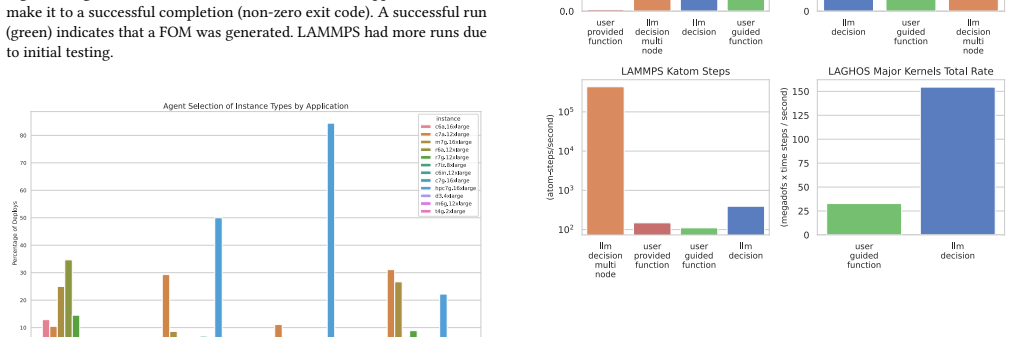
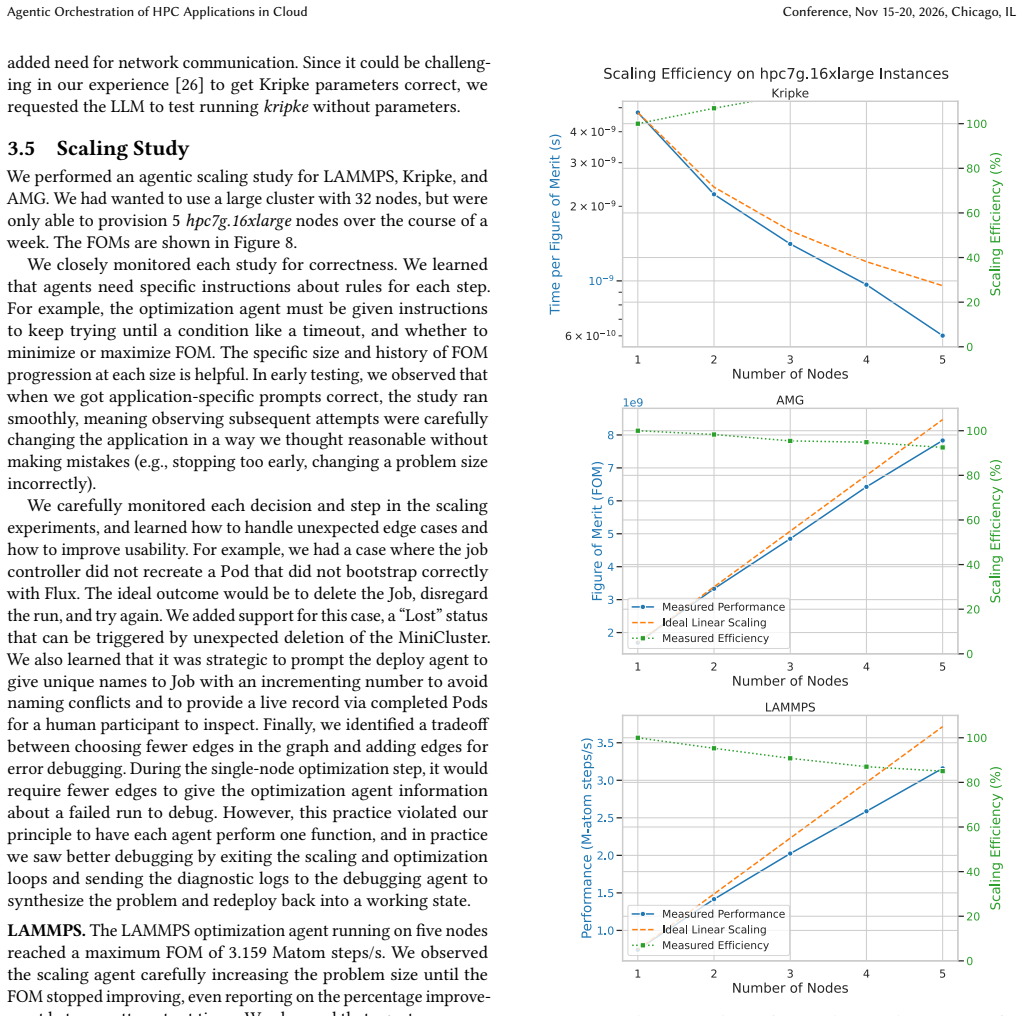
Summary. The paper presents a prototype agentic system (manager + step agents for build/deploy/optimize/scale + helper agents for debug/result-parsing) that uses Gemini to execute the full experimental lifecycle of HPC applications in Kubernetes on AWS: multi-platform container builds, Job/MiniCluster deployment, instance selection and FOM optimization across 21 instance types, and strong-scaling studies. Experiments cover LAMMPS, AMG2013, Kripke, Laghos (and OSU for multi-node), reporting best FOMs (Table 2), instance histograms (Fig. 5), token patterns (Fig. 3), scaling curves (Fig. 8), and human-expert review of design choices (Table 3). The authors claim successful linear scaling patterns approved by experts, reduced time-to-completion designs, and best practices for agentic collaboration.
Significance. If the architecture and results hold under reduced human gating, this is a useful early systems contribution to agentic orchestration for scientific computing. Concrete strengths include measured FOMs and scaling curves for real proxy apps, explicit comparison of three optimization strategies (LLM decision vs. user-function variants), documentation of failure modes (OOM, timeouts, temporal pinning of dependency versions), and practical lessons on prompt emphasis, self-healing via debug agents, and controlled interfaces. The work is timely given national initiatives (FG-HPCC, Genesis) and the gap between commercial agent frameworks and institutional constraints. Reproducible artifacts and clearer autonomy metrics would raise impact further.
major comments (3)
- Sections 2.2–2.3 and 3.3–3.5: The central claim of an agentic team delivering the “entire life-cycle” rests on Gemini converging under scoped prompts and max-attempt limits. Yet the manuscript documents load-bearing human interventions that are not quantified: Laghos builds required explicit human-supplied version/flag expertise after N=10 failures; every FOM regex required human yes/no/feedback validation before caching; AMG problem-size and OpenMP-thread advice was injected after observation; scaling was limited to 5 nodes rather than the planned 32. Without a clear metric of autonomy (e.g., fraction of decisions made without human edit, or ablation removing the gates), it is impossible to attribute success to the agentic graph versus iterative human prompt engineering and domain knowledge.
- Section 3.5 and Figure 8: The scaling study is presented as evidence of “successful linear scaling with patterns approved by human experts.” Only five hpc7g.16xlarge nodes could be provisioned; the planned N=32 never occurred. While the observed efficiency curves (including super-linear cache effects for Kripke) are interesting, the limited scale and the fact that problem size was pinned after a human-validated single-node optimization weaken the claim that the scaling agent autonomously orchestrated a full study. A stronger experiment or explicit discussion of the gap is needed.
- Reproducibility of the architectural claim: The manager, step agents, helper agents, plan YAML schema, exact prompts, and controlled interfaces are described at a high level (Section 2) but neither code nor the concrete plan files used for the reported runs are released. Given that “stuck sequences,” premature STOP decisions, and temporal pinning of dependency versions are acknowledged in the Discussion, independent verification of the FOMs in Table 2 and the design choices in Table 3 is currently impossible. Release of the prototype and the exact plans used would make the contribution falsifiable.
minor comments (5)
- Abstract and Section 1 claim “four well-known HPC applications” while Methods (2.1) and multi-node experiments include five (adding OSU). Align the counts.
- Table 1 lists 21 instance types; Figure 5 caption and text occasionally refer to hpc7g.12xlarge (non-existent). Correct the typo.
- Figure 3 caption says “LAMMPS (green)” while the body text attributes the highest token counts to Laghos (green). Resolve the color/label inconsistency.
- Section 2.3: “user guided function” vs. “user-guided function” and “llm decision” capitalization are inconsistent; standardize terminology.
- Discussion notes that multi-stage Docker builds made the build agent’s task harder, yet Table 3 scores “Monolithic layers” as good practice. Clarify the recommendation.
Circularity Check
No significant circularity: experimental systems evaluation whose FOMs, scaling curves, and instance choices are external measurements, not tautological reductions of inputs.
full rationale
The paper is an empirical systems prototype and evaluation, not a derivation of a first-principles result. Its strongest claims (successful multi-platform builds, Kubernetes deploys, optimization across 21 instance types, and linear scaling patterns for LAMMPS/AMG/Kripke/Laghos/OSU) are judged by external application metrics (atom-steps/s, nnz/s, grind time, megadofs/s) that the agents do not define or fit by construction. Human-expert approval of patterns and occasional human gates (regex validation, Laghos version flags, problem-size advice) are acknowledged limitations of autonomy, not circular definitions. Self-citations ([25] Flux Operator MiniCluster CRD, [26] prior cloud-HPC usability) supply infrastructure and application baselines; they do not supply uniqueness theorems, fitted parameters renamed as predictions, or load-bearing premises that force the reported FOMs or stop/retry decisions. No equations equate outputs to inputs; no ansatz is smuggled via self-citation; no known empirical pattern is merely renamed. The work is therefore self-contained against external benchmarks, warranting only a minimal score for ordinary self-reference that is not load-bearing.
Axiom & Free-Parameter Ledger
free parameters (4)
- max_attempts_per_step
- pod_timeout_seconds
- instance_cost_cap
- initial_problem_size_advice
axioms (4)
- domain assumption Gemini API responses plus conversational memory are sufficient to generate correct Dockerfiles, Kubernetes YAML, and optimization JSON when given structured MUST/MUST-NOT prompts and filtered error logs.
- domain assumption Controlled subprocess interfaces (docker buildx, kubectl apply, log scraping) plus return-code checks constitute a safe and complete environment for agent action.
- ad hoc to paper Human validation of a single regular expression for FOM extraction is an acceptable and non-circular gate for subsequent autonomous optimization.
- standard math Standard Kubernetes Job/MiniCluster semantics and AWS EFA networking behave as documented.
invented entities (2)
-
step-agent / helper-agent / manager graph
no independent evidence
-
optimization agent returning RETRY/STOP + JSON manifest patch
no independent evidence
read the original abstract
Large Language Models (LLMs) are serving as a catalyst of change for research practices, touching the daily lives of staff scientists, software engineers, and system administrators. The developments promise new degrees of autonomy, where categories of human work and decision making are replaced by autonomous, goal-oriented systems. This transition necessitates novel architectural paradigms and solid understanding of the strengths and limitations of LLMs. In this work, we design agents to intelligently deliver the entire life-cycle of an HPC application experimental run in cloud -- creation and build of a container, deployment in Kubernetes, optimization, and orchestration of a scaling study. We pursue this task for four well-known HPC applications to build multi-platform images and optimize across 21 instance types in Kubernetes. We demonstrate successful linear scaling with patterns approved by human experts, designs that improve work time to completion, and review suggested best practices for agentic design and collaboration.
Figures



Reference graph
Works this paper leans on
-
[1]
Ahn, Ned Bass, Albert Chu, Jim Garlick, Mark Grondona, Stephen Herbein, Helgi I
Dong H. Ahn, Ned Bass, Albert Chu, Jim Garlick, Mark Grondona, Stephen Herbein, Helgi I. Ingólfsson, Joseph Koning, Tapasya Patki, Thomas R.W. Scogland, Becky Springmeyer, and Michela Taufer. 2020. Flux: Overcoming scheduling challenges for exascale workflows.Future Generation Computer Systems110 (2020), 202–213. doi:10.1016/j.future.2020.04.006
-
[2]
Amazon Web Services. 2022. The Elastic Fabric Adapter (EFA). https://docs.aws. amazon.com/AWSEC2/latest/UserGuide/efa.html Accessed: 2024-12-12
2022
-
[3]
Anthropic. 2024. Introducing the Model Context Protocol. https://www.anthropic. com/news/model-context-protocol. Accessed: 2025-8-31
2024
-
[4]
Zain Asgar. [n. d.]. Efficient and Scalable Agentic AI with Heterogeneous Systems. https://arxiv.org/html/2507.19635v1. doi:10.48550/arXiv.2507.19635 Accessed: 2025-8-31
-
[5]
Y Combinator. 2025. Andrej Karpathy: Software Is Changing (Again)
2025
-
[6]
Kubernetes Community. 2019. Metric-server cpu and memory units - General Discussions. https://discuss.kubernetes.io/t/metric-server-cpu-and-memory- units/7497. Accessed: 2025-9-1
2019
-
[7]
DAIR.AI. 2025. LLM Agents. https://www.promptingguide.ai/research/llm- agents. Accessed: 2025-9-1
2025
-
[8]
Aseem Datar. 2025. Transforming R&D with agentic AI: Introducing Mi- crosoft Discovery. https://azure.microsoft.com/en-us/blog/transforming-rd- with-agentic-ai-introducing-microsoft-discovery/. Accessed: 2025-8-31
2025
-
[9]
Wensheng Gan, Zhenyao Ning, Zhenlian Qi, and Philip S Yu. 2025. Mixture of experts (MoE): A big data perspective.arXiv [cs.LG](Jan. 2025)
2025
-
[10]
Gil and K
D. Gil and K. A. Moler. 2025. Accelerating science with AI.Science390 (2025),
2025
-
[11]
doi:10.1126/science.aee0605
-
[12]
Google. 2025. Agent Development Kit. https://google.github.io/adk-docs. Ac- cessed: 2025-9-1
2025
-
[13]
Mourad Gridach, Jay Nanavati, Khaldoun Zine El Abidine, Lenon Mendes, and Christina Mack. 2025. Agentic ai for scientific discovery: A survey of progress, challenges, and future directions.arXiv preprint arXiv:2503.08979(2025)
Pith/arXiv arXiv 2025
-
[14]
Honeypot. 2022. Kubernetes: The Documentary [PART 1]
2022
-
[15]
Google Inc. 2025. Understand and count tokens. https://ai.google.dev/gemini- api/docs/tokens. Accessed: 2025-11-7
2025
-
[16]
2023.Integrating Artificial Intelligence into Sci- ence Gateways
Biggs Jr and Brandon Samuel. 2023.Integrating Artificial Intelligence into Sci- ence Gateways. Technical Report INL/CON-23-72098-Rev000. Idaho National Laboratory (INL), Idaho Falls, ID (United States)
2023
-
[17]
Martin Laun and Fabian Wolff. 2025. Chatbots in education: hype or help? A meta-analysis.Learning and Individual Differences119 (2025), 102646
2025
-
[18]
2025.Future Generation High Perfor- mance Computing Center (FG-HPCC) Request for Information (RFI) No
Lawrence Livermore National Security, LLC. 2025.Future Generation High Perfor- mance Computing Center (FG-HPCC) Request for Information (RFI) No. HPC-007. Technical Report HPC-007. Lawrence Livermore National Laboratory (LLNL), Livermore, CA. https://hpc.llnl.gov/fg-hpcc-rfi Attachment (1) RFI Technical Considerations
2025
-
[19]
Peter Martin. 2025. Context Drift: Why AI Loses Coherence Over Time and How to Fix It. https://www.linkedin.com/pulse/context-drift-why-ai-loses-coherence- over-time-how-fix-martin--zlfuf/. Accessed: 2025-9-10
2025
-
[20]
Microsoft. 2025. Azure AI Foundry. https://azure.microsoft.com/en-us/products/ ai-foundry. Accessed: 2025-9-1
2025
-
[21]
Felix Mölder, Kim Philipp Jablonski, Brice Letcher, Michael B Hall, Christopher H Tomkins-Tinch, Vanessa Sochat, Jan Forster, Soohyun Lee, Sven O Twardziok, Alexander Kanitz, Andreas Wilm, Manuel Holtgrewe, Sven Rahmann, Sven Nahnsen, and Johannes Köster. 2021. Sustainable data analysis with Snakemake. F1000Res.10 (Jan. 2021), 33. doi:10.12688/f1000resear...
-
[22]
Pavan Nutalapati. 2022. Self-Healing Cloud Systems: Designing Resilient and Autonomous Cloud Services.International Journal of Science and Research11, 8 (2022), 1173–1187
2022
-
[23]
OpenAI. 2025. API Reference - OpenAI API. https://platform.openai.com/docs/ api-reference/introduction. Accessed: 2025-8-31
2025
-
[24]
Panda Pranoy, Raghav Magazine, Devaguptapu Chaitanya, Takemori Sho, and Sharma Vishal. 2025. Adaptive LLM Routing under Budget Constraints.arXiv [cs.LG](Aug. 2025)
2025
-
[25]
D Salomone and Aishwarya Prabhat. 2025. Build KYC agentic workflows with Google’s ADK. https://cloud.google.com/blog/products/ai-machine-learning/ build-kyc-agentic-workflows-with-googles-adk. Accessed: 2025-8-31
2025
-
[26]
Vanessa Sochat, Aldo Culquicondor, Antonio Ojea, and Daniel Milroy. 2024. The Flux Operator.F1000Res.13, 203 (March 2024), 203
2024
-
[27]
Vanessa Sochat, Daniel Milroy, Abhik Sarkar, Aniruddha Marathe, and Tapasya Patki. 2025. Usability Evaluation of Cloud for HPC Applications. InProceedings of the SC ’25 Workshops of the International Conference for High Performance Computing, Networking, Storage and Analysis (SC Workshops ’25). Association for Computing Machinery, New York, NY, USA, 135–1...
doi:10.1145/3731599 2025
-
[28]
Renan et al Souza. [n. d.]. PROV-AGENT: Unified Provenance for Tracking AI Agent Interactions in Agentic Workflows. https://arxiv.org/html/2508.02866v2. Accessed: 2025-9-1
Pith/arXiv arXiv 2025
-
[29]
Qiqi Wang, Hongjie Zhang, Cheng Qu, Yu Shen, Xiaohui Liu, and Jing Li. 2021. RLSchert: An HPC job scheduler using deep reinforcement learning and remain- ing time prediction.Appl. Sci. (Basel)11, 20 (Oct. 2021), 9448
2021
-
[30]
Qiuhong Wei, Zhengxiong Yao, Ying Cui, Bo Wei, Zhezhen Jin, and Ximing Xu
-
[31]
Evaluation of ChatGPT-generated medical responses: a systematic review and meta-analysis.Journal of biomedical informatics151 (2024), 104620
2024
-
[32]
Adar Weidman. 2025. Regular expression Denial of Service - Re- DoS. https://owasp.org/www-community/attacks/Regular_expression_Denial_ of_Service_-_ReDoS. Accessed: 2025-9-1
2025
discussion (0)
Sign in with ORCID, Apple, or X to comment. Anyone can read and Pith papers without signing in.