REVIEW 3 major objections 6 minor 50 references
Approximate universality and large measurement gain of Rabi model in a linear potential under strong Doppler broadening
T0 review · 3 major / 6 minor · reviewed 2026-08-06 · deepseek-v4-flash
Pith's one-line read Even under strong Doppler broadening, the phase-rotation measurement keeps an almost optimal rotation angle and delivers substantial sensitivity gain.
desk verdict Solid analytical core for the Rabi model in a linear potential, but the approximate-universality claim under strong Doppler broadening is not yet supported by the numerics as presented. read the letter →
The pith
A machine-rendered reading of the paper's core claim, the machinery that carries it, and where it could break.
The reading
What carries the argument
The central object is the phase-rotation operation (PRO): a two-step unitary, $\hat U_s$ followed by a displaced harmonic phase rotation $\hat U_{ho}(\theta)=\hat D(z_0)e^{-i\theta(\hat p^2/2m + m\omega^2\hat z^2/2)}\hat D^\dagger(z_0)$, which rotates the atomic momentum and position before detection. The mathematical engine is the SU(2) Lie-group factorization of the evolution operator, which reduces the unitary dynamics to a scalar Riccati equation for the pulse parameter $f_+(t)$; at chirping resonance the equation yields the closed-form unitary $\tilde U_2$ built from operators $\hat A,\hat B,\hat C$ that depend on $\hat\Delta=\sqrt{\hat B_0^2+\Omega^2}$. The PRO converts the ideal-case CFI into an expression proportional to $2n+1$, making the optimal angle $\theta_{\max}$ independent of $n$; in the Doppler regime the same proportionality is shown numerically to hold approximately.
What would settle it
Recompute the optimal PRO angle and the ratio $\max(F_{C,p}^{\mathrm{Doppler,HO}})/F_Q^{\mathrm{Doppler}}$ for $n>30$, for pulse areas such as $\Omega t=\pi/2$ or $\Omega t=\pi$, and for a thermal Boltzmann mixture of eigenstates; if the optimal angle shifts by more than the numerical scatter seen in the paper or the CFI/QFI ratio drops far below the near-ideal plateau, the claimed approximate universality does not generalize.
Extended reading notes
Core claim
The discovery is that the phase-rotation operation, introduced to make joint momentum–population measurements saturate the quantum Cramér–Rao bound in the ideal zero-Doppler setting, keeps its approximate universality under strong Doppler broadening. The Doppler effect appears through the momentum-dependent detuning operator $\hat B_0 = k_0\hat p/m + \delta_0$, and the strong regime is defined by $k_0\Delta p/m \ge |\Omega|$. For harmonic-oscillator inputs with $0\le n\le 30$ at $\Omega t = 2.5\pi$, the authors compute that the optimal rotation angle $\theta_{\max}$ oscillates around a mean value that is independent of $n$, and that $\max(F_{C,p}^{\mathrm{Doppler,HO}})/F_Q^{\mathrm{Doppler}}$ remains roughly constant while exceeding the no-PRO ratio by several times. The approximate universality is traced to the QFI and CFI maintaining scaling behaviors with $n$ similar to those in the ideal case.
Load-bearing premise
The numerical evidence covers only harmonic-oscillator eigenstates with $0\le n\le 30$, one pulse area $\Omega t=2.5\pi$, detuning $\hbar\delta_0=-E_0/2$, and Rabi frequency $\Omega=10E_0$, and the paper assumes without proof that the same approximate universality holds for all $n$, other times, and thermal mixtures.
Editorial extensions
If this is right
- Atom gravimeters can use input states with large momentum width while keeping the phase-rotation measurement near optimal.
- A single optimized PRO angle can serve a thermal ensemble of harmonic-oscillator eigenstates, because the optimal angle barely depends on $n$.
- The PRO scheme delivers several-fold classical Fisher information gain over joint momentum–population measurement without PRO, even when $k_0\Delta p/m \ge |\Omega|$.
- The closed-form unitary from the Riccati equation supports design of chirped, composite, or shaped pulses for broad-momentum matter-wave states.
- The same unitary framework extends to multi-pulse sequences such as the $\pi/2$–$\pi$–$\pi/2$ sequence used in standard atom gravimeters.
Reading between the lines
- Editorial inference: the numerical demonstration is confined to one pulse area, $\Omega t = 2.5\pi$; if the near-constancy of $\theta_{\max}$ also holds at $\pi/2$ and $\pi$ pulse areas, the claim would directly cover the pulses used in real gravimeter sequences.
- Editorial inference: in the ideal case the universality follows from identical $2n+1$ scaling of CFI and QFI; an analytic proof of a similar scaling in the Doppler regime would replace the numerical scan with a theorem.
- Editorial inference: the paper predicts a testable plateau—in a thermal gas, a PRO angle optimized at one temperature should remain near-optimal at nearby temperatures, and the measurement gain over no-PRO should persist as the temperature changes.
Editorial analysis
A structured set of objections, weighed in public.
Referee Report
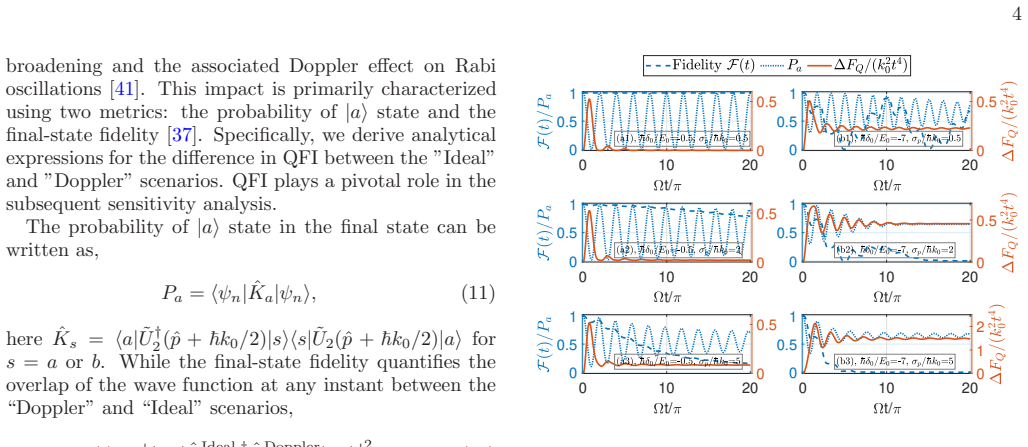
Summary. The paper studies the quantum dynamics of a two-level atom coupled to light in a linear potential, with emphasis on the Doppler effect arising from large momentum broadening of the external atomic state. Using SU(2) Lie-group techniques, the authors derive a scalar Riccati equation for the unitary evolution and obtain an analytic form of the propagator in the chirped-detuning regime. They analyze Rabi oscillations, fidelity, and the quantum Fisher information difference between the ideal and Doppler regimes. In the measurement part, they compute classical Fisher information for joint momentum-population measurements with and without a phase-rotation operation (PRO), in both the ideal and strong-Doppler regimes. The central claim is that under strong Doppler broadening the PRO protocol retains 'approximate universality' — the optimal rotation angle is nearly n-independent — and still provides substantial metrological gain relative to no PRO. The paper concludes with implications for Kasevich-Chu atom gravimeters and thermal atomic ensembles.
Significance. If the central claim holds, the paper would provide a useful robustness result for phase-rotation-based measurement optimization in atom gravimeters operating with broad momentum distributions, and it would extend the ideal-regime analysis of Ref. [21] into a regime that is usually treated only semiclassically. The analytical treatment of the unitary dynamics via a scalar Riccati equation is a valuable contribution, and the ideal-regime Fisher information formulas are checked symbolically and numerically. The paper also makes a falsifiable quantitative prediction: the CFI-to-QFI ratio for the optimized PRO measurement is approximately independent of n up to n=30 for the parameter values studied. However, as detailed below, the evidence presented does not yet directly support the approximate-universality claim, because the numerical figures display per-n optimized quantities rather than the behavior of a single fixed measurement angle.
major comments (3)
- [Section IV B, Figs. 3 and 4] The central claim of approximate universality under strong Doppler broadening is not directly tested by the quantities plotted. Fig. 3 shows max_theta F_C^{Doppler,HO}/F_Q^{Doppler} as a function of n, i.e., each n is evaluated at its own individually optimal angle theta_max^{Doppler}(n). A flat ratio across n only shows that every n admits some good angle; it does not show that a single angle works for all n. The text states that theta_max^{Doppler} 'oscillates around the mean value as n varies' but gives no measure of the spread, no standard deviation, and no plot of theta_max^{Doppler}(n). Since the final paragraph of Section IV B extrapolates to 'thermal atomic gases across the entire Doppler broadening spectrum,' where a mixture of n values must be addressed with one fixed PRO angle, the manuscript should quantify theta_max^{Doppler}(n) and show, for example, the CFI at a fixed angle chosen once for all n, or the CFI averaged over a thermal distribution of n. Without this, the approximate-universality claim is not established; the numerical evidence is consistent with a weaker claim of per-n tunability only.
- [Section IV B, Eqs. (20) and (21)] The Doppler-regime CFI formulas are asserted without derivation. Equation (20) introduces K_s(p) as 'the eigenvalue in the momentum basis of \hat K_s' and combines it with P_n(p) in a form that resembles Fisher information for a probability distribution K_s(p)P_n(p), but the derivation of this expression from the measurement model and the derivative with respect to the parameter g is not shown. Equation (21) similarly involves L_{1,s}(p) and L_{2,s}(p) and a double numerical integration, but the steps leading to it are omitted. Because the numerical results of Section IV B, which are the main support for the central claim, depend entirely on these formulas, a derivation or a clear reference for them must be provided. The statement that F_C^{Doppler} 'approaches F_C^{Ideal} by neglecting the term of K_s(p)' also needs a precise justification.
- [Section IV B and Conclusion] The numerical parameter coverage is too narrow to support the conclusion as stated. The simulations use a single pulse area Omega t = 2.5 pi, a single detuning hbar delta_0 = -E_0/2, a single Rabi frequency Omega = 10 E_0, and initial harmonic-oscillator eigenstates with 0 <= n <= 30. The final paragraph of Section IV B extrapolates to thermal atomic gases 'across the entire Doppler broadening spectrum,' and the Conclusion repeats that approximate universality and substantial gain are 'largely preserved' under strong Doppler broadening. No argument is given that these conclusions hold for other pulse areas, other detunings, or for superpositions or thermal mixtures of n. At minimum, the manuscript should either restrict the claims to the scanned parameter range or provide additional scans over t and delta_0, and an explicit treatment of a thermal mixture.
minor comments (6)
- [Section IV B title] The section heading contains a typo: 'Dpppler Scenario' should read 'Doppler Scenario.'
- [Section II, Eq. (7)] The notation for the operators \hat A, \hat B, \hat C is introduced but it would help to state explicitly that they are functions of \hat p and t, and that \hat\Delta is an operator; the current notation may be confusing for readers.
- [Section IV A, after Eq. (18)] The text says the analytical result in the second line of Eq. (18) was verified symbolically for 0 <= n <= 2 and numerically for 3 <= n <= 30, yet earlier it is stated 'for arbitrary n.' A comment explaining that the n-independence of the optimal angle is proven in the ideal case by the scaling argument would strengthen the presentation.
- [References [39] and [41]] References [39] and [41] appear to be duplicate entries for the same work by Gea-Banacloche, Wu, and Xiao; one should be removed or the citations should point to distinct works.
- [Section III, text near Fig. 2] The phrase 'this constant is likely to be determined by a combination of quantum fluctuations and \delta_0' is vague; if the asymptotic value is computed, state the result determinately, or remove the probabilistic wording.
- [Abstract] The abstract says 'Rabi model' while the paper treats the Rabi model in a linear potential; consider using the full phrase to avoid ambiguity with the usual quantum-optics Rabi model.
Circularity Check
No circularity: the Doppler-universality claim is a numerical consequence of derived Fisher-information expressions, not a fitted or self-cited input.
full rationale
The paper's derivation chain is self-contained. The unitary evolution is constructed from the Hamiltonian via SU(2) Lie-group factorization; the Riccati equation (4) is a direct mathematical consequence of that factorization, and the analytic form of U2(t) under chirping is obtained by solving the equation. The QFI expressions (13)-(15) are computed from this unitary evolution, and the ideal-scenario CFI (18) is evaluated analytically with symbolic/numeric verification; the optimal angle (19) is obtained by setting F_C = F_Q, not by fitting. The ideal universality (theta_max independent of n) follows from the derived scalings F_C proportional to 2n+1 and F_Q proportional to 2n+1. For the Doppler scenario, the approximate-universality and metrological-gain claims are supported by direct numerical evaluation of Eqs. (20)-(21) over n and theta (Figs. 3-4); no parameter is fitted to the plotted ratios, and the comparison is made against the QFI computed from the same unitary dynamics. Citations [21], [43], [44], and [45] are prior work by other groups; there is no load-bearing self-citation and no uniqueness theorem imported from the authors' own previous papers. The only arguable weakness is that the Doppler-universality conclusion rests on per-n optimized maxima and a visual statement that theta_max oscillates around the mean, without a quantified spread; that is an evidential robustness concern, not a circular reduction of the claim to its inputs.
Assumptions & free parameters
free parameters (5)
- Single-photon Rabi frequency Ω =
10 E0
- Two-photon detuning δ0 =
-E0/2 (and -7E0 in Fig. 1)
- PRO harmonic potential frequency ω =
not specified
- Pulse area Ωt =
2.5π (Figs. 3-4); 1000π (Fig. 2)
- Momentum broadening σp =
0.5, 2, 5 ℏk0 (and 2.45 ℏk0 in Fig. 2)
assumptions (6)
- standard math SU(2) Lie group decomposition and scalar Riccati equation for two-level dynamics
- domain assumption Chirping condition δ(t)=δ0-k0gt exactly cancels the gravitational Doppler shift
- domain assumption Initial external state is a pure harmonic-oscillator eigenstate |ψ_n⟩
- domain assumption Evolution is purely unitary with no decoherence
- domain assumption The harmonic phase-rotation U_ho(θ) is implementable as an ideal noiseless operation
- domain assumption Strong Doppler regime ordering k0Δp/m ≥ |Ω| defines the parameter region of interest
Cite this review
Pith. "Pith review of Approximate universality and large measurement gain of Rabi model in a linear potential under strong Doppler broadening." pith.science (2026). https://pith.science/paper/4SQBFLKY
@misc{pith2026250712971,
  author       = {Pith},
  title        = {Pith review of: Approximate universality and large measurement gain of Rabi model in a linear potential under strong Doppler broadening},
  year         = {2026},
  howpublished = {\url{https://pith.science/paper/4SQBFLKY}},
  note         = {Machine review of arXiv:2507.12971}
}
abstract
Harnessing quantum resources in the atomic external degrees of freedom, particularly matter-wave states with large momentum broadening, holds significant potential for enhancing the sensitivity of Kasevich-Chu atom gravimeters at the standard quantum limit. However, a fully quantum-mechanical investigation of the critical Doppler effect inherent to this approach remains lacking. Employing SU(2) Lie group theory, we derive a generic scalar Riccati equation governing the unitary dynamics of the Rabi model within a linear potential and analyze the Doppler effect's impact on Rabi oscillations because of the strong coupling between the internal and external states. Furthermore, by integrating Fisher information theory, we demonstrate the approximate universality and high metrological gain of phase-rotation measurement protocols under strong Doppler broadening induced by large-momentum width. This theoretical work provides insightful implications for broader generalization, such as extensions to finite-temperature scenarios or multi-pulse sequences, exemplified by the $\pi/2-\pi-\pi/2$ pulse sequence characteristic of Kasevich-Chu atom gravimeters. Thus this study lays a theoretical foundation for developing high-sensitivity, noise-resistant atom gravimeters that leverage external-state quantum resources.
Figures


Figures from the paper (1 more)

Reference graph
Works this paper leans on
- [21]
-
[1]
M. Kasevich and S. Chu, Applied Physics B Photophysics and Laser Chemistry 54, 321–332 (1992)
work page 1992
-
[2]
Evidently, ∆ FQ de- creases with increasing the two-photon detuning δ0, and the decay slope (absolute value) of ∆ FQ increases with the initial quantum number n until saturation. Notably, under conditions of two-photon resonance, it can be rig- 5 -0.6 -0.4 -0.2 0 0.2 -0.2 -0.1 0 0.1 0.2 0.3 0 5 10 15 20 25 30 FIG. 2. (Color online) In the long-time limit,...
-
[3]
This indicates that the ap- proximate universality of the PRO scheme is largely pre- served even under strong Doppler broadening (character- ized by σp √ n + 1/2 ≥ Ω). This preservation originates from the fact that both the QFI and CFI under strong Doppler broadening maintain the scaling behaviors with respect to the initial quantum number n which are qu...
-
[4]
[ 21, 44]. Finally, we observe that the PRO scheme delivers substantial measurement gains, often by factors of several times or more, compared to the scenario without PRO optimization, as evidenced by the compar- ison between the red circular data points and the black dashed line in Fig. 3. To explicitly elucidate the impact of the Doppler broadening stre...
-
[5]
D. S. Weiss, B. C. Young, and S. Chu, Applied Physics B Lasers and Optics 59, 217–256 (1994)
work page 1994
-
[6]
T. Berrada, S. van Frank, R. B¨ ucker, T. Schumm, J.-F. Schaff, and J. Schmiedmayer, Nature Communications 4, 10.1038/ncomms3077 (2013)
-
[7]
K. S. Hardman, P. J. Everitt, G. D. McDonald, P. Manju, P. B. Wigley, M. A. Sooriyabandara, C. C. N. Kuhn, J. E. Debs, J. D. Close, and N. P. Robins, Phys. Rev. Lett. 117, 138501 (2016)
work page 2016
Show all 50 references
-
[8]
Z. Fu, B. Wu, B. Cheng, Y. Zhou, K. Weng, D. Zhu, Z. Wang, and Q. Lin, Metrologia 56, 025001 (2019)
2019
-
[9]
Heine, J
N. Heine, J. Matthias, M. Sahelgozin, W. Herr, S. Abend, L. Timmen, J. M¨ uller, and E. M. Rasel, The European Physical Journal D 74, 10.1140/epjd/e2020-10120-x (2020)
2020 doi
-
[10]
Bidel, N
Y. Bidel, N. Zahzam, C. Blanchard, A. Bon- nin, M. Cadoret, A. Bresson, D. Rouxel, and M. F. Lequentrec-Lalancette, Nature Communications 9, 10.1038/s41467-018-03040-2 (2018). 8
2018 doi
-
[11]
Zhang, W.-J
J.-Y. Zhang, W.-J. Xu, S.-D. Sun, Y.-B. Shu, Q. Luo, Y. Cheng, Z.-K. Hu, and M.-K. Zhou, AIP Advances 11, 10.1063/5.0068761 (2021)
2021 doi
-
[12]
H. Wang, K. Wang, Y. Xu, Y. Tang, B. Wu, B. Cheng, L. Wu, Y. Zhou, K. Weng, D. Zhu, P. Chen, K. Zhang, and Q. Lin, Sensors 22, 6172 (2022)
2022
-
[13]
Li, J.-B
C.-Y. Li, J.-B. Long, M.-Q. Huang, B. Chen, Y.-M. Yang, X. Jiang, C.-F. Xiang, Z.-L. Ma, D.-Q. He, L.-K. Chen, and S. Chen, Physical Review A 108, 10.1103/physreva.108.032811 (2023)
2023 doi
-
[14]
P. Chen, S. Peng, J. Wang, M. Gao, X. Lv, D. Yang, Z. Jin, Y. Wang, X. Tang, B. Wu, X. Wang, B. Cheng, and Q. Lin, IEEE Sensors Journal 25, 13102–13116 (2025)
2025
-
[15]
Merlet, J
S. Merlet, J. Le Gou¨ et, Q. Bodart, A. Clairon, A. Landragin, F. Pereira Dos Santos, and P. Rouchon, Metrologia 46, 87–94 (2009)
2009
-
[16]
Zhang, Y
L. Zhang, Y. Zhou, K. Weng, B. Cheng, B. Wu, Q. Lin, and Z. Hu, The European Physical Journal D 74, 10.1140/epjd/e2020-100446-6 (2020)
2020 doi
-
[17]
Cheinet, B
P. Cheinet, B. Canuel, F. Pereira Dos Santos, A. Gauguet, F. Yver-Leduc, and A. Landragin, IEEE Transactions on Instrumentation and Measurement 57, 1141–1148 (2008)
2008
-
[18]
Le Gou¨ et, T
J. Le Gou¨ et, T. Mehlst¨ aubler, J. Kim, S. Merlet, A. Clairon, A. Landragin, and F. Pereira Dos Santos, Applied Physics B 92, 133–144 (2008)
2008
-
[19]
F. E. Oon and R. Dumke, A VS Quantum Science 4, 10.1116/5.0119151 (2022)
2022 doi
-
[20]
Oon and R
F. Oon and R. Dumke, Phys. Rev. Appl. 18, 044037 (2022)
2022
-
[22]
S. S. Szigeti, S. P. Nolan, J. D. Close, and S. A. Haine, Phys. Rev. Lett. 125, 100402 (2020)
2020
-
[23]
Braun, G
D. Braun, G. Adesso, F. Benatti, R. Floreanini, U. Marzolino, M. W. Mitchell, and S. Pirandola, Rev. Mod. Phys. 90, 035006 (2018)
2018
-
[24]
Kritsotakis, S
M. Kritsotakis, S. S. Szigeti, J. A. Dunningham, and S. A. Haine, Phys. Rev. A 98, 023629 (2018)
2018
-
[25]
Chalony, A
M. Chalony, A. Kastberg, B. Klappauf, and D. Wilkowski, Phys. Rev. Lett. 107, 243002 (2011)
2011
-
[26]
J. Hu, A. Urvoy, Z. Vendeiro, V. Crepel, W. Chen, and V. Vuletic, SCIENCE 358, 1078 (2017)
2017
-
[27]
Y. Yu, N. R. Hutzler, J. T. Zhang, L. R. Liu, J. D. Hood, T. Rosenband, and K.-K. Ni, Phys. Rev. A 97, 063423 (2018)
2018
-
[28]
Schreck and K
F. Schreck and K. v. Druten, NATURE PHYSICS 17, 1296 (2021)
2021
-
[29]
M. Xin, W. S. Leong, Z. Chen, Y. Wang, and S.-Y. Lan, NATURE PHYSICS 21, 10.1038/s41567-024-02677-9 (2025)
2025 doi
-
[30]
Y. Luo, S. Yan, Q. Hu, A. Jia, C. Wei, and J. Yang, EUROPEAN PHYSICAL JOURNAL D 70, 10.1140/epjd/e2016-70428-6 (2016)
2016 doi
-
[31]
J. C. Saywell, I. Kuprov, D. Goodwin, M. Carey, and T. Freegarde, Physical Review A 98, 10.1103/physreva.98.023625 (2018)
2018 doi
-
[32]
B. Fang, N. Mielec, D. Savoie, M. Al- torio, A. Landragin, and R. Geiger, New Journal of Physics 20, 023020 (2018)
2018
-
[33]
L¨ ammerzahl and C
C. L¨ ammerzahl and C. J. Bord´ e, Physics Letters A 203, 59 (1995)
1995
-
[34]
Aouachria and L
M. Aouachria and L. Chetouani, EUROPEAN PHYSICAL JOURNAL C 25, 333 (2002)
2002
-
[35]
Benkhelil, INDIAN JOURNAL OF PHYSICS 97, 255 (2023)
H. Benkhelil, INDIAN JOURNAL OF PHYSICS 97, 255 (2023)
2023
-
[36]
S. L. Braunstein and C. M. Caves, Phys. Rev. Lett. 72, 3439 (1994)
1994
-
[37]
Markovich, R
L. Markovich, R. Grimaudo, A. Messina, and H. Nakazato, Annals of Physics 385, 522–531 (2017)
2017
-
[38]
Cheng, P
B. Cheng, P. Gillot, S. Merlet, and F. Pereira Dos Santos , Phys. Rev. A 92, 063617 (2015)
2015
-
[39]
C. J. Bord´ e,Comptes Rendus de l’Acad´ emie des Sciences - Series
-
[40]
Zhang and X
X. Zhang and X. Wang, Journal of Physics A: Mathematical and Theoretical 54, 115302
-
[41]
Novaes, Revista Brasileira de Ensino de F ´ ısica 26, 351–357 (2004)
M. Novaes, Revista Brasileira de Ensino de F ´ ısica 26, 351–357 (2004)
2004
-
[42]
A. V. Kozlovskii, Journal of Experimental and Theoretical Physics
-
[43]
Gea-Banacloche, H
J. Gea-Banacloche, H. Wu, and M. Xiao, Phys. Rev. A 78, 023828 (2008)
2008
-
[44]
Gea-Banacloche, H
J. Gea-Banacloche, H. Wu, and M. Xiao, Physical Review A 78, 10.1103/physreva.78.023828 (2008)
2008 doi
-
[45]
Wilkason, M
T. Wilkason, M. Nantel, J. Rudolph, Y. Jiang, B. E. Gar- ber, H. Swan, S. P. Carman, M. Abe, and J. M. Hogan, Phys. Rev. Lett. 129, 183202 (2022)
2022
-
[46]
S. S. Szigeti, J. E. Debs, J. J. Hope, N. P. Robins, and J. D. Close, New Journal of Physics 14, 023009 (2012)
2012
-
[47]
Shun-Long, Chinese Physics Letters 23, 3127–3130 (2006)
L. Shun-Long, Chinese Physics Letters 23, 3127–3130 (2006)
2006
-
[48]
Facchi, R
P. Facchi, R. Kulkarni, V. Man’ko, G. Marmo, E. Sudarshan, and F. Ventriglia, Physics Letters A 374, 4801–4803 (2010)
2010
-
[49]
Robins, P
N. Robins, P. Altin, J. Debs, and J. Close, Physics Reports 529, 265–296 (2013)
2013
-
[50]
C. Lv, R. Zhang, and Q. Zhou, Phys. Rev. Lett. 125, 253002 (2020)
2020
Reviewed August 6, 2026 · model on record in the stance chip above.
Discussion (0). Sign in to comment.