REVIEW 2 major objections 5 minor 53 references
UprightNet: Geometry-Aware Camera Orientation Estimation from Single Images
T0 review · 2 major / 5 minor · reviewed 2026-08-14 · deepseek-v4-flash
Pith's one-line read A network that predicts two surface geometries at every pixel estimates camera roll and pitch more accurately than direct regression, by solving for the up vector that best aligns them.
desk verdict Solid geometry-aware calibration paper; the dual surface-frame representation and differentiable weighted solver are the real contributions, and the stress-test concern about global axes dissolves once you see Eq. (2). read the letter →
The pith
A machine-rendered reading of the paper's core claim, the machinery that carries it, and where it could break.
The reading
What carries the argument
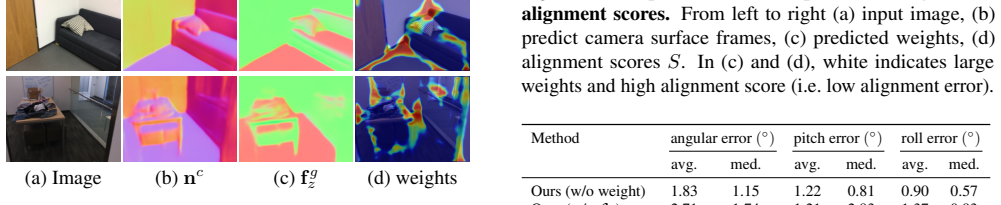
The load-bearing object is the per-pixel surface frame $\mathbf{F}(i)=[\mathbf{n}(i)\ \mathbf{t}(i)\ \mathbf{b}(i)]$, an orthonormal basis composed of the surface normal and two tangent vectors. The network predicts these frames in camera coordinates and, in global upright coordinates, only the third row $\mathbf{f}^g_z$ of the global frame, a scene-layout vector whose normal component sets floor, wall, and ceiling pixels to fixed values. The identity $\mathbf{f}^g_z(i)=\mathbf{u}^T\mathbf{F}_c(i)$ turns the unknown up vector into the solution of a constrained least-squares problem, and the solver reduces it to a quadratic eigenvalue problem $I\lambda^2-2H\lambda+H^2-\mathbf{g}\mathbf{g}^T=0$ with $H=A^TA$ and $\mathbf{g}=A^T\mathbf{b}$. Because the needed eigenvalue derivative is closed-form, the orientation loss propagates through the solver to the network, while separately predicted per-pixel weights make the fit robust to unreliable regions by concentrating on line junctions and structure edges.
What would settle it
Build a test set of indoor images with little or no visible floor, ceiling, or wall plane (close-up furniture views, cluttered corners), run UprightNet and the direct-regression baseline on it, and check whether the up-vector error gap shrinks or reverses; the alignment mechanism predicts the method should lose its advantage exactly where planar supporting structure is absent.
Extended reading notes
Core claim
The central claim is that the information needed for single-image roll and pitch is already present in local surface geometry, but only becomes usable when the same geometry is also predicted in a global upright coordinate system. Writing the per-pixel surface frame as $\mathbf{F}_c(i)$ and the third row of the global upright frame as $\mathbf{f}^g_z(i)$, the scene up vector $\mathbf{u}$ must satisfy $\mathbf{f}^g_z(i)=\mathbf{u}^T\mathbf{F}_c(i)$ at every pixel, so orientation estimation reduces to a weighted constrained least-squares problem in $\mathbf{u}$ alone. The paper shows this problem has an analytic solution through a quadratic eigenvalue problem, and that the eigenvalue derivative is available in closed form, making the entire alignment differentiable and trainable by back-propagating the orientation error. With this formulation, the average up-vector error drops from 1.76 degrees to 1.17 degrees on InteriorNet relative to the best prior CNN-based method, with consistent gains on ScanNet and a large margin on the SUN360 cross-dataset test.
Load-bearing premise
The method assumes a single indoor image contains enough visible flat, structured surfaces—floors, ceilings, walls, and their junctions—to give a clear alignment signal between the two predicted geometries; the paper's own limitations section says images without such supporting structure lead to inaccurate predictions.
Editorial extensions
If this is right
- Single-image roll and pitch can be framed as an alignment of two predicted geometry maps, and this framing is trainable end-to-end through a differentiable constrained least-squares solver.
- Supervising the intermediate surface frames in both coordinate systems adds accuracy on top of the orientation loss, so the method can exploit partial geometric ground truth when full camera poses are available.
- The learned weight maps form an interpretable by-product: they highlight line junctions and plane boundaries, the same regions that carry vanishing-point information in classical calibration.
- Cross-dataset results on SUN360 indicate the geometric intermediate representation transfers to new indoor scene distributions better than direct regression or horizon classification.
Reading between the lines
- The differentiable two-frame alignment is not tied to indoor scenes: replacing the global upright frame with a sky-versus-ground semantic prior could give outdoor roll and pitch estimation the same structure.
- Because the orientation loss alone already improves accuracy, a self-supervised variant could be built that aligns predicted frames across generated rotations, reducing the need for dense ground-truth normals.
- A testable consequence of the paper's mechanism is that accuracy should depend on how much of the image is covered by planar supporting structures; partitioning a test set by that coverage would draw the boundary where the method loses its advantage over direct regression.
Signed reviews
Editorial analysis
A structured set of objections, weighed in public.
Referee Report
Summary. The paper introduces UprightNet, an end-to-end deep network for estimating 2DoF camera orientation (roll and pitch) from a single indoor RGB image. The central idea is to predict per-pixel surface frames in both local camera coordinates (F_c) and a global upright coordinate system (f_z^g), then solve for the camera up vector as the unit vector that best aligns these two predictions via a differentiable weighted constrained least-squares module. Training is end-to-end with a combination of an orientation loss, surface-frame losses, and gradient-consistency losses. Experiments on InteriorNet, ScanNet, and a SUN360 cross-dataset test show consistent improvements over regression, classification, and classical baselines, and ablations support the design choices of the predicted weights and the full surface-frame representation.
Significance. If the formulation is sound, this is a valuable contribution to single-image camera calibration. The paper convincingly demonstrates that injecting explicit geometric reasoning through dual surface-frame prediction and a differentiable constrained least-squares solver can improve both accuracy and cross-dataset generalization relative to black-box regression or classification. The differentiable solver itself is a reusable module, and the extensive experimental comparison and ablation study strengthen the empirical case. The main concern is a gap in the definition of the global upright coordinate system, which affects the mathematical foundation and reproducibility of the method.
major comments (2)
- [Section 3, Eqs. (1)-(2) and Eq. (13)] The global upright coordinate system is not fully specified: the paper states only that its up vector aligns with the scene up vector, leaving the global x/y axes undefined. Because the tangent vector t is defined as n × (camera y-axis), the analogous definition in the global frame depends on the arbitrary global y-axis. For a vertical wall, t_g^z is the sine of the angle between the wall normal and the global y-axis, so its sign and magnitude change under a scene-level yaw rotation. Consequently, the ground-truth f_z^g used in the surface-frame loss L_F (Eq. 13) is not well-defined as a function of the image, and Eq. (1) F_g = R F_c holds only if R maps the camera y-axis to the global y-axis, which is generally false for a camera with nonzero yaw. The authors should specify a canonical global yaw convention (e.g., projecting the camera's right vector onto the horizontal plane) or redefine the tangent vectors in a yaw-invariant way, then re-derive the alignment equation and re-run the experiments under that convention.
- [Section 4.3, Tables 1-5] The paper repeatedly describes improvements as 'significant,' but no statistical significance tests, confidence intervals, or variance across multiple training runs are reported. On ScanNet, the gain over Hold-Geoffroy et al. is about 0.8 degrees in mean angular error (3.74 vs. 4.55), which may not be robust given that the baselines were re-implemented by the authors and that only a single split is used. Please report error bars, significance tests, or at least a discussion of variance to support the claim of significant improvement.
minor comments (5)
- [Section 3.1, Eqs. (7)-(8)] The paper states that the derivative of the eigenvalue is computed in closed form using [45], but the actual derivative formula and its backpropagation details are not presented. A short derivation or a pointer to the supplementary material would improve reproducibility.
- [Table 3] In the row 'Ours (w/o Lo)', the median pitch error (2.83°) is reported as larger than the mean pitch error (1.21°), which is atypical for an angular error distribution; please check this entry for a possible typo.
- [Section 4.1] The description of InteriorNet says 'Each scene includes 3 images randomly sampled from a rendered videos.' This should read 'a rendered video' or 'rendered videos.'
- [Eq. (9)] The nested-norm notation in Eq. (9) is confusing; it should be a single L2 norm of the vector W(i)(u^T F_c(i) - f_z^g(i)).
- [Figure 4 caption] The caption says the weight maps are overlaid on the input images, but the overlay alpha or blending mode is not specified; adding this detail would improve clarity.
Circularity Check
No significant circularity: the up vector is recovered from independently supervised geometry predictions via an external least-squares solver.
full rationale
UprightNet's derivation chain is self-contained. The estimated camera up vector u is the solution of a constrained weighted least-squares problem (Eq. 3, Eq. 9) that aligns two network outputs: local camera surface frames Fc and global upright scene-layout vectors f_g_z. The solver is an external mathematical result (Gander, Golub, and von Matt, Eq. 7-8), not a learned or fitted quantity. The network outputs are supervised directly by ground-truth surface geometry and ground-truth camera poses through the losses in Eq. 11-14, and the orientation loss backpropagates through the differentiable solver. No predicted quantity is also used as a fitted input, and no parameter is renamed as a prediction. The only same-author citations are [19], used as a comparison baseline, and [44], cited only as inspiration for end-to-end intermediate representation learning; neither supplies a load-bearing premise or a uniqueness theorem. The noted ambiguity in the global upright frame's x/y axes is a label-consistency and reproducibility concern, not circularity, because the supervision labels are still computed from ground-truth orientation rather than from the model's own outputs. Therefore the central claim does not reduce to its inputs by construction.
Assumptions & free parameters
free parameters (4)
- Loss weight alpha_L for surface frame loss LF in Eq. 11 =
not specified (deferred to supplementary)
- Loss weight alpha_gradient for gradient consistency loss in Eq. 11 =
not specified (deferred to supplementary)
- Orientation loss switch threshold epsilon =
1e-6
- Number of scales S for gradient consistency loss in Eq. 14 =
4
assumptions (4)
- standard math Constrained least squares solution via Gander-Golub-von Matt theorem (Theorem 1 from reference [14])
- domain assumption Indoor scenes are predominantly composed of structured planar surfaces (floors, ceilings, walls)
- domain assumption Non-degeneracy of the tangent frame definition
- domain assumption Global upright coordinate system is consistent across images
Cite this review
Pith. "Pith review of UprightNet: Geometry-Aware Camera Orientation Estimation from Single Images." pith.science (2026). https://pith.science/paper/4SQKEOWF
@misc{pith2026190807070,
  author       = {Pith},
  title        = {Pith review of: UprightNet: Geometry-Aware Camera Orientation Estimation from Single Images},
  year         = {2026},
  howpublished = {\url{https://pith.science/paper/4SQKEOWF}},
  note         = {Machine review of arXiv:1908.07070}
}
read the original abstract
We introduce UprightNet, a learning-based approach for estimating 2DoF camera orientation from a single RGB image of an indoor scene. Unlike recent methods that leverage deep learning to perform black-box regression from image to orientation parameters, we propose an end-to-end framework that incorporates explicit geometric reasoning. In particular, we design a network that predicts two representations of scene geometry, in both the local camera and global reference coordinate systems, and solves for the camera orientation as the rotation that best aligns these two predictions via a differentiable least squares module. This network can be trained end-to-end, and can be supervised with both ground truth camera poses and intermediate representations of surface geometry. We evaluate UprightNet on the single-image camera orientation task on synthetic and real datasets, and show significant improvements over prior state-of-the-art approaches.
Figures


Figures from the paper (4 more)



Reference graph
Works this paper leans on
- [1]
-
[2]
A machine learning approach to horizon line detection using local features
Touqeer Ahmad, George Bebis, Emma E Regentova, and Ara Nefian. A machine learning approach to horizon line detection using local features. In International Symposium on Visual Computing, pages 181–193. Springer, 2013
work page 2013
-
[3]
A global approach for the detection of vanishing points and mutually orthogonal vanishing directions
Michel Antunes and Joao P Barreto. A global approach for the detection of vanishing points and mutually orthogonal vanishing directions. In Proc. Computer Vision and Pattern Recognition (CVPR), pages 1336–1343, 2013
work page 2013
-
[4]
Marr revisited: 2d-3d alignment via surface normal prediction
Aayush Bansal, Bryan Russell, and Abhinav Gupta. Marr revisited: 2d-3d alignment via surface normal prediction. In Proc. Computer Vision and Pattern Recognition (CVPR), pages 5965–5974, 2016
work page 2016
-
[5]
3-line ransac for orthogonal vanishing point detection
Jean-Charles Bazin and Marc Pollefeys. 3-line ransac for orthogonal vanishing point detection. In IEEE/RSJ Interna- tional Conference on Intelligent Robots and Systems, pages 4282–4287. IEEE, 2012
work page 2012
-
[6]
Globally optimal line clustering and vanishing point estimation in manhattan world
Jean-Charles Bazin, Yongduek Seo, C´edric Demonceaux, Pas- cal Vasseur, Katsushi Ikeuchi, Inso Kweon, and Marc Polle- feys. Globally optimal line clustering and vanishing point estimation in manhattan world. In Proc. Computer Vision and Pattern Recognition (CVPR), pages 638–645. IEEE, 2012
work page 2012
-
[7]
Dsac-differentiable ransac for camera localization
Eric Brachmann, Alexander Krull, Sebastian Nowozin, Jamie Shotton, Frank Michel, Stefan Gumhold, and Carsten Rother. Dsac-differentiable ransac for camera localization. In Proc. Computer Vision and Pattern Recognition (CVPR) , pages 6684–6692, 2017
work page 2017
-
[8]
Learning less is more- 6d camera localization via 3d surface regression
Eric Brachmann and Carsten Rother. Learning less is more- 6d camera localization via 3d surface regression. In Proc. Computer Vision and Pattern Recognition (CVPR) , pages 4654–4662, 2018
work page 2018
Show all 53 references
-
[9]
Camera cali- bration with two arbitrary coplanar circles
Qian Chen, Haiyuan Wu, and Toshikazu Wada. Camera cali- bration with two arbitrary coplanar circles. In Proc. European Conf. on Computer Vision (ECCV), pages 521–532. Springer, 2004
2004
-
[10]
Scannet: Richly- annotated 3d reconstructions of indoor scenes
Angela Dai, Angel X Chang, Manolis Savva, Maciej Halber, Thomas Funkhouser, and Matthias Nießner. Scannet: Richly- annotated 3d reconstructions of indoor scenes. In Proc. Com- puter Vision and Pattern Recognition (CVPR), pages 5828– 5839, 2017
2017
-
[11]
Automatic camera calibration from a single manhattan image
Jonathan Deutscher, Michael Isard, and John MacCormick. Automatic camera calibration from a single manhattan image. In Proc. European Conf. on Computer Vision (ECCV), pages 175–188. Springer, 2002
2002
-
[12]
Predicting depth, surface nor- mals and semantic labels with a common multi-scale convo- lutional architecture
David Eigen and Rob Fergus. Predicting depth, surface nor- mals and semantic labels with a common multi-scale convo- lutional architecture. In Proc. Int. Conf. on Computer Vision (ICCV), pages 2650–2658, 2015
2015
-
[13]
Horizon detection using machine learning techniques
Sergiy Fefilatyev, V olha Smarodzinava, Lawrence O Hall, and Dmitry B Goldgof. Horizon detection using machine learning techniques. In International Conference on Machine Learning and Applications, pages 17–21. IEEE, 2006
2006
-
[14]
A con- strained eigenvalue problem
Walter Gander, Gene H Golub, and Urs von Matt. A con- strained eigenvalue problem. Linear Algebra and its applica- tions, 114:815–839, 1989
1989
-
[15]
Robust manhattan frame estimation from a single rgb-d image
Bernard Ghanem, Ali Thabet, Juan Carlos Niebles, and Fabian Caba Heilbron. Robust manhattan frame estimation from a single rgb-d image. In Proc. Computer Vision and Pattern Recognition (CVPR), pages 3772–3780, 2015
2015
-
[16]
Unsupervised monocular depth estimation with left-right con- sistency
Cl´ement Godard, Oisin Mac Aodha, and Gabriel J Brostow. Unsupervised monocular depth estimation with left-right con- sistency. In Proc. Computer Vision and Pattern Recognition (CVPR), pages 270–279, 2017
2017
-
[17]
Multiple view geom- etry in computer vision
Richard Hartley and Andrew Zisserman. Multiple view geom- etry in computer vision. Cambridge university press, 2003
2003
-
[18]
Deep residual learning for image recognition
Kaiming He, Xiangyu Zhang, Shaoqing Ren, and Jian Sun. Deep residual learning for image recognition. In Proc. Com- puter Vision and Pattern Recognition (CVPR), pages 770–778, 2016
2016
-
[19]
A perceptual measure for deep single image camera calibration
Yannick Hold-Geoffroy, Kalyan Sunkavalli, Jonathan Eisen- mann, Matthew Fisher, Emiliano Gambaretto, Sunil Hadap, and Jean-Franc ¸ois Lalonde. A perceptual measure for deep single image camera calibration. In Proc. Computer Vision and Pattern Recognition (CVPR), pages 2354–2363, 2018
2018
-
[20]
Texturenet: Consis- tent local parametrizations for learning from high-resolution signals on meshes
Jingwei Huang, Haotian Zhang, Li Yi, Thomas Funkhouser, Matthias Nießner, and Leonidas J Guibas. Texturenet: Consis- tent local parametrizations for learning from high-resolution signals on meshes. In Proc. Computer Vision and Pattern Recognition (CVPR), pages 4440–4449, 2019
2019
-
[21]
Framenet: Learning local canonical frames of 3d surfaces from a single rgb image
Jingwei Huang, Yichao Zhou, Thomas Funkhouser, and Leonidas Guibas. Framenet: Learning local canonical frames of 3d surfaces from a single rgb image. arXiv preprint arXiv:1903.12305, 2019
1903 arXiv
-
[22]
Globally optimal manhattan frame estimation in real-time
Kyungdon Joo, Tae-Hyun Oh, Junsik Kim, and In So Kweon. Globally optimal manhattan frame estimation in real-time. In Proceedings of the IEEE Conference on Computer Vision and Pattern Recognition, pages 1763–1771, 2016
2016
-
[23]
Posenet: A convolutional network for real-time 6-dof camera relocal- ization
Alex Kendall, Matthew Grimes, and Roberto Cipolla. Posenet: A convolutional network for real-time 6-dof camera relocal- ization. In Proc. Int. Conf. on Computer Vision (ICCV), pages 2938–2946, 2015
2015
-
[24]
Indoor rgb-d compass from a single line and plane
Pyojin Kim, Brian Coltin, and H Jin Kim. Indoor rgb-d compass from a single line and plane. In CVPR, 2018
2018
-
[25]
Adam: A method for stochastic optimization
Diederik P Kingma and Jimmy Ba. Adam: A method for stochastic optimization. arXiv preprint arXiv:1412.6980 , 2014
2014 arXiv
-
[26]
Automatic upright adjustment of photographs with robust camera calibration
Hyunjoon Lee, Eli Shechtman, Jue Wang, and Seungyong Lee. Automatic upright adjustment of photographs with robust camera calibration. Trans. Pattern Analysis and Machine Intelligence, 36(5):833–844, 2014
2014
-
[27]
Finding vanishing points via point alignments in image primal and dual domains
Jos´e Lezama, Rafael Grompone von Gioi, Gregory Randall, and Jean-Michel Morel. Finding vanishing points via point alignments in image primal and dual domains. In Proc. Com- puter Vision and Pattern Recognition (CVPR), pages 509–515, 2014
2014
-
[28]
Interiornet: Mega-scale multi-sensor photo-realistic indoor scenes dataset
Wenbin Li, Sajad Saeedi, John McCormac, Ronald Clark, Dimos Tzoumanikas, Qing Ye, Yuzhong Huang, Rui Tang, and Stefan Leutenegger. Interiornet: Mega-scale multi-sensor photo-realistic indoor scenes dataset. InProc. British Machine Vision Conf. (BMVC), 2018
2018
-
[29]
Huttenlocher
Yunpeng Li, Noah Snavely, and Daniel P. Huttenlocher. Loca- tion recognition using prioritized feature matching. In Proc. European Conf. on Computer Vision (ECCV), 2010
2010
-
[30]
Learning the depths of moving people by watching frozen people
Zhengqi Li, Tali Dekel, Forrester Cole, Richard Tucker, Noah Snavely, Ce Liu, and William T Freeman. Learning the depths of moving people by watching frozen people. In Proc. Com- puter Vision and Pattern Recognition (CVPR), pages 4521– 4530, 2019
2019
-
[31]
CGIntrinsics: Better intrinsic image decomposition through physically-based rendering
Zhengqi Li and Noah Snavely. CGIntrinsics: Better intrinsic image decomposition through physically-based rendering. In Proc. European Conf. on Computer Vision (ECCV) , pages 371–387, 2018
2018
-
[32]
Megadepth: Learning single- view depth prediction from internet photos
Zhengqi Li and Noah Snavely. Megadepth: Learning single- view depth prediction from internet photos. In Proc. Com- puter Vision and Pattern Recognition (CVPR), pages 2041– 2050, 2018
2018
-
[33]
Planenet: Piece-wise planar reconstruction from a single rgb image
Chen Liu, Jimei Yang, Duygu Ceylan, Ersin Yumer, and Ya- sutaka Furukawa. Planenet: Piece-wise planar reconstruction from a single rgb image. In Proc. Computer Vision and Pat- tern Recognition (CVPR), pages 2579–2588, 2018
2018
-
[34]
Groundnet: Segmentation-aware monocular ground plane estimation with geometric consistency
Yunze Man, Xinshuo Weng, and Kris Kitani. Groundnet: Segmentation-aware monocular ground plane estimation with geometric consistency. arXiv preprint arXiv:1811.07222 , 2018
2018 arXiv
-
[35]
Optimal estima- tion of vanishing points in a manhattan world
Faraz M Mirzaei and Stergios I Roumeliotis. Optimal estima- tion of vanishing points in a manhattan world. In Proc. Int. Conf. on Computer Vision (ICCV), pages 2454–2461. IEEE, 2011
2011
-
[36]
Simple camera calibration from a single image using five points on two orthogonal 1-d objects
Isao Miyagawa, Hiroyuki Arai, and Hideki Koike. Simple camera calibration from a single image using five points on two orthogonal 1-d objects. IEEE Transactions on Image Processing, 19(6):1528–1538, 2010
2010
-
[37]
U-net: Convolutional networks for biomedical image segmentation
Olaf Ronneberger, Philipp Fischer, and Thomas Brox. U-net: Convolutional networks for biomedical image segmentation. In International Conference on Medical image computing and computer-assisted intervention, pages 234–241. Springer, 2015
2015
-
[38]
Imagenet large scale visual recognition challenge
Olga Russakovsky, Jia Deng, Hao Su, Jonathan Krause, San- jeev Satheesh, Sean Ma, Zhiheng Huang, Andrej Karpathy, Aditya Khosla, Michael Bernstein, et al. Imagenet large scale visual recognition challenge. Int. J. of Computer Vision, 115(3):211–252, 2015
2015
-
[39]
Fast image- based localization using direct 2d-to-3d matching
Torsten Sattler, Bastian Leibe, and Leif Kobbelt. Fast image- based localization using direct 2d-to-3d matching. In Proc. Int. Conf. on Computer Vision (ICCV), 2011
2011
-
[40]
Planar group- ing for automatic detection of vanishing lines and points
Frederik Schaffalitzky and Andrew Zisserman. Planar group- ing for automatic detection of vanishing lines and points. Image and Vision Computing, 18(9):647–658, 2000
2000
-
[41]
Semantic scene comple- tion from a single depth image
Shuran Song, Fisher Yu, Andy Zeng, Angel X Chang, Mano- lis Savva, and Thomas Funkhouser. Semantic scene comple- tion from a single depth image. Proc. Computer Vision and Pattern Recognition (CVPR), 2017
2017
-
[42]
Real-time manhattan world rotation estimation in 3d
Julian Straub, Nishchal Bhandari, John J Leonard, and John W Fisher. Real-time manhattan world rotation estimation in 3d. In 2015 IEEE/RSJ International Conference on Intelligent Robots and Systems (IROS), pages 1913–1920. IEEE, 2015
2015
-
[43]
The manhattan frame modelmanhat- tan world inference in the space of surface normals
Julian Straub, Oren Freifeld, Guy Rosman, John J Leonard, and John W Fisher. The manhattan frame modelmanhat- tan world inference in the space of surface normals. Trans. Pattern Analysis and Machine Intelligence, 40(1):235–249, 2018
2018
-
[44]
Discovery of latent 3d keypoints via end-to-end geometric reasoning
Supasorn Suwajanakorn, Noah Snavely, Jonathan J Tompson, and Mohammad Norouzi. Discovery of latent 3d keypoints via end-to-end geometric reasoning. In Neural Information Processing Systems, pages 2063–2074, 2018
2018
-
[45]
Perturbation theory for eigenvalue problems
Nico van der Aa. Perturbation theory for eigenvalue problems. 2005
2005
-
[46]
Design- ing deep networks for surface normal estimation
Xiaolong Wang, David Fouhey, and Abhinav Gupta. Design- ing deep networks for surface normal estimation. In Proc. Computer Vision and Pattern Recognition (CVPR) , pages 539–547, 2015
2015
-
[47]
Robust camera self- calibration from monocular images of manhattan worlds
Horst Wildenauer and Allan Hanbury. Robust camera self- calibration from monocular images of manhattan worlds. In Proc. Computer Vision and Pattern Recognition (CVPR) , pages 2831–2838. IEEE, 2012
2012
-
[48]
Hori- zon lines in the wild
Scott Workman, Menghua Zhai, and Nathan Jacobs. Hori- zon lines in the wild. In Proc. British Machine Vision Conf. (BMVC), 2016
2016
-
[49]
Recognizing scene viewpoint using panoramic place representation
Jianxiong Xiao, Krista A Ehinger, Aude Oliva, and Anto- nio Torralba. Recognizing scene viewpoint using panoramic place representation. In Proc. Computer Vision and Pattern Recognition (CVPR), pages 2695–2702, 2012
2012
-
[50]
Pose estimation from line correspondences: A complete analysis and a series of solutions.Trans
Chi Xu, Lilian Zhang, Li Cheng, and Reinhard Koch. Pose estimation from line correspondences: A complete analysis and a series of solutions.Trans. Pattern Analysis and Machine Intelligence, 39(6):1209–1222, 2017
2017
-
[51]
A minimum error vanishing point detection approach for uncalibrated monocular images of man-made environments
Yiliang Xu, Sangmin Oh, and Anthony Hoogs. A minimum error vanishing point detection approach for uncalibrated monocular images of man-made environments. In Proc. Com- puter Vision and Pattern Recognition (CVPR), pages 1376– 1383, 2013
2013
-
[52]
Detect- ing vanishing points using global image context in a non- manhattan world
Menghua Zhai, Scott Workman, and Nathan Jacobs. Detect- ing vanishing points using global image context in a non- manhattan world. In Proc. Computer Vision and Pattern Recognition (CVPR), pages 5657–5665, 2016
2016
-
[53]
Deep depth comple- tion of a single rgb-d image
Yinda Zhang and Thomas Funkhouser. Deep depth comple- tion of a single rgb-d image. In Proc. Computer Vision and Pattern Recognition (CVPR), pages 175–185, 2018
2018
Reviewed August 14, 2026 · model on record in the stance chip above.
Discussion (0). Continue with ORCID to comment.