HEACalculator: An Open-Source Python Tool for Thermodynamic Property Calculation and Solid Solution Prediction in High-Entropy Alloys
Pith reviewed 2026-06-26 16:52 UTC · model grok-4.3
The pith
HEACalculator computes sixteen thermodynamic descriptors and evaluates eight published solid-solution rules for high-entropy alloys from one curated dataset.
A machine-rendered reading of the paper's core claim, the machinery that carries it, and where it could break.
Core claim
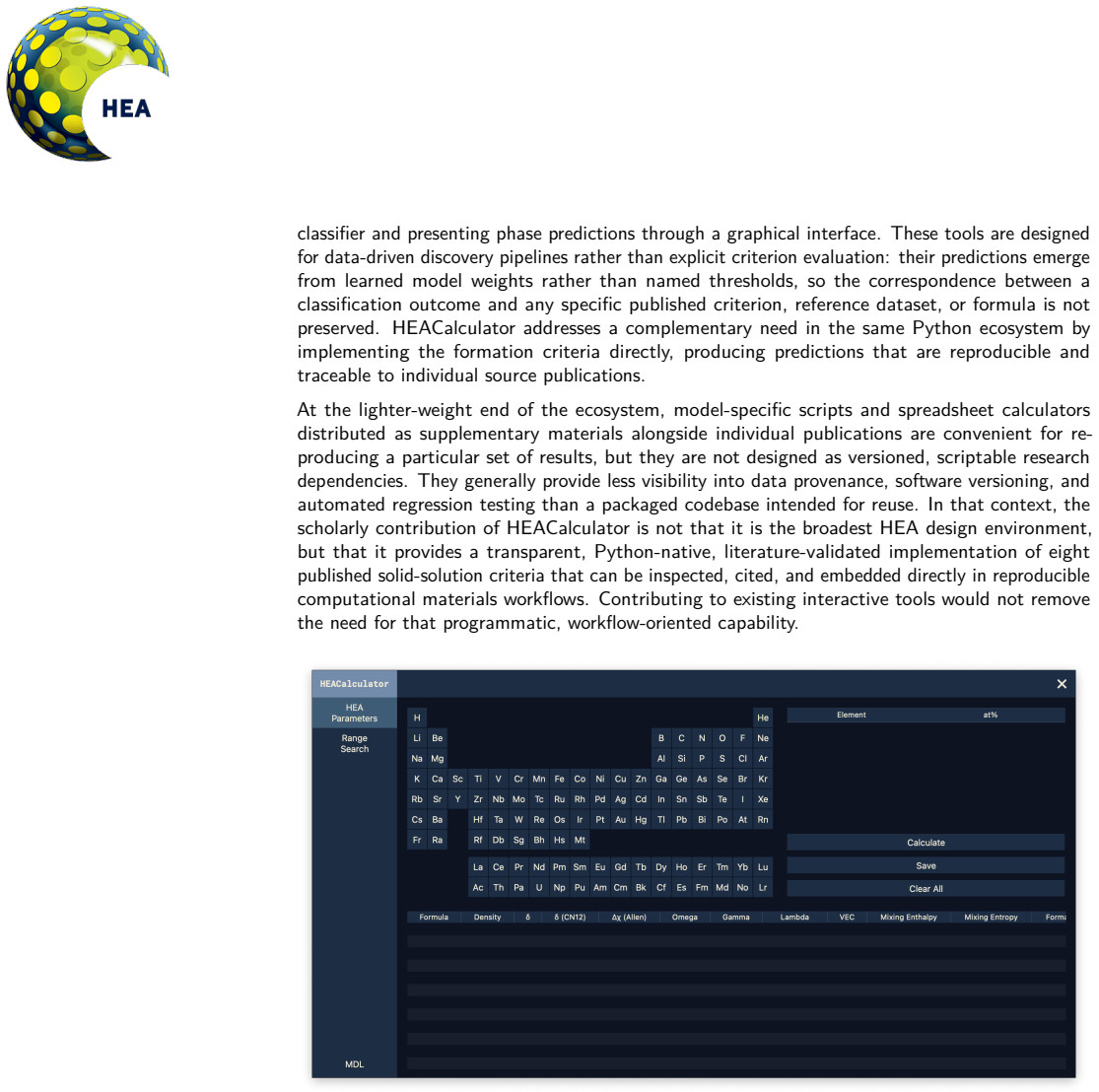
HEACalculator is an open-source Python package that computes sixteen commonly used thermodynamic and structural quantities, including mixing enthalpy, configurational entropy, valence electron concentration, Hume-Rothery electron-to-atom ratio, atomic size mismatch, electronegativity mismatch, and derived parameters such as Omega, Lambda, and Phi, while simultaneously evaluating eight published solid-solution formation criteria against a single curated elemental and binary-interaction dataset. The package is offered in three access modes: command-line interface, desktop graphical user interface, and Python API.
What carries the argument
The HEACalculator package, which combines a curated elemental and binary-interaction dataset with CLI, GUI, and API access modes to compute the sixteen descriptors and apply the eight prediction criteria in one place.
If this is right
- Users can screen candidate compositions for single-phase likelihood using a uniform set of descriptors without assembling separate data tables or scripts.
- The same composition can be evaluated against all eight published rules at once, revealing where the rules agree or disagree.
- Integration into notebooks or larger screening pipelines becomes possible through the provided Python API.
- Early-stage alloy design workflows can insert the thermodynamic checks before committing resources to CALPHAD modeling or synthesis.
Where Pith is reading between the lines
- The package could serve as a reference implementation that makes it easier to test new prediction rules against the same baseline calculations.
- If the underlying dataset is extended with additional binary systems, the same code base could support screening in higher-order alloys without rewriting the descriptor formulas.
- Routine use might highlight which of the eight criteria are most or least consistent with experimental outcomes, prompting refinement of those rules.
Load-bearing premise
The curated elemental and binary-interaction dataset accurately reflects the interactions required for reliable multi-component calculations, and the eight published prediction criteria function as appropriate screening tools.
What would settle it
Direct comparison of the package outputs for a set of experimentally verified single-phase and multi-phase high-entropy alloys against independent thermodynamic databases or experimental phase diagrams would show systematic mismatches in the computed descriptors or incorrect predictions from the eight criteria.
Figures
read the original abstract
High-entropy alloys (HEAs) have attracted sustained interest since their introduction by Cantor et al. and Yeh et al. because multi-principal-element compositions can exhibit unusual combinations of strength, thermal stability, and functional performance. A recurring problem in HEA design is determining whether a candidate composition is likely to form a single-phase solid solution or instead separate into multiple phases or intermetallic compounds. That question sits early in the alloy-design workflow because it shapes which compositions require further thermodynamic analysis, synthesis, and experimental validation. HEACalculator is an open-source Python package for calculating thermodynamic and structural descriptors used in HEA research and for evaluating published solid-solution formation rules in a single place. It computes sixteen commonly used quantities, including mixing enthalpy, configurational entropy, valence electron concentration, Hume-Rothery electron-to-atom ratio, atomic size mismatch, electronegativity mismatch, and derived stability parameters such as Omega, Lambda, and Phi, and it evaluates eight published prediction criteria. The package combines a curated elemental and binary-interaction dataset with three access modes: a command-line interface (CLI), a desktop graphical user interface (GUI), and a Python application programming interface (API) for programmatic use in notebooks and screening workflows.
Editorial analysis
A structured set of objections, weighed in public.
Referee Report
Summary. The manuscript presents HEACalculator, an open-source Python package that computes sixteen thermodynamic and structural descriptors commonly used in high-entropy alloy (HEA) research—including mixing enthalpy, configurational entropy, valence electron concentration, Hume-Rothery e/a ratio, atomic size mismatch, electronegativity mismatch, and derived parameters such as Omega, Lambda, and Phi—and evaluates eight published solid-solution formation criteria. The package integrates a curated elemental and binary-interaction dataset and provides three access modes: CLI, GUI, and Python API.
Significance. If the dataset provenance and numerical implementations prove reliable, the tool would consolidate multiple published HEA screening methods into a single, accessible open-source resource with multiple interfaces, potentially aiding reproducibility and workflow integration for composition screening. The open-source release and provision of CLI/GUI/API modes are concrete strengths that lower barriers to use.
major comments (2)
- [Abstract] Abstract: the central claim that the package enables reliable solid-solution prediction for multi-component HEAs rests on the accuracy of the curated elemental and binary-interaction dataset for extrapolation beyond binaries, yet the manuscript supplies no provenance details, no comparison to independent sources (Miedema, CALPHAD), and no benchmark against measured ternary or quaternary enthalpies.
- [Abstract] The description of the dataset (Abstract) contains no error-propagation analysis or validation of the sixteen computed quantities against independent calculations or experiments, which is load-bearing for any claim that the outputs are usable for HEA screening.
Simulated Author's Rebuttal
We thank the referee for the constructive feedback on our manuscript describing HEACalculator. We address each major comment below and indicate the revisions we will make.
read point-by-point responses
-
Referee: [Abstract] Abstract: the central claim that the package enables reliable solid-solution prediction for multi-component HEAs rests on the accuracy of the curated elemental and binary-interaction dataset for extrapolation beyond binaries, yet the manuscript supplies no provenance details, no comparison to independent sources (Miedema, CALPHAD), and no benchmark against measured ternary or quaternary enthalpies.
Authors: We agree that explicit documentation of dataset provenance is absent from the current manuscript. The elemental and binary parameters are drawn from standard literature sources routinely cited in HEA studies (Miedema model and related compilations), but these origins are not detailed in the text. The manuscript's scope is the implementation and integration of existing descriptors rather than a new validation campaign; therefore no direct comparisons to CALPHAD or new ternary/quaternary benchmarks are provided. In the revised version we will add a dedicated 'Dataset Sources' subsection citing the primary references and will insert a limitations paragraph that explicitly notes the extrapolation assumptions when applying binary-derived parameters to multi-component systems. revision: yes
-
Referee: [Abstract] The description of the dataset (Abstract) contains no error-propagation analysis or validation of the sixteen computed quantities against independent calculations or experiments, which is load-bearing for any claim that the outputs are usable for HEA screening.
Authors: The sixteen descriptors are evaluated from deterministic algebraic expressions taken directly from the cited literature; consequently no statistical error-propagation analysis applies. The package reproduces published formulas rather than generating new experimental data, so independent experimental validation is outside the stated contribution. We will revise the abstract to clarify that the tool implements established methods and will add a short 'Limitations and Scope' paragraph discussing the deterministic character of the calculations and the absence of new experimental benchmarks. These changes will better frame the reliability context for users without expanding the paper beyond a software-tool description. revision: yes
Circularity Check
No circularity: tool implements external published criteria from curated dataset
full rationale
The manuscript describes a software package that computes 16 standard descriptors (mixing enthalpy, Omega, atomic size mismatch, etc.) and evaluates 8 published solid-solution criteria drawn from prior literature. These quantities are obtained from a curated elemental/binary dataset whose values are inputs, not outputs fitted inside the paper. No equations, predictions, or uniqueness claims are presented that reduce by construction to parameters defined or optimized within this work; the contribution is integration and accessibility rather than a derivation chain.
Axiom & Free-Parameter Ledger
Reference graph
Works this paper leans on
-
[1]
and Chang, I
Cantor, B. and Chang, I. T. H. and Knight, P. and Vincent, A. J. B. , title =. Materials Science and Engineering: A , year =
-
[2]
and Chen, S.-K
Yeh, J.-W. and Chen, S.-K. and Lin, S.-J. and Gan, J.-Y. and Chin, T.-S. and Shun, T.-T. and Tsau, C.-H. and Chang, S.-Y. , title =. Advanced Engineering Materials , year =
-
[3]
George, E. P. and Raabe, D. and Ritchie, R. O. , title =. Nature Reviews Materials , year =
-
[4]
Miracle, D. B. and Senkov, O. N. , title =. Acta Materialia , year =
-
[5]
and Zhang, Y
Yang, X. and Zhang, Y. , title =. Materials Chemistry and Physics , year =
-
[6]
and Ng, C
Guo, S. and Ng, C. and Lu, J. and Liu, C. T. , title =. Journal of Applied Physics , year =
-
[7]
and Huang, Y
Wang, Z. and Huang, Y. and Yang, Y. and Wang, J. and Liu, C. T. , title =. Scripta Materialia , year =
-
[8]
Singh, A. K. and Kumar, N. and Dwivedi, A. and Subramaniam, A. , title =. Intermetallics , year =
-
[9]
Ye, Y. F. and Wang, Q. and Lu, J. and Liu, C. T. and Yang, Y. , title =. Scripta Materialia , year =
-
[10]
Troparevsky, M. C. and Morris, J. R. and Kent, P. R. C. and Lupini, A. R. and Stocks, G. M. , title =. Physical Review X , year =
-
[11]
Senkov, O. N. and Miracle, D. B. , title =. Journal of Alloys and Compounds , year =
-
[12]
King, D. J. M. and Middleburgh, S. C. and McGregor, A. G. and Cortie, M. B. , title =. Acta Materialia , year =
-
[13]
and Inoue, A
Takeuchi, A. and Inoue, A. , title =. Materials Transactions , year =
-
[14]
Martin, P. and Madrid-Cortes, C. E. and C. Computer Physics Communications , year =. doi:10.1016/j.cpc.2022.108398 , url =
-
[15]
and Dunn, A
Ward, L. and Dunn, A. and Faghaninia, A. and Zimmermann, N. E. R. and Bajaj, S. and Wang, Q. and Montoya, J. H. and Chen, J. and Bystrom, K. and Dylla, M. and Chard, K. and Asta, M. and Persson, K. A. and Snyder, G. J. and Foster, I. and Jain, A. , title =. Computational Materials Science , year =
-
[16]
and Kunwar, A
Subedi, U. and Kunwar, A. and Coutinho, Y. A. and Gyanwali, K. , title =. Metals and Materials International , year =
-
[17]
and Coutinho, Y
Subedi, U. and Coutinho, Y. A. and Malla, P. B. and Gyanwali, K. and Kunwar, A. , title =. Metals , year =
-
[18]
Sarıtürk, Doğuhan , title =. 2019 , publisher =. doi:10.5281/zenodo.3590318 , url =
-
[19]
and Qian, Xiaoning and Karaman, Ibrahim and Arroyave, Raymundo , title =
Zadeh, Sina Hossein and Cakirhan, Cem and Khatamsaz, Danial and Broucek, John and Brown, Timothy D. and Qian, Xiaoning and Karaman, Ibrahim and Arroyave, Raymundo , title =. Materials and Design , year =. doi:10.1016/j.matdes.2024.113096 , url =
-
[20]
Sheikh, Sofia and Zadeh, Sina Hossein and Mulukutla, Mrinalini and Hastings, Trevor and Arroyave, Raymundo , title =. Materials Letters , year =. doi:10.1016/j.matlet.2025.138940 , url =
-
[21]
and Hu, Q
Guo, S. and Hu, Q. and Ng, C. and Liu, C. T. , title =. Intermetallics , year =
discussion (0)
Sign in with ORCID, Apple, or X to comment. Anyone can read and Pith papers without signing in.