REVIEW 4 major objections 6 minor 30 references
IncA-DES: An incremental and adaptive dynamic ensemble selection approach using online K-d tree neighborhood search for data streams with concept drift
T0 review · 4 major / 6 minor · reviewed 2026-08-06 · deepseek-v4-flash
Pith's one-line read A dynamic ensemble selection framework for drifting data streams claims the best average accuracy among eight tested classifiers on 22 datasets — including under delayed, partial labels — while being the fastest among the most accurate…
desk verdict A solid streaming-DES paper with honestly reported stats, but the best-accuracy headline flips if you drop Letter, and the speed claim mixes Java and Python timings. read the letter →
The pith
A machine-rendered reading of the paper's core claim, the machinery that carries it, and where it could break.
The reading
What carries the argument
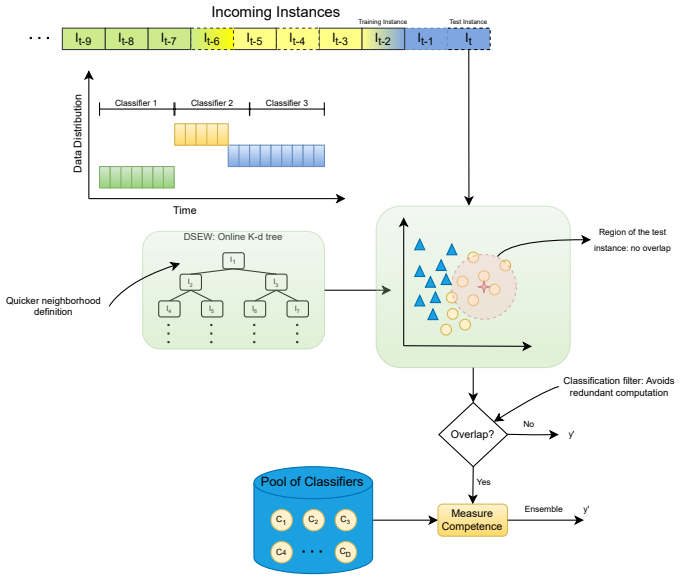
The load-bearing objects are three. The Online K-d tree is a K-dimensional binary tree built from the labeled window in which deletion is lazy (nodes are flagged inactive rather than removed, so the tree never becomes inconsistent), rebuilds are triggered when the tree doubles in size or when the fraction of inactive nodes passes $\beta$=0.3, and neighborhood search prunes branches using a Canberra-distance segment on the current node's split dimension rather than the squared Euclidean difference, which removes the need to normalize features. The overlap-based classification filter is the rule $|\{s_i \in \theta : y_i = y_{\mathrm{maj}}\}| / |\theta| \geq \omega \Rightarrow \mathrm{return}\ y_{\mathrm{maj}}$, which routes easy instances straight to a kNN answer and reserves dynamic selection for genuinely ambiguous neighborhoods. The adaptive Dynamic Selection Window coupled to the drift detector lets the validation set grow without a fixed bound and shrinks it to the detector's warning level on drift, together with the one-classifier-at-a-time training policy that produces local experts as different regions of the feature space arrive over time.
What would settle it
Re-implement DynED (and optionally all eight methods) in the same language and framework as IncA-DES, run the identical 22-dataset, four-label-availability protocol, and compare average accuracy and instances per second; if IncA-DES no longer holds both the best average accuracy and the smallest processing time among the top-accuracy methods, the central claim fails. A second, complementary check: stream enough labeled data to force the Dynamic Selection Window to evict instances (exceed memory), so that the lazy-deletion path and the beta rebuild trigger are actually exercised, since the paper reports that no tested dataset ever required a deletion.
Extended reading notes
Core claim
On the paper's own terms, the discovery is a training-and-window-management policy that makes dynamic ensemble selection work under drift: instead of resampling every incoming instance across the whole pool (online bagging), IncA-DES trains only the most recently created classifier, giving each candidate at most F=200 instances before a fresh one is started and the oldest of up to D=75 classifiers is pruned; instead of a fixed sliding window, the Dynamic Selection Window accumulates every labeled instance and is shrunk to the drift detector's warning point only when RDDM raises an alert, while old classifiers are retained to survive false alarms and recurring concepts. On top of this, an overlap-based filter (majority-class rate in the k-nearest neighborhood at or above omega=0.8 answers directly; otherwise the KNORA-Eliminate selection is invoked) and an Online K-d tree neighborhood search convert the cost of the region-of-competence computation into a manageable overhead. The experimental claim, stated in Section 5.3.1, is that IncA-DES obtained the best average accuracy, followed by DynED and ARE, that it had the smallest accuracy drop among the accurate methods as label delay grew to 1,000 instances, and that among the most accurate methods it processed the most instances per second.
Load-bearing premise
The headline speed claim assumes that measuring throughput in two different programming languages — Java for IncA-DES and most rivals, Python for one rival — yields directly comparable numbers; if the language gap, not the method, explains part of the 34.57x difference, the 'smallest processing time among the most accurate' claim weakens.
Editorial extensions
If this is right
- Neighborhood-based dynamic selection becomes deployable on high-speed streams: the Online K-d tree labels up to 24-30 times more instances per second than brute-force kNN when the search space reaches 50,000 instances, with accuracy loss within a few tenths of a point.
- Label scarcity stops being a disqualifying condition: under a 1,000-instance label delay with partial labeling, IncA-DES kept the highest average accuracy of the eight methods and the smallest drop from the full-supervision regime among the accurate ones.
- The stability-plasticity trade-off of sliding windows is softened: keeping a memory-limited window intact and shrinking it only on drift detection retains useful information under stable and virtual concepts while still adapting to real drift.
- A simple consensus shortcut generalizes: the paper argues every neighborhood-based DS method should adopt the overlap-based filter, since in its ablation the filter improved both accuracy and processing time on all tested datasets, whereas the K-d tree's speed benefit was problem-dependent.
- The framework's robustness to false drift alarms follows from keeping old classifiers in the pool: even if a detector fires spuriously and the window shrinks, the pruned old experts remain available as candidates.
Reading between the lines
- The 34.57x throughput advantage over DynED is not fully vouched for by the experimental design, because DynED alone runs in Python while every other method runs in Java; the gaps over ARE (1.25x) and ARF (3.98x) rest on same-language comparisons and are the more defensible speed evidence.
- The lazy-deletion machinery that distinguishes the Online K-d tree was never actually stressed: the paper states that no tested dataset needed a deletion, so the beta=0.3 rebuild rule and the flag-based removal logic are validated by construction only, not by experiment.
- A natural transfer: the overlap filter's early-exit logic could be applied to batch-setting DS methods, or to any region-of-competence-based competent classifier as a consensus gate before computing competence, where it may yield the same accuracy-and-speed gains the paper reports for streams.
- Because the virtual-drift benchmark feeds chunks of 200 instances and IncA-DES trains each classifier on F=200 instances, the strong results on those five datasets may reflect a favourable match between the benchmark's chunk size and the method's training window; a reader should not assume equal gains when the two are mismatched.
Editorial analysis
A structured set of objections, weighed in public.
Referee Report
Summary. The paper proposes IncA-DES, a dynamic ensemble selection framework for data streams with concept drift. The method combines (i) an incremental training policy that trains one Hoeffding tree at a time on up to F=200 instances, targeting generation of local experts, (ii) an adaptive Dynamic Selection Window (DSEW) that grows freely and shrinks when a drift detector (RDDM) triggers, (iii) an overlap-based classification filter that bypasses dynamic selection when the k-nearest neighbors agree, and (iv) an Online K-d tree with lazy deletion and Canberra distance for approximate neighborhood search. The authors report experiments on 22 datasets (11 real-world without induced drift, 5 virtual-drift, and 7 synthetic) plus delayed/partial label scenarios, comparing against ARE, Dynse, DynED, ARF, OzaBag, LevBag, and OAUE. They claim the best average accuracy among the eight methods and the smallest processing time among the most accurate methods, with the Online K-d tree improving speed at a negligible accuracy cost. An ablation study and a case study varying the search-space size are also included.
Significance. If fully supported, the paper would be a useful contribution to dynamic selection for drifting streams: the incremental local-expert training idea is coherent, the adaptive DSEW is a sensible response to the stability-plasticity dilemma, the overlap filter is a practical speedup, and the Online K-d tree addresses a real bottleneck. The paper has notable strengths: hyperparameters are tuned on Electricity, NOAA, Nursery, and Digits and those datasets are then excluded from the comparison; the benchmark spans 22 datasets and four label-availability settings; the ablation isolates the contribution of each component; and the code is publicly released. That said, the headline accuracy claim is not statistically significant against ARE, DynED, or ARF (Wilcoxon p=0.98, 0.68, 0.39 in Table 5), it is sensitive to the construction of the virtual-drift datasets described in Section 5.1, and the online deletion/rebuild mechanism that is central to the K-d tree contribution is never exercised in the experiments.
major comments (4)
- [Sec. 5.1, 5.3.1, Tables 3-5] The best-average-accuracy claim is not robust to the construction of the virtual-drift datasets. Section 5.1 induces virtual drift by repeatedly choosing a random instance and emitting its 199 nearest neighbors as a 200-instance chunk, and this chunk size exactly equals the IncA-DES training budget F=200 (Table 3). The resulting stream directly instantiates the paper's assumption that different regions of the feature space become available over time, giving IncA-DES an ordering tailored to its local-expert training. The effect on the headline result is decisive: in Table 4, IncA-DES averages 85.50 versus ARE's 84.10, but on the Letter dataset alone IncA-DES scores 85.34 versus ARE's 50.82. Removing Letter flips the averages to ARE 85.68 versus IncA-DES 85.51. Moreover, Table 5 reports Wilcoxon p-values of 0.98 (ARE), 0.68 (DynED), and 0.39 (ARF), so the advantage over the strongest competitors is not statistically significant. Please report the comparison with the five virtual-drift datasets removed, test sensitivity to different chunk sizes, and soften the 'best average accuracy' wording accordingly.
- [Sec. 5.2, Table 17] The processing-time comparison mixes implementations in different languages and this undermines the speed claim. Section 5.2 states that all methods run in Java 17 with MOA except DynED, which runs in Python 3.8 with scikit-multiflow. Table 17 reports average instances per second, and the text highlights that IncA-DES processes 34.57 times more instances than DynED. That gap conflates algorithmic efficiency with implementation-language overhead, so the claim of 'smaller processing time between the most accurate methods' is not interpretable as an algorithmic advantage over DynED. Please either reimplement DynED in the same Java/MOA framework, report per-operation or per-instance CPU measurements that are language-independent, or at minimum present the Java/Python comparison with an explicit caveat and per-run variance.
- [Sec. 5.2, 5.5, Algorithms 1 and 3] The online deletion and rebuild mechanism of the proposed K-d tree is not experimentally validated. Section 5.2 says 'Since the DSEW has its size limited solely by the memory, none of the datasets tested needed a deletion operation in IncA-DES. Therefore, the beta parameter... did not influence IncA-DES,' and Section 5.5 explicitly states 'In these experiments, the K-d tree is not rebuilt.' Thus the algorithmic claims of 'quickly remove instances without becoming inconsistent' and dealing with unbalancing via beta-based rebuilds are supported only by the illustrative Figures 9-10, not by measurements. Please add experiments with bounded DSEW sizes that force lazy deletions and beta-triggered rebuilds, comparing accuracy and processing time against brute-force kNN under the same window budget.
- [Tables 4, 7, 8, 17] All results are reported as averages over 10 runs without standard deviations or confidence intervals. This is particularly problematic for the central claim, since the accuracy difference between IncA-DES and ARE is only 1.40 percentage points and the runtime comparisons involve ratios such as the 34.57x gap with DynED. Without per-run variance, a reader cannot tell whether a 0.5-1.5 point average difference is meaningful or within run-to-run noise. Please include standard deviations (or another dispersion measure) for the main accuracy and processing-time tables.
minor comments (6)
- [Table 4 caption] The caption contains a typo: 'mumber' should be 'number'.
- [Sec. 5.3.2] In the paragraph beginning 'Now, we present the wilcoxon signed-ranks tests...', the phrase 'os most of the datasets' should read 'on most of the datasets'.
- [Conclusion] In the future-work paragraph, 'Additionally,, imbalanced data streams' contains a double comma that should be removed.
- [Figure 12] The y-axis label 'Instances pe Second' should read 'Instances per Second'.
- [Tables 7 and 8] The 'Average I/s' rows appear to be arithmetic means of per-dataset rates rather than harmonic means or totals/total-time. For example, in Table 8 with n=1,000, the K-d tree total time is 6.47 s for 100,000 instances (about 15,455 I/s) but the reported average is 34,285 I/s. Please clarify how average I/s is computed and prefer a rate-consistent aggregation.
- [Sec. 3.3.2, Algorithm 3] The depth/split-dimension bookkeeping in the insertion algorithm is hard to follow: depth is incremented before the new node's split dimension is assigned, but the comparison with the parent uses (depth-1) mod K. Consider rewriting to make explicit that the split dimension of a node is determined by its depth in the tree.
Circularity Check
No significant circularity: the central accuracy claim is an out-of-sample comparison against external methods; only minor, non-load-bearing self-citations and benchmark-alignment risks appear.
full rationale
The paper's headline result, the average-accuracy comparison in Table 4, is not derived from the method's own definitions or from parameters fitted to the test data. IncA-DES hyperparameters were tuned on Electricity, NOAA, Nursery, and Digits, and those datasets were excluded from the state-of-the-art comparison (Section 5.2), so the reported averages are genuine out-of-sample scores against seven external baselines. There is no equation that makes the reported accuracy equal to an input by construction. The virtual-drift stream construction in Section 5.1 emits 200-instance chunks equal to F=200, which aligns the benchmark with IncA-DES's local-expert design and strongly favors it on Letter; this is a correctness/evaluation-validity risk, not a circular derivation. Similarly, the Java-versus-Python implementation mismatch for DynED (Section 5.2) weakens the processing-time claim but is not circular. Self-citations to Almeida et al. (2018) for the pruning engine and virtual-drift protocol and to Barboza et al. (2023) for the Canberra distance are minor and not load-bearing: the cited results are external empirical findings, and the central accuracy claim does not reduce to them. No circular step was found.
Assumptions & free parameters
free parameters (7)
- F =
200
- D =
75
- k =
5
- omega =
0.8
- beta =
0.3
- drift detector choice =
RDDM
- DSEW maximum size W =
memory-limited, no bound
assumptions (7)
- domain assumption RDDM's warning and drift levels correctly identify concept drift and the right time to shrink the DSEW.
- domain assumption Sequential arrival in a meaningful order creates local experts when each classifier is trained on a time-limited window of F instances.
- domain assumption KNORA-Eliminate competence in the kNN region of competence is a valid selector for the ensemble.
- standard math The one-dimensional Canberra segment is a safe pruning bound for the full Canberra distance.
- domain assumption Age-based pruning is as good as accuracy-based pruning for this framework.
- domain assumption Simulated virtual drift via 199 nearest neighbors approximates real-world virtual drift.
- domain assumption Cross-language processing-time comparisons (Java versus Python) are valid for I/s claims.
Cite this review
Pith. "Pith review of IncA-DES: An incremental and adaptive dynamic ensemble selection approach using online K-d tree neighborhood search for data streams with concept drift." pith.science (2026). https://pith.science/paper/4U44WHG5
@misc{pith2026250712573,
  author       = {Pith},
  title        = {Pith review of: IncA-DES: An incremental and adaptive dynamic ensemble selection approach using online K-d tree neighborhood search for data streams with concept drift},
  year         = {2026},
  howpublished = {\url{https://pith.science/paper/4U44WHG5}},
  note         = {Machine review of arXiv:2507.12573}
}
read the original abstract
Data streams pose challenges not usually encountered in batch-based ML. One of them is concept drift, which is characterized by the change in data distribution over time. Among many approaches explored in literature, the fusion of classifiers has been showing good results and is getting growing attention. DS methods, due to the ensemble being instance-based, seem to be an efficient choice under drifting scenarios. However, some attention must be paid to adapting such methods for concept drift. The training must be done in order to create local experts, and the commonly used neighborhood-search DS may become prohibitive with the continuous arrival of data. In this work, we propose IncA-DES, which employs a training strategy that promotes the generation of local experts with the assumption that different regions of the feature space become available with time. Additionally, the fusion of a concept drift detector supports the maintenance of information and adaptation to a new concept. An overlap-based classification filter is also employed in order to avoid using the DS method when there is a consensus in the neighborhood, a strategy that we argue every DS method should employ, as it was shown to make them more applicable and quicker. Moreover, aiming to reduce the processing time of the kNN, we propose an Online K-d tree algorithm, which can quickly remove instances without becoming inconsistent and deals with unbalancing concerns that may occur in data streams. Experimental results showed that the proposed framework got the best average accuracy compared to seven state-of-the-art methods considering different levels of label availability and presented the smaller processing time between the most accurate methods. Additionally, the fusion with the Online K-d tree has improved processing time with a negligible loss in accuracy. We have made our framework available in an online repository.
Figures


Figures from the paper (13 more)


Reference graph
Works this paper leans on
-
[4]
Distance functions and normalization under stream scenarios, in: 2023 International Joint Conference on Neural Networks (IJCNN), pp. 1–8. Barros, R.S., Cabral, D.R., Gonçalves, P.M., Santos, S.G.,
work page 2023
-
[5]
UCI Machine Learning Repository
Covertype. UCI Machine Learning Repository. DOI: https://doi.org/10.24432/C50K5N. Breiman, L.,
-
[6]
Cavalheiro, L.P., De Souza Britto, A., Barddal, J.P., Heutte, L.,
ikd-tree: An incremental k-d tree for robotic applications.arXiv:2102.10808. Cavalheiro, L.P., De Souza Britto, A., Barddal, J.P., Heutte, L.,
-
[7]
Dynamically selected ensemble for data stream classification, in: 2021 International Joint Conference on Neural Networks (IJCNN), pp. 1–7. E.V.L. Barboza et al.:Preprint submitted to Elsevier Page 41 of 49 Cerqueira,V.,Gomes,H.M.,Bifet,A.,Torgo,L.,2023. Studd:astudent–teachermethodforunsupervisedconceptdriftdetection. MachineLearning 112, 4351–4378. Cesch...
work page 2021
-
[11]
As we can see,𝐹 =200 got the best average accuracy and is set as the default. A.3. Size of Pool of Classifiers – D The𝐷parameteralsobringstrade-offsregardingdriftadaptationsinceweuseanage-basedpruningengine.Higher values of𝐷 maintain older classifiers for longer, which still would be candidates for classifying incoming instances. Remember that this would ...
work page 2018
-
[14]
Streaming data classification based on hierarchical concept drift and online ensemble. IEEE Access 11, 126040–126051. doi:10.1109/ACCESS.2023.3327637. Liu,W.,Zhang,H.,Ding,Z.,Liu,Q.,Zhu,C.,2021. Acomprehensiveactivelearningmethodformulticlassimbalanceddatastreamswithconcept drift. Knowledge-Based Systems 215, 106778. Losing, V., Hammer, B., Wersing, H.,
-
[20]
Pattern Recognition Letters 180, 55–61
Adaptive regularized ensemble for evolving data stream classification. Pattern Recognition Letters 180, 55–61. Paim,A.M.,Enembreck,F.,2025. Adaptiverandomtreeensembleforevolvingdatastreamclassification. Knowledge-BasedSystems309,112830. Pears, R., Sakthithasan, S., Koh, Y.S.,
work page 2025
-
[21]
(Eds.), Advances in Neural Information Processing Systems, Curran Associates, Inc
Empirical bernstein inequalities for u-statistics, in: Lafferty, J., Williams, C., Shawe-Taylor, J., Zemel, R., Culotta, A. (Eds.), Advances in Neural Information Processing Systems, Curran Associates, Inc.. pp. 1903–1911. Perlibakas, V.,
work page 1903
Show all 30 references
-
[22]
(Eds.), Machine Learning and Knowledge Discovery in Databases, Springer International Publishing, Cham
Fast hoeffding drift detection method for evolving data streams, in: Frasconi, P., Landwehr, N., Manco, G., Vreeken, J. (Eds.), Machine Learning and Knowledge Discovery in Databases, Springer International Publishing, Cham. pp. 96–111. Pfahringer,B.,Holmes,G.,Kirkby,R.,2007. N...
2007
-
[23]
UCI Machine Learning Repository
Letter Recognition. UCI Machine Learning Repository. DOI: https://doi.org/10.24432/C5ZP40. Souza, M.A., Sabourin, R., Cavalcanti, G.D., Cruz, R.M.,
-
[27]
ICT Express 6, 332–338
Accurate detecting concept drift in evolving data streams. ICT Express 6, 332–338. Yang,C.,Cheung,Y.M.,Ding,J.,Tan,K.C.,2022. Conceptdrift-toleranttransferlearningindynamicenvironments. IEEETransactionsonNeural Networks and Learning Systems 33, 3857–3871. Yu, H., Zhang, Q., Li...
2022
-
[1991]
UCI Machine Learning Repository
Yeast. UCI Machine Learning Repository. DOI: https://doi.org/10.24432/C5KG68. Nishida,K.,Yamauchi,K.,2007. Detectingconceptdriftusingstatisticaltesting,in:Corruble,V.,Takeda,M.,Suzuki,E.(Eds.),DiscoveryScience, Springer Berlin Heidelberg, Berlin, Heidelberg. pp. 264–269. Oza, N.,
2007 doi
-
[1995]
Information and Computation 121, 256–285
Boosting a weak learning algorithm by majority. Information and Computation 121, 256–285. Frías-Blanco,I.,Campo-Ávila,J.d.,Ramos-Jiménez,G.,Morales-Bueno,R.,Ortiz-Díaz,A.,Caballero-Mota,Y.,2015. Onlineandnon-parametric drift detection methods based on hoeffding’s bounds. IEEE ...
2015
-
[1998]
UCI Machine Learning Repository
Optical Recognition of Handwritten Digits. UCI Machine Learning Repository. DOI: https://doi.org/10.24432/C50P49. Assis,D.N.,Enembreck,F.,Barddal,J.P.,2023.Mass-basedshorttermselectionofclassifiersindatastreams,in:2023InternationalJointConference on Neural Networks (IJCNN), pp...
2023 doi
-
[2000]
was defined as the base classifier. E.V.L. Barboza et al.:Preprint submitted to Elsevier Page 45 of 49 Table 9 Initial set of Hyperparameters before the tuning.𝐹 is the maximum training size of each classifier,𝐷 is the maximum size of the pool of classifiers,𝑘 the neighborhood...
2018
-
[2003]
Mining concept-drifting data streams using ensemble classifiers, in: Proceedings of the Ninth ACM SIGKDD International Conference on Knowledge Discovery and Data Mining, Association for Computing Machinery, New York, NY, USA. p. 226–235. Wei,B.,Chen,J.,Deng,L.,Mo,Z.,Jiang,M.,W...
2024
-
[2004]
(Eds.), Advances in Artificial Intelligence – SBIA 2004, Springer Berlin Heidelberg, Berlin, Heidelberg
Learning with drift detection, in: Bazzan, A.L.C., Labidi, S. (Eds.), Advances in Artificial Intelligence – SBIA 2004, Springer Berlin Heidelberg, Berlin, Heidelberg. pp. 286–295. Gama, J.a., Žliobaitundefined, I., Bifet, A., Pechenizkiy, M., Bouchachia, A.,
2004
-
[2005]
2340–2345 Vol
Online bagging and boosting, in: 2005 IEEE International Conference on Systems, Man and Cybernetics, pp. 2340–2345 Vol
2005
-
[2008]
UCI Machine Learning Repository
Ozone Level Detection. UCI Machine Learning Repository. DOI: https://doi.org/10.24432/C5NG6W. Zhu,X.,Wu,X.,Yang,Y.,2004. Dynamicclassifierselectionforeffectiveminingfromnoisydatastreams,in:FourthIEEEInternationalConference on Data Mining (ICDM’04), pp. 305–312. Zhu, X., Wu, X....
2004 doi
-
[2010]
IEEE Transactions on Knowledge and Data Engineering 22, 730–742
The impact of diversity on online ensemble learning in the presence of concept drift. IEEE Transactions on Knowledge and Data Engineering 22, 730–742. E.V.L. Barboza et al.:Preprint submitted to Elsevier Page 43 of 49 Minku,L.L.,Yao,X.,2012. Ddd:Anewensembleapproachfordealingw...
2012 doi
-
[2011]
IEEE Transactions on Neural Networks 22, 1517–1531
Incremental learning of concept drift in nonstationary environments. IEEE Transactions on Neural Networks 22, 1517–1531. FeitosaNeto,A.,Canuto,A.M.,2021. Eocd:Anensembleoptimizationapproachforconceptdriftapplications. InformationSciences561,81–100. Forman,G.,2006. Tacklingconc...
2021
-
[2012]
UCI Machine Learning Repository
Gas Sensor Array Drift Dataset. UCI Machine Learning Repository. DOI: https://doi.org/10.24432/C5RP6W. Wang, H., Fan, W., Yu, P.S., Han, J.,
-
[2016]
Knn classifier with self adjusting memory for heterogeneous concept drift, in: 2016 IEEE 16th International Conference on Data Mining (ICDM), pp. 291–300. Lu, J., Liu, A., Dong, F., Gu, F., Gama, J., Zhang, G.,
2016
-
[2017]
A progressive k-d tree for approximate k-nearest neighbors, in: 2017 IEEE Workshop on Data Systems for Interactive Analysis (DSIA), pp. 1–5. Kelly, M., Longjohn, R., Nottingham, K., . The uci machine learning repository. URL:https://archive.ics.uci.edu. Ko,A.H.,Sabourin,R.,Bri...
2017
-
[2018]
Engineering Applications of Artificial Intelligence 74, 198–211
Asphalt pavement classification using smartphone accelerometer and complexity invariant distance. Engineering Applications of Artificial Intelligence 74, 198–211. Souza,V.M.A.,dosReis,D.M.,Maletzke,A.G.,Batista,G.E.A.P.A.,2020. Challengesinbenchmarkingstreamlearningalgorithmsw...
2020
-
[2019]
International Journal of Intelligent Systems and Applications in Engineering
Classification of rice varieties using artificial intelligence methods. International Journal of Intelligent Systems and Applications in Engineering . Cruz, R.M., Sabourin, R., Cavalcanti, G.D., 2017a. Meta-des.oracle: Meta-learning and feature selection for dynamic ensemble s...
2018
-
[2020]
Digital Threats: Research and Practice
Machine learning (in) security: A stream of problems. Digital Threats: Research and Practice . Chen,Y.,Yang,X.,Dai,H.L.,2024. Cost-sensitivecontinuousensemblekernellearningforimbalanceddatastreamswithconceptdrift. Knowledge- Based Systems 284, 111272. Chen,Y.,Zhou,L.,Tang,Y.,S...
2024
-
[2021]
CoRR abs/2107.01873
Detecting concept drift with neural network model uncertainty. CoRR abs/2107.01873. arXiv:2107.01873. Barboza, E.V.L., de Almeida, P.R.L., de Souza Britto, A., Cruz, R.M.O.,
-
[2023]
Dyned: Dynamic ensemble diversification in data stream classification, in: CIKM ’23: Proceedings of the 32nd ACM International Conference on Information and Knowledge Management, Association for Computing Machinery, New York, NY, USA. pp. 3707–3711. E.V.L. Barboza et al.:Prepr...
2022
-
[2024]
Applied Computing and Informatics 20, 35–54
A lifelong spam emails classification model. Applied Computing and Informatics 20, 35–54. Montiel,J.,Read,J.,Bifet,A.,Abdessalem,T.,2018. Scikit-multiflow:Amulti-outputstreamingframework. JournalofMachineLearningResearch 19, 1–5. Muja,M.,Lowe,D.G.,2009. Fastapproximatenearestn...
2018
Reviewed August 6, 2026 · model on record in the stance chip above.
Discussion (0). Continue with ORCID to comment.