REVIEW 4 major objections 6 minor 43 references
Portraits of Charmoniumlike States
T0 review · 4 major / 6 minor · reviewed 2026-08-07 · deepseek-v4-flash
Pith's one-line read Lattice QCD computes gauge-invariant charm density correlations and reads them as three-dimensional spatial wave functions of charmonium and charmoniumlike states, revealing relativistic Dirac dynamics and an S-wave hybrid structure.
desk verdict Genuine first lattice correlation data for these states, but the wave-function bridge in Eq. (1) is not just uncontrolled; it is wrong as written, so the portraits and hybrid conclusions are conditional on a corrected derivation. read the letter →
The pith
A machine-rendered reading of the paper's core claim, the machinery that carries it, and where it could break.
The reading
What carries the argument
The load-bearing object is the density-density correlation $C_H(r)=\int d^3x\,|\Phi_{c'}(x)|^2|\Phi_c(x+r)|^2$ of Eq. (1), which under the paper's two-body factorization is read as the squared spatial wave function of the $c\bar{c}$ pair in each state. The interpretive engine is the Dirac Coulomb bound-state solution $\Psi_{n,\kappa,m}(r)=\big(F_{n,\kappa}(r)\chi^{(l)}_{j,m},\, iG_{n,\kappa}(r)\chi^{(l')}_{j,m}\big)$, whose lower component $G_{n,\kappa}$ is of order $\alpha_s$ relative to $F_{n,\kappa}$ for charm quarks; its small-$r$ behavior $r^{s-1}$ produces the central densities and partial-wave admixtures absent from the nonrelativistic quark model. For the exotic states, the same correlation data are decoded by the quantum-number decomposition of a color-octet $c\bar{c}$ pair plus a chromomagnetic gluonic component in a relative $S$-wave.
What would settle it
Compute the same four-point correlation on the same ensemble with the full $C_H^{(4)}$ without invoking the factorized product in Eq. (1), and compare the extracted radial and angular shapes to the Dirac predictions; in particular, if $\chi_{c1}$'s angular distribution shows no $l=2$ component, or if $\eta_{c1}$'s relative distribution acquires a $P$-wave node under a different interpolating operator, the paper's relativistic hybrid portrait is refuted.
Extended reading notes
Core claim
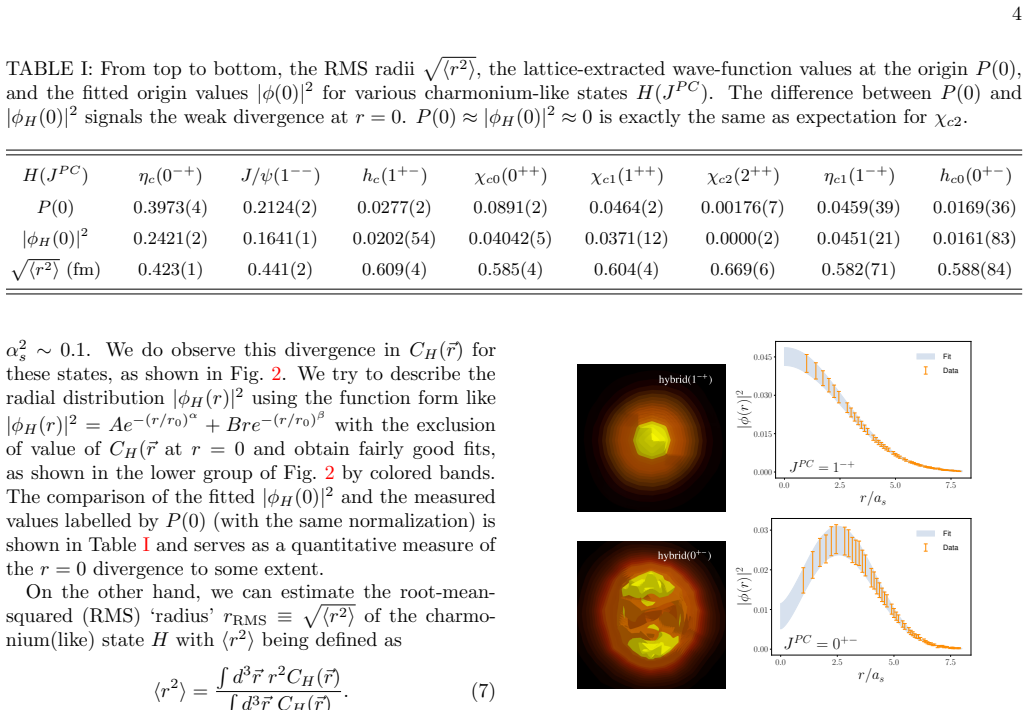
The central claim is that the charm density-density correlation $C_H(r)$, computed ab initio on a $16^3\times 128$ lattice with two degenerate light quark flavors and a tuned valence charm mass, resolves the internal spatial structure of charmonium and charmoniumlike states well enough to distinguish competing dynamical pictures. For 1S and 1P charmonia the small-$r$ behavior deviates from the nonrelativistic quark model and follows the Dirac asymptotic form $(F_{n,\kappa},G_{n,\kappa})\sim r^{s-1}$ with $s=\sqrt{\kappa^2-\alpha_s^2}$, so the lower component is not negligible because $\alpha_s\sim 0.3$; this explains the nonzero or weakly divergent density at the origin for $\eta_c$, $J/\psi$, $h_c$, $\chi_{c0}$, $\chi_{c1}$ and the small $l=2$ admixture seen in $\chi_{c1}$ and $\chi_{c2}$. For the hybrid $\eta_{c1}(1^{-+})$, the $c\bar{c}$ distribution is spherical with an $S$-wave radial profile, indicating that the charm pair is in $1^{--}$ and the $1^{+-}$ gluonic component sits in a relative $S$-wave, a configuration incompatible with the Born-Oppenheimer flux-tube picture.
Load-bearing premise
The whole reading rests on Eq. (1), which treats each charmonium state as a two-body $c\bar c$ bound state with factorized single-particle densities, neglects $c\bar c$ annihilation, and integrates out all other degrees of freedom; if this two-body factorization is inaccurate, the computed $C_H(r)$ remains a gauge-invariant lattice correlation but cannot be interpreted as the spatial wave function, or portrait, that the paper claims.
Editorial extensions
If this is right
- For 1S and 1P charmonia, the spatial wave function at $r=0$ is nonzero and weakly divergent (except for $\chi_{c2}$), so any nonrelativistic quark model prediction that forces $|\phi(r)|^2\sim r^2$ for P-waves must be revised.
- The $\eta_{c1}(1^{-+})$ hybrid should be described as a color-octet $1^{--}$ $c\bar{c}$ core in $S$-wave with a $1^{+-}$ chromomagnetic gluonic component, not as a flux tube with the $c\bar{c}$ pair in an effective $P$-wave.
- The octet Cornell potential with Casimir scaling gives a $1S$-$2S$ mass splitting of about $1.27$ GeV for this hybrid, matching the lattice spacing of $1.1$-$1.3$ GeV rather than the Born-Oppenheimer estimate near $350$ MeV.
- The measured RMS charm separations, $0.42$-$0.67$ fm across the states studied, provide a model-independent size scale against which future quark-model and effective-field-theory predictions can be tested.
Reading between the lines
- If the two-body factorization is robust, the same density-density observable could classify tetraquark and $D\bar D^*$ molecular candidates by showing whether their heavy-quark pair is compact or spatially extended.
- An implication the paper leaves implicit is that the chromomagnetic gluonic component behaves like a constituent with a mass near $0.8$ GeV; a testable extension is to predict radiative transitions of $\eta_{c1}$ from the compact $1^{--}$ core and compare with experiment.
- The conflict with the flux-tube picture suggests that other hybrid multiplets may also be organized by Casimir-scaled octet potentials rather than by string excitations; computing $C_H(r)$ for the $0^{+-}$ state and higher radial excitations would test this systematically.
Editorial analysis
A structured set of objections, weighed in public.
Referee Report
Summary. The paper reports a lattice QCD calculation of the charm quark density-density correlation C_H(r) in the conventional charmonia eta_c, J/psi, hc, chi_c0, chi_c1, chi_c2 and the charmoniumlike exotic states eta_c1(1^-+) and hc0(0^+-). Using N_f=2 gauge configurations with m_pi about 420 MeV, the authors extract C_H(r) from a four-point function and interpret it, via Eq. (1), as the squared spatial wavefunction of a two-body c-cbar bound state. On this basis they claim that the 1S and 1P charmonia show substantial relativistic effects described by the Dirac equation, that the c-cbar component of eta_c1 has quantum numbers 1-- and is in an S-wave relative to a 1^+- gluonic (chromomagnetic) component, and that this configuration disfavors the Born-Oppenheimer flux tube picture.
Significance. If the wavefunction identification were justified, this would be a novel, gauge-invariant visualization of quark distributions in charmonia and the first lattice-based portrait of the internal spatial structure of a charmoniumlike hybrid. The underlying four-point functions are legitimate lattice observables, and the idea of using density-density correlations to access hadron spatial structure is well motivated. However, the significance is conditional: the central physical conclusions all depend on the validity of Eq. (1), which is not properly derived. The raw correlation data could still be useful if reinterpreted, but the paper's headline claims as they stand are not supported.
major comments (4)
- [Introduction, Eq. (1)] Equation (1) is not a valid bridge from the lattice four-point function to a two-body spatial wavefunction. Inserting a single-particle position basis between the two density operators and identifying the resulting overlaps as one-body charge densities leads to a convolution of one-body densities. For the zero-momentum states used in Eq. (3), translation invariance makes each one-body density uniform, so the convolution is independent of r; this cannot reproduce the non-trivial r dependence in Figs. 2 and 3. The correct two-body relative distribution would be obtained from a two-body density matrix or an equal-time Bethe-Salpeter amplitude, and the connection to C_H(r) must be derived explicitly. Because the r->0 Dirac behavior, the 1-- assignment for the c-cbar component of eta_c1, the S-wave assignment for the gluonic component, and the flux-tube disfavoring all pass through this identification, this is a load-bearing issue that must be addressed before the results can be interpreted as spatial wavefunctions.
- [Portraits of 1S and 1P charmonia, Fig. 2 and Table I] The claimed small-r divergence is not directly measured. The fits to |phi_H(r)|^2 use the ad hoc functional form A exp[-(r/r0)^alpha] + B r exp[-(r/r0)^beta] and explicitly exclude r=0, and the paper does not report fit qualities, parameter uncertainties, or an analysis of the first few lattice separations. The comparison between the raw lattice value P(0) and the extrapolated |phi(0)|^2 in Table I is sensitive to the fit ansatz and to discretization effects at the shortest distance, and no continuum extrapolation is attempted. The statement that the Dirac prediction r^{-alpha_s^2} is "observed" therefore goes beyond what the data demonstrate; this matters because the radial behavior is central to the relativistic-effect claim.
- [Supplemental Material S1, Eq. (S17) and main text] The explicit total wavefunction for chi_c0 in Eq. (S17) contains only the large component F2,1 combined with Y1M S1M terms, whereas the main text (bullet list after Eq. (6)) states that the small-r behavior of chi_c0 is dominated by the lower component G2,1 with G2,1 ~ r^{s-1}. The lower component of the quark spinor, iG2,1 Y00 in the appropriate spin coupling, can combine with the antiquark spin to form a J=0 state and should appear in Psi_00(0++). This should either be included in Eq. (S17) or the omission explicitly explained; as written the two statements are inconsistent.
- [1-+ and 0+- charmoniumlike states, hybrid mass-splitting estimate] The quantitative estimate of the 1S-2S hybrid splitting is illustrative rather than a robust result. It relies on assumed effective masses of 3.0 GeV and 0.8 GeV, alpha_s about 0.3, sigma about 0.25 GeV^2, Casimir scaling, and a non-relativistic Schrodinger equation. The agreement with the lattice range 1.1-1.3 GeV should be presented as a consistency check of the model, not as a prediction of the lattice calculation reported here. This does not affect the raw correlator results but should be contextualized.
minor comments (6)
- [Throughout] There are several typographical errors: "componet" for "component", "samll r" for "small r", "nad" for "and", "view" for "viewed", and "ηc1(1−+ is" missing the closing parenthesis. These should be corrected.
- [Numerical results] The text says "N_s^3 x N_t = 16^3 x 128 isotropic lattice with the aspect ratio as/at about 5". If as/at is about 5, the lattice is not isotropic; please clarify whether the intended statement is about the temporal extent or the lattice spacing ratio.
- [Fig. 2 caption] The caption states that all panels share a common logarithmic colour scale, but the lower six panels are one-dimensional radial plots, not color-scale renderings. Please specify that the color scale applies only to the three-dimensional renderings.
- [Numerical results, Eq. (3)] The normalization in Eq. (3) should be derived more explicitly: the factor 2m_H and the cancellation of the source-sink overlap are not shown. A reader cannot verify that the ratio is the ground-state matrix element without additional intermediate steps.
- [Numerical results, spin projection] The statement that the spin state is |J J_z> = |10> for J/psi, hc, chi_c1 and proportional to (|22> - |2-2>) for chi_c2 refers to continuum quantum numbers, but the lattice operators used are in irreducible representations of the cubic group. Please clarify how the continuum quantum numbers are assigned from the cubic irreps used.
- [Abstract and Summary] The phrase "first gauge invariant and model-independent three-dimensional portraits" overstates the results: Eq. (1) is an uncontrolled approximation, and the Dirac interpretation introduces model assumptions. The wording should be softened to match what is actually established.
Circularity Check
No significant circularity: the lattice density-density correlations are independent observables, the Dirac interpretation uses external inputs, and the same-group citation [34] is corroborative rather than load-bearing.
full rationale
The central derivation is self-contained. The lattice four-point function C_H^(4) in Eq. (2) and the ratio in Eq. (3) are first-principles QCD observables; Eq. (1) is an interpretive identification of the density-density correlation with a two-body relative distribution, not a reduction of the result to a fitted input. The Dirac explanation uses the textbook Coulomb-Dirac solution [29] with an external value alpha_s ~ 0.3, not parameters fitted to C_H(r), so the r -> 0 behavior and angular multipole expectations are genuine model comparisons. The 1-- / S-wave assignment for eta_c1 follows from the measured spherical angular distribution and standard C-parity/angular-momentum rules; the same-group citation [34] is used only as corroboration, while the current lattice data independently exhibit the same shape, so the self-citation is not load-bearing. The Supplemental S2 mass-splitting is an explicit postdiction with stated external masses and couplings, and it is not used to derive the main portrait claims. The two-body factorization in Eq. (1) is an uncontrolled approximation and may threaten the wavefunction interpretation, but that is a validity concern, not circularity, because no equation or fitted parameter is recycled as a prediction.
Assumptions & free parameters
free parameters (5)
- strong coupling alpha_s =
about 0.3 (chosen, not fitted to lattice data here)
- string tension sigma =
about 0.25 GeV^2 (chosen)
- effective mass of color-octet c cbar block =
3.0 GeV (chosen)
- effective mass of chromomagnetic excitation =
0.8 GeV (chosen)
- per-state radial fit parameters (A, B, r0, alpha, beta) =
fitted to lattice |phi_H(r)|^2 for each of eight states
assumptions (5)
- domain assumption C_H(r) as defined in Eq. (1) equals the convolution of the charm and anticharm single-particle densities of the state, which requires treating the charmonium as a two-body c c' bound state with factorized densities and neglecting annihilation.
- domain assumption Near r=0 the interaction is dominated by the one-gluon-exchange Coulomb potential -alpha_s/r, so the confining term can be neglected in the Dirac equation.
- ad hoc to paper The radial and angular parts factorize as C_H(r) = |phi_H(r)|^2 |xi_H(theta, phi)|^2.
- domain assumption The 1-+ and 0+- states are c cbar g hybrids with a single gluon such that C(g) = - and the c cbar component has negative C-parity.
- domain assumption Casimir scaling of the static potential between octet charges with factor 9/4 and a Cornell form applies to the c cbar plus gluelump system.
invented entities (2)
-
1+- chromomagnetic gluonic component (gluelump)
independent evidence
-
color-octet c cbar block
Cite this review
Pith. "Pith review of Portraits of Charmoniumlike States." pith.science (2026). https://pith.science/paper/4UVMRIBE
@misc{pith2026250521193,
  author       = {Pith},
  title        = {Pith review of: Portraits of Charmoniumlike States},
  year         = {2026},
  howpublished = {\url{https://pith.science/paper/4UVMRIBE}},
  note         = {Machine review of arXiv:2505.21193}
}
abstract
The charm quark density-density correlation is calculated for $1S$ and $1P$ conventional charmonia and $J^{PC}=1^{-+},0^{+-}$ charmoniumlike states from lattice QCD and are interpreted as spatial wave functions of these states with some approximations. The angular distributions of $c\bar{c}$ in conventional charmonia are found to be in accordance with the expectation of two-body systems, while that of the $1^{-+}$ state exhibits an $S$-wave feature. However, the $c\bar{c}$ radial distributions turn out to be strikingly different from the non-relativistic quark model and can be understood by the Dirac theory of two-body bound states. These results provide the first gauge invariant and model-independent three-dimensional portraits of charmonium(like) states.
Figures


Reference graph
Works this paper leans on
-
[1]
These are more 3 or less the cases for the measured results of |ξH (θ, ϕ)|2 shown in Fig
and χc1(L = 1 , S = 1) have angular distributions |ξH (θ, ϕ)|2 ∝ cos2 θ (spindle shape) and sin 2 θ (donut shape), respectively, and that for the ( |22⟩ + |2 − 2⟩) state of χc2 is proportional to sin 2 θ. These are more 3 or less the cases for the measured results of |ξH (θ, ϕ)|2 shown in Fig. 2. We have tested rotational symmetry for z → x → y transforma...
-
[2]
Weak Interactions with Lepton-Hadron Symmetry,
S. L. Glashow, J. Iliopoulos, and L. Maiani, “Weak Interactions with Lepton-Hadron Symmetry,” Phys. Rev. D 2, 1285–1292 (1970)
work page 1970
-
[3]
Experimental Observation of a Heavy Particle J,
J. J. Aubert et al. (E598), “Experimental Observation of a Heavy Particle J,” Phys. Rev. Lett. 33, 1404–1406 (1974)
work page 1974
-
[4]
Discovery of a Narrow Resonance in e+e− Annihilation,
J. E. Augustin et al. (SLAC-SP-017), “Discovery of a Narrow Resonance in e+e− Annihilation,” Phys. Rev. Lett. 33, 1406–1408 (1974)
work page 1974
-
[5]
Thomas Appelquist, A. De Rujula, H. David Politzer, and S. L. Glashow, “Charmonium Spectroscopy,” Phys. Rev. Lett. 34, 365 (1975)
work page 1975
-
[6]
E. Eichten, K. Gottfried, T. Kinoshita, John B. Kogut, K. D. Lane, and Tung-Mow Yan, “The Spectrum of Charmonium,” Phys. Rev. Lett. 34, 369–372 (1975), [Erratum: Phys.Rev.Lett. 36, 1276 (1976)]
work page 1975
-
[7]
Mesons in a Relativized Quark Model with Chromodynamics,
S. Godfrey and Nathan Isgur, “Mesons in a Relativized Quark Model with Chromodynamics,” Phys. Rev. D 32, 189–231 (1985)
work page 1985
-
[8]
M. B. Voloshin, “Charmonium,” Prog. Part. Nucl. Phys. 61, 455–511 (2008), arXiv:0711.4556 [hep-ph]
arXiv 2008
Show all 43 references
-
[9]
Hadron Wave Functions in Lattice QCD,
B. Velikson and D. Weingarten, “Hadron Wave Functions in Lattice QCD,” Nucl. Phys. B 249, 433–444 (1985)
1985
-
[10]
Quark - Anti- quark Charge Distributions and Confinement,
K. Barad, M. Ogilvie, and C. Rebbi, “Quark - Anti- quark Charge Distributions and Confinement,” Phys. Lett. B 143, 222–226 (1984)
1984
-
[11]
Wave functions of S wave hadrons in the quenched approxi- mation to lattice QCD,
Matthew W. Hecht and Thomas A. DeGrand, “Wave functions of S wave hadrons in the quenched approxi- mation to lattice QCD,” Phys. Rev. D 46, 2155–2168 (1992)
1992
-
[12]
Comparison of lattice Coulomb gauge wave functions in quenched approximation and with dynamical fermions,
M. W. Hecht et al., “Comparison of lattice Coulomb gauge wave functions in quenched approximation and with dynamical fermions,” Phys. Rev. D 47, 285–294 (1993), arXiv:hep-lat/9208005
1993 arXiv
-
[13]
Diquark correlations in baryons on the lattice with over- lap quarks,
Ronald Babich, Nicolas Garron, Christian Hoelbling, Joseph Howard, Laurent Lellouch, and Claudio Rebbi, “Diquark correlations in baryons on the lattice with over- lap quarks,” Phys. Rev. D 76, 074021 (2007), arXiv:hep- lat/0701023
2007
-
[14]
Pion wave function from lattice QCD vs. chiral quark models,
Wojciech Broniowski, Sasa Prelovsek, Luka Santelj, and Enrique Ruiz Arriola, “Pion wave function from lattice QCD vs. chiral quark models,” Phys. Lett. B 686, 313– 318 (2010), arXiv:0911.4705 [hep-ph]. 6
2010 arXiv
-
[15]
Hadron structure in lattice QCD. 1. Correlation func- tions and wave functions,
M. C. Chu, Marcello Lissia, and John W. Negele, “Hadron structure in lattice QCD. 1. Correlation func- tions and wave functions,” Nucl. Phys. B 360, 31–66 (1991)
1991
-
[16]
Comparison of hadron quark distributions from lattice QCD and the MIT bag model,
Marcello Lissia, M. C. Chu, John W. Negele, and J. M. Grandy, “Comparison of hadron quark distributions from lattice QCD and the MIT bag model,” Nucl. Phys. A 555, 272–292 (1993)
1993
-
[17]
Charge Radii From Lattice Relative Charge Distributions,
Walter Wilcox and Keh-Fei Liu, “Charge Radii From Lattice Relative Charge Distributions,” Phys. Lett. B 172, 62 (1986)
1986
-
[18]
Relative Charge Distributions for Quarks in Lattice Mesons,
Walter Wilcox, Keh-Fei Liu, Bing-An Li, and Yun- lun Zhu, “Relative Charge Distributions for Quarks in Lattice Mesons,” Phys. Rev. D 34, 3882 (1986)
1986
-
[19]
Current overlap methods in lattice QCD,
Walter Wilcox, “Current overlap methods in lattice QCD,” Phys. Rev. D 43, 2443–2446 (1991)
1991
-
[20]
Calculation and interpretation of hadron correlation functions in lattice QCD,
M. Burkardt, J. M. Grandy, and John W. Negele, “Calculation and interpretation of hadron correlation functions in lattice QCD,” Annals Phys. 238, 441–472 (1995), arXiv:hep-lat/9406009
1995 arXiv
-
[21]
Probing hadron wave functions in lattice QCD,
C. Alexandrou, P. de Forcrand, and A. Tsapalis, “Probing hadron wave functions in lattice QCD,” Phys. Rev. D 66, 094503 (2002), arXiv:hep-lat/0206026
2002 arXiv
-
[22]
The Matter and the pseudoscalar densities in lattice QCD,
C. Alexandrou, P. de Forcrand, and A. Tsapalis, “The Matter and the pseudoscalar densities in lattice QCD,” Phys. Rev. D 68, 074504 (2003), arXiv:hep-lat/0307009
2003 arXiv
-
[23]
A Study of Hadron Deformation in Lattice QCD,
Constantia Alexandrou and Giannis Koutsou, “A Study of Hadron Deformation in Lattice QCD,” Phys. Rev. D 78, 094506 (2008), arXiv:0809.2056 [hep-lat]
2008 arXiv
-
[24]
Density distribu- tions in the B meson,
Beno ˆ ıt Blossier and Antoine G´ erardin, “Density distribu- tions in the B meson,” Phys. Rev. D 94, 074504 (2016), arXiv:1604.02891 [hep-lat]
2016 arXiv
-
[25]
Two-current correlations in the pion on the lattice,
Gunnar S. Bali, Peter C. Bruns, Luca Castagnini, Markus Diehl, Jonathan R. Gaunt, Benjamin Gl¨ aßle, Andreas Sch¨ afer, Andr´ e Sternbeck, and Christian Zim- mermann, “Two-current correlations in the pion on the lattice,” JHEP 12, 061 (2018), arXiv:1807.03073 [hep- lat]
2018 arXiv
-
[26]
X(3872) Relevant D ¯D∗ Scattering in Nf = 2 Lattice QCD,
Haozheng Li, Chunjiang Shi, Ying Chen, Ming Gong, Juzheng Liang, Zhaofeng Liu, and Wei Sun, “ X(3872) Relevant D ¯D∗ Scattering in Nf = 2 Lattice QCD,” (2024), arXiv:2402.14541 [hep-lat]
2024 arXiv
-
[27]
Decay properties of light 1 −+ hybrids,
Juzheng Liang, Siyang Chen, Ying Chen, Chunjiang Shi, and Wei Sun, “Decay properties of light 1 −+ hybrids,” Sci. China Phys. Mech. Astron. 68, 251011 (2025), arXiv:2409.14410 [hep-lat]
2025 arXiv
-
[28]
A Novel quark-field creation operator construction for hadronic physics in lattice QCD,
Michael Peardon, John Bulava, Justin Foley, Colin Morn- ingstar, Jozef Dudek, Robert G. Edwards, Balint Joo, Huey-Wen Lin, David G. Richards, and Keisuke Jimmy Juge (Hadron Spectrum), “A Novel quark-field creation operator construction for hadronic physics in lattice QCD,” Phy...
2009 arXiv
-
[29]
Excited meson radiative transitions from lat- tice QCD using variationally optimized operators,
Christian J. Shultz, Jozef J. Dudek, and Robert G. Edwards, “Excited meson radiative transitions from lat- tice QCD using variationally optimized operators,” Phys. Rev. D 91, 114501 (2015), arXiv:1501.07457 [hep-lat]
2015 arXiv
-
[30]
Wave Equations (Springer, Berlin, 1997)
Walter Greiner, Relativistic Quantum Mechanics. Wave Equations (Springer, Berlin, 1997)
1997
-
[31]
Heavy quarkonium dissociation cross-sections in rela- tivistic heavy ion collisions,
Cheuk-Yin Wong, E. S. Swanson, and Ted Barnes, “Heavy quarkonium dissociation cross-sections in rela- tivistic heavy ion collisions,” Phys. Rev. C 65, 014903 (2002), [Erratum: Phys.Rev.C 66, 029901 (2002)], arXiv:nucl-th/0106067
2002 arXiv
-
[32]
Wave Function Based Characteristics of Hybrid Mesons,
Nosheen Akbar, Bilal Masud, and Saba Noor, “Wave Function Based Characteristics of Hybrid Mesons,” Eur. Phys. J. A 47, 124 (2011), [Erratum: Eur.Phys.J.A 50, 121 (2014)], arXiv:1106.3465 [hep-ph]
2011 arXiv
-
[33]
The lightest hybrid meson super- multiplet in QCD,
Jozef J. Dudek, “The lightest hybrid meson super- multiplet in QCD,” Phys. Rev. D 84, 074023 (2011), arXiv:1106.5515 [hep-ph]
2011 arXiv
-
[34]
Hybrid Baryons in QCD,
Jozef J. Dudek and Robert G. Edwards, “Hybrid Baryons in QCD,” Phys. Rev. D 85, 054016 (2012), arXiv:1201.2349 [hep-ph]
2012 arXiv
-
[35]
Color halo scenario of charmonium- like hybrids,
Yunheng Ma, Wei Sun, Ying Chen, Ming Gong, and Zhaofeng Liu, “Color halo scenario of charmonium- like hybrids,” Chin. Phys. C 45, 093111 (2021), arXiv:1910.09819 [hep-lat]
2021 arXiv
-
[36]
Casimir scaling of SU(3) static potentials,
Gunnar Singh Bali, “Casimir scaling of SU(3) static potentials,” Phys. Rev. D 62, 114503 (2000), arXiv:hep- lat/0006022
2000
-
[37]
Charmonium: The Model,
E. Eichten, K. Gottfried, T. Kinoshita, K. D. Lane, and Tung-Mow Yan, “Charmonium: The Model,” Phys. Rev. D 17, 3090 (1978), [Erratum: Phys.Rev.D 21, 313 (1980)]
1978
-
[38]
Ab initio study of hybrid anti-b g b mesons,
K. J. Juge, J. Kuti, and C. J. Morningstar, “Ab initio study of hybrid anti-b g b mesons,” Phys. Rev. Lett. 82, 4400–4403 (1999), arXiv:hep-ph/9902336
1999 arXiv
-
[39]
Born-Oppenheimer Approximation for the XYZ Mesons,
Eric Braaten, Christian Langmack, and D. Hud- son Smith, “Born-Oppenheimer Approximation for the XYZ Mesons,” Phys. Rev. D 90, 014044 (2014), arXiv:1402.0438 [hep-ph]
2014 arXiv
-
[40]
The Chroma software system for lattice QCD,
Robert G. Edwards and Balint Joo (SciDAC, LHPC, UKQCD), “The Chroma software system for lattice QCD,” Nucl. Phys. B Proc. Suppl. 140, 832 (2005), arXiv:hep-lat/0409003
2005 arXiv
-
[41]
Solving Lattice QCD systems of equations using mixed precision solvers on GPUs,
M. A. Clark, R. Babich, K. Barros, R. C. Brower, and C. Rebbi, “Solving Lattice QCD systems of equations using mixed precision solvers on GPUs,” Comput. Phys. Commun. 181, 1517–1528 (2010), arXiv:0911.3191 [hep- lat]
2010 arXiv
-
[42]
Scaling Lattice QCD beyond 100 GPUs,
R. Babich, M. A. Clark, B. Joo, G. Shi, R. C. Brower, and S. Gottlieb, “Scaling Lattice QCD beyond 100 GPUs,” in SC11 International Conference for High Per- formance Computing, Networking, Storage and Analysis (2011) arXiv:1109.2935 [hep-lat]
2011 arXiv
-
[43]
Use quda for lattice qcd calculation with python,
Xiangyu Jiang, Chunjiang Shi, Ying Chen, Ming Gong, and Yi-Bo Yang, “Use quda for lattice qcd calculation with python,” (2024), arXiv:2411.08461 [hep-lat]. 7 SUPPLEMENT AR Y MA TERIALS S1. Relativistic angular-momentum coupling: A complete derivation When considering relativis...
2024 arXiv
Reviewed August 7, 2026 · model on record in the stance chip above.
Discussion (0). Sign in to comment.