You Shall Not Pass! Where and Why Developers Draw The Line on AI Autonomy
Pith reviewed 2026-07-02 06:31 UTC · model grok-4.3
The pith
Developers accept AI producing work under oversight but grant less autonomy for identity-defining and design tasks.
A machine-rendered reading of the paper's core claim, the machinery that carries it, and where it could break.
Core claim
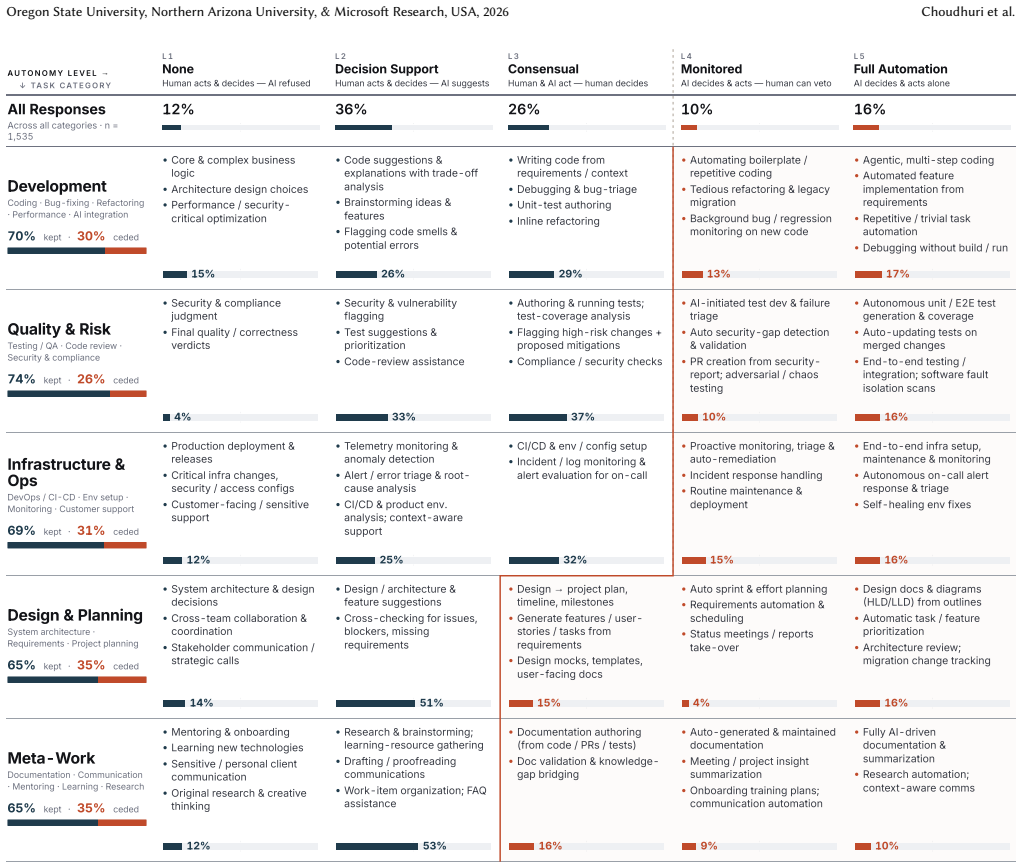
Most developers accepted AI producing work under their oversight, although accepted autonomy varied substantively across tasks and individuals. Acceptance was lowest for identity-defining, human-facing, and design-oriented work, and higher among developers with more AI experience and risk tolerance. Task accountability was associated with lower odds of allowing AI to act on developers' behalf, whereas task identity was associated with lower odds of granting AI decision-making autonomy. Task demands had the opposite effect, increasing willingness to delegate decision-making to AI.
What carries the argument
Associations between task characteristics (accountability, identity, demands) and accepted AI autonomy levels, measured via survey and interpreted through cognitive appraisal and work design theories.
If this is right
- Developers with more AI experience show higher acceptance of autonomy across tasks.
- Higher task demands increase willingness to delegate decision-making to AI.
- Task accountability lowers the odds of permitting AI to act independently on a developer's behalf.
- Preferences for AI autonomy track how developers cognitively experience their own work.
Where Pith is reading between the lines
- AI tool interfaces could adapt autonomy levels based on detected task identity or accountability.
- The pattern of resistance in identity-defining work may appear in other professional domains such as law or medicine.
- Individual risk tolerance could be assessed to personalize AI assistance levels within teams.
- As AI capabilities grow, repeated surveys might reveal whether these boundaries shift over time.
Load-bearing premise
That self-reported preferences from this single-company sample of developers reflect stable attitudes toward AI autonomy that hold beyond this population and context.
What would settle it
A replication survey at multiple non-Microsoft companies showing no link between task identity and reduced acceptance of AI decision-making autonomy.
Figures
read the original abstract
As AI takes on more software work, the line between human and AI effort is shifting. Where developers draw that line around AI autonomy bears on how we design tools and roles that preserve meaningful work. Drawing on cognitive appraisal theory, work design, and automation research, we conducted a mixed-methods study of 448 professional developers at Microsoft to investigate their accepted levels of AI autonomy across software engineering work. Most developers accepted AI producing work under their oversight, although accepted autonomy varied substantively across tasks and individuals. Acceptance was lowest for identity-defining, human-facing, and design-oriented work, and higher among developers with more AI experience and risk tolerance. Task accountability was associated with lower odds of allowing AI to act on developers' behalf, whereas task identity was associated with lower odds of granting AI decision-making autonomy. Task demands had the opposite effect, increasing willingness to delegate decision-making to AI. Our findings suggest that preferences for AI autonomy reflect how developers cognitively experience their work, highlighting important considerations for designing meaningful work.
Editorial analysis
A structured set of objections, weighed in public.
Referee Report
Summary. The paper reports results from a mixed-methods survey of 448 professional developers at Microsoft on accepted levels of AI autonomy across software engineering tasks. Drawing on cognitive appraisal theory and work design research, it finds that most developers accept AI producing work under human oversight, with acceptance varying across tasks (lowest for identity-defining, human-facing, and design-oriented work) and individuals (higher with greater AI experience and risk tolerance). Logistic associations indicate that task accountability lowers odds of allowing AI to act on the developer's behalf, task identity lowers odds of granting decision-making autonomy, and task demands increase willingness to delegate decision-making. The findings are interpreted as reflecting how developers cognitively experience their work, with implications for tool and role design.
Significance. If the reported associations hold after full methodological scrutiny, the work supplies concrete empirical patterns on developer preferences for AI autonomy that can inform HCI and software engineering tool design aimed at preserving meaningful work. The mixed-methods design and explicit grounding in established theories (cognitive appraisal, work design) are strengths that allow the authors to move beyond purely descriptive results. The single-organization sample, however, constrains claims about broader developer populations.
major comments (2)
- [Methods] Methods section: The manuscript provides no details on sampling frame, recruitment procedure, response rate, or demographic controls for the 448 Microsoft respondents. Without these, it is impossible to evaluate selection bias or to interpret the reported logistic associations (task accountability, task identity, task demands) as stable preferences rather than artifacts of the specific Microsoft context and tooling.
- [Discussion] Discussion and Conclusion: The central interpretive claim that 'preferences for AI autonomy reflect how developers cognitively experience their work' generalizes from a single-company sample to 'developers' broadly. This step is load-bearing for the paper's contribution to tool design but is not supported by cross-organization replication or behavioral validation data.
minor comments (2)
- [Abstract] Abstract: Effect sizes, model specifications, and confidence intervals for the logistic regressions are not reported, making it difficult to assess the substantive importance of the reported associations.
- [Results] Results: Tables presenting the logistic models should include the full set of predictors, variance inflation factors, and goodness-of-fit statistics to allow readers to judge robustness.
Simulated Author's Rebuttal
We thank the referee for the constructive feedback. We address each major comment below and describe the revisions we will make to strengthen the manuscript.
read point-by-point responses
-
Referee: [Methods] Methods section: The manuscript provides no details on sampling frame, recruitment procedure, response rate, or demographic controls for the 448 Microsoft respondents. Without these, it is impossible to evaluate selection bias or to interpret the reported logistic associations (task accountability, task identity, task demands) as stable preferences rather than artifacts of the specific Microsoft context and tooling.
Authors: We agree that the current Methods section lacks sufficient detail on these aspects. In the revised manuscript we will expand the Methods section to include the sampling frame (Microsoft's internal developer population), recruitment procedure (company survey distribution), response rate, and available demographic characteristics. These additions will allow readers to better assess potential selection bias and contextualize the logistic associations within the Microsoft setting. revision: yes
-
Referee: [Discussion] Discussion and Conclusion: The central interpretive claim that 'preferences for AI autonomy reflect how developers cognitively experience their work' generalizes from a single-company sample to 'developers' broadly. This step is load-bearing for the paper's contribution to tool design but is not supported by cross-organization replication or behavioral validation data.
Authors: We acknowledge that the single-organization sample constrains broad generalization. The manuscript already identifies the sample as Microsoft developers; we will revise the Discussion and Conclusion to more explicitly caveat that the observed patterns reflect cognitive experiences in this specific context and to emphasize implications for tool design primarily within similar large technology organizations. The theoretical grounding in cognitive appraisal and work design theories supports the interpretation as a basis for future research, but we will avoid overgeneralizing to all developers. revision: partial
- Absence of cross-organization replication data or behavioral validation measures beyond the survey responses
Circularity Check
No circularity: empirical survey findings rest on direct data analysis
full rationale
This is a mixed-methods empirical study reporting survey responses and logistic associations from 448 developers. No equations, derivations, fitted parameters renamed as predictions, or self-citation chains appear in the abstract or described approach. Claims about task accountability, identity, and autonomy preferences are presented as direct outputs of the data collection and analysis rather than reductions to prior inputs by construction. The paper is self-contained against external benchmarks with no load-bearing self-referential steps.
Axiom & Free-Parameter Ledger
axioms (1)
- domain assumption Cognitive appraisal theory, work design, and automation research frameworks apply to developers' decisions about AI autonomy in software engineering tasks.
Reference graph
Works this paper leans on
- [1]
-
[2]
Sadia Afroz, Zixuan Feng, Tyler Menezes, Katie Kimura, Bianca Trinkenreich, Igor Steinmacher, and Anita Sarma. 2026. The Fast and Spurious: Developer Productivity with GenAI. ACM International Conference on the Foundations of Software Engineering
2026
-
[3]
Akerlof and Rachel E
George A. Akerlof and Rachel E. Kranton. 2000. Economics and Identity.The Quarterly Journal of Economics115, 3 (2000), 715–753
2000
-
[4]
Moaath Alshaikh, Tasneem Alshaher, Ricardo Vieira, Beatriz Santana, Clelio Xavier, Jose Amancio, Glauco Carneiro, Julio Leite, Savio Freire, and Manoel Mendonca. 2026. Prompt Engineering Strategies for LLM-based Qualitative Cod- ing of Psychological Safety in Software Engineering Communities: A Controlled Empirical Study. InProceedings of the 1st Internat...
work page internal anchor Pith review Pith/arXiv arXiv 2026
-
[5]
Andrew Anderson, Jimena Noa Guevara, Fatima Moussaoui, Tianyi Li, Mihaela Vorvoreanu, and Margaret Burnett. 2022. Measuring User Experience Inclusivity in Human-AI Interaction via Five User Problem-Solving Styles.ACM Transactions on Interactive Intelligent Systems(2022)
2022
-
[6]
Anthropic. 2025. Claude. https://claude.ai/
2025
-
[7]
Julian Ashwin, Aditya Chhabra, and Vijayendra Rao. 2026. Using large language models for qualitative analysis can introduce serious bias.Sociological Methods & Research55, 3 (2026), 795–839
2026
-
[8]
David H Autor. 2015. Why are there still so many jobs? The history and future of workplace automation.Journal of economic perspectives29, 3 (2015), 3–30
2015
-
[9]
Lisanne Bainbridge. 1983. Ironies of automation. InAnalysis, design and evaluation of man–machine systems. Elsevier, 129–135
1983
-
[10]
Arnold B Bakker and Evangelia Demerouti. 2007. The job demands-resources model: State of the art.Journal of managerial psychology22, 3 (2007), 309–328
2007
-
[11]
Victor R Basili, Forrest Shull, and Filippo Lanubile. 2002. Building knowledge through families of experiments.IEEE transactions on software engineering25, 4 (2002), 456–473
2002
-
[12]
Christian Bird, Denae Ford, Thomas Zimmermann, Nicole Forsgren, Eirini Kalliamvakou, Travis Lowdermilk, and Idan Gazit. 2022. Taking Flight with Copilot: Early insights and opportunities of AI-powered pair-programming tools. Queue20, 6 (2022), 35–57
2022
-
[13]
Christian Bird, Nachiappan Nagappan, Brendan Murphy, Harald Gall, and Premkumar Devanbu. 2011. Don’t touch my code! Examining the effects of You Shall Not Pass! Where and Why Developers Draw The Line on AI Autonomy Oregon State University, Northern Arizona University, & Microsoft Research, USA, 2026 ownership on software quality. InFSE. 4–14
2011
-
[14]
Barry Boehm, Victor R Basili, et al. 2005. Software defect reduction top 10 list. Foundations of empirical software engineering: the legacy of Victor R. Basili426, 37 (2005), 426–431
2005
-
[15]
Virginia Braun and Victoria Clark. 2006. Using thematic analysis in psychology. Qualitative research in psychology3, 2 (2006), 77–101
2006
-
[16]
Virginia Braun and Victoria Clarke. 2022. Conceptual and design thinking for thematic analysis.Qualitative Psychology9, 1 (2022), 3
2022
-
[17]
1987.No silver bullet
Frederick Brooks and H Kugler. 1987.No silver bullet. April
1987
-
[18]
Adam Brown, Sarah D’Angelo, Ambar Murillo, Ciera Jaspan, and Collin Green
-
[19]
In Proceedings of the 1st ACM International Conference on AI-Powered Software
Identifying the factors that influence trust in AI code completion. In Proceedings of the 1st ACM International Conference on AI-Powered Software. 1–9
-
[20]
Jenna Butler, Jina Suh, Sankeerti Haniyur, and Constance Hadley. 2025. Dear Diary: A randomized controlled trial of Generative AI coding tools in the work- place. In2025 IEEE/ACM 47th International Conference on Software Engineering: Software Engineering in Practice (ICSE-SEIP). IEEE, 319–329
2025
-
[21]
Tavis S Campbell, Jillian A Johnson, and Kristin A Zernicke. 2020. Cognitive appraisal. InEncyclopedia of behavioral medicine. Springer, 486–487
2020
-
[22]
Ruijia Cheng, Ruotong Wang, Thomas Zimmermann, and Denae Ford. 2023. ‘It would work for me too’: How Online Communities Shape Software Developers’ Trust in AI-Powered Code Generation Tools.ACM Transactions on Interactive Intelligent Systems(2023)
2023
-
[23]
Rudrajit Choudhuri, Carmen Badea, Christian Bird, Jenna Butler, Robert DeLine, and Brian Houck. 2026. AI Where It Matters: Where, Why, and How Developers Want AI Support in Daily Work. InProceedings of the 48th International Conference on Software Engineering: Software Engineering in Practice (ICSE-SEIP)
2026
-
[24]
Rudrajit Choudhuri, Christian Bird, Carmen Badea, and Anita Sarma. 2026. To Copilot and Beyond: 22 AI Systems Developers Want Built.arXiv preprint arXiv:2604.07830(2026)
work page internal anchor Pith review Pith/arXiv arXiv 2026
-
[25]
Rudrajit Choudhuri, Christopher A Sanchez, Margaret Burnett, and Anita Sarma
-
[26]
Thinking Less, Trusting More: GenAI’s Impacts on Students’ Cognitive Habits.SSRN(2026)
2026
-
[27]
Rudrajit Choudhuri, Bianca Trinkenreich, Rahul Pandita, Eirini Kalliamvakou, Igor Steinmacher, Marco Gerosa, Christopher Sanchez, and Anita Sarma. 2025. What Guides Our Choices? Modeling Developers’ Trust and Behavioral Intentions Towards GenAI. In2025 IEEE/ACM 47th International Conference on Software Engineering (ICSE). IEEE, 1691–1703
2025
-
[28]
Rudrajit Choudhuri, Bianca Trinkenreich, Rahul Pandita, Eirini Kalliamvakou, Igor Steinmacher, Marco Gerosa, Christopher Sanchez, and Anita Sarma. 2025. What Needs Attention? Prioritizing Drivers of Developers’ Trust and Adoption of Generative AI.arXiv preprint arXiv:2505.17418(2025)
-
[29]
2023.ordinal—Regression Models for Ordinal Data
Rune Haubo Bojesen Christensen. 2023.ordinal—Regression Models for Ordinal Data. https://CRAN.R-project.org/package=ordinal R package version 2023.12-4
2023
-
[30]
2013.Statistical power analysis for the behavioral sciences
Jacob Cohen. 2013.Statistical power analysis for the behavioral sciences. Routledge
2013
-
[31]
Kevin Crowston and Francesco Bolici. 2025. Deskilling and upskilling with AI systems.Information Research an international electronic journal30, iConf (2025), 1009–1023
2025
-
[32]
Joost CF De Winter and Dimitra Dodou. 2014. Why the Fitts list has persisted throughout the history of function allocation.Cognition, Technology & Work16, 1 (2014), 1–11
2014
- [33]
-
[34]
Upol Ehsan, Samir Passi, Koustuv Saha, Todd McNutt, Mark O. Riedl, and Sara Alcorn. 2026. From Future of Work to Future of Workers: Addressing Asymp- tomatic AI Harms to Foster Dignified human-AI Interaction. InProceedings of the 2026 CHI Conference on Human Factors in Computing Systems (CHI ’26). ACM. doi:10.1145/3772318.3791081
-
[35]
Endsley and Esin O
Mica R. Endsley and Esin O. Kiris. 1995. The Out-of-the-Loop Performance Problem and Level of Control in Automation.Human Factors37, 2 (1995), 381–
1995
-
[36]
doi:10.1518/001872095779064555
- [37]
-
[38]
Zixuan Feng, Reed Milewicz, Emerson Murphy-Hill, Tyler Menezes, Alexander Serebrenik, Igor Steinmacher, and Anita Sarma. 2025. Charting Uncertain Waters: A Socio-Technical Roadmap for Sustaining Open Source Communities in the Age of GenAI.ACM Transactions on Software Engineering and Methodology(2025). doi:10.1145/3789210
-
[39]
Paul M Fitts. 1951. Human engineering for an effective air-navigation and traffic- control system. (1951)
1951
-
[40]
Bent Flyvbjerg. 2006. Five misunderstandings about case-study research.Quali- tative inquiry12, 2 (2006), 219–245
2006
-
[41]
Yitzhak Fried and Gerald R Ferris. 1987. The validity of the job characteristics model: A review and meta-analysis.Personnel psychology40, 2 (1987), 287–322
1987
-
[42]
Frink and Richard J
Dwight D. Frink and Richard J. Klimoski. 1998. Toward a Theory of Accountability in Organizations and Human Resources Management. InResearch in Personnel and Human Resources Management, Gerald R. Ferris (Ed.). Vol. 16. JAI Press, Greenwich, CT, 1–51
1998
-
[43]
2007.Data analysis using regression and multilevel/hierarchical models
Andrew Gelman and Jennifer Hill. 2007.Data analysis using regression and multilevel/hierarchical models. Cambridge university press
2007
-
[44]
Amir Ghorbani, Nathan Cassee, Derek Robinson, Adam Alami, Neil A Ernst, Alexander Serebrenik, and Andrzej Wąsowski. 2023. Autonomy is an acquired taste: Exploring developer preferences for GitHub bots. In2023 IEEE/ACM 45th International Conference on Software Engineering (ICSE). IEEE, 1405–1417
2023
-
[45]
2014.Handbook of inter-rater reliability: The definitive guide to measuring the extent of agreement among raters
Kilem L Gwet. 2014.Handbook of inter-rater reliability: The definitive guide to measuring the extent of agreement among raters. Advanced Analytics, LLC
2014
-
[46]
J Richard Hackman and Greg R Oldham. 1976. Motivation through the design of work: Test of a theory.Organizational behavior and human performance16, 2 (1976), 250–279
1976
-
[47]
Joseph F Hair. 2009. Multivariate data analysis. (2009)
2009
-
[48]
Angela T Hall, Dwight D Frink, and M Ronald Buckley. 2017. An accountability account: A review and synthesis of the theoretical and empirical research on felt accountability.Journal of Organizational Behavior38, 2 (2017), 204–224
2017
-
[49]
Donald Hedeker and Robert D Gibbons. 1994. A random-effects ordinal regression model for multilevel analysis.Biometrics(1994), 933–944
1994
- [50]
-
[51]
Stephen E Humphrey, Jennifer D Nahrgang, and Frederick P Morgeson. 2007. Integrating motivational, social, and contextual work design features: a meta- analytic summary and theoretical extension of the work design literature.Journal of applied psychology92, 5 (2007), 1332
2007
-
[52]
Brittany Johnson, Christian Bird, Denae Ford, Nicole Forsgren, and Thomas Zimmermann. 2023. Make Your Tools Sparkle with Trust: The PICSE Framework for Trust in Software Tools. In2023 IEEE/ACM 45th International Conference on Software Engineering: Software Engineering in Practice (ICSE-SEIP). IEEE, 409–419
2023
-
[53]
William A Kahn. 1990. Psychological conditions of personal engagement and disengagement at work.Academy of management journal33, 4 (1990), 692–724
1990
-
[54]
Mansi Khemka and Brian Houck. 2024. Toward Effective AI Support for Devel- opers: A survey of desires and concerns.Commun. ACM67, 11 (2024), 42–49
2024
-
[55]
Barbara A Kitchenham and Shari L Pfleeger. 2008. Personal opinion surveys. In Guide to advanced empirical software engineering. Springer, 63–92
2008
-
[56]
Richard Koestner, Natasha Lekes, Theodore A Powers, and Emanuel Chicoine
-
[57]
Attaining personal goals: self-concordance plus implementation intentions equals success.Journal of personality and social psychology83, 1 (2002), 231
2002
-
[58]
Sukrit Kumar, Drishti Goel, Thomas Zimmermann, Brian Houck, Balasubra- manyan Ashok, and Chetan Bansal. 2025. Time Warp: The Gap Between Devel- opers’ Ideal vs Actual Workweeks in an AI-Driven Era. In2025 IEEE/ACM 47th International Conference on Software Engineering: Software Engineering in Practice (ICSE-SEIP). IEEE, 12–22
2025
-
[59]
Stefano Lambiase, Gemma Catolino, Fabio Palomba, Filomena Ferrucci, and Daniel Russo. 2025. Exploring Individual Factors in the Adoption of LLMs for Specific Software Engineering Tasks.arXiv preprint arXiv:2504.02553(2025)
work page internal anchor Pith review Pith/arXiv arXiv 2025
-
[60]
1991.Emotion and adaptation
Richard S Lazarus. 1991.Emotion and adaptation. Oxford University Press
1991
-
[61]
John D Lee and Katrina A See. 2004. Trust in automation: Designing for appro- priate reliance.Human factors46, 1 (2004), 50–80
2004
-
[62]
Jeffery A. LePine, Nathan P. Podsakoff, and Marcie A. LePine. 2005. A Meta- Analytic Test of the Challenge Stressor–Hindrance Stressor Framework: An Explanation for Inconsistent Relationships Among Stressors and Performance. Academy of Management Journal48, 5 (2005), 764–775. doi:10.5465/amj.2005. 18803921
-
[63]
Jennifer S Lerner and Philip E Tetlock. 1999. Accounting for the effects of accountability.Psychological bulletin125, 2 (1999), 255
1999
-
[64]
Zijian Li, Luzhen Tang, Mengyu Xia, Xinyu Li, Naping Chen, Dragan Gašević, and Yizhou Fan. 2026. When LLMs Fall Short in Deductive Coding: Model Comparisons and Human-AI Collaboration Workflow Design. InProceedings of the 16th International Conference on Learning Analytics and Knowledge (LAK ’26). arXiv:2512.21041
-
[65]
Hannah Limerick, David Coyle, and James W Moore. 2014. The experience of agency in human-computer interactions: a review.Frontiers in human neuro- science8 (2014), 643
2014
-
[66]
Marjolein Lips-Wiersma and Lani Morris. 2009. Discriminating between ‘mean- ingful work’and the ‘management of meaning’.Journal of business ethics88, 3 (2009), 491–511
2009
-
[67]
Brian Lubars and Chenhao Tan. 2019. Ask not what AI can do, but what AI should do: Towards a framework of task delegability.Advances in neural information processing systems32 (2019)
2019
-
[68]
Russell A Matthews, Laura Pineault, and Yeong-Hyun Hong. 2022. Normalizing the use of single-item measures: Validation of the single-item compendium for organizational psychology.Journal of Business and Psychology37, 4 (2022), 639– 673
2022
-
[69]
Richard D. McKelvey and William Zavoina. 1975. A statistical model for the analysis of ordinal level dependent variables.Journal of Mathematical Sociology 4, 1 (1975), 103–120. doi:10.1080/0022250X.1975.9989847
-
[70]
John P Meyer and Natalie J Allen. 1991. A three-component conceptualization of organizational commitment.Human resource management review1, 1 (1991), Oregon State University, Northern Arizona University, & Microsoft Research, USA, 2026 Choudhuri et al. 61–89
1991
-
[71]
Microsoft. 2024. Copilot. https://copilot.microsoft.com
2024
-
[72]
Courtney Miller, Rudrajit Choudhuri, Mara Ulloa, Sankeerti Haniyur, Robert DeLine, Margaret-Anne Storey, Emerson Murphy-Hill, Christian Bird, and Jenna L Butler. 2025. ‘Maybe We Need Some More Examples:’ Individual and Team Drivers of Developer GenAI Tool Use.arXiv preprint arXiv:2507.21280(2025)
-
[73]
Shinichi Nakagawa and Holger Schielzeth. 2013. A general and simple method for obtaining R2 from generalized linear mixed-effects models.Methods in Ecology and Evolution4, 2 (2013), 133–142. doi:10.1111/j.2041-210x.2012.00261.x
-
[74]
Raja Parasuraman and Dietrich H Manzey. 2010. Complacency and bias in human use of automation: An attentional integration.Human factors52, 3 (2010), 381–410
2010
-
[75]
Raja Parasuraman, Thomas B Sheridan, and Christopher D Wickens. 2000. A model for types and levels of human interaction with automation.IEEE Transac- tions on systems, man, and cybernetics-Part A: Systems and Humans30, 3 (2000), 286–297
2000
-
[76]
Guilherme Vaz Pereira, Victoria Jackson, Rafael Prikladnicki, André van der Hoek, Luciane Fortes, Carolina Araújo, André Coelho, Ligia Chelli, and Diego Ramos
-
[77]
In2025 IEEE/ACM 47th International Conference on Software Engineering: Software Engineering in Practice (ICSE-SEIP)
Exploring GenAI in Software Development: Insights from a Case Study in a Large Brazilian Company. In2025 IEEE/ACM 47th International Conference on Software Engineering: Software Engineering in Practice (ICSE-SEIP). IEEE, 330–341
-
[78]
Qualtrics. 2026. Qualtrics Survey Platform. https://www.qualtrics.com. Accessed June 11, 2026
2026
-
[79]
Foyzur Rahman and Premkumar Devanbu. 2011. Ownership, experience and defects: a fine-grained study of authorship. InProceedings of the 33rd international conference on software engineering. 491–500
2011
-
[80]
Ira J Roseman and Craig A Smith. 2001. Appraisal theory.Appraisal processes in emotion: Theory, methods, research(2001), 3–19
2001
discussion (0)
Sign in with ORCID, Apple, or X to comment. Anyone can read and Pith papers without signing in.