A 3D tomography of the Local Bubble with SKA-Low
Pith reviewed 2026-06-25 20:40 UTC · model grok-4.3
The pith
An SKA-Low polarization survey at 50-350 MHz can map the three-dimensional structure of the magnetized gas inside the Local Bubble.
A machine-rendered reading of the paper's core claim, the machinery that carries it, and where it could break.
Core claim
An SKA-Low polarization survey covering 50-350 MHz will deliver high-sensitivity and high-resolution images of diffuse polarized emission that originates from the local interstellar medium and is probably related with the LB. Such a survey will also determine precisely the rotation measures for the polarized structures using RM synthesis. These will allow us to reveal the 3D structure of the magnetized medium in the LB and to understand how the LB forms and evolves.
What carries the argument
RM synthesis applied to high-sensitivity polarization images from SKA-Low, which separates emission at different distances along the line of sight to build a 3D map.
If this is right
- High-sensitivity and high-resolution images of diffuse polarized emission from the local ISM will be produced.
- Precise rotation measures for the polarized structures will be obtained across 50-350 MHz.
- The three-dimensional distribution of the magnetized medium inside the Local Bubble will be reconstructed.
- New constraints on the formation and evolutionary history of the Local Bubble will become available.
Where Pith is reading between the lines
- Comparison of the resulting 3D magnetic maps with existing X-ray or dust data could test whether the Local Bubble is a single coherent structure or a composite of overlapping cavities.
- The same survey data might reveal whether magnetic fields inside the bubble differ systematically from those in the surrounding galactic disk.
- If successful, the technique could be extended to other nearby bubbles or shells once similar low-frequency polarization surveys cover wider sky areas.
Load-bearing premise
The observed diffuse polarized emission originates from the local interstellar medium and is connected to the Local Bubble.
What would settle it
If the derived rotation measures or polarized structures show no spatial correspondence with the known boundaries and distances of the Local Bubble, the 3D tomography would not map the bubble's interior.
Figures
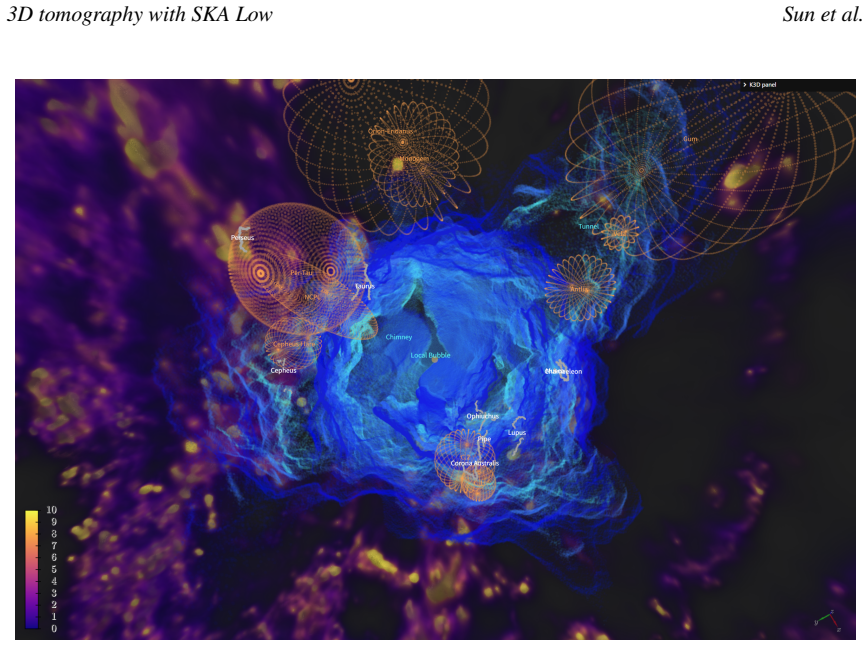
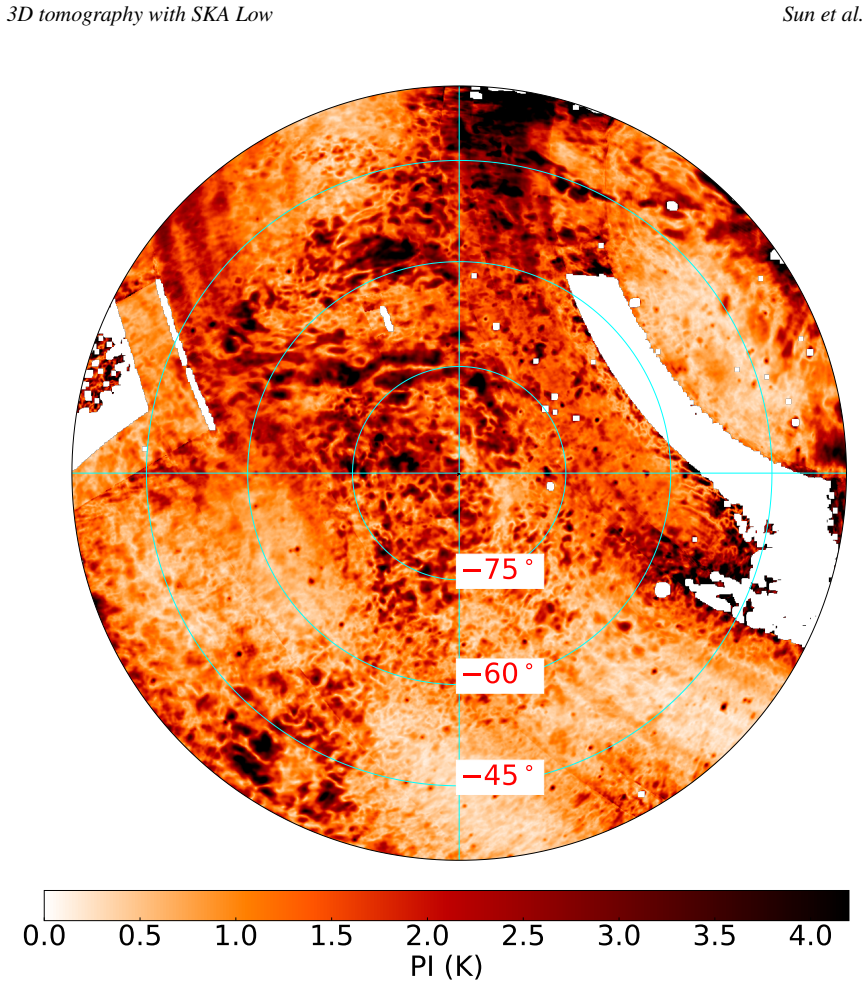
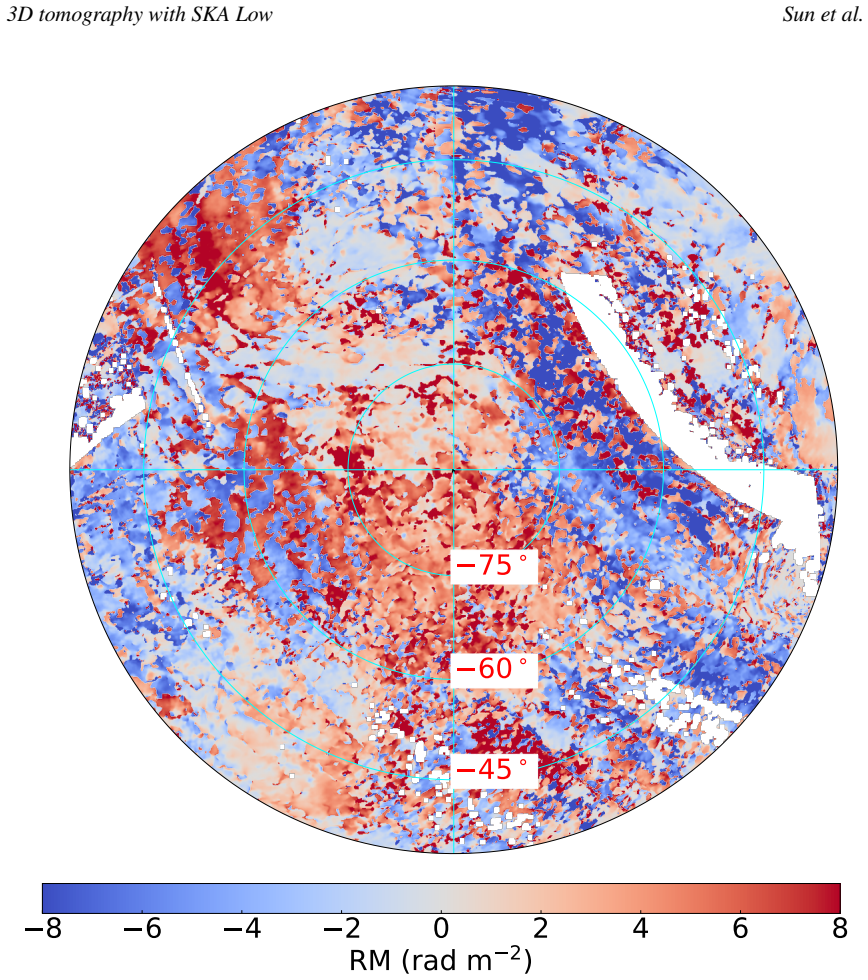
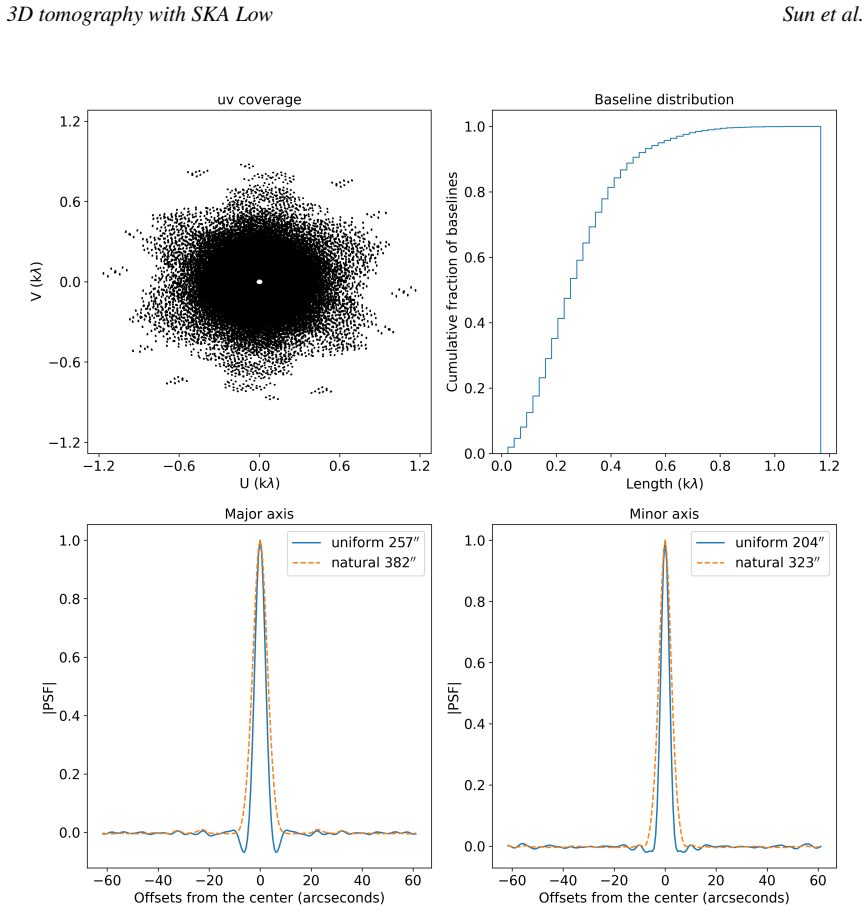
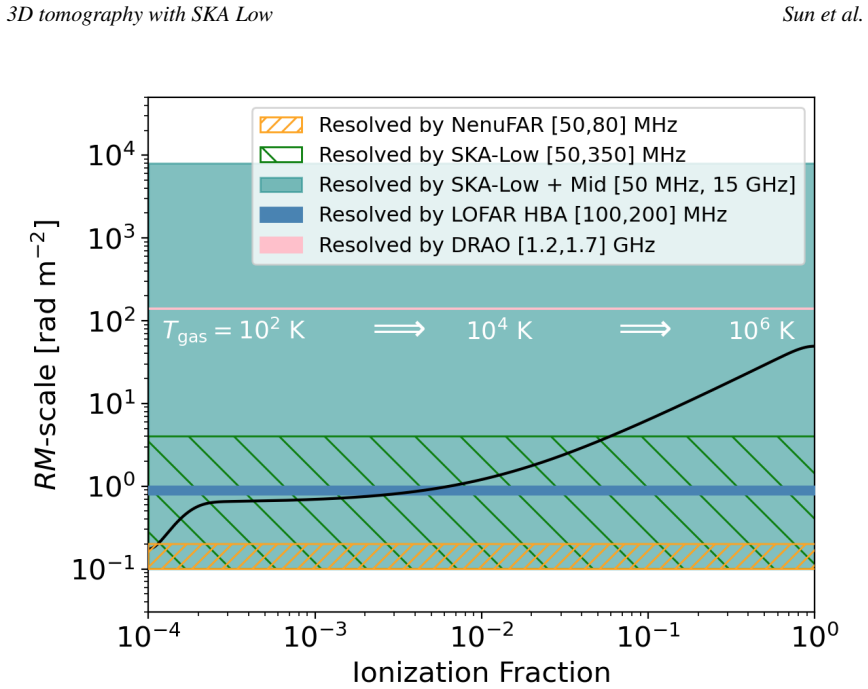
read the original abstract
We know we reside in the Local Bubble (LB), but we know little about the magnetized gas inside the LB. The SKA-Low with more than half of the total number of stations distributed within 1 km distance provides enough short baselines and thus great surface brightness sensitivity. An SKA-Low polarization survey covering the frequency range of 50-350 MHz will deliver high-sensitivity and high-resolution images of diffuse polarized emission that originates from the local interstellar medium (ISM) and is probably related with the LB. Such a survey will also determine precisely the rotation measures (RMs) for the polarized structures using RM synthesis. These will allow us to reveal the 3D structure of the magnetized medium in the LB and to understand how the LB forms and evolves.
Editorial analysis
A structured set of objections, weighed in public.
Referee Report
Summary. The manuscript proposes that an SKA-Low polarization survey covering 50-350 MHz will deliver high-sensitivity, high-resolution images of diffuse polarized emission from the local ISM (presumed related to the Local Bubble) and enable precise RM determination via RM synthesis, thereby revealing the 3D magnetized structure of the LB and its formation/evolution.
Significance. If the local-origin assumption holds and the survey is executed, the approach could provide novel 3D constraints on the magnetized local ISM. The paper presents no data, validation, or error analysis, so significance remains prospective and contingent on addressing the separation of local versus distant contributions.
major comments (1)
- [Abstract] Abstract: The assertion that diffuse polarized emission 'originates from the local interstellar medium (ISM) and is probably related with the LB' is stated without citation, supporting argument, or any described method to isolate local from distant Galactic contributions. RM synthesis on non-local or superposed emission would not map LB properties, rendering this premise load-bearing for the central tomography claim.
Simulated Author's Rebuttal
We thank the referee for their constructive report on our proposal for an SKA-Low polarization survey to perform 3D tomography of the Local Bubble. The single major comment highlights a key premise that requires strengthening, and we address it directly below. We will revise the manuscript accordingly while preserving its prospective nature as a survey concept.
read point-by-point responses
-
Referee: [Abstract] Abstract: The assertion that diffuse polarized emission 'originates from the local interstellar medium (ISM) and is probably related with the LB' is stated without citation, supporting argument, or any described method to isolate local from distant Galactic contributions. RM synthesis on non-local or superposed emission would not map LB properties, rendering this premise load-bearing for the central tomography claim.
Authors: We agree this premise is load-bearing and currently under-supported in the text. The revised manuscript will add citations to existing literature on local ISM polarized emission (e.g., studies linking low-frequency diffuse polarization to nearby structures) and include a dedicated paragraph outlining approaches to separate local versus distant contributions. These will draw on the survey's wide 50-350 MHz bandwidth for depolarization analysis, frequency-dependent Faraday effects, and cross-checks with extragalactic RM grids. We note that full validation of separation techniques would require future data, but the proposal will now explicitly discuss how the survey design facilitates such isolation rather than assuming it outright. revision: yes
Circularity Check
No circularity: proposal paper with no derivations or self-referential steps
full rationale
The document is a forward-looking observational proposal. It contains no equations, no fitted parameters, no derivation chain, and no self-citations that bear load on any claimed result. The central statement is a prediction about future survey capabilities conditioned on an explicit premise (diffuse polarized emission originates from the local ISM and is probably related to the LB). That premise is stated outright rather than derived, and the paper performs no reduction of any output back to its own inputs. This matches the default case of a self-contained proposal with no circularity.
Axiom & Free-Parameter Ledger
axioms (1)
- domain assumption Diffuse polarized emission at 50-350 MHz originates from the local ISM and is probably related to the LB
Reference graph
Works this paper leans on
-
[1]
doi: 10.1051/0004-6361/201832637. G. Bernardi et al.ApJ, 771(2):105, July
-
[2]
doi: 10.1088/0004-637X/771/2/105. F. Boulanger et al.A&A, 687:A102, July
-
[3]
doi: 10.1051/0004-6361/202348953. A. Bracco et al.A&A, 644:L3, Dec
-
[4]
doi: 10.1051/0004-6361/202039283. A. Bracco et al.A&A, 663:A37, July
-
[5]
doi: 10.1051/0004-6361/202142453. D. Breitschwerdt et al.Nature, 532(7597):73–76, Apr
-
[6]
M.A.BrentjensandA.G.deBruyn.A&A,441(3):1217–1228,Oct.2005
doi: 10.1038/nature17424. M.A.BrentjensandA.G.deBruyn.A&A,441(3):1217–1228,Oct.2005. doi: 10.1051/0004-6361: 20052990. B. J. Burn.MNRAS, 133:67, Jan
-
[7]
doi: 10.1093/mnras/133.1.67. R. Byrne et al.MNRAS, 510(2):2011–2024, Feb
-
[8]
X.Chenetal.ChineseJournalofSpaceScience,43(1):43–59,Jan.2023
doi: 10.1093/mnras/stab3276. X.Chenetal.ChineseJournalofSpaceScience,43(1):43–59,Jan.2023. doi: 10.11728/cjss2023. 01.220104001. D.P.CoxandR.J.Reynolds.ARA&A,25:303–344,Jan.1987. doi: 10.1146/annurev.aa.25.090187. 001511. G. Edenhofer et al.A&A, 685:A82, May
-
[9]
doi: 10.1051/0004-6361/202347628. A. Erceg et al.A&A, 663:A7, July
-
[10]
doi: 10.1051/0004-6361/202142244. A. Erceg et al.A&A, 687:A23, July 2024a. doi: 10.1051/0004-6361/202348586. A. Erceg et al.A&A, 688:A200, Aug. 2024b. doi: 10.1051/0004-6361/202450082. K. Ferrière.Plasma Physics and Controlled Fusion, 62(1):014014, Jan
-
[11]
doi: 10.1111/j.1365-2966.2006.11044.x. B. M. Gaensler et al.ApJ, 549(2):959–978, Mar
-
[12]
doi: 10.1086/319468. M. Gerin, H. Liszt, J. Pety, and A. Faure.A&A, 686:A49, June
-
[14]
doi: 10.1146/annurev-astro-091916-055221. M.Haverkorn. InA.Lazarian,E.M.deGouveiaDalPino,andC.Melioli,editors,MagneticFields in Diffuse Media, volume 407 ofAstrophysics and Space Science Library, page 483, Jan
-
[15]
doi: 10.1007/978-3-662-44625-6_17. V. Jelić et al.A&A, 568:A101, Aug
-
[16]
doi: 10.1051/0004-6361/201423998. V. Jelić et al.A&A, 615:L3, July
-
[17]
M.Johnston-Hollittetal.In AdvancingAstrophysicswiththeSquareKilometreArray(AASKA14), page 92,
doi: 10.1051/0004-6361/201833291. 12 3D tomography with SKA Low Sun et al. A.Korochkin,D.Semikoz,andP.Tinyakov.A&A,693:A284,Jan.2025. doi: 10.1051/0004-6361/ 202451440. A. Lazarian, K. H. Yuen, and D. Pogosyan.ApJ, 974(2):237, Oct
-
[19]
doi: 10.3847/0004-637X/830/1/38. E. Maconi et al.MNRAS, 523(4):5995–6010, Aug
-
[20]
doi: 10.1093/mnras/stad1854. E. Maconi et al.A&A, 698:A84, June
-
[21]
doi: 10.1051/0004-6361/202451477. M. E. Nord et al.AJ, 132(1):242–252, July
-
[22]
doi: 10.1086/504407. T. J. O’Neill, C. Zucker, A. A. Goodman, and G. Edenhofer.ApJ, 973(2):136, Oct
-
[23]
doi: 10.3847/1538-4357/ad61de. T. J. O’Neill et al.ApJ, 988(2):191, Aug
-
[24]
doi: 10.3847/1538-4357/ade306. V. Pelgrims, M. Unger, and I. C. Mariş.A&A, 695:A148, Mar
-
[25]
doi: 10.1051/0004-6361/ 202452943. R. S. Roger, C. H. Costain, T. L. Landecker, and C. M. Swerdlyk.A&AS., 137:7–19, May
-
[26]
doi: 10.1051/aas:1999239. T. W. Shimwell et al.A&A, 598:A104, Feb
-
[27]
O.M.Smirnovetal.Monthly Notices of the Royal Astronomical Society: Letters,538(1):L62–L68,
doi: 10.1051/0004-6361/201629313. D.D.Sokoloffetal.MNRAS,299(1):189–206,Aug.1998.doi: 10.1046/j.1365-8711.1998.01782.x. M. Spinelli, G. Bernardi, and M. G. Santos.MNRAS, 479(1):275–283, Sept
-
[28]
doi: 10.1088/1674-4527/10/12/009. X. H. Sun, W. Reich, A. Waelkens, and T. A. Enßlin.A&A, 477(2):573–592, Jan
-
[29]
doi: 10.1051/0004-6361:20078671. X. H. Sun et al.AJ, 149(2):60, Feb
-
[30]
doi: 10.1088/0004-6256/149/2/60. L. Turić et al.A&A, 654:A5, Oct
-
[31]
doi: 10.1051/0004-6361/202141071. C. L. Van Eck et al.A&A, 597:A98, Jan
-
[32]
doi: 10.1051/0004-6361/201629707. C. L. Van Eck et al.A&A, 623:A71, Mar
-
[33]
doi: 10.1051/0004-6361/201834777. S. Vanderwoude et al.AJ, 167(5):226, May
-
[34]
doi: 10.3847/1538-3881/ad2fc8. I. Šnidarić et al.A&A, 674:A119, June
-
[35]
doi: 10.1051/0004-6361/202245124. R. B. Wayth et al.PASA, 32:e025, June
-
[36]
doi: 10.1017/pasa.2015.26. J. M. Yao, R. N. Manchester, and N. Wang.ApJ, 835(1):29, Jan
-
[37]
doi: 10.3847/1538-4357/ 835/1/29. C. Zucker et al.Nature, 601(7893):334–337, Jan
-
[38]
doi: 10.1038/s41586-021-04286-5. 13
discussion (0)
Sign in with ORCID, Apple, or X to comment. Anyone can read and Pith papers without signing in.