REVIEW 3 major objections 6 minor 65 references
Information-Theoretic Detection of Unusual Source Code Changes
T0 review · 3 major / 6 minor · reviewed 2026-08-07 · deepseek-v4-flash
Pith's one-line read Shannon entropy of source code flags unusual commits with over 60% precision.
desk verdict Large-scale entropy-evolution study with a candid but author-labelled precision claim; worth peer review, but the >60% anomaly-detection number needs maintainer labels and a baseline before it becomes credible. read the letter →
The pith
A machine-rendered reading of the paper's core claim, the machinery that carries it, and where it could break.
The reading
What carries the argument
The mechanism is the per-commit entropy delta. Textual entropy is the Shannon entropy of the token histogram, $H_{\text{TOKEN}} = -\sum_{w\in W} p(w)\log_2 p(w)$, and structural entropy is the same calculation over the frequencies of abstract-syntax-tree edge types. After each commit, the total entropy of the changed files is recomputed and compared with the previous state, producing a delta that is added to a running distribution of past deltas; a commit is flagged as unusual when its delta has a z-score of at least 3. A configurable memory window determines how many past deltas remain in the distribution, and the study varies this window at 50%, 75%, and 100% of the commit history.
What would settle it
Ask the maintainers of the sampled projects to label the detected outlier commits as surprising or routine without seeing the researchers' labels, then recompute precision against those maintainer labels; if agreement is no better than chance or precision falls below 60%, the paper's central claim fails.
Extended reading notes
Core claim
The paper's central claim is that the Shannon entropy of a project's source code, measured over token frequencies and over abstract-syntax-tree edge types, captures how much information each commit inserts or removes, and that large entropy deltas mark changes a maintainer would want to examine. Textual entropy is $H_{\text{TOKEN}} = -\sum_{w \in W} p(w)\log_2 p(w)$, and structural entropy applies the same formula to the histogram of AST edge types. Over 1,827,204 change events from 95 Java projects, commits whose delta against the recent distribution of deltas exceeded a z-score threshold were judged by the authors' manual review to be relevant in 58–83% of cases, with 72.5% under their main conservative definition. The same data yield weak correlations with McCabe's cyclomatic complexity and with line/token counts, leading the paper to claim that entropy measures a different dimension of complexity, and support Lehman's laws of continuing change and increasing complexity while contradicting the smooth-growth and organizational-stability laws.
Load-bearing premise
The load-bearing premise is that the research team's judgement of which outlier commits are important matches what the projects' own maintainers would consider important.
Editorial extensions
If this is right
- On the full-history setting, flagged commits were judged relevant in 58% of cases under the most conservative definition and 83% under the least conservative, with 72.5% at the paper's main conservative level.
- Entropy metrics correlate weakly with McCabe cyclomatic complexity (range -0.05 to 0.32) and with line/token counts, indicating that information-theoretic measures capture a different dimension of code complexity.
- About two-thirds of detected unusual events involve internal, programmer-facing concerns, while user-facing changes are rare (about 10%) but tend to touch many files at once.
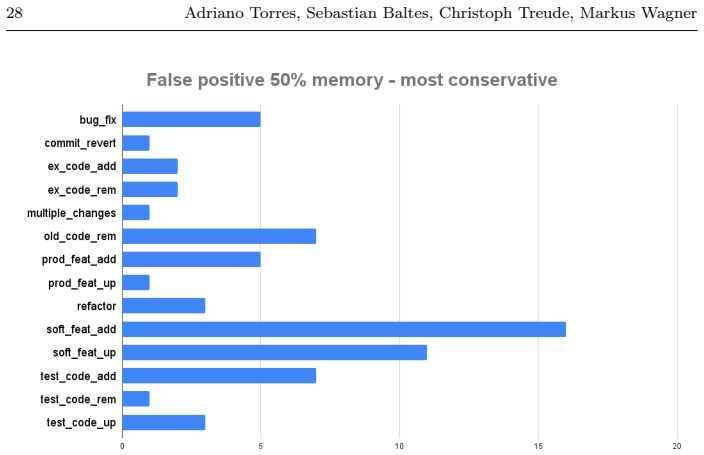
- Limiting the memory window from full history to 50% of commits raises the number of detected events by roughly 20% but lowers precision, meaning detection thresholds must track the project's current pace of entropy change.
- Lehman's laws of continuing change and increasing complexity are supported by the entropy data, while the smooth-growth and organizational-stability laws are not in this open-source sample.
Reading between the lines
- The paper does not test it, but the memory-size results suggest the z-score threshold should be adapted to the local slope of entropy growth, so that early steep phases and later stable phases receive different outlier criteria.
- The paper argues for language agnosticism from representation histograms, yet only studies Java; a direct check is to run the same detector on Python or JavaScript repositories and see whether maintainer-validated precision holds above 60%.
- Because entropy correlates weakly with cyclomatic complexity, a fused surprisal index may catch changes neither metric flags alone; the correlation tables in the paper make that a concrete next experiment rather than a mere suggestion.
Editorial analysis
A structured set of objections, weighed in public.
Referee Report
Summary. The paper defines Shannon-entropy metrics for two source-code representations (token streams and abstract syntax tree edges), mines the complete commit histories of 95 actively maintained Java GitHub projects, and investigates four research questions: trends of entropy evolution (RQ1), correlations with classic complexity metrics (RQ2), agreement with Lehman's laws of software evolution (RQ3), and entropy-based anomaly detection of unusual source-code changes (RQ4). The central quantitative claim is that the proposed detection approach can recognize unusual change events with over 60% precision, based on manually labeled samples of outlier commits.
Significance. If validated, the paper would provide a lightweight, deterministic, and language-agnostic signal for identifying unusual source-code changes, complementing existing complexity metrics and offering a reproducible basis for future information-theoretic work on software evolution. The study's strengths include its scale (95 projects, 1,827,204 change events), commit-by-commit granularity, promised availability of code and data, explicit reporting of inter-rater agreement, and unusually candid treatment of threats to validity. However, the headline precision claim is currently supported only by labels assigned by the authors themselves, and the detection threshold appears to be selected on the same labeled data, so the practical significance of the >60% figure remains conditional on external validation.
major comments (3)
- [Abstract; §4.4.1; Table 7] The central claim that the approach 'may effectively recognise unusual source code change events with over 60% precision' is measured against labels assigned by the authors, not by the maintainers of the 95 projects. Section 7 explicitly concedes that 'the precision of our detection may be vastly inferior to that obtained if events were labelled by the actual maintainers.' Moreover, Table 7 shows that the most conservative strictness level yields 58.12% precision for the 100% memory configuration, so the abstract's 'over 60%' is not supported by the most conservative row. The paper should either obtain maintainer ground-truth labels for a validation sample or reframe the claim as a proof-of-concept precision estimate under author-defined relevance, with the associated uncertainty made explicit.
- [§4.4.1; §7] The z-score threshold used to define outliers appears to be tuned on the same manually labeled data used for evaluation. Section 4.4.1 states that any change with z-score less than or equal to 3 was considered a false positive, while Section 7 reveals that the authors selected 'the definition of statistical outlier (i.e., z-score) for which we observed the best signal-to-noise ratio.' This in-sample threshold selection, combined with the additional free parameters of maximum memory size and the 50% feature-code contribution filter, means the precision estimates in Table 7 are likely optimistic. The authors should report how the threshold was chosen, justify it independently of the evaluation labels, or provide a sensitivity analysis that separates threshold selection from precision measurement.
- [§4.4.1; Table 7] The precision results are highly sensitive to the maximum memory configuration, yet the manuscript presents only the 100% memory setting as supporting the abstract's claim. Table 7 reports precision drops to 40.12% at 50% memory even in the least conservative strictness level, and the RQ4 summary notes that reducing memory increases detected events by about 20% but decreases precision. Since the choice of maximum memory is a free parameter with no clear a-priori justification, the paper should either justify the full-memory configuration as the intended deployment setting or present the precision claim across configurations with a clear recommendation.
minor comments (6)
- [§1.2, Eq. (2)] Equation (2) is missing the minus sign that appears in Equation (1); as written, H(X) would be negative for a non-degenerate distribution.
- [§1.1, §5, §10] There are several typos: 'cyclomacic complexity' should be 'cyclomatic complexity', 'Halmstead' should be 'Halstead', and 'README.me' should be 'README.md'.
- [Table 3] The table caption reads 'increasing percentual changes of information content' but the table reports counts of spikes and drops; please clarify whether these are absolute percentage changes and how the spike/drop rows are defined.
- [§4.4.2, Figure 10, Table 6] The text and Figure 10 refer to a sample of 350 points for the full context window, while Table 6 lists a 95% confidence-interval sample of 320 points and the accompanying text says n = 321; these numbers should be reconciled.
- [§6] The comparison with ChatGPT-4 is largely speculative and not grounded in the empirical data collected for the other research questions; consider moving it to a clearly marked discussion subsection or shortening it so it does not distract from the paper's contributions.
- [§3.2, Eq. (4)] The paper refers to 'structural entropy obtained from the edges of the respective AST' but does not explain whether edge types, node types, or both are counted; please clarify the exact histogram used for Equation (4).
Circularity Check
Precision claim in RQ4 is fitted to the same labels used for evaluation, not predicted independently.
-
fitted input called prediction
[Section 7 (Threats to validity), construct validity paragraph, re Section 4.4.1 and Table 7]
"We attempted to mitigate both effects by being conservative when labelling points, i.e., by being willing to accept higher false positive rates, and by selecting the definition of statistical outlier (i.e., z-score) for which we observed the best signal-to-noise ratio."
The detector's z-score cutoff is described as selected for the best signal-to-noise ratio on the observed data, and the same manually labelled events are then used to compute the precision in Table 7 that supports the abstract's 'over 60% precision' claim. This is a fitted parameter being presented as if it were an independent evaluation: the precision is not a neutral prediction of detector quality but partly an artifact of choosing the cutoff that makes the labelled data look best. Since the label set was created by the authors (Section 4.4.1) and not by project maintainers, there is no external ground truth to break the loop. The central RQ4 result is therefore statistically forced by the threshold selection rather than derived from the entropy measure alone.
full rationale
Most of the paper is self-contained: the entropy metrics in Equations 3 and 4 are standard Shannon entropy applied to token and AST-edge histograms, and the RQ1-RQ3 analyses (trends, correlations, Lehman's laws) do not reduce to their inputs. No load-bearing self-citation chain or imported uniqueness theorem appears; the cited prior work (Torres et al., 2023) is an earlier version rather than a forbidden premise. The circularity concern is concentrated in RQ4. The paper's own Section 7 admits that the z-score definition of an outlier was selected for the best observed signal-to-noise ratio, and the precision table used to support the 'over 60% precision' claim is computed on the same manually labelled events. That is a fitted parameter being evaluated on the fitting label set, so the headline precision is optimistically biased by construction. The authors also candidly state that maintainer-validated precision 'may be vastly inferior' to their own labels, reinforcing that the quantitative claim is not independently grounded. A maintainer relabeling study with a pre-registered threshold would be needed to turn the precision estimate into a genuine prediction. Because the entropy definitions and evolution analyses are independent, the circularity is partial rather than total.
Assumptions & free parameters
free parameters (3)
- z-score outlier threshold =
3
- maximum memory size =
50%, 75%, 100% of commits
- false-positive feature-code threshold =
50% of entropy contribution
assumptions (4)
- standard math The Shannon entropy formula (Eq. 1) is a valid measure of information content for a discrete source.
- domain assumption Frequencies of tokens and AST edges in each file adequately represent the information content of source code.
- domain assumption The 95 selected GitHub projects are representative of actively maintained open-source software.
- domain assumption Software 'naturalness' (Hindle et al.) implies that language choices do not materially affect entropy evolution patterns.
invented entities (1)
-
Surprisal Index (SI)
Cite this review
Pith. "Pith review of Information-Theoretic Detection of Unusual Source Code Changes." pith.science (2026). https://pith.science/paper/4VS2Y5UC
@misc{pith2026250606508,
  author       = {Pith},
  title        = {Pith review of: Information-Theoretic Detection of Unusual Source Code Changes},
  year         = {2026},
  howpublished = {\url{https://pith.science/paper/4VS2Y5UC}},
  note         = {Machine review of arXiv:2506.06508}
}
read the original abstract
The code base of software projects evolves essentially through inserting and removing information to and from the source code. We can measure this evolution via the elements of information - tokens, words, nodes - of the respective representation of the code. In this work, we approach the measurement of the information content of the source code of open-source projects from an information-theoretic standpoint. Our focus is on the entropy of two fundamental representations of code: tokens and abstract syntax tree nodes, from which we derive definitions of textual and structural entropy. We proceed with an empirical assessment where we evaluate the evolution patterns of the entropy of 95 actively maintained open source projects. We calculate the statistical relationships between our derived entropy metrics and classic methods of measuring code complexity and learn that entropy may capture different dimensions of complexity than classic metrics. Finally, we conduct entropy-based anomaly detection of unusual changes to demonstrate that our approach may effectively recognise unusual source code change events with over 60% precision, and lay the groundwork for improvements to information-theoretic measurement of source code evolution, thus paving the way for a new approach to statically gauging program complexity throughout its development.
Figures


Figures from the paper (14 more)




Reference graph
Works this paper leans on
-
[1]
Aho AV, Sethi R, Ullman JD (1986) Compilers, Principles, Techniques, and Tools . Addison-Wesley
work page 1986
-
[2]
Akundi A, Smith E, Tseng TL (2018) Information entropy applied to software based control flow graphs. International Journal of System Assurance Engineering and Management 9, doi:10.1007/s13198-018-0740-y
-
[3]
Allen E, Khoshgoftaar T, Chen Y (2001) Measuring coupling and cohesion of software modules: an information-theory approach. In: Proceedings Seventh International Software Metrics Symposium, pp 124--134, doi:10.1109/METRIC.2001.915521
-
[4]
Anonymous (2024) GSM -symbolic: Understanding the limitations of mathematical reasoning in large language models. In: Submitted to The Thirteenth International Conference on Learning Representations, ://openreview.net/forum?id=AjXkRZIvjB, under review
work page 2024
-
[5]
Empirical Software Engineering 27(4):94
Baltes S, Ralph P (2022) Sampling in software engineering research: A critical review and guidelines. Empirical Software Engineering 27(4):94
work page 2022
- [6]
-
[7]
Software Engineering, IEEE Transactions on 22:875 -- 885, doi:10.1109/32.553636
Blackburn J, Scudder G, Van Wassenhove L (1997) Improving speed and productivity of software development: A global survey of software developers. Software Engineering, IEEE Transactions on 22:875 -- 885, doi:10.1109/32.553636
-
[8]
Annals of software engineering 1:57--94
Boehm B, Clark B, Horowitz E, Westland C, Madachy R, Selby R (1995) Cost models for future software life cycle processes: Cocomo 2.0. Annals of software engineering 1:57--94
work page 1995
Show all 65 references
-
[9]
Prentice Hall Press
Boehm BW, Abts C, Brown AW, Chulani S, Clark BK, Horowitz E, Madachy R, Reifer DJ, Steece B (2009) Software cost estimation with COCOMO II. Prentice Hall Press
2009
-
[10]
Handbook of research methods in social and personality psychology pp 3--16
Brewer MB, Crano WD (2000) Research design and issues of validity. Handbook of research methods in social and personality psychology pp 3--16
2000
-
[11]
CoRR abs/2005.14165, ://arxiv.org/abs/2005.14165, 2005.14165
Brown TB, Mann B, Ryder N, Subbiah M, Kaplan J, Dhariwal P, Neelakantan A, Shyam P, Sastry G, Askell A, Agarwal S, Herbert - Voss A, Krueger G, Henighan T, Child R, Ramesh A, Ziegler DM, Wu J, Winter C, Hesse C, Chen M, Sigler E, Litwin M, Gray S, Chess B, Clark J, Berner C, M...
2020 arXiv
-
[12]
Empirical Software Engineering 19(1):1--38
Canfora G, Cerulo L, Cimitile M, Di Penta M (2014) How changes affect software entropy: an empirical study. Empirical Software Engineering 19(1):1--38
2014
-
[13]
Int J Syst Assur Eng Manag 5(2):155--164, doi:10.1007/s13198-014-0226-5, ://doi.org/10.1007/s13198-014-0226-5
Chaturvedi KK, Kapur PK, Anand S, Singh VB (2014) Predicting the complexity of code changes using entropy based measures. Int J Syst Assur Eng Manag 5(2):155--164, doi:10.1007/s13198-014-0226-5, ://doi.org/10.1007/s13198-014-0226-5
2014 doi
-
[14]
IEEE Transactions on Software Engineering SE-4(3):187--194, doi:10.1109/TSE.1978.231497
Chen E (1978) Program complexity and programmer productivity. IEEE Transactions on Software Engineering SE-4(3):187--194, doi:10.1109/TSE.1978.231497
1978
-
[15]
In: 2016 31st IEEE/ACM International Conference on Automated Software Engineering (ASE), pp 332--343
Christakis M, Bird C (2016) What developers want and need from program analysis: An empirical study. In: 2016 31st IEEE/ACM International Conference on Automated Software Engineering (ASE), pp 332--343
2016
-
[16]
Computer 27(8):44--49, doi:10.1109/2.303623
Coleman D, Ash D, Lowther B, Oman P (1994) Using metrics to evaluate software system maintainability. Computer 27(8):44--49, doi:10.1109/2.303623
1994 doi
-
[17]
Software Engineering Strategies pp 52--60
Cook C (1993) Information theory metric for assembly language. Software Engineering Strategies pp 52--60
1993
-
[18]
The Annals of Probability 3(1):146 -- 158, doi:10.1214/aop/1176996454, ://doi.org/10.1214/aop/1176996454
Csiszar I (1975) I -Divergence Geometry of Probability Distributions and Minimization Problems . The Annals of Probability 3(1):146 -- 158, doi:10.1214/aop/1176996454, ://doi.org/10.1214/aop/1176996454
1975
-
[19]
In: 18th IEEE/ACM International Conference on Mining Software Repositories, MSR 2021, IEEE , pp 560--564
Dabic O, Aghajani E, Bavota G (2021) Sampling projects in github for MSR studies. In: 18th IEEE/ACM International Conference on Mining Software Repositories, MSR 2021, IEEE , pp 560--564
2021
-
[20]
IEEE Transactions on Software Engineering 14(9):1366--1372, doi:10.1109/32.6179
Davis J, LeBlanc R (1988) A study of the applicability of complexity measures. IEEE Transactions on Software Engineering 14(9):1366--1372, doi:10.1109/32.6179
1988 doi
-
[21]
In: Workshop on the Application of Engineering Principles to System Security Design, Citeseer, pp 1--10
De Win B, Piessens F, Joosen W, Verhanneman T (2002) On the importance of the separation-of-concerns principle in secure software engineering. In: Workshop on the Application of Engineering Principles to System Security Design, Citeseer, pp 1--10
2002
-
[22]
Dourish P, Bellotti V (1992) Awareness and coordination in shared workspaces. In: Proceedings of the 1992 ACM Conference on Computer-Supported Cooperative Work, Association for Computing Machinery, New York, NY, USA, CSCW '92, p 107–114, doi:10.1145/143457.143468, ://doi.org/1...
1992
-
[23]
Addison-Wesley Professional
Fowler M (2018) Refactoring. Addison-Wesley Professional
2018
-
[24]
Paul Graham
Graham P (2012) Startup= growth. Paul Graham
2012
-
[25]
Elsevier Science Inc., USA
Halstead MH (1977) Elements of Software Science (Operating and Programming Systems Series). Elsevier Science Inc., USA
1977
-
[26]
In: 2009 IEEE 31st international conference on software engineering, IEEE, pp 78--88
Hassan AE (2009) Predicting faults using the complexity of code changes. In: 2009 IEEE 31st international conference on software engineering, IEEE, pp 78--88
2009
-
[27]
Springer Series in Statistics, Springer New York Inc., New York, NY, USA
Hastie T, Tibshirani R, Friedman J (2001) The Elements of Statistical Learning. Springer Series in Statistics, Springer New York Inc., New York, NY, USA
2001
-
[28]
IEEE Transactions on Computers C-21(5):439--446, doi:10.1109/T-C.1972.223539
Hellerman L (1972) A measure of computational work. IEEE Transactions on Computers C-21(5):439--446, doi:10.1109/T-C.1972.223539
1972
-
[29]
Communications of the ACM 59(5):122--131
Hindle A, Barr ET, Gabel M, Su Z, Devanbu P (2016) On the naturalness of software. Communications of the ACM 59(5):122--131
2016
-
[30]
Journal of Open Source Software 3(24):653, doi:10.21105/joss.00653, ://doi.org/10.21105/joss.00653
Hucka M (2018) Spiral: splitters for identifiers in source code files. Journal of Open Source Software 3(24):653, doi:10.21105/joss.00653, ://doi.org/10.21105/joss.00653
2018 doi
-
[31]
Kalyuga S (2011) Cognitive load theory: How many types of load does it really need? Educational Psychology Review 23(1):1--19
2011
-
[32]
u chemann S, Bannert M, Dementieva D, Fischer F, Gasser U, Groh G, G \
Kasneci E, Se ler K, K \"u chemann S, Bannert M, Dementieva D, Fischer F, Gasser U, Groh G, G \"u nnemann S, H \"u llermeier E, et al. (2023) Chatgpt for good? on opportunities and challenges of large language models for education. Learning and individual differences 103:102274
2023
-
[33]
Int J Syst Assur Eng Manag 8(2s):599--616, doi:10.1007/s13198-016-0479-2, ://doi.org/10.1007/s13198-016-0479-2
Kaur A, Kaur K, Chopra D (2017) An empirical study of software entropy based bug prediction using machine learning. Int J Syst Assur Eng Manag 8(2s):599--616, doi:10.1007/s13198-016-0479-2, ://doi.org/10.1007/s13198-016-0479-2
2017 doi
-
[34]
In: International Conference on Product-Focused Software Process Improvement, Springer, pp 282--297
Keenan D, Greer D, Cutting D (2022) An investigation of entropy and refactoring in software evolution. In: International Conference on Product-Focused Software Process Improvement, Springer, pp 282--297
2022
-
[35]
Software Quality Journal 3:79--103
Khoshgoftaar TM, Allen EB (1994) Applications of information theory to software engineering measurement. Software Quality Journal 3:79--103
1994
-
[36]
International Journal of Reliability, Quality and Safety Engineering 5(03):227--248
Khoshgoftaar TM, Allen EB (1998) An information theoretic approach to predicting software faults. International Journal of Reliability, Quality and Safety Engineering 5(03):227--248
1998
-
[37]
Kitchenham B, Pearl Brereton O, Budgen D, Turner M, Bailey J, Linkman S (2009) Systematic literature reviews in software engineering – a systematic literature review. Information and Software Technology 51(1):7--15, doi:https://doi.org/10.1016/j.infsof.2008.09.009, ://www.scie...
2009 doi
-
[38]
Physical Review E—Statistical, Nonlinear, and Soft Matter Physics 69(6):066138
Kraskov A, St \"o gbauer H, Grassberger P (2004) Estimating mutual information. Physical Review E—Statistical, Nonlinear, and Soft Matter Physics 69(6):066138
2004
-
[39]
biometrics pp 159--174
Landis JR, Koch GG (1977) The measurement of observer agreement for categorical data. biometrics pp 159--174
1977
-
[41]
Proceedings of the IEEE 68(9):1060--1076, doi:10.1109/PROC.1980.11805
Lehman M (1980) Programs, life cycles, and laws of software evolution. Proceedings of the IEEE 68(9):1060--1076, doi:10.1109/PROC.1980.11805
1980
-
[42]
Lehman M (1984) Program evolution. Information Processing & Management 20(1):19--36, doi:https://doi.org/10.1016/0306-4573(84)90037-2, ://www.sciencedirect.com/science/article/pii/0306457384900372, special Issue Empirical Foundations of Information and Software Science
1984
-
[43]
In: Oh AH, Agarwal A, Belgrave D, Cho K (eds) Advances in Neural Information Processing Systems, ://openreview.net/forum?id=IFXTZERXdM7
Lewkowycz A, Andreassen AJ, Dohan D, Dyer E, Michalewski H, Ramasesh VV, Slone A, Anil C, Schlag I, Gutman-Solo T, Wu Y, Neyshabur B, Gur-Ari G, Misra V (2022) Solving quantitative reasoning problems with language models. In: Oh AH, Agarwal A, Belgrave D, Cho K (eds) Advances ...
2022
-
[44]
IEEE Transactions on Software Engineering SE-2(4):308--320, doi:10.1109/TSE.1976.233837
McCabe T (1976) A complexity measure. IEEE Transactions on Software Engineering SE-2(4):308--320, doi:10.1109/TSE.1976.233837
1976
-
[45]
Microsoft Press, Redmond, WA, USA
McConnell S (2004) Code Complete, Second Edition. Microsoft Press, Redmond, WA, USA
2004
-
[46]
Available at http://www.construx.com/uploadedfiles/resources/whitepapers/Managing\
McConnell S (2008) Managing technical debt. Available at http://www.construx.com/uploadedfiles/resources/whitepapers/Managing\
2008
-
[47]
Journal of Systems and Software 2(1):39--46, doi:https://doi.org/10.1016/0164-1212(81)90045-5, ://www.sciencedirect.com/science/article/pii/0164121281900455
Mohanty SN (1981) Entropy metrics for software design evaluation. Journal of Systems and Software 2(1):39--46, doi:https://doi.org/10.1016/0164-1212(81)90045-5, ://www.sciencedirect.com/science/article/pii/0164121281900455
1981
-
[48]
Nicholas Smith FT Danny van Bruggen (2023) Javaparser
2023
-
[49]
://arxiv.org/abs/2303.08774, 2303.08774
OpenAI, Achiam J, Adler S, Agarwal S, Ahmad L, Akkaya I, Aleman FL, Almeida D, Altenschmidt J, Altman S, Anadkat S, Avila R, Babuschkin I, Balaji S, Balcom V, Baltescu P, Bao H, Bavarian M, Belgum J, Bello I, Berdine J, Bernadett-Shapiro G, Berner C, Bogdonoff L, Boiko O, Boyd...
2024 arXiv
-
[50]
Communications of the ACM 44(10):43--50
Ossher H, Tarr P (2001) Using multidimensional separation of concerns to (re) shape evolving software. Communications of the ACM 44(10):43--50
2001
-
[51]
The Pragmatic Bookshelf
Parr T (2013) The definitive ANTLR 4 reference. The Pragmatic Bookshelf
2013
-
[52]
Available at https://github.com/antlr/grammars-v4
Parr T (2025) Antlr grammars v4. Available at https://github.com/antlr/grammars-v4
2025
-
[53]
IEEE Transactions on Software Engineering 18(3):174--189, doi:10.1109/32.126767
Paulson D, Wand Y (1992) An automated approach to information systems decomposition. IEEE Transactions on Software Engineering 18(3):174--189, doi:10.1109/32.126767
1992 doi
-
[54]
Ralph P, Tempero E (2018) Construct validity in software engineering research and software metrics. In: Proceedings of the 22nd International Conference on Evaluation and Assessment in Software Engineering 2018, Association for Computing Machinery, New York, NY, USA, EASE '18,...
2018
-
[55]
The Bell system technical journal 27(3):379--423
Shannon CE (1948) A mathematical theory of communication. The Bell system technical journal 27(3):379--423
1948
-
[56]
In: The 26th ACM Joint European Software Engineering Conference and Symposium on the Foundations of Software Engineering (ESEC/FSE), doi:10.1145/3236024.3264598
Spadini D, Aniche M, Bacchelli A (2018) Pydriller: Python framework for mining software repositories. In: The 26th ACM Joint European Software Engineering Conference and Symposium on the Foundations of Software Engineering (ESEC/FSE), doi:10.1145/3236024.3264598
2018
-
[57]
Available at https://survey.stackoverflow.co/2024/technology
StackOverflow (2024) 2024 survey. Available at https://survey.stackoverflow.co/2024/technology
2024
-
[58]
In: Proceedings of the 21st international conference on Software engineering, pp 107--119
Tarr P, Ossher H, Harrison W, Sutton Jr SM (1999) N degrees of separation: Multi-dimensional separation of concerns. In: Proceedings of the 21st international conference on Software engineering, pp 107--119
1999
-
[59]
Journal of Clinical Epidemiology 41(10):949--958, doi:https://doi.org/10.1016/0895-4356(88)90031-5, ://www.sciencedirect.com/science/article/pii/0895435688900315
Thompson W, Walter SD (1988) A reappraisal of the kappa coefficient. Journal of Clinical Epidemiology 41(10):949--958, doi:https://doi.org/10.1016/0895-4356(88)90031-5, ://www.sciencedirect.com/science/article/pii/0895435688900315
1988
-
[60]
Morgan Kaufmann Publishers Inc., San Francisco, CA, USA
Torczon L, Cooper K (2007) Engineering A Compiler, 2nd edn. Morgan Kaufmann Publishers Inc., San Francisco, CA, USA
2007
-
[61]
Available at https://zenodo.org/records/11180885
Torres A (2024) Supplementary material. Available at https://zenodo.org/records/11180885
2024
-
[62]
In: 2023 IEEE/ACM 2nd International Workshop on Natural Language-Based Software Engineering (NLBSE), pp 48--55, doi:10.1109/NLBSE59153.2023.00017
Torres A, Baltes S, Treude C, Wagner M (2023) Applying information theory to software evolution. In: 2023 IEEE/ACM 2nd International Workshop on Natural Language-Based Software Engineering (NLBSE), pp 48--55, doi:10.1109/NLBSE59153.2023.00017
2023
-
[63]
Treude C, Figueira Filho F, Kulesza U (2015) Summarizing and measuring development activity. In: Proceedings of the 2015 10th Joint Meeting on Foundations of Software Engineering, Association for Computing Machinery, New York, NY, USA, ESEC/FSE 2015, p 625–636, doi:10.1145/278...
2015
-
[64]
Journal of Systems and Software 142:237--247, doi:https://doi.org/10.1016/j.jss.2018.04.063, ://www.sciencedirect.com/science/article/pii/S0164121218300876
Treude C, Leite L, Aniche M (2018) Unusual events in github repositories. Journal of Systems and Software 142:237--247, doi:https://doi.org/10.1016/j.jss.2018.04.063, ://www.sciencedirect.com/science/article/pii/S0164121218300876
2018 doi
-
[65]
science 185(4157):1124--1131
Tversky A, Kahneman D (1974) Judgment under uncertainty: Heuristics and biases: Biases in judgments reveal some heuristics of thinking under uncertainty. science 185(4157):1124--1131
1974
-
[66]
Zapf A, Castell S, Morawietz L, Karch A (2016) Measuring inter-rater reliability for nominal data – which coefficients and confidence intervals are appropriate? BMC Medical Research Methodology 16, ://api.semanticscholar.org/CorpusID:16038581
2016
Reviewed August 7, 2026 · model on record in the stance chip above.
Discussion (0). Continue with ORCID to comment.