REVIEW 3 major objections 5 minor 77 references
Chat-Ghosting: A Comparative Study of Methods for Auto-Completion in Dialog Systems
T0 review · 3 major / 5 minor · reviewed 2026-08-06 · deepseek-v4-flash
Pith's one-line read For chat-message autocomplete, simple tries and n-gram models beat deep learning on prefixes seen in training, while T5 and Phi-2 win on novel ones.
desk verdict Useful broad comparison and benchmark for chat autocomplete, but the headline n-gram vs neural finding rests on a confounded max-TR evaluation and is not yet established. read the letter →
The pith
A machine-rendered reading of the paper's core claim, the machinery that carries it, and where it could break.
The reading
What carries the argument
The argument is carried by the comparison apparatus: character-level tries (a main trie over training utterances and a suffix trie for unseen prefixes), QueryBlazer's finite-state-transducer n-gram language model, fine-tuned T5 and GPT-2, and prompted or fine-tuned Phi-2, Mistral-7B, and GPT-4. Evaluation uses prefix-match metrics (match rate, partial recall, partial precision), trigger rate as the operating point, and typing-effort saved measured at the utterance level. The paper's own contribution to the machinery is the entropy-based dynamic early stopping strategy, which thresholds the entropy of the next-token distribution so that generation stops when the model's confidence drops. This machinery lets the authors compare methods at maximum trigger rate while also showing metric-versus-trigger-rate curves, exposing the tradeoff between coverage and correctness.
What would settle it
Fix a single trigger-rate operating point for all methods—for instance, require every method to emit a suggestion for every prefix in the DD unseen test set—and recompute match rate, partial precision, and typing-effort saved; if the statistical-method advantage on seen prefixes and the T5/Phi-2 advantage on unseen prefixes does not survive this fixed-coverage comparison, the reported ordering is an artifact of silent models.
Extended reading notes
Core claim
On the paper's own terms, the discovery is that chat-ghosting has two distinct regimes with different winners. For seen prefixes, memory-based models—the trie-based MPC and MPC++ and the n-gram QueryBlazer—outperform deep learning, delivering higher match rate, partial precision, and typing-effort savings at a fraction of the latency. For unseen prefixes, fine-tuned T5 and to some extent GPT-2 and Phi-2 generate completions that are more useful, measured by exact match, partial recall, and semantic judgment, with zero-shot Phi-2 actually leading on several human-bot datasets. The paper further shows that prepending dialog context improves neural models much more than it improves reranking-based statistical models, and that an entropy-based early stopping rule—halting generation when the model's next-token distribution becomes confident enough—markedly increases partial precision and typing-effort savings while shortening suggestions. The paper's conclusion is that effective ghosting systems should use language models with inherent memory and train them on logs, using MPC for seen prefixes and T5 or QB for unseen ones depending on latency budget.
Load-bearing premise
The rankings compare each method only on the prefixes where that method actually emits a non-empty suggestion, at its own maximum trigger rate, so a model that stays silent on hard prefixes is scored on an easier subset than one that always answers.
Editorial extensions
If this is right
- A production autocomplete system can serve seen prefixes from a trie or an n-gram model at low latency and reserve a neural generator like T5 for novel prefixes.
- Dialog context is a lever that mainly helps neural models; reranking trie and n-gram candidates with TF-IDF similarity transfers little benefit, suggesting context-conditioned generation is the mechanism that matters.
- Entropy-based dynamic early stopping improves the precision and keystroke savings of autoregressive ghosting models, so the choice of where to stop is as important as the choice of model.
- Zero-shot instruction-tuned LLMs are not competitive for ghosting unless they are fine-tuned on conversation logs; pretrained knowledge alone does not produce reliable inline completions.
Reading between the lines
- A hybrid router that detects whether a prefix is seen or unseen could combine MPC's near-perfect recall on seen prefixes with a neural model's generation on unseen ones; the paper identifies the methods as complementary but does not build this router.
- Because the main tables compare at each method's own maximum trigger rate, the practical ordering may shift for a low-TR deployment; the published MR-versus-TR curves are the right data to consult when choosing a single operating point.
- The prefix-bucket results suggest a length-based selector: memory-based models win on long prefixes in seen data while T5 leads on short prefixes, so a simple extension would route by typed-character count.
Editorial analysis
A structured set of objections, weighed in public.
Referee Report
Summary. The paper defines "chat-ghosting" as inline auto-completion of a partially typed user utterance in a dialog system, and presents a benchmark study on four public datasets (DailyDialog, DSTC7-Ubuntu, Open Assistant, ShareGPT). It compares trie-based methods (MPC, MPC++), an n-gram method (Query Blazer), fine-tuned neural models (T5, GPT-2, Phi-2), and zero-shot prompted models (Phi-2, Mistral-7B, GPT-4), in both non-contextual and contextual settings. The authors introduce prefix-match metrics (MR, P-Rec, P-Prec), report trigger-rate trade-offs, test an entropy-based dynamic early stopping strategy, and measure inference latency. The headline findings are that statistical n-gram/trie methods outperform deep learning methods on seen prefixes, that neural models like T5 and Phi-2 are better on unseen queries, that conversational context helps especially on human-bot datasets, and that entropy-based early stopping improves the trade-off between precision and effort saved.
Significance. If the comparative claims hold, the paper would provide a useful practical guideline: cheap memory-based models can serve common prefixes while neural generation is reserved for novel ones, which is valuable because ghosting in chat interfaces is under-studied. The study's strengths include the breadth of the evaluation (four datasets, multiple metrics, TR sweeps, latency measurements), the public release of code and data, and an honest limitations section. The main risk is that the central cross-method rankings are computed at each method's own maximum trigger rate, which confounds accuracy with coverage; the paper's own TR-vs-metric curves show that orderings change with the operating point. The claim of a uniform neural advantage on unseen queries is also stronger than the tables support. These issues affect the abstract's main message and should be resolved before the paper is accepted.
major comments (3)
- [Section 5, Tables 2-4; Figs. 2-5] The headline comparisons are made at each method's own maximum trigger rate, so methods with low max TR are evaluated only on an easier subset of prefixes. For example, on DD unseen, Phi-2 (PT) has max TR 59.14% and Mistral has 65.58%, while T5 has 100%; the metrics for Phi-2 and Mistral therefore exclude the instances where these models emit no suggestion, whereas T5 is scored on all instances. The paper's own TR sweeps in Figs. 2-5 show that rankings change with TR (GPT2 is best on TES for TR<0.75, Phi-2 FT is best on P-Prec at low TR, and QB is best at max TR), so the abstract's claim that n-gram/trie methods win on seen prefixes and neural models on unseen prefixes is not established at a common operating point. Please re-evaluate at matched operating points: either score all models at the same TR thresholds, or restrict evaluation to the subset of prefixes for which every model returns a non-empty suggestion, or treat empty predictions as failures in the denominators of MR/P-Rec/P-Prec/TES.
- [Abstract and Section 5 ('Main Ghosting Results')] The claim that 'for unseen queries, neural models like T5 and Phi-2 lead to better results' is not uniformly supported by the max-TR tables. On DD unseen (Table 2), QB has the highest P-Prec (43.31) and TES (31.63), while T5 has the highest MR (6.10); on DU unseen (Table 3), QB again has the highest P-Prec (39.77) and TES (24.70), with T5 highest only on MR (3.93). On OASST unseen (Table 9), Phi-2 (FT) has the best MR and TES, but on SGPT unseen (Table 10), QB has the best TES (20.04). The conclusion should be restated metric-by-metric and dataset-by-dataset, and the synthesis should not assert a uniform neural advantage on unseen queries.
- [Section 5, Table 7 (Dynamic early stopping)] The entropy-based early stopping thresholds (0.6 and 3) are introduced without a validation protocol or a stated selection criterion, and they are applied only to T5 and GPT-2 on DD and DU unseen sets. The subsequent claim that dynamic early stopping 'offers a better trade-off across metrics compared to static truncation' is not directly demonstrated: Table 7 compares no truncation against two threshold values, while the static truncation results appear separately in Appendix K with no matched comparison. Please specify how the thresholds were chosen and on which split, and provide a direct comparison against static truncation under identical conditions.
minor comments (5)
- [Section 5, 'Contextual Ghosting Results'] The cross-references are swapped: the text says Tables 14 and 15 in Appendix G show OASST and SGPT, but those tables are for DD and DU, while the OASST/SGPT contextual results are Tables 11 and 12 in Appendix C. The sentence referring to Tables 11 and 12 for DD/DU is similarly inverted.
- [Section 5 and Table 4] The text says that at max TR 'comparison is made with respect to all samples in the test sets,' but for models with max TR below 100% some samples receive no suggestion and are excluded from the denominators of MR/P-Rec/P-Prec. Please clarify the exact denominator used for each metric.
- [Appendix N.2] The FAQ refers to 'DialogCC' as the general open-ended dataset; the dataset actually used is DailyDialog (DD). Please correct the name.
- [Appendix K, Figs. 10 and 14] The y-axis labels in these figures say 'Syntactic Match' while the surrounding text and the other figures refer to MR; please align the labels with the metric definitions.
- [Appendix M] Using GPT-4o as the evaluator when GPT-4 is one of the compared methods introduces a mild circularity; the reported human correlation (0.57) mitigates this, but Table 23 should be interpreted with this caveat stated explicitly.
Circularity Check
No significant circularity: the paper's claims are empirical benchmark results on held-out data, not derivations that reduce to their own inputs.
full rationale
The central claims are direct comparisons of fixed methods on held-out test splits, with evaluation metrics (MR, P-Rec, P-Prec, TES) computed from ground-truth prefixes and completions. The reranking weights (alpha, beta, gamma) = (0.5, 0.3, 0.2) are explicitly tuned on a validation set before the reported test evaluation, so they are not fitted inputs renamed as predictions. The seen/unseen distinction in the main results is defined by train-set utterance membership, not by any method's output, and the tables show that memory-based trie methods do not achieve 100% on seen sets (e.g., DD seen MPC MR = 48.92), so their advantage is empirical rather than forced by construction. The self-citations (Santra et al., 2021a,b; Gupta and Agrawal, 2022; Maheswaran et al., 2024) appear only in related work, latency discussion, or ethics statements and are not load-bearing for the empirical findings. No imported uniqueness theorem or ansatz-via-citation pattern is present. The max-TR comparison protocol is a legitimate evaluation-validity concern (methods are scored at different operating points), but it is not a circular step: it does not make any result equivalent to its inputs by definition. The entropy early-stopping thresholds are hyperparameter comparisons, not predictions derived from fitted values. Overall, the derivation chain is self-contained and externally benchmarked.
Assumptions & free parameters
free parameters (5)
- Reranking weights alpha, beta, gamma =
0.5, 0.3, 0.2
- Entropy early-stopping thresholds =
0.6 and 3
- Max generation word limits for prompted models =
Mistral: 2, Phi-2 (PT): 10, Phi-2 (FT): 3
- Suffix-trie frequency threshold =
freq >= 2
- Trie index string max length for OASST/SGPT =
500 characters
assumptions (4)
- domain assumption Cosine similarity over TF-IDF vectors is a valid signal for context-completion relevance in reranking.
- domain assumption User typing is simulated by greedy accept-if-prefix-match in TES.
- domain assumption Evaluating at each model's max TR is a fair comparison.
- domain assumption Entropy of the next-token distribution reflects generation confidence.
Cite this review
Pith. "Pith review of Chat-Ghosting: A Comparative Study of Methods for Auto-Completion in Dialog Systems." pith.science (2026). https://pith.science/paper/4VUDCFSM
@misc{pith2026250705940,
  author       = {Pith},
  title        = {Pith review of: Chat-Ghosting: A Comparative Study of Methods for Auto-Completion in Dialog Systems},
  year         = {2026},
  howpublished = {\url{https://pith.science/paper/4VUDCFSM}},
  note         = {Machine review of arXiv:2507.05940}
}
read the original abstract
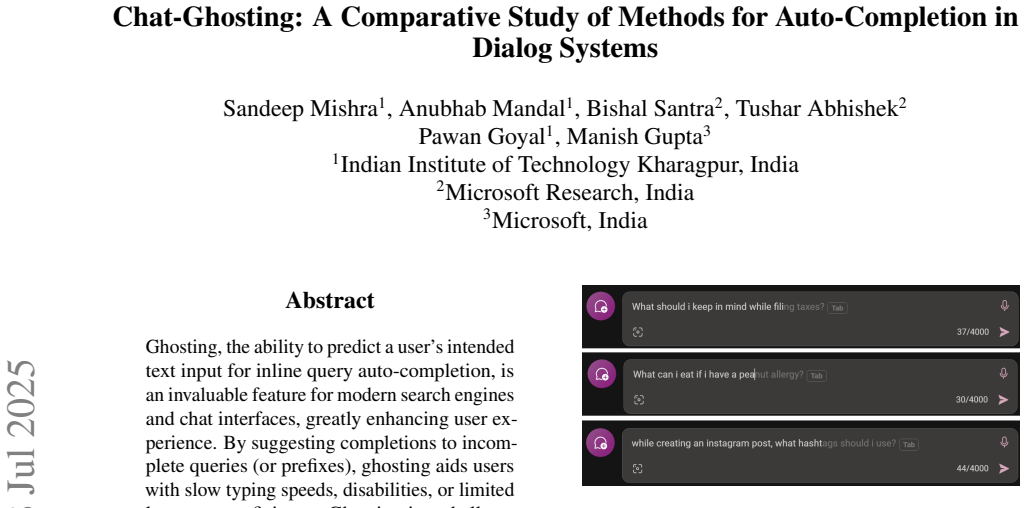
Ghosting, the ability to predict a user's intended text input for inline query auto-completion, is an invaluable feature for modern search engines and chat interfaces, greatly enhancing user experience. By suggesting completions to incomplete queries (or prefixes), ghosting aids users with slow typing speeds, disabilities, or limited language proficiency. Ghosting is a challenging problem and has become more important with the ubiquitousness of chat-based systems like ChatGPT, Copilot, etc. Despite the increasing prominence of chat-based systems utilizing ghosting, this challenging problem of Chat-Ghosting has received little attention from the NLP/ML research community. There is a lack of standardized benchmarks and relative performance analysis of deep learning and non-deep learning methods. We address this through an open and thorough study of this problem using four publicly available dialog datasets: two human-human (DailyDialog and DSTC7-Ubuntu) and two human-bot (Open Assistant and ShareGPT). We experiment with various existing query auto-completion methods (using tries), n-gram methods and deep learning methods, with and without dialog context. We also propose a novel entropy-based dynamic early stopping strategy. Our analysis finds that statistical n-gram models and tries outperform deep learning based models in terms of both model performance and inference efficiency for seen prefixes. For unseen queries, neural models like T5 and Phi-2 lead to better results. Adding conversational context leads to significant improvements in ghosting quality, especially for Open-Assistant and ShareGPT. We make code and data publicly available
Figures


Figures from the paper (6 more)


Reference graph
Works this paper leans on
-
[1]
online" 'onlinestring :=
ENTRY address archivePrefix author booktitle chapter edition editor eid eprint eprinttype howpublished institution journal key month note number organization pages publisher school series title type volume year doi pubmed url lastchecked label extra.label sort.label short.list INTEGERS output.state before.all mid.sentence after.sentence after.block STRING...
-
[2]
write newline
" write newline "" before.all 'output.state := FUNCTION n.dashify 't := "" t empty not t #1 #1 substring "-" = t #1 #2 substring "--" = not "--" * t #2 global.max substring 't := t #1 #1 substring "-" = "-" * t #2 global.max substring 't := while if t #1 #1 substring * t #2 global.max substring 't := if while FUNCTION word.in bbl.in capitalize " " * FUNCT...
-
[3]
Josh Achiam, Steven Adler, Sandhini Agarwal, Lama Ahmad, Ilge Akkaya, Florencia Leoni Aleman, Diogo Almeida, Janko Altenschmidt, Sam Altman, Shyamal Anadkat, et al. 2023. Gpt-4 technical report. arXiv preprint arXiv:2303.08774
arXiv 2023
-
[4]
Daniel Adiwardana, Minh-Thang Luong, David R So, Jamie Hall, Noah Fiedel, Romal Thoppilan, Zi Yang, Apoorv Kulshreshtha, Gaurav Nemade, Yifeng Lu, et al. 2020. Towards a human-like open-domain chatbot. arXiv preprint arXiv:2001.09977
arXiv 2020
-
[5]
Lars Backstrom, Jon Kleinberg, Ravi Kumar, and Jasmine Novak. 2008. Spatial variation in search engine queries. In Proceedings of the 17th international conference on World Wide Web, pages 357--366
work page 2008
-
[6]
Siqi Bao, Huang He, Fan Wang, Hua Wu, and Haifeng Wang. 2019. Plato: Pre-trained dialogue generation model with discrete latent variable. arXiv preprint arXiv:1910.07931
work page Pith review arXiv 2019
-
[7]
Ziv Bar-Yossef and Naama Kraus. 2011. Context-sensitive query auto-completion. In Proceedings of the 20th international conference on World wide web, pages 107--116
work page 2011
-
[8]
Holger Bast and Ingmar Weber. 2006. Type less, find more: fast autocompletion search with a succinct index. In Proceedings of the 29th annual international ACM SIGIR conference on Research and development in information retrieval, pages 364--371
work page 2006
Show all 77 references
-
[9]
Tom Brown, Benjamin Mann, Nick Ryder, Melanie Subbiah, Jared D Kaplan, Prafulla Dhariwal, Arvind Neelakantan, Pranav Shyam, Girish Sastry, Amanda Askell, et al. 2020. Language models are few-shot learners. Advances in neural information processing systems, 33:1877--1901
2020
-
[10]
Hengyi Cai, Hongshen Chen, Yonghao Song, Xiaofang Zhao, and Dawei Yin. 2021. Exemplar guided neural dialogue generation. In Proceedings of the Twenty-Ninth International Conference on International Joint Conferences on Artificial Intelligence, pages 3601--3607
2021
-
[11]
Ciprian Chelba, Mia Chen, Ankur Bapna, and Noam Shazeer. 2020. Faster transformer decoding: N-gram masked self-attention. arXiv preprint arXiv:2001.04589
2020 arXiv
-
[12]
Mia Xu Chen, Benjamin N Lee, Gagan Bansal, Yuan Cao, Shuyuan Zhang, Justin Lu, Jackie Tsay, Yinan Wang, Andrew M Dai, Zhifeng Chen, et al. 2019. Gmail smart compose: Real-time assisted writing. In Proceedings of the 25th ACM SIGKDD International Conference on Knowledge Discove...
2019
-
[13]
Qian Chen and Wen Wang. 2019. https://arxiv.org/abs/1901.02609 Sequential attention-based network for noetic end-to-end response selection . ArXiv preprint, abs/1901.02609
2019 arXiv
-
[14]
Mostafa Dehghani, Sascha Rothe, Enrique Alfonseca, and Pascal Fleury. 2017. Learning to attend, copy, and generate for session-based query suggestion. In Proceedings of the 2017 ACM on Conference on Information and Knowledge Management, pages 1747--1756
2017
-
[15]
Giovanni Di Santo, Richard McCreadie, Craig Macdonald, and Iadh Ounis. 2015. Comparing approaches for query autocompletion. In Proceedings of the 38th International ACM SIGIR Conference on Research and Development in Information Retrieval, pages 775--778
2015
-
[16]
Huizhong Duan and Bo-June Hsu. 2011. Online spelling correction for query completion. In Proceedings of the 20th international conference on World wide web, pages 117--126
2011
-
[17]
Luis Fernando D’Haro, Koichiro Yoshino, Chiori Hori, Tim K Marks, Lazaros Polymenakos, Jonathan K Kummerfeld, Michel Galley, and Xiang Gao. 2020. Overview of the seventh dialog system technology challenge: Dstc7. Computer Speech & Language, 62:101068
2020
-
[18]
Nicolas Fiorini and Zhiyong Lu. 2018. Personalized neural language models for real-world query auto completion. In Proceedings of NAACL-HLT, pages 208--215
2018
-
[19]
Elias Frantar, Saleh Ashkboos, Torsten Hoefler, and Dan Alistarh. 2022. Gptq: Accurate post-training quantization for generative pre-trained transformers. arXiv preprint arXiv:2210.17323
2022 arXiv
-
[20]
Georgi Gerganov. 2025. llama.cpp: Llm inference in c/c++. https://github.com/ggerganov/llama.cpp. Accessed: 2025-02-10
2025
-
[21]
Simon Gog, Giulio Ermanno Pibiri, and Rossano Venturini. 2020. Efficient and effective query auto-completion. In Proceedings of the 43rd International ACM SIGIR Conference on Research and Development in Information Retrieval, pages 2271--2280
2020
-
[22]
Shani Goren, Oren Kalinsky, Tomer Stav, Yuri Rapoport, Yaron Fairstein, Ram Yazdy, Nachshon Cohen, Alexander Libov, and Guy Kushilevitz. 2024. Chai-tea: A benchmark for evaluating autocompletion of interactions with llm-based chatbots. arXiv preprint arXiv:2412.18377
2024 arXiv
-
[23]
Suriya Gunasekar, Yi Zhang, Jyoti Aneja, Caio C \'e sar Teodoro Mendes, Allie Del Giorno, Sivakanth Gopi, Mojan Javaheripi, Piero Kauffmann, Gustavo de Rosa, Olli Saarikivi, et al. 2023. Textbooks are all you need. arXiv preprint arXiv:2306.11644
2023 arXiv
-
[24]
Manish Gupta and Puneet Agrawal. 2022. Compression of deep learning models for text: A survey. ACM Transactions on Knowledge Discovery from Data (TKDD), 16(4):1--55
2022
-
[25]
Song Han, Huizi Mao, and William J Dally. 2015. Deep compression: Compressing deep neural networks with pruning, trained quantization and huffman coding. arXiv preprint arXiv:1510.00149
2015 arXiv
-
[26]
Matthew Henderson, I \ n igo Casanueva, Nikola Mrk s i \'c , Pei-Hao Su, Tsung-Hsien Wen, and Ivan Vuli \'c . 2020. Convert: Efficient and accurate conversational representations from transformers. In Findings of the Association for Computational Linguistics: EMNLP 2020, pages...
2020
-
[27]
Connor Holmes, Masahiro Tanaka, Michael Wyatt, Ammar Ahmad Awan, Jeff Rasley, Samyam Rajbhandari, Reza Yazdani Aminabadi, Heyang Qin, Arash Bakhtiari, Lev Kurilenko, et al. 2024. Deepspeed-fastgen: High-throughput text generation for llms via mii and deepspeed-inference. arXiv...
2024 arXiv
-
[28]
Samuel Humeau, Kurt Shuster, Marie-Anne Lachaux, and Jason Weston. 2019. Poly-encoders: Architectures and pre-training strategies for fast and accurate multi-sentence scoring. In International Conference on Learning Representations
2019
-
[29]
Albert Q Jiang, Alexandre Sablayrolles, Arthur Mensch, Chris Bamford, Devendra Singh Chaplot, Diego de las Casas, Florian Bressand, Gianna Lengyel, Guillaume Lample, Lucile Saulnier, et al. 2023. Mistral 7b. arXiv preprint arXiv:2310.06825
2023 arXiv
-
[30]
Jyun-Yu Jiang, Yen-Yu Ke, Pao-Yu Chien, and Pu-Jen Cheng. 2014. Learning user reformulation behavior for query auto-completion. In Proceedings of the 37th international ACM SIGIR conference on Research & development in information retrieval, pages 445--454
2014
-
[31]
Jyun-Yu Jiang and Wei Wang. 2018. Rin: Reformulation inference network for context-aware query suggestion. In Proceedings of the 27th ACM International Conference on Information and Knowledge Management, pages 197--206
2018
-
[32]
Tian Jin, Gheorghe-Teodor Bercea, Tung D Le, Tong Chen, Gong Su, Haruki Imai, Yasushi Negishi, Anh Leu, Kevin O'Brien, Kiyokuni Kawachiya, et al. 2020. Compiling onnx neural network models using mlir. arXiv preprint arXiv:2008.08272
2020 arXiv
-
[33]
Young Mo Kang, Wenhao Liu, and Yingbo Zhou. 2021. Queryblazer: efficient query autocompletion framework. In Proceedings of the 14th ACM International Conference on Web Search and Data Mining, pages 1020--1028
2021
-
[34]
Eugene Kharitonov, Craig Macdonald, Pavel Serdyukov, and Iadh Ounis. 2013. User model-based metrics for offline query suggestion evaluation. In Proceedings of the 36th international ACM SIGIR conference on Research and development in information retrieval, pages 633--642
2013
-
[35]
Gyuwan Kim. 2019. Subword language model for query auto-completion. In Proceedings of the 2019 Conference on Empirical Methods in Natural Language Processing and the 9th International Joint Conference on Natural Language Processing (EMNLP-IJCNLP), pages 5022--5032
2019
-
[36]
Mojtaba Komeili, Kurt Shuster, and Jason Weston. 2021. https://arxiv.org/abs/2107.07566 Internet-augmented dialogue generation . ArXiv preprint, abs/2107.07566
2021 arXiv
-
[37]
o pf, Yannic Kilcher, Dimitri von R \
Andreas K \"o pf, Yannic Kilcher, Dimitri von R \"u tte, Sotiris Anagnostidis, Zhi Rui Tam, Keith Stevens, Abdullah Barhoum, Duc Nguyen, Oliver Stanley, Rich \'a rd Nagyfi, et al. 2024. Openassistant conversations-democratizing large language model alignment. Advances in Neura...
2024
-
[38]
Woosuk Kwon, Zhuohan Li, Siyuan Zhuang, Ying Sheng, Lianmin Zheng, Cody Hao Yu, Joseph Gonzalez, Hao Zhang, and Ion Stoica. 2023. Efficient memory management for large language model serving with pagedattention. In Proceedings of the 29th Symposium on Operating Systems Princip...
2023
-
[39]
Dong-Ho Lee, Zhiqiang Hu, and Roy Ka-Wei Lee. 2021. Improving text auto-completion with next phrase prediction. In Findings of the Association for Computational Linguistics: EMNLP 2021, pages 4434--4438
2021
-
[40]
Yanran Li, Hui Su, Xiaoyu Shen, Wenjie Li, Ziqiang Cao, and Shuzi Niu. 2017. Dailydialog: A manually labelled multi-turn dialogue dataset. arXiv preprint arXiv:1710.03957
2017 arXiv
-
[41]
Ji Lin, Jiaming Tang, Haotian Tang, Shang Yang, Wei-Ming Chen, Wei-Chen Wang, Guangxuan Xiao, Xingyu Dang, Chuang Gan, and Song Han. 2024. Awq: Activation-aware weight quantization for on-device llm compression and acceleration. Proceedings of Machine Learning and Systems, 6:87--100
2024
-
[42]
Alisa Liu, Maarten Sap, Ximing Lu, Swabha Swayamdipta, Chandra Bhagavatula, Noah A Smith, and Yejin Choi. 2021. Dexperts: Decoding-time controlled text generation with experts and anti-experts. arXiv preprint arXiv:2105.03023
2021 arXiv
-
[43]
Ilya Loshchilov and Frank Hutter. 2022. Sgdr: Stochastic gradient descent with warm restarts. In International Conference on Learning Representations
2022
-
[44]
Ryan Lowe, Nissan Pow, Iulian Vlad Serban, and Joelle Pineau. 2015. The ubuntu dialogue corpus: A large dataset for research in unstructured multi-turn dialogue systems. In Proceedings of the 16th Annual Meeting of the Special Interest Group on Discourse and Dialogue, pages 285--294
2015
-
[45]
Ximing Lu, Sean Welleck, Jack Hessel, Liwei Jiang, Lianhui Qin, Peter West, Prithviraj Ammanabrolu, and Yejin Choi. 2022. Quark: Controllable text generation with reinforced unlearning. Advances in neural information processing systems, 35:27591--27609
2022
-
[46]
Aishwarya Maheswaran, Kaushal Kumar Maurya, Manish Gupta, and Maunendra Sankar Desarkar. 2024. Dac: Quantized optimal transport reward-based reinforcement learning approach to detoxify query auto-completion. In Proceedings of the 47th International ACM SIGIR Conference on Rese...
2024
-
[47]
Bhaskar Mitra and Nick Craswell. 2015. Query auto-completion for rare prefixes. In Proceedings of the 24th ACM international on conference on information and knowledge management, pages 1755--1758
2015
-
[48]
Agn \`e s Mustar, Sylvain Lamprier, and Benjamin Piwowarski. 2020. Using bert and bart for query suggestion. In Joint Conference of the Information Retrieval Communities in Europe, volume 2621. CEUR-WS. org
2020
-
[49]
NVIDIA. 2025. Tensorrt-llm: A tensorrt toolbox for optimized large language model inference. https://github.com/NVIDIA/TensorRT-LLM. Accessed: 2025-02-10
2025
-
[50]
Alexandra Olteanu, Fernando Diaz, and Gabriella Kazai. 2020. When are search completion suggestions problematic? Proceedings of the ACM on Human-Computer Interaction, 4(CSCW2):1--25
2020
-
[51]
Dae Hoon Park and Rikio Chiba. 2017. A neural language model for query auto-completion. In Proceedings of the 40th International ACM SIGIR Conference on Research and Development in Information Retrieval, pages 1189--1192
2017
-
[52]
Lakshmi Ramachandran and Uma Murthy. 2019. Ghosting: contextualized query auto-completion on amazon search. In Proceedings of the 42nd international ACM SIGIR conference on research and development in information retrieval, pages 1377--1378
2019
-
[53]
Alan Ritter, Colin Cherry, and William B. Dolan. 2011. https://aclanthology.org/D11-1054 Data-driven response generation in social media . In Proceedings of the 2011 Conference on Empirical Methods in Natural Language Processing, pages 583--593, Edinburgh, Scotland, UK. Associ...
2011
-
[54]
Adam Roberts, Colin Raffel, Katherine Lee, Michael Matena, Noam Shazeer, Peter J Liu, Sharan Narang, Wei Li, and Yanqi Zhou. 2019. Exploring the limits of transfer learning with a unified text-to-text transformer. Google, Tech. Rep
2019
-
[55]
Stephen Roller, Emily Dinan, Naman Goyal, Da Ju, Mary Williamson, Yinhan Liu, Jing Xu, Myle Ott, Eric Michael Smith, Y-Lan Boureau, and Jason Weston. 2021. Recipes for building an open-domain chatbot. In Proceedings of the 16th Conference of the European Chapter of the Associa...
2021
-
[56]
Bishal Santra, Potnuru Anusha, and Pawan Goyal. 2021 a . Hierarchical transformer for task oriented dialog systems. In Proceedings of the 2021 Conference of the North American Chapter of the Association for Computational Linguistics: Human Language Technologies, pages 5649--5658
2021
-
[57]
Bishal Santra, Sumegh Roychowdhury, Aishik Mandal, Vasu Gurram, Atharva Naik, Manish Gupta, and Pawan Goyal. 2021 b . Representation learning for conversational data using discourse mutual information maximization. arXiv preprint arXiv:2112.05787
2021 arXiv
-
[58]
Courville, and Joelle Pineau
Iulian Vlad Serban, Alessandro Sordoni, Yoshua Bengio, Aaron C. Courville, and Joelle Pineau. 2016. http://www.aaai.org/ocs/index.php/AAAI/AAAI16/paper/view/11957 Building end-to-end dialogue systems using generative hierarchical neural network models . In Proceedings of the T...
2016
-
[59]
Courville, and Yoshua Bengio
Iulian Vlad Serban, Alessandro Sordoni, Ryan Lowe, Laurent Charlin, Joelle Pineau, Aaron C. Courville, and Yoshua Bengio. 2017. http://aaai.org/ocs/index.php/AAAI/AAAI17/paper/view/14567 A hierarchical latent variable encoder-decoder model for generating dialogues . In Proceed...
2017
-
[60]
Xiaoyu Shen, Hui Su, Yanran Li, Wenjie Li, Shuzi Niu, Yang Zhao, Akiko Aizawa, and Guoping Long. 2017. https://doi.org/10.18653/v1/P17-2080 A conditional variational framework for dialog generation . In Proceedings of the 55th Annual Meeting of the Association for Computationa...
2017 doi
-
[61]
Milad Shokouhi. 2013. Learning to personalize query auto-completion. In Proceedings of the 36th international ACM SIGIR conference on Research and development in information retrieval, pages 103--112
2013
-
[62]
Milad Shokouhi and Kira Radinsky. 2012. Time-sensitive query auto-completion. In Proceedings of the 35th international ACM SIGIR conference on Research and development in information retrieval, pages 601--610
2012
-
[63]
Jun Song, Jun Xiao, Fei Wu, Haishan Wu, Tong Zhang, Zhongfei Mark Zhang, and Wenwu Zhu. 2017. Hierarchical contextual attention recurrent neural network for map query suggestion. IEEE Transactions on Knowledge and Data Engineering, 29(9):1888--1901
2017
-
[64]
Alessandro Sordoni, Yoshua Bengio, Hossein Vahabi, Christina Lioma, Jakob Grue Simonsen, and Jian-Yun Nie. 2015. A hierarchical recurrent encoder-decoder for generative context-aware query suggestion. In proceedings of the 24th ACM international on conference on information an...
2015
-
[65]
Stojan Trajanovski, Chad Atalla, Kunho Kim, Vipul Agarwal, Milad Shokouhi, and Chris Quirk. 2021. When does text prediction benefit from additional context? an exploration of contextual signals for chat and email messages. In Proceedings of the 2021 Conference of the North Ame...
2021
-
[66]
Po-Wei Wang, Huan Zhang, Vijai Mohan, Inderjit S Dhillon, and J Zico Kolter. 2018. Realtime query completion via deep language models. In eCOM@ SIGIR
2018
-
[67]
Sida Wang, Weiwei Guo, Huiji Gao, and Bo Long. 2020. Efficient neural query auto completion. In Proceedings of the 29th ACM International Conference on Information & Knowledge Management, pages 2797--2804
2020
-
[68]
Yingfei Wang, Hua Ouyang, Hongbo Deng, and Yi Chang. 2017. Learning online trends for interactive query auto-completion. IEEE Transactions on Knowledge and Data Engineering, 29(11):2442--2454
2017
-
[69]
Michael J Welch and Junghoo Cho. 2008. Automatically identifying localizable queries. In Proceedings of the 31st annual international ACM SIGIR conference on Research and development in information retrieval, pages 507--514
2008
-
[70]
Yuqiao Wen, Guoqing Luo, and Lili Mou. 2022. An empirical study on the overlapping problem of open-domain dialogue datasets. arXiv preprint arXiv:2201.06219
2022 arXiv
-
[71]
Taesun Whang, Dongyub Lee, Dongsuk Oh, Chanhee Lee, Kijong Han, Dong-hun Lee, and Saebyeok Lee. 2021. Do response selection models really know what’s next? utterance manipulation strategies for multi-turn response selection. In Proceedings of the AAAI Conference on Artificial ...
2021
-
[72]
Stewart Whiting and Joemon M Jose. 2013. Exploring real-time temporal query auto-completion. In DIR, pages 12--15. Citeseer
2013
-
[73]
Ruijian Xu, Chongyang Tao, Daxin Jiang, Xueliang Zhao, Dongyan Zhao, and Rui Yan. 2021. Learning an effective context-response matching model with self-supervised tasks for retrieval-based dialogues. In Proceedings of the AAAI Conference on Artificial Intelligence, volume 35, ...
2021
-
[74]
Harish Yenala, Manoj Chinnakotla, and Jay Goyal. 2017. Convolutional bi-directional lstm for detecting inappropriate query suggestions in web search. In Pacific-Asia Conference on Knowledge Discovery and Data Mining, pages 3--16. Springer
2017
-
[75]
Di Yin, Jiwei Tan, Zhe Zhang, Hongbo Deng, Shujian Huang, and Jiajun Chen. 2020. Learning to generate personalized query auto-completions via a multi-view multi-task attentive approach. In Proceedings of the 26th ACM SIGKDD International Conference on Knowledge Discovery & Dat...
2020
-
[76]
Yizhe Zhang, Siqi Sun, Michel Galley, Yen-Chun Chen, Chris Brockett, Xiang Gao, Jianfeng Gao, Jingjing Liu, and Bill Dolan. 2020. https://doi.org/10.18653/v1/2020.acl-demos.30 DIALOGPT : Large-scale generative pre-training for conversational response generation . In Proceeding...
2020 doi
-
[77]
Tiancheng Zhao, Ran Zhao, and Maxine Eskenazi. 2017. https://doi.org/10.18653/v1/P17-1061 Learning discourse-level diversity for neural dialog models using conditional variational autoencoders . In Proceedings of the 55th Annual Meeting of the Association for Computational Lin...
2017 doi
Reviewed August 6, 2026 · model on record in the stance chip above.
Discussion (0). Sign in to comment.