REVIEW 4 major objections 7 minor 6 references
InqEduAgent: Adaptive AI Learning Partners with Gaussian Process Augmentation
T0 review · 4 major / 7 minor · reviewed 2026-08-06 · deepseek-v4-flash
Pith's one-line read InqEduAgent claims that pairing learners through Gaussian-process-predicted collaboration gains plus Pareto-front screening beats random co-learning in simulated inquiry classrooms.
desk verdict A sensible GP-for-partner-selection pipeline undone by a likely Equation (6) definition error and an evaluation that doesn't support the 'consistently superior' claim. read the letter →
The pith
A machine-rendered reading of the paper's core claim, the machinery that carries it, and where it could break.
The reading
What carries the argument
The load-bearing object is the Gaussian-process-augmented matching mechanism. Its input is the concatenation of a short learner-characteristic vector and a BERT-embedded exercise-domain vector, $x = (l, \ell, d)$; its target is the domain-level collaboration gain $y = \left(\sum_{e\in d} r_{l,\ell,e} - \sum_{e\in d} r_{\ell,e}\right)/|d|$, the difference between the learner's post-exchange score and the partner's independent score on that domain. The Gaussian process with a radial basis function kernel supplies a predictive distribution over that gain, so matching becomes: screen candidates by Pareto dominance of score vectors, then pick the candidate with maximum predicted gain. The Pareto front does the constraining; the Gaussian process does the prediction. Together they replace heuristic or random pairing with a probability-based similarity assessment.
What would settle it
Hold out one or more CMMLU knowledge domains, train the Gaussian process on the rest, and compare realized collaboration gains of GP-selected pairs against random pairs on the held-out domain; if the correlation between predicted and realized gain is not positive, the selection rule cannot be delivering the reported advantage. A human replication would make the same comparison with real students answering the same questions before and after discussion, with options hidden during discussion.
Extended reading notes
Core claim
The paper's central claim is that collaboration gains in inquiry learning can be modeled nonparametrically and then used to select partners. InqEduAgent represents each learner by a persona vector (subject preference and logical preference, each in {-1,0,1}) and records, for each partnered attempt on a domain block, the difference between the learner's post-exchange score and the partner's independent score. A Gaussian process with an RBF kernel is fit to this target, producing a predictive mean and variance for any new learner-partner-domain input. At matching time, learners are filtered by a Pareto front — global in one variant, per-learner local in another — and the candidate with the highest predicted gain is selected. The author's claim is that this GP-plus-Pareto pipeline consistently achieves superior performance over baseline, self-learning, and random co-learning across the tested knowledge domains and LLM backends, with the localized Pareto variant giving the best overall mean gain (0.3047). Component-removal experiments are used to attribute the improvement to the agent roles, co-learning, Gaussian process, and Pareto front.
Load-bearing premise
The load-bearing premise is that two scalar personality traits (subject preference and logical preference) plus a Gaussian-process model of normally distributed learner and exercise features capture what actually determines collaboration benefits in inquiry learning; if real human gains depend on other factors, the simulated results will not transfer.
Editorial extensions
If this is right
- Partner assignment in inquiry learning can be cast as regression on collaboration gain rather than as a heuristic or random process.
- The localized Pareto variant, which maintains a per-learner candidate set from interaction history, yields the highest overall mean gain (0.3047) and the best STEM gain (0.3871), while the global Pareto variant gives the best humanities gain (0.3502) and lowest overall variance.
- Removing the Gaussian process and Pareto front degrades performance to random co-learning (0.2935), and replacing the Gaussian process with a neural network lowers mean gains (0.2873 and 0.2910), suggesting the Gaussian process is the larger contributor in these experiments.
- Because the same pipeline works with two LLM backends and a range of knowledge domains, the authors claim the matching mechanism generalizes across language-model configurations.
Reading between the lines
- A direct human-classroom test is the natural next step: the same GP-Pareto matcher could recommend partners from real learner profiles with post-discussion test accuracy as the outcome; the two-scalar persona would likely need richer features, and the normality assumption would need checking.
- The Pareto filter may be doing less work than the Gaussian process: comparing InqEduAgent-GP (0.3030) with InqEduAgent-LP (0.3047) and the NN variants suggests the selection gain is mostly from predicted gain, so an ablation that replaces Pareto with a top-k predicted-gain candidate set could isolate its contribution.
- The task design deliberately hides answer options during explanation exchange, so measured gain is driven by explanation content rather than answer leakage; that makes the simulation a useful probe for how LLMs reason collaboratively and suggests the same metric could build multi-agent ensembles that improve each other's accuracy.
Editorial analysis
A structured set of objections, weighed in public.
Referee Report
Summary. The paper proposes InqEduAgent, an LLM-based generative-agent framework for simulating and selecting learning partners in inquiry-based education. Each learner agent is characterized by two three-valued traits (subject preference and logical preference), and agents exchange explanations before re-answering exercises. A Gaussian process with an RBF kernel is trained on interaction records to predict the collaboration gain of a candidate partner, and the final partner is chosen from a Pareto front of score vectors using the maximum predicted value. Experiments on 112 questions from six CMMLU domains compare seven settings: Baseline, Self-Learning Model, Co-Learning Model, InqEduAgent-GP, InqEduAgent-LP, and neural-network variants of the latter two. The paper reports mean gain, best gain, and standard deviation, and includes a component-removal ablation. The abstract and Section IV claim that InqEduAgent consistently achieves superior performance across learning scenarios and LLM configurations.
Significance. If the central claims were supported, the framework would contribute a data-driven, nonparametric approach to adaptive study-partner selection in simulated and eventually human-AI collaborative learning. The paper has useful ingredients: it provides a public code/data/appendix link, an ablation that separates the contribution of roles, co-learning, Gaussian process prediction, and Pareto selection, and a comparison against neural-network regression variants. However, the current evidence does not support the stated claims: the objective defined in Eq. (6) is internally inconsistent with the notion of collaboration gain, Table 1 directly contradicts the 'consistently superior' claim in one of the three reported domains, and the experimental protocol lacks a described train/test split and significance testing. As submitted, the contribution is more of a proof-of-concept simulation than a validated recommendation mechanism.
major comments (4)
- [Section III-C, Eq. (6)] The Gaussian process target is defined as y = (average over d of r_{l,ell,e}) - (average over d of r_{ell,e}), where the second term is the partner's independent score from Eq. (3), not the target learner's pre-collaboration score. This quantity is not the target learner's collaboration gain; it rewards a partner who performs poorly alone while the target performs well after interacting with that partner. Consequently, the GP trained on this target and the selection rule in Eq. (7), which maximizes the predicted value of this quantity, are optimizing a measure that does not correspond to learning improvement. The sentence immediately after Eq. (6) also confuses the notation: it says r_{l,e} represents the independent exercise score of learner l after communicating with learner ell, which contradicts Eq. (3) where r_{l,e} is the independent score before communication. If the intended target is the target learner's pre- versus post-collaboration difference, the notation and all reported gains must be corrected and recomputed; as written, this is a load-bearing error.
- [Table 1 and Section IV-B] The abstract claims InqEduAgent 'consistently achieves superior performance,' and Section IV-B states that the InqEduAgent series 'consistently outperforms both the baseline and non-strategic collaboration methods across all metrics.' Table 1 directly contradicts this: in the Social Science column, the Baseline mean is 0.2654, Co-Learning Model (CLM) is 0.2139, InqEduAgent-GP is 0.1913, and InqEduAgent-LP is 0.1896, so both proposed methods are substantially worse than both Baseline and CLM. Even in the overall totals, the difference between InqEduAgent-LP (0.3047) and CLM (0.2935) is about one percentage point, and no significance tests, confidence intervals, or effect sizes are reported. The superiority claim cannot be sustained on the basis of these numbers, and the paper should either provide proper statistical comparisons or explicitly qualify the claim as applying only to selected domains.
- [Section IV-A and Section IV-B] The paper refers to 'during training' and 'during testing' for the Gaussian process and neural-network variants, but it never describes how the interaction records are split into training and test sets, whether partners or target learners are held out, how many folds are used, or whether the reported gains are computed on data used for fitting. Without an explicit held-out evaluation, the GP and NN models may be reporting in-sample fitted values rather than predictions, and the partner selection in Eq. (7) may be evaluated on the very records used to train the regressor. The experimental protocol must specify the split, the level at which data are separated (e.g., by exercise, by partner pair, or by learner), and the evaluation procedure.
- [Section IV-A, Section III-C] The evidence base is small and fragile: the six selected knowledge domains contain only 112 questions (n = 20, 20, 23, 12, 11, 26), yet the paper reports per-domain means and standard deviations without giving the number of learner agents, the number of pairing trials per domain, or the number of repetitions beyond a statement that accuracy is averaged over 10 repeated runs. In addition, Section III-C asserts that 'the characteristic distributions of learners and exercises belong to typical normal distributions' without presenting any empirical justification, even though this normality assumption is the stated basis for using a Gaussian process. The authors should report the number of agents and samples, provide confidence intervals, and either justify the normality assumption with data or adopt a nonparametric alternative.
minor comments (7)
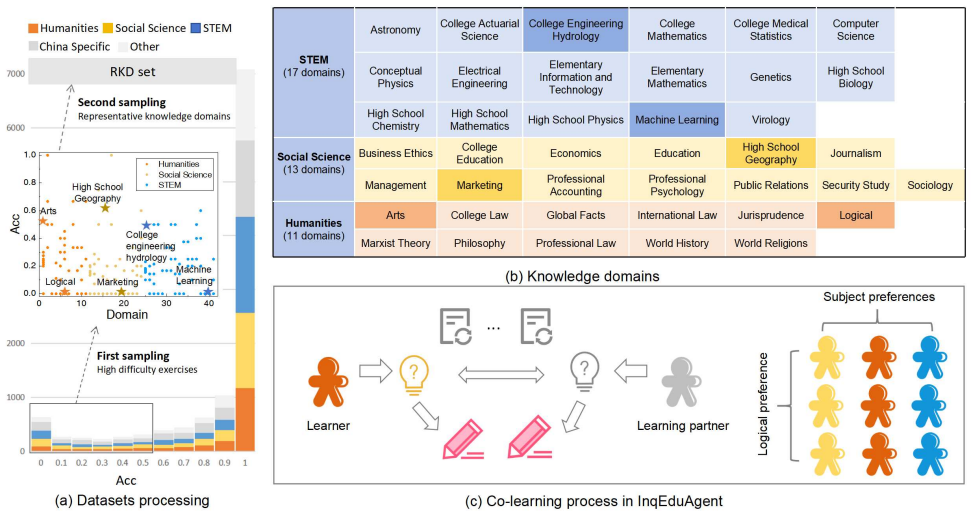
- [Section IV-A] The sentence 'LLMs fail to pass 17.2% of the exercises that form the first sampling set' refers to a 'first sampling set' that has not been defined; the preceding text describes the full CMMLU dataset, so the intended referent should be stated explicitly.
- [Section IV-A] The sentence 'All the selected knwoledge domain distribute on both the .' is incomplete and contains a typo ('knwoledge'); it should be rewritten to describe the coverage of the selected domains.
- [Equation (6)] The notation r_{l,e} is used for both the independent score in Eq. (3) and the post-communication score in Eq. (6); distinct symbols such as r^{(pre)}_{l,e} and r^{(post)}_{l,ell,e} should be introduced to avoid ambiguity.
- [Section IV-C] The statement that 'the accuracy score of InqEduAgent-LP is 0.17 higher than that of InqEduAgent-GP' should specify units: Table 2 shows 30.47 versus 30.30, which is 0.17 percentage points, not 0.17 in absolute accuracy.
- [Introduction] The citations '[eduAgent][Agent4Edu]' appear as literal placeholders rather than numbered references, and the reference list does not contain entries for these placeholders.
- [Table 1] The 'Total' columns appear to aggregate per-domain means over unequal numbers of exercises; the weighting scheme should be stated, or per-question aggregates should be reported instead.
- [Figure 1] The paper uses 'Figure 1' for the overall framework and then refers to 'Figure 1(a)' for the dataset-difficulty scatter plot; the two figures should be numbered separately.
Circularity Check
No demonstrated circularity: the GP is a standard supervised predictor and no load-bearing self-citation or definitional loop is present.
full rationale
The paper's derivation chain is not circular. The GP target y in Eq. (6) is a function of observable interaction scores (r_{l,ell,e} and r_{ell,e}); the GP is fit by maximum marginal likelihood and then evaluated through the predictive distribution for candidate inputs x*. This is the standard supervised-learning loop, not a self-referential definition. The Pareto-front filter is an independent screening rule over raw score vectors, and the final partner choice maximizes the GP's predicted value over that front; no equation defines the GP target in terms of the chosen partner, nor vice versa. The paper contains no load-bearing self-citations: the cited generative-agent works (Park et al.; EduAgent; Agent4Edu) are external and serve only as background, and no uniqueness theorem or prior result by the same authors is invoked to force the GP/Pareto choice. The evaluation is anchored to the CMMLU benchmark with LLM-simulated learners, so the reported accuracy gains are externally defined rather than derived from the model's own fitted parameters. Two concerns are worth noting but are not circularity: (i) the paper does not explicitly describe a held-out train/test split, so if the same interaction records were used to fit the GP and to compute the reported Mean Gain, those numbers would be in-sample fits; the text does say 'during training' and 'during testing,' however, and absent a quoted statement that testing reuses training data, this remains a reporting gap rather than an exhibited reduction. (ii) Eq. (6) subtracts the partner's independent score r_{ell,e} rather than the target learner's pre-communication score; if this is not a typo, the model optimizes a mislabeled quantity. That is a correctness/validity issue, not a circular dependency. Under the hard rules, I therefore find no significant circularity.
Assumptions & free parameters
free parameters (1)
- GP kernel hyperparameters (RBF lengthscale, signal variance, noise variance) =
not reported
assumptions (4)
- domain assumption Learner and exercise characteristic distributions are Gaussian
- domain assumption Two binary-valued traits (subject preference, logical preference) sufficiently characterize learners
- domain assumption LLM agents are valid proxies for real learners
- domain assumption Gain in MCQ accuracy after exchanging explanations is a valid measure of inquiry-based learning effectiveness
invented entities (1)
-
InqEduAgent generative agents with two trait dimensions
Cite this review
Pith. "Pith review of InqEduAgent: Adaptive AI Learning Partners with Gaussian Process Augmentation." pith.science (2026). https://pith.science/paper/4W4OFCXL
@misc{pith2026250803174,
  author       = {Pith},
  title        = {Pith review of: InqEduAgent: Adaptive AI Learning Partners with Gaussian Process Augmentation},
  year         = {2026},
  howpublished = {\url{https://pith.science/paper/4W4OFCXL}},
  note         = {Machine review of arXiv:2508.03174}
}
read the original abstract
Collaborative partnerships play a crucial role in inquiry-oriented education. However, most learning partners are currently assigned through experience-driven heuristics or rule-based machine assistants, which often result in limited knowledge expansion and low adaptability. To address these challenges, this study introduces InqEduAgent, an LLM-empowered generative agent framework designed to simulate and select adaptive learning partners for inquiry-based learning. InqEduAgent integrates a Gaussian process-augmented matching mechanism to model the cognitive and evaluative characteristics of learners, allowing adaptive partner selection based on prior knowledge patterns. Comprehensive experiments demonstrate that InqEduAgent consistently achieves superior performance across diverse learning scenarios and large language model configurations. This study advances human-AI collaborative learning by enabling intelligent pairing between human- and AI-based learning partners, and contributes to adaptive user modeling and personalized recommendation within Web-based educational environments.
Figures

Reference graph
Works this paper leans on
-
[3]
Cmmlu: Measuring mas- sive multitask language understanding in chinese.arXiv preprint arXiv:2306.09212. Li, J.; Lai, Y .; Li, W.; Ren, J.; Zhang, M.; Kang, X.; Wang, S.; Li, P.; Zhang, Y .-Q.; Ma, W.; et al
-
[4]
arXiv preprint arXiv:2405.02957
Agent hospi- tal: A simulacrum of hospital with evolvable medical agents. arXiv preprint arXiv:2405.02957. Liu, J.; Huang, Z.; Xiao, T.; Sha, J.; Wu, J.; Liu, Q.; Wang, S.; and Chen, E
-
[6]
Zhang, G.; Chong, L.; Kotovsky, K.; and Cagan, J
Eduagent: Generative student agents in learning.arXiv preprint arXiv:2404.07963. Zhang, G.; Chong, L.; Kotovsky, K.; and Cagan, J
-
[2020]
InExtended abstracts of the 2020 CHI conference on human factors in computing systems, 1–6
From human-human collab- oration to Human-AI collaboration: Designing AI systems that can work together with people. InExtended abstracts of the 2020 CHI conference on human factors in computing systems, 1–6. Wu, P.-H.; and Wu, H.-K
work page 2020
-
[2023]
arXiv preprint arXiv:2308.02773
Educhat: A large-scale lan- guage model-based chatbot system for intelligent education. arXiv preprint arXiv:2308.02773. Fazlollahi, A. M.; Bakhaidar, M.; Alsayegh, A.; Yilmaz, R.; Winkler-Schwartz, A.; Mirchi, N.; Langleben, I.; Ledwos, N.; Sabbagh, A. J.; Bajunaid, K.; et al
-
[2024]
Jansson, M.; Hrastinski, S.; Stenbom, S.; and Enoksson, F
Predicting student performance in a programming tutoring system using ai and filtering tech- niques.IEEE Transactions on Learning Technologies, 17: 1891–1905. Jansson, M.; Hrastinski, S.; Stenbom, S.; and Enoksson, F
work page 1905
Reviewed August 6, 2026 · model on record in the stance chip above.
Discussion (0). Continue with ORCID to comment.