REVIEW
Quantitative infrared nanoscopy: Probe-cavity eigenmodes and nano-gap polaritons for strongly coupled nanoscale optics
T0 review · reviewed 2026-08-04 · deepseek-v4-flash
Pith's one-line read A sparse sum over probe-cavity eigenmodes quantitatively predicts near-field infrared nanoscopy, retrieves optical constants, and forecasts strong coupling.
desk verdict Genuinely useful eigenmode framework with real non-fitted experimental matches; the load-bearing single-parameter probe idealization is not independently validated and the manuscript is unfinished in ways that matter. read the letter →
The pith
A machine-rendered reading of the paper's core claim, the machinery that carries it, and where it could break.
The reading
What carries the argument
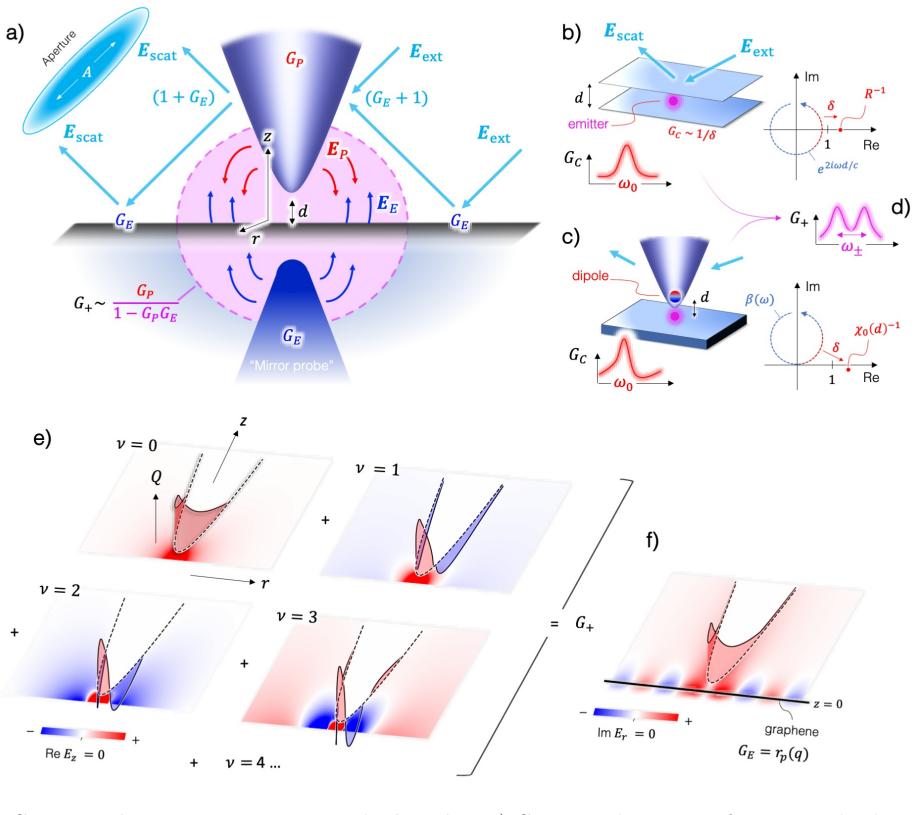
The central object is the set of probe-cavity eigenmodes |j_ν): surface current distributions on the probe that solve (1/iω)(Ê_P − ρ_ν Ê_S^QS)|j_ν)=0 (Eq. 16), where Ê_P is the probe's electrodynamic self-impedance and Ê_S^QS is the quasi-electrostatic mirror interaction with a planar surface. The eigenvalues ρ_ν, ordered by increasing |ρ|, quantify field confinement (via Reρ) and radiative loss (via −Imρ). By construction these modes are orthogonal under both operators, so they nearly diagonalize the probe-sample scattering matrix and reduce the composite response to the sparse rational expression Eq. 18, with poles at β(ω)=ρ_ν. This machinery supplies forward predictions (approach curves,
What would settle it
Take a commercial PtSi s-SNOM probe, characterize its tip shape by electron microscopy, and simulate (or measure) the probe-scattered field with the actual pyramidal geometry and finite conductivity; if the EigenProbe expression with a single fitted apex radius systematically fails to reproduce the Au/Si contrast and SiC approach curves in a way that correlates with asymmetric or non-PEC features, the idealized hyperboloid model is falsified.
Extended reading notes
Core claim
The paper claims that the composite probe-sample response function of an s-SNOM experiment can be written, formally exactly and without a perturbative assumption, as G_PS = −Σ_ν |E_ν)(j_ν|/(ρ_ν − β(ω)) (Eq. 18), where |E_ν) are fields generated by probe-cavity eigencurrents |j_ν), ρ_ν are dimensionless 'eigenreflectivities' of a generalized eigenproblem combining the probe's electrodynamic self-impedance with a quasi-electrostatic mirror operator, and β(ω) is the local surface reflectivity. When β approaches an eigenvalue ρ_ν, the response is dominated by a self-sustaining nano-gap polariton — a collective excitation of the probe-sample cavity. The paper reports that retaining about 20 eigen
Load-bearing premise
All quantitative predictions inherit the assumption that a real pyramidal, finitely conducting PtSi probe is adequately represented by an axisymmetric, perfectly conducting hyperboloid whose only adjustable parameter is the apex radius a; if real probes deviate in ways not absorbable by changing a — facet currents, finite THz conductivity, or wear beyond radius growth — the extracted optical constants and predicted splittings are systematically biased.
Editorial extensions
If this is right
- If Eq. 18 holds, near-field experiments previously interpreted qualitatively become quantitatively predictable from a small (~20) eigenmode set, including in the non-perturbative strong-coupling regime.
- The formalism yields an inversion scheme that retrieves local optical constants of polar crystals (SiC, SrTiO3) and polymers (kapton) from demodulated scattering spectra in under a minute on down-sampled data.
- The same eigenvalues predict gap-dependent approach curves on phonon-resonant surfaces, identifying nano-gap polaritons as real, gap-tunable excitations that dominate the measured signal.
- The strong-coupling analysis predicts an experimentally observable avoided crossing and Rabi splitting near 0.4 THz for a THz antenna probe over thin SrTiO3 at gap d/a≈0.2, with g/g_crit≈2.
- EigenProbe encoding (Eq. 27) reuses one modal-reflectivity calculation to compute scattering at all probe-sample gaps, making multi-harmonic demodulation and nano-imaging computationally cheap.
Reading between the lines
- The same sparse eigenmode expansion should extend to other active nanoscopies (e.g., THz-STM and photo-induced force microscopy) by replacing the far-field scattering observable with tunneling current or mechanical force; the paper gestures at this but does not demonstrate it.
- A testable extension is to compare the eigenmode prediction against an independent full-wave simulation of a realistic pyramidal PtSi probe with finite conductivity, isolating whether residual discrepancies come from the axisymmetric-PEC idealization or from the single-radius calibration.
- The explicit role of −Imρ_ν (radiative loss) and Imβ (surface absorption) suggests the formalism could be adapted to predict photothermal-expansion nanoscopy lineshapes; the paper notes the ambiguity but leaves a concrete prediction for future work.
- Because the forward model is fast, one could train a machine-learned surrogate on the eigenmode expansion for real-time optical-constant mapping, an avenue the paper mentions only in passing.
Editorial analysis
A structured set of objections, weighed in public.
Assumptions & free parameters
free parameters (6)
- Probe apex radius a =
≈25-30 nm (fresh PtSi-FM), ≈40 nm (SiC approach curves), ≈15 nm (kapton), >400 nm (worn probe)
- Probe opening half-angle θ =
7°, 10°, or 25° by case
- Lorentz oscillator parameters for SiC and STO (ε0, ω_TO, γ, f_p) =
γ_SiC ≈ 25 cm⁻¹, γ_STO ≈ 20 cm⁻¹ (others in Fig. 9c)
- Kapton multi-oscillator permittivity =
10+ free Lorentz oscillators plus 50+ fixed narrow oscillators (Fig. 9e)
- Far-field brightness correction factor (1 + 0.3i·r_p(θ))² =
0.3i
- STO strong-coupling parameters (f_P, β_0, N, γ_P, γ_S) =
f_P ≈ 0.5, β_0 ≈ 0, N ≈ 1, γ_P ≈ 0.15 THz, γ_S ≈ 0.1 THz
assumptions (6)
- domain assumption Probe is a perfect electrical conductor (PEC) with boundary condition Ê_P|j_P) + θ̂_∂P|E_ext) = 0 (Eq. 14).
- domain assumption Probe, illumination, and detection are axisymmetric; real probes are pyramidal with directional illumination.
- domain assumption Sample is a translationally invariant layered medium described by Fresnel r_p(ω,q), with quasi-electrostatic limit r_p ≈ β for q ≫ ω/c (Eqs. 21-23).
- standard math The eigenmode basis nearly diagonalizes surface scattering, i.e., (j_μ|Ē_QS_ν) = δ_μν (Eq. 16 and Sec. III B).
- standard math Kramers-Kronig compatibility of the isolated-probe susceptibility ρ_ν(ω)⁻¹ (Sec. III C).
- domain assumption Perturbative far-field probe-surface scattering corrections are small because |(j_ν|δĜ_S,FF|j_ν)| < |(j_ν|δĜ_P,FF|j_ν)| (Sec. III B).
invented entities (1)
-
Nano-gap polariton
independent evidence
Cite this review
Pith. "Pith review of Quantitative infrared nanoscopy: Probe-cavity eigenmodes and nano-gap polaritons for strongly coupled nanoscale optics." pith.science (2026). https://pith.science/paper/4X7B2WQG
@misc{pith2026260723950,
  author       = {Pith},
  title        = {Pith review of: Quantitative infrared nanoscopy: Probe-cavity eigenmodes and nano-gap polaritons for strongly coupled nanoscale optics},
  year         = {2026},
  howpublished = {\url{https://pith.science/paper/4X7B2WQG}},
  note         = {Machine review of arXiv:2607.23950}
}
read the original abstract
Optical nanoscopies including near-field optical microscopy and spectroscopy circumvent the diffraction limit of conventional optics thanks to the nanoscale light focus emerging at the apex of a sharp irradiated probe. However, while strong optical coupling between the apex and its dielectric environment affords both enhanced nanoscopic measurement sensitivity and potentially ultra-strong fields within a nano-gap cavity, the conditions for this coupling remain poorly quantified by prevailing analytic models. Here we present a robust formalism of probe-cavity eigenmodes that fully describes how mutual near-field interactions between probe and environment produce a composite response to external fields qualitatively distinct from that of its distinct components. This "EigenProbe" model identifies the fundamental excitations of realistic optical nanoscopies as nano-gap polaritons, which provide an elegant basis to accurately predict near-field microscopy and spectroscopy experiments especially when probe-sample interactions are non-perturbative. Through comparison to carefully controlled nanoscopies of polar phonons and molecular vibrations alike, we show how nano-gap polaritons are both realized and utilized for reliable and rapid "inversion" of local optical constants. This advance demands both a careful understanding of the probe response through quantitative calibration, and our efficient semi-analytic description of cavity eigenmode scattering at the probe apex. Our EigenProbe formalism sets the stage for maturing diverse and proliferating optical nanoscopies into precision metrologies of nano-scale optical environments, and guides future use of nano-gap cavities to manipulate local excitations of quantum materials and to achieve strong coupling over photonic emitters.
Figures


Figures from the paper (17 more)


Reviewed August 4, 2026 · model on record in the stance chip above.
Discussion (0). Continue with ORCID to comment.