Constriction-induced modulation of charging energy in a quantum Hall cavity
Pith reviewed 2026-06-26 19:57 UTC · model grok-4.3
The pith
Charging energy in a quantum Hall cavity is strongly modulated by magnetic field through its constrictions.
A machine-rendered reading of the paper's core claim, the machinery that carries it, and where it could break.
Core claim
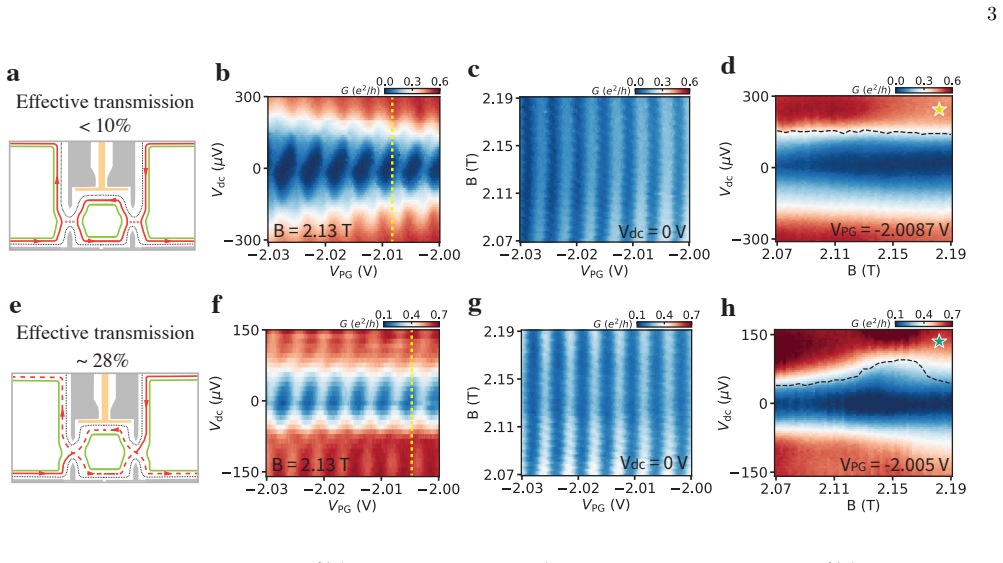
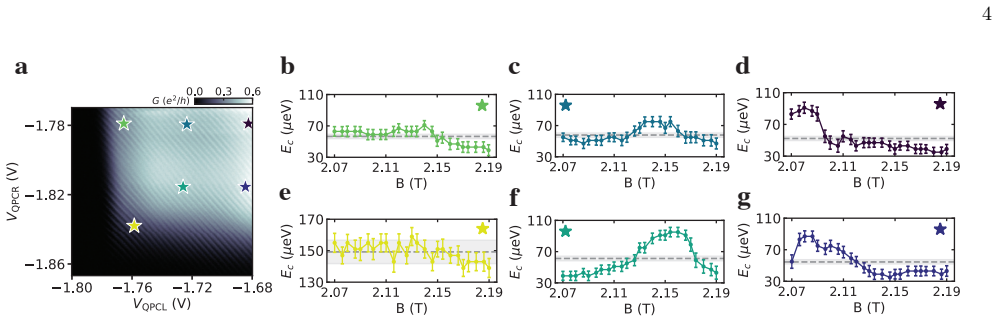
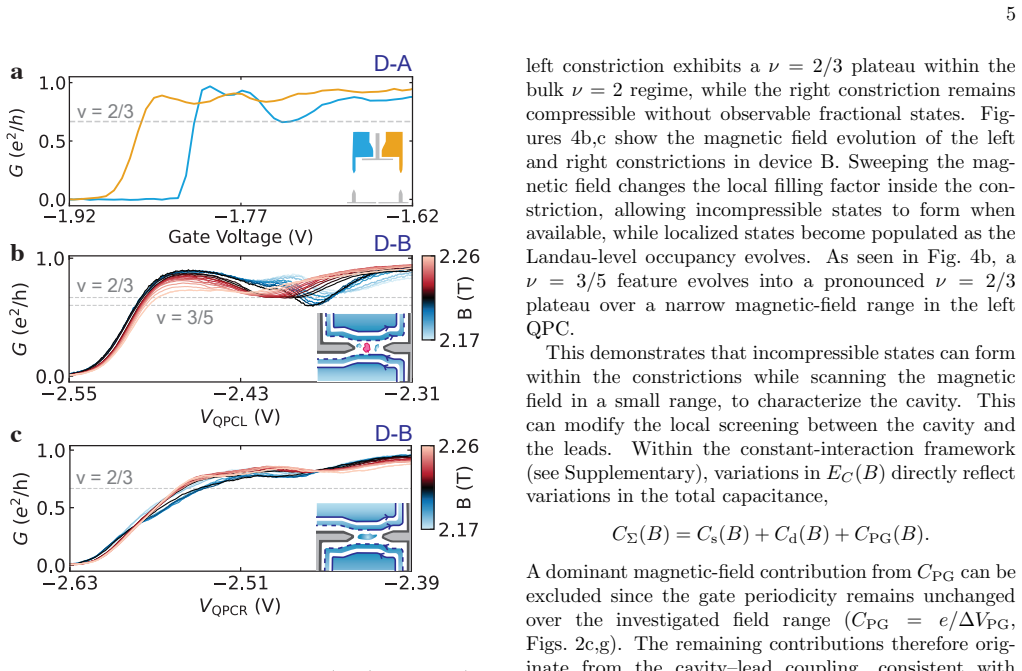
Using a gate-defined quantum Hall cavity in the Coulomb-dominated regime, the charging energy is shown to be strongly and non-monotonically modulated by the magnetic field, varying by up to 60% over 100 mT exclusively when the quantum point contacts are weakly pinched off. The modulation is attributed to field-dependent changes in local compressibility and electrostatic screening driven by incompressible fractional quantum Hall states within the constrictions, establishing the constrictions as active electrostatic elements.
What carries the argument
The quantum point contact constrictions that form the cavity boundaries, which become active modulators of screening when fractional quantum Hall states form inside them.
Load-bearing premise
Changes in the magneto-conductance of the quantum point contacts directly reflect the formation of incompressible states that alter screening to the cavity.
What would settle it
Observation of charging energy modulation in the absence of any fractional quantum Hall features in the QPC conductance traces, or persistence of the effect when the QPCs are fully pinched off.
Figures
read the original abstract
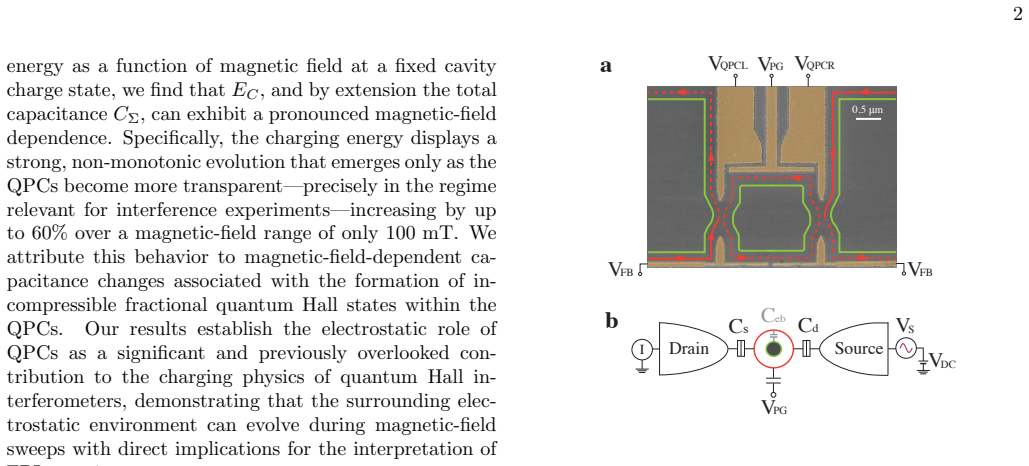
Electronic Fabry-P\'erot interferometers (FPIs) operating in the fractional quantum Hall regime are a key platform for probing anyonic braiding statistics, yet interpreting their interference signals is complicated by Coulomb charging effects, which are commonly treated as parasitic, static properties governed by the cavity's geometry and electrostatics. Here, using a gate-defined quantum Hall cavity tuned to the Coulomb-dominated regime, we demonstrate that the charging energy is in fact strongly and non-monotonically modulated by the magnetic field, varying by up to 60% over a range of only 100 mT. The effect appears exclusively when the quantum point contacts (QPCs) forming the cavity are weakly pinched off, i.e., in the strong cavity-to-lead coupling regime. By correlating the charging energy modulation with the QPC magneto-conductance, we attribute this behavior to field-dependent changes in local compressibility and electrostatic screening between the cavity and the leads, driven by the formation of incompressible fractional quantum Hall states within the constrictions. This result establishes QPC constrictions of quantum Hall cavities as active electrostatic elements rather than passive boundaries, revealing a dynamic screening mechanism, with direct consequences for the interpretation of interference measurements and the extraction of anyonic statistics.
Editorial analysis
A structured set of objections, weighed in public.
Referee Report
Summary. The manuscript reports an experimental study of a gate-defined quantum Hall cavity operated in the Coulomb-dominated regime. It claims that the charging energy exhibits strong, non-monotonic modulation by magnetic field (up to 60% variation over ~100 mT) exclusively when the defining QPCs are weakly pinched off, and attributes the effect to B-dependent changes in local compressibility and electrostatic screening arising from incompressible fractional quantum Hall states forming inside the constrictions.
Significance. If substantiated by the data and controls, the result would establish that QPC constrictions function as active electrostatic elements whose screening properties vary with field, rather than passive boundaries. This has direct consequences for the analysis of Fabry-Pérot interferometers in the fractional regime and for the reliable extraction of anyonic statistics from interference signals.
major comments (2)
- [mechanism attribution / discussion of QPC conductance correlation] The central mechanistic claim—that the observed charging-energy modulation is caused by FQHS-induced screening changes inside the constrictions—rests on correlation between the charging-energy variation and features in the QPC magneto-conductance. No quantitative electrostatic model relating conductance features to cavity-lead potential shifts, nor any direct local probe of compressibility, is presented; alternative explanations (density inhomogeneity, backscattering) therefore remain viable. This correlation is load-bearing for the interpretation advanced in the abstract and discussion.
- [results / data analysis] The extraction of charging energy (presumably from Coulomb-blockade periodicity or interference) and the quoted 60% variation lack reported details on fitting procedures, error bars, background subtraction, or how the non-monotonic dependence is distinguished from other field-dependent effects. Without these, it is not possible to assess whether the data robustly support the stated magnitude and exclusivity to the weakly pinched regime.
minor comments (2)
- [figures] Figure captions and axis labels should explicitly state the range of gate voltages or QPC transmissions corresponding to the 'weakly pinched' regime.
- [abstract / experimental methods] The abstract states the effect 'appears exclusively' when QPCs are weakly pinched; the main text should quantify the transmission or conductance threshold used to define this regime.
Simulated Author's Rebuttal
We thank the referee for the careful and constructive review of our manuscript. The comments highlight important points regarding the strength of the mechanistic interpretation and the transparency of the data analysis. We address each major comment below and have revised the manuscript to incorporate additional details and discussion where appropriate.
read point-by-point responses
-
Referee: [mechanism attribution / discussion of QPC conductance correlation] The central mechanistic claim—that the observed charging-energy modulation is caused by FQHS-induced screening changes inside the constrictions—rests on correlation between the charging-energy variation and features in the QPC magneto-conductance. No quantitative electrostatic model relating conductance features to cavity-lead potential shifts, nor any direct local probe of compressibility, is presented; alternative explanations (density inhomogeneity, backscattering) therefore remain viable. This correlation is load-bearing for the interpretation advanced in the abstract and discussion.
Authors: We agree that the absence of a quantitative electrostatic model leaves room for alternative interpretations and that the correlation is central to our claim. In the revised manuscript we have added an expanded discussion section that presents a qualitative electrostatic model linking the formation of incompressible states in the QPC constrictions to changes in local screening and the resulting shift in the cavity-lead potential. We explicitly address why density inhomogeneity is unlikely to produce the observed non-monotonic field dependence that tracks specific fractional filling factors, and why backscattering contributions are inconsistent with the Coulomb-dominated regime data. While a direct local compressibility probe is not available in this device geometry, the QPC conductance serves as a direct experimental proxy for the local state within the constriction. We have also clarified that the effect is absent when the QPCs are fully open, further supporting the constriction-specific mechanism. revision: partial
-
Referee: [results / data analysis] The extraction of charging energy (presumably from Coulomb-blockade periodicity or interference) and the quoted 60% variation lack reported details on fitting procedures, error bars, background subtraction, or how the non-monotonic dependence is distinguished from other field-dependent effects. Without these, it is not possible to assess whether the data robustly support the stated magnitude and exclusivity to the weakly pinched regime.
Authors: We acknowledge that the original manuscript did not provide sufficient detail on the analysis procedures. In the revised version we have added a new subsection (and corresponding supplementary material) that fully describes: (i) the fitting procedure used to extract charging energy from the periodicity of Coulomb-blockade oscillations in gate voltage, (ii) the method for background subtraction, (iii) how error bars were determined from repeated measurements and fit uncertainties, and (iv) the criteria used to identify and isolate the non-monotonic field dependence from other monotonic or slowly varying effects. The 60% variation is now reported with explicit error bounds and is shown to occur exclusively in the weakly pinched QPC regime; the revised figures include these error bars and the relevant raw data traces. revision: yes
Circularity Check
No circularity: purely experimental report with no derivations or fitted predictions
full rationale
The manuscript is an experimental study reporting measurements of charging energy modulation in a gate-defined quantum Hall cavity. No equations, derivations, ansatzes, or model fits are presented that reduce a claimed prediction or result to an input parameter by construction. The central observations (60% variation in charging energy, correlation with QPC conductance) are direct experimental findings; attribution to FQHS in constrictions is an interpretation based on correlation, not a mathematical reduction. No self-citations are load-bearing for any derivation. This matches the default case of a self-contained experimental paper (score 0-2).
Axiom & Free-Parameter Ledger
axioms (1)
- domain assumption Standard quantum Hall physics and electrostatic screening in 2D electron gases
Reference graph
Works this paper leans on
-
[1]
J. Kim, H. Dev, R. Kumar, A. Ilin, A. Haug, V. Bhard- waj, C. Hong, K. Watanabe, T. Taniguchi, A. Stern, and Y. Ronen, Nat. Nanotechnol.19, 1619 (2024)
2024
-
[2]
thesis, ETH (2021)
Roosli, Marc Philippe,Quasiparticle tunneling between edge channels in quantum dots in the integer and frac- tional quantum Hall regimes, Ph.D. thesis, ETH (2021)
2021
-
[3]
B. I. Halperin, A. Stern, I. Neder, and B. Rosenow, Phys. Rev. B83, 155440 (2011)
2011
-
[4]
Stern, B
A. Stern, B. Rosenow, R. Ilan, and B. I. Halperin, Phys. Rev. B82, 085321 (2010)
2010
-
[5]
B. I. Halperin, Phys. Rev. B25, 2185 (1982)
1982
-
[6]
I. Sivan, H. K. Choi, J. Park, A. Rosenblatt, Y. Gefen, D. Mahalu, and V. Umansky, Nature Communications7, 10.1038/ncomms12184 (2016)
-
[7]
Zhang, D
Y. Zhang, D. T. McClure, E. M. Levenson-Falk, C. M. Marcus, L. N. Pfeiffer, and K. W. West, Phys. Rev. B 79, 241304(R) (2009)
2009
-
[8]
N. Ofek, A. Bid, M. Heiblum, A. Stern, V. Umansky, and D. Mahalu, Proc. Natl. Acad. Sci. U.S.A.107, 5276 (2010)
2010
-
[9]
Rosenow and B
B. Rosenow and B. I. Halperin, Phys. Rev. Lett.98, 106801 (2007)
2007
-
[10]
C. W. von Keyserlingk, S. H. Simon, and B. Rosenow, Phys. Rev. Lett.115, 126807 (2015)
2015
-
[11]
Nakamura, S
J. Nakamura, S. Liang, G. C. Gardner, and M. J. Manfra, Nat. Commun.13, 1 (2022)
2022
-
[12]
D. T. McClure, Y. Zhang, B. Rosenow, E. M. Levenson- Falk, C. M. Marcus, L. N. Pfeiffer, and K. W. West, Phys. Rev. Lett.103, 206806 (2009)
2009
-
[13]
H. K. Choi, I. Sivan, A. Rosenblatt, M. Heiblum, V. Umansky, and D. Mahalu, Nat. Commun.6, 1 (2015)
2015
-
[14]
Sivan, R
I. Sivan, R. Bhattacharyya, H. K. Choi, M. Heiblum, D. E. Feldman, D. Mahalu, and V. Umansky, Phys. Rev. B97, 125405 (2018). 7
2018
-
[15]
Nakamura, S
J. Nakamura, S. Fallahi, H. Sahasrabudhe, R. Rahman, S. Liang, G. C. Gardner, and M. J. Manfra, Nat. Phys. 15, 563 (2019)
2019
-
[16]
Nakamura, S
J. Nakamura, S. Liang, G. C. Gardner, and M. J. Manfra, Nat. Phys.16, 931 (2020)
2020
-
[17]
Ronen, T
Y. Ronen, T. Werkmeister, D. Haie Najafabadi, A. T. Pierce, L. E. Anderson, Y. J. Shin, S. Y. Lee, Y. H. Lee, B. Johnson, K. Watanabe, T. Taniguchi, A. Yacoby, and P. Kim, Nat. Nanotechnol.16, 563 (2021)
2021
-
[18]
D´ eprez, L
C. D´ eprez, L. Veyrat, H. Vignaud, G. Nayak, K. Watan- abe, T. Taniguchi, F. Gay, H. Sellier, and B. Sac´ ep´ e, Nat. Nanotechnol.16, 555 (2021)
2021
-
[19]
L. Zhao, E. G. Arnault, T. F. Q. Larson, Z. Iftikhar, A. Seredinski, T. Fleming, K. Watanabe, T. Taniguchi, F. Amet, and G. Finkelstein, Nano Letters22, 9645–9651 (2022)
2022
-
[20]
H. Fu, K. Huang, K. Watanabe, T. Taniguchi, M. Kayyalha, and J. Zhu, Nano Letters23, 718–725 (2023)
2023
-
[21]
Werkmeister, J
T. Werkmeister, J. R. Ehrets, Y. Ronen, M. E. Wesson, D. Najafabadi, Z. Wei, K. Watanabe, T. Taniguchi, D. E. Feldman, B. I. Halperin, A. Yacoby, and P. Kim, Nat. Commun.15, 1 (2024)
2024
-
[22]
N. L. Samuelson, L. A. Cohen, W. Wang, S. Blanch, T. Taniguchi, K. Watanabe, M. P. Zaletel, and A. F. Young, Phys. Rev. Lett.134, 256301 (2025)
2025
-
[23]
J. Kim, H. Dev, A. Shaer, R. Kumar, A. Ilin, A. Haug, S. Iskoz, K. Watanabe, T. Taniguchi, D. F. Mross, A. Stern, and Y. Ronen, Nature649, 323–329 (2026)
2026
-
[24]
N. L. Samuelson, L. A. Cohen, W. Wang, S. Blanch, T. Taniguchi, K. Watanabe, M. P. Zaletel, and A. F. Young, Phys. Rev. X16, 011062 (2026)
2026
-
[25]
C. E. Henzinger, J. R. Ehrets, R. Fushio, J. Dong, T. Werkmeister, M. E. Wesson, K. Watanabe, T. Taniguchi, A. Vishwanath, B. I. Halperin, A. Ya- coby, and P. Kim, arXiv preprint arXiv:2603.11182 10.48550/ARXIV.2603.11182 (2026)
-
[26]
J. Kim, A. Shaer, R. Kumar, A. Ilin, K. Watanabe, T. Taniguchi, A. Stern, D. F. Mross, and Y. Ronen, arXiv preprint arXiv:2603.11162 10.48550/ARXIV.2603.11162 (2026)
-
[27]
D. B. Chklovskii, B. I. Shklovskii, and L. I. Glazman, Phys. Rev. B46, 4026 (1992)
1992
-
[28]
M. P. R¨ o¨ osli, L. Brem, B. Kratochwil, G. Nicol´ ı, B. A. Braem, S. Hennel, P. M¨ arki, M. Berl, C. Reichl, W. Wegscheider, K. Ensslin, T. Ihn, and B. Rosenow, Phys. Rev. B101, 125302 (2020)
2020
-
[29]
M. P. R¨ o¨ osli, M. Hug, G. Nicol´ ı, P. M¨ arki, C. Reichl, B. Rosenow, W. Wegscheider, K. Ensslin, and T. Ihn, Sci. Adv.7, 10.1126/sciadv.abf5547 (2021)
-
[30]
C. L. Kane and M. P. A. Fisher, Physical Review B51, 13449–13466 (1995)
1995
-
[31]
A. Bid, N. Ofek, H. Inoue, M. Heiblum, C. L. Kane, V. Umansky, and D. Mahalu, Nature466, 585–590 (2010)
2010
-
[32]
R. Sabo, I. Gurman, A. Rosenblatt, F. Lafont, D. Banitt, J. Park, M. Heiblum, Y. Gefen, V. Umansky, and D. Ma- halu, Nat. Phys.13, 491 (2017)
2017
-
[33]
J. Wang, Y. Meir, and Y. Gefen, Phys. Rev. Lett.111, 246803 (2013)
2013
-
[34]
Bhattacharyya, M
R. Bhattacharyya, M. Banerjee, M. Heiblum, D. Mahalu, and V. Umansky, Phys. Rev. Lett.122, 246801 (2019)
2019
-
[35]
H. Inoue, A. Grivnin, Y. Ronen, M. Heiblum, V. Uman- sky, and D. Mahalu, Nature Communications5, 10.1038/ncomms5067 (2014)
-
[36]
Fractional charges in emergent neutral modes at the integer quantum Hall effect
H. Inoue, A. Grivnin, N. Ofek, I. Neder, M. Heiblum, V. Umansky, and D. Mahalu, arXiv 10.48550/arXiv.1310.0691 (2013), 1310.0691
work page internal anchor Pith review Pith/arXiv arXiv doi:10.48550/arxiv.1310.0691 2013
-
[37]
Goldstein and Y
M. Goldstein and Y. Gefen, Phys. Rev. Lett.117, 276804 (2016)
2016
-
[38]
A. Rosenblatt, F. Lafont, I. Levkivskyi, R. Sabo, I. Gur- man, D. Banitt, M. Heiblum, and V. Umansky, Nature Communications8, 10.1038/s41467-017-02433-z (2017)
-
[39]
S. Baer, C. R¨ ossler, E. C. de Wiljes, P.-L. Ardelt, T. Ihn, K. Ensslin, C. Reichl, and W. Wegscheider, Physical Re- view B89, 10.1103/physrevb.89.085424 (2014)
-
[40]
Duprez,Helical edge transport and Fabry-P´ erot inter- ferometry in graphene quantum Hall effect — hal.science, Ph.D
C. Duprez,Helical edge transport and Fabry-P´ erot inter- ferometry in graphene quantum Hall effect — hal.science, Ph.D. thesis, Universite Grenoble Alpes (2021), [Ac- cessed 12-05-2026]
2021
-
[41]
Ihn,Semiconductor Nanostructures(Oxford Univer- sity Press, 2009)
T. Ihn,Semiconductor Nanostructures(Oxford Univer- sity Press, 2009)
2009
-
[42]
Hanson, L
R. Hanson, L. P. Kouwenhoven, J. R. Petta, S. Tarucha, and L. M. K. Vandersypen, Reviews of Modern Physics 79, 1217–1265 (2007)
2007
-
[43]
Coulomb-Blockade Oscillations in Semiconductor Nanostructures
H. van Houten, C. W. J. Beenakker, and A. A. M. Star- ing, arXiv 10.48550/arXiv.cond-mat/0508454 (2005), cond-mat/0508454. 8 SUPPLEMENTARY SECTION SAMPLE FABRICATION The devices are fabricated from a GaAs/AlGaAs heterostructure with a two-dimensional electron gas (2DEG) located 138 nm below the top surface. The 2DEG electron densityn e = 1.05×10 11 cm−2 a...
work page internal anchor Pith review Pith/arXiv arXiv doi:10.48550/arxiv.cond-mat/0508454 2005
discussion (0)
Sign in with ORCID, Apple, or X to comment. Anyone can read and Pith papers without signing in.