A Human-in-the-Loop Bayesian Optimization Framework for Constraint-Aware Bioprocess Development
Pith reviewed 2026-06-26 21:10 UTC · model grok-4.3
The pith
Extending Pareto-guided sampling lets experts interactively balance performance, uncertainty, constraints and robustness in Bayesian bioprocess optimization
A machine-rendered reading of the paper's core claim, the machinery that carries it, and where it could break.
Core claim
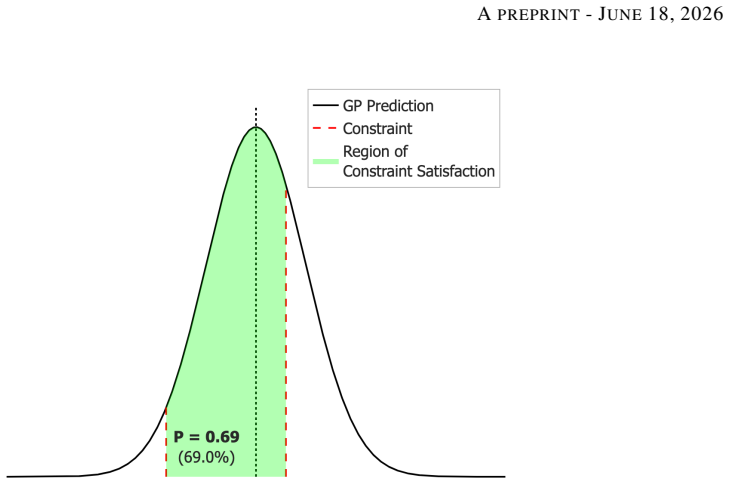
The framework reformulates Gaussian process surrogate-derived quantities as objectives of a multi-objective optimization problem; the posterior probability of satisfying output specification limits is computed analytically from the GP posterior and incorporated as an explicit Pareto objective, while a Monte Carlo strategy estimates expected lower-confidence performance over user-defined input perturbations; the resulting multi-dimensional Pareto representation is exposed to a domain expert for interactive candidate selection rather than returning a single automated recommendation.
What carries the argument
Multi-dimensional Pareto front whose objectives are GP-predicted performance, model uncertainty, analytically computed probability of constraint satisfaction, and Monte Carlo estimate of robustness to input perturbations
If this is right
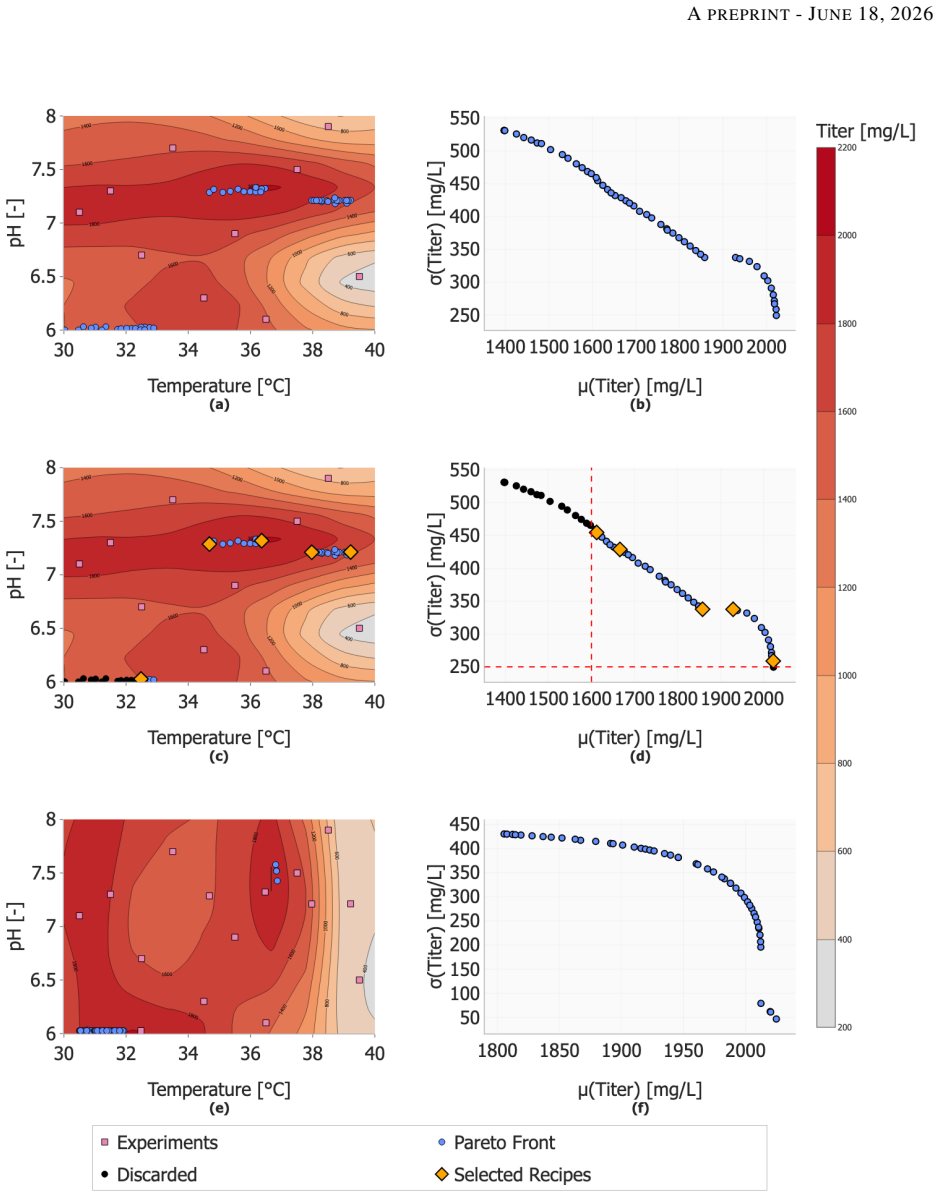
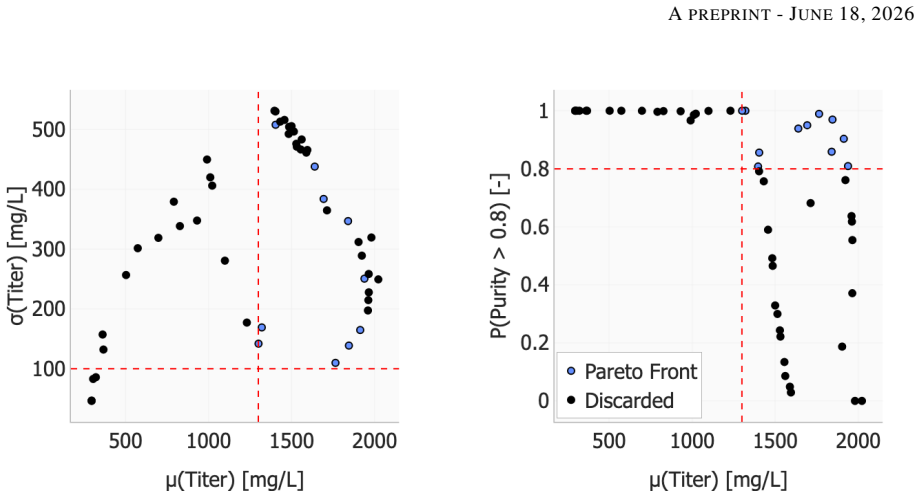
- Pairwise two-dimensional projections make simultaneous trade-offs between performance, uncertainty, feasibility and robustness visible to the expert
- Expert selection criteria can be iteratively refined as the surrogate improves and development objectives evolve
- The dashboard provides a principled, expert-defined stopping criterion for experimental resource allocation
- High-performing, feasibility-compliant and perturbation-resilient operating conditions can be identified systematically in the eight-dimensional fed-batch example
Where Pith is reading between the lines
- The interactive dashboard could be combined with sequential experimental data to update the surrogate and re-compute the Pareto front after each new measurement
- Similar reformulation of surrogate quantities into Pareto objectives might apply to other surrogate-based optimization settings that require explicit handling of safety constraints and implementation uncertainty
- The Monte Carlo robustness estimate could be replaced by an analytic approximation if the input perturbation distribution is Gaussian, potentially reducing computational cost
Load-bearing premise
The Gaussian process surrogate model provides sufficiently accurate posterior distributions to allow reliable analytical computation of constraint satisfaction probabilities and meaningful Monte Carlo estimates of robustness under input perturbations.
What would settle it
Running the conditions selected from the dashboard on the actual CHO simulator or real process and observing that the measured constraint satisfaction rates or robustness levels fall outside the ranges predicted by the Pareto front would falsify the framework's utility for informed selection.
Figures
read the original abstract
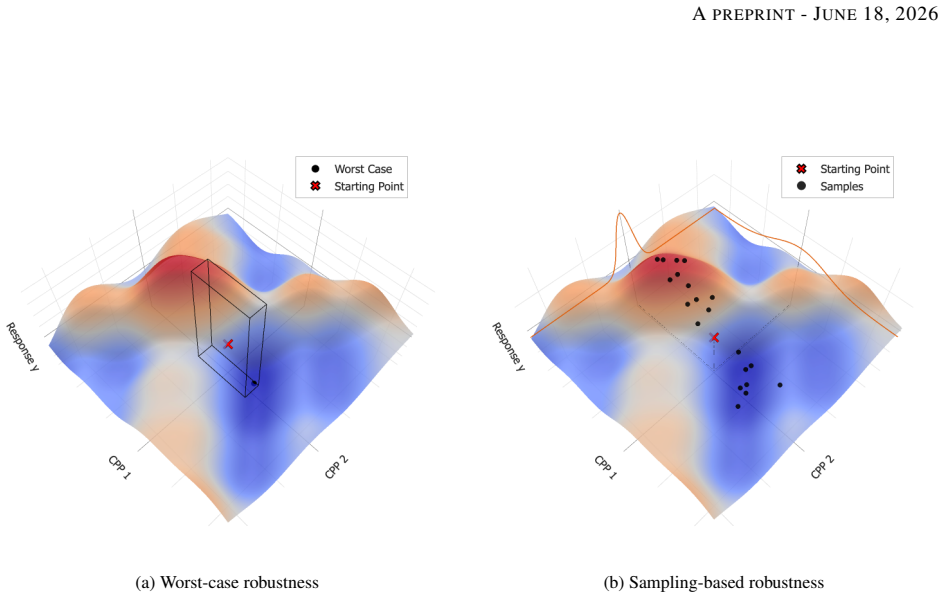
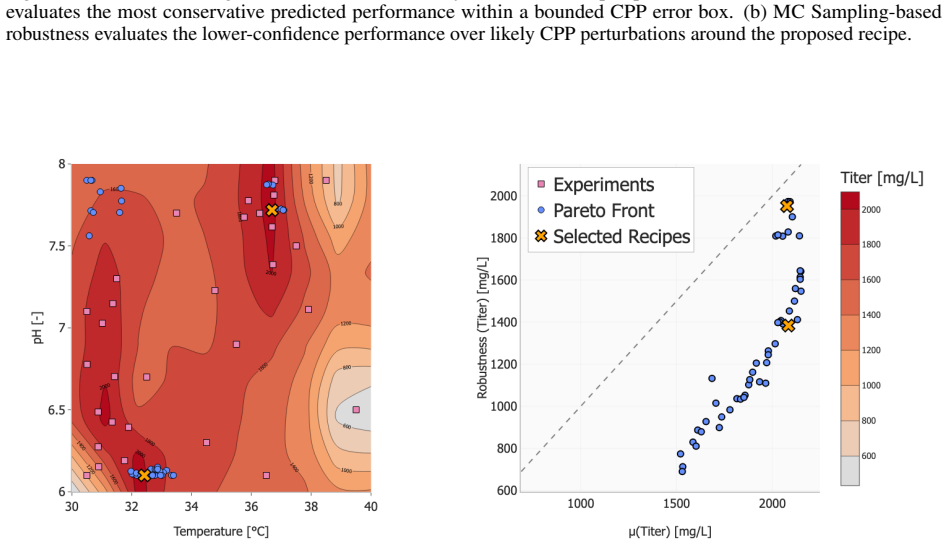
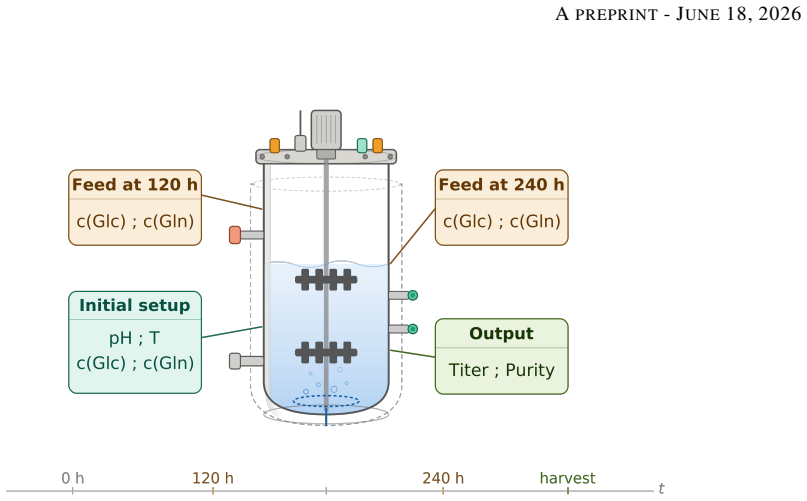
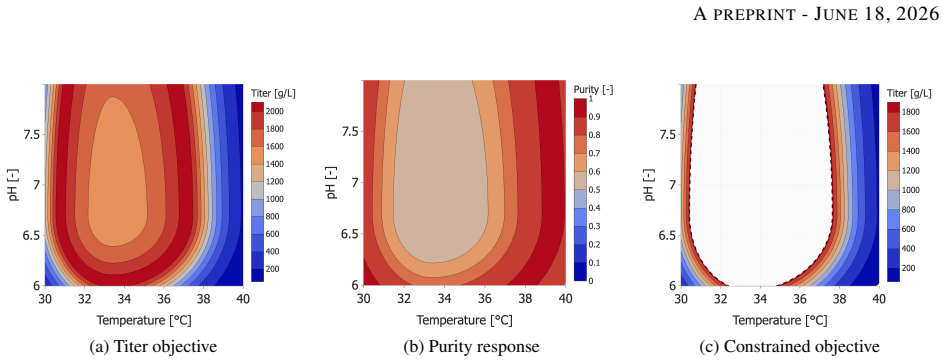
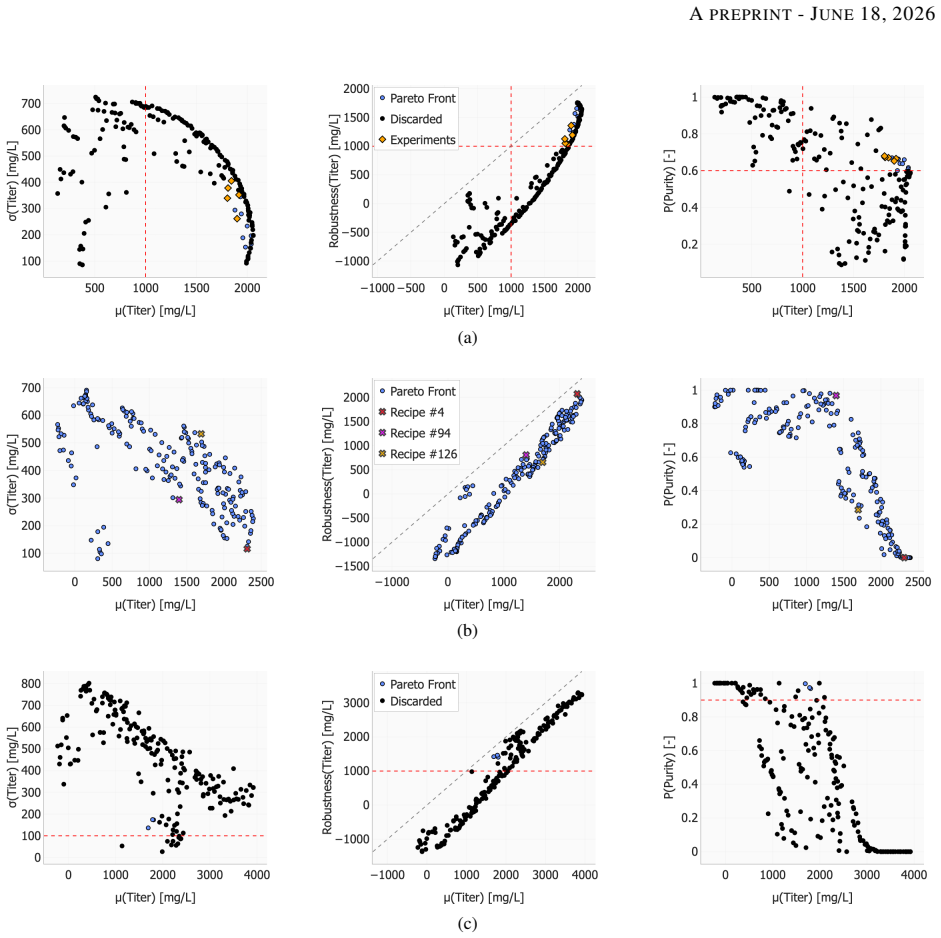
This work presents an extension to Pareto Front Guided Sampling (PFGS), a Human-in-the-Loop (HitL) Bayesian Optimization (BO) framework in which Gaussian process (GP) surrogate-derived quantities are reformulated as objectives of a multi-objective optimization problem, and the resulting Pareto front is exposed to a domain expert for interactive candidate selection rather than returning a single automated recommendation. The framework is extended in two directions: constrained optimization is addressed by incorporating the posterior probability of satisfying output specification limits as an explicit Pareto objective, computed analytically from the GP posterior distribution; robust optimization is addressed by a Monte Carlo sampling strategy that estimates expected lower-confidence performance over a user-defined variability of input perturbations, capturing performance degradation under likely implementation deviations. The resulting multi-dimensional Pareto representation renders trade-offs between predicted performance, model uncertainty, probabilistic constraint satisfaction, and input robustness simultaneously visible through pairwise two-dimensional projections on an interactive dashboard, enabling selection criteria to be iteratively refined as the surrogate model improves and development objectives evolve. The framework is showcased on an eight-dimensional fed-batch Chinese Hamster Ovary (CHO) cell culture simulator demonstrating systematic identification of high-performing, feasibility-compliant, and perturbation-resilient operating conditions, and illustrating how expert-defined requirements provide a principled stopping criterion and support informed allocation of experimental resources.
Editorial analysis
A structured set of objections, weighed in public.
Referee Report
Summary. The manuscript extends the Pareto Front Guided Sampling (PFGS) human-in-the-loop Bayesian optimization framework. Gaussian process surrogate quantities are reformulated as objectives in a multi-objective optimization problem whose Pareto front is exposed to a domain expert via an interactive dashboard for candidate selection. Two extensions are introduced: constrained optimization via the analytically computed posterior probability of satisfying output limits, and robust optimization via Monte Carlo estimation of expected lower-confidence performance under input perturbations. The resulting multi-dimensional Pareto representation is demonstrated on an eight-dimensional fed-batch CHO cell culture simulator, where it supports systematic identification of high-performing, feasibility-compliant, and perturbation-resilient conditions together with expert-defined stopping criteria.
Significance. If the implementation details hold, the framework supplies a usable interface for incorporating probabilistic constraints and input robustness directly into the selection process of Bayesian optimization, which is relevant for bioprocess applications. The interactive dashboard that renders pairwise projections of the multi-objective trade-offs is a concrete contribution that allows iterative refinement of selection criteria. The simulator demonstration is a legitimate vehicle for illustrating the workflow; the approach relies on standard GP posterior properties and does not exhibit internal circularity or unsupported derivations.
minor comments (3)
- [Methods] The manuscript should add a short paragraph in the methods section clarifying the precise definition of the Monte Carlo robustness objective (number of samples, perturbation distribution, and how the lower-confidence bound is aggregated) to allow exact reproduction.
- [Results] Figure captions for the dashboard projections should explicitly state the number of objectives being visualized and the mapping from the four-dimensional Pareto set to the displayed pairwise planes.
- [Discussion] A brief discussion of computational cost for the analytical constraint probability versus the Monte Carlo robustness estimate would help readers assess scalability beyond the eight-dimensional simulator.
Simulated Author's Rebuttal
We thank the referee for the detailed and positive assessment of our manuscript, including the accurate summary of the PFGS extensions for probabilistic constraints and input robustness. The recommendation for minor revision is noted; we will prepare a revised version addressing any editorial or minor points that may arise during production.
Circularity Check
No significant circularity identified
full rationale
The described framework applies standard GP posterior properties to compute analytical constraint satisfaction probabilities and uses Monte Carlo sampling for robustness estimates under input perturbations. These quantities are then treated as additional objectives in a multi-objective optimization whose Pareto front is presented to a human expert. No derivation reduces a prediction to a fitted input by construction, no self-citation is invoked as a uniqueness theorem, and no ansatz is smuggled via prior work. The central claim is an engineering extension of existing BO techniques rather than a closed mathematical reduction.
Axiom & Free-Parameter Ledger
Reference graph
Works this paper leans on
-
[1]
A Guide to Bayesian Optimization in Bioprocess Engineering
Maximilian Siska et al. “A Guide to Bayesian Optimization in Bioprocess Engineering”. en. In:Biotechnology and Bioengineering123.4 (2026), pp. 805–830.ISSN: 1097-0290.DOI:10.1002/bit.70129
-
[2]
Bayesian reaction optimization as a tool for chemical synthesis
Benjamin J. Shields et al. “Bayesian reaction optimization as a tool for chemical synthesis”. en. In:Nature 590.7844 (Feb. 2021), pp. 89–96.ISSN: 1476-4687.DOI:10.1038/s41586-021-03213-y
-
[3]
InProceedings of the 15th ACM SIGPLAN-SIGACT symposium on Principles of programming languages
Peter I. Frazier and Jialei Wang.Bayesian optimization for materials design. 2016.DOI: 10.1007/978-3-319- 23871-5_3
-
[4]
Osney Pérez-Ones and Antonio Flores-Tlacuahuac. “A stochastic data-driven Bayesian optimization approach for intensified ethanol–water separation systems”. In:Chemical Engineering and Processing - Process Intensification 197 (Mar. 2024), p. 109708.ISSN: 0255-2701.DOI:10.1016/j.cep.2024.109708
-
[5]
Design of experiments and design space approaches in the pharmaceutical bioprocess optimization
Alice Kasemiire et al. “Design of experiments and design space approaches in the pharmaceutical bioprocess optimization”. In:European Journal of Pharmaceutics and Biopharmaceutics166 (Sept. 2021), pp. 144–154. ISSN: 0939-6411.DOI:10.1016/j.ejpb.2021.06.004
-
[6]
Bayesian Optimization for Adaptive Experimental Design: A Review
Stewart Greenhill et al. “Bayesian Optimization for Adaptive Experimental Design: A Review”. In:IEEE Access 8 (2020), pp. 13937–13948.ISSN: 2169-3536.DOI:10.1109/ACCESS.2020.2966228. 18 APREPRINT- JUNE18, 2026
-
[7]
A Tutorial on Bayesian Optimization
Peter I. Frazier.A Tutorial on Bayesian Optimization. July 2018.DOI:10.48550/arXiv.1807.02811
work page internal anchor Pith review Pith/arXiv arXiv doi:10.48550/arxiv.1807.02811 2018
-
[8]
Shiwei Yang et al. “Aspects and Implementation of Pharmaceutical Quality by Design from Conceptual Frame- works to Industrial Applications”. en. In:Pharmaceutics17.5 (May 2025), p. 623.ISSN: 1999-4923.DOI: 10.3390/pharmaceutics17050623
-
[9]
Mohammad Mehrian et al. “Maximizing neotissue growth kinetics in a perfusion bioreactor: An in silico strategy using model reduction and Bayesian optimization”. en. In:Biotechnology and Bioengineering115.3 (2018), pp. 617–629.ISSN: 1097-0290.DOI:10.1002/bit.26500
-
[10]
Design of Biopharmaceutical Formulations Accelerated by Machine Learning
Harini Narayanan et al. “Design of Biopharmaceutical Formulations Accelerated by Machine Learning”. eng. In:Molecular Pharmaceutics18.10 (Oct. 2021), pp. 3843–3853.ISSN: 1543-8392.DOI: 10 . 1021 / acs . molpharmaceut.1c00469
2021
-
[11]
Zachary Cosenza et al. “Multi-objective Bayesian algorithm automatically discovers low-cost high-growth serum- free media for cellular agriculture application”. en. In:Engineering in Life Sciences23.8 (2023), e2300005.ISSN: 1618-2863.DOI:10.1002/elsc.202300005
-
[12]
Laura Marie Helleckes et al. “High-throughput screening of catalytically active inclusion bodies using laboratory automation and Bayesian optimization”. en. In:Microbial Cell Factories23.1 (Feb. 2024), p. 67.ISSN: 1475-2859. DOI:10.1186/s12934-024-02319-y
-
[13]
Adrian Martens et al.Holistic Bioprocess Development Across Scales Using Multi-Fidelity Batch Bayesian Optimization. Aug. 2025.DOI:10.48550/arXiv.2508.10970
-
[14]
Bayesian Optimization with Inequality Constraints
Jacob Gardner et al. “Bayesian Optimization with Inequality Constraints”. en. In:Proceedings of the 31st International Conference on Machine Learning. PMLR, June 2014, pp. 937–945
2014
-
[15]
Bayesian optimization with known experimental and design constraints for chemistry applications
Riley J. Hickman et al. “Bayesian optimization with known experimental and design constraints for chemistry applications”. en. In:Digital Discovery1.5 (Oct. 2022), pp. 732–744.ISSN: 2635-098X.DOI: 10 . 1039 / D2DD00028H
2022
-
[16]
Joel A. Paulson and Congwen Lu. “COBALT: COnstrained Bayesian optimizAtion of computationaLly expensive grey-box models exploiting derivaTive information”. In:Computers & Chemical Engineering160 (Apr. 2022), p. 107700.ISSN: 0098-1354.DOI:10.1016/j.compchemeng.2022.107700
-
[17]
Akshay Kudva, Farshud Sorourifar, and Joel A. Paulson. “Constrained robust Bayesian optimization of expensive noisy black-box functions with guaranteed regret bounds”. en. In:AIChE Journal68.12 (2022), e17857.ISSN: 1547-5905.DOI:10.1002/aic.17857
-
[18]
Bayesian optimization with safety constraints: safe and automatic parameter tuning in robotics
Felix Berkenkamp, Andreas Krause, and Angela P. Schoellig. “Bayesian optimization with safety constraints: safe and automatic parameter tuning in robotics”. en. In:Machine Learning112.10 (Oct. 2023), pp. 3713–3747. ISSN: 0885-6125, 1573-0565.DOI:10.1007/s10994-021-06019-1
-
[19]
Dinesh Krishnamoorthy and Francis J. Doyle.Safe Bayesian Optimization using Interior-Point Methods – Applied to Personalized Insulin Dose Guidance. May 2022.DOI:10.48550/arXiv.2205.02327
-
[20]
Neural network training as an optimal control problem : — an augmented lagrangian approach —
Panagiotis Petsagkourakis, Benoit Chachuat, and Ehecatl Antonio del Rio-Chanona. “Safe Real-Time Optimiza- tion using Multi-Fidelity Gaussian Processes”. In:2021 60th IEEE Conference on Decision and Control (CDC). Dec. 2021, pp. 6734–6741.DOI:10.1109/CDC45484.2021.9683599
-
[21]
Santiago Ramos Garces et al. “Efficient Tuning of an Isotope Separation Online System Through Safe Bayesian Optimization with Simulation-Informed Gaussian Process for the Constraints”. en. In:Mathematics12.23 (Jan. 2024), p. 3696.ISSN: 2227-7390.DOI:10.3390/math12233696
-
[22]
Bayesian Optimization Searching for Robust Solutions
Hoai Phuong Le and Juergen Branke. “Bayesian Optimization Searching for Robust Solutions”. In:2020 Winter Simulation Conference (WSC). Dec. 2020, pp. 2844–2855.DOI:10.1109/WSC48552.2020.9383978
-
[23]
Adversarially Robust Optimization with Gaussian Processes
Ilija Bogunovic et al. “Adversarially Robust Optimization with Gaussian Processes”. In:Advances in Neural Information Processing Systems. V ol. 31. Curran Associates, Inc., 2018
2018
-
[24]
Dorina Weichert et al.Robust Entropy Search for Safe Efficient Bayesian Optimization. May 2024.DOI: 10. 48550/arXiv.2405.19059
arXiv 2024
-
[25]
Joel A. Paulson, Georgios Makrygiorgos, and Ali Mesbah. “Adversarially robust Bayesian optimization for efficient auto-tuning of generic control structures under uncertainty”. en. In:AIChE Journal68.6 (2022), e17591. ISSN: 1547-5905.DOI:10.1002/aic.17591
-
[26]
Akshay Kudva, Wei-Ting Tang, and Joel A. Paulson. “Robust Bayesian optimization for flexibility analysis of expensive simulation-based models with rigorous uncertainty bounds”. In:Computers & Chemical Engineering 181 (Feb. 2024), p. 108515.ISSN: 0098-1354.DOI:10.1016/j.compchemeng.2023.108515
-
[27]
Akshay Kudva and Joel A. Paulson. “BONSAI: Structure-exploiting robust Bayesian optimization for networked black-box systems under uncertainty”. In:Computers & Chemical Engineering(Sept. 2025), p. 109393.ISSN: 0098-1354.DOI:10.1016/j.compchemeng.2025.109393. 19 APREPRINT- JUNE18, 2026
-
[28]
Qi Zhang, Kaiyi Ji, and Shaofeng Zou.Distributionally Robust Bayesian Optimization: From Single to Multiple Objectives. en. Oct. 2025
2025
-
[29]
Human-in-the-Loop AI Use in Ongoing Process Verification in the Pharmaceutical Industry
Miquel Romero-Obon et al. “Human-in-the-Loop AI Use in Ongoing Process Verification in the Pharmaceutical Industry”. en. In:Information16.12 (Dec. 2025), p. 1082.ISSN: 2078-2489.DOI:10.3390/info16121082
-
[30]
Human-algorithm collaborative Bayesian optimization for engineering systems
Tom Savage and Ehecatl Antonio del Rio Chanona. “Human-algorithm collaborative Bayesian optimization for engineering systems”. In:Computers & Chemical Engineering189 (Oct. 2024), p. 108810.ISSN: 0098-1354. DOI:10.1016/j.compchemeng.2024.108810
-
[31]
Masaki Adachi et al.Looping in the Human: Collaborative and Explainable Bayesian Optimization. en. Feb. 2024
2024
-
[32]
Human–machine collaboration for improving semiconductor process development
Keren J. Kanarik et al. “Human–machine collaboration for improving semiconductor process development”. en. In:Nature616.7958 (Apr. 2023), pp. 707–711.ISSN: 1476-4687.DOI:10.1038/s41586-023-05773-7
-
[33]
Optimal Design of Experiments for Bio-Processes using Hybrid Models
Samuel Stricker. “Optimal Design of Experiments for Bio-Processes using Hybrid Models”. English. MA thesis. Zurich: ETH Zurich, Sept. 2024
2024
-
[34]
Pareto Front Guided Sampling for Efficient Bioprocess Experimentation
Samuel Stricker et al. “Pareto Front Guided Sampling for Efficient Bioprocess Experimentation”. en. In:System & Control Transactions. PSE Press, June 2026
2026
-
[35]
A Comprehensive Review on Implementation of Quality by Design in Varied Pharmaceutical Formulations
Aqsa Qaisar et al. “A Comprehensive Review on Implementation of Quality by Design in Varied Pharmaceutical Formulations”. en. In:Global Pharmaceutical Sciences Review9.1 (Mar. 2024), pp. 1–9.ISSN: 2788-5445.DOI: 10.31703/gpsr.2024(IX-I).01
-
[36]
Carl Edward Rasmussen and Christopher K. I. Williams.Gaussian Processes for Machine Learning. en. The MIT Press, Nov. 2005.ISBN: 978-0-262-25683-4.DOI:10.7551/mitpress/3206.001.0001
-
[37]
Hybrid Gaussian Process Models for continuous time series in bolus fed- batch cultures
M. Nicolás Cruz-Bournazou et al. “Hybrid Gaussian Process Models for continuous time series in bolus fed- batch cultures”. In:IFAC-PapersOnLine. 13th IFAC Symposium on Dynamics and Control of Process Systems, including Biosystems DYCOPS 2022 55.7 (Jan. 2022), pp. 204–209.ISSN: 2405-8963.DOI: 10 . 1016 / j . ifacol.2022.07.445
2022
-
[38]
Bayesian Optimization in Bioprocess Engineering—Where Do We Stand Today?
Florian Gisperg et al. “Bayesian Optimization in Bioprocess Engineering—Where Do We Stand Today?” en. In: Biotechnology and Bioengineering122.6 (2025), pp. 1313–1325.ISSN: 1097-0290.DOI: 10.1002/bit.28960
-
[39]
Niranjan Srinivas et al. “Information-Theoretic Regret Bounds for Gaussian Process Optimization in the Bandit Setting”. In:IEEE Transactions on Information Theory58.5 (May 2012), pp. 3250–3265.ISSN: 1557-9654.DOI: 10.1109/TIT.2011.2182033
-
[40]
Maximilian Balandat et al.BoTorch: A Framework for Efficient Monte-Carlo Bayesian Optimization. Dec. 2020
2020
-
[41]
Batch Bayesian Optimization
Nathan Hunt. “Batch Bayesian Optimization”. PhD thesis. Massachusetts Institute of Technology, 2020
2020
-
[42]
Bayesian Optimization with Unknown Constraints
Michael A. Gelbart, Jasper Snoek, and Ryan P. Adams.Bayesian Optimization with Unknown Constraints. Mar. 2014.DOI:10.48550/arXiv.1403.5607
work page internal anchor Pith review Pith/arXiv arXiv doi:10.48550/arxiv.1403.5607 2014
-
[43]
On Safety in Safe Bayesian Optimization
Christian Fiedler et al. “On Safety in Safe Bayesian Optimization”. en. In:Transactions on Machine Learning Research(May 2024).ISSN: 2835-8856
2024
-
[44]
Pymoo: Multi-Objective Optimization in Python
Julian Blank and Kalyanmoy Deb. “Pymoo: Multi-Objective Optimization in Python”. In:IEEE Access8 (2020), pp. 89497–89509.ISSN: 2169-3536
2020
-
[45]
Stephen Craven et al. “Process model comparison and transferability across bioreactor scales and modes of operation for a mammalian cell bioprocess”. en. In:Biotechnology Progress29.1 (2013), pp. 186–196.ISSN: 1520-6033.DOI:10.1002/btpr.1664. 20 APREPRINT- JUNE18, 2026 A Appendix A.1 Dashboard Visualization Fig A1: The setting section loads the relevant r...
discussion (0)
Sign in with ORCID, Apple, or X to comment. Anyone can read and Pith papers without signing in.