REVIEW 3 major objections 5 minor 87 references
Exhaustive Model Selection in $b \to s \ell \ell$ Decays: Pitting Cross-Validation against AIC$_c$
T0 review · 3 major / 5 minor · reviewed 2026-08-14 · deepseek-v4-flash
Pith's one-line read A model-selection scan over all 511 new-physics operator combinations for b→sℓℓ decays finds that every surviving model contains the left-handed vector-muon operator O9, which is also the only one-operator scenario that survives.
desk verdict A useful exhaustive NP model-selection scan whose O9-central result is solid within the chosen set but is never tested against the Standard Model baseline. read the letter →
The pith
A machine-rendered reading of the paper's core claim, the machinery that carries it, and where it could break.
The reading
What carries the argument
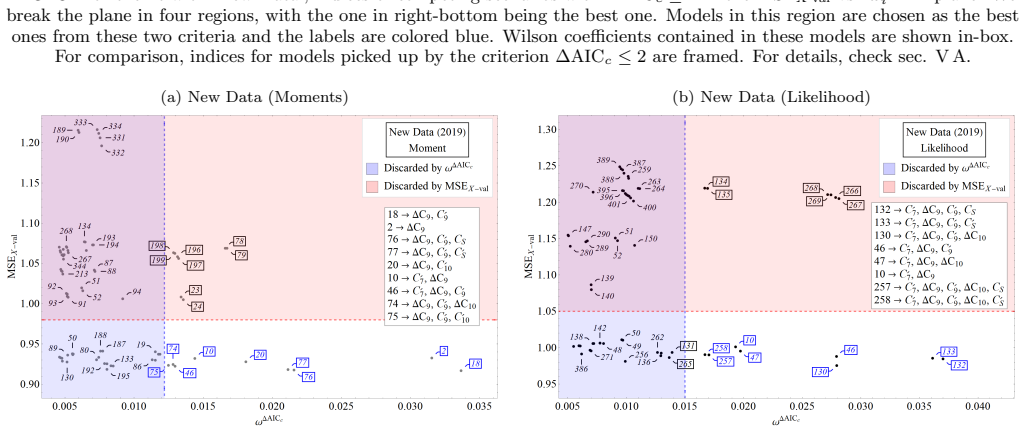
The load-bearing object is the complete candidate set: every non-empty combination of the new-physics Wilson coefficients, 511 scenarios, each fitted to the same data with a $\chi^2$ statistic and then ranked by two competing criteria. The first is the corrected Akaike information criterion, $\mathrm{AIC_c} = \chi^2_{\min} + 2K + 2K(K+1)/(n-K-1)$, with $K$ the number of new-physics parameters and $n$ the number of observables, converted to Akaike weights $w_i \propto e^{-\Delta_i/2}$. The second is leave-one-out cross-validation, summarized by its mean-squared prediction error. The selection rule combines them: keep models with $\Delta\mathrm{AIC_c}\le 4$, plot them in the plane of cross-validation error against Akaike weight, and retain the low-error, high-weight cluster. This two-criterion filter is what turns 511 fits into a small surviving list, and it is why the single-operator $\mathcal{O}_9$ outcome is a model-selection result rather than a single best-fit point.
What would settle it
Run the same 511-model exercise with the Standard Model added as a 512th candidate (all Wilson coefficients fixed to zero); if AIC$_c$ or cross-validation selects it, the claim that $\mathcal{O}_9$ is the only surviving one-operator scenario collapses. A second, independent check is to measure $R_{K^*}$ in the low $q^2$ bin $[0.045,1.1]\,\mathrm{GeV}^2$, or the angular observable $S_5$ in $B\to K^*\mu^+\mu^-$, at higher precision and see whether the value returns to the Standard Model prediction, which would remove the tension that $\Delta C_9\approx -1.1$ fits are absorbing.
Extended reading notes
Core claim
On the paper's own terms, the discovery is that exhaustive model selection over the 511 non-empty subsets of the operator set narrows the new-physics explanations of $b\to s\ell^+\ell^-$ data to a small family with a common member. For the 'New Moments' dataset the survivors are one-, two-, and three-operator models, and the unique one-operator survivor is $\mathcal{O}_9 = (\bar{s}\gamma_\mu P_L b)(\bar{\mu}\gamma^\mu\mu)$, with $\Delta C_9$ between about $-1.1$ and $-1.4$; every multi-operator survivor also contains $\Delta C_9$. With the 'Likelihood' angular dataset the same criteria select two- to five-operator models, again all containing $\Delta C_9$, with a small $C'_7$ component in most. The paper reports that the angular observables play the dominant role in this selection, and that when only $R_{K^{(*)}}$ are considered, the axial-vector operator $\mathcal{O}_{10}$ is the sole one-operator explanation, with a couple of two-operator combinations also capable of explaining the ratios while respecting $\mathrm{Br}(B_s\to\mu^+\mu^-)$.
Load-bearing premise
The load-bearing premise is that new physics must be present: the 511 candidate models are all non-empty new-physics combinations, so the Standard Model (all Wilson coefficients zero) is never entered in the model-selection contest, and the procedure cannot detect that the data might prefer no new physics at all.
Editorial extensions
If this is right
- Every surviving model in the four data-set variants contains $\Delta C_9$, so a positive experimental confirmation of a universal $\Delta C_9$ shift near $-1.1$ would single out the $\mathcal{O}_9$ operator as the carrier of the $b\to s\ell\ell$ anomaly.
- The $\Delta C_9\approx -1.1$ to $-1.4$ solution predicts specific distortions of the $B\to K^*\mu^+\mu^-$ angular observables $A_{FB}$ and $S_5$ relative to the Standard Model, which the next round of high-statistics $B$-decay data can test directly.
- Models containing $C'_7$ alongside $\Delta C_9$ remain consistent with the measured radiative decays $B\to X_s\gamma$, $B\to K^*\gamma$, and $B_s\to\phi\gamma$ within $1\sigma$, so those decays cannot currently separate them, but more precise radiative measurements would.
- Dropping $R_{K^{(*)}}$ from the fit shrinks the survivor list toward fewer operators, which implies the updated lepton-universality ratios are the input pushing the selection toward multi-operator scenarios.
- The $\Delta C_9=-\Delta C_{10}$ alignment common in leptoquark scenarios fails the $\Delta\mathrm{AIC_c}\le 4$ filter, so this particular class of new-physics models is not supported by the selection.
Reading between the lines
- If the Standard Model were admitted as a candidate model alongside the 511 new-physics scenarios, the information-theoretic ranking would test whether the data require new physics at all; the paper does not perform this comparison, so its 'only surviving one-operator scenario' is a claim about the best new-physics explanation, not about the existence of new physics.
- The strong dataset dependence of the survivor list, single-operator $\mathcal{O}_9$ with Moments data versus three-to-five-operator models with Likelihood data, suggests that the conclusion should be re-checked as the experimental analysis of angular observables evolves; future unbinned likelihood fits with more statistics could resolve which list is physical.
- The same exhaustive-scan-plus-two-criteria procedure could be applied to the current $b\to s\ell\ell$ data with a different operator basis, including tensor or four-quark operators, and the natural expectation is that the surviving set would remain anchored on $\mathcal{O}_9$ if the data pull is genuine.
- Because $\Delta C_9\approx -1.1$ is a coherent shift, any ultraviolet completion proposed to explain the anomalies, for instance a leptoquark or a heavy $Z'$, must produce the same left-handed vector coupling to muons to reproduce these model-selection results.
Editorial analysis
A structured set of objections, weighed in public.
Referee Report
Summary. The paper performs an exhaustive frequentist fit of 511 non-empty combinations of nine dimension-six Wilson coefficients to b→sℓℓ data, and ranks the resulting models with AICc and leave-one-out cross-validation for four dataset variants ('Old'/'New' LFUV data × 'Moments'/'Likelihood' angular data). The authors report that a small set of one-, two-, and three-operator scenarios survive, that all surviving scenarios contain the left-handed vector muon coupling O9, and that O9 is the only surviving one-operator scenario, with ΔC9 best-fit values near −1.1 to −1.4. They also study the impact of RK(*) data, check consistency with radiative B→Xsγ, B→K*γ, and Bs→φγ constraints, and provide best-fit Wilson coefficients, correlations, and ancillary model-index files.
Significance. If the central claim were properly benchmarked against the Standard Model, this would be a useful systematic study: the exhaustive coverage of 511 operator combinations, the simultaneous use of AICc and cross-validation, the separate treatment of Moments versus Likelihood angular data, and the radiative-decay consistency checks are genuine strengths. The ancillary 'models.json' file and the explicit AICc formula aid reproducibility. However, the headline conclusion is currently established only within the set of non-empty NP scenarios, not against the zero-parameter Standard Model, and one textual claim about 'all datasets' is contradicted by the paper's own table. The significance of the paper therefore depends on revisions that add the SM null comparison and qualify the dataset-specific claims.
major comments (3)
- [Sec. IV A; Eq. (12); Abstract] The candidate set consists of the 511 non-empty combinations of the nine NP Wilson coefficients, explicitly excluding the Standard Model (all Wilson coefficients zero) as a candidate. This omission is load-bearing because AICc is a relative criterion: Eq. (12) with K=0 gives AICc(SM)=χ²_SM, whereas for the New Moments dataset the selected one-operator model 2 has χ²_min=252.44, n=258, K=1, so AICc=252.44+2+4/256≈254.45. If χ²_SM is below 254.45, the SM would be preferred over every NP model by AICc, and the statement that O9 is 'the only surviving one-operator scenario' would not imply that the data prefer new physics over no new physics. The paper never reports χ²_SM for any of the four datasets. I request that the SM be included as a K=0 candidate in both the AICc comparison and leave-one-out cross-validation, and that the abstract and summary be reworded so that 'survives' is understood as 'survives among the 511 NP scenarios' unless the SM is explicitly disfavored.
- [Sec. V A; Table III] The text states 'Model 2 is clearly the better option for all the datasets' and that the single-operator scenario with ΔC9 is selected by the New data set. This is contradicted by Table III, where the selected models for the New Likelihood data are 132, 133, 130, 46, 47, 10, 257, 258, 131, and 265, and model 2 (the single-operator ΔC9 model) is absent. For the Likelihood data the selected models contain two or more operators, and the text itself later says that for Likelihood data 'an explanation of the observed data with a single operator is less plausible.' The abstract's unqualified statement that O9 is 'the only surviving one-operator scenario' is therefore valid, at best, for the New Moments dataset. Please qualify the claim by dataset and correct the 'all datasets' sentence.
- [Sec. IV A(c)] The post-processing step drops all scenarios that fail the Cramér–von Mises normality check on the pull distribution. The number of models dropped, the threshold used for the normality criterion, and the resulting model set are not reported. Since this filter is applied before the model selection and influences which models enter the AICc/cross-validation comparison, it can affect the central conclusion (e.g., the claim that only O9 survives as a one-operator scenario). Please report the number of dropped models for each dataset, the exact criterion, and, ideally, a robustness check showing that the selected models do not change under reasonable variations of the normality threshold.
minor comments (5)
- [Sec. I; Sec. IV B 2] There are two incomplete citations rendered as '[? ]' (one in the Introduction and one in Sec. IV B 2 about the relation between AIC and cross-validation). These need to be completed.
- [Fig. 4 caption] The caption of Fig. 4 says 'Same as fig. 4, but for the fit with Old Data' but should refer to Fig. 3. This makes the comparison of the two figures confusing.
- [Fig. 5 caption] The caption contains the typo 'avilable' instead of 'available'.
- [Sec. IV A, Footnote 4] The description of the Differential Evolution optimizer is placed in a footnote that reads as an unfinished sentence or a fragment left from a footnote marker. Please integrate it into a complete sentence in the text or in the footnote itself.
- [Sec. V A] The sentence 'Evidently, AIC accounts for uncertainty in the data (-2Log(L)) and assumes that more parameters lead to a higher risk of overfitting (2k)' is imprecise: the 2K term is a penalty for parametric complexity, not an assumption about overfitting risk. Consider rephrasing to avoid conflating the penalty with a prior over models.
Circularity Check
No significant circularity: AICc and LOOCV are external benchmarks; the O9-only claim is conditional on the 511 NP scenarios, not self-derived.
full rationale
The analysis is an empirical model-selection exercise rather than a derivation. In Sec. IV A the candidate set is fixed as “all possible combinations (511 in total) of the coefficients forming a predefinite global set of different scenarios,” and every candidate is fitted to the same b→sℓℓ data; selection is then made by the externally defined AICc of Eq. (12) and by leave-one-out cross-validation MSE. The surviving models and Wilson-coefficient values in Tables II and III are outputs of these fits and of the selection rules, not inputs that define the rules. The only self-citations, refs. [38,39], report the authors' earlier use of AICc in b→cτν analyses; they do not define the operator basis, the observables, the form factors, or the selection threshold, so they are not load-bearing. The paper explicitly contrasts its hierarchy with the SM-referenced ranking of ref. [27]: “in our case the best model is picked up first and the hierarchy is defined with respect to that.” Thus excluding the SM (all Wilson coefficients zero) from the 511 candidates is a stated scope condition, not a disguised input: the conclusion that O9 is “the only surviving one-operator scenario” means the only one-operator NP scenario surviving within that candidate set, and the paper does not claim to have derived the SM as a candidate. No fitted parameter is renamed as a prediction: LOOCV uses held-out points, and the reported ΔC9 values are best-fit estimates. I therefore find no circular step that can be exhibited as an equation reducing to itself or as a fitted input masquerading as a prediction.
Assumptions & free parameters
free parameters (7)
- Delta C9 (Wilson coefficient of O9) =
-1.13 +/- 0.13 (New Moments, Model 2); -1.28 +/- 0.13 to -1.43 +/- 0.15 across selected models and data sets
- C'9 (Wilson coefficient of O'9) =
0.25 +/- 0.17 (New Moments, Model 18)
- C'7 (Wilson coefficient of O'7) =
0.01 +/- 0.015 (New Moments, Model 10)
- C'10 (Wilson coefficient of O'10) =
-0.1 +/- 0.104 (New Moments, Model 20)
- Delta C10 (Wilson coefficient of O10) =
-0.041 +/- 0.118 (New Moments, Model 74)
- CS (Wilson coefficient of OS) =
-0.035 +/- 0.016 (New Moments, Model 76)
- C'S (Wilson coefficient of O'S) =
0.035 +/- 0.016 (New Moments, Model 77)
assumptions (6)
- domain assumption The b to s l l effective Hamiltonian and the operator basis (O7, O7', O9, O9', O10, O10', OS, OS', OP, OP') are taken from Refs. [22,23] and no four-quark, chromomagnetic, or tensor operators are included.
- domain assumption NP Wilson coefficients are real (no new CP-violating phases); CP asymmetries are not considered.
- domain assumption The fit statistic chi-square follows a chi-square distribution with degrees of freedom counted as n minus K, and the 'naive way of parameter counting works fine' for AICc.
- domain assumption Only low-q2 bins (q2 <= 6 GeV2) are used, avoiding the charmonium resonance region; theoretical predictions in this region are trustworthy.
- domain assumption The theoretical uncertainties are propagated through a covariance matrix and any interplay between SM and NP uncertainties at higher order is neglected.
- domain assumption The form factors for B to K* and Bs to phi are taken from Ref. [6], and B to K form factors from Ref. [22]; these hadronic inputs are assumed correct.
Cite this review
Pith. "Pith review of Exhaustive Model Selection in $b \to s \ell \ell$ Decays: Pitting Cross-Validation against AIC$_c$." pith.science (2026). https://pith.science/paper/4XQORX3I
@misc{pith2026190804835,
  author       = {Pith},
  title        = {Pith review of: Exhaustive Model Selection in $b \to s \ell \ell$ Decays: Pitting Cross-Validation against AIC$_c$},
  year         = {2026},
  howpublished = {\url{https://pith.science/paper/4XQORX3I}},
  note         = {Machine review of arXiv:1908.04835}
}
abstract
In the light of recent data, we study the new physics effects in the exclusive $b \to s \ell^+\ell^-$ decays from a model independent perspective. Different combinations of the dimension six effective operators along with their respective Wilson coefficients are chosen for the analysis. To find out the operator or sets of operators that can best explain the available data in this channel, we simultaneously apply popular model selection tools like cross-validation and the information theoretic approach like Akaike Information Criterion (AIC). There are one, two, and three-operator scenarios which survive the test and a left-handed quark current with vector muon coupling is common among them. This is also the only surviving one-operator scenario. Best-fit values and correlations of the new Wilson coefficients are supplied for all the selected scenarios. We find that the angular observables play the dominant role in the model selection procedure. We also note that while a left-handed quark current with axial-vector muon coupling is the only one-operator scenario able to explain the ratios $R_{K^{(*)}}$ ($R_{K^*}$ for $q^2\in [ 0.045, 1.1] {\rm GeV}^2$ in particular), there are also a couple of two operator scenarios that can simultaneously explain the measured $R_{K^{(*)}}$.
Figures


Figures from the paper (9 more)







Reference graph
Works this paper leans on
-
[1]
leave-one-out cross- validation
Cross-Validation: As we have mentioned in the introduction, ‘cross- validation’ is the most generally applicable, powerful, re- liable, and computationally expensive method for model comparison. The most straightforward and the most ex- pensive flavor of cross-validation is “leave-one-out cross- validation” (LOOCV). In LOOCV, one of the data points is left...
-
[2]
Cram´ er-von Mises
In single operator scenarios, the correlations between all the above-mentioned observables are shown in figures 1a and 1b. It would be difficult to explain the observed data for RLow K∗ within their 1σ ranges will be difficult in the single-operator scenarios. Although the allowed re- gion is tightly constrained, O10 (with WC ∆C10) is the only operator that ca...
-
[3]
S. Descotes-Genon, J. Matias, M. Ramon, and J. Virto, JHEP 01, 048 (2013), arXiv:1207.2753 [hep-ph]
arXiv 2013
-
[4]
Akaike weights
Criteria from Information Theory: In addition to the extreme computational cost demanded by cross-validation methods, especially LOOCV, its ap- plicability is questionable to very small sample sizes [77, 78]. Due to this reason, in our earlier works [38, 39], we have shown the importance and use of the information- theoretic criterion ‘AIC’[37] and its se...
-
[5]
models.json
between SM, our selected models and the measured values for the above mentioned observables. The uncertainties of the observables, in terms of the pa- rameters, are obtained by two different techniques for fig- ures 7 and 8. For figure 7, which contains spaces for any 2 observables, we take, from our fit-results, all the infor- mation (best-fit values, uncerta...
2019
-
[6]
A. Bharucha, D. M. Straub, and R. Zwicky, JHEP 08, 098 (2016), arXiv:1503.05534 [hep-ph]. 18 FIG. 9: Results similar to fig. 3 but with RK and RK∗ dropped. (a) New data (Moments; w/o RK(∗)) (b) New data (Likelihood; w/o RK(∗))
arXiv 2016
-
[7]
The fitted values of C′ 9 and C′ 10 have large errors
The other two plots show the allowed parameter spaces and the correla- tions of ∆C9 with C′ 9 with C′ 10, respectively. The fitted values of C′ 9 and C′ 10 have large errors. Guessing the ex- act correlations between them from the figures alone is therefore difficult. However, one can see that in the anal- ysis with new data, the value of the correlation betw...
-
[8]
Selected models are obtained from fig
between SM, our selected models and the mea- 17 TABLE IV: Fit-qualities, model selection criteria, parameter estimates and effects on radiative decays for the ‘best’ selected models with the ‘Old’ data-set, with the ‘Moments’ estimate of the angular observables. Selected models are obtained from fig. 4a. Last four columns showcase the deviations (in units o...
Show all 87 references
- [9]
- [10]
-
[11]
Descotes-Genon, T
S. Descotes-Genon, T. Hurth, J. Matias, and J. Virto, JHEP 05, 137 (2013), arXiv:1303.5794 [hep-ph]
2013 arXiv
-
[12]
R. R. Horgan, Z. Liu, S. Meinel, and M. Wingate, Phys. Rev. Lett. 112, 212003 (2014), arXiv:1310.3887 [hep-ph]
2014 arXiv
-
[13]
Abdesselam et al., (2019), arXiv:1908.01848 [hep-ex]
A. Abdesselam et al., (2019), arXiv:1908.01848 [hep-ex]
2019 arXiv
-
[14]
Ciuchini, M
M. Ciuchini, M. Fedele, E. Franco, S. Mishima, A. Paul, L. Silvestrini, and M. Valli, JHEP 06, 116 (2016), arXiv:1512.07157 [hep-ph]
2016 arXiv
-
[15]
Hiller and F
G. Hiller and F. Kruger, Phys. Rev. D69, 074020 (2004), arXiv:hep-ph/0310219 [hep-ph]
2004 arXiv
-
[16]
Bordone, G
M. Bordone, G. Isidori, and A. Pattori, Eur. Phys. J. C76, 440 (2016), arXiv:1605.07633 [hep-ph]
2016 arXiv
- [17]
- [18]
- [19]
-
[20]
Beaujean, C
F. Beaujean, C. Bobeth, and D. van Dyk, Eur. Phys. J. C74, 2897 (2014), [Erratum: Eur. Phys. J.C74,3179(2014)], arXiv:1310.2478 [hep-ph]
2014 arXiv
-
[21]
Aebischer, W
J. Aebischer, W. Altmannshofer, D. Guadagnoli, M. Re- boud, P. Stangl, and D. M. Straub, (2019), arXiv:1903.10434 [hep-ph]
2019 arXiv
-
[22]
A. K. Alok, A. Dighe, S. Gangal, and D. Kumar, JHEP 06, 089 (2019), arXiv:1903.09617 [hep-ph]
2019 arXiv
-
[23]
Capdevila, A
B. Capdevila, A. Crivellin, S. Descotes-Genon, J. Matias, and J. Virto, JHEP 01, 093 (2018), arXiv:1704.05340 [hep-ph]
2018 arXiv
-
[24]
Arbey, T
A. Arbey, T. Hurth, F. Mahmoudi, and S. Neshatpour, Phys. Rev. D98, 095027 (2018), arXiv:1806.02791 [hep- ph]
2018 arXiv
-
[25]
Descotes-Genon, J
S. Descotes-Genon, J. Matias, and J. Virto, Phys. Rev. D88, 074002 (2013), arXiv:1307.5683 [hep-ph]
2013 arXiv
-
[26]
Altmannshofer and D
W. Altmannshofer and D. M. Straub, Eur. Phys. J. C73, 2646 (2013), arXiv:1308.1501 [hep-ph]
2013 arXiv
-
[27]
Ciuchini, A
M. Ciuchini, A. M. Coutinho, M. Fedele, E. Franco, A. Paul, L. Silvestrini, and M. Valli, (2019), arXiv:1903.09632 [hep-ph]
2019 arXiv
- [28]
-
[29]
Altmannshofer and D
W. Altmannshofer and D. M. Straub, Eur. Phys. J. C75, 382 (2015), arXiv:1411.3161 [hep-ph]
2015 arXiv
-
[30]
Altmannshofer, P
W. Altmannshofer, P. Ball, A. Bharucha, A. J. Buras, D. M. Straub, and M. Wick, JHEP 01, 019 (2009), arXiv:0811.1214 [hep-ph]
2009 arXiv
-
[31]
Egede, T
U. Egede, T. Hurth, J. Matias, M. Ramon, and W. Reece, JHEP 10, 056 (2010), arXiv:1005.0571 [hep- ph]
2010 arXiv
- [32]
-
[33]
Hurth, F
T. Hurth, F. Mahmoudi, and S. Neshatpour, JHEP 12, 053 (2014), arXiv:1410.4545 [hep-ph]
2014 arXiv
-
[34]
K. P. Burnham and D. R. Anderson, Model Selection and Multimodel Inference: A Practical Information-Theoretic Approach (Springer-Verlag, New York, NY, 2002)
2002
-
[35]
Bobeth, G
C. Bobeth, G. Hiller, D. van Dyk, and C. Wacker, JHEP 01, 107 (2012), arXiv:1111.2558 [hep-ph]
2012 arXiv
-
[36]
L.-S. Geng, B. Grinstein, S. J¨ ager, J. Martin Camalich, X.-L. Ren, and R.-X. Shi, Phys. Rev. D96, 093006 (2017), arXiv:1704.05446 [hep-ph]
2017 arXiv
-
[37]
Ciuchini, A
M. Ciuchini, A. M. Coutinho, M. Fedele, E. Franco, A. Paul, L. Silvestrini, and M. Valli, Eur. Phys. J. C77, 688 (2017), arXiv:1704.05447 [hep-ph]
2017 arXiv
- [38]
-
[39]
G. E. P. Box, Journal of the American Statistical Asso- ciation 71, 791 (1976)
1976
-
[40]
G. E. Box, J. S. Hunter, and W. G. Hunter, Hoboken: Wiley-Interscience 639 (2005)
2005
-
[41]
Ando, Biometrika 94, 443 (2007), http://oup.prod.sis.lan/biomet/article- pdf/94/2/443/598231/asm017.pdf
T. Ando, Biometrika 94, 443 (2007), http://oup.prod.sis.lan/biomet/article- pdf/94/2/443/598231/asm017.pdf
2007
-
[42]
Geisser and W
S. Geisser and W. F. Eddy, Journal of the American Statistical Association 74, 153 (1979), https://amstat.tandfonline.com/doi/pdf/10.1080/01621459.1979.10481632
1979
-
[43]
Andrae, T
R. Andrae, T. Schulze-Hartung, and P. Melchior, (2010), arXiv:1012.3754 [astro-ph.IM]
2010 arXiv
-
[44]
Akaike, Selected Papers of Hirotugu Akaike
H. Akaike, Selected Papers of Hirotugu Akaike. (Springer, New York, NY, 1998)
1998
-
[45]
Bhattacharya, S
S. Bhattacharya, S. Nandi, and S. K. Patra, Phys. Rev. D95, 075012 (2017), arXiv:1611.04605 [hep-ph]
2017 arXiv
-
[46]
Bhattacharya, S
S. Bhattacharya, S. Nandi, and S. Kumar Patra, Eur. Phys. J. C79, 268 (2019), arXiv:1805.08222 [hep-ph]
2019 arXiv
-
[47]
Gelman, J
A. Gelman, J. Hwang, and A. Vehtari, arXiv e-prints , arXiv:1307.5928 (2013), arXiv:1307.5928 [stat.ME]. 19 FIG. 10: Comparison of the CP -averaged angular observables in different bins which are obtained in experiment, SM and from our fit results after dropping RK(∗). (a) (b) (...
2013 arXiv
-
[48]
low bins
by LHCb is replaced by the new one [11], while both the previous [10] and the current [12] estimates for the RK∗ ratio have been included. We also in- clude the most recent measurement for RK due to Belle [13]. 4 Observable SM prediction Measurement ×105 ×105 BR(B→Xsγ)Eγ>1.6 G...
-
[49]
The bayesian information criterion,
G. Claeskens and N. L. Hjort, “The bayesian information criterion,” in Model Selection and Model Averaging , Cam- bridge Series in Statistical and Probabilistic Mathematics (Cambridge University Press, 2008) pp. 70–98
2008
-
[50]
Cdf public note 10894,
C. Collaboration et al., “Cdf public note 10894,” (2012)
2012
-
[51]
Aaij et al
R. Aaij et al. (LHCb), JHEP 11, 047 (2016), [Erratum: JHEP04,142(2017)], arXiv:1606.04731 [hep-ex]
2016 arXiv
- [52]
-
[53]
A. M. Sirunyan et al. (CMS), Phys. Rev. D98, 112011 (2018), arXiv:1806.00636 [hep-ex]. 20 FIG. 11: Allowed parameter space for ∆C9 in one-operator scenario and allowed NP parameter spaces and their respective correlation for some selected two-operator scenarios. (a) (b) (c) (d)
2018 arXiv
- [54]
-
[55]
Aaij et al
R. Aaij et al. (LHCb), Phys. Rev. Lett. 113, 151601 (2014), arXiv:1406.6482 [hep-ex]
2014 arXiv
-
[56]
Hflav bs → µµ average,
“Hflav bs → µµ average,” https://hflav-eos.web. cern.ch/hflav-eos/rare/April2019/BS/OUTPUT/HTML/ bs_table1.html
-
[57]
Charles, S
J. Charles, S. Descotes-Genon, Z. Ligeti, S. Monteil, M. Papucci, and K. Trabelsi, Phys. Rev. D89, 033016 (2014), arXiv:1309.2293 [hep-ph]
2014 arXiv
-
[58]
Aoki et al
S. Aoki et al. (Flavour Lattice Averaging Group), (2019), arXiv:1902.08191 [hep-lat]
2019 arXiv
-
[59]
Beaujean, M
F. Beaujean, M. Chrzaszcz, N. Serra, and D. van Dyk, Phys. Rev. D91, 114012 (2015), arXiv:1503.04100 [hep- ex]
2015 arXiv
-
[60]
Gratrex, M
J. Gratrex, M. Hopfer, and R. Zwicky, Phys. Rev. D93, 054008 (2016), arXiv:1506.03970 [hep-ph]
2016 arXiv
-
[61]
Efron, Ann
B. Efron, Ann. Statist. 7, 1 (1979)
1979
-
[62]
Misiak et al
M. Misiak et al. , Phys. Rev. Lett. 114, 221801 (2015), arXiv:1503.01789 [hep-ph]
2015 arXiv
-
[63]
Misiak and M
M. Misiak and M. Steinhauser, Eur. Phys. J. C77, 201 (2017), arXiv:1702.04571 [hep-ph]
2017 arXiv
-
[64]
Amhis et al
Y. Amhis et al. (Heavy Flavor Averaging Group (HFAG)), (2014), arXiv:1412.7515 [hep-ex]
2014 arXiv
- [65]
-
[66]
Dutta et al
D. Dutta et al. (Belle), Phys. Rev. D91, 011101 (2015), arXiv:1411.7771 [hep-ex]
2015 arXiv
-
[67]
Gubernari, A
N. Gubernari, A. Kokulu, and D. van Dyk, JHEP 01, 150 (2019), arXiv:1811.00983 [hep-ph]
2019 arXiv
-
[68]
Bobeth, G
C. Bobeth, G. Hiller, and G. Piranishvili, JHEP 12, 040 (2007), arXiv:0709.4174 [hep-ph]
2007 arXiv
-
[69]
Bouchard, G
C. Bouchard, G. P. Lepage, C. Monahan, H. Na, and J. Shigemitsu (HPQCD), Phys. Rev. D88, 054509 (2013), [Erratum: Phys. Rev.D88,no.7,079901(2013)], arXiv:1306.2384 [hep-lat]
2013 arXiv
-
[70]
Ball and R
P. Ball and R. Zwicky, Phys. Rev. D71, 014015 (2005), arXiv:hep-ph/0406232 [hep-ph]
2005 arXiv
-
[71]
Bartsch, M
M. Bartsch, M. Beylich, G. Buchalla, and D. N. Gao, JHEP 11, 011 (2009), arXiv:0909.1512 [hep-ph]
2009 arXiv
-
[72]
A. J. Buras, J. Girrbach-Noe, C. Niehoff, and D. M. Straub, JHEP 02, 184 (2015), arXiv:1409.4557 [hep-ph]. 21 FIG. 12: Zero crossing values in the q2 distributions of the angular observables shown in fig. 8. q2 0 represents the value of q2 at the zero crossing. (a) (b) (c)
2015 arXiv
- [73]
-
[74]
Alonso, B
R. Alonso, B. Grinstein, and J. Martin Camalich, Phys. Rev. Lett. 113, 241802 (2014), arXiv:1407.7044 [hep-ph]
2014 arXiv
-
[75]
S. K. Patra, “OptEx,” (2019), still under development, updates will be available in the url in future
2019
-
[76]
Storn and K
R. Storn and K. Price, Journal of Global Optimization 11, 341 (1997)
1997
-
[77]
Gross, CERN Yellow Reports: School Proceedings 4, 165 (2017)
E. Gross, CERN Yellow Reports: School Proceedings 4, 165 (2017)
2017
-
[78]
Demortier and L
L. Demortier and L. Lyons (CDF), CDF/ANAL/PUBLIC/5776 B773 (2008)
2008
-
[79]
Harald, Scandinavian Actu- arial Journal 1928, 13 (1928), https://doi.org/10.1080/03461238.1928.10416862
C. Harald, Scandinavian Actu- arial Journal 1928, 13 (1928), https://doi.org/10.1080/03461238.1928.10416862
1928
-
[80]
James and M
F. James and M. Roos, Comput. Phys. Commun. 10, 343 (1975)
1975
- [81]
-
[82]
Box and G
G. Box and G. Jenkins, Time series analysis: forecasting and control. (Holden-Day, London, 1970)
1970
-
[83]
Breiman, Journal of the American Statistical Associa- tion 87, 738 (1992)
L. Breiman, Journal of the American Statistical Associa- tion 87, 738 (1992)
1992
-
[84]
Beleites, U
C. Beleites, U. Neugebauer, T. Bocklitz, C. Krafft, and J. Popp, Analytica Chimica Acta 760, 25 (2013)
2013
-
[85]
Varoquaux, (2017), arXiv:1706.07581 [q-bio.QM]
G. Varoquaux, (2017), arXiv:1706.07581 [q-bio.QM]
2017 arXiv
-
[86]
Sugiura, Communications in Statistics - Theory and Methods 7, 13 (1978)
N. Sugiura, Communications in Statistics - Theory and Methods 7, 13 (1978)
1978
-
[87]
Shibata, Biometrika 68, 45 (1981)
R. Shibata, Biometrika 68, 45 (1981)
1981
Reviewed August 14, 2026 · model on record in the stance chip above.
Discussion (0). Continue with ORCID to comment.