REVIEW 3 major objections 6 minor 59 references
Insights into the Pulsar Timing Array hypothesis space
T0 review · 3 major / 6 minor · reviewed 2026-08-11 · deepseek-v4-flash
Pith's one-line read Reanalyzing the same pulsar timing data with a newer pipeline changes which noise models are preferred, with solar wind rising to the top model for ten pulsars instead of four.
desk verdict A genuinely useful pipeline comparison, but the solar-wind claim is conditional on a fixed model set with no chromatic competitor—send to review with revision. read the letter →
The pith
A machine-rendered reading of the paper's core claim, the machinery that carries it, and where it could break.
The reading
What carries the argument
The analysis is carried by posterior model probabilities computed from independently estimated marginal likelihoods. For each of 22 pulsars and each of 13 fixed noise models, a marginal-likelihood estimator runs separate sampling and evidence calculation, so the Bayes factor between any two models and the posterior probability of every model follow from one application of Bayes' theorem. The candidate set combines white-noise components, with a per-observation error scale factor present in all models, with power-law red noise, dispersion-measure variations, and a solar-wind term parametrized by electron density at 1 AU plus amplitude and spectral index; this design lets the data choose both the stochastic-process family and the white-noise variant simultaneously.
What would settle it
Re-process the same raw observations with a third, independent pipeline and run the same 13-model comparison: if the solar-wind component does not appear in most of the ten pulsars, or the inferred electron densities disagree with the independent longer-release values, the claim that reprocessing reveals a real solar-wind signal would be falsified.
Extended reading notes
Core claim
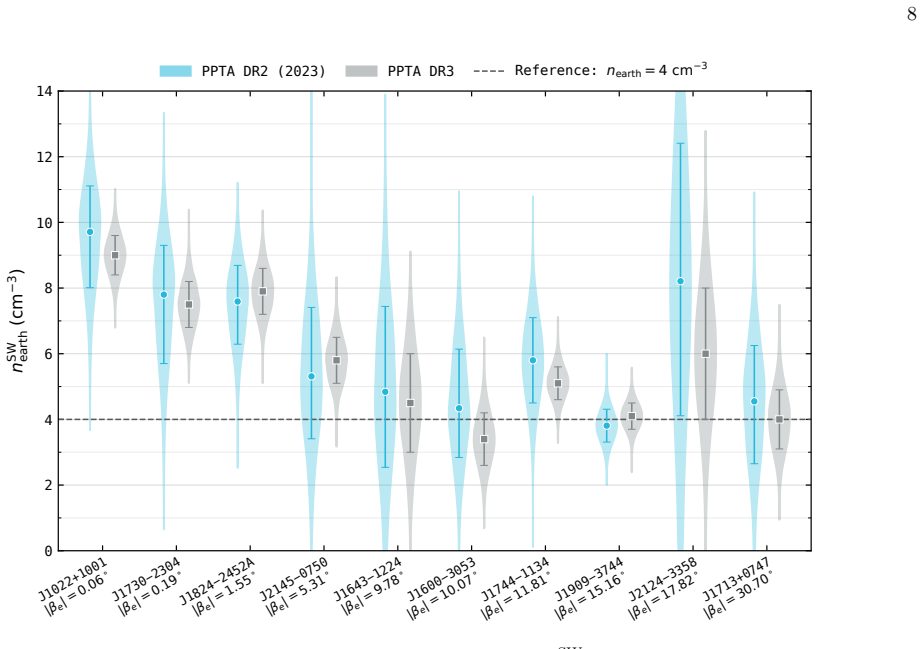
The central discovery is a comparative map of the noise hypothesis space for each pulsar under two processing pipelines. The authors evaluate the same 13 candidate noise models—combinations of white-noise parameters, achromatic red noise, dispersion-measure variations, and solar-wind variations—using marginal-likelihood estimates for every model, and compute posterior model probabilities with uniform model priors. They find that reprocessing changes both the concentration and the composition of these posteriors, changing the classification of seven pulsars between decisive, competitive, and diffuse, and systematically increasing support for solar-wind-containing models. The solar-wind densities inferred for the ten pulsars are consistent with the longer, independently analyzed data release, which the authors take as evidence that the solar-wind signal was already present in the older observations and that improved processing, not longer baseline, revealed it.
Load-bearing premise
The analysis assumes that the fixed set of 13 candidate noise models includes the true noise processes for every pulsar; if a real process is missing, the reported posterior probabilities, the 75% non-decisive fraction, and the ten-versus-four solar-wind count are conditional artifacts.
Editorial extensions
If this is right
- Single-pulsar noise uncertainty should be propagated into gravitational-wave searches, for example by Bayesian model averaging, rather than conditioning on one selected model; otherwise common-process inference will overstate confidence.
- For the roughly 75% of pulsars whose model posteriors are not decisive, reported noise parameters should be quoted as model-averaged quantities rather than as properties of a single top model.
- Because reprocessing alone increased the number of pulsars with a top solar-wind model from four to ten, future data releases should treat processing choices as part of the systematic-error budget.
- The agreement between the reprocessed shorter-baseline solar-wind densities and the longer-data-release values implies that improved processing can recover weak chromatic signals that older pipelines miss.
Reading between the lines
- If the candidate set were expanded to include white-noise-only models or additional chromatic noise components, the ten-versus-four solar-wind count could shift; the reported numbers are conditional on a specific 13-model space.
- Because each model evidence is estimated independently, the same results can be reweighted under informed model priors without resampling, offering a direct way to test how sensitive gravitational-wave-background evidence is to prior assumptions about noise components.
- A natural extension is to apply the same hypothesis-space comparison to data from other pulsar timing arrays; if the solar-wind emergence is a generic reprocessing effect, the same pattern should appear in independent data.
Editorial analysis
A structured set of objections, weighed in public.
Referee Report
Summary. This paper compares Bayesian single-pulsar noise-model inference for 22 pulsars from the Parkes Pulsar Timing Array second data release (PPTA DR2), processed with the original 2020 pipeline and the reprocessed 2023 pipeline. A fixed set of 13 candidate noise models is evaluated for each pulsar and each pipeline, with marginal likelihoods estimated using the authors' MorphZ method. The paper reports that posterior model probabilities change markedly between pipelines, with a solar-wind component appearing in the highest-posterior model for ten pulsars under the 2023 pipeline versus four under the 2020 pipeline, and that the recovered solar-wind electron densities at 1 au are consistent with the longer PPTA DR3 analysis. The authors conclude that single-pulsar noise-model selection is processing-dependent and argue that model uncertainty should be propagated into gravitational-wave background searches.
Significance. If the central claims hold, the paper makes a useful and timely contribution by quantifying how preprocessing choices can alter PTA noise-model selection and by demonstrating that many pulsars do not have a decisively preferred noise model. The explicit comparison of two processing chains on identical observations, the use of publicly available data, and the careful reporting of evidence-estimation precision are strengths. The paper also provides a concrete illustration of the differences between component-level support and complete-model selection, which is directly relevant to current PTA gravitational-wave analyses. However, the headline solar-wind result and the DR3 'validation' rest on assumptions about the candidate model set and the independence of the comparison that need to be tested before the physical interpretation can be accepted.
major comments (3)
- [Section IV and Section V.B] The 10-versus-4 solar-wind count is conditional on a candidate set that contains no chromatic noise process other than DMv and SW; Section IV restricts SW-containing models to four combinations that always include RN and/or DMv. The 2023 reprocessing (Section III) introduces FD parameters to absorb frequency-dependent profile-evolution systematics; residual frequency-dependent systematics from this step could be absorbed by the only flexible chromatic terms in the set, namely DMv and SW. The interpretation in Section V.D that the solar-wind signal is 'already present' therefore requires the assumption that no unmodeled chromatic process in the 2023 residuals mimics SW. Please test this assumption by adding a chromatic noise component with a free spectral index (or an explicit FD-like process) to the candidate set, and/or by showing that the recovered nearth values correlate with ecliptic latitude in the physically expected way and agree with in-situ solar-wind measurements.
- [Section V.D and Table III] The DR3 comparison is not an independent validation because the '2023 DR2' data used here are the reprocessed subset of the observations included in the PPTA DR3 analysis (Section III, refs [13,37]). The agreement of n_earth with the DR3 values therefore does not establish that the recovered signal is a physical solar wind; both analyses can share the same processing-induced systematic. To support the physical interpretation, please validate against an external dataset or a differently processed sample (for example, in-situ OMNI solar-wind measurements, or NANOGrav/EPTA solar-wind results obtained with different pipelines), or otherwise demonstrate that the SW parameters cannot be explained by the FD/profile-evolution systematics introduced in the 2023 reprocessing.
- [Section IV and Section VI] The candidate model set excludes white-noise-only models, with the assertion that 'these excluded models have a zero posterior model probabilities for every pulsar in both datasets'; no supporting calculation or reference is provided. Because the reported posterior model probabilities, the 10-versus-4 SW count, and the 75% non-decisive fraction are all conditional on the chosen 13-model set, the exclusion needs to be justified quantitatively. Please report the evidence values for the white-noise-only models for at least a representative subset of pulsars, or state clearly that the reported probabilities are not directly comparable to analyses that include such models. This is load-bearing because the conclusion that model uncertainty should be marginalized over depends on the completeness of the candidate space.
minor comments (6)
- [References [13] and [37]] References [13] and [37] appear to be the same paper (Zic et al. 2023, PASA 40, e049); please merge them.
- [Section II] The phrase 'assuming apriori equally probable' should read 'assuming a priori equally probable'.
- [Section IV] The phrase 'a custom prior model probabilities' is ungrammatical; it should be 'custom priors on the model probabilities'.
- [Section V.A and Table II] The sentence describing Table II is awkward and missing punctuation: 'The median and standard deviation of log(bz) the standard deviation...' Please rephrase to clarify that one quantity is the median of the run-to-run standard deviations and another is the standard deviation of those standard deviations.
- [Figure 4] The caption says the violin profiles show 'posterior summaries from Table III', but the markers already show medians and credible intervals. Please clarify whether the violins are smoothed full posteriors or are schematic, and how they relate to the tabulated intervals.
- [Section V.D] The statement that the DR3 values were 'independently obtained' is misleading in light of the shared reprocessed data; consider rewording to 'obtained with the longer DR3 dataset' or similar.
Circularity Check
No significant circularity: the central Bayes-factor analysis is self-contained, and the MorphZ/DR3 citations are not derivation-equivalent to the results.
full rationale
The derivation is self-contained: posterior model probabilities are computed from Eq. (1) using marginal likelihoods estimated independently for each of the 13 fixed models, and the paper's central 10-versus-4 solar-wind count is a posterior summary of those calculations, not an input. The use of MorphZ is a self-citation, but it is a general-purpose evidence estimator whose stated assumptions (power-law spectra, Table I priors) do not include the target result, and the run-to-run stability in Table II is reported rather than assumed. No step equates a fitted parameter with a prediction, and no uniqueness theorem or ansatz is imported from the authors' prior work to force the model choice. The comparison with PPTA DR3 n_earth estimates is not a derivation from this paper's inputs; although the phrase 'independently obtained' is somewhat overstated because the 2023 DR2 processing is part of the DR3 release, that is a concern about the strength of external validation, not circularity. The paper also explicitly states that the numerical model probabilities are conditional on the candidate model space and uniform model priors, so the fixed 13-model set is disclosed rather than smuggled in as a conclusion. No circular step meets the required standard of equivalence to inputs by construction.
Assumptions & free parameters
free parameters (5)
- n_earth per pulsar (10 pulsars) =
Table III, e.g., J1909-3744: 3.81 +0.50 -0.51 cm^-3
- SW power-law parameters (log10 A_SW, gamma_SW) per pulsar =
e.g., J1909-3744: log10 A_SW = 5.69 +0.28 -0.28; gamma prior U(-2,-1)
- RN power-law parameters (log10 A_RN, gamma_RN) per pulsar =
e.g., J1909-3744: log10 A_RN = 14.00 +0.24 -0.53; gamma_RN U(0,7)
- DMv power-law parameters (log10 A_DMv, gamma_DMv) per pulsar =
e.g., J1909-3744: log10 A_DMv = 13.67 +0.11 -0.11
- White-noise parameters (EF, EQUAD, ECORR) per pulsar =
not tabulated; priors in Table I
assumptions (5)
- standard math Bayes theorem and marginal-likelihood identities (Eqs. 1-3)
- domain assumption Timing residuals are Gaussian and each stochastic process is a power law with 30 Fourier harmonics
- ad hoc to paper The 13 fixed candidate models, with only four SW-containing combinations, span the relevant hypothesis space
- domain assumption Uniform prior over the 13 models
- ad hoc to paper The 2023 processing is more accurate than the 2020 processing
Cite this review
Pith. "Pith review of Insights into the Pulsar Timing Array hypothesis space." pith.science (2026). https://pith.science/paper/4Y2AQQHK
@misc{pith2026260807821,
  author       = {Pith},
  title        = {Pith review of: Insights into the Pulsar Timing Array hypothesis space},
  year         = {2026},
  howpublished = {\url{https://pith.science/paper/4Y2AQQHK}},
  note         = {Machine review of arXiv:2608.07821}
}
read the original abstract
We present novel insights into the pulsar-noise model space in pulsar timing array (PTA) experiments. Through a comparative analysis of the same Parkes PTA second data release observations processed with the 2020 and 2023 pipelines, we show that data processing materially changes the distribution of posterior support across competing noise hypotheses and increases sensitivity to weak contributions such as the solar wind. A solar-wind component appears in the highest-posterior hypothesis for ten pulsars under the 2023 pipeline, against four under the 2020 pipeline, while the corresponding mean electron density estimates are consistent with PPTA DR3 results. Furthermore, hypothesis-space analysis exposes model competition and degeneracies that are hidden by single-model summaries. Approximately 75% of the pulsars retain substantial posterior support for alternative noise descriptions. Therefore, understanding the nature of the pulsar noise hypothesis space is crucial for robust inference and nanohertz gravitational-wave background searches.
Figures


Figures from the paper (4 more)


Reference graph
Works this paper leans on
-
[1]
As shown in Figure 2(a), an RN+DMv+SW model family dom- inates the model space under both pipelines
A decisive model space: PSR J1909−3744 PSR J1909−3744 provides an example in which the inferred stochastic-process composition is stable while the preferred white-noise description changes. As shown in Figure 2(a), an RN+DMv+SW model family dom- inates the model space under both pipelines. The EC+RN+DMv+SW model carries approximately 92% of the posterior ...
work page 2020
-
[2]
The model posterior is concentrated on four SW models in both datasets Figure 2(b)
A competitive model space: PSR J1022+1001 PSR J1022+1001 illustrates a different form of model uncertainty. The model posterior is concentrated on four SW models in both datasets Figure 2(b). In the 2020 analysis, EC+RN+DMv+SW and EC+DMv+SW have posterior probabilities of approximately 0.41 and 0.34, respectively. In the 2023 analysis, the two models beco...
work page 2020
-
[3]
Posterior reorganization: PSR J1730−2304 PSR J1730−2304 illustrates how reprocessing can re- organize a previously diffuse model posterior. Under the 2020 pipeline, the posterior probability is divided among several DMv-containing models, with no model reaching the competitive threshold. The hypothesis space there- fore does not provide a clear preference...
work page 2023
-
[4]
M. A. McLaughlin, Classical and Quantum Gravity30, 224008 (2013)
work page 2013
-
[5]
R. N. Manchester, G. Hobbs, M. Bailes, W. A. Coles, W. Van Straten,et al., Publications of the Astronomical Society of Australia30, e017 (2013)
work page 2013
-
[6]
M. V. Sazhin, Soviet Ast.22, 36 (1978)
1978
-
[7]
R. W. Hellings and G. S. Downs, Astrophysical Journal, Part 2-Letters to the Editor, vol. 265, Feb. 15, 1983, p. L39-L42.265, L39 (1983)
work page 1983
-
[8]
R. S. Foster and D. C. Backer, Astrophys. J.361, 300 (1990)
1990
Show all 59 references
-
[9]
H. Xu, S. Chen, Y. Guo, J. Jiang, B. Wang,et al., Re- search in Astronomy and Astrophysics23, 075024 (2023)
2023
-
[10]
D. J. Reardon, A. Zic, R. M. Shannon, V. Di Marco, G. B. Hobbs, A. Kapur, M. E. Lower, R. Mandow, H. Mid- dleton, M. T. Miles,et al., The Astrophysical Journal Letters951, L7 (2023)
2023
-
[11]
R. D. Ferdman, R. van Haasteren, C. G. Bassa, M. Bur- gay, I. Cognard,et al., Classical and Quantum Gravity 27, 084014 (2010)
2010
-
[12]
B. C. Joshi, P. Arumugasamy, M. Bagchi, D. Bandy- opadhyay, A. Basu,et al., Journal of Astrophysics and Astronomy39, 51 (2018)
2018
-
[13]
M. T. Miles, R. M. Shannon, M. Bailes, D. J. Reardon, M. J. Keith,et al., Monthly Notices of the Royal Astronomical Society519, 3976 (2022), https://academic.oup.com/mnras/article- pdf/519/3/3976/48617501/stac3644.pdf
2022
-
[14]
M. T. Miles, R. M. Shannon, M. Bailes, D. J. Reardon, M. J. Keith,et al., Monthly Notices of the Royal Astro- nomical Society519, 3976 (2023)
2023
-
[15]
A. F. Rogers, W. van Straten, S. Gulyaev, A. Parthasarathy, G. Hobbs, Z.-C. Chen, Y. Feng, B. Goncharov, A. Kapur, X. Liu,et al., The Astrophysi- cal Journal973, 94 (2024)
2024
-
[16]
Agazie, A
G. Agazie, A. Anumarlapudi, A. M. Archibald, Z. Arzou- manian, P. T. Baker,et al., The Astrophysical Journal Letters951, L8 (2023)
2023
-
[17]
Antoniadis, P
J. Antoniadis, P. Arumugam, S. Arumugam, S. Babak, M. Bagchi,et al., Astronomy & Astrophysics678, A50 (2023)
2023
-
[18]
A. Zic, D. J. Reardon, A. Kapur, G. Hobbs, R. Mandow, et al., Publications of the Astronomical Society of Aus- tralia40, e049 (2023)
2023
-
[19]
Lentati, P
L. Lentati, P. Alexander, M. P. Hobson, S. Taylor, J. Gair, S. T. Balan, and R. van Haasteren, Phys. Rev. D87, 104021 (2013), arXiv:1210.3578 [astro-ph.IM]
2013 arXiv
-
[20]
J. A. Ellis, Classical and Quantum Gravity30, 224004 (2013), arXiv:1305.0835 [astro-ph.IM]
2013 arXiv
-
[21]
T. T. Pennucci, The Astrophysical Journal871, 34 (2019)
2019
-
[22]
Lentati, M
L. Lentati, M. Kerr, S. Dai, M. Hobson, R. M. Shan- non, G. Hobbs, M. Bailes, N. R. Bhat, S. Burke-Spolaor, W. Coles,et al., Monthly Notices of the Royal Astronom- ical Society466, 3706 (2017)
2017
-
[23]
Van Haasteren, Y
R. Van Haasteren, Y. Levin, P. McDonald, and T. Lu, Monthly Notices of the Royal Astronomical Society395, 1005 (2009)
2009
-
[24]
Lentati, R
L. Lentati, R. M. Shannon, W. A. Coles, J. P. W. Ver- biest, R. van Haasteren, J. A. Ellis, R. N. Caballero, R. N. Manchester, Z. Arzoumanian, S. Babak, and et al., Mon. Not. Roy. Astron. Soc.458, 2161 (2016), arXiv:1602.05570 [astro-ph.IM]
2016 arXiv
-
[25]
J. S. Hazboun, J. Simon, D. R. Madison, Z. Arzouma- nian, H. T. Cromartie, K. Crowter, M. E. DeCesar, P. B. Demorest, T. Dolch, J. A. Ellis, R. D. Ferdman, E. C. Ferrara, E. Fonseca, P. A. Gentile, G. Jones, M. L. Jones, M. T. Lam, L. Levin, D. R. Lorimer, R. S. Lynch, M. A. M...
2022
-
[26]
Goncharov, D
B. Goncharov, D. Reardon, R. Shannon, X.-J. Zhu, E. Thrane, M. Bailes, N. Bhat, S. Dai, G. Hobbs, M. Kerr,et al., Monthly Notices of the Royal Astronom- ical Society502, 478 (2021)
2021
-
[27]
S. Chen, H. Xu, Y. Guo, B. Wang, R. N. Caballero, J. Jiang, J. Xu, Z. Xue, K. Lee, J. Yuan,et al., As- tronomy & Astrophysics699, A165 (2025)
2025
-
[28]
collaboration, I
E. collaboration, I. Collaboration,et al., Astronomy and Astrophysics690, A118 (2024)
2024
-
[29]
B. P. Carlin and S. Chib, Journal of the Royal Statistical Society Series B: Statistical Methodology57, 473 (1995)
1995
-
[30]
J. A. Ellis, M. Vallisneri, S. R. Taylor, and P. T. Baker, Astrophysics Source Code Library , ascl (2019)
2019
-
[31]
M. L. Jones, M. A. McLaughlin, M. T. Lam, J. M. Cordes, L. Levin,et al., The Astrophysical Journal841, 125 (2017)
2017
-
[32]
Chalumeau, S
A. Chalumeau, S. Babak, A. Petiteau, S. Chen, A. Sama- jdar, R. N. Caballero, G. Theureau, L. Guillemot, G. Desvignes, A. Parthasarathy, and et al., Mon. Not. Roy. Astron. Soc.509, 5538 (2022), arXiv:2111.05186 [astro-ph.HE]
2022 arXiv
-
[33]
and MorphZ [34], have substantially improved the arXiv:2608.07821v1 [astro-ph.HE] 7 Aug 2026 2 feasibility of estimating marginal likelihoods and, in turn, posterior model probabilities. Unlike product-space and trans-dimensional methods, which estimate model prob- abilities f...
2026 arXiv
-
[34]
Antoniadis, P
J. Antoniadis, P. Arumugam, S. Arumugam, S. Babak, M. Bagchi,et al., Astronomy & Astrophysics678, A49 (2023)
2023
-
[35]
R. E. Kass and A. E. Raftery, Journal of the american statistical association90, 773 (1995)
1995
-
[36]
The data are referred to the TT(BIPM2018) timescale and the JPL DE436 solar sys- tem ephemeris
and [21], respectively. The data are referred to the TT(BIPM2018) timescale and the JPL DE436 solar sys- tem ephemeris. The reprocessed DR2 was produced to enable consis- tent combination with new ultra-wide-bandwidth (UWL) receiver observations [37]. The reprocessing involved...
2020
-
[37]
Ellis and R
J. Ellis and R. van Haasteren, jel- lis18/PTMCMCSampler: Official Release (2017)
2017
-
[38]
V. D. Marco, N. Guttman, M. T. Miles, A. Zic, R. M. Shannon, and E. Thrane, A transdimensional sampling framework for pulsar timing noise modelling (2026), arXiv:2603.23817 [astro-ph.IM]
2026
-
[39]
E. M. Zahraoui, P. Maturana-Russel, W. van Straten, R. Meyer, and S. Gulyaev, Monthly Notices of the Royal Astronomical Society540, 3818 (2025)
2025
-
[40]
E. M. Zahraoui, P. Maturana-Russel, A. Vajpeyi, W. van Straten, R. Meyer, and S. Gulyaev, Phys. Rev. D113, 083014 (2026)
2026
-
[41]
D. J. Reardon, R. M. Shannon, A. D. Cameron, B. Gon- charov, G. B. Hobbs, H. Middleton, M. Shamohammadi, N. Thyagarajan, M. Bailes, N. D. R. Bhat, and et al., Monthly Notices of the Royal Astronomical Society507, 2137 (2021), arXiv:2107.04609 [astro-ph.HE]
2021 arXiv
-
[42]
A. Zic, D. J. Reardon, A. Kapur, G. Hobbs, R. Mandow, M. Cury lo, R. M. Shannon, J. Askew, M. Bailes, N. D. R. Bhat, and et al., Publications of the Astronomical Soci- ety of Australia40, e049 (2023), arXiv:2306.16230 [astro- ph.HE]
2023 arXiv
-
[43]
M. Kerr, D. J. Reardon, G. Hobbs, R. M. Shannon, R. N. Manchester, S. Dai, C. J. Russell, L. Toomey, 14 B. Goncharov, H. Middleton,et al., Publications of the Astronomical Society of Australia37, e020 (2020), arXiv:2003.09780 [astro-ph.HE]
2020 arXiv
-
[44]
Lazarus, R
P. Lazarus, R. Karuppusamy, E. Graikou, R. N. Ca- ballero, D. J. Champion, K. J. Lee, J. P. W. Verbiest, and M. Kramer, Monthly Notices of the Royal Astronomical Society458, 868 (2016), arXiv:1601.06194 [astro-ph.IM]
2016 arXiv
-
[45]
Cury lo, T
M. Cury lo, T. T. Pennucci, M. Bailes, N. D. R. Bhat, A. D. Cameron, W. A. Coles, P. B. Demorest, G. Hobbs, A. Kapur, M. J. Keith,et al., Monthly No- tices of the Royal Astronomical Society528, 3304 (2024), arXiv:2309.07862 [astro-ph.HE]
2024 arXiv
-
[46]
A. W. Hotan, W. van Straten, and R. N. Manchester, Publications of the Astronomical Society of Australia21, 302 (2004), arXiv:astro-ph/0404549
2004 arXiv
-
[47]
S. R. Taylor, P. T. Baker, J. S. Hazboun, J. Simon, and S. J. Vigeland, enterprise extensions (2021), v2.4.3
2021
-
[48]
Foreman-Mackey, D
D. Foreman-Mackey, D. W. Hogg, D. Lang, and J. Good- man, PASP125, 306 (2013), 1202.3665
2013 arXiv
-
[49]
Karamanis, F
M. Karamanis, F. Beutler, J. A. Peacock, D. Nabergoj, and U. Seljak, Monthly Notices of the Royal Astronomi- cal Society516, 1644 (2022)
2022
-
[50]
Karamanis, D
M. Karamanis, D. Nabergoj, F. Beutler, J. A. Peacock, and U. Seljak, arXiv preprint arXiv:2207.05660 (2022)
2022 arXiv
-
[51]
Iraci, A
F. Iraci, A. Chalumeau, C. Tiburzi, J. Verbiest, A. Pos- senti, S. Susarla, M. Krishnakumar, G. Shaifullah, J. An- toniadis, M. Bagchi,et al., Astronomy & Astrophysics 704, A109 (2025)
2025
-
[52]
van Haasteren, Monthly Notices of the Royal Astronomical Society: Letters537, L1 (2025), https://academic.oup.com/mnrasl/article- pdf/537/1/L1/61215365/slae108.pdf
R. van Haasteren, Monthly Notices of the Royal Astronomical Society: Letters537, L1 (2025), https://academic.oup.com/mnrasl/article- pdf/537/1/L1/61215365/slae108.pdf
2025
-
[53]
A. Zic, D. J. Reardon, A. Kapur, G. Hobbs, R. Mandow, M. Cury lo, R. M. Shannon, J. Askew, M. Bailes, N. D. R. Bhat, A. Cameron, Z.-C. Chen, S. Dai, V. Di Marco, Y. Feng, M. Kerr, A. Kulkarni, M. Lower, R. Luo, R. N. Manchester, M. Miles, R. Nathan, S. Os lowski, A. Rogers, C....
2023
-
[54]
Dalc ´ ın, R
L. Dalc ´ ın, R. Paz, and M. Storti, Journal of Parallel and Distributed Computing65, 1108 (2005)
2005
-
[55]
Kluyver, B
T. Kluyver, B. Ragan-Kelley, F. P´ erez, B. Granger, M. Bussonnier,et al., inPositioning and power in aca- demic publishing: Players, agents and agendas(IOS press, 2016) pp. 87–90
2016
-
[56]
J. D. Hunter, Computing in Science & Engineering9, 90 (2007)
2007
-
[57]
C. R. Harris, K. J. Millman, S. J. Van Der Walt, R. Gom- mers, P. Virtanen,et al., Nature585, 357 (2020)
2020
-
[58]
Virtanen, R
P. Virtanen, R. Gommers, E. Burovski, T. E. Oliphant, W. Weckesser,et al., scipy/scipy: SciPy 1.6.0 (2020)
2020
-
[59]
Kumar, C
R. Kumar, C. Carroll, A. Hartikainen, and O. Martin, Journal of Open Source Software4, 1143 (2019)
2019
Reviewed August 11, 2026 · model on record in the stance chip above.
Discussion (0). Continue with ORCID to comment.