REVIEW 1 major objections 46 references
Fractional Pareto-Optimality in Multiwinner Voting
T0 review · 1 major / 0 minor · reviewed 2026-06-27 · grok-4.3
Pith's one-line read Fractional Pareto-optimality equals weighted utilitarian welfare maximization for some weights.
desk verdict The paper defines fPO and characterizes it via weighted utilitarian welfare, which directly yields a poly-time check plus monotonicity and connectedness; the cloning motivation is secondary and not load-bearing for the results. read the letter →
The pith
A machine-rendered reading of the paper's core claim, the machinery that carries it, and where it could break.
The reading
What carries the argument
The equivalence between fPO and maximization of weighted utilitarian welfare for some positive weights, which converts dominance checks into linear optimization problems.
What would settle it
An election profile containing a committee that maximizes weighted welfare for every positive weight vector yet is fractionally dominated by another committee, or a one-dimensional preference domain containing a Pareto-optimal committee that is fractionally dominated.
Extended reading notes
Core claim
A committee is fractionally Pareto-optimal if and only if there exist positive weights such that the committee maximizes the weighted sum of voter utilities; this characterization is proved by showing that any non-maximizing committee is dominated by a suitable fractional committee and conversely that welfare maximizers cannot be fractionally dominated.
Load-bearing premise
Non-domination by any convex combination of committees exactly matches the robustness of efficiency when every candidate is uniformly cloned.
Editorial extensions
If this is right
- Verification of fPO for a given committee can be done in polynomial time via linear programming.
- The collection of all fPO committees is closed under adding a candidate when the new committee remains fPO.
- Any two fPO committees can be transformed into each other by a sequence of single-candidate swaps that each preserve fPO.
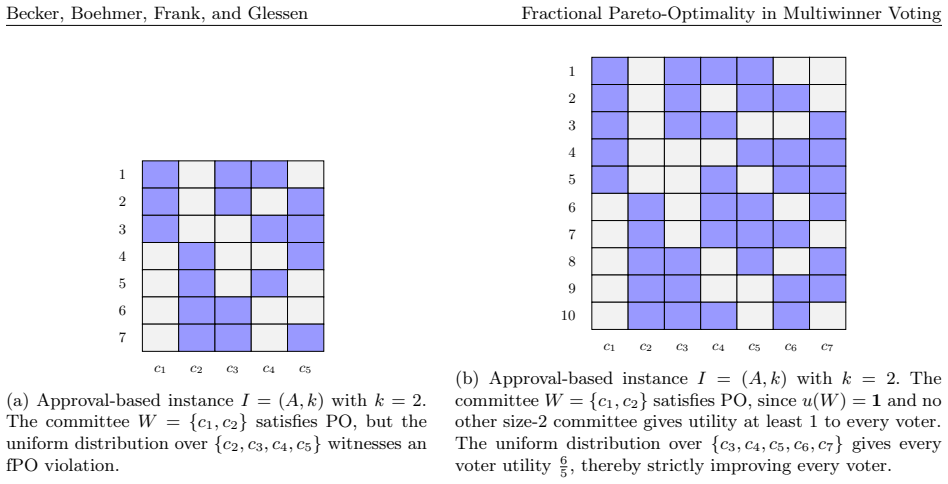
- Proportional approval voting can return a committee that is not fPO even when Pareto-optimal committees exist.
- On one-dimensional preference domains the sets of PO and fPO committees coincide.
Reading between the lines
- The welfare characterization may allow designing new multiwinner rules that explicitly target fPO rather than PO.
- In large elections the connectivity result suggests local search heuristics could enumerate or sample fPO committees efficiently.
- The incompatibility with equality-focused rules like PAV indicates a potential trade-off between robustness to cloning and proportionality that future rules might balance differently.
Editorial analysis
A structured set of objections, weighed in public.
Referee Report
Summary. The paper introduces fractional Pareto-optimality (fPO) for multiwinner voting, defined as the property that a committee is not dominated by any convex combination of committees. It claims fPO refines PO by retaining exactly those PO committees whose efficiency is robust under uniform candidate cloning, proves existence of fPO committees, and gives a characterization of fPO committees as maximizers of weighted utilitarian welfare. This characterization yields a polynomial-time algorithm for verifying fPO, and the paper proves that the set of fPO committees satisfies committee monotonicity and is connected under single-candidate swaps. It further shows an incompatibility between fPO and equality-oriented rules (including that PAV violates fPO in the approval setting) and identifies domains (including various one-dimensional ones) where PO and fPO coincide.
Significance. If the characterization and proofs hold, the work makes a meaningful contribution by identifying a computationally tractable refinement of PO with attractive structural properties (monotonicity and swap-connectedness) and a simple verification algorithm. The explicit credit to the weighted-welfare characterization, the poly-time algorithm, and the domain-collapse results is warranted; these are load-bearing strengths. The incompatibility result with PAV is a clear negative finding of interest to the field. The cloning-robustness interpretation is presented as motivation rather than a load-bearing technical step, so any gap there would affect framing only.
major comments (1)
- The central characterization (via weighted utilitarian welfare) and its consequences for the poly-time algorithm, monotonicity, and connectedness appear to follow directly from the fPO definition; no circularity or parameter-fitting is visible in the abstract or reader's summary.
Simulated Author's Rebuttal
We thank the referee for their positive evaluation and recommendation of minor revision. The single major comment is addressed point by point below.
read point-by-point responses
-
Referee: The central characterization (via weighted utilitarian welfare) and its consequences for the poly-time algorithm, monotonicity, and connectedness appear to follow directly from the fPO definition; no circularity or parameter-fitting is visible in the abstract or reader's summary.
Authors: We confirm that the characterization is derived directly from the definition of fPO (no committee is dominated by any convex combination of committees). The weighted-utilitarian-welfare maximizers are shown to be exactly the fPO committees by a standard separating-hyperplane argument that does not rely on any auxiliary parameters or circular reasoning; the same argument immediately yields the polynomial-time verification procedure (by solving a linear program), committee monotonicity, and single-swap connectedness. These consequences are therefore intrinsic to the definition rather than additional assumptions. revision: no
Circularity Check
No circularity; characterization derived directly from fPO definition
full rationale
The paper defines fPO as non-domination by any convex combination of committees and derives the weighted utilitarian welfare characterization, poly-time verification, monotonicity, and swap-connectedness as mathematical consequences of that definition. No self-citation is load-bearing for the central claims, no parameters are fitted and renamed as predictions, and the cloning-robustness statement is presented only as interpretive motivation for why fPO refines PO, not as a premise in the derivation chain. The technical results remain intact under the stated definition alone.
Assumptions & free parameters
assumptions (1)
- domain assumption Voter preferences admit utility or approval representations over committees
Cite this review
Pith. "Pith review of Fractional Pareto-Optimality in Multiwinner Voting." pith.science (2026). https://pith.science/paper/4Y2HA4PJ
@misc{pith2026260611160,
  author       = {Pith},
  title        = {Pith review of: Fractional Pareto-Optimality in Multiwinner Voting},
  year         = {2026},
  howpublished = {\url{https://pith.science/paper/4Y2HA4PJ}},
  note         = {Machine review of arXiv:2606.11160}
}
read the original abstract
Efficiency in multiwinner voting is most naturally captured by Pareto-optimality (PO), yet this notion is computationally and structurally difficult to handle. We therefore study fractional Pareto-optimality (fPO), under which a committee may not be dominated even by a fractional committee, i.e., any convex combination of committees. fPO turns out to be a natural refinement of PO as it retains exactly those Pareto-optimal committees whose efficiency is robust under uniform cloning of candidates. Furthermore, fPO committees are guaranteed to exist and have strong structural properties. We present a characterization of fPO in terms of weighted utilitarian welfare maximization, which yields a polynomial-time algorithm for verifying fPO and shows that the set of fPO committees satisfies committee monotonicity and is connected under single-candidate swaps. Analyzing welfarist rules through the lens of fPO, we further uncover an incompatibility between fPO and equality-oriented objectives. Most notably, we show that proportional approval voting (PAV) violates fPO in the approval setting. We close by pinpointing preference domains, including various one-dimensional ones, on which PO and fPO collapse into one notion.
Figures


Figures from the paper (5 more)


Reference graph
Works this paper leans on
-
[1]
K. J. Arrow. Social Choice and Individual Values. New Haven: Cowles Foundation, 1st edition, 1951. 2nd edition 1963
1951
-
[2]
Computing Thiele Rules on Interval Elections and their Generalizations
D. Avramidis, A. Lassota, U. Schmidt-Kraepelin, and A. Vetta. Computing T hiele rules on interval elections and their generalizations, 2026. arXiv:2605.03067 [cs.GT]
work page Pith review arXiv 2026
-
[3]
Aziz and J
H. Aziz and J. Monnot. Computing and testing pareto optimal committees. Autonomous Agents and Multi-Agent Systems, 34: 0 1--20, 2020
2020
- [4]
-
[5]
Barman, S
S. Barman, S. K. Krishnamurthy, and R. Vaish. Finding fair and efficient allocations. In Proceedings of the 2018 ACM Conference on Economics and Computation (ACM-EC), pages 557--574. ACM , 2018
2018
-
[6]
R. E. Berker, S. Casacuberta, I. Robinson, C. Ong, V. Conitzer, and E. Elkind. From independence of clones to composition consistency: A hierarchy of barriers to strategic nomination. In Proceedings of the 26th ACM Conference on Economics and Computation (ACM-EC), page 1109. ACM , 2025
2025
-
[7]
Explanation Systems for Approval-Based Multiwinner Voting
N. Boehmer, L. Kreisel, and J. Peters. Explanation systems for approval-based multiwinner voting, 2026. arXiv:2604.24307 [cs.GT]
work page Pith review arXiv 2026
-
[8]
Boyd and L
S. Boyd and L. Vandenberghe. Convex Optimization. Cambridge University Press, 2004
2004
Show all 46 references
-
[9]
Brill and J
M. Brill and J. Peters. Robust and verifiable proportionality axioms for multiwinner voting. In Proceedings of the 24th ACM Conference on Economics and Computation (ACM-EC), 2023
2023
-
[10]
Caragiannis, R
I. Caragiannis, R. LeGrand, E. Markakis, and E. Pountourakis. An impossibility result for strongly group-strategyproof multi-winner approval-based voting. In Proceedings of the 20th International Conference on Web and Internet Economics (WINE), pages 457--475. Springer, 2024
2024
-
[11]
J. Chen, X. Luo, M. Sorge, and N. Talmon. Multi-winner reconfiguration. In Advances in Neural Information Processing Systems 37 (NeurIPS), 2024
2024
-
[12]
Cheng, Z
Y. Cheng, Z. Jiang, K. Munagala, and K. Wang. Group fairness in committee selection. ACM Trans. Economics and Comput. , 8 0 (4): 0 23:1--23:18, 2020
2020
-
[13]
de Keijzer, S
B. de Keijzer, S. Bouveret, T. Klos, and Y. Zhang. On the complexity of efficiency and envy-freeness in fair division of indivisible goods with additive preferences. In Proceedings of the 1st International Conference on Algorithmic Decision Theory (ADT), pages 98--110. Springer, 2009
2009
-
[14]
G. Debreu. Topological methods in cardinal utility theory. Cowles Foundation Discussion Paper 76, Cowles Foundation at Yale University, 1959
1959
-
[15]
T. Dey. Improved bounds for planar k-sets and related problems. Discrete and Computational Geometry, 19: 0 373--382, 03 1998
1998
-
[16]
C. Dong, F. Frank, J. Peters, and W. Suksompong. Reconfiguring proportional committees. In Proceedings of the 38th AAAI Conference on Artificial Intelligence (AAAI), pages 16829--16837. AAAI Press, 2026
2026
-
[17]
Elkind and M
E. Elkind and M. Lackner. Structure in dichotomous preferences. In Proceedings of the 24th International Joint Conference on Artificial Intelligence (IJCAI), pages 2019--2025. AAAI Press, 2015
2019
-
[18]
Elkind, P
E. Elkind, P. Faliszewski, and A. M. Slinko. Cloning in elections: Finding the possible winners. J. Artif. Intell. Res., 42: 0 529--573, 2011
2011
-
[19]
Elkind, P
E. Elkind, P. Faliszewski, P. Skowron, and A. Slinko. Properties of multiwinner voting rules. Soc. Choice Welf., 48 0 (3): 0 599--632, 2017
2017
-
[20]
Faliszewski, Łukasz Janeczko, A
P. Faliszewski, Łukasz Janeczko, A. Kaczmarczyk, G. Lisowski, and G. Pierczyński. Project submission games in participatory budgeting, 2025. arXiv:2508.09741 [cs.GT]
2025
-
[21]
A. M. Feldman and R. Serrano. Welfare Economics and Social Choice Theory. Springer-Verlag, 2nd edition, 2006
2006
-
[22]
Garg and A
J. Garg and A. Murhekar. Computing fair and efficient allocations with few utility values. Theor. Comput. Sci., 962: 0 113932, 2023
2023
-
[23]
Garg and A
J. Garg and A. Murhekar. Computing pareto-optimal and almost envy-free allocations of indivisible goods. J. Artif. Intell. Res., 80: 0 1--25, 2024
2024
-
[24]
J. Garg, A. Murhekar, and J. Qin. New algorithms for the fair and efficient allocation of indivisible chores. In Proceedings of the 32nd International Joint Conference on Artificial Intelligence (IJCAI), pages 2710--2718. ijcai.org, 2023
2023
-
[25]
M. T. Godziszewski, P. Batko, P. Skowron, and P. Faliszewski. An analysis of approval-based committee rules for 2d-euclidean elections. In Proceedings of the 35th AAAI Conference on Artificial Intelligence (AAAI), pages 5448--5455. AAAI Press, 2021
2021
-
[26]
Gorski, K
J. Gorski, K. Klamroth, and S. Ruzika. Connectedness of efficient solutions in multiple objective combinatorial optimization. Journal of Optimization Theory and Applications, 138 0 (2): 0 251--266, 2008
2008
-
[27]
S. Janson. Phragm \'e n’s and thiele’s election methods. Technical report, Technical report, 2016
2016
-
[28]
Kawase and R
Y. Kawase and R. Mahara. Fair and efficient balanced allocation for indivisible goods. In Proceedings of the 40th AAAI Conference on Artificial Intelligence (AAAI), pages 17067--17075. AAAI Press, 2026
2026
-
[29]
Kroer and D
C. Kroer and D. Peters. Computing L indahl equilibrium for public goods with and without funding caps. In Proceedings of the 26th ACM Conference on Economics and Computation (ACM-EC), page 129, 2025
2025
-
[30]
Lackner and P
M. Lackner and P. Skowron. Utilitarian welfare and representation guarantees of approval-based multiwinner rules. Artificial Intelligence, 288: 0 103366, Nov. 2020
2020
-
[31]
Lackner and P
M. Lackner and P. Skowron. Consistent approval-based multi-winner rules. J. Econ. Theory, 192: 0 105173, 2021
2021
-
[32]
Lackner and P
M. Lackner and P. Skowron. Multi-winner voting with approval preferences. Springer Nature, 2023
2023
-
[33]
Lain \'e , J
J. Lain \'e , J. Lang, \.I . \"O zkal-Sanver, and M. Remzi Sanver. Pareto-efficiency of ordinal multiwinner voting rules. Review of Economic Design, pages 1--35, 2025
2025
-
[34]
Mas-Colell, M
A. Mas-Colell, M. D. Whinston, and J. R. Green. Microeconomic theory, volume 1. Oxford university press New York, 1995
1995
-
[35]
Peters and P
D. Peters and P. Skowron. Proportionality and the limits of welfarism. In Proceedings of the 21nd ACM Conference on Economics and Computation (ACM-EC), pages 793--794, 2020
2020
-
[36]
Pierczy \' n ski and P
G. Pierczy \' n ski and P. Skowron. Core-stable committees under restricted domains. In Proceedings of the 18th International Conference on Web and Internet Economics (WINE), pages 311--329. Springer, 2022
2022
-
[37]
Sandomirskiy and E
F. Sandomirskiy and E. Segal - Halevi. Efficient fair division with minimal sharing. Oper. Res., 70 0 (3): 0 1762--1782, 2022
2022
-
[38]
Schrijver
A. Schrijver. Theory of Linear and Integer Programming. Wiley-Interscience Series in Discrete Mathematics. John Wiley & Sons, Chichester, 1986
1986
-
[39]
Schrijver
A. Schrijver. Combinatorial Optimization: Polyhedra and Efficiency, volume 24 of Algorithms and Combinatorics. Springer, Berlin, 2003
2003
-
[40]
J. Schünke. Pareto optimality in approval-based multiwinner voting, 2026. arXiv:2605.30490 [cs.GT]
2026 arXiv
-
[41]
P. Skowron. Proportionality degree of multiwinner rules. In Proceedings of the 22nd ACM Conference on Economics and Computation (ACM-EC), pages 820--840. ACM, 2021
2021
-
[42]
Suzuki and J
M. Suzuki and J. Vollen. Maximum flow is fair: A network flow approach to committee voting. In Proceedings of the 25th ACM Conference on Economics and Computation (ACM-EC), pages 964--983, 2024
2024
-
[43]
Talmon and P
N. Talmon and P. Faliszewski. A framework for approval-based budgeting methods. In Proceedings of the 33rd AAAI Conference on Artificial Intelligence (AAAI), pages 2181--2188. AAAI Press, 2019
2019
-
[44]
T. N. Thiele. Om flerfoldsvalg. Oversigt over det Kongelige Danske Videnskabernes Selskabs Forhandlinger, 1895: 0 415--441, 1895
-
[45]
T. N. Tideman. Independence of clones as a criterion for voting rules. Social Choice and Welfare, 4 0 (3): 0 185--206, 1987
1987
-
[46]
G. M. Ziegler. Lectures on Polytopes, volume 152 of Graduate Texts in Mathematics. Springer, 1995
1995
Reviewed June 27, 2026 · model on record in the stance chip above.
Discussion (0). Sign in to comment.