REVIEW 2 major objections 1 minor 57 references
Sampling Theory for Super-Resolution with Implicit Neural Representations
T0 review · 2 major / 1 minor · reviewed 2026-08-07 · deepseek-v4-flash
Pith's one-line read This paper proves that shallow ReLU Fourier-feature INRs are exactly recoverable from low-pass Fourier samples once the sampling cutoff scales with the network width or feature frequency, and it derives those scaling laws.
desk verdict Theorem 2's proof has a genuine gap — Lemma 10 is false as stated for s=1 and the theorem omits a distinctness hypothesis the proof assumes — but the core sample-complexity results are new, largely sound, and worth refereeing. read the letter →
The pith
A machine-rendered reading of the paper's core claim, the machinery that carries it, and where it could break.
The reading
What carries the argument
The load-bearing object is the convex measure reformulation of the training problem: after rescaling, a shallow network $f_\theta$ corresponds to a signed measure $\mu=\sum_i a_i\delta_{w_i}$ on the unit sphere, and the generalized weight-decay objective becomes the weighted total-variation norm $\|\mu\|_{TV,\eta}$. The training problem with the Fourier data constraint $F_\Omega f=y$ is then equivalent to the convex program $\min \|\mu\|_{TV,\eta}$ subject to $K_\Omega\mu=y$, and optimality is certified by a dual function $\Phi(w)=\langle F_\Omega[w^\top\gamma(\cdot)]_+,z\rangle$ that is bounded by $\eta(w)$ everywhere and interpolates it on the support. For the width-$s$ theorem the certificate is built from the second-order operator $(\Delta+4\pi^2)[\tau]_+$, whose distributional support is the zero curve $Z(\tau)$ with density $\|\nabla\tau\|$; the proof then uses algebraic facts about zero sets of two-variable trigonometric polynomials—minimal polynomials, finitely many critical points, and divisibility.
What would settle it
Take $s=2$, distinct weight vectors $w_1,w_2\in\mathbb{R}^4\setminus V$ with $w_i\ne\pm w_j$, positive coefficients, and $\Omega=\{k\in\mathbb{Z}^2:\|k\|_1\le 4\}$. A numerical or algebraic search that finds two different four-point measures on the unit sphere producing identical Fourier samples over $\Omega$ would falsify the injectivity lemma behind the theorem; conversely, verifying on a fine spherical grid that the constructed dual function satisfies $|\Phi(w)|\le\eta(w)$ everywhere would directly confirm the certificate for that instance.
Extended reading notes
Core claim
The paper's central claim is that exact recovery of a shallow Fourier-feature INR from low-pass Fourier samples is governed by a sampling cutoff, not by parameter counting. For the width-$s$ theorem, if $f=\sum_{i=1}^s a_i[w_i^\top\gamma(\cdot)]_+$ with $a_i>0$ and $w_i\in\mathbb{R}^4\setminus V$, and if $\Omega$ contains every $k\in\mathbb{Z}^2$ with $\|k\|_1\le 2s$, then $f$ is the unique function-space minimizer of the INR training problem with $\eta(w)=\int_{\mathbb{T}^2}[w^\top\gamma(x)]_+\,dx$, for every width $W\ge s$. The width-1 theorem gives an analogous guarantee with a general integer Fourier-feature embedding and the weighting $\eta(w)=\|F_\Omega[w^\top\gamma(\cdot)]_+\|_2$ once $\Omega$ contains all frequencies with $\|k\|_\infty\le 3K_0$. The positive-coefficient assumption and the exclusion of the measure-zero set $V$ are exactly the hypotheses that make the dual certificate and the injectivity argument work.
Load-bearing premise
The width-$s$ guarantee rests on the assumption that the zero sets of the two-variable trigonometric polynomials involved behave like algebraic curves: each must be irreducible or a minimal polynomial, each must have only finitely many critical points, and each must divide any trigonometric polynomial that vanishes on that zero set; these facts are imported from the paper's reference [35] rather than proved here.
Editorial extensions
If this is right
- With $\|k\|_1\le 2s$ low-pass samples, a 2D positive width-$s$ image is uniquely recovered as the function-space minimizer for every fitting width $W\ge s$.
- With $\|k\|_\infty\le 3K_0$ samples, a width-1 image with general integer Fourier features is uniquely recovered for every fitting width $W\ge 1$.
- The nonconvex INR training problem has exactly the global optima of a convex measure program, so optimality can be certified independently of the optimization trajectory.
- The two specialized weight-decay penalties are sufficient for the proofs, and the paper's experiments indicate standard weight decay behaves at least as well in practice.
Reading between the lines
- Extension: the same dual-certificate construction should transfer to any linear forward operator whose adjoint maps into trigonometric polynomials, so non-uniform Fourier samples and tomographic projections are natural next cases.
- Extension: the positivity and $d=2$ restrictions look like artifacts of the certificate proof; a signed-coefficient or higher-dimensional version of the certificate would be a direct test of whether the $O(s^2)$ law is the real boundary.
- Extension: the depth experiments hint that deep ReLU INRs with weight decay carry a piecewise-constant bias; if so, a deep sampling theory might stack the shallow result layer by layer, which this paper does not attempt.
Editorial analysis
A structured set of objections, weighed in public.
Referee Report
Summary. The paper studies exact recovery of continuous-domain images from low-pass Fourier samples when the image is represented by a shallow ReLU INR with an initial Fourier-features layer and the training objective is regularized by a generalized weight-decay penalty. The authors show that function-space minimizers of the nonconvex INR problem coincide with minimizers of a convex measure-space program, and then prove two sampling theorems. Theorem 1 treats width-1 images with a general integer-frequency Fourier-features embedding and shows uniqueness when the sampling set contains the cube of radius 3K0, using the regularizer η(w)=||FΩ[w^Tγ]_+||2. Theorem 2 treats width-s images in d=2 with the restricted four-feature embedding, positive outer coefficients, and generic weight vectors outside the measure-zero set V, showing uniqueness when the sampling set contains the ℓ1 ball of radius 2s, using η(w)=∫[w^Tγ]_+ dx. The proofs construct explicit dual certificates and rely on algebraic facts about zero sets of bivariate trigonometric polynomials imported from Ongie-Jacob. The experiments map empirical exact-recovery probabilities and compare standard and modified weight decay on phantom super-resolution.
Significance. If the theorems hold as stated after the fixes described below, this appears to be the first exact-recovery sampling bound for shallow Fourier-feature INRs, and it gives a clean connection between INR training and off-the-grid compressed sensing. The main theorems are genuinely parameter-free: the constants 3, 2, and 2s are fixed by the proofs, and the dual certificates are explicit rather than fitted to the data. The paper also contains complete proofs of the supporting lemmas, releases code for the experiments, and is careful to distinguish global-minimizer guarantees from the nonconvex optimization actually performed. The use of modified, rather than standard, weight decay is clearly stated and the conjecture that standard weight decay behaves similarly is supported only empirically, which is an honest limitation.
major comments (2)
- [B.2, Lemma 10] Lemma 10 is false as stated for s=1. With Ω={k∈Z²: ||k||₁≤0}={(0,0)}, choose any w₁∈R⁴\V such that τ₁=w₁^Tγ is irreducible and set ν=δ_{w₁}-δ_{-w₁}. Because the restricted embedding γ in (12) has no constant feature, ∫τ₁ dx=0, and since [t]_+-[-t]_+=t, one has K_Ων=F_Ω([τ₁]_+-[-τ₁]_+)=F_Ω(τ₁)=0. Yet f_ν=[τ₁]_+-[-τ₁]_+=τ₁≠0, contradicting the lemma's implication K_Ων=0 ⇒ f_ν=0. The proof's final step "since Γ₁⊂Ω" is false under the lemma's own hypothesis when s=1. The conclusion is recoverable under Theorem 2's actual sampling assumption Ω⊇{k: ||k||₁≤2s}, so this is a localized but load-bearing gap: Lemma 10 supplies the injectivity condition used in Lemma 4 for Theorem 2.
- [B.2, Theorem 2 and Lemmas 10–11] Theorem 2 states only w_i∈R⁴\V, but the proofs of Lemma 10 and Lemma 11 require the additional hypothesis w_i≠±w_j for i≠j. Lemma 7(a) gives finiteness of Z(τ_i)∩Z(τ_j) only when τ_i and τ_j are not scalar multiples, and such pairs are not excluded by V (for example, w=(1,1,2,1) and -w are both outside V). Without distinctness, ψ_j=∏_{i≠j}τ_i² vanishes identically on Z(τ_j) when τ_i=±τ_j, so the integral argument forcing a_j+b_j=0 in Lemma 10 collapses, and the divisibility step in Lemma 11 also breaks. The theorem's conclusion remains plausible for generic weights after adding w_i≠±w_j, which is still a measure-zero exceptional set, but the statement and proof must be aligned.
minor comments (1)
- [Supplementary Material F, Lemma 8 proof] In the coefficient-matching display, the line defining c₁ contains a typo: the coefficient of z₁²z₂ is a₁b₃+a₂b₄, and the z₂-coefficient is a₀b₂+a₂b₀; the displayed expression a₁b₂+a₂b₄ does not match the expansion of the product. The subsequent argument does not appear to depend on this erroneous equality, but the display should be corrected.
Circularity Check
No significant circularity: the INR sampling theorems are proven via explicit convex dual certificates, and the cited algebraic facts from [35] are independent, parameter-free support rather than a self-referential input.
full rationale
The paper's central claims are exact-recovery sampling theorems for shallow Fourier-feature ReLU INRs. The proof reduces the non-convex INR training problem to a convex measure problem (P_mu), proves equivalence via Lemma 1, and then constructs explicit dual certificates. No parameter in the theorems is fitted to the target data: the regularizers eta(w)=||F_Omega[w^T gamma(.)]_+||_2 (Theorem 1) and eta(w)=int [w^T gamma(.)]_+ dx (Theorem 2) are fixed functions of the known sampling operator Omega and the known Fourier-feature map, not of y. The dual certificates are existential objects built from the assumed ground-truth weights, following the standard off-the-grid compressed-sensing argument; this is not an input-output identity. The algebraic facts imported from Ongie-Jacob [35] in Lemma 7 are published, parameter-free statements about zero sets of two-variable trigonometric polynomials, and although one current author co-authored [35], these facts do not themselves contain the INR recovery result, so they constitute independent mathematical support rather than circularity. The paper also explicitly acknowledges that the generalized weight-decay forms arise from proof techniques and conjectures extension to standard weight decay, further indicating that no fitted quantity is being relabeled as a prediction. The proof of Theorem 2 has a statement-to-proof gap in that Lemma 10 assumes w_i != +/- w_j while Theorem 2 does not state that hypothesis; however, this is a soundness concern rather than a self-referential reduction, so it does not affect the circularity score. The experimental component is validated against independently defined phantoms (Shepp-Logan, MRI brain phantoms) and random teacher networks, so it is not a re-labeling of the derived quantities.
Assumptions & free parameters
assumptions (7)
- standard math Representer theorem of Bredies and Carioni [6] guarantees sparse minimizers for (P_mu) when W >= |Omega|.
- standard math Fenchel-Rockafellar strong duality for the measure-space primal and its predual (Lemma 3, Section A.3).
- standard math Zero-set algebra of 2-variable trigonometric polynomials from [35] (Lemma 7) and the classification in Lemma 8.
- domain assumption Weighting function eta is admissible: positive, 1-homogeneous, and zero only for zero ReLU units.
- domain assumption Fourier features use integer frequencies and the image is periodic on the torus; architecture is single-hidden-layer ReLU.
- ad hoc to paper For Theorem 2, outer weights a_i > 0 and w_i not in V (measure-zero exceptional set).
- ad hoc to paper The generalized weight decay regularizers eta(w) = ||F_Omega [w^T gamma]_+||_2 and eta(w) = integral [w^T gamma]_+ dx are the regularizers used in the guarantee.
Cite this review
Pith. "Pith review of Sampling Theory for Super-Resolution with Implicit Neural Representations." pith.science (2026). https://pith.science/paper/4Y2KW6JC
@misc{pith2026250609949,
  author       = {Pith},
  title        = {Pith review of: Sampling Theory for Super-Resolution with Implicit Neural Representations},
  year         = {2026},
  howpublished = {\url{https://pith.science/paper/4Y2KW6JC}},
  note         = {Machine review of arXiv:2506.09949}
}
read the original abstract
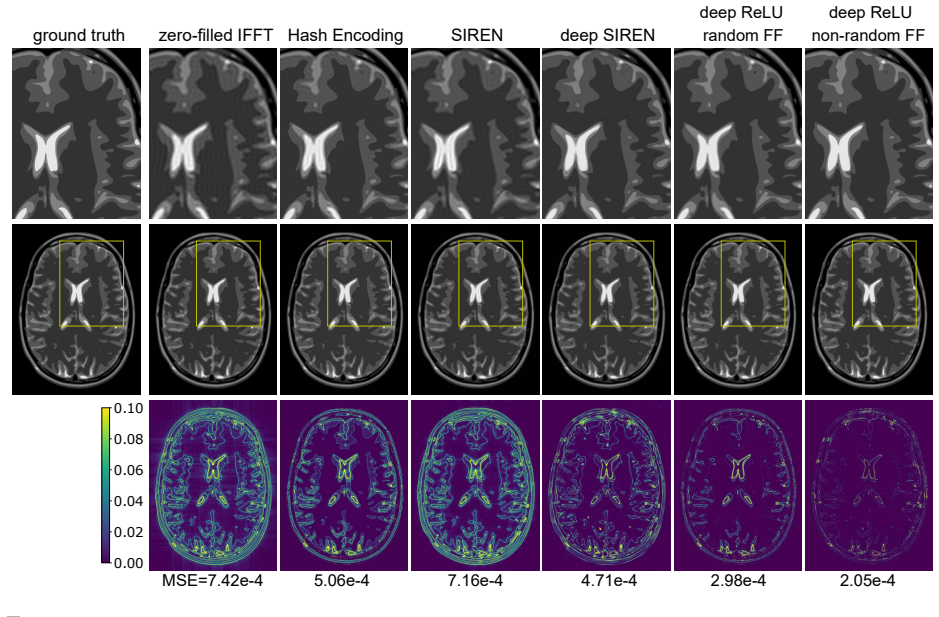
Implicit neural representations (INRs) have emerged as a powerful tool for solving inverse problems in computer vision and computational imaging. INRs represent images as continuous domain functions realized by a neural network taking spatial coordinates as inputs. However, unlike traditional pixel representations, little is known about the sample complexity of estimating images using INRs in the context of linear inverse problems. Towards this end, we study the sampling requirements for recovery of a continuous domain image from its low-pass Fourier samples by fitting a single hidden-layer INR with ReLU activation and a Fourier features layer using a generalized form of weight decay regularization. Our key insight is to relate minimizers of this non-convex parameter space optimization problem to minimizers of a convex penalty defined over an infinite-dimensional space of measures. We identify a sufficient number of Fourier samples for which an image realized by an INR is exactly recoverable by solving the INR training problem. To validate our theory, we empirically assess the probability of achieving exact recovery of images realized by low-width single hidden-layer INRs, and illustrate the performance of INRs on super-resolution recovery of continuous domain phantom images.
Figures


Figures from the paper (11 more)




Reference graph
Works this paper leans on
-
[46]
J. Shenouda, Y. Zhou, and R. D. Nowak , R e LU s are sufficient for learning implicit neural representations , International Conference on Machine Learning (ICML), (2024)
work page 2024
-
[1]
R. Archibald and A. Gelb , A method to reduce the G ibbs ringing artifact in MRI scans while keeping tissue boundary integrity , IEEE Transactions on Medical Imaging, 21 (2002), pp. 305--319
work page 2002
-
[2]
F. Bach , Breaking the curse of dimensionality with convex neural networks , Journal of Machine Learning Research, 18 (2017), pp. 1--53
work page 2017
-
[3]
N. Benbarka, T. H \"o fer, A. Zell, et al. , Seeing implicit neural representations as F ourier series , in Proceedings of the IEEE/CVF Winter Conference on Applications of Computer Vision, 2022, pp. 2041--2050
work page 2022
- [4]
-
[5]
B. N. Bhaskar, G. Tang, and B. Recht , Atomic norm denoising with applications to line spectral estimation , IEEE Transactions on Signal Processing, 61 (2013), pp. 5987--5999
work page 2013
-
[6]
K. Bredies and M. Carioni , Sparsity of solutions for variational inverse problems with finite-dimensional data , Calculus of Variations and Partial Differential Equations, 59 (2020), p. 14
work page 2020
-
[7]
Z. Cai, H. Zhu, Q. Shen, X. Wang, and X. Cao , Batch normalization alleviates the spectral bias in coordinate networks , in Proceedings of the IEEE/CVF Conference on Computer Vision and Pattern Recognition, 2024, pp. 25160--25171
work page 2024
Show all 57 references
-
[8]
E. J. Cand \`e s and C. Fernandez-Granda , Towards a mathematical theory of super-resolution , Communications on pure and applied Mathematics, 67 (2014), pp. 906--956
2014
-
[9]
Chi and Y
Y. Chi and Y. Chen , Compressive two-dimensional harmonic retrieval via atomic norm minimization , IEEE Transactions on Signal Processing, 63 (2014), pp. 1030--1042
2014
-
[10]
Chi and M
Y. Chi and M. F. Da Costa , Harnessing sparsity over the continuum: Atomic norm minimization for superresolution , IEEE Signal Processing Magazine, 37 (2020), pp. 39--57
2020
-
[11]
J. B. Conway , A course in functional analysis , vol. 96, Springer, 2nd ed., 1990
1990
-
[12]
Eftekhari, T
A. Eftekhari, T. Bendory, and G. Tang , Stable super-resolution of images: theoretical study , Information and Inference: A Journal of the IMA, 10 (2021), pp. 161--193
2021
-
[13]
Ekeland and R
I. Ekeland and R. Temam , Convex analysis and variational problems , SIAM, 1999
1999
-
[14]
Ergen and M
T. Ergen and M. Pilanci , Convex geometry and duality of over-parameterized neural networks , Journal of machine learning research, 22 (2021), pp. 1--63
2021
-
[15]
Essakine, Y
A. Essakine, Y. Cheng, C.-W. Cheng, L. Zhang, Z. Deng, L. Zhu, C.-B. Sch \"o nlieb, and A. I. Aviles-Rivero , Where do we stand with implicit neural representations? a technical and performance survey , arXiv preprint arXiv:2411.03688, (2024)
2024 arXiv
-
[16]
J. Feng, R. Feng, Q. Wu, Z. Zhang, Y. Zhang, and H. Wei , Spatiotemporal implicit neural representation for unsupervised dynamic MRI reconstruction , arXiv preprint arXiv:2301.00127, (2022)
2022
-
[17]
J. A. Fessler , Model-based image reconstruction for MRI , IEEE signal processing magazine, 27 (2010), pp. 81--89
2010
-
[18]
F. G. Friedlander , Introduction to the Theory of Distributions , Cambridge University Press, 1998
1998
-
[19]
Guerquin-Kern, L
M. Guerquin-Kern, L. Lejeune, K. P. Pruessmann, and M. Unser , Realistic analytical phantoms for parallel magnetic resonance imaging , IEEE Transactions on Medical Imaging, 31 (2011), pp. 626--636
2011
-
[20]
Gunasekar, J
S. Gunasekar, J. Lee, D. Soudry, and N. Srebro , Characterizing implicit bias in terms of optimization geometry , in International Conference on Machine Learning, PMLR, 2018, pp. 1832--1841
2018
-
[21]
Huang, H
W. Huang, H. B. Li, J. Pan, G. Cruz, D. Rueckert, and K. Hammernik , Neural implicit k-space for binning-free non-cartesian cardiac MR imaging , in International Conference on Information Processing in Medical Imaging, Springer, 2023, pp. 548--560
2023
-
[22]
Krogh and J
A. Krogh and J. Hertz , A simple weight decay can improve generalization , Advances in neural information processing systems, 4 (1991)
1991
-
[23]
J. F. Kunz, S. Ruschke, and R. Heckel , Implicit neural networks with fourier-feature inputs for free-breathing cardiac MRI reconstruction , IEEE Transactions on Computational Imaging, (2024)
2024
-
[24]
Kurmanbek and E
B. Kurmanbek and E. Robeva , Multivariate super-resolution without separation , Information and Inference: A Journal of the IMA, 12 (2023), pp. 1938--1963
2023
-
[25]
Z. Liu, H. Zhu, Q. Zhang, J. Fu, W. Deng, Z. Ma, Y. Guo, and X. Cao , FINER : Flexible spectral-bias tuning in implicit neural representation by variable-periodic activation functions , in Proceedings of the IEEE/CVF Conference on Computer Vision and Pattern Recognition, 2024,...
2024
-
[26]
McGinnis, S
J. McGinnis, S. Shit, H. B. Li, V. Sideri-Lampretsa, R. Graf, M. Dannecker, J. Pan, N. Stolt-Ans \'o , M. M \"u hlau, J. S. Kirschke, et al. , Single-subject multi-contrast MRI super-resolution via implicit neural representations , in Medical Image Computing and Computer-Assis...
2023
-
[27]
Mildenhall, P
B. Mildenhall, P. P. Srinivasan, M. Tancik, J. T. Barron, R. Ramamoorthi, and R. Ng , Nerf: Representing scenes as neural radiance fields for view synthesis , Communications of the ACM, 65 (2021), pp. 99--106
2021
-
[28]
M \"u ller, A
T. M \"u ller, A. Evans, C. Schied, and A. Keller , Instant neural graphics primitives with a multiresolution hash encoding , ACM transactions on graphics (TOG), 41 (2022), pp. 1--15
2022
-
[29]
Najaf and G
M. Najaf and G. Ongie , Towards a sampling theory for implicit neural representations , in Asilomar Conference on Signals, Systems, and Computers, 2024, pp. 105--110
2024
-
[30]
Nocedal and S
J. Nocedal and S. J. Wright , Numerical optimization , Springer, 2 ed., 2006
2006
-
[31]
Novello , Understanding sinusoidal neural networks , arXiv preprint arXiv:2212.01833, (2022)
T. Novello , Understanding sinusoidal neural networks , arXiv preprint arXiv:2212.01833, (2022)
2022 arXiv
-
[32]
Novello, D
T. Novello, D. Aldana, A. Araujo, and L. Velho , Tuning the frequencies: Robust training for sinusoidal neural networks , 2025, https://arxiv.org/abs/2407.21121, https://arxiv.org/abs/2407.21121
2025 arXiv
-
[33]
Ongie, S
G. Ongie, S. Biswas, and M. Jacob , Convex recovery of continuous domain piecewise constant images from nonuniform F ourier samples , IEEE Transactions on Signal Processing, 66 (2017), pp. 236--250
2017
-
[34]
Ongie and M
G. Ongie and M. Jacob , Recovery of piecewise smooth images from few F ourier samples , in 2015 International Conference on Sampling Theory and Applications (SampTA), 2015, pp. 543--547
2015
-
[35]
Ongie and M
G. Ongie and M. Jacob , Off-the-grid recovery of piecewise constant images from few F ourier samples , SIAM Journal on Imaging Sciences, 9 (2016), pp. 1004--1041
2016
-
[36]
Ongie, R
G. Ongie, R. Willett, D. Soudry, and N. Srebro , A function space view of bounded norm infinite width R e LU nets: The multivariate case , in International Conference on Learning Representations, 2020
2020
-
[37]
Parhi and R
R. Parhi and R. D. Nowak , Banach space representer theorems for neural networks and ridge splines , Journal of Machine Learning Research, 22 (2021), pp. 1--40
2021
-
[38]
Parhi and R
R. Parhi and R. D. Nowak , Deep learning meets sparse regularization: A signal processing perspective , IEEE Signal Processing Magazine, 40 (2023), pp. 63--74
2023
-
[39]
C. Poon, N. Keriven, and G. Peyr \'e , The geometry of off-the-grid compressed sensing , Foundations of Computational Mathematics, 23 (2023), pp. 241--327
2023
-
[40]
Poon and G
C. Poon and G. Peyr \'e , Multidimensional sparse super-resolution , SIAM Journal on Mathematical Analysis, 51 (2019), pp. 1--44
2019
-
[41]
Ramasinghe and S
S. Ramasinghe and S. Lucey , Beyond periodicity: Towards a unifying framework for activations in coordinate- MLP s , in European Conference on Computer Vision, Springer, 2022, pp. 142--158
2022
-
[42]
Saragadam, D
V. Saragadam, D. LeJeune, J. Tan, G. Balakrishnan, A. Veeraraghavan, and R. G. Baraniuk , WIRE : Wavelet implicit neural representations , in Proceedings of the IEEE/CVF Conference on Computer Vision and Pattern Recognition, 2023, pp. 18507--18516
2023
-
[43]
Saratchandran, S
H. Saratchandran, S. Ramasinghe, V. Shevchenko, A. Long, and S. Lucey , A sampling theory perspective on activations for implicit neural representations , in Proceedings of the 41st International Conference on Machine Learning, 2024, pp. 43422--43444
2024
-
[44]
Savarese, I
P. Savarese, I. Evron, D. Soudry, and N. Srebro , How do infinite width bounded norm networks look in function space? , in Conference on Learning Theory, PMLR, 2019, pp. 2667--2690
2019
-
[45]
L. Shen, J. Pauly, and L. Xing , NeRP : implicit neural representation learning with prior embedding for sparsely sampled image reconstruction , IEEE Transactions on Neural Networks and Learning Systems, 35 (2022), pp. 770--782
2022
-
[47]
L. A. Shepp and B. F. Logan , The F ourier reconstruction of a head section , IEEE Transactions on nuclear science, 21 (1974), pp. 21--43
1974
-
[48]
Sitzmann, J
V. Sitzmann, J. Martel, A. Bergman, D. Lindell, and G. Wetzstein , Implicit neural representations with periodic activation functions , Advances in Neural Information Processing Systems, 33 (2020), pp. 7462--7473
2020
-
[49]
Tancik, P
M. Tancik, P. Srinivasan, B. Mildenhall, S. Fridovich-Keil, N. Raghavan, U. Singhal, R. Ramamoorthi, J. Barron, and R. Ng , Fourier features let networks learn high frequency functions in low dimensional domains , Advances in Neural Information Processing Systems, 33 (2020), p...
2020
-
[50]
Van Veen, R
D. Van Veen, R. Van der Sluijs, B. Ozturkler, A. D. Desai, C. Bluethgen, R. D. Boutin, M. H. Willis, G. Wetzstein, D. B. Lindell, S. Vasanawala, et al. , Scale-agnostic super-resolution in MRI using feature-based coordinate networks , in Medical Imaging with Deep Learning, 2022
2022
-
[51]
Veraart, E
J. Veraart, E. Fieremans, I. O. Jelescu, F. Knoll, and D. S. Novikov , Gibbs ringing in diffusion MRI , Magnetic resonance in medicine, 76 (2016), pp. 301--314
2016
-
[52]
Q. Wu, Y. Li, Y. Sun, Y. Zhou, H. Wei, J. Yu, and Y. Zhang , An arbitrary scale super-resolution approach for 3D MR images via implicit neural representation , IEEE Journal of Biomedical and Health Informatics, 27 (2022), pp. 1004--1015
2022
-
[53]
Q. Wu, Y. Li, L. Xu, R. Feng, H. Wei, Q. Yang, B. Yu, X. Liu, J. Yu, and Y. Zhang , IREM : High-resolution magnetic resonance image reconstruction via implicit neural representation , in Medical Image Computing and Computer Assisted Intervention, Springer, 2021, pp. 65--74
2021
-
[54]
Y. Xie, T. Takikawa, S. Saito, O. Litany, S. Yan, N. Khan, F. Tombari, J. Tompkin, V. Sitzmann, and S. Sridhar , Neural fields in visual computing and beyond , Computer Graphics Forum, 41 (2022), pp. 641--676
2022
-
[55]
Y \"u ce, G
G. Y \"u ce, G. Ortiz-Jim \'e nez, B. Besbinar, and P. Frossard , A structured dictionary perspective on implicit neural representations , in Proceedings of the IEEE/CVF Conference on Computer Vision and Pattern Recognition, 2022, pp. 19228--19238
2022
-
[56]
Zou and M
Q. Zou and M. Jacob , Recovery of surfaces and functions in high dimensions: sampling theory and links to neural networks , SIAM Journal on Imaging Sciences, 14 (2021), pp. 580--619
2021
-
[57]
write newline
" write newline "" before.all 'output.state := FUNCTION fin.entry add.period write newline FUNCTION new.block output.state before.all = 'skip after.block 'output.state := if FUNCTION not #0 #1 if FUNCTION and 'skip pop #0 if FUNCTION or pop #1 'skip if FUNCTION new.block.check...
Reviewed August 7, 2026 · model on record in the stance chip above.
Discussion (0). Sign in to comment.