REVIEW 2 major objections 4 minor 80 references
Enhanced thermopower in two-dimensional ruthenium dichalcogenides $RuX_2$ (X = S, Se): a first-principles study
T0 review · 2 major / 4 minor · reviewed 2026-08-07 · deepseek-v4-flash
Pith's one-line read Monolayer T'-RuS2 and T'-RuSe2 reach ZT 0.85 and 0.87 at 1200 K, with 300 K Seebeck coefficients above 2500 µV/K.
desk verdict Headline ZT values for T'-RuX2 rest on a 300 K relaxation time applied at 1200 K, so the maxima are likely overestimated, but the Seebeck and phonon work is solid. read the letter →
The pith
A machine-rendered reading of the paper's core claim, the machinery that carries it, and where it could break.
The reading
What carries the argument
The load-bearing object is the T' (distorted-octahedral) phase of RuX2, an orthorhombic six-atom cell that the paper identifies as the only dynamically stable monolayer structure for these compounds. The transport argument is carried by a rigid-band (doping only shifts the chemical potential, band shapes unchanged) constant-relaxation-time Boltzmann transport calculation paired with an independent phonon thermal conductivity from anharmonic force constants; deformation-potential theory supplies the one numerical relaxation time, $\tau = 0.101\times10^{-13}$ s, that converts $\sigma/\tau$ and $k_e/\tau$ into absolute values. The high Seebeck coefficients come from the band structure itself: degenerate states near the valence and conduction edges raise $S$, while the absence of a gap between acoustic and optical phonon branches strengthens phonon-phonon scattering and suppresses lattice thermal conductivity.
What would settle it
An ab initio electron-phonon calculation of the relaxation time in monolayer T'-RuS2 at 1200 K would settle it: if $\tau$ there comes out markedly below the 300 K value of $0.101\times10^{-13}$ s, the predicted power factor and ZT near 0.85 will not be reached, and the same would hold for T'-RuSe2.
Extended reading notes
Core claim
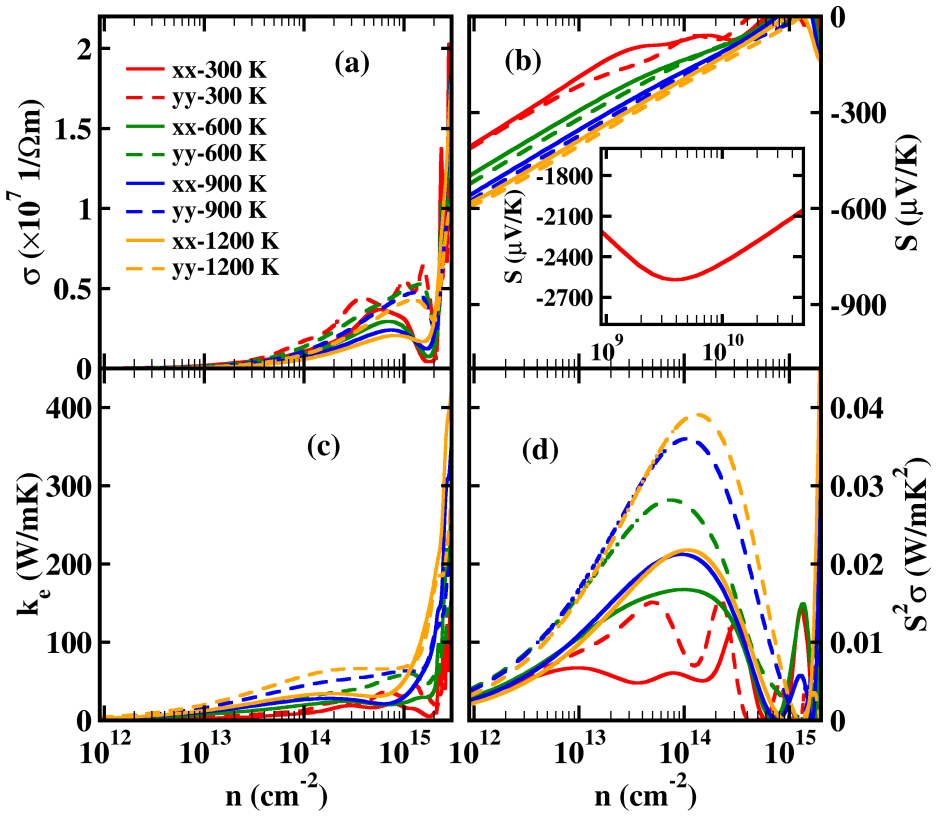
The central discovery is that ruthenium dichalcogenides belong in the two-dimensional thermoelectric family: monolayer T'-RuS2 and T'-RuSe2 are energetically, mechanically, and thermally stable indirect-gap semiconductors with bandgaps of 1.69 eV and 1.67 eV, and their band shapes produce very large Seebeck coefficients. With lattice thermal conductivities of about 19.30 and 12.64 W m$^{-1}$ K$^{-1}$ (x-direction, 300 K) and a deformation-potential relaxation time of $\tau = 0.101\times10^{-13}$ s, the transport calculation gives maximum ZT values of 0.85 (T'-RuS2) and 0.87 (T'-RuSe2) for p-type doping at 1200 K along the y-direction, with n-type peaks of 0.78 for both. Because the Seebeck coefficient is independent of $\tau$, the huge thermopower is the more robust part of the result, while the absolute electrical and electronic thermal conductivities, and hence the ZT numbers, inherit the uncertainty of the constant-relaxation-time approximation.
Load-bearing premise
The whole absolute scale of electrical conductivity, electronic thermal conductivity, and ZT rests on one relaxation time, $\tau = 0.101\times10^{-13}$ s, obtained at 300 K and then used at all temperatures, even though the deformation-potential formula used to obtain it implies $\tau$ falls roughly as $1/T$.
Editorial extensions
If this is right
- If the calculation is right, p-type monolayers of T'-RuS2 and T'-RuSe2 become competitive high-temperature thermoelectric materials, with peak ZT of 0.85 and 0.87 at 1200 K along the y-direction.
- The room-temperature Seebeck coefficients above 2500 µV/K for T'-RuS2 mean these monolayers could turn a modest temperature difference into a large voltage, and since $S$ does not depend on $\tau$, this part of the prediction is more robust than the conductivity values.
- The strong y-direction preference of the best ZT means a working device would need the transport direction aligned with the shorter axis of the T' cell.
- Because n-type ZT peaks at 0.78 for both compounds, p-type doping is the better route for high-temperature heat-to-electricity conversion within this material family.
Reading between the lines
- Beyond the paper: because the deformation-potential mobility scales as $1/T$, carrying the 300 K relaxation time to 1200 K likely inflates $\sigma$, the power factor, and ZT, so the true high-temperature ZT may be noticeably below 0.85 and 0.87.
- Beyond the paper: a direct measurement of the Seebeck coefficient at low carrier density would test the band-structure half of the claim cleanly, since $S$ is independent of $\tau$ and should reach thousands of microvolts per kelvin if the band calculations are right.
- Beyond the paper: alloying S and Se in the T' structure, or applying strain, could further lower the already small lattice thermal conductivity and push ZT higher, though the paper only lists such strategies as future directions.
- Beyond the paper: the optimum carrier concentration for peak ZT is near $10^{13}$ cm$^{-2}$, and because the Seebeck coefficient collapses as doping increases, real devices would need tight doping control to sit in that window.
Editorial analysis
A structured set of objections, weighed in public.
Referee Report
Summary. The manuscript reports first-principles HSE06 calculations for monolayer T'-RuS2 and T'-RuSe2, including structural, mechanical, and dynamical stability, phonon thermal conductivity from Phono3py, and electronic transport from BoltzTraP. The headline results are Seebeck coefficients up to 2685 microV/K at 300 K and maximum ZT values of 0.85 (RuS2) and 0.87 (RuSe2) for p-type doping at 1200 K along the y-direction. Electronic transport uses a constant relaxation time tau = 10.1 fs obtained from deformation-potential theory at 300 K, applied at all temperatures.
Significance. The Seebeck coefficients are independent of tau and are derived from the HSE band structure, so the reported thermopower values are parameter-free within the rigid-band approximation and constitute a solid contribution. The phonon calculations use third-order force constants with convergence checks, and the stability analysis is multi-pronged (cohesive/formation energy, phonons, elastic constants, and AIMD). The main quantitative claim, high-temperature ZT, is not parameter-free: it inherits tau from the deformation-potential mobility formula, which the paper itself identifies as a rough estimate. Because the headline ZT values depend on this assumption, the manuscript requires revision before the conclusions can be accepted at face value.
major comments (2)
- [Section III.D, Eqs. (17)-(18), Table II, and the Abstract] The calculation applies a single room-temperature tau = 0.101x10^-13 s at all temperatures, but combining Eq. (17) with Eq. (18) implies tau proportional to 1/T. At 1200 K the deformation-potential tau would be about 2.5 fs, a factor of four smaller than the 10.1 fs used. Since sigma and k_e are proportional to tau while S is not, the reported ZT at 1200 K is overestimated. Writing ZT = S^2 sigma T / (k_e + k_ph), the corrected value satisfies ZT_corr/ZT_paper approximately equal to 0.25 (k_e + k_ph)/(0.25 k_e + k_ph), so in the phonon-dominated limit the headline values would drop by roughly a factor of four. The paper's own caveat that 'assuming a constant tau can introduce significant uncertainties' appears in Section III.D, but the Abstract and Conclusions report the uncorrected maxima without this caveat. The authors should recompute sigma, k_e, and ZT with the temperature-dependent tau implied by Eq. (17), or explicitly present the reported maxima as upper bounds based on the 300 K scattering estimate.
- [Section III.D, Figs. 8(a) and 9(a)] The text attributes the decrease of electrical conductivity with temperature to enhanced electron-phonon scattering and reduced mobility, but the BoltzTraP calculation with constant tau does not include such scattering; the temperature dependence of sigma in this calculation comes only from the Fermi-Dirac window and the band structure. This conflation matters because the reported ZT(T) trend is partly an artifact of the fixed-tau assumption. The authors should separate what is computed from what is assumed when interpreting the temperature dependence of sigma and ZT.
minor comments (4)
- [Section III.A, phonon dispersion discussion] The discussion of low-frequency optical modes in RuS2 versus RuSe2 is internally difficult to follow: in RuS2 the modes are said to enhance phonon-phonon scattering and reduce thermal conductivity, while in RuSe2 weaker contributions are said to 'limit such interactions and further reduce its thermal conductivity.' Please clarify whether the reduction in RuSe2 comes from reduced heat-carrying capacity or from altered scattering.
- [Section III.D, Seebeck discussion] The text says the high Seebeck values occur 'within a reasonable substantial range of carrier concentrations (10^10 cm^-2)'; 10^10 cm^-2 is extremely low for a 2D thermoelectric device. Please state the doping level at which the quoted Seebeck maxima occur and discuss whether that range is relevant to the ZT optimization shown in Fig. 10.
- [Section III.D, electrical conductivity] The statement that the oscillatory behavior of sigma versus n arises from quantum confinement is not substantiated; such oscillations in BoltzTraP calculations typically reflect the multi-band structure and Fermi-surface topology. Please rephrase or provide evidence for the confinement interpretation.
- [General presentation] The manuscript contains typographical and formatting errors, including 'SUPPLEMET AR Y' in the supplementary heading, 'PA W' for PAW, and missing spaces such as 'µV /Kfrom'. A careful proofreading pass is needed.
Circularity Check
No significant circularity: the thermoelectric predictions follow from first-principles band structures and independently computed deformation-potential parameters, with no fitted target data entering the chain.
full rationale
The paper's central claims are the Seebeck coefficients (2685/2585 uV/K for RuS2, 1515/1533 uV/K for RuSe2) and ZT maxima at 1200 K. The Seebeck coefficients are computed directly from the HSE06 band structure via BoltzTraP and are explicitly tau-independent, as stated in Section III.D: 'the Seebeck coefficient is fixed by the intrinsic electronic properties of the material without any adjustable parameters related to carrier scattering mechanisms.' The relaxation time tau is not fitted to any experimental ZT or Seebeck data; it is obtained from first-principles deformation-potential theory (Eqs. 17-18) using effective masses, elastic moduli, and deformation-potential constants computed for the same structures (Table II). Applying this 300 K tau as a constant at all temperatures is a modeling approximation that the paper itself flags: 'assuming a constant tau can introduce significant uncertainties in the calculation of electrical conductivity, power factor, and ZT, particularly when comparing different materials.' That concern is a correctness or risk issue, not a circularity: the high-temperature ZT could indeed be overestimated if tau decreases with temperature, but the result is not equivalent to its input by construction. The only self-citations ([4], [9], [10]) provide methodological precedent or contextual comparison of tau values; they are not load-bearing for the derived transport coefficients, and the DP-theory tau value is computed in this paper rather than imported from those references. The structural and phonon results are also compared against external prior calculations. Hence no circular step, self-definitional or otherwise, can be identified.
Assumptions & free parameters
free parameters (3)
- Relaxation time tau =
0.101e-13 s (average, 300 K)
- Effective masses (m*) =
0.68 to 0.91 m0 (Table II)
- Deformation potential constants (EDP) =
14.15 to 15.56 eV (Table II)
assumptions (5)
- domain assumption HSE06 hybrid functional accurately describes the electronic structure and band gap
- domain assumption Constant relaxation time approximation and rigid band approximation are valid for doped transport
- domain assumption Deformation potential theory captures the dominant carrier scattering (acoustic phonons) for tau estimation
- domain assumption Single-mode relaxation time approximation for phonon thermal conductivity is accurate
- domain assumption 2D slab with 15 A vacuum is isolated and thickness for transport is well-defined
Cite this review
Pith. "Pith review of Enhanced thermopower in two-dimensional ruthenium dichalcogenides $RuX_2$ (X = S, Se): a first-principles study." pith.science (2026). https://pith.science/paper/4YF2APPI
@misc{pith2026250522510,
  author       = {Pith},
  title        = {Pith review of: Enhanced thermopower in two-dimensional ruthenium dichalcogenides $RuX_2$ (X = S, Se): a first-principles study},
  year         = {2026},
  howpublished = {\url{https://pith.science/paper/4YF2APPI}},
  note         = {Machine review of arXiv:2505.22510}
}
abstract
Transition metal dichalcogenides (TMDs) have garnered attention for their potential in thermoelectric applications due to their unique electronic properties and tunable bandgaps. In this study, we systematically explore the electronic and thermoelectric properties of $T^{\prime}-RuX_2$ (X = S, Se) using first-principles calculations and semi-classical Boltzmann transport equations. Our findings confirm that $T^{\prime}-RuX_2$ is energetically and mechanically stable, with high thermopower values such that $T^{\prime}-RuS_2$ exhibits a Seebeck coefficient of $2685~\mu V/K$ for hole doping and $2585~\mu V/K$ for electron doping, while $T^{\prime}-RuSe_2$ shows values of $1515~\mu V/K$ and $1533~\mu V/K$ for hole and electron doping, respectively. Both materials exhibit reasonable power factors and $ZT$ values, with p-type $T^{\prime}-RuS_2$ and $T^{\prime}-RuSe_2$ achieving maximum ZT values of 0.85 and 0.87, respectively, at 1200~K along the y-direction. These results highlight $T^{\prime}$-$RuS_2$ and $T^{\prime}$-$RuSe_2$ as promising candidates for high-temperature TMD-based thermoelectric devices.
Figures


Figures from the paper (7 more)



Reference graph
Works this paper leans on
-
[1]
D. Li, Y. Gong, Y. Chen, J. Lin, Q. Khan, Y. Zhang, Y. Li, H. Zhang, and H. Xie , Recent progress of two-dimensional thermoelectric materials , Nano-Micro Letters, 12 (2020), pp. 1–40
work page 2020
-
[2]
The broader phonon bandwidth in T ′-RuS2 indicates stronger phonon-electron interac- tions, which enhance the phonon drag effect. Consequently, this results in an increase of the Seebeck coefficient in T ′-RuS2 compared to T ′-RuSe2. [58]. In T ′-RuS2, low-frequency opti- cal phonons extend below 4 THz (between Y to Γ path), enabling interactions with aco...
-
[3]
G. J. Snyder and A. H. Snyder , Figure of merit zt of a thermoelectric device defined from materials properties, Energy & Environmental Science, 10 (2017), pp. 2280–2283
work page 2017
-
[4]
W. Liu, Q. Jie, H. S. Kim, and Z. Ren , Current progress and future challenges in thermo- electric power generation: From materials to devices , Acta Materialia, 87 (2015), pp. 357–376
work page 2015
-
[5]
P. Senapati and P. Parida , Charge and spin thermoelectric transport in benzene-based molecular nano-junctions: a quantum many-body study , Nanoscale, 16 (2024), pp. 2574–2590
work page 2024
-
[6]
N. R. Glavin, R. Rao, V. V arshney, E. Bianco, A. Apte, A. Roy, E. Ringe, and P. M. Ajayan , Emerging applications of elemental 2d materials , Advanced Materials, 32 (2020), p. 1904302
work page 2020
-
[7]
S. Yang, C. Jiang, and S.-h. Wei , Gas sensing in 2d materials , Applied Physics Reviews, 4 (2017)
work page 2017
-
[8]
S. J. Kim, K. Choi, B. Lee, Y. Kim, and B. H. Hong , Materials for flexible, stretchable electronics: graphene and 2d materials , Annual Review of Materials Research, 45 (2015), pp. 63–84
work page 2015
Show all 80 references
-
[9]
Gupta, S
N. Gupta, S. Rani, P. Kumari, R. Ahuja, and S. J. Ray , Ultralow lattice thermal conductivity and thermoelectric performance of twisted graphene/boron nitride heterostructure through strain engineering, Carbon, 215 (2023), p. 118437
2023
-
[10]
Kumar, P
A. Kumar, P. Senapati, and P. Parida, Theoretical insights into the structural, electronic and thermoelectric properties of the inorganic biphenylene monolayer , Physical Chemistry Chemical Physics, 26 (2024), pp. 2044–2057
2024
-
[11]
Senapati, A
P. Senapati, A. Kumar, and P. Parida, Thermoelectric properties of c2p4 monolayer: A first principle study , Journal of Applied Physics, 133 (2023)
2023
-
[12]
Y. Liu, S. Zhang, J. He, Z. M. W ang, and Z. Liu , Recent progress in the fabrication, properties, and devices of heterostructures based on 2d materials , Nano-Micro Letters, 11 33 (2019), pp. 1–24
2019
-
[13]
L. Li, Y. Yu, G. J. Ye, Q. Ge, X. Ou, H. Wu, D. Feng, X. H. Chen, and Y. Zhang , Black phosphorus field-effect transistors , Nature nanotechnology, 9 (2014), pp. 372–377
2014
-
[14]
L.-Y. Feng, R. A. B. Villaos, H. N. Cruzado, Z.-Q. Huang, C.-H. Hsu, H.-C. Hsueh, H. Lin, and F.-C. Chuang , Magnetic and topological properties in hydrogenated transition metal dichalcogenide monolayers , Chinese Journal of Physics, 66 (2020), pp. 15–23
2020
-
[15]
L.-Y. Feng, R. A. B. Villaos, Z.-Q. Huang, C.-H. Hsu, and F.-C. Chuang , Layer- dependent band engineering of pd dichalcogenides: a first-principles study , New Journal of Physics, 22 (2020), p. 053010
2020
-
[16]
R. A. B. Villaos, C. P. Crisostomo, Z.-Q. Huang, S.-M. Huang, A. A. B. Padama, M. A. Albao, H. Lin, and F.-C. Chuang , Thickness dependent electronic properties of pt dichalcogenides, npj 2D Materials and Applications, 3 (2019), p. 2
2019
-
[17]
G. Chen, S. T. Howard, A. B. Maghirang III, K. Nguyen Cong, R. A. B. Villaos, L.-Y. Feng, K. Cai, S. C. Ganguli, W. Swiech, E. Morosan, et al. , Correlating structural, electronic, and magnetic properties of epitaxial v se 2 thin films , Physical Review B, 102 (2020), p. 115149
2020
-
[18]
Tao, J.-Q
W.-L. Tao, J.-Q. Lan, C.-E. Hu, Y. Cheng, J. Zhu, and H.-Y. Geng , Thermoelectric properties of janus mxy (m= pd, pt; x, y= s, se, te) transition-metal dichalcogenide monolayers from first principles , Journal of Applied Physics, 127 (2020)
2020
-
[19]
Zhang, Z
L. Zhang, Z. Yang, T. Gong, R. Pan, H. W ang, Z. Guo, H. Zhang, and X. Fu , Recent advances in emerging janus two-dimensional materials: from fundamental physics to device applications, Journal of materials chemistry A, 8 (2020), pp. 8813–8830
2020
-
[20]
A. B. Maghirang III, Z.-Q. Huang, R. A. B. Villaos, C.-H. Hsu, L.-Y. Feng, E. Florido, H. Lin, A. Bansil, and F.-C. Chuang , Predicting two-dimensional topo- logical phases in janus materials by substitutional doping in transition metal dichalcogenide monolayers, npj 2D Materi...
2019
-
[21]
Chang, M
C. Chang, M. Wu, D. He, Y. Pei, C.-F. Wu, X. Wu, H. Yu, F. Zhu, K. W ang, Y. Chen, et al. , 3d charge and 2d phonon transports leading to high out-of-plane zt in n-type snse crystals , Science, 360 (2018), pp. 778–783
2018
-
[22]
M. Xin, J. Li, Z. Ma, L. Pan, and Y. Shi , Mxenes and their applications in wearable sensors, Frontiers in chemistry, 8 (2020), p. 297. 34
2020
-
[23]
Huang, M.-L
Z.-Q. Huang, M.-L. Xu, G. Macam, C.-H. Hsu, and F.-C. Chuang , Large-gap topo- logical insulators in functionalized ordered double transition metal carbide mxenes , Physical Review B, 102 (2020), p. 075306
2020
-
[24]
W. Peng, S. Chanakian, and A. Zevalkink , Crystal chemistry and thermoelectric trans- port of layered am 2 x 2 compounds , Inorganic Chemistry Frontiers, 5 (2018), pp. 1744–1759
2018
-
[25]
L.-Y. Feng, R. A. B. Villaos, A. B. Maghirang III, Z.-Q. Huang, C.-H. Hsu, H. Lin, and F.-C. Chuang , Prediction of topological dirac semimetal in ca-based zintl layered com- pounds cam2x2 (m= zn or cd; x= n, p, as, sb, or bi) , Scientific reports, 12 (2022), p. 4582
2022
-
[26]
Yuhara, Y
J. Yuhara, Y. Fujii, K. Nishino, N. Isobe, M. Nakatake, L. Xian, A. Rubio, and G. Le Lay, Large area planar stanene epitaxially grown on ag (1 1 1) , 2D Materials, 5 (2018), p. 025002
2018
-
[27]
X. Xiao, H. W ang, P. Urbankowski, and Y. Gogotsi , Topochemical synthesis of 2d materials, Chemical Society Reviews, 47 (2018), pp. 8744–8765
2018
-
[28]
K. S. Novoselov, A. K. Geim, S. V. Morozov, D.-e. Jiang, Y. Zhang, S. V. Dubonos, I. V. Grigorieva, and A. A. Firsov , Electric field effect in atomically thin carbon films, science, 306 (2004), pp. 666–669
2004
-
[29]
Zhang and Y.-W
G. Zhang and Y.-W. Zhang, Thermoelectric properties of two-dimensional transition metal dichalcogenides, Journal of Materials Chemistry C, 5 (2017), pp. 7684–7698
2017
-
[30]
Purwitasari, R
W. Purwitasari, R. A. B. Villaos, I. M. R. Verzola, A. Sufyan, Z.-Q. Huang, C.-H. Hsu, and F.-C. Chuang, High thermoelectric performance in 2d technetium dichalcogenides tcx2 (x= s, se, or te) , ACS Applied Energy Materials, 5 (2022), pp. 8650–8657
2022
-
[31]
Huang, X
W. Huang, X. Luo, C. K. Gan, S. Y. Quek, and G. Liang , Theoretical study of ther- moelectric properties of few-layer mos 2 and wse 2 , Physical Chemistry Chemical Physics, 16 (2014), pp. 10866–10874
2014
-
[32]
Chen, X.-M
K.-X. Chen, X.-M. W ang, D.-C. Mo, and S.-S. Lyu, Thermoelectric properties of transi- tion metal dichalcogenides: from monolayers to nanotubes , The Journal of Physical Chemistry C, 119 (2015), pp. 26706–26711
2015
-
[33]
A. V. Kolobov and J. Tominaga , Two-dimensional transition-metal dichalcogenides , vol. 239, Springer, 2016
2016
-
[34]
Y. Shi, H. Zhang, W.-H. Chang, H. S. Shin, and L.-J. Li , Synthesis and structure of two-dimensional transition-metal dichalcogenides, MRS Bulletin, 40 (2015), pp. 566–576. 35
2015
-
[35]
Ajayan, P
P. Ajayan, P. Kim, and K. Banerjee , Two-dimensional van der waals materials , Physics Today, 69 (2016), pp. 38–44
2016
-
[36]
Yumnam, T
G. Yumnam, T. Pandey, and A. K. Singh , High temperature thermoelectric properties of zr and hf based transition metal dichalcogenides: A first principles study , The Journal of chemical physics, 143 (2015)
2015
-
[37]
Y. Ding, B. Xiao, G. Tang, and J. Hong , Transport properties and high thermopower of snse2: a full ab-initio investigation , The Journal of Physical Chemistry C, 121 (2017), pp. 225–236
2017
-
[38]
W. Zhou, H. Gong, X. Jin, Y. Chen, H. Li, and S. Liu , Recent progress of two- dimensional transition metal dichalcogenides for thermoelectric applications , Frontiers in Physics, 10 (2022), p. 842789
2022
-
[39]
R. Sai, O. Gorochov, and H. Ezzaouia , The study of the electronic structure of rus2 , Results in Physics, 26 (2021), p. 104393
2021
-
[40]
Bichsel, F
R. Bichsel, F. Levy, and H. Berger , Growth and physical properties of rus2 single crys- tals, Journal of Physics C: Solid State Physics, 17 (1984), p. L19
1984
-
[41]
Y. Zhao, H. Cong, P. Li, D. Wu, S. Chen, and W. Luo, Hexagonal ruse2 nanosheets for highly efficient hydrogen evolution electrocatalysis, Angewandte Chemie, 133 (2021), pp. 7089– 7093
2021
-
[42]
Ersan, S
F. Ersan, S. Cahangirov, G. G ¨oko˘glu, A. Rubio, and E. Akt ¨urk, Stable monolayer honeycomb-like structures of ru x 2 (x= s, se) , Physical Review B, 94 (2016), p. 155415
2016
-
[43]
Hohenberg and W
P. Hohenberg and W. Kohn , Inhomogeneous electron gas , Physical review, 136 (1964), p. B864
1964
-
[44]
Kresse and D
G. Kresse and D. Joubert , From ultrasoft pseudopotentials to the projector augmented- wave method, Physical review b, 59 (1999), p. 1758
1999
-
[45]
Kresse and J
G. Kresse and J. Furthm ¨uller, Efficient iterative schemes for ab initio total-energy cal- culations using a plane-wave basis set , Physical review B, 54 (1996), p. 11169
1996
-
[46]
J. Heyd, G. E. Scuseria, and M. Ernzerhof , Hybrid functionals based on a screened coulomb potential, The Journal of chemical physics, 118 (2003), pp. 8207–8215
2003
-
[47]
A. V. Krukau, O. A. Vydrov, A. F. Izmaylov, and G. E. Scuseria , Influence of the exchange screening parameter on the performance of screened hybrid functionals , The Journal of chemical physics, 125 (2006). 36
2006
-
[48]
H. J. Monkhorst and J. D. Pack , Special points for brillouin-zone integrations , Physical review B, 13 (1976), p. 5188
1976
-
[49]
Togo and I
A. Togo and I. Tanaka , First principles phonon calculations in materials science , Scripta Materialia, 108 (2015), pp. 1–5
2015
-
[50]
H. A. Eivari and R. Hafizi , Mechanical properties of two-dimensional sheets of TiO 2: a DFT study , The European Physical Journal Plus, 137 (2022), pp. 1128
2022
-
[51]
Barron and M
T. Barron and M. Klein, Second-order elastic constants of a solid under stress, Proceedings of the Physical Society, 85 (1965), p. 523
1965
-
[52]
A. Togo, L. Chaput, and I. Tanaka, Distributions of phonon lifetimes in brillouin zones , Physical review B, 91 (2015), p. 094306
2015
-
[53]
Chaput , Direct solution to the linearized phonon boltzmann equation , Physical review letters, 110 (2013), p
L. Chaput , Direct solution to the linearized phonon boltzmann equation , Physical review letters, 110 (2013), p. 265506
2013
-
[54]
Mizokami, A
K. Mizokami, A. Togo and I. Tanaka , Lattice thermal conductivities of two SiO 2 poly- morphs by first-principles calculations and the phonon Boltzmann transport equation , Physical review B, 97 (2018), p. 224306
2018
-
[55]
G. K. Madsen and D. J. Singh , Boltztrap. a code for calculating band-structure dependent quantities, Computer Physics Communications, 175 (2006), pp. 67–71
2006
-
[56]
Bardeen and W
J. Bardeen and W. Shockley, Deformation potentials and mobilities in non-polar crystals, Physical review, 80 (1950), p. 72
1950
-
[57]
W ang, R
G. W ang, R. Pandey, and S. P. Karna , Carbon phosphide monolayers with superior carrier mobility, Nanoscale, 8 (2016), pp. 8819–8825
2016
-
[58]
Bruzzone and G
S. Bruzzone and G. Fiori, Ab-initio simulations of deformation potentials and electron mo- bility in chemically modified graphene and two-dimensional hexagonal boron-nitride , Applied Physics Letters, 99 (2011)
2011
-
[59]
W agner-Reetz, D
M. W agner-Reetz, D. Kasinathan, W. Schnelle, R. Cardoso-Gil, H. Rosner, Y. Grin, and P. Gille , Phonon-drag effect in FeGa 3, Physical Review B, 90 (2014), pp. 195206
2014
-
[60]
Mouhat and F.-X
F. Mouhat and F.-X. Coudert , Necessary and sufficient elastic stability conditions in various crystal systems , Physical review B, 90 (2014), p. 224104
2014
-
[61]
H. Sun, P. Agrawal, and C. V. Singh , A first-principles study of the relationship be- tween modulus and ideal strength of single-layer, transition metal dichalcogenides , Materials 37 Advances, 2 (2021), pp. 6631–6640
2021
-
[62]
Singh, C
S. Singh, C. Espejo, and A. H. Romero , Structural, electronic, vibrational, and elastic properties of graphene/mos 2 bilayer heterostructures, Physical Review B, 98 (2018), p. 155309
2018
-
[63]
M. K. Mohanta and A. De Sarkar , Interfacial hybridization of janus mosse and bx (x= p, as) monolayers for ultrathin excitonic solar cells, nanopiezotronics and low-power memory devices, Nanoscale, 12 (2020), pp. 22645–22657
2020
-
[64]
Shafique and Y.-H
A. Shafique and Y.-H. Shin , The effect of non-analytical corrections on the phononic thermal transport in InX (X= S, Se, Te) monolayers , Scientific Reports, 10 (2020), p. 1093
2020
-
[65]
J. Bera, A. Betal, Z. Singh, A. N. Gandi, and S. Sahu, Low lattice thermal conductivity and its role in the remarkable thermoelectric performance of newly predicted sis2 and sise2 monolayers, Computational Materials Science, 201 (2022), p. 110931
2022
-
[66]
R. Yan, J. R. Simpson, S. Bertolazzi, J. Brivio, M. W atson, X. Wu, A. Kis, T. Luo, A. R. Hight W alker, and H. G. Xing , Thermal conductivity of monolayer molybde- num disulfide obtained from temperature-dependent raman spectroscopy, ACS nano, 8 (2014), pp. 986–993
2014
-
[67]
Bera and S
J. Bera and S. Sahu , Strain induced valley degeneracy: a route to the enhancement of thermoelectric properties of monolayer ws 2 , RSC advances, 9 (2019), pp. 25216–25224
2019
-
[68]
Takagi, A
S. Takagi, A. Toriumi, M. Iwase, and H. Tango , On the universality of inversion layer mobility in Si MOSFETs: Part I—Effects of substrate impurity concentration , IEEE Transactions on Electron Devices, 41 (1994), pp. 2357–2362
1994
-
[69]
J. Qiao, X. Kong, Z.-X. Hu, F. Yang, and W. Ji, High-mobility transport anisotropy and linear dichroism in few-layer black phosphorus , Nature Communications, 5 (2014), p. 4475
2014
-
[70]
Sohier, D
T. Sohier, D. Campi, N. Marzari, and M. Gibertini, Mobility of two-dimensional mate- rials from first principles in an accurate and automated framework, Physical Review Materials, 2 (2018), p. 114010
2018
-
[71]
X. Li, Z. Zhang, J. Xi, D. J. Singh, Y. Sheng, J. Yang, and W. Zhang , TransOpt: A code to solve electrical transport properties of semiconductors in constant electron-phonon coupling approximation, Computational Materials Science, 186 (2021), p. 110074
2021
-
[72]
F. Q. W ang, S. Zhang, J. Yu, and Q. W ang, Thermoelectric properties of single-layered snse sheet, Nanoscale, 7 (2015), pp. 15962–15970
2015
-
[73]
L. D. Whalley, J. M. Frost, B. J. Morgan, and A. W alsh , Impact of nonparabolic 38 electronic band structure on the optical and transport properties of photovoltaic materials , Physical Review B, 99 (2019), pp. 085207
2019
-
[74]
Ghosh, A
K. Ghosh, A. Kusiak, P. No ´e,M. C. Cyrille, and J. L. Battaglia , Thermal con- ductivity of amorphous and crystalline GeTe thin film at high temperature: Experimental and theoretical study, Physical Review B, 101 (2020), p. 214305
2020
-
[75]
Thesberg, H
M. Thesberg, H. Kosina and N. Neophytou , On the Lorenz number of multiband mate- rials, Physical Review B, 95 (2017), p. 125206
2017
-
[76]
Hippalgaonkar, Y
K. Hippalgaonkar, Y. W ang, Y. Ye, D. Y. Qiu, H. Zhu, Y. W ang, J. Moore, S. G. Louie, and X. Zhang , High thermoelectric power factor in two-dimensional crystals of mo s 2 , Physical Review B, 95 (2017), p. 115407
2017
-
[77]
Kumar and U
S. Kumar and U. Schwingenschlogl , Thermoelectric response of bulk and monolayer mose2 and wse2 , Chemistry of Materials, 27 (2015), pp. 1278–1284
2015
-
[78]
Pallecchi, N
I. Pallecchi, N. Manca, B. Patil, L. Pellegrino, and D. Marr ´e, Review on thermo- electric properties of transition metal dichalcogenides , Nano Futures, 4 (2020), p. 032008
2020
-
[79]
X. Ruan, R. Xiong, Z. Cui, C. Wen, J. J. Ma, B. T. W ang, and B. Sa, Strain-enhanced thermoelectric performance in GeS2 monolayer , Materials, 15 (2022), p. 4016
2022
-
[80]
Zhang, E
P. Zhang, E. Jiang, T. Ouyang, C. Tang, C. He, J. Li, C. Zhang, J. Zhong , Po- tential thermoelectric candidate monolayer silicon diphosphide (SiP2) from a first-principles calculation, Computational Materials Science, 188 (2021), p. 110154. 39
2021
Reviewed August 7, 2026 · model on record in the stance chip above.
Discussion (0). Sign in to comment.