REVIEW 3 major objections 5 minor 20 references
Comments on a Recent Review Paper on Near-Sun Comets
T0 review · 3 major / 5 minor · reviewed 2026-08-14 · deepseek-v4-flash
Pith's one-line read A corrections note argues that a widely cited 2018 review of near-Sun comets factually misrepresents the author's published results, including Lovejoy's post-perihelion appearance and the Kreutz family's breakup location.
desk verdict A credible, well-documented correction note that deserves peer review; the only significant weak spot is the unverified Kracht linkage in Section 6. read the letter →
The pith
A machine-rendered reading of the paper's core claim, the machinery that carries it, and where it could break.
The reading
What carries the argument
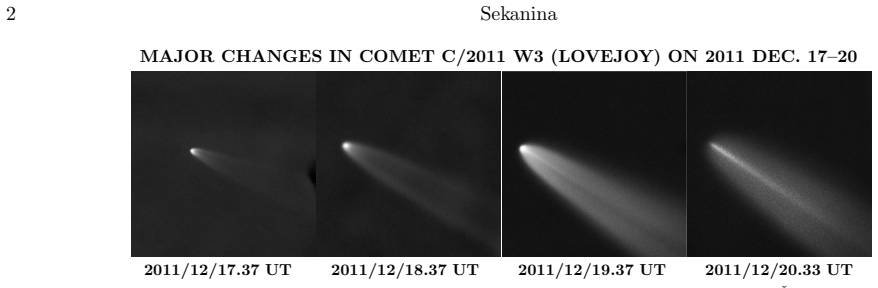
The argument turns on a small set of concrete observational and dynamical objects: the four FRAM telescope images of C/2011 W3, which carry the claim that a central condensation persisted for roughly three days after perihelion; the cascading fragmentation model of the Kreutz system, in which an instantaneous breakup of the parent comet at large heliocentric distance, with small separation velocities, reproduces the observed spread of orbital elements and the clustering of perihelion dates; and the orbital linkages of individual SOHO detections that tie fragments of C/2002 R5 to the 2008 and 2014 returns. The Lorentz-force discussion rests on diagnostic orientations of narrow dust tails in SOHO C2 images, while the sporadic-sungrazer argument uses the Bortle survival limit and the synoptic perihelion-survival index to reject an Oort Cloud origin for faint surviving objects.
What would settle it
Re-examine the four FRAM frames of C/2011 W3: if no central condensation is present on December 17-19, or if a condensation is still present on December 20, the claim that the comet survived perihelion and disintegrated about two days later would be contradicted.
Extended reading notes
Core claim
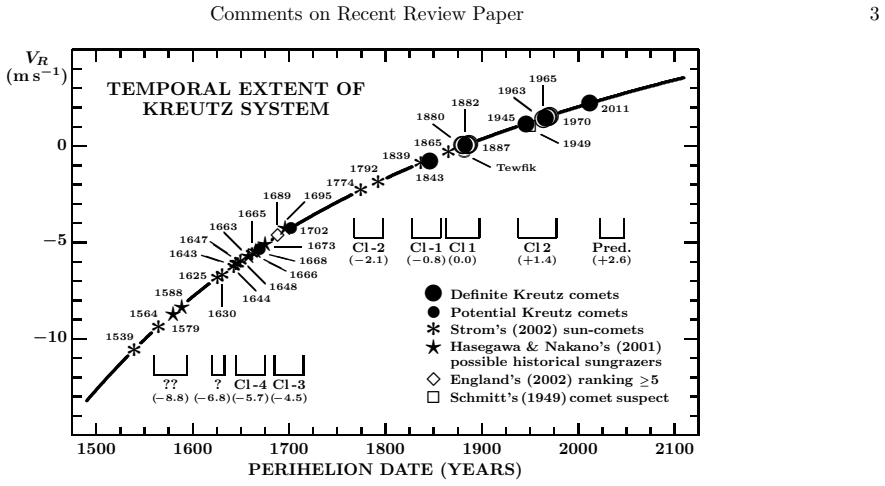
The paper's central claim is that a recent comprehensive review paper on near-Sun comets contains factual misrepresentations of the author's cited research, and that specific corrections are needed. For C/2011 W3, the four FRAM images show a clear central condensation in the first three post-perihelion frames, on December 17.37-19.37 UT, with the condensation lost only by December 20.33 UT; the author's conclusion was that the comet survived perihelion and disintegrated about two days afterward, not that it appeared only as a headless tail. For the Kreutz system, the author's papers proposed an initial breakup of the parent comet far from the Sun, followed by cascading fragmentation, and predicted a new cluster of bright sungrazers whose first member was C/2011 W3; the review instead describes the parent as breaking up near perihelion. The note also asserts that both fragments of C/2002 R5 were observed at their 2014 return, that SOHO dust-tail orientations rule out perceptible Lorentz-force effects, and that random inclinations do not by themselves point to an Oort Cloud origin for sporadic sungrazers.
Load-bearing premise
The corrections stand or fall on the reliability and correct interpretation of external evidence not fully reproduced in the note: the FRAM images, the SOHO detection reports for SOHO-2673 and SOHO-2712, and Kracht's orbital linkages and 2019 return prediction.
Editorial extensions
If this is right
- If these corrections are right, the review's account of C/2011 W3 should be revised: the comet was not headless immediately after perihelion, and its disintegration occurred about two days later.
- The Kreutz system's formation story changes from a parent broken up near perihelion to an early breakup far from the Sun followed by cascading fragmentation, with the known orbital spread explained by small separation velocities.
- The confirmed 2014 returns of the C/2002 R5 fragments would remove the review's stated uncertainty about that linkage and support the predicted 2019 November return.
- Diagnostic tail orientations argue that the Lorentz force is not needed to explain the narrow dust tails of SOHO sungrazers, so models invoking dust charging for these tails are not supported by the SOHO evidence.
- Random orbital inclinations alone would not establish an Oort Cloud origin for sporadic near-Sun comets, especially for faint objects that survive perihelion.
Reading between the lines
- One implication the author leaves implicit is that if a central condensation survived until December 19, physical models of C/2011 W3's nucleus and its post-perihelion brightness should be revisited, since the comet was not simply a tail after perihelion.
- A testable extension would be to photometrically reanalyze the archival FRAM frames and SOHO data to quantify when the condensation faded, which would sharpen the proposed two-day delay in disintegration.
- The note's success in documenting misstatements suggests that other citation-linked statements in the same review, not examined here, could merit independent checking against the original papers.
- If the far-from-Sun breakup scenario is accepted, tidal-disruption calculations for the Kreutz family need to be supplemented by nontidal fragmentation mechanisms operating at large heliocentric distances.
Signed reviews
Editorial analysis
A structured set of objections, weighed in public.
Referee Report
Summary. This manuscript by Zdenek Sekanina (arXiv:1908.11368) is a comment on the review paper Jones et al. (2018), 'The Science of Sungrazers, Sunskirters, and Other Near-Sun Comets,' which the author calls Paper 1. The note claims that several results from the author's own published papers are factually misrepresented in that review, and offers corrections and additions. Specific points include: (1) C/2011 W3 Lovejoy was observed with a clear condensation for several days after perihelion, contrary to Paper 1's account of a headless tail; (2) the Kreutz parent comet likely fragmented far from the Sun rather than near perihelion; (3) the review understates the spread in orbital elements among Kreutz sungrazers; (4) the handling of Lorentz-force evidence for SOHO dust tails is misleading; (5) the 2014 returns of C/2002 R5 fragments were observed; (6) sporadic sungrazers are improbable Oort Cloud objects; and (7) several specific attributions and citations in Paper 1 are wrong. The manuscript reproduces a figure from Sekanina & Chodas (2012) and uses direct quotes from Paper 1 to support its claims.
Significance. If the corrections are valid, this note documents substantive errors in a widely cited and influential review, which is valuable for the community. The paper's strengths include direct quotation of the reviewed text, a reproduced primary figure, and precise page/section references. Its weaknesses are that some corrections depend on non-peer-reviewed sources (a project website and a personal webpage) and that certain arguments blur the line between factual misrepresentation and interpretive disagreement. The paper does not present new derivations; its scientific value is proportionate to the reliability of each individual correction and to the fairness of the characterization of Paper 1.
major comments (3)
- [Section 6] The assertion that Paper 1's statement about C/2002 R5 is 'manifestly incorrect' rests entirely on detections announced on the Sungrazer Project website and on R. Kracht's personal webpage, with no orbital elements, astrometric residuals, identification criteria, or uncertainty estimates provided. If Kracht's linkage is not robust, then Paper 1's caution that 'the linkage remains uncertain' is appropriate, and this specific accusation of factual misrepresentation is unsupported. This is load-bearing because the abstract promises corrections of 'numerous errors and inaccuracies,' and one demonstrably weak correction undermines the paper's own standard of factual care. The author should either supply the underlying orbital data or explicitly downgrade this item from 'manifestly incorrect' to 'disputed'.
- [Section 3] The claim that Paper 1 factually misrepresents the Kreutz parent breakup location is not fully established. The quoted sentence, 'most investigators ... are in agreement about the general picture ... the original parent comet was perturbed into a sungrazing orbit and broke up near perihelion,' can reasonably be read as a summary of a broad consensus rather than a specific attribution to the cited Sekanina & Chodas papers. The author correctly notes that Sekanina & Chodas (2004, 2007) proposed far-from-Sun fragmentation, but he does not demonstrate that Paper 1's sentence is intended to describe those papers. Moreover, the observation that Marsden and Sekanina & Chodas 'paid no attention' to the perturbation process is not directly relevant to whether the breakup location was near perihelion. Section 3 should be reframed as a complaint about a misleading simplification, with explicit evidence that the cited papers are being misrepresented, rather than as a flat factual misrepresentation.
- [Section 7] The correction on sporadic sungrazers asserts that random inclinations are not a diagnostic of Oort Cloud origin and that the Oort Cloud origin 'should be rejected' for comets observed after perihelion, but no quantitative argument is presented. The Bortle limit and the author's synoptic index are invoked, yet no calculations, thresholds, or applications are shown to justify the rejection. As written, this is an unsupported assertion rather than a documented correction, and it stands in tension with the paper's announced purpose of correcting 'errors and inaccuracies' on the basis of verifiable evidence. If the intent is only to challenge the review's line of reasoning, the text should say so, and should supply the missing analysis.
minor comments (5)
- [Section 8] There is a typographical error: 'C/2013 W3 Lovejoy' should be 'C/2011 W3 Lovejoy.'
- [Figure 1 caption] The caption contains several spelling errors, such as 'remotely controled telesco pe' and 'iamge'; the running text also has 'suden' for 'sudden' in Section 2.
- [Section 8] The text refers to 'Fugure 2' rather than 'Figure 2.'
- [General] The anecdotal remarks about the 'unsatisfactory reply' from the authors of Paper 1 are editorial and not verifiable; they do not contribute to the technical argument and could be removed or moved to a footnote.
- [General] The manuscript would benefit from a careful proofread, as several spacing and typesetting artifacts (e.g., 'Techno logy,' 'cite d,' 'telesco pe') impair readability.
Circularity Check
No significant circularity; the corrections are anchored in external observations and the cited prior papers' actual content.
full rationale
This note is a corrections/comment piece, not a derivation: it claims that Jones et al. (2018) factually misrepresented specific results, and it supports each correction with external or archival evidence. Section 2 reproduces the FRAM images (taken by external observers at the Pierre Auger Observatory) and cites Sekanina & Chodas (2012) for the analysis; the presence of a condensation after perihelion is an observational fact, not an output of the paper's own model. Section 3's correction about early breakup far from the Sun points to the content of Sekanina (2002b) and Sekanina & Chodas (2004, 2007); the 'prediction' of a future Kreutz cluster was published in 2007 and tested by the independent 2011 discovery of C/2011 W3, so it is an out-of-sample validation rather than a fitted result. Section 6's claim that the 2014 returns of C/2002 R5 fragments were observed rests on the Sungrazer Project website and R. Kracht's orbital linkage from his personal webpage; this is a robustness-of-evidence concern, since the linkage is not reproduced in the note, but it is not circular because the linkage is not derived from the note's own assumptions. Sections 7 and 8 use the author's synoptic perihelion-survival index and prior papers, but the relevant arguments also invoke the independent Bortle (1991) limit and the text of the cited papers themselves. No equation or argument reduces by construction to a fitted parameter, a renamed input, or a self-citation chain; therefore no circular step is present.
Assumptions & free parameters
assumptions (3)
- domain assumption The FRAM images in Figure 1 accurately show the state of C/2011 W3 on the stated dates.
- domain assumption The SOHO-2673 and SOHO-2712 objects are the 2014 returns of C/2002 R5 fragments.
- domain assumption Kracht's predicted 2019 return of the C/2002 R5 pair is accurate.
Cite this review
Pith. "Pith review of Comments on a Recent Review Paper on Near-Sun Comets." pith.science (2026). https://pith.science/paper/4YFWNLZF
@misc{pith2026190811368,
  author       = {Pith},
  title        = {Pith review of: Comments on a Recent Review Paper on Near-Sun Comets},
  year         = {2026},
  howpublished = {\url{https://pith.science/paper/4YFWNLZF}},
  note         = {Machine review of arXiv:1908.11368}
}
read the original abstract
It is noted that some results of the author's research papers cited in the comprehensive review paper "The Science of Sungrazers, Sunskirters, and Other Near-Sun Comets" by G. H. Jones et al. (2018) have been factually misrepresented. The purpose of this note is to offer (i) revisions in order to correct the numerous errors and inaccuracies and (ii) additions where the text is confusing.
Figures
Reference graph
Works this paper leans on
-
[1]
Bortle, J. E. 1991, Int. Comet Quart., 13, 89
work page 1991
-
[2]
England, K. J. 2002, JBAA, 112, 13
work page 2002
-
[3]
1966, AJ, 71, 857 Hasegawa., I., & Nakano, S
Harwit, M. 1966, AJ, 71, 857 Hasegawa., I., & Nakano, S. 2001, PASJ, 53, 931
work page 1966
- [4]
-
[5]
Jones, G. H., Knight, M. M., Battams, K., et al. 2018, Space Sc i. Rev., 214, 20
work page 2018
-
[6]
G., Battams, K., & Sekanina, Z
Kracht, R., Marsden, B. G., Battams, K., & Sekanina, Z. 2008, IAUC 8983
work page 2008
-
[7]
Kramer, E. A., Fernandez, Y. R., Lisse, C. M., et al. 2014, Ica rus, 236, 136
work page 2014
-
[8]
Marsden, B. G. 1967, AJ, 72, 1170
work page 1967
Show all 20 references
-
[9]
Marsden, B. G. 1989, AJ, 98, 2306
1989
-
[10]
Marsden, B. G. 2005, Ann. Rev. Astron. & Astrophys., 43, 75 ¨Opik, E. J. 1966, Ir. Astron. J., 7, 141
2005
-
[11]
Seargent, D. A. J. 2012, Sungrazing Comets: Snowballs in the Fur- nace. Amazon Books (Kindle Edition, 128pp)
2012
- [12]
-
[13]
Sekanina, Z., & Chodas, P. W. 2004, ApJ, 607, 620
2004
-
[14]
Sekanina, Z., & Chodas, P. W. 2007, ApJ, 663, 657
2007
-
[15]
Sekanina, Z., & Chodas, P. W. 2008, ApJ, 687, 1415
2008
-
[16]
Sekanina, Z., & Chodas, P. W. 2012, ApJ, 757, 127
2012
-
[17]
Sekanina, Z., & Farrell, J. A. 1980, AJ, 85, 1538
1980
- [18]
-
[19]
2015, ApJ, 801, 135
Sekanina, Z., & Kracht, R. 2015, ApJ, 801, 135
2015
-
[20]
Thompson, W. T. 2009, Icarus, 200, 351 7 See the website https://sungrazer.nrl.navy.mil/index.php? p=comets.found.old/comets.arch. The messages are dated 2014 April 17, 08:55:55 for SOHO-2673 and 2014 August 22, 15:39:4 7 for SOHO-2712. 8 See the website http://www.rkracht.de/...
2009
Reviewed August 14, 2026 · model on record in the stance chip above.
Discussion (0). Continue with ORCID to comment.