Composite Quantum Geometry and Semiclassical Dynamics
Pith reviewed 2026-06-27 08:09 UTC · model grok-4.3
The pith
For neutral composite particles a uniform electric field couples to a difference of Berry connections rather than standard Berry curvature.
A machine-rendered reading of the paper's core claim, the machinery that carries it, and where it could break.
Core claim
The authors establish that neutral composites do not couple to a Berry curvature term under uniform electric fields; instead the equations of motion contain a quantum geometric dipole arising as the difference between inequivalent Berry connections. Charged composites acquire an extra Berry curvature contribution, but an infinite family of inequivalent composite Berry curvatures exists and the correct member is selected by the definition of a spatial centre. These geometric quantities produce dynamics with no single-electron counterpart, including electric-field-driven transverse drift of trions together with oscillation of their dipole moment.
What carries the argument
The difference between inequivalent Berry connections that can be defined for the composite, which generalizes the quantum geometric dipole and replaces the usual Berry curvature term for neutral states.
If this is right
- Neutral composites experience no Berry curvature contribution to their velocity under a uniform electric field.
- Charged composites acquire a Berry curvature term whose physical value is fixed once a spatial centre is chosen.
- Trions undergo a transverse drift whose magnitude is set by both the quantum geometric dipole and the selected Berry curvature.
- The same two geometric quantities cause the internal dipole moment of a trion to oscillate in time.
- Composite dynamics can contain transverse motion and internal oscillations that have no direct single-particle analog.
Where Pith is reading between the lines
- The centre-dependent choice of Berry curvature may alter predicted diffusion constants for excitons or trions in different host lattices.
- Transport measurements on charged composites could distinguish among candidate Berry curvatures by comparing observed drift to the predicted centre-dependent value.
- The same geometric-difference mechanism may govern semiclassical motion of other neutral bound states such as biexcitons or interlayer excitons.
- Device design that relies on composite-particle transport could exploit the geometric dipole to produce drift directions or oscillation frequencies unavailable to single carriers.
Load-bearing premise
The semiclassical approximation remains valid for composite bound states and a well-defined spatial centre can be chosen to select the physical Berry curvature from the infinite family.
What would settle it
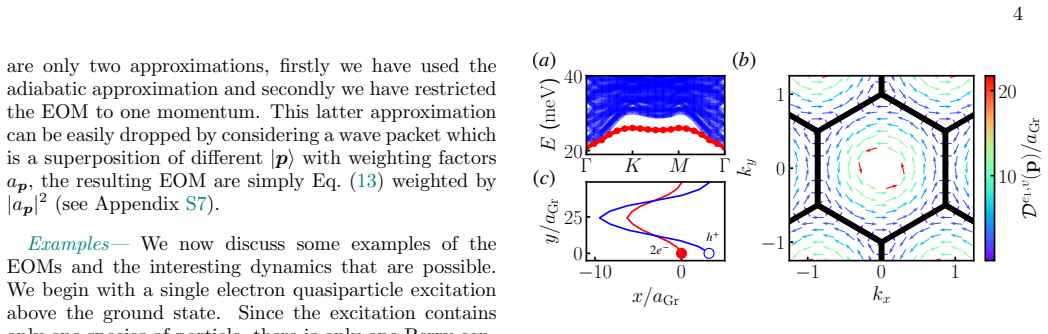
Observation of the transverse drift velocity and the frequency of dipole-moment oscillation for trions in magic-angle twisted bilayer graphene under a uniform electric field.
Figures
read the original abstract
We derive semiclassical equations of motion for general composite bound states in insulators and semiconductors, covering excitations such as excitons and trions. For neutral composites we find that a uniform external electric field does not couple to a Berry curvature term, contrary to the naive expectation from single-electron dynamics. Instead, a distinct quantum geometric quantity appears generically in the equations of motion. This quantity is the difference between inequivalent Berry connections that can be defined for the composite, generalising the concept of the quantum geometric dipole previously studied for excitons. In the case of charged composites such as trions, we find an additional Berry curvature contribution to the equations of motion. As we demonstrate, however, there is an infinite family of inequivalent composite Berry curvatures, and so care must be taken to make the correct choice that describes the physical dynamics. We explain how this choice should be made dependent on the definition of a spatial centre for the composite. We end by discussing composite dynamics that have no single-electron counterpart. We find that trions in magic-angle twisted bilayer graphene undergo a transverse drift under an applied electric field and that this is driven not only by the Berry curvature contribution but also by the quantum geometric dipole. The interplay of these two geometric contributions further imprints itself on the trion's internal dynamics, causing its dipole moment to oscillate in time.
Editorial analysis
A structured set of objections, weighed in public.
Referee Report
Summary. The manuscript derives semiclassical equations of motion for general composite bound states (excitons, trions) in insulators and semiconductors. For neutral composites, a uniform external electric field couples to a quantum geometric dipole (difference between inequivalent Berry connections) rather than a Berry curvature term. For charged composites an additional Berry curvature contribution appears, but must be selected from an infinite family by defining a spatial centre of the composite. The paper illustrates the framework with trions in magic-angle twisted bilayer graphene, where the interplay of the geometric dipole and chosen Berry curvature produces a transverse drift and time-dependent oscillation of the internal dipole moment.
Significance. If the derivations hold, the work provides a first-principles extension of quantum geometry to composite excitations, identifying dynamics with no single-particle analogue. The TBG trion example supplies a concrete, falsifiable prediction of combined geometric effects on drift and internal motion. The absence of free parameters or ad-hoc axioms in the central claims is a strength.
major comments (2)
- [section discussing charged composites and spatial centre definition] The section on charged composites and the spatial-centre selection rule: the claim that a unique physical Berry curvature can be identified by choosing the composite's spatial centre is load-bearing for the TBG trion predictions, yet the manuscript provides no independent criterion (gauge invariance, matching to microscopic current operator, or semiclassical limit consistency) that fixes the choice among inequivalent centres (centre-of-mass, charge-weighted, probability-density-weighted). Different choices generically yield distinct curvatures and therefore distinct drift velocities, leaving the transverse-drift result non-unique.
- [central derivation of neutral-composite EOM] The derivation of the semiclassical EOM for neutral composites (abstract and central derivation sections): the statement that the uniform E-field couples exclusively to the difference of Berry connections rather than Berry curvature rests on the assumption that a well-defined spatial centre exists for the composite; this assumption is not verified for asymmetric bound states, and the manuscript does not show that the resulting EOM remain invariant under centre redefinition.
minor comments (2)
- The abstract states the central results but contains no equations or error estimates; adding a compact equation for the quantum geometric dipole would improve readability.
- Notation for the family of inequivalent Berry connections is introduced without an explicit index or label in the early sections; consistent indexing would clarify the infinite-family statement.
Simulated Author's Rebuttal
We thank the referee for the careful reading and constructive comments on our manuscript. The points raised highlight important aspects of the physical interpretation and uniqueness of the derived equations of motion. We address each major comment below and will incorporate clarifications into a revised version of the manuscript.
read point-by-point responses
-
Referee: [section discussing charged composites and spatial centre definition] The section on charged composites and the spatial-centre selection rule: the claim that a unique physical Berry curvature can be identified by choosing the composite's spatial centre is load-bearing for the TBG trion predictions, yet the manuscript provides no independent criterion (gauge invariance, matching to microscopic current operator, or semiclassical limit consistency) that fixes the choice among inequivalent centres (centre-of-mass, charge-weighted, probability-density-weighted). Different choices generically yield distinct curvatures and therefore distinct drift velocities, leaving the transverse-drift result non-unique.
Authors: We agree that an explicit independent criterion is needed to ensure uniqueness. The criterion is consistency with the semiclassical limit: the spatial centre is defined such that the position variable is conjugate to the total crystal momentum of the composite, ensuring the group velocity equals dE/dP with P the total momentum. This selects the centre-of-mass definition. Other weightings do not satisfy this for the total momentum. We will revise the charged-composites section to state this semiclassical consistency condition explicitly and confirm its use for the TBG trion, rendering the transverse drift unique for the physically relevant dynamics. revision: yes
-
Referee: [central derivation of neutral-composite EOM] The derivation of the semiclassical EOM for neutral composites (abstract and central derivation sections): the statement that the uniform E-field couples exclusively to the difference of Berry connections rather than Berry curvature rests on the assumption that a well-defined spatial centre exists for the composite; this assumption is not verified for asymmetric bound states, and the manuscript does not show that the resulting EOM remain invariant under centre redefinition.
Authors: The derivation begins from the multi-particle wavefunction and separates centre-of-mass and relative coordinates. For neutral composites the individual Berry curvature terms cancel due to total neutrality, leaving only the geometric dipole (difference of connections). This difference is invariant under centre redefinition because a uniform shift adds an identical term to each connection. The centre remains well-defined for asymmetric bound states as the expectation value of the position operator with respect to the total probability density. We will add an appendix explicitly demonstrating the invariance and confirming the assumption holds for general bound states. revision: yes
Circularity Check
No significant circularity; derivation is first-principles with independent content
full rationale
The paper derives semiclassical EOM for composites by introducing the difference of inequivalent Berry connections for neutral cases and an additional curvature term for charged cases, selected via a spatial-centre definition. No quoted equations reduce a claimed prediction or result to a fitted input, self-citation chain, or definitional tautology. The infinite-family selection is framed as a physical choice dependent on centre definition rather than a self-referential construction. The abstract and described steps remain self-contained against external benchmarks, with no load-bearing self-citation or ansatz smuggling evident in the provided text.
Axiom & Free-Parameter Ledger
Reference graph
Works this paper leans on
-
[1]
M. Z. Hasan and C. L. Kane, Colloquium: Topological insulators, Rev. Mod. Phys.82, 3045 (2010)
2010
-
[2]
C. L. Kane and E. J. Mele, Quantum spin hall effect in graphene, Phys. Rev. Lett.95, 226801 (2005)
2005
-
[3]
B. A. Bernevig and S.-C. Zhang, Quantum spin hall ef- fect, Phys. Rev. Lett.96, 106802 (2006)
2006
-
[4]
Wen, Colloquium: Zoo of quantum-topological phases of matter, Rev
X.-G. Wen, Colloquium: Zoo of quantum-topological phases of matter, Rev. Mod. Phys.89, 041004 (2017)
2017
-
[5]
Fu, Topological crystalline insulators, Phys
L. Fu, Topological crystalline insulators, Phys. Rev. Lett. 106, 106802 (2011)
2011
-
[6]
Slager, A
R.-J. Slager, A. Mesaros, V. Juriˇ ci´ c, and J. Zaanen, The space group classification of topological band-insulators, Nature Physics9, 98 (2013)
2013
-
[7]
S. Ryu, A. P. Schnyder, A. Furusaki, and A. W. W. Lud- wig, Topological insulators and superconductors: tenfold way and dimensional hierarchy, New Journal of Physics 12, 065010 (2010)
2010
-
[8]
H. C. Po, A. Vishwanath, and H. Watanabe, Symmetry- based indicators of band topology in the 230 space groups, Nature Communications8, 50 (2017)
2017
-
[9]
Bradlyn, L
B. Bradlyn, L. Elcoro, J. Cano, M. G. Vergniory, Z. Wang, C. Felser, M. I. Aroyo, and B. A. Bernevig, Topological quantum chemistry, Nature547, 298 (2017)
2017
- [10]
-
[11]
Kruthoff, J
J. Kruthoff, J. de Boer, J. van Wezel, C. L. Kane, and R.-J. Slager, Topological classification of crystalline insu- lators through band structure combinatorics, Phys. Rev. X7, 041069 (2017)
2017
-
[12]
Kitaev, V
A. Kitaev, V. Lebedev, and M. Feigel’man, Periodic table for topological insulators and superconductors, inAIP Conference Proceedings(AIP, 2009)
2009
-
[13]
M. O. Soldini, N. Astrakhantsev, M. Iraola, A. Tiwari, M. H. Fischer, R. Valent´ ı, M. G. Vergniory, G. Wagner, 6 and T. Neupert, Interacting topological quantum chem- istry of mott atomic limits, Phys. Rev. B107, 245145 (2023)
2023
-
[14]
Shiozaki, C
K. Shiozaki, C. Z. Xiong, and K. Gomi, Generalized homology and atiyah–hirzebruch spectral sequence in crystalline symmetry protected topological phenomena, Progress of Theoretical and Experimental Physics2023, 083I01 (2023)
2023
-
[15]
Manjunath, V
N. Manjunath, V. Calvera, and M. Barkeshli, Char- acterization and classification of interacting (2 + 1)-dimensional topological crystalline insulators with orientation-preserving wallpaper groups, Phys. Rev. B 109, 035168 (2024)
2024
-
[16]
Herzog-Arbeitman, B
J. Herzog-Arbeitman, B. A. Bernevig, and Z.-D. Song, Interacting topological quantum chemistry in 2d with many-body real space invariants, Nature Communica- tions15, 1171 (2024)
2024
-
[17]
F. Wu, T. Lovorn, and A. H. MacDonald, Topological exciton bands in moir´ e heterojunctions, Phys. Rev. Lett. 118, 147401 (2017)
2017
-
[18]
Schindler, O
F. Schindler, O. Vafek, and B. A. Bernevig, Trions in twisted bilayer graphene, Phys. Rev. B105, 155135 (2022)
2022
-
[19]
M. O. Sauer and T. G. Pedersen, Exciton absorption, band structure, and optical emission in biased bilayer graphene, Phys. Rev. B105, 115416 (2022)
2022
-
[20]
Davenport, F
H. Davenport, F. Schindler, and J. Knolle, Berry curva- ture of low-energy excitons in rhombohedral graphene, Phys. Rev. B113, 115102 (2026)
2026
-
[21]
Y. H. Kwan, Y. Hu, S. H. Simon, and S. A. Parameswaran, Exciton band topology in spontaneous quantum anomalous hall insulators: Applications to twisted bilayer graphene, Phys. Rev. Lett.126, 137601 (2021)
2021
-
[22]
H.-Y. Xie, P. Ghaemi, M. Mitrano, and B. Uchoa, Theory of topological exciton insulators and condensates in flat chern bands, Proceedings of the National Academy of Sciences121, e2401644121 (2024)
2024
-
[23]
K. Yang, H. Zheng, X. Xu, D. Xiao, and T. Cao, Giant and helical exciton dipole from berry curvature in flat chern bands (2026), arXiv:2604.12295 [cond-mat.mes- hall]
Pith/arXiv arXiv 2026
-
[24]
P. J. Ledwith, A. Vishwanath, and E. Khalaf, Exotic car- riers from concentrated topology: Dirac trions as the origin of the missing spectral weight in twisted bilayer graphene (2025), arXiv:2505.08779 [cond-mat.str-el]
arXiv 2025
-
[25]
Khalaf and A
E. Khalaf and A. Vishwanath, Baby skyrmions in chern ferromagnets and topological mechanism for spin-polaron formation in twisted bilayer graphene, Nature Commu- nications13, 6245 (2022)
2022
-
[26]
Davenport, J
H. Davenport, J. Knolle, and F. Schindler, Exciton berry- ology, Phys. Rev. B113, 045125 (2026)
2026
-
[27]
H. Davenport, J. Knolle, and F. Schindler, Interaction- induced crystalline topology of excitons, Physical Review Letters133, 10.1103/physrevlett.133.176601 (2024)
-
[28]
W. J. Jankowski, J. J. P. Thompson, B. Monserrat, and R.-J. Slager, Excitonic topology and quantum geometry in organic semiconductors, Nature Communications16, 4661 (2025)
2025
-
[29]
Yao and Q
W. Yao and Q. Niu, Berry phase effect on the exciton transport and on the exciton bose-einstein condensate, Phys. Rev. Lett.101, 106401 (2008)
2008
-
[30]
Z. R. Gong, W. Z. Luo, Z. F. Jiang, and H. C. Fu, Chiral topological excitons in the monolayer transition metal dichalcogenides, Scientific Reports7, 42390 (2017)
2017
-
[31]
J. Cao, H. A. Fertig, and L. Brey, Quantum geometric exciton drift velocity, Phys. Rev. B103, 115422 (2021)
2021
-
[32]
Y. Hwang, H. Davenport, and F. Schindler, Stable wave-function zeros indicate exciton topology (2026), arXiv:2604.21643 [cond-mat.mes-hall]
Pith/arXiv arXiv 2026
-
[33]
J. J. P. Thompson, W. J. Jankowski, R.-J. Slager, and B. Monserrat, Topologically-enhanced exciton transport (2025), arXiv:2410.00967 [cond-mat.mes-hall]
arXiv 2025
- [34]
-
[35]
Chen and R
K. Chen and R. Shindou, Chiral topological excitons in a chern band insulator, Phys. Rev. B96, 161101(R) (2017)
2017
-
[36]
R. Eto and J. Knolle, Odd-parity magnons in the haldane-hubbard model from topological exciton conden- sation (2026), arXiv:2606.05837 [cond-mat.str-el]
Pith/arXiv arXiv 2026
-
[37]
Marzari and D
N. Marzari and D. Vanderbilt, Maximally localized gen- eralized wannier functions for composite energy bands, Phys. Rev. B56, 12847 (1997)
1997
-
[38]
J. B. Haber, D. Y. Qiu, F. H. da Jornada, and J. B. Neaton, Maximally localized exciton wannier functions for solids, Phys. Rev. B108, 125118 (2023)
2023
-
[39]
H. A. Fertig and L. Brey, Many-body quantum geometric dipole, Phys. Rev. B111, 035158 (2025)
2025
-
[40]
L. Chen, S. A. A. Ghorashi, J. Cano, and V. Cr´ epel, Quantum-geometric dipole: a topological boost to flavor ferromagnetism in flat bands (2026), arXiv:2506.22417 [cond-mat.mes-hall]
arXiv 2026
-
[41]
F. I. Mendez, L. Brey, and H. A. Fertig, Signatures of the quantum geometric dipole of interlayer excitons in counterflow conductivity (2026), arXiv:2605.22810 [cond- mat.mes-hall]
Pith/arXiv arXiv 2026
-
[42]
M. R. Hirsbrunner, F. Desrochers, J. Huxford, and Y. B. Kim, Topological phonons in anomalous hall crystals (2026), arXiv:2601.06246 [cond-mat.mes-hall]
arXiv 2026
-
[43]
Xiao, M.-C
D. Xiao, M.-C. Chang, and Q. Niu, Berry phase effects on electronic properties, Rev. Mod. Phys.82, 1959 (2010)
1959
-
[44]
M. F. Lapa and T. L. Hughes, Semiclassical wave packet dynamics in nonuniform electric fields, Phys. Rev. B99, 121111(R) (2019)
2019
-
[45]
Y. Gao, S. A. Yang, and Q. Niu, Geometrical effects in orbital magnetic susceptibility, Phys. Rev. B91, 214405 (2015)
2015
-
[46]
J. Dong, T. Wang, T. Wang, T. Soejima, M. P. Zaletel, A. Vishwanath, and D. E. Parker, Anomalous hall crys- tals in rhombohedral multilayer graphene. i. interaction- driven chern bands and fractional quantum hall states at zero magnetic field, Phys. Rev. Lett.133, 206503 (2024)
2024
-
[47]
Z. Dong, A. S. Patri, and T. Senthil, Stability of anoma- lous hall crystals in multilayer rhombohedral graphene, Phys. Rev. B110, 205130 (2024)
2024
-
[48]
Z. Lu, T. Han, Y. Yao, A. P. Reddy, J. Yang, J. Seo, K. Watanabe, T. Taniguchi, L. Fu, and L. Ju, Fractional quantum anomalous hall effect in multilayer graphene, Nature626, 759 (2024)
2024
-
[49]
A. S. Patri, Z. Dong, and T. Senthil, Extended quantum anomalous hall effect in moir´ e structures: Phase transi- tions and transport, Phys. Rev. B110, 245115 (2024)
2024
-
[50]
Soejima, J
T. Soejima, J. Dong, T. Wang, T. Wang, M. P. Zale- tel, A. Vishwanath, and D. E. Parker, Anomalous hall crystals in rhombohedral multilayer graphene. ii. gen- eral mechanism and a minimal model, Phys. Rev. B110, 205124 (2024). 7
2024
-
[51]
B. Zhou, H. Yang, and Y.-H. Zhang, Fractional quan- tum anomalous hall effect in rhombohedral multilayer graphene in the moir´ eless limit, Phys. Rev. Lett.133, 206504 (2024)
2024
-
[52]
Z. Lu, T. Han, Y. Yao, Z. Hadjri, J. Yang, J. Seo, L. Shi, S. Ye, K. Watanabe, T. Taniguchi, and L. Ju, Ex- tended quantum anomalous hall states in graphene/hbn moir´ esuperlattices, Nature637, 1090 (2025)
2025
-
[53]
J. Hu, S. Kundu, Z. Guo, J. J. P. Thompson, W. Li, H. Wang, and B. Monserrat, Generalized shift vector as the intrinsic dipole of many-body correlated electronic states (2026), arXiv:2605.23431 [cond-mat.mes-hall]
Pith/arXiv arXiv 2026
-
[54]
B. A. Bernevig, Z.-D. Song, N. Regnault, and B. Lian, Twisted bilayer graphene. i. matrix elements, approxima- tions, perturbation theory, and ak·ptwo-band model, Phys. Rev. B103, 205411 (2021)
2021
-
[55]
Z.-D. Song, B. Lian, N. Regnault, and B. A. Bernevig, Twisted bilayer graphene. ii. stable symmetry anomaly, Phys. Rev. B103, 205412 (2021)
2021
-
[56]
Composite Quantum Geometry and Semiclassical Dynamics
B. A. Bernevig, Z.-D. Song, N. Regnault, and B. Lian, Twisted bilayer graphene. iii. interacting hamiltonian and exact symmetries, Phys. Rev. B103, 205413 (2021). 8 Supplemental Material for “Composite Quantum Geometry and Semiclassical Dynamics” CONTENTS S1. Electron semiclassical equations of motion 9 S2. Arbitrary bound state wave functions 12 S3. Boun...
2021
discussion (0)
Sign in with ORCID, Apple, or X to comment. Anyone can read and Pith papers without signing in.