REVIEW 4 major objections 6 minor 56 references
Selecting and Merging: Towards Adaptable and Scalable Named Entity Recognition with Large Language Models
T0 review · 4 major / 6 minor · reviewed 2026-08-06 · deepseek-v4-flash
Pith's one-line read The paper claims that selecting and merging a small set of LoRA-trained domain experts at inference time outperforms a fully trained unified model for zero-shot named entity recognition.
desk verdict A sensible selection-and-merging framework for NER that is well ablated, but the headline 10% gain is against a deliberately under-tuned baseline and the merged-expert count is tuned on test domains. read the letter →
The pith
A machine-rendered reading of the paper's core claim, the machinery that carries it, and where it could break.
The reading
What carries the argument
The framework rests on the task-vector view of fine-tuning: each expert is represented by the parameter difference $\delta_{\text{sft}} = \theta_{\text{sft}} - \theta_{\text{base}}$ between the supervised fine-tuned model and the base model. Ties-Merging combines selected task vectors by trimming redundant parameters and resolving sign conflicts before averaging. Selection is driven by two complementary signals: cosine similarity between the centroid embedding of a source domain and the centroid embedding of target raw text, and each expert's F1 score on ten target sentences labeled by majority-vote pseudo-labels from all experts. The two selected expert subsets are merged into two task-specific models, $M_{DS}$ and $M_{SE}$, and the final prediction is the union of their outputs.
What would settle it
Run SaM on a held-out target domain under two conditions: with normal selection using target raw text, and with selection replaced by a random subset of three experts or by merging all experts. If random or full merging matches or beats SaM's F1 on that domain, the paper's key claim that the two selection mechanisms drive the roughly 10% gain would be falsified.
Extended reading notes
Core claim
The central claim, stated in Section 4.2, is that selecting and merging a small number of LoRA-trained domain experts gives substantially better zero-shot NER on unseen domains than a fully trained unified model. The authors report an average improvement of about 10% in entity-level micro-F1 over the unified-model baseline, with gains up to 20% in specific domains. Zero-shot here means no gold labels for the target domain, but the method does use raw target-domain text for selection: a few hundred sentences for domain-similarity embeddings and ten sampled sentences for pseudo-label evaluation. The paper also argues that this design is scalable, because experts can be added or removed independently, and that a single merged task model can approximate the full two-model setup at the same inference cost as a unified model.
Load-bearing premise
The framework only works if the practitioner has raw, unlabeled text from the target domain: a few hundred sentences for the domain-similarity embedding and ten sampled sentences for the pseudo-label evaluation; without any target text, neither selection strategy is defined.
Editorial extensions
If this is right
- An organization that already maintains several fine-tuned NER models can combine them for new domains without retraining a single model on pooled data.
- The best model for a given target domain is not necessarily the one trained on all data; keeping experts separate and merging on demand gives better zero-shot transfer.
- Domain-similarity selection and sampled pseudo-label selection capture different signals, and their union is stronger than either strategy used alone.
- The number of experts merged should be treated as a domain-dependent choice, with two to four usually optimal and more experts sometimes harmful.
- With only one target-domain sentence, the method still works in most tested domains, so it degrades gracefully as target text becomes scarce.
Reading between the lines
- Because the selection step needs raw target-domain text, the zero-shot framing rests on a specific resource assumption; a genuinely cold-start extension would need a fallback selector, such as merging all experts or using entity-type overlap, which the paper only hints at.
- The paper's own comparison with a redundancy-removal baseline suggests its gains are additive: better-trained experts, produced by improved data cleaning or instruction optimization, should raise the ceiling of SaM further.
- The multilingual and non-strict-domain experiments point to a general design principle: a diverse set of complementary experts, not necessarily labeled by domain, is enough for the select-and-merge mechanism to pay off.
- A natural testable extension is to apply the same selection metrics to relation extraction and event extraction, where the framework's logic predicts similar or larger gains in proportion to domain heterogeneity.
Editorial analysis
A structured set of objections, weighed in public.
Referee Report
Summary. The paper proposes SaM, a framework for zero-shot named entity recognition with LLMs. Instead of training a single unified model on all source domains, SaM trains per-domain LoRA expert models and, at inference time, selects a subset of experts for a target domain using two complementary signals: (i) cosine similarity between target-domain text embeddings and source-domain centroid embeddings, and (ii) performance on k randomly sampled target-domain instances scored against majority-vote pseudo-labels produced by the experts themselves. The selected experts are merged with Ties-Merging, and two task-specific models (one per selection signal) are used to produce a union of predictions. Experiments on CrossNER and MIT across seven domains with Llama3.1-8B and Qwen2.5-7B report an average improvement of about 10% over a fully-trained unified model, with additional ablations, cost analysis, and extensions to non-strict domains and multilingual settings.
Significance. If the reported result holds, SaM is a valuable modular alternative to unified training for instruction-tuned NER: it decouples training from target-domain adaptation, allows experts to be added or removed, and its ablations on two backbones consistently support the usefulness of selection plus Ties-Merging over a same-configuration unified model. The paper also provides useful practical analyses, including a cost comparison, sensitivity to the number of source domains, an extreme one-sample scenario, alternative merging techniques, and evidence that the framework generalizes beyond strict domains and to multilingual settings. However, the headline quantitative claim is weakened by the choice of the primary baseline and by the fact that a key hyperparameter (the number of merged experts) is selected using the evaluation domains themselves; a properly calibrated comparison to a stronger or tuned unified baseline is needed before the 10% figure can be taken at face value.
major comments (4)
- [§4.2, Table 1; §3.1] The central claim of an approximate 10% average improvement is measured only against the "Fully-trained" baseline, which Section 3.1 explicitly describes as non-optimal by design. Against the stronger published unified model B2NER, SaM-Llama improves by only 1.67 points (66.24 vs. 64.57, about 2.6% relative), and SaM-Qwen (63.13) is actually below B2NER (64.57). The abstract and conclusion should either report the comparison against a properly tuned or stronger unified baseline, or consistently qualify the claim as "improvement over a same-configuration, non-optimized unified model." This is load-bearing because the current phrasing overstates the method's advantage over existing unified NER models.
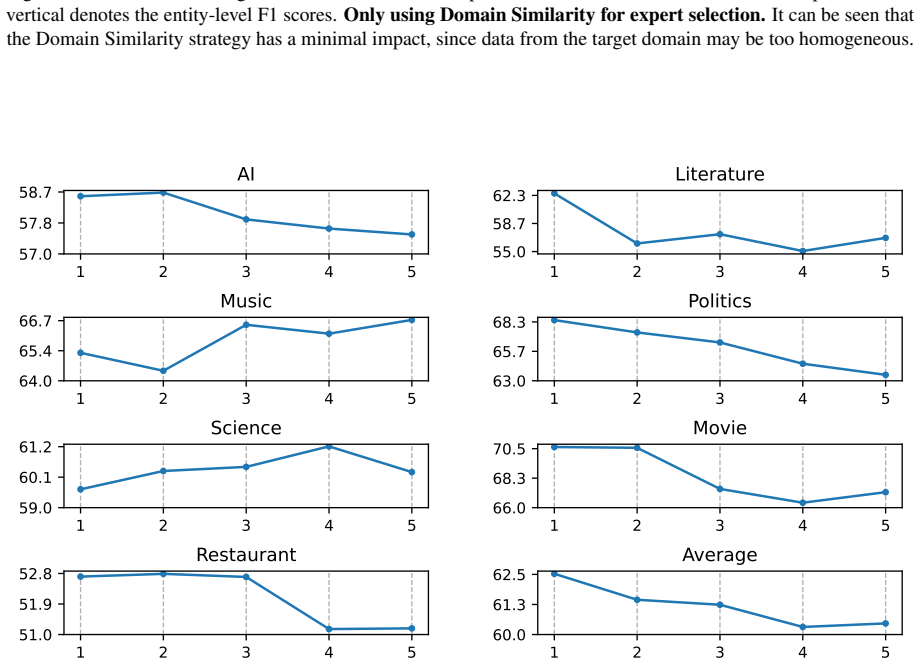
- [§4.5, Figure 3; §4.2] The number of merged experts, m = 3, is fixed after inspecting the average F1 curves on the seven target test domains in Figure 3. This means the main results in Table 1 are partly selected on the test set, which is likely to inflate the reported gains. The authors should either fix m by a principled criterion before evaluation, use a held-out validation split for this choice, or report the full sensitivity curves with the selection protocol explicitly stated. Without this, the "approximately 10%" figure cannot be treated as an unbiased estimate of the framework's advantage.
- [§3.2, §4.7, Table 5] The zero-shot framing requires clarification: both selection strategies need unlabeled target-domain text (a few hundred sentences for the domain-similarity embedding and k = 10 sampled instances for sampling evaluation). The paper claims "zero-shot" only in the sense of no gold labels, but a practitioner with no target-domain text at all cannot apply either selection strategy. In addition, the sampling-evaluation path constructs pseudo-labels by majority voting over the same experts being ranked, making the selection signal partially self-referential, and no variance or significance estimates are reported for a procedure that depends on a random sample of k = 10 instances. The authors should state the target-text assumption explicitly and provide stability analysis, e.g., repeated sampling or a comparison of pseudo-label-based rankings with gold-label-based rankings on the sampled instances.
- [Table 2, §4.2] The main tables report single runs without error bars or significance tests. Given that the differences between some configurations in Table 2 (e.g., Llama w/o Sampling Evaluation 64.41 vs. w/o Selection 64.33) are small, and that the selection process includes random sampling, the claim that the framework "significantly outperforms" baselines needs at least run-to-run variance or a paired test over multiple random seeds.
minor comments (6)
- [§3.1] Typo: "Refering" should be "Referring."
- [§3.2, §4.5, §4.3] The symbol k is used inconsistently: Section 3.2 and the implementation description define k as the number of sampled target instances and set it to 10, while Section 4.5 uses k for the number of merged experts and Section 4.3 repeats this usage ("we fix the number of selected experts to k = 3"). Use m for the number of merged experts throughout.
- [Table 13] The caption reads "Our-of-domain performance" and should be "Out-of-domain performance."
- [Figures 3, 4, 9, 10, 11, 12] The captions inconsistently say "denotes as k" for the number of experts or splits; please unify the notation with the text (m for experts, and a distinct symbol for splits).
- [Appendix C, Table 14] The storage formula 1+0.02n and the "2x" inference cost for SaM are not derived in the table; a sentence explaining the 0.02 factor and the trade-off between SaM and SaMeco would help reproducibility.
- [§4.7, Table 5] The one-sample experiment is averaged over five trials, but the main results are not; stating whether the reported main results are single trials or averaged over multiple seeds would make the reliability of the numbers clearer.
Circularity Check
No significant circularity: the reported F1 gains are measured on held-out gold labels, and the selection mechanisms do not by construction determine those numbers.
full rationale
The paper's central claim is empirical: SaM outperforms a fully trained unified model by about 10% average F1 on CrossNER/MIT target domains. These F1 scores are computed against held-out gold labels that are not used by either selection strategy, so the result is not forced by construction. Domain-similarity selection uses unlabeled target-domain text and an external text encoder, and sampling evaluation selects experts using pseudo-labels formed by majority voting over the same experts; although the pseudo-label scoring is self-referential as a heuristic, it does not by construction determine the final gold-label F1, so it is not a derivation-equivalence circularity. The paper explicitly discloses that its training configuration is not optimal for the fully trained baseline, which is a baseline-strength concern rather than a circular derivation. The choice m=3 is made by inspecting target-domain performance in Section 4.5, which is a test-set hyperparameter selection issue, not a case where a fitted parameter is renamed as a prediction. Self-citations in the related work are contextual and are not load-bearing for the framework's claims. Overall, the derivation chain is self-contained with respect to the reported evaluation.
Assumptions & free parameters
free parameters (3)
- m (number of selected experts for merging) =
3
- k (number of sampled target instances) =
10
- Data augmentation mix (70% source/entity descriptions, 30% label drop, 5% label masking) =
70/30/5
assumptions (4)
- domain assumption Centroid of text embeddings is a valid proxy for NER domain similarity
- domain assumption Majority-vote pseudo-labels are a reliable oracle for expert selection
- domain assumption Task-vector arithmetic preserves expert capabilities after merging
- domain assumption Unlabeled target-domain text is available at inference
Cite this review
Pith. "Pith review of Selecting and Merging: Towards Adaptable and Scalable Named Entity Recognition with Large Language Models." pith.science (2026). https://pith.science/paper/4Z6IDRN2
@misc{pith2026250622813,
  author       = {Pith},
  title        = {Pith review of: Selecting and Merging: Towards Adaptable and Scalable Named Entity Recognition with Large Language Models},
  year         = {2026},
  howpublished = {\url{https://pith.science/paper/4Z6IDRN2}},
  note         = {Machine review of arXiv:2506.22813}
}
read the original abstract
Supervised fine-tuning (SFT) is widely used to align large language models (LLMs) with information extraction (IE) tasks, such as named entity recognition (NER). However, annotating such fine-grained labels and training domain-specific models is costly. Existing works typically train a unified model across multiple domains, but such approaches lack adaptation and scalability since not all training data benefits target domains and scaling trained models remains challenging. We propose the SaM framework, which dynamically Selects and Merges expert models at inference time. Specifically, for a target domain, we select domain-specific experts pre-trained on existing domains based on (i) domain similarity to the target domain and (ii) performance on sampled instances, respectively. The experts are then merged to create task-specific models optimized for the target domain. By dynamically merging experts beneficial to target domains, we improve generalization across various domains without extra training. Additionally, experts can be added or removed conveniently, leading to great scalability. Extensive experiments on multiple benchmarks demonstrate our framework's effectiveness, which outperforms the unified model by an average of 10%. We further provide insights into potential improvements, practical experience, and extensions of our framework.
Figures


Figures from the paper (9 more)


Reference graph
Works this paper leans on
-
[1]
online" 'onlinestring :=
ENTRY address archivePrefix author booktitle chapter edition editor eid eprint eprinttype howpublished institution journal key month note number organization pages publisher school series title type volume year doi pubmed url lastchecked label extra.label sort.label short.list INTEGERS output.state before.all mid.sentence after.sentence after.block STRING...
-
[2]
write newline
" write newline "" before.all 'output.state := FUNCTION n.dashify 't := "" t empty not t #1 #1 substring "-" = t #1 #2 substring "--" = not "--" * t #2 global.max substring 't := t #1 #1 substring "-" = "-" * t #2 global.max substring 't := while if t #1 #1 substring * t #2 global.max substring 't := if while FUNCTION word.in bbl.in capitalize " " * FUNCT...
-
[3]
Josh Achiam, Steven Adler, Sandhini Agarwal, Lama Ahmad, Ilge Akkaya, Florencia Leoni Aleman, Diogo Almeida, Janko Altenschmidt, Sam Altman, Shyamal Anadkat, et al. 2023. Gpt-4 technical report. arXiv preprint arXiv:2303.08774
arXiv 2023
-
[4]
Ting Wai Terence Au, Vasileios Lampos, and Ingemar Cox. 2022. E-ner—an annotated named entity recognition corpus of legal text. In Proceedings of the Natural Legal Language Processing Workshop 2022, pages 246--255
work page 2022
-
[5]
Pei Chen, Haotian Xu, Cheng Zhang, and Ruihong Huang. 2022. Crossroads, buildings and neighborhoods: A dataset for fine-grained location recognition. In Proceedings of the 2022 conference of the North American chapter of the association for computational linguistics: human language technologies, pages 3329--3339
work page 2022
-
[6]
Nigel Collier, Tomoko Ohta, Yoshimasa Tsuruoka, Yuka Tateisi, and Jin-Dong Kim. 2004. Introduction to the bio-entity recognition task at jnlpba. In Proceedings of the International Joint Workshop on Natural Language Processing in Biomedicine and its Applications (NLPBA/BioNLP), pages 73--78
work page 2004
-
[7]
Leon Derczynski, Kalina Bontcheva, and Ian Roberts. 2016. Broad twitter corpus: A diverse named entity recognition resource. In Proceedings of COLING 2016, the 26th International Conference on Computational Linguistics: Technical Papers, pages 1169--1179
work page 2016
-
[8]
Leon Derczynski, Eric Nichols, Marieke Van Erp, and Nut Limsopatham. 2017. Results of the wnut2017 shared task on novel and emerging entity recognition. In Proceedings of the 3rd Workshop on Noisy User-generated Text, pages 140--147
work page 2017
Show all 56 references
-
[9]
Yuyang Ding, Juntao Li, Pinzheng Wang, Zecheng Tang, Yan Bowen, and Min Zhang. 2024 a . Rethinking negative instances for generative named entity recognition. In Findings of the Association for Computational Linguistics: ACL 2024, pages 3461--3475
2024
-
[10]
Zhuojun Ding, Wei Wei, Xiaoye Qu, and Dangyang Chen. 2024 b . Improving pseudo labels with global-local denoising framework for cross-lingual named entity recognition. In Proceedings of the Thirty-Third International Joint Conference on Artificial Intelligence, pages 6252--6260
2024
-
[11]
Rezarta Islamaj Do g an, Robert Leaman, and Zhiyong Lu. 2014. Ncbi disease corpus: a resource for disease name recognition and concept normalization. Journal of biomedical informatics, 47:1--10
2014
-
[12]
Chenghao Fan, Zhenyi Lu, Sichen Liu, Xiaoye Qu, Wei Wei, Chengfeng Gu, and Yu Cheng. 2025. Make lora great again: Boosting lora with adaptive singular values and mixture-of-experts optimization alignment
2025
-
[13]
Chenghao Fan, Zhenyi Lu, Wei Wei, Jie Tian, Xiaoye Qu, Dangyang Chen, and Yu Cheng. 2024 a . On giant's shoulders: Effortless weak to strong by dynamic logits fusion. In The Thirty-eighth Annual Conference on Neural Information Processing Systems
2024
-
[14]
Chenghao Fan, Wei Wei, Xiaoye Qu, Zhenyi Lu, Wenfeng Xie, Yu Cheng, and Dangyang Chen. 2024 b . Enhancing low-resource relation representations through multi-view decoupling. Proceedings of the AAAI Conference on Artificial Intelligence, 38:17968--17976
2024
-
[15]
Runwei Guan, Ka Lok Man, Feifan Chen, Shanliang Yao, Rongsheng Hu, Xiaohui Zhu, Jeremy Smith, Eng Gee Lim, and Yutao Yue. 2024. Findvehicle and vehiclefinder: a ner dataset for natural language-based vehicle retrieval and a keyword-based cross-modal vehicle retrieval system. M...
2024
-
[16]
Daya Guo, Dejian Yang, Haowei Zhang, Junxiao Song, Ruoyu Zhang, Runxin Xu, Qihao Zhu, Shirong Ma, Peiyi Wang, Xiao Bi, et al. 2025 a . Deepseek-r1: Incentivizing reasoning capability in llms via reinforcement learning. arXiv preprint arXiv:2501.12948
2025 arXiv
-
[17]
Quanjiang Guo, Yihong Dong, Ling Tian, Zhao Kang, Yu Zhang, and Sijie Wang. 2025 b . Baner: Boundary-aware llms for few-shot named entity recognition. In Proceedings of the 31st International Conference on Computational Linguistics, pages 10375--10389
2025
-
[18]
Edward J Hu, Phillip Wallis, Zeyuan Allen-Zhu, Yuanzhi Li, Shean Wang, Lu Wang, Weizhu Chen, et al. 2022. Lora: Low-rank adaptation of large language models. In International Conference on Learning Representations
2022
-
[19]
Gabriel Ilharco, Marco Tulio Ribeiro, Mitchell Wortsman, Ludwig Schmidt, Hannaneh Hajishirzi, and Ali Farhadi. 2023. Editing models with task arithmetic. In The Eleventh International Conference on Learning Representations
2023
-
[20]
Xisen Jin, Xiang Ren, Daniel Preotiuc-Pietro, and Pengxiang Cheng. 2023. Dataless knowledge fusion by merging weights of language models. In The Eleventh International Conference on Learning Representations
2023
-
[21]
Martin Krallinger, Obdulia Rabal, Florian Leitner, Miguel Vazquez, David Salgado, Zhiyong Lu, Robert Leaman, Yanan Lu, Donghong Ji, Daniel M Lowe, et al. 2015. The chemdner corpus of chemicals and drugs and its annotation principles. Journal of cheminformatics, 7:1--17
2015
-
[22]
Aman Kumar and Binil Starly. 2022. “fabner”: information extraction from manufacturing process science domain literature using named entity recognition. Journal of Intelligent Manufacturing, 33(8):2393--2407
2022
-
[23]
Jiao Li, Yueping Sun, Robin J Johnson, Daniela Sciaky, Chih-Hsuan Wei, Robert Leaman, Allan Peter Davis, Carolyn J Mattingly, Thomas C Wiegers, and Zhiyong Lu. 2016. Biocreative v cdr task corpus: a resource for chemical disease relation extraction. Database, 2016
2016
-
[24]
Peng Li, Tianxiang Sun, Qiong Tang, Hang Yan, Yuanbin Wu, Xuan-Jing Huang, and Xipeng Qiu. 2023. Codeie: Large code generation models are better few-shot information extractors. In Proceedings of the 61st Annual Meeting of the Association for Computational Linguistics (Volume ...
2023
-
[25]
Zixuan Li, Yutao Zeng, Yuxin Zuo, Weicheng Ren, Wenxuan Liu, Miao Su, Yucan Guo, Yantao Liu, Lixiang Lixiang, Zhilei Hu, Long Bai, Wei Li, Yidan Liu, Pan Yang, Xiaolong Jin, Jiafeng Guo, and Xueqi Cheng. 2024. Know C oder: Coding structured knowledge into llms for universal in...
2024
-
[26]
Wei Liu, Weihao Zeng, Keqing He, Yong Jiang, and Junxian He. 2024. What makes good data for alignment? a comprehensive study of automatic data selection in instruction tuning. In The Twelfth International Conference on Learning Representations
2024
-
[27]
Zihan Liu, Yan Xu, Tiezheng Yu, Wenliang Dai, Ziwei Ji, Samuel Cahyawijaya, Andrea Madotto, and Pascale Fung. 2021. Crossner: Evaluating cross-domain named entity recognition. In Proceedings of the AAAI Conference on Artificial Intelligence, volume 35, pages 13452--13460
2021
-
[28]
Zhenyi Lu, Chenghao Fan, Wei Wei, Xiaoye Qu, Dangyang Chen, and Yu Cheng. 2024. Twin-merging: Dynamic integration of modular expertise in model merging. In The Thirty-eighth Annual Conference on Neural Information Processing Systems
2024
-
[29]
Michael S Matena and Colin Raffel. 2022. Merging models with fisher-weighted averaging. In Advances in Neural Information Processing Systems
2022
-
[30]
Alexis Mitchell, Stephanie Strassel, Shudong Huang, and Ramez Zakhary. 2005. Ace 2004 multilingual training corpus. LDC corpora
2005
-
[31]
Xiaoman Pan, Boliang Zhang, Jonathan May, Joel Nothman, Kevin Knight, and Heng Ji. 2017. Cross-lingual name tagging and linking for 282 languages. In Proceedings of the 55th annual meeting of the association for computational linguistics (volume 1: long papers), pages 1946--1958
2017
-
[32]
Chaoxu Pang, Yixuan Cao, Qiang Ding, and Ping Luo. 2023. Guideline learning for in-context information extraction. In Proceedings of the 2023 Conference on Empirical Methods in Natural Language Processing, pages 15372--15389
2023
-
[33]
Sameer Pradhan, Alessandro Moschitti, Nianwen Xue, Hwee Tou Ng, Anders Bj \"o rkelund, Olga Uryupina, Yuchen Zhang, and Zhi Zhong. 2013. Towards robust linguistic analysis using ontonotes. In Proceedings of the Seventeenth Conference on Computational Natural Language Learning,...
2013
-
[34]
Sampo Pyysalo and Sophia Ananiadou. 2014. Anatomical entity mention recognition at literature scale. Bioinformatics, 30(6):868--875
2014
-
[35]
Yunjia Qi, Hao Peng, Xiaozhi Wang, Bin Xu, Lei Hou, and Juanzi Li. 2024. Adelie: Aligning large language models on information extraction. In Proceedings of the 2024 Conference on Empirical Methods in Natural Language Processing, pages 7371--7387
2024
-
[36]
Rafael Rafailov, Archit Sharma, Eric Mitchell, Christopher D Manning, Stefano Ermon, and Chelsea Finn. 2024. Direct preference optimization: Your language model is secretly a reward model. Advances in Neural Information Processing Systems, 36
2024
-
[37]
Oscar Sainz, Iker Garc \' a-Ferrero, Rodrigo Agerri, Oier Lopez de Lacalle, German Rigau, and Eneko Agirre. 2024. Gollie: Annotation guidelines improve zero-shot information-extraction. In The Twelfth International Conference on Learning Representations
2024
-
[38]
Larry Smith, Lorraine K Tanabe, Rie Johnson nee Ando, Cheng-Ju Kuo, I-Fang Chung, Chun-Nan Hsu, Yu-Shi Lin, Roman Klinger, Christoph M Friedrich, Kuzman Ganchev, et al. 2008. Overview of biocreative ii gene mention recognition. Genome biology, 9:1--19
2008
-
[39]
Zeliang Tong, Zhuojun Ding, and Wei Wei. 2025. Evoprompt: Evolving prompts for enhanced zero-shot named entity recognition with large language models. In Proceedings of the 31st International Conference on Computational Linguistics, pages 5136--5153
2025
-
[40]
Asahi Ushio, Francesco Barbieri, Vitor Sousa, Leonardo Neves, and Jose Camacho-Collados. 2022. Named entity recognition in twitter: A dataset and analysis on short-term temporal shifts. In Proceedings of the 2nd Conference of the Asia-Pacific Chapter of the Association for Com...
2022
-
[41]
Asahi Ushio and Jose Camacho-Collados. 2021. T-ner: An all-round python library for transformer-based named entity recognition. In Proceedings of the 16th Conference of the European Chapter of the Association for Computational Linguistics: System Demonstrations, pages 53--62
2021
-
[42]
Christopher Walker, Stephanie Strassel, Julie Medero, and Kazuaki Maeda. 2006. Ace 2005 multilingual training corpus. LDC corpora
2006
-
[43]
Zhen Wan, Fei Cheng, Zhuoyuan Mao, Qianying Liu, Haiyue Song, Jiwei Li, and Sadao Kurohashi. 2023. Gpt-re: In-context learning for relation extraction using large language models. In Proceedings of the 2023 Conference on Empirical Methods in Natural Language Processing, pages ...
2023
-
[44]
Xiao Wang, Weikang Zhou, Can Zu, Han Xia, Tianze Chen, Yuansen Zhang, Rui Zheng, Junjie Ye, Qi Zhang, Tao Gui, et al. 2023 a . Instructuie: Multi-task instruction tuning for unified information extraction. arXiv preprint arXiv:2304.08085
2023 arXiv
-
[45]
Xuezhi Wang, Jason Wei, Dale Schuurmans, Quoc V Le, Ed H Chi, Sharan Narang, Aakanksha Chowdhery, and Denny Zhou. 2023 b . Self-consistency improves chain of thought reasoning in language models. In The Eleventh International Conference on Learning Representations
2023
-
[46]
Zihan Wang, Jingbo Shang, Liyuan Liu, Lihao Lu, Jiacheng Liu, and Jiawei Han. 2019. Crossweigh: Training named entity tagger from imperfect annotations. In Proceedings of the 2019 Conference on Empirical Methods in Natural Language Processing and the 9th International Joint Co...
2019
-
[47]
Tingyu Xie, Qi Li, Jian Zhang, Yan Zhang, Zuozhu Liu, and Hongwei Wang. 2023. Empirical study of zero-shot ner with chatgpt. In Proceedings of the 2023 Conference on Empirical Methods in Natural Language Processing, pages 7935--7956
2023
-
[48]
Tingyu Xie, Qi Li, Yan Zhang, Zuozhu Liu, and Hongwei Wang. 2024. Self-improving for zero-shot named entity recognition with large language models. In Proceedings of the 2024 Conference of the North American Chapter of the Association for Computational Linguistics: Human Langu...
2024
-
[49]
Derong Xu, Wei Chen, Wenjun Peng, Chao Zhang, Tong Xu, Xiangyu Zhao, Xian Wu, Yefeng Zheng, Yang Wang, and Enhong Chen. 2024. Large language models for generative information extraction: A survey. Frontiers of Computer Science, 18(6):186357
2024
-
[50]
Prateek Yadav, Derek Tam, Leshem Choshen, Colin Raffel, and Mohit Bansal. 2023. Ties-merging: Resolving interference when merging models. In Annual Conference on Neural Information Processing Systems
2023
-
[51]
An Yang, Baosong Yang, Beichen Zhang, Binyuan Hui, Bo Zheng, Bowen Yu, Chengyuan Li, Dayiheng Liu, Fei Huang, Haoran Wei, et al. 2024. Qwen2. 5 technical report. arXiv preprint arXiv:2412.15115
2024 arXiv
-
[52]
Yuming Yang, Wantong Zhao, Caishuang Huang, Junjie Ye, Xiao Wang, Huiyuan Zheng, Yang Nan, Yuran Wang, Xueying Xu, Kaixin Huang, Yunke Zhang, Tao Gui, Qi Zhang, and Xuanjing Huang. 2025. Beyond boundaries: Learning a universal entity taxonomy across datasets and languages for ...
2025
-
[53]
Le Yu, Bowen Yu, Haiyang Yu, Fei Huang, and Yongbin Li. 2024. Language models are super mario: Absorbing abilities from homologous models as a free lunch. In Forty-first International Conference on Machine Learning
2024
-
[54]
Urchade Zaratiana, Nadi Tomeh, Pierre Holat, and Thierry Charnois. 2024. Gliner: Generalist model for named entity recognition using bidirectional transformer. In Proceedings of the 2024 Conference of the North American Chapter of the Association for Computational Linguistics:...
2024
-
[55]
Chunting Zhou, Pengfei Liu, Puxin Xu, Srinivasan Iyer, Jiao Sun, Yuning Mao, Xuezhe Ma, Avia Efrat, Ping Yu, Lili Yu, et al. 2024 a . Lima: Less is more for alignment. Advances in Neural Information Processing Systems, 36
2024
-
[56]
Wenxuan Zhou, Sheng Zhang, Yu Gu, Muhao Chen, and Hoifung Poon. 2024 b . Universalner: Targeted distillation from large language models for open named entity recognition. In The Twelfth International Conference on Learning Representations
2024
Reviewed August 6, 2026 · model on record in the stance chip above.
Discussion (0). Continue with ORCID to comment.