REVIEW 3 major objections 7 minor 1 cited by
Global versus Local Discrimination of Locally Implementable Multipartite Unitaries
T0 review · 3 major / 7 minor · reviewed 2026-08-15 · deepseek-v4-flash
Pith's one-line read This paper establishes that for locally implementable bipartite unitaries, global and LOCC distinguishability can separate in both directions: some pairs are globally but not locally distinguishable, while other sets are locally but not…
desk verdict Real examples inside a nonstandard probe model, but the 'LOCC' label hides a load-bearing restriction that makes Theorem 2 false under the standard channel-discrimination convention. read the letter →
The pith
A machine-rendered reading of the paper's core claim, the machinery that carries it, and where it could break.
The reading
What carries the argument
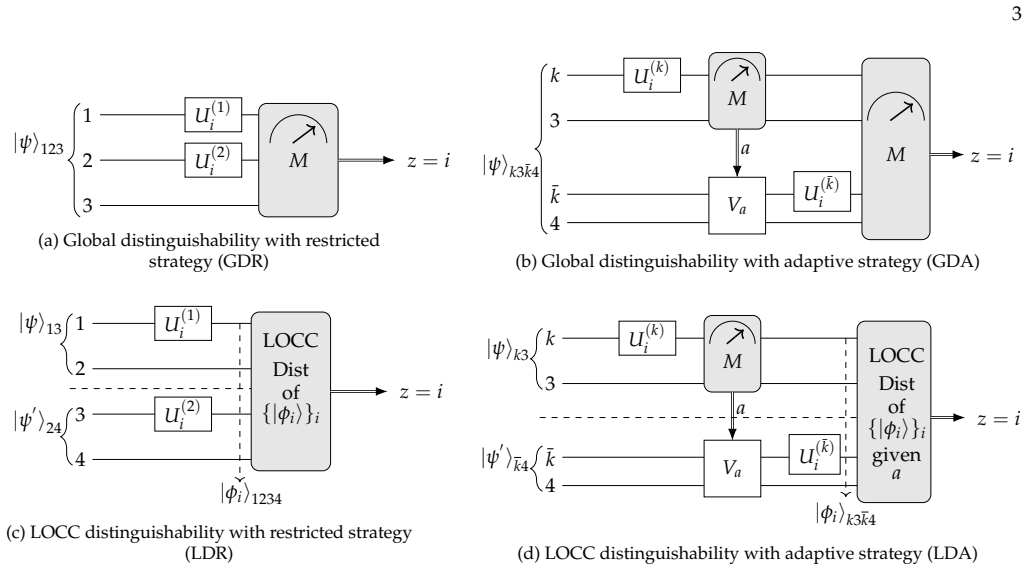
The carrying mechanism is a four-way classification of discrimination protocols (global restricted, global adaptive, LOCC restricted, LOCC adaptive), together with the standard criterion that two unitaries $U_1, U_2$ are perfectly distinguishable iff the convex hull of the eigenvalues of $U_1^\dagger U_2$ contains zero (the $\min|\mathrm{con}\{\cdot\}|$ condition). The proofs hinge on constructing unitary sets with engineered phase relations---e.g. $\alpha+\beta+\gamma+\delta = \pi$ for Theorem 2---so that a chosen probe (the Bell state $|\phi^+\rangle$) makes evolved states orthogonal while local probes can never achieve the eigenvalue-convex-hull condition. For Theorem 3, the asymmetry comes from the order of operation: Alice's initial qutrit measurement splits Bob's task into distinguishable pairs, whereas Bob's starting measurement cannot eliminate enough candidates.
What would settle it
For the qutrit set (3), numerically maximize over all four-qutrit probing states $|\psi\rangle$ the quantity $\min_{i\neq j} |\langle\psi| V_i^\dagger V_j \otimes 1 \otimes 1 |\psi\rangle|$; if any probe makes all pairs orthogonal, the claimed global restricted indistinguishability of Theorem 3 collapses.
Extended reading notes
Core claim
On the paper's own terms, the central discovery is a set of counterexamples to the intuition that global access is always at least as powerful as LOCC for telling apart unitary processes. Theorem 2 gives a pair of qubit unitaries of the form $U_1 = A_1\otimes R_1$, $U_2 = A_2\otimes R_2$ with phases satisfying $\alpha+\beta+\gamma+\delta = \pi$; these are globally distinguishable with a restricted strategy (using the shared Bell state $|\phi^+\rangle$ as probe, the evolved states are orthogonal) yet are not distinguishable under LOCC, even adaptively. Theorem 3 gives four qutrit unitaries $\{1_3\otimes 1_3, 1_3\otimes\Omega, \Omega\otimes 1_3, \Omega\otimes B\}$ that are LOCC-distinguishable when Alice starts adaptively but globally indistinguishable under any restricted strategy; moreover they are LOCC-indistinguishable if Bob starts (Proposition 1). Theorem 4 gives five qubit unitaries $\{1_2\otimes 1_2, Z\otimes X, X\otimes H, X\otimes \bar H, XZ\otimes H\}$ that are globally indistinguishable to every adaptive strategy using single-system separable probes yet LOCC-distinguishable when Alice and Bob share a Bell probe. The paper also proves Theorem 1: for bipartite qubit unitaries, adaptive and restricted LOCC strategies coincide for perfect distinguishability.
Load-bearing premise
The load-bearing assumption is that in every LOCC protocol each party independently prepares its own probe state locally, so the parties share no initial entanglement; if LOCC were allowed to begin with a shared entangled state such as $|\phi^+\rangle$, some of the claimed separations (in particular Theorem 2) would fail, since any two orthogonal pure states are LOCC-distinguishable.
Editorial extensions
If this is right
- For any bipartite qubit unitary set, an optimal perfect-distinguishing LOCC protocol can always be restricted (fixed probe): adaptivity buys nothing (Theorem 1).
- Global access is not strictly stronger than LOCC for unitary discrimination: the four-qutrit set (3) is LOCC-distinguishable but globally restricted-indistinguishable.
- LOCC is not always weaker either: the pairs in (2) are globally distinguishable but LOCC-indistinguishable even adaptively.
- Probe entanglement can activate LOCC distinguishability: the five-qubit set (4) fails under separable probes globally but succeeds via an entangled Bell probe under LOCC.
- The order in which LOCC parties act can matter: the set (3) is distinguishable if Alice starts but not if Bob does.
Reading between the lines
- A natural next step is a multipartite example separating global adaptive strategies from both global restricted and LOCC adaptive; the paper's Observation 2 already reduces the bipartite case to a dichotomy.
- These separations are sensitive to the probe-preparation model; allowing free pre-shared entanglement in LOCC may erase the Theorem 2-type gaps, so the boundary between 'LOCC with local probes' and 'LOCC with shared resources' deserves explicit treatment in future work.
- The asymmetry of Proposition 1 hints that 'who speaks first' is a structural resource for unitary discrimination, analogous to asymmetric state-discrimination scenarios; one could test whether similar starter-dependence appears in other channel discrimination tasks.
- The Theorem 4 result suggests a practical principle: when entanglement is cheap between parties but global access is unavailable, entanglement-assisted LOCC can outperform any separable-probe global strategy---an observation with potential relevance to distributed quantum certification.
Signed reviews
Editorial analysis
A structured set of objections, weighed in public.
Referee Report
Summary. The paper studies single-shot discrimination of locally implementable (product) multipartite unitaries, comparing global operations with LOCC and classifying strategies as restricted (fixed probing states) or adaptive (probing states chosen based on previous outcomes). The main results are: Theorem 1 (for bipartite qubit unitaries, adaptive and restricted LOCC are equivalent), Theorem 2 (a family of product qubit unitaries is globally distinguishable with restricted strategies but not LOCC-distinguishable), Theorem 3 (a set of four product qutrit unitaries is LOCC-distinguishable adaptively but globally indistinguishable with restricted strategies), Proposition 1 (asymmetry of LOCC distinguishability for the set in Theorem 3), and Theorem 4 (a set of five product qubit unitaries is globally indistinguishable with single-system probes but LOCC-distinguishable with an entangled probe). The proofs are mainly explicit constructions in the appendices, with orthogonality conditions checked directly, and the paper also proves structural equivalences among strategy classes.
Significance. If the results are read under a clearly and consistently stated probe model, the paper offers concrete examples of global/LOCC separations for locally implementable unitaries, a relatively underexplored question. The constructions in Appendices A and B are explicit and self-contained, and the paper usefully distinguishes restricted vs adaptive strategies. However, the significance is substantially undercut by the manuscript's inconsistent treatment of whether LOCC protocols may begin with an entangled probe shared across the parties: Theorem 2 is false under the standard convention allowing an arbitrary input probe, while Theorem 4's LOCC protocol uses exactly such a shared entangled probe. These issues must be resolved before the claimed separations can be accepted.
major comments (3)
- [Protocols for LOCC distinguishability; Theorem 2] The LOCC model defined in this section restricts each party to independently prepare its own probe state ρ_AkBk, so the collective input is a tensor product across the parties and no pre-shared entanglement is available. This restriction is not stated in the abstract, the introduction, or the theorem statements, which use the unqualified phrase 'under LOCC'. Under the standard channel-discrimination convention in which the input probe is part of the strategy and may be entangled across the parties, Theorem 2 is false: the shared Bell state |φ+> used in the GDR proof in Appendix A is an allowed input, and after applying U1 or U2 from (2) the output states are orthogonal, so they are perfectly distinguishable by LOCC. The claimed separation (i) therefore holds only for the paper's restricted probe model, and the paper must state this restriction in the abstract and in every theorem statement.
- [Theorem 4 and Appendix D] Theorem 4's LOCC protocol begins with the shared Bell state |φ+> as the initial probing state, which is not a product of independently prepared local states and is therefore not allowed by the LOCC model defined in the section 'Protocols for LOCC distinguishability'. Conversely, if the authors intend to allow entangled probes under LOCC, then Theorem 2's LOCC-indistinguishability claim fails. The manuscript therefore uses two incompatible notions of LOCC in Theorems 2 and 4. The authors should adopt one convention and revise the affected statements and proofs accordingly.
- [Appendix D, first paragraph] The proof that the unitaries in (4) are globally indistinguishable with single-system probes is not given in full. It asserts that the only triples Alice can eliminate are (X,X,XZ) and that all other listed triples are impossible, but no argument is provided to rule out other measurements on a single-qubit probe. Since this is the basis for the first half of Theorem 4, a complete proof is needed.
minor comments (7)
- [Abstract and Introduction] The phrases 'under LOCC' and 'indistinguishable under LOCC' should be qualified as 'LOCC with independently prepared (product) probes' once the model in Section 'Protocols for LOCC distinguishability' is adopted.
- [Observation 1, Eq. (1)] The ordering diagram GDR≤GDA≤≤LDR≤LDA is visually confusing; the intended nesting of the two chains (global vs LOCC) should be made explicit with labeled arrows or a clear sentence.
- [Appendix A] In the GDR proof, the phrase 'from (1)' is misleading; the distinguishability follows from orthogonality of the evolved states, not from the ordering diagram in Observation 1.
- [Appendix B] The notation '1(R1)+e^{i2π/3}(R2)+e^{i4π/3}(R3)' is hard to read; it should be written with explicit multiplication, e.g., R1 + e^{i2π/3}R2 + e^{i4π/3}R3. Also, 'Krauss operators' should be 'Kraus operators'.
- [Appendix D] The text lists Bob's distinguishable pairs as including '(H,H)', but from (4) the relevant pair is (H, \bar H); this appears to be a typo and should be corrected.
- [Theorem 1 proof] The proof relies on Theorem 4 of the authors' own preprint arXiv:2504.14499 as a black box; this dependency should be stated explicitly in the main text, and the status of that preprint should be clarified.
- [Appendix C] The see-saw SDP method is described in a single sentence; to make Proposition 1 verifiable, the authors should give the full SDP formulation or a reference that completely specifies the method.
Circularity Check
No circularity: central theorems are explicit constructions verified by direct orthogonality and enumeration; the sole self-citation is parameter-free and not derived from this paper's conclusions.
full rationale
The derivation chain is self-contained for the central claims. Theorems 2-4 are explicit constructions: the proofs check orthogonality of evolved probe states (Appendix A), show that no restricted probe can make all required pairs orthogonal (Appendix B), and enumerate the possible eliminating measurements for single-system probes (Appendix D). These are direct computations, not fitted parameters disguised as predictions. The only backward reference is in Theorem 1, whose proof invokes Theorem 4 of the same authors' arXiv:2504.14499; that cited theorem is a parameter-free statement about qubit unitary discrimination with maximally entangled probes and does not assume the current paper's conclusions, so under the review rules it is independent support and not circular. The LOCC protocol definitions explicitly restrict each party to preparing its own probe state; this is a modeling convention stated in the 'Protocols for LOCC distinguishability' section. Whether the abstract's unqualified 'LOCC' should carry that caveat is a scope or correctness question, not a circularity: the theorem proofs use the stated definition rather than smuggling the conclusion into the premise. Appendix C's SDP ('see-saw') finding that S_max^Q < 1 is a numerical claim that would need independent verification, but lack of verification is not circular dependence.
Assumptions & free parameters
free parameters (1)
- phases α, β, γ, δ in Theorem 2 unitaries =
not fitted; any values with α,β,γ,δ < π/2 and α+β+γ+δ=π
assumptions (5)
- standard math Two unitaries U1,U2 are distinguishable iff 0 is in the convex hull of eigenvalues of U1†U2.
- domain assumption Theorem 4 of [28] (same authors, arXiv:2504.14499): if a set of qubit unitaries is distinguishable, then any common maximally entangled probe distinguishes them.
- ad hoc to paper Observation 2: For bipartite unitaries, GDA is equivalent to either GDR or LDA.
- ad hoc to paper Observation 1: The strategy ordering GDR ≤ GDA, LDR ≤ LDA, with the given inclusions between global and LOCC classes.
- ad hoc to paper The see-saw SDP hierarchy in Appendix C correctly decides non-existence of a discriminating measurement.
Cite this review
Pith. "Pith review of Global versus Local Discrimination of Locally Implementable Multipartite Unitaries." pith.science (2026). https://pith.science/paper/4ZJVPKNL
@misc{pith2026250910430,
  author       = {Pith},
  title        = {Pith review of: Global versus Local Discrimination of Locally Implementable Multipartite Unitaries},
  year         = {2026},
  howpublished = {\url{https://pith.science/paper/4ZJVPKNL}},
  note         = {Machine review of arXiv:2509.10430}
}
read the original abstract
We study single-shot distinguishability of locally implementable multipartite unitaries under Local Operations and Classical Communication (LOCC) and global operations. As unitary discrimination depends on both the choice of probing states and the measurements on the evolved states, we classify LOCC and global distinguishability into two categories: adaptive strategies, where probing states are chosen based on measurement outcomes from other subsystems, and restricted strategies, where probing states remain fixed. Our findings uncover three surprising features in the bipartite setting and establish new structural limits for unitary discrimination: (i) Certain pairs of unitaries are globally distinguishable with restricted strategies but indistinguishable under LOCC, even with adaptive strategies. (ii) There exist sets of four unitaries that are distinguishable via LOCC, yet remain globally indistinguishable with restricted strategies. (iii) Some sets of unitaries are globally indistinguishable under adaptive strategies, when probed with separable states, but become distinguishable via LOCC.
Figures
Forward citations
Cited by 1 Pith paper
-
Nonlocality without entanglement in exclusion of quantum states
Three bipartite product states are globally antidistinguishable yet not LOCC antidistinguishable under the paper's restricted one-pass LOCC model, giving a claimed minimal example of exclusion-based nonlocality.
Reference graph
Works this paper leans on
-
[1]
Quantum nonlocality without entanglement,
Charles H. Bennett, David P . DiVincenzo, Christopher A. Fuchs, Tal Mor, Eric Rains, Peter W. Shor, John A. Smolin, and William K. Wootters, “Quantum nonlocality without entanglement,” Phys. Rev. A59, 1070–1091 (1999)
1999
-
[2]
Local distinguishability of multipartite orthogonal quantum states,
Jonathan Walgate, Anthony J. Short, Lucien Hardy, and Vlatko Vedral, “Local distinguishability of multipartite orthogonal quantum states,” Phys. Rev. Lett.85, 4972– 4975 (2000)
2000
-
[3]
Nonlocality, asym- metry, and distinguishing bipartite states,
Jonathan Walgate and Lucien Hardy, “Nonlocality, asym- metry, and distinguishing bipartite states,” Phys. Rev. Lett.89, 147901 (2002)
2002
-
[4]
Distinguishing bipartitite orthogo- nal states using locc: Best and worst cases,
Michael Nathanson, “Distinguishing bipartitite orthogo- nal states using locc: Best and worst cases,” Journal of Mathematical Physics46(2005)
work page 2005
-
[5]
Locc distinguishability of unilaterally transformable quantum states,
Somshubhro Bandyopadhyay, Sibasish Ghosh, and Gu- ruprasad Kar, “Locc distinguishability of unilaterally transformable quantum states,” New Journal of Physics 13, 123013 (2011)
work page 2011
-
[6]
Nonlocality without entanglement: Quantum theory and beyond,
Some Sankar Bhattacharya, Sutapa Saha, Tamal Guha, and Manik Banik, “Nonlocality without entanglement: Quantum theory and beyond,” Phys. Rev. Res.2, 012068 (2020)
2020
-
[7]
Strong quantum nonlo- cality without entanglement,
Saronath Halder, Manik Banik, Sristy Agrawal, and Somshubhro Bandyopadhyay, “Strong quantum nonlo- cality without entanglement,” Phys. Rev. Lett.122, 040403 (2019)
2019
-
[8]
Local distinguishability with preserva- tion of entanglement,
Scott M. Cohen, “Local distinguishability with preserva- tion of entanglement,” Phys. Rev. A75, 052313 (2007)
work page 2007
Show all 39 references
-
[9]
Entanglement, mixed- ness, and perfect local discrimination of orthogonal quan- tum states,
Somshubhro Bandyopadhyay, “Entanglement, mixed- ness, and perfect local discrimination of orthogonal quan- tum states,” Phys. Rev. A85, 042319 (2012)
2012
-
[10]
Activating strong nonlocality from lo- cal sets: An elimination paradigm,
Subhendu B. Ghosh, Tathagata Gupta, Ardra A. V ., Anan- damay Das Bhowmik, Sutapa Saha, Tamal Guha, and Amit Mukherjee, “Activating strong nonlocality from lo- cal sets: An elimination paradigm,” Phys. Rev. A106, L010202 (2022)
2022
-
[11]
Non- locality without entanglement in general multipartite quantum systems,
Xiao-Fan Zhen, Shao-Ming Fei, and Hui-Juan Zuo, “Non- locality without entanglement in general multipartite quantum systems,” Phys. Rev. A106, 062432 (2022)
2022
-
[12]
Self-testing nonlocality without entanglement,
Ivan ˇSupi´c and Nicolas Brunner, “Self-testing nonlocality without entanglement,” Phys. Rev. A107, 062220 (2023)
2023
-
[13]
Quantum non- locality without entanglement: explicit dependence on prior probabilities of nonorthogonal mirror-symmetric states,
Donghoon Ha and Younghun Kwon, “Quantum non- locality without entanglement: explicit dependence on prior probabilities of nonorthogonal mirror-symmetric states,” npj Quantum Information7, 81 (2021)
2021
-
[14]
Strong quantum nonlocality and unextendibility without entanglement in N-partite systems with oddN,
Yiyun He, Fei Shi, and Xiande Zhang, “Strong quantum nonlocality and unextendibility without entanglement in N-partite systems with oddN,” Quantum8, 1349 (2024)
2024
-
[15]
Multipartite nonlocality with- out entanglement in many dimensions,
J. Niset and N. J. Cerf, “Multipartite nonlocality with- out entanglement in many dimensions,” Phys. Rev. A74, 052103 (2006)
2006
-
[16]
Bounds on multipartite entangled orthogo- nal state discrimination using local operations and classi- cal communication,
M. Hayashi, D. Markham, M. Murao, M. Owari, and S. Virmani, “Bounds on multipartite entangled orthogo- nal state discrimination using local operations and classi- cal communication,” Phys. Rev. Lett.96, 040501 (2006)
2006
-
[17]
Bipartite subspaces having no bases dis- tinguishable by local operations and classical communi- cation,
John Watrous, “Bipartite subspaces having no bases dis- tinguishable by local operations and classical communi- cation,” Phys. Rev. Lett.95, 080505 (2005)
2005
-
[18]
Local indistinguishability: More nonlocal- ity with less entanglement,
Michał Horodecki, Aditi Sen(De), Ujjwal Sen, and Karol Horodecki, “Local indistinguishability: More nonlocal- ity with less entanglement,” Phys. Rev. Lett.90, 047902 (2003)
2003
-
[19]
Quantum computations: algorithms and er- ror correction,
A Yu Kitaev, “Quantum computations: algorithms and er- ror correction,” Russian Mathematical Surveys52, 1191 (1997)
1997
-
[20]
All entangled states are useful for channel discrimination,
Marco Piani and John Watrous, “All entangled states are useful for channel discrimination,” Phys. Rev. Lett.102, 250501 (2009)
2009
-
[21]
Using entanglement improves the precision of quantum measurements,
G. Mauro D’Ariano, Paoloplacido Lo Presti, and Matteo G. A. Paris, “Using entanglement improves the precision of quantum measurements,” Phys. Rev. Lett.87, 270404 (2001)
2001
-
[22]
Optimal discrimination of quan- tum operations,
Massimiliano F. Sacchi, “Optimal discrimination of quan- tum operations,” Phys. Rev. A71, 062340 (2005)
2005
-
[23]
Adaptive versus nonadaptive strate- gies for quantum channel discrimination,
Aram W. Harrow, Avinatan Hassidim, Debbie W. Leung, and John Watrous, “Adaptive versus nonadaptive strate- gies for quantum channel discrimination,” Phys. Rev. A 81, 032339 (2010)
2010
-
[24]
Entanglement in channel discrimination with restricted measurements,
William Matthews, Marco Piani, and John Watrous, “Entanglement in channel discrimination with restricted measurements,” Phys. Rev. A82, 032302 (2010)
2010
-
[25]
Distinguishing quantum operations hav- ing few kraus operators,
John Watrous, “Distinguishing quantum operations hav- ing few kraus operators,” (2008), arXiv:0710.0902 [quant- ph]
2008 arXiv
-
[26]
Single-shot distinguisha- 6 bility and antidistinguishability of quantum measure- ments,
Satyaki Manna, Sneha Suresh, Manan Singh Kach- hawaha, and Debashis Saha, “Single-shot distinguisha- 6 bility and antidistinguishability of quantum measure- ments,” Phys. Rev. A111, 022221 (2025)
2025
-
[27]
Improved discrimination of unitary transfor- mations by entangled probes,
G Mauro D’Ariano, Paoloplacido Lo Presti, and Matteo G A Paris, “Improved discrimination of unitary transfor- mations by entangled probes,” Journal of Optics B: Quan- tum and Semiclassical Optics4, S273 (2002)
2002
-
[28]
Maximally entangled states are not always useful for single shot distinguishability of unitaries,
Satyaki Manna, Anandamay Das Bhowmik, and De- bashis Saha, “Maximally entangled states are not always useful for single shot distinguishability of unitaries,” (2025), arXiv:2504.14499 [quant-ph]
2025 arXiv
-
[29]
Statistical distinguishability between unitary operations,
A. Ac ´ın, “Statistical distinguishability between unitary operations,” Phys. Rev. Lett.87, 177901 (2001)
2001
-
[30]
Optimal estimation of quantum dynamics,
A. Ac ´ın, E. Jan ´e, and G. Vidal, “Optimal estimation of quantum dynamics,” Phys. Rev. A64, 050302 (2001)
2001
-
[31]
Per- fect distinguishability of quantum operations,
Runyao Duan, Yuan Feng, and Mingsheng Ying, “Per- fect distinguishability of quantum operations,” Phys. Rev. Lett.103, 210501 (2009)
2009
-
[32]
Entan- glement is not necessary for perfect discrimination be- tween unitary operations,
Runyao Duan, Yuan Feng, and Mingsheng Ying, “Entan- glement is not necessary for perfect discrimination be- tween unitary operations,” Phys. Rev. Lett.98, 100503 (2007)
2007
-
[33]
Lo- cal distinguishability of multipartite unitary operations,
Runyao Duan, Yuan Feng, and Mingsheng Ying, “Lo- cal distinguishability of multipartite unitary operations,” Phys. Rev. Lett.100, 020503 (2008)
2008
-
[34]
Single-shot discrimination of quantum unitary processes,
M ´ario Ziman and Michal Sedl ´ak, “Single-shot discrimination of quantum unitary processes,” Journal of Modern Optics57, 253–259 (2010), https://doi.org/10.1080/09500340903349963
2010 doi
-
[35]
Perfect discrimination of quantum measurements using entangled systems,
Chandan Datta, Tanmoy Biswas, Debashis Saha, and Remigiusz Augusiak, “Perfect discrimination of quantum measurements using entangled systems,” New Journal of Physics23, 043021 (2021)
2021
-
[36]
General approach to quantum channel impossibility by local operations and classical communi- cation,
Scott M. Cohen, “General approach to quantum channel impossibility by local operations and classical communi- cation,” Phys. Rev. Lett.118, 020501 (2017)
2017
-
[37]
Distinguishability and indistinguishability by local operations and classical communication,
Heng Fan, “Distinguishability and indistinguishability by local operations and classical communication,” Phys. Rev. Lett.92, 177905 (2004)
2004
-
[38]
Everything you always wanted to know about locc (but were afraid to ask),
Eric Chitambar, Debbie Leung, Laura Man ˇcinska, Maris Ozols, and Andreas Winter, “Everything you always wanted to know about locc (but were afraid to ask),” Communications in Mathematical Physics (2014)
2014
-
[39]
Activating strong nonlocality from lo- cal sets: An elimination paradigm,
Subhendu B. Ghosh, Tathagata Gupta, Ardra A. V ., Anan- damay Das Bhowmik, Sutapa Saha, Tamal Guha, and Amit Mukherjee, “Activating strong nonlocality from lo- cal sets: An elimination paradigm,” Phys. Rev. A106, L010202 (2022). Appendix A: Proof of theorem 2 For GDR, Alice an...
2022
Reviewed August 15, 2026 · model on record in the stance chip above.
Discussion (0). Continue with ORCID to comment.