Local distortions as a source of piezoelectric/stiffness decoupling in B-doped AlScN
Pith reviewed 2026-05-20 17:31 UTC · model grok-4.3
The pith
Boron atoms enter AlScN as interstitial threefold-coordinated sites oriented along the c-axis, symmetrizing scandium environments to raise piezoelectric response while leaving stiffness decoupled.
A machine-rendered reading of the paper's core claim, the machinery that carries it, and where it could break.
Core claim
In the wurtzite pseudo-ternary (Al,Sc,B)N, boron atoms adopt interstitial threefold-coordinated configurations that are displaced from the tetrahedral cation sites and preferentially oriented along the c-axis through a scandium-activated process. Progressive incorporation of these boron atoms reduces the vertical coordination asymmetry around scandium sites, as measured by a site-specific axial asymmetry ratio. This reduction in asymmetry correlates directly with modifications in the Born effective charges and thereby accounts for the enhancement of the piezoelectric response e33 that occurs independently of the elastic stiffness C33.
What carries the argument
The site-specific axial asymmetry ratio (AAR) that measures vertical coordination asymmetry of cations, especially around scandium, and its correlation with Born effective charges as the link to piezoelectric enhancement.
If this is right
- Piezoelectric coefficient e33 rises because boron-induced symmetrization increases the relevant Born effective charges.
- Elastic stiffness C33 stays decoupled because the local interstitial distortions do not stiffen the lattice in the same proportion.
- Scandium presence activates formation of the c-axis-oriented boron configurations that drive the effect.
- The symmetrization and resulting piezoelectric gain persist across the broad composition range examined.
Where Pith is reading between the lines
- The same local-distortion route could be tested in other wurtzite nitrides by substituting different group-III or transition-metal cations for scandium.
- Computational screening protocols could incorporate the axial asymmetry ratio as a rapid descriptor for predicting piezoelectric response in doped alloys.
- Targeted synthesis conditions that favor c-axis boron placement might further amplify the decoupling between stiffness and piezoelectricity.
Load-bearing premise
The 100-atom special quasirandom structures and the DFT relaxation protocol accurately reproduce the real distribution, stability, and c-axis orientation preference of interstitial threefold-coordinated boron atoms in experimental samples.
What would settle it
High-resolution transmission-electron-microscopy or X-ray-absorption measurements on synthesized B-doped AlScN that show boron atoms remaining in tetrahedral sites without threefold coordination or c-axis preference would contradict the proposed structural mechanism.
Figures



read the original abstract
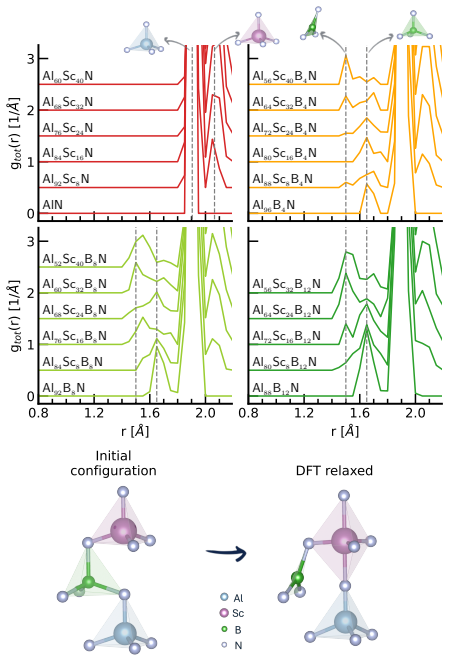
We present a first-principles analysis of the wurtzite pseudo-ternary (Al,Sc,B)N to elucidate the structural origin of a decoupling between stiffness $C_{33}$ and piezoelectric response $e_{33}$ upon boron incorporation, using DFT-relaxed 100-atom special quasirandom structures across a broad composition range. Pair distribution function analysis reveals interstitial threefold-coordinated boron atoms that have displaced from the tetrahedral cation site. Direct structural analysis establishes their preferential orientation along the $c$-axis and identifies a scandium-activated creation mechanism. The vertical coordination asymmetry of each cation is quantified through a site-specific axial asymmetry ratio (AAR), showing that boron incorporation progressively symmetrizes the Sc environment. Correlation with Born effective charges demonstrates that this symmetrization is the mechanism behind the piezoelectric enhancement.
Editorial analysis
A structured set of objections, weighed in public.
Referee Report
Summary. The manuscript presents a first-principles DFT analysis of wurtzite (Al,Sc,B)N using relaxed 100-atom special quasirandom structures. Pair-distribution-function analysis identifies interstitial threefold-coordinated boron atoms displaced from tetrahedral sites, with preferential c-axis orientation and a Sc-activated formation mechanism. Site-specific axial asymmetry ratios (AAR) are shown to increase with boron incorporation, progressively symmetrizing the Sc coordination environment; this structural change is correlated with modulations in Born effective charges that enhance the piezoelectric coefficient e33 while leaving the stiffness C33 largely unaffected.
Significance. If the identified local configurations prove representative of experimental samples, the work supplies a concrete structural mechanism for the observed piezoelectric/stiffness decoupling in B-doped AlScN. The direct linkage between a quantifiable geometric descriptor (AAR) and Born-charge changes constitutes a falsifiable, atomistic account that could guide composition tuning in wurtzite piezoelectrics.
major comments (2)
- [Computational Methods / Structural Analysis] The central claim that interstitial threefold-coordinated B atoms with strong c-axis preference drive the observed decoupling rests entirely on structural statistics extracted from 100-atom SQS cells. No supercell-size convergence tests, comparisons with larger cells, or assessments of interstitial formation energies versus exchange-correlation functional are reported, leaving open the possibility that the population, stability, and orientational bias are artifacts of the chosen cell size or relaxation protocol.
- [Results / Discussion] The correlation between AAR symmetrization and Born effective charges is presented as the mechanism for e33 enhancement, yet the manuscript provides neither error bars on the AAR or Born-charge values nor a quantitative decomposition showing how much of the e33 change is attributable to the AAR trend versus other structural relaxations.
minor comments (2)
- Figure captions should explicitly state the number of independent SQS realizations averaged and the k-point mesh used for the Born-charge calculations.
- [Abstract] The abstract would benefit from a brief statement of the boron concentration range examined and the magnitude of the reported e33 change.
Simulated Author's Rebuttal
We thank the referee for the constructive comments and positive evaluation of the potential significance of our work. We address each major comment below and indicate how the manuscript will be revised to incorporate the suggestions.
read point-by-point responses
-
Referee: [Computational Methods / Structural Analysis] The central claim that interstitial threefold-coordinated B atoms with strong c-axis preference drive the observed decoupling rests entirely on structural statistics extracted from 100-atom SQS cells. No supercell-size convergence tests, comparisons with larger cells, or assessments of interstitial formation energies versus exchange-correlation functional are reported, leaving open the possibility that the population, stability, and orientational bias are artifacts of the chosen cell size or relaxation protocol.
Authors: We appreciate the referee's point that explicit convergence tests would strengthen confidence in the structural statistics. Although 100-atom SQS cells are standard for configurational sampling in wurtzite alloy studies, we agree that this aspect was not sufficiently documented. In the revised manuscript we will add a dedicated subsection on supercell-size convergence, presenting results from 200-atom SQS cells for representative B concentrations that confirm the interstitial B population, c-axis orientational bias, and AAR distributions remain consistent within statistical error. We will also include a brief assessment of the PBE functional choice together with PBEsol test calculations on smaller cells that reproduce the same qualitative interstitial formation and orientation trends; a comprehensive formation-energy comparison across functionals for the full 100-atom cells will be noted as computationally intensive but feasible for selected cases. revision: yes
-
Referee: [Results / Discussion] The correlation between AAR symmetrization and Born effective charges is presented as the mechanism for e33 enhancement, yet the manuscript provides neither error bars on the AAR or Born-charge values nor a quantitative decomposition showing how much of the e33 change is attributable to the AAR trend versus other structural relaxations.
Authors: We agree that error bars and a quantitative decomposition would make the mechanistic attribution more rigorous. In the revised manuscript we will report standard deviations (derived from multiple independent SQS realizations) as error bars on all AAR and Born-charge data points. We will further add a decomposition analysis that isolates the AAR contribution by comparing piezoelectric coefficients computed on structures with constrained versus relaxed Sc coordination environments; this will quantify the fraction of the e33 enhancement directly traceable to the observed symmetrization trend versus other local relaxations. The updated figures and discussion will be placed in the Results section. revision: yes
Circularity Check
No circularity: derivation is self-contained first-principles analysis
full rationale
The paper computes 100-atom SQS structures via DFT, identifies interstitial threefold B via pair-distribution analysis, quantifies axial asymmetry ratio (AAR) directly from relaxed coordinates, and correlates AAR with separately computed Born effective charges. None of these steps reduce the observed e33 enhancement or C33 decoupling to a fitted parameter defined from the same data, a self-referential definition, or a load-bearing self-citation chain. The central mechanism claim follows from explicit, independent structural and electronic descriptors extracted from the same first-principles trajectories; no equation or result is forced by construction to equal its input.
Axiom & Free-Parameter Ledger
Reference graph
Works this paper leans on
-
[1]
M. Akiyama, T. Kamohara, K. Kano, A. Teshigahara, Y. Takeuchi, and N. Kawahara. Enhance- ment of piezoelectric response in scandium aluminum nitride alloy thin films prepared by dual reactive cosputtering.Advanced Materials, 21(5):593–596, 2009
work page 2009
-
[2]
O. Ambacher, S. Mihalic, M. Yassine, A. Yassine, N. Afshar, and B. Christian. Review: Structural, elastic, and thermodynamic properties of cubic and hexagonal scaln crystals.Journal of Applied Physics, 134(16):160702, 10 2023. 7
work page 2023
- [3]
-
[4]
P. E. Bl¨ ochl. Projector augmented-wave method.Phys. Rev. B, 50:17953–17979, Dec 1994
work page 1994
-
[5]
S. Calderon, J. Hayden, S. M. Baksa, W. Tzou, S. Trolier-McKinstry, I. Dabo, J.-P. Maria, and E. C. Dickey. Atomic-scale polarization switching in wurtzite ferroelectrics.Science, 380(6649):1034–1038, 2023
work page 2023
-
[6]
P. Chen, D. Wang, A. M. Tejerina, K. Yazawa, A. Zakutayev, C. Paillard, and L. Bellaiche. Towards a deeper fundamental understanding of (al,sc)n ferroelectric nitrides.Phys. Rev. Mater., 9:124418, Dec 2025
work page 2025
-
[7]
M. De Jong, W. Chen, T. Angsten, A. Jain, R. Notestine, A. Gamst, M. Sluiter, C. Krishna Ande, S. Van Der Zwaag, J. J. Plata, et al. Charting the complete elastic properties of inorganic crystalline compounds.Scientific data, 2(1):150009, 2015
work page 2015
-
[8]
M. De Jong, W. Chen, H. Geerlings, M. Asta, and K. A. Persson. A database to enable discovery and design of piezoelectric materials.Scientific data, 2(1):1–13, 2015
work page 2015
-
[9]
S. Fichtner, G. Sch¨ onweger, C.-W. Lee, K. Yazawa, P. Gorai, and G. L. Brennecka. Polarization and domains in wurtzite ferroelectrics: Fundamentals and applications.Applied Physics Reviews, 12(2):021310, 04 2025
work page 2025
-
[10]
S. Fichtner, N. Wolff, F. Lofink, L. Kienle, and B. Wagner. Alscn: A iii-v semiconductor based ferroelectric.Journal of Applied Physics, 125(11):114103, 03 2019
work page 2019
-
[11]
M. Gremmel, C. Prakash Savant, D. Bhattacharya, G. Sch¨ onweger, D. Jena, and S. Fichtner. The effect of boron incorporation on leakage and wake-up in ferroelectric al1- xscxn.Journal of Applied Physics, 137(24), 2025
work page 2025
- [12]
-
[13]
H. Jing, Y. Wang, Q. Wen, X. Cai, K. Liu, W. Li, L. Zhu, X. Li, and H. Zhu. Large piezo- electric and elastic properties in b and sc codoped wurtzite aln.Journal of Applied Physics, 131(24):245108, 06 2022
work page 2022
-
[14]
D. A. Keen. A comparison of various commonly used correlation functions for describing total scattering.Journal of Applied Crystallography, 34(2):172–177, Apr 2001
work page 2001
-
[15]
G. Kresse and D. Joubert. From ultrasoft pseudopotentials to the projector augmented-wave method.Phys. Rev. B, 59:1758–1775, Jan 1999
work page 1999
-
[16]
N. Kurz, A. Ding, D. F. Urban, Y. Lu, L. Kirste, N. M. Feil, A. ˇZukauskait˙ e, and O. Ambacher. Experimental determination of the electro-acoustic properties of thin film alscn using surface acoustic wave resonators.Journal of Applied Physics, 126(7), 2019
work page 2019
-
[17]
Y. Le Page and P. Saxe. Symmetry-general least-squares extraction of elastic data for strained materials from ab initio calculations of stress.Physical Review B, 65(10):104104, 2002
work page 2002
-
[18]
C.-W. Lee, K. Yazawa, A. Zakutayev, G. L. Brennecka, and P. Gorai. Switching it up: New mechanisms revealed in wurtzite-type ferroelectrics.Science Advances, 10(20):eadl0848, 2024
work page 2024
-
[19]
Y. Lu, M. Reusch, N. Kurz, A. Ding, T. Christoph, M. Prescher, L. Kirste, O. Ambacher, and A. ˇZukauskait˙ e. Elastic modulus and coefficient of thermal expansion of piezoelectric al1- xscxn (up to x= 0.41) thin films.APL materials, 6(7), 2018
work page 2018
-
[20]
J. Patidar, K. Thorwarth, T. Schmitz-Kempen, R. Kessels, and S. Siol. Deposition of highly crystalline alscn thin films using synchronized high-power impulse magnetron sputtering: From combinatorial screening to piezoelectric devices.Phys. Rev. Mater., 8:095001, Sep 2024. 8
work page 2024
-
[21]
J. P. Perdew, K. Burke, and M. Ernzerhof. Generalized gradient approximation made simple. Phys. Rev. Lett., 77:3865–3868, Oct 1996
work page 1996
-
[22]
R. Petrich, H. Bartsch, K. Tonisch, K. Jaekel, S. Barth, H. Bartzsch, D. Gl¨ oß, A. Delan, S. Krischok, S. Strehle, et al. Investigation of scaln for piezoelectric and ferroelectric applica- tions. In2019 22nd European Microelectronics and Packaging Conference & Exhibition (EMPC), pages 1–5. IEEE, 2019
work page 2019
-
[23]
H. Qin, N. He, C. Han, M. Zhang, Y. Wang, R. Hu, J. Wu, W. Shao, M. Saadi, H. Zhang, Y. Hu, Y. Liu, X. Wang, and Y. Tong. Perspectives of ferroelectric wurtzite alscn: Material characteristics, preparation, and applications in advanced memory devices.Nanomaterials, 14(11), 2024
work page 2024
-
[24]
K. Saha, P. Simeoni, L. Colombo, and M. Rinaldi. Piezoelectric and ferroelectric measurements on casted target-deposited al 0.45 sc 0.45 b 0.1 n thin films.Frontiers in Materials, 12:1567614, 2025
work page 2025
-
[25]
C. Skidmore, J. Nordlander, J. Hayden, A. Rice, R. Collazo, Z. Sitar, and J.-P. Maria. Sputtered ferroelectric aluminum scandium boron nitride (al1- x- ybxscyn)/n-gan heterostructures.Journal of Applied Physics, 138(1), 2025
work page 2025
-
[26]
K. R. Talley, S. L. Millican, J. Mangum, S. Siol, C. B. Musgrave, B. Gorman, A. M. Holder, A. Za- kutayev, and G. L. Brennecka. Implications of heterostructural alloying for enhanced piezoelectric performance of (al,sc)n.Phys. Rev. Mater., 2:063802, Jun 2018
work page 2018
-
[27]
F. Tasn´ adi, B. Alling, C. H¨ oglund, G. Wingqvist, J. Birch, L. Hultman, and I. A. Abrikosov. Origin of the anomalous piezoelectric response in wurtzite sc xal1−xNalloys.Phys. Rev. Lett., 104:137601, Apr 2010
work page 2010
- [28]
-
[29]
A. Van De Walle. Multicomponent multisublattice alloys, nonconfigurational entropy and other additions to the alloy theoretic automated toolkit.Calphad, 33(2):266–278, 2009
work page 2009
-
[30]
W. Wang, P. M. Mayrhofer, X. He, M. Gillinger, Z. Ye, X. Wang, A. Bittner, U. Schmid, and J. K. Luo. High performance alscn thin film based surface acoustic wave devices with large electromechanical coupling coefficient.Applied Physics Letters, 105(13):133502, 09 2014
work page 2014
-
[31]
L. Wolf, A. Novick, and V. Stevanovi´ c. Modeling glasses from first principles using random structure sampling.Journal of Applied Physics, 137(9):095101, 03 2025
work page 2025
-
[32]
X. Wu, D. Vanderbilt, and D. Hamann. Systematic treatment of displacements, strains, and electric fields in density-functional perturbation theory.Physical Review B—Condensed Matter and Materials Physics, 72(3):035105, 2005
work page 2005
-
[33]
P. Yousefian, X. Tong, J. Tan, D. K. Pradhan, D. Jariwala, and R. H. Olsson. Leakage suppression across temperature in al1-xscxn thin film ferroelectric capacitors through boron incorporation. IEEE Electron Device Letters, 2025
work page 2025
- [34]
-
[35]
A. Zunger, S.-H. Wei, L. G. Ferreira, and J. E. Bernard. Special quasirandom structures.Phys. Rev. Lett., 65:353–356, Jul 1990. 9 Supplementary Material Figure 5: Evolution of the piezoelectric strain response tensor componentd 33 with respect to composi- tion for all four series. Colored cross markers are experimental data from AlScN samples[3, 1, 28, 19...
work page 1990
discussion (0)
Sign in with ORCID, Apple, or X to comment. Anyone can read and Pith papers without signing in.