REVIEW 2 minor 2 cited by
Multimodal deep networks for text and image-based document classification
T0 review · 0 major / 2 minor · reviewed 2026-05-24 · grok-4.3
Pith's one-line read Multimodal network fusing image features with OCR word embeddings raises document classification accuracy by 3%.
desk verdict The paper delivers a modest 3% accuracy lift on two document datasets by fusing CNN image features with OCR text embeddings and releases the corresponding text data as QS-OCR. read the letter →
The pith
A machine-rendered reading of the paper's core claim, the machinery that carries it, and where it could break.
The reading
What carries the argument
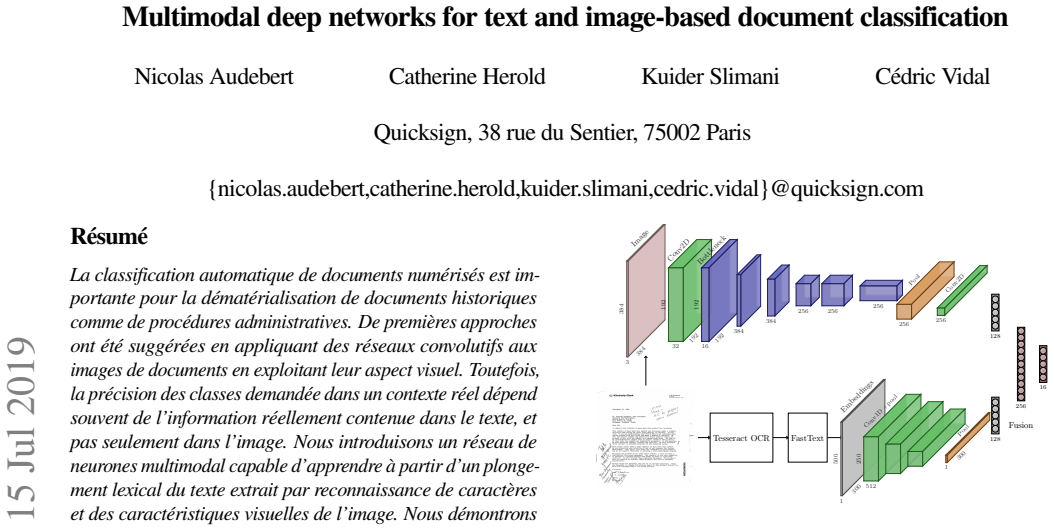
Multimodal neural network that fuses image features with text embeddings derived from OCR output.
What would settle it
Running the identical image-only and multimodal models on Tobacco3482 or RVL-CDIP and observing no accuracy difference or a drop when the OCR text branch is added.
Extended reading notes
Core claim
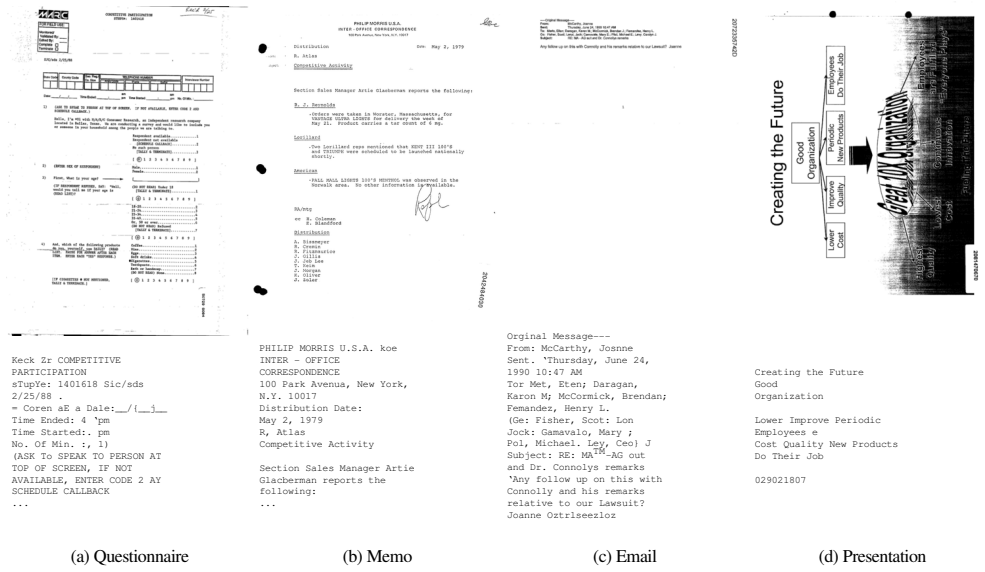
A multimodal neural network that learns jointly from word embeddings computed on OCR-extracted text and from the document image itself improves classification accuracy by 3% over pure image models on the Tobacco3482 and RVL-CDIP datasets augmented with the QS-OCR text dataset, and the gain occurs even without clean text information.
Load-bearing premise
That OCR-derived text embeddings supply complementary signal the network can fuse with image features to produce reliable accuracy gains.
Editorial extensions
If this is right
- Document classification systems can improve by incorporating OCR text even when the OCR is noisy.
- Fine-grained distinctions that depend on textual content become reachable without requiring perfectly transcribed text.
- The new QS-OCR dataset provides a public resource for training and evaluating multimodal document models.
- The 3% gain demonstrates that image and text modalities are not redundant for this task.
Reading between the lines
- The same fusion strategy could be tested on document collections in languages with different OCR error profiles.
- Performance might degrade on documents where text and image content conflict rather than reinforce each other.
- Future work could measure how much of the gain survives when the OCR engine is replaced by a weaker or stronger model.
Editorial analysis
A structured set of objections, weighed in public.
Referee Report
Summary. The manuscript proposes a multimodal neural network for document image classification that fuses image features with word embeddings derived from OCR-extracted text. It reports that this fusion yields a 3% accuracy improvement over image-only baselines on the Tobacco3482 and RVL-CDIP datasets when augmented with the newly released QS-OCR text dataset, and that the gain holds even with noisy OCR output rather than clean text.
Significance. If the empirical result holds, the work provides evidence that OCR-derived text embeddings supply complementary signal to visual features for fine-grained document classification tasks. The public release of the QS-OCR dataset constitutes a concrete, reusable contribution that can support further multimodal experiments on standard benchmarks.
minor comments (2)
- The abstract states the 3% boost but does not name the fusion architecture (e.g., late fusion of CNN and embedding features), the exact baselines, or any error bars/statistical tests; these details should be added to the abstract or highlighted in §3–4 for immediate evaluability.
- The new QS-OCR dataset is introduced with a GitHub link; the manuscript should include a brief description of its construction, size, and OCR quality statistics in the experimental section to allow readers to assess robustness to OCR noise.
Simulated Author's Rebuttal
We thank the referee for the positive summary of our work and the recommendation for minor revision. No specific major comments were raised in the report.
Circularity Check
No significant circularity; purely empirical result
full rationale
The paper reports an empirical accuracy improvement from late fusion of CNN image features and word-embedding text features extracted via OCR. No derivation chain, equations, or parameter-fitting steps are presented as predictions; the 3% lift on Tobacco3482 and RVL-CDIP is a measured experimental outcome after describing the architecture and training protocol. No self-citations, uniqueness theorems, or ansatzes are invoked to justify the result, and the claim does not reduce to its inputs by construction. The work is self-contained as a standard multimodal classification experiment.
Assumptions & free parameters
Cite this review
Pith. "Pith review of Multimodal deep networks for text and image-based document classification." pith.science (2026). https://pith.science/paper/4ZP2K2YJ
@misc{pith2026190706370,
  author       = {Pith},
  title        = {Pith review of: Multimodal deep networks for text and image-based document classification},
  year         = {2026},
  howpublished = {\url{https://pith.science/paper/4ZP2K2YJ}},
  note         = {Machine review of arXiv:1907.06370}
}
read the original abstract
Classification of document images is a critical step for archival of old manuscripts, online subscription and administrative procedures. Computer vision and deep learning have been suggested as a first solution to classify documents based on their visual appearance. However, achieving the fine-grained classification that is required in real-world setting cannot be achieved by visual analysis alone. Often, the relevant information is in the actual text content of the document. We design a multimodal neural network that is able to learn from word embeddings, computed on text extracted by OCR, and from the image. We show that this approach boosts pure image accuracy by 3% on Tobacco3482 and RVL-CDIP augmented by our new QS-OCR text dataset (https://github.com/Quicksign/ocrized-text-dataset), even without clean text information.
Figures

Figures from the paper (1 more)
Forward citations
Cited by 2 Pith papers
-
WordVIS: A Color Worth A Thousand Words
Recoloring words with a hand-crafted letter-to-color scheme improves image-only document classifiers on Tobacco-3482 by 3-5%, reaching a reported 91.14%.
-
STORM: Strategic Orchestration of Modalities for Rare Event Classification
STORM uses entropy imbalance and decision-tree logic to select informative modalities for rare-event classification, and reports that temporal expert features do not help SOZ detection.
Reference graph
Works this paper leans on
-
[1]
Evaluation of Deep Convolutional Nets for Document Image Classification and Retrieval,
A. W . Harleyet al., “Evaluation of Deep Convolutional Nets for Document Image Classification and Retrieval,” inICDAR, Aug. 2015
work page 2015
-
[2]
K. Y . W onget al., “Document Analysis System,” IBM J. Res. Dev ., Nov. 1982
work page 1982
-
[3]
Tesseract: An Open-Source Optical Character Recognition Engine,
A. Kay, “Tesseract: An Open-Source Optical Character Recognition Engine, ”Linux J., July 2007
work page 2007
-
[4]
D. X. Le et al., “Classification of binary document images into textual or nontextual data blocks using neural network models, ” Mach. V is. Appl., Sept. 1995
work page 1995
-
[5]
Segmentation and classification for mixed text/image documents using neural network,
S. Imade et al., “Segmentation and classification for mixed text/image documents using neural network,” inICDAR, Oct. 1993
work page 1993
-
[6]
Gradient-based learning applied to document recognition,
Y . LeCunet al., “Gradient-based learning applied to document recognition, ”Proc. IEEE, Nov. 1998
work page 1998
-
[7]
A survey of document image classification,
N. Chen and D. Blostein, “ A survey of document image classification, ”Int. J. Doc. Anal. Recogn., June 2007
work page 2007
-
[8]
Structural similarity for document image classification and retrieval,
J. Kumar et al. , “Structural similarity for document image classification and retrieval, ”P attern Recognit. Lett., 2014
work page 2014
Show all 39 references
-
[9]
Analysis of CNNs for Document Image Classification,
C. Tensmeyer and T . Martinez, “ Analysis of CNNs for Document Image Classification, ” inICDAR, Nov. 2017
2017
-
[10]
Cutting the Error by Half: Investigation of V ery Deep CNN and Advanced Training Strategies for Document Image Classification,
M. Z. Afzal et al., “Cutting the Error by Half: Investigation of V ery Deep CNN and Advanced Training Strategies for Document Image Classification, ” inICDAR, Nov. 2017
2017
-
[11]
Document Image Classification with Intra- Domain Transfer Learning and Stacked Generalization of Deep Convolutional Neural Networks,
A. Das et al. , “Document Image Classification with Intra- Domain Transfer Learning and Stacked Generalization of Deep Convolutional Neural Networks, ” inICPR, Aug. 2018
2018
-
[12]
Identity Documents Classification as an Image Classification Problem,
R. Sicre et al., “Identity Documents Classification as an Image Classification Problem, ” inICIAP, Sept. 2017
2017
-
[13]
dhSegment : A generic deep-learning approach for document segmentation,
S. Ares Oliveiraet al., “dhSegment : A generic deep-learning approach for document segmentation, ” inICFHR, Aug. 2018
2018
-
[14]
Automatic Document Classification,
H. Borko and M. Bernick, “ Automatic Document Classification, ” J. ACM, Apr. 1963
1963
-
[15]
One-Class SVMs for Document Classification,
L. M. Manevitz and M. Y ousef, “One-Class SVMs for Document Classification, ”J. Mach. Learn. Res, Dec. 2001
2001
-
[16]
Statistical topic models for multi-label document classification,
T . N. Rubin et al., “Statistical topic models for multi-label document classification, ”Mach. Learn., July 2012
2012
-
[17]
Efficient Estimation of W ord Representations in V ector Space,
T . Mikolovet al., “Efficient Estimation of W ord Representations in V ector Space, ” inICLR, Jan. 2013
2013
-
[18]
Deep Contextualized W ord Representations,
M. Peterset al., “Deep Contextualized W ord Representations,” in NAACL, June 2018
2018
-
[19]
Hierarchical Attention Networks for Document Classification,
Z. Y anget al., “Hierarchical Attention Networks for Document Classification, ” inNAACL, 2016
2016
-
[20]
Embedded Textual Content for Document Image Classification with CNNs,
L. Noce et al., “Embedded Textual Content for Document Image Classification with CNNs, ” inACM DocEng, 2016
2016
-
[21]
Learning to Extract Semantic Structure from Documents Using Multimodal FCNNs,
X. Y anget al., “Learning to Extract Semantic Structure from Documents Using Multimodal FCNNs, ” inCVPR, July 2017
2017
-
[22]
Improving Classification of an Industrial Document Image Database by Combining Visual and Textual Features,
O. Augereauet al., “Improving Classification of an Industrial Document Image Database by Combining Visual and Textual Features, ” inIAPR W orkshop, Apr. 2014
2014
-
[23]
MobileNetV2: Inverted Residuals and Linear Bottlenecks,
M. Sandleret al., “MobileNetV2: Inverted Residuals and Linear Bottlenecks, ” inCVPR, June 2018
2018
-
[24]
CNN Features Off-the-Shelf: An Astounding Baseline for Recognition,
A. S. Razavian et al. , “CNN Features Off-the-Shelf: An Astounding Baseline for Recognition, ” inCVPRW, June 2014
2014
-
[25]
Deep Residual Learning for Image Recognition,
K. He et al., “Deep Residual Learning for Image Recognition, ” in CVPR, June 2016
2016
-
[26]
A Threshold Selection Method from Gray-Level Histograms,
N. Otsu, “ A Threshold Selection Method from Gray-Level Histograms, ”IEEE Trans. Syst. Man. Cybern., Jan. 1979
1979
-
[27]
Glove: Global V ectors for W ord Representation,
J. Pennington et al. , “Glove: Global V ectors for W ord Representation, ” inEMNLP, Oct. 2014
2014
-
[28]
Mimicking W ord Embeddings using Subword RNNs,
Y . Pinteret al., “Mimicking W ord Embeddings using Subword RNNs, ” inEMNLP, Sept. 2017
2017
-
[29]
Enriching W ord V ectors with Subword Information,
P . Bojanowskiet al., “Enriching W ord V ectors with Subword Information, ”Trans. Assoc. Comput. Linguist., 2017
2017
-
[30]
Bag of Tricks for Efficient T ext Classification,
A. Joulinet al., “Bag of Tricks for Efficient T ext Classification, ” in EACL, 2017
2017
-
[31]
Magnitude: A Fast, Efficient Universal V ector Embedding Utility Package,
A. Patelet al., “Magnitude: A Fast, Efficient Universal V ector Embedding Utility Package, ” inEMNLP, Nov. 2018
2018
-
[32]
A Simple but T ough-to-Beat Baseline for Sentence Embeddings,
S. Arora et al. , “ A Simple but T ough-to-Beat Baseline for Sentence Embeddings, ” inICLR, Nov. 2016
2016
-
[33]
spaCy 2: Natural language understanding with Bloom embeddings, convolutional neural networks and incremental parsing,
M. Honnibal and I. Montani, “spaCy 2: Natural language understanding with Bloom embeddings, convolutional neural networks and incremental parsing, ”T o appear, 2017
2017
-
[34]
Multimodal deep learning for robust RGB-D object recognition,
A. Eitel et al., “Multimodal deep learning for robust RGB-D object recognition, ” inIROS, Sept. 2015
2015
-
[35]
Delving Deep into Rectifiers,
K. He et al., “Delving Deep into Rectifiers, ” inICCV, 2015
2015
-
[36]
Convolutional Neural Networks for Sentence Classification,
Y . Kim, “Convolutional Neural Networks for Sentence Classification, ” inEMNLP, Oct. 2014
2014
-
[37]
Nielsen, Usability Engineering
J. Nielsen, Usability Engineering. 1993
1993
-
[38]
Xception: Deep Learning with Depthwise Separable Convolutions,
F . Chollet, “Xception: Deep Learning with Depthwise Separable Convolutions, ” inCVPR, July 2017
2017
-
[39]
Robust W ord V ectors: Context-Informed Embeddings for Noisy T exts,
V . Malykhet al., “Robust W ord V ectors: Context-Informed Embeddings for Noisy T exts, ” inEMNLP W-NUT, 2018
2018
Reviewed May 24, 2026 · model on record in the stance chip above.
Discussion (0). Continue with ORCID to comment.