REVIEW 3 major objections 5 minor 51 references
Off-Policy Evaluation and Learning for Matching Markets
T0 review · 3 major / 5 minor · reviewed 2026-08-06 · deepseek-v4-flash
Pith's one-line read This paper claims that treating a match as two stages — a scout and a response — yields off-policy estimators for matching markets that lower MSE relative to DM, IPS, and DR, with proven variance reduction over IPS and a direct extension…
desk verdict Novel two-stage OPE estimators for matching markets with clean bias results, but the headline variance-reduction guarantee rests on a bad inequality and the paper needs revision before the theory is trustworthy. read the letter →
The pith
A machine-rendered reading of the paper's core claim, the machinery that carries it, and where it could break.
The reading
What carries the argument
The load-bearing mechanism is the two-stage reward factorization with the intermediate scout reward $s$. DiPS (Direct and Propensity Score) is the estimator that importance-weights $s$ and multiplies by a learned response probability $\hat{q}_r$, so the variance-prone importance weight never touches the sparse final match label. DPR (Direct, Propensity, and doubly Robust) extends DiPS by adding a match-probability model $\hat{q}_m$ in a doubly robust structure, leaving the bias unchanged while shrinking the variance term to depend on the error $\Delta_{q_r,\hat{q}_r}$ of the response model rather than on $q_r$ itself. The variance theorems decompose estimator error through the law of total variance, isolating the noise of the first-stage signal, $\sigma_s^2(c,j)$, as the quantity that replaces the much larger noise $\sigma_m^2(c,j)$ of the match label.
What would settle it
Take logged data from two logging policies that send different volumes of scouts to the same job seekers, estimate $q_r$ under each, and test whether the response rate conditional on the company-seeker pair changes with scout volume; any detectable shift would falsify the policy-invariance assumption that DiPS and DPR rely on.
Extended reading notes
Core claim
On its own terms, the paper's central discovery is that the policy value in a matching market factorizes as $V(\pi)=\frac{1}{|\mathcal{C}|}\sum_{c\in\mathcal{C}}\sum_{j\in\mathcal{J}}\pi(j|c)q_s(c,j)q_r(c,j)$, where $q_s$ is the probability that the recommending side sends a first-stage signal and $q_r$ is the conditional probability that the receiving side responds, and that this factorization can be exploited by two estimators. DiPS, $\hat{V}_{\mathrm{DiPS}}(\pi;\mathcal{D})=\frac{1}{|\mathcal{C}|}\sum_c \frac{\pi(j_c|c)}{\pi_0(j_c|c)}s_c\hat{q}_r(c,j_c)$, uses an inverse-propensity weight on the first-stage scout label and a learned model for the second-stage response; DPR adds a doubly-robust-style match model $\hat{q}_m$ around the same first-stage term. Theorems 4.1-4.6 give the bias and variance of both estimators, and Theorem 4.4 shows that when the response model does not overestimate, DiPS cuts the variance of IPS by at least $\frac{1}{|\mathcal{C}|^2}\sum_c \mathbb{E}_{\pi(j|c)}[w^2 q_s\sigma_r^2]\ge 0$. The same construction yields policy-gradient estimators for offline learning.
Load-bearing premise
The load-bearing premise is that a job seeker's response probability $q_r(c,j)$ depends only on the company-seeker pair and not on the recommendation policy or on how many other scout messages the seeker receives; if a new policy changes scout volume or composition, the response model can shift and the estimators' unbiasedness breaks.
Editorial extensions
If this is right
- DiPS and DPR lower MSE relative to DM, IPS, and DR in the synthetic configurations tested, with the gains growing as the action space (number of job seekers) grows.
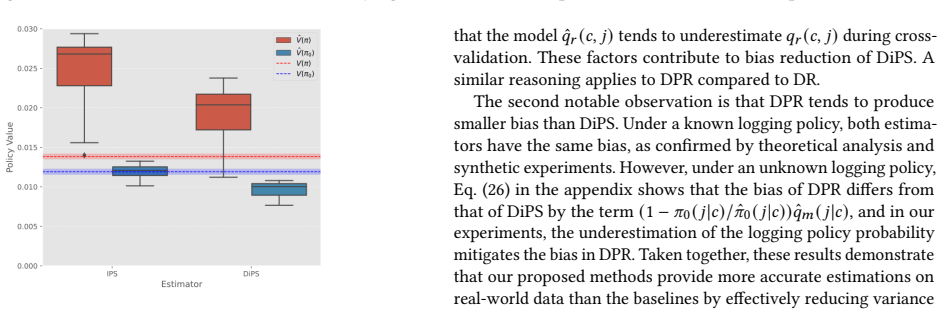
- In the real A/B log experiments, DPR achieves lower MSE than the baselines, and both proposed estimators also reduce the error rate in ranking the target policy against the logging policy.
- When the logging policy must be estimated, the bias of DiPS can undershoot that of IPS if errors in the estimated logging policy and the response model are positively correlated.
- The same first-stage-reward trick extends to Switch-DR and marginalized-IPS style estimators, as shown in the appendix, so the principle is not tied to the two specific estimators.
Reading between the lines
- Editorial extension: if first-stage signals exist in other reciprocal settings (e.g., 'like' before a conversation in dating apps, or a showing before an offer in real estate), the same DiPS/DPR construction should transfer directly.
- Editorial extension: the variance-reduction theorem suggests that DiPS/DPR should be most valuable exactly where OPE is hardest, i.e., large action spaces and strong policy divergence, because those are where $w^2$ is large.
- Editorial extension: a testable prediction is that the advantage over IPS grows as second-stage response noise $\sigma_r^2$ grows, which could be checked by reweighting logged data to vary response noise artificially.
Editorial analysis
A structured set of objections, weighed in public.
Referee Report
Summary. The paper studies off-policy evaluation (OPE) and off-policy learning (OPL) for reciprocal recommendation in matching markets, where a successful match requires both a first-stage action (e.g., a company sending a scout) and a second-stage response (e.g., the job seeker replying). The authors propose two estimators, DiPS and DPR, that combine importance weighting with regression models for the second-stage reward and the ultimate match probability, and they derive bias and variance expressions for these estimators (Theorems 4.1-4.6). They also extend the estimators to policy-gradient-based OPL and report synthetic and real-world experiments from a job-matching platform, claiming improved MSE and ErrorRate over DM, IPS, and DR.
Significance. The problem is practically important and understudied: matching-market OPE has distinctive reward sparsity and two-stage structure, and the paper's core idea of explicitly exploiting first-stage labels is sensible and potentially useful. The paper is also constructive: it gives an explicit modeling framework, derives exact bias and variance expressions under that framework, and evaluates on both synthetic data and production A/B logs. The empirical comparison against standard baselines is a useful contribution. However, the main theoretical guarantee of variance reduction over IPS is not correctly proven and, as stated, is false. Since the paper's headline claims rely on this theorem, the contribution is not yet established at the level asserted.
major comments (3)
- [Section 4.2, Theorem 4.6 and Appendix C.3] Theorem 4.4 is false as stated. In the proof, the difference Var(IPS) - Var(DiPS) is lower-bounded by replacing \hat q_r with q_r inside the subtracted variance term -V_\pi[w q_s \hat q_r]. The required inequality V_\pi[w q_s \hat q_r] <= V_\pi[w q_s q_r] does not follow from the pointwise condition 0 <= \hat q_r <= q_r, because variance is not monotone under pointwise ordering. A concrete counterexample within the paper's own model is: |C|=1, two job seekers, \pi=\pi_0 uniform, q_s=q_r=1 for both seekers, and \hat q_r=(0.9,0.1). Then the match label is identically 1 and Var(IPS)=0, while Eq. (15) gives Var(DiPS)=0.16 and the claimed lower bound in Eq. (16) is 0, so the inequality fails. The text's conclusion that DiPS gives lower variance than IPS is therefore unsupported, and the theorem must be restated with an additional sufficient condition or removed.
- [Section 2, Eq. (2) and Section 6] The variance formula for DPR in Eq. (19) appears incorrect as stated. The derivation in Appendix C.3 produces an outer variance term of the form V_\pi[w(q_s \hat q_r - \hat q_m)], not V_\pi[w q_s (\hat q_r - q_r)]. The latter reduction is valid only if \hat q_m(c,j) = q_s(c,j) q_r(c,j), i.e., if the match model equals the true match probability, which is not assumed in the theorem and is inconsistent with treating \hat q_m as a learned prediction model. As a result, the claimed comparison between DPR and DiPS variance, and the statement that DPR has lower variance when \hat q_r is accurate, are not justified. The theorem needs either an explicit assumption on \hat q_m or a corrected derivation.
- [Section 2, Eq. (2) and Section 6] The unbiasedness and variance analysis relies on the data-generating process p(D) = \Pi_c \pi_0(j_c|c) p(s_c|c,j_c) p(r_c|c,j_c,s_c), which treats each company-seeker pair independently and assumes the second-stage response probability q_r(c,j) depends only on the pair (c,j). In the real system described in Section 6, a job seeker can receive multiple scouts from different companies, and the response probability may plausibly depend on the volume or composition of those scouts, as well as on other recommendations the seeker receives. This is a modeling limitation that bears on the real-world claims; the paper should state it explicitly and, ideally, test sensitivity to violations (e.g., by including the number or identity of other recommendations as context).
minor comments (5)
- [Appendix C.3] The first sentence says 'We first derive the variance of DR', but the displayed estimator is DPR, not DR.
- [Appendix A] The estimator name 'ExtentedSwitch-DR' is misspelled; it should be 'ExtendedSwitch-DR'.
- [Table 1 caption] The caption reads 'Statistics of the read-world dataset'; it should be 'real-world dataset'.
- [Section 2.1, footnote] There is a typo 'bais' in the footnote; it should be 'bias'.
- [Section 4.1, Theorem 4.2] The statement that the bias of DiPS can be smaller than that of IPS 'when the estimation errors ... are positively correlated' is informal; the correlation condition is not defined precisely, and the practical verifiability of this condition is unclear.
Circularity Check
No significant circularity: DiPS and DPR are plug-in estimators derived directly from the factored data-generating process, and the theoretical results are algebraic consequences of those definitions.
full rationale
The proposed estimators are not defined in terms of the quantities they are claimed to predict. DiPS in Eq. (12) is formed by applying importance weighting to the first-stage reward s and multiplying by a regression model for the second-stage reward, while DPR in Eq. (17) is the analogous doubly robust combination; both are plug-in constructions from the factored DGP in Eq. (2). The bias and variance theorems (Theorems 4.1-4.6) follow by direct expectation and law-of-total-variance computations in Appendix C, and none of these results is obtained by fitting a constant to the target or by defining the target to equal the estimator. The self-citations in the paper (e.g., [7], [26], [28], [33]) are contextual or describe baseline methods and are not load-bearing for the derivation of DiPS or DPR, so they do not constitute circular support. The real-world evaluation's 'true' policy value is not defined in the text in a quotable way, so there is no exhibited equation showing that the MSE target is constructed from the same fitted GBDT reward models used by the estimators; without such a reduction, that concern cannot be scored as circularity under the stated rules. The gap in the proof of Theorem 4.4, where \hat q_r is replaced by q_r inside a subtracted variance term, is a mathematical correctness issue rather than a circularity, because the claimed lower bound does not reduce the theorem to its assumptions by definition. Overall, the derivation chain is self-contained, and no load-bearing step is equivalent to its own inputs.
Assumptions & free parameters
assumptions (4)
- domain assumption The reward factorizes as m = s·r with s ~ Bernoulli(q_s(c,j)) and r ~ Bernoulli(q_r(c,j)) conditional on s=1, independent across companies.
- domain assumption Common support: π(j|c) > 0 ⇒ π0(j|c) > 0 for all (c,j), and the logging policy is known or consistently estimated.
- ad hoc to paper The second-stage imputation model is conservative: \hat q_r(c,j) ≤ q_r(c,j) for all (c,j).
- ad hoc to paper The match model \hat q_m(c,j) equals the product q_s(c,j)q_r(c,j) (or its error is negligible) for the variance formula of DPR in Theorem 4.6.
Cite this review
Pith. "Pith review of Off-Policy Evaluation and Learning for Matching Markets." pith.science (2026). https://pith.science/paper/4ZYB7UZM
@misc{pith2026250713608,
  author       = {Pith},
  title        = {Pith review of: Off-Policy Evaluation and Learning for Matching Markets},
  year         = {2026},
  howpublished = {\url{https://pith.science/paper/4ZYB7UZM}},
  note         = {Machine review of arXiv:2507.13608}
}
read the original abstract
Matching users based on mutual preferences is a fundamental aspect of services driven by reciprocal recommendations, such as job search and dating applications. Although A/B tests remain the gold standard for evaluating new policies in recommender systems for matching markets, it is costly and impractical for frequent policy updates. Off-Policy Evaluation (OPE) thus plays a crucial role by enabling the evaluation of recommendation policies using only offline logged data naturally collected on the platform. However, unlike conventional recommendation settings, the large scale and bidirectional nature of user interactions in matching platforms introduce variance issues and exacerbate reward sparsity, making standard OPE methods unreliable. To address these challenges and facilitate effective offline evaluation, we propose novel OPE estimators, \textit{DiPS} and \textit{DPR}, specifically designed for matching markets. Our methods combine elements of the Direct Method (DM), Inverse Propensity Score (IPS), and Doubly Robust (DR) estimators while incorporating intermediate labels, such as initial engagement signals, to achieve better bias-variance control in matching markets. Theoretically, we derive the bias and variance of the proposed estimators and demonstrate their advantages over conventional methods. Furthermore, we show that these estimators can be seamlessly extended to offline policy learning methods for improving recommendation policies for making more matches. We empirically evaluate our methods through experiments on both synthetic data and A/B testing logs from a real job-matching platform. The empirical results highlight the superiority of our approach over existing methods in off-policy evaluation and learning tasks for a variety of configurations.
Figures


Figures from the paper (5 more)




Reference graph
Works this paper leans on
-
[1]
Oliver Bembom and Mark J van der Laan. 2008. Data-adaptive selection of the truncation level for inverse-probability-of-treatment-weighted estimators. (2008)
work page 2008
-
[2]
Jiaxing Chen, Hongzhi Liu, Hongrui Guo, Yingpeng Du, Zekai Wang, Yang Song, and Zhonghai Wu. 2023. Bilateral Sequential Hypergraph Convolution Network for Reciprocal Recommendation. In 2023 IEEE International Conference on Data Mining (ICDM). IEEE, 974–979
work page 2023
-
[3]
Miroslav Dudík, Dumitru Erhan, John Langford, and Lihong Li. 2014. Doubly Robust Policy Evaluation and Optimization. Statist. Sci. 29, 4 (2014), 485 – 511. https://doi.org/10.1214/14-STS500
-
[4]
Mehrdad Farajtabar, Mohammad Ghavamzadeh, and Yinlam Chow. 2018. More Robust Doubly Robust Off-policy Evaluation
work page 2018
- [5]
-
[6]
Alexandre Gilotte, Clément Calauzènes, Thomas Nedelec, Alexandre Abraham, and Simon Dollé. 2018. Offline a/b testing for recommender systems. In Proceed- ings of the Eleventh ACM International Conference on Web Search and Data Mining . 198–206
work page 2018
-
[7]
Shuhei Goda, Yudai Hayashi, and Yuta Saito. 2024. A Best-of-Both Approach to Improve Match Predictions and Reciprocal Recommendations for Job Search. arXiv:2409.10992 [cs.IR]
work page Pith review arXiv 2024
-
[8]
Xiao Hu, Yuan Cheng, Zhi Zheng, Yue Wang, Xinxin Chi, and Hengshu Zhu. 2023. Boss: A bilateral occupational-suitability-aware recommender system for online recruitment. In Proceedings of the 29th ACM SIGKDD Conference on Knowledge Discovery and Data Mining . 4146–4155
work page 2023
Show all 51 references
-
[9]
Olivier Jeunen and Bart Goethals. 2021. Pessimistic reward models for off- policy learning in recommendation. In Proceedings of the 15th ACM Conference on Recommender Systems. 63–74
2021
-
[10]
Joseph DY Kang and Joseph L Schafer. 2007. Demystifying double robustness: A comparison of alternative strategies for estimating a population mean from incomplete data. (2007)
2007
-
[11]
Haruka Kiyohara, Ren Kishimoto, Kosuke Kawakami, Ken Kobayashi, Kazuhide Nakata, and Yuta Saito. 2024. Towards Assessing and Benchmarking Risk-Return Tradeoff of Off-Policy Evaluation. In The Twelfth International Conference on Learning Representations. https://openreview.net/...
2024
-
[12]
Haruka Kiyohara, Masahiro Nomura, and Yuta Saito. 2024. Off-policy evaluation of slate bandit policies via optimizing abstraction. In Proceedings of the ACM on Web Conference 2024. 3150–3161
2024
-
[13]
Akiva Kleinerman, Ariel Rosenfeld, Francesco Ricci, and Sarit Kraus. 2018. Op- timally balancing receiver and recommended users’ importance in reciprocal recommender systems. In Proceedings of the 12th ACM Conference on Recom- mender Systems. 131–139
2018
-
[14]
Kai-Huang Lai, Zhe-Rui Yang, Pei-Yuan Lai, Chang-Dong Wang, Mohsen Guizani, and Min Chen. 2024. Knowledge-Aware Explainable Reciprocal Recommendation. Proceedings of the AAAI Conference on Artificial Intelligence 38, 8 (Mar. 2024), 8636–8644. https://doi.org/10.1609/aaai.v38i8.28708
2024 doi
-
[15]
Lei Li and Tao Li. 2012. MEET: a generalized framework for reciprocal rec- ommender systems. In Proceedings of the 21st ACM International Conference on Information and Knowledge Management (Maui, Hawaii, USA) (CIKM ’12). Association for Computing Machinery, New York, NY, USA, ...
2012
-
[16]
Dawen Liang and Nikos Vlassis. 2022. Local policy improvement for recom- mender systems. arXiv preprint arXiv:2212.11431 (2022)
2022 arXiv
-
[17]
Jan Malte Lichtenberg, Alexander Buchholz, Giuseppe Di Benedetto, Matteo Ruffini, and Ben London. 2023. Double clipping: Less-biased variance reduction in off-policy evaluation. arXiv preprint arXiv:2309.01120 (2023)
2023 arXiv
-
[18]
Ping Liu, Haichao Wei, Xiaochen Hou, Jianqiang Shen, Shihai He, Kay Qianqi Shen, Zhujun Chen, Fedor Borisyuk, Daniel Hewlett, Liang Wu, Srikant Veeraraghavan, Alex Tsun, Chengming Jiang, and Wenjing Zhang. 2024. LinkSAGE: Optimizing Job Matching Using Graph Neural Networks. ar...
2024 arXiv
-
[19]
Linhao Luo, Liqi Yang, Ju Xin, Yixiang Fang, Xiaofeng Zhang, Xiaofei Yang, Kai Chen, Zhiyuan Zhang, and Kai Liu. 2020. RRCN: A Reinforced Random Convolutional Network based Reciprocal Recommendation Approach for Online Dating. arXiv:2011.12586 [cs.IR]
2020 arXiv
-
[20]
Rishabh Mehrotra, James McInerney, Hugues Bouchard, Mounia Lalmas, and Fernando Diaz. 2018. Towards a fair marketplace: Counterfactual evaluation of the trade-off between relevance, fairness & satisfaction in recommendation systems. In Proceedings of the 27th ACM International...
2018
-
[21]
Alberto Maria Metelli, Alessio Russo, and Marcello Restelli. 2021. Subgaussian and Differentiable Importance Sampling for Off-Policy Evaluation and Learning. In Advances in Neural Information Processing Systems, A. Beygelzimer, Y. Dauphin, P. Liang, and J. Wortman Vaughan (Eds...
2021
-
[22]
Tsunenori Mine, Tomoyuki Kakuta, and Akira Ono. 2013. Reciprocal Rec- ommendation for Job Matching with Bidirectional Feedback. In 2013 Second IIAI International Conference on Advanced Applied Informatics . 39–44. https: //doi.org/10.1109/IIAI-AAI.2013.91
2013 doi
-
[23]
James Neve and Ivan Palomares. 2019. Latent factor models and aggregation operators for collaborative filtering in reciprocal recommender systems. In Pro- ceedings of the 13th ACM Conference on Recommender Systems (Copenhagen, Denmark) (RecSys ’19). Association for Computing M...
2019
-
[24]
Iván Palomares, Carlos Porcel, Luiz Pizzato, Ido Guy, and Enrique Herrera-Viedma
-
[25]
Luiz Pizzato, Tomek Rej, Thomas Chung, Irena Koprinska, and Judy Kay. 2010. RECON: a reciprocal recommender for online dating. In Proceedings of the Fourth ACM Conference on Recommender Systems (Barcelona, Spain) (RecSys ’10). Association for Computing Machinery, New York, NY,...
2010
-
[26]
Yuta Saito, Himan Abdollahpouri, Jesse Anderton, Ben Carterette, and Mounia Lalmas. 2024. Long-term Off-Policy Evaluation and Learning. In Proceedings of the ACM Web Conference 2024 (Singapore, Singapore) (WWW ’24). Association for Computing Machinery, New York, NY, USA, 3432–...
2024
-
[27]
Yuta Saito and Thorsten Joachims. 2021. Counterfactual Learning and Evaluation for Recommender Systems: Foundations, Implementations, and Recent Advances. In Fifteenth ACM Conference on Recommender Systems (Amsterdam, Netherlands) (RecSys ’21). 828–830
2021
-
[28]
Yuta Saito and Thorsten Joachims. 2022. Off-Policy Evaluation for Large Action Spaces via Embeddings. arXiv:2202.06317 [cs.LG]
2022 arXiv
-
[29]
Yuta Saito and Thorsten Joachims. 2022. Off-Policy Evaluation for Large Action Spaces via Embeddings. In Proceedings of the 39th International Conference on Machine Learning. PMLR, 19089–19122
2022
-
[30]
Yuta Saito, Qingyang Ren, and Thorsten Joachims. 2023. Off-policy evaluation for large action spaces via conjunct effect modeling. In Proceedings of the 40th International Conference on Machine learning . PMLR, 29734–29759
2023
-
[31]
Yuta Saito, Qingyang Ren, and Thorsten Joachims. 2023. Off-policy evaluation for large action spaces via conjunct effect modeling. In Proceedings of the 40th International Conference on Machine Learning (Honolulu, Hawaii, USA) (ICML’23). JMLR.org, Article 1234, 26 pages
2023
-
[32]
Yuta Saito, Takuma Udagawa, Haruka Kiyohara, Kazuki Mogi, Yusuke Narita, and Kei Tateno. 2021. Evaluating the Robustness of Off-Policy Evaluation. In Proceedings of the 15th ACM Conference on Recommender Systems. ACM, 114–123
2021
-
[33]
Tatsuhiro Shimizu, Koichi Tanaka, Ren Kishimoto, Haruka Kiyohara, Masahiro Nomura, and Yuta Saito. 2024. Effective Off-Policy Evaluation and Learning in Contextual Combinatorial Bandits. In Proceedings of the 18th ACM Conference on Recommender Systems (Bari, Italy) (RecSys ’24...
2024
-
[34]
Yi Su, Magd Bayoumi, and Thorsten Joachims. 2022. Optimizing rankings for recommendation in matching markets. In Proceedings of the ACM Web Conference
2022
-
[35]
Yi Su, Maria Dimakopoulou, Akshay Krishnamurthy, and Miroslav Dudík. 2020. Doubly robust off-policy evaluation with shrinkage. In Proceedings of the 37th International Conference on Machine Learning (ICML’20) . JMLR.org, Article 850, 10 pages
2020
-
[36]
Yi Su, Pavithra Srinath, and Akshay Krishnamurthy. 2020. Adaptive Esti- mator Selection for Off-Policy Evaluation. In Proceedings of the 37th Interna- tional Conference on Machine Learning (Proceedings of Machine Learning Re- search, Vol. 119) , Hal Daumé III and Aarti Singh (...
2020
-
[37]
Yi Su, Lequn Wang, Michele Santacatterina, and Thorsten Joachims. 2019. Cab: Continuous adaptive blending for policy evaluation and learning. InProceedings of the 36th International Conference on Machine Learning, Vol. 97. PMLR, 6005–6014
2019
-
[38]
Yi Su, Lequn Wang, Michele Santacatterina, and Thorsten Joachims. 2019. CAB: Continuous Adaptive Blending for Policy Evaluation and Learning. InProceedings of the 36th International Conference on Machine Learning (Proceedings of Machine Learning Research, Vol. 97), Kamalika Ch...
2019
-
[39]
Thomas and Emma Brunskill
Philip S. Thomas and Emma Brunskill. 2016. Data-efficient off-policy policy evaluation for reinforcement learning. In Proceedings of the 33rd International Conference on International Conference on Machine Learning - Volume 48 (New York, NY, USA) (ICML’16). JMLR.org, 2139–2148
2016
-
[40]
Yoji Tomita, Riku Togashi, Yuriko Hashizume, and Naoto Ohsaka. 2023. Fast and Examination-agnostic Reciprocal Recommendation in Matching Markets. In Proceedings of the 17th ACM Conference on Recommender Systems . 12–23
2023
-
[41]
Yoji Tomita, Riku Togashi, and Daisuke Moriwaki. 2022. Matching theory-based recommender systems in online dating. InProceedings of the 16th ACM Conference on Recommender Systems. 538–541
2022
-
[42]
Kun Tu, Bruno Ribeiro, David Jensen, Don Towsley, Benyuan Liu, Hua Jiang, and Xiaodong Wang. 2014. Online dating recommendations: matching markets and RecSys ’25, September 22–26, 2025, Prague, Czech Republic Hayashi et al. learning preferences. In Proceedings of the 23rd Inte...
2014
-
[43]
Masatoshi Uehara, Chengchun Shi, and Nathan Kallus. 2022. A review of off- policy evaluation in reinforcement learning. arXiv preprint arXiv:2212.06355 (2022)
2022 arXiv
-
[44]
Yu-Xiang Wang, Alekh Agarwal, and Miroslav Dudík. 2017. Optimal and adaptive off-policy evaluation in contextual bandits. InProceedings of the 34th International Conference on Machine Learning - Volume 70 (Sydney, NSW, Australia)(ICML’17). JMLR.org, 3589–3597
2017
-
[45]
Peng Xia, Benyuan Liu, Yizhou Sun, and Cindy Chen. 2015. Reciprocal Rec- ommendation System for Online Dating. In Proceedings of the 2015 IEEE/ACM International Conference on Advances in Social Networks Analysis and Mining 2015 (ASONAM ’15). ACM. https://doi.org/10.1145/280879...
2015
-
[46]
Chen Yang, Sunhao Dai, Yupeng Hou, Wayne Xin Zhao, Jun Xu, Yang Song, and Hengshu Zhu. 2024. Revisiting Reciprocal Recommender Systems: Metrics, Formulation, and Method. In Proceedings of the 30th ACM SIGKDD Conference on Knowledge Discovery and Data Mining (Barcelona, Spain) ...
2024
-
[47]
Ezgi Yıldırım, Payam Azad, and Şule Gündüz Öğüdücü. 2021. biDeepFM: A multi- objective deep factorization machine for reciprocal recommendation.Engineering Science and Technology, an International Journal 24, 6 (2021), 1467–1477
2021
-
[48]
Ezgi Yıldırım, Payam Azad, and Şule Gündüz Öğüdücü. 2021. biDeepFM: A multi- objective deep factorization machine for reciprocal recommendation.Engineering Science and Technology, an International Journal 24, 6 (2021), 1467–1477. https: //doi.org/10.1016/j.jestch.2021.03.010
2021 doi
-
[49]
Bowen Zheng, Yupeng Hou, Wayne Xin Zhao, Yang Song, and Hengshu Zhu
-
[2021]
Information Fusion 69 (2021), 103–127
Reciprocal Recommender Systems: Analysis of state-of-art literature, chal- lenges and opportunities towards social recommendation. Information Fusion 69 (2021), 103–127
2021
-
[2023]
In Proceedings of the 17th ACM Conference on Recommender Systems (Singapore, Singapore) (RecSys ’23)
Reciprocal Sequential Recommendation. In Proceedings of the 17th ACM Conference on Recommender Systems (Singapore, Singapore) (RecSys ’23) . As- sociation for Computing Machinery, New York, NY, USA, 89–100. https: //doi.org/10.1145/3604915.3608798 Off-Policy Evaluation and Lea...
Reviewed August 6, 2026 · model on record in the stance chip above.
Discussion (0). Continue with ORCID to comment.