High-Order ADER-DG Hydrodynamics with ExaHyPE: Implementation, Validation, and Astrophysical Benchmarking
Pith reviewed 2026-05-20 14:24 UTC · model grok-4.3
The pith
High-order ADER-DG with subcell limiting in ExaHyPE reproduces expected Euler wave patterns and gains accuracy in smooth regions.
A machine-rendered reading of the paper's core claim, the machinery that carries it, and where it could break.
Core claim
The high-order ADER-DG implementation with a posteriori subcell finite-volume limiter in ExaHyPE recovers the expected Euler wave patterns and demonstrates clear order-dependent gains in smooth regions while remaining stable near discontinuities in the tested 1D and 2D problems.
What carries the argument
The a posteriori subcell finite-volume limiter that switches in near shocks and steep interfaces to enforce stability while the high-order ADER-DG update operates elsewhere.
If this is right
- The implementation supplies a reproducible tool for inviscid non-relativistic flows dominated by shocks and interfaces.
- Order-dependent accuracy improvements appear in smooth and oscillatory flow regions.
- Contact preservation and baroclinic vorticity deposition are achieved in two-dimensional shock-interface problems.
- Adaptive mesh refinement integrates with the high-order update without breaking stability.
Where Pith is reading between the lines
- The same limiter and predictor structure could be applied to other hyperbolic conservation laws beyond the Euler equations.
- Extending the validated tests to three dimensions would directly check performance for realistic astrophysical configurations.
- The code base could serve as a starting point for adding viscosity or magnetic fields while retaining the shock-capturing mechanism.
Load-bearing premise
The chosen set of idealized test problems sufficiently represents the demands of the targeted astrophysical flows, especially contact preservation and vorticity production at multidimensional interfaces.
What would settle it
A three-dimensional simulation of Richtmyer-Meshkov instability or supernova remnant evolution that exhibits instability, order reduction, or unphysical vorticity loss near interfaces would contradict the claim.
Figures




read the original abstract
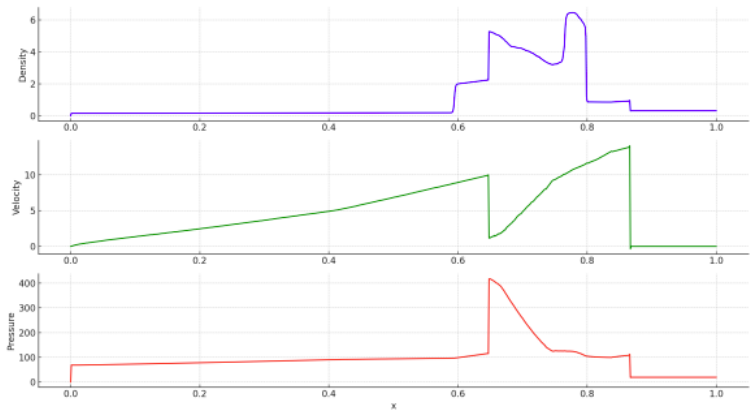
We describe a high-order ADER-DG solver for the compressible Euler equations within the ExaHyPE framework. The implementation combines a high-order ADER-DG polynomial representation, a local space-time DG predictor, adaptive mesh refinement, and an a posteriori subcell finite-volume limiter. We test the code on a deliberately mixed set of one- and two-dimensional problems: a strong-shock Sod-type problem, the Shu-Osher shock-entropy interaction, the Woodward-Colella blast wave, a contact-driven vortex sheet, and a shock-interface interaction. The one-dimensional cases recover the expected Euler wave patterns and show clear order-dependent gains in smooth and oscillatory regions. The two-dimensional cases probe a different part of the method, namely contact preservation, shear-driven roll-up, baroclinic vorticity deposition, and Richtmyer-Meshkov-type growth. In these tests the high-order update gives the expected resolution away from discontinuities, whereas the subcell limiter keeps the calculation stable near shocks and steep interfaces. The resulting code provides a reproducible ExaHyPE implementation for idealised inviscid, non-relativistic flows in which shocks, contacts, and multidimensional interfaces are the dominant features.
Editorial analysis
A structured set of objections, weighed in public.
Referee Report
Summary. The paper presents an implementation of a high-order ADER-DG method for the compressible Euler equations within the ExaHyPE framework. The solver combines a high-order polynomial representation, local space-time DG predictor, adaptive mesh refinement, and an a posteriori subcell finite-volume limiter. Validation is performed on a mixed suite of 1D and 2D problems (Sod-type shock, Shu-Osher shock-entropy interaction, Woodward-Colella blast wave, contact-driven vortex sheet, and shock-interface interaction), with the central claim that the scheme recovers expected Euler wave patterns, exhibits order-dependent accuracy gains in smooth regions, and remains stable near discontinuities while probing contact preservation, shear-driven roll-up, and baroclinic vorticity deposition in 2D.
Significance. If the implementation and results hold, the work supplies a reproducible, open ExaHyPE-based high-order hydrodynamics code suitable for idealized inviscid flows dominated by shocks and interfaces. The deliberate inclusion of both 1D accuracy tests and 2D multidimensional interface problems is a strength, as is the explicit focus on a posteriori limiting to maintain stability. This adds a practical tool for the astrophysical hydrodynamics community without introducing new free parameters beyond the DG polynomial order.
major comments (2)
- [Abstract / validation section] Abstract and validation section: the claim that the 2D cases demonstrate contact preservation, shear-driven roll-up, and baroclinic vorticity deposition with high-order resolution away from discontinuities rests on qualitative descriptions of wave patterns and stability. No L2 vorticity error norms, interface thickness measures, or long-time contact-smearing diagnostics are referenced, which are load-bearing for confirming that order-dependent gains persist once the subcell limiter activates in multidimensional shock-interface flows.
- [Title / introduction] Title and positioning for astrophysical benchmarking: the manuscript title invokes astrophysical applications, yet the tested suite consists of standard idealized 1D/2D hydrodynamics benchmarks. Without additional quantitative comparisons (e.g., vorticity production rates or contact advection errors versus reference solutions over extended times), the link between the reported results and readiness for astrophysical flows remains under-supported.
minor comments (2)
- Figure captions should explicitly state the polynomial orders and limiter activation thresholds used in each panel to allow direct comparison of order-dependent behavior.
- The description of the a posteriori limiter activation criterion could be expanded with a brief equation or pseudocode reference for reproducibility.
Simulated Author's Rebuttal
We thank the referee for the constructive and detailed review. The comments highlight opportunities to strengthen the validation and positioning of the work. We respond to each major comment below and indicate the revisions we will make.
read point-by-point responses
-
Referee: [Abstract / validation section] Abstract and validation section: the claim that the 2D cases demonstrate contact preservation, shear-driven roll-up, and baroclinic vorticity deposition with high-order resolution away from discontinuities rests on qualitative descriptions of wave patterns and stability. No L2 vorticity error norms, interface thickness measures, or long-time contact-smearing diagnostics are referenced, which are load-bearing for confirming that order-dependent gains persist once the subcell limiter activates in multidimensional shock-interface flows.
Authors: We agree that the 2D results are presented primarily through qualitative comparison with expected physical features. While this approach is standard for demonstrating stability and correct wave propagation in multidimensional hydrodynamics benchmarks, we acknowledge that quantitative support for order-dependent accuracy gains in the presence of the a posteriori limiter would strengthen the claims. In the revised manuscript we will add L2 vorticity error norms computed in smooth sub-regions of the 2D tests and interface-thickness diagnostics for the contact-driven and shock-interface cases, thereby providing a more rigorous quantification of the high-order resolution away from discontinuities. revision: yes
-
Referee: [Title / introduction] Title and positioning for astrophysical benchmarking: the manuscript title invokes astrophysical applications, yet the tested suite consists of standard idealized 1D/2D hydrodynamics benchmarks. Without additional quantitative comparisons (e.g., vorticity production rates or contact advection errors versus reference solutions over extended times), the link between the reported results and readiness for astrophysical flows remains under-supported.
Authors: The title and abstract frame the implementation as a practical tool for idealized inviscid flows in which shocks, contacts and multidimensional interfaces dominate—features central to many astrophysical hydrodynamics problems. The chosen benchmarks are deliberately selected because they isolate the same physical mechanisms (shock capturing, contact preservation, baroclinic vorticity generation) that appear in astrophysical contexts. We do not claim that the current test suite constitutes a full astrophysical validation. In the revision we will expand the introduction to make this distinction explicit, add a short discussion of how the reported mechanisms map onto astrophysical applications, and note that direct astrophysical simulations lie beyond the scope of this implementation-focused paper. revision: partial
Circularity Check
No circularity: implementation and benchmarking against external standards
full rationale
The manuscript describes a software implementation of an existing ADER-DG scheme with a posteriori limiting inside the ExaHyPE framework. All reported results consist of direct numerical comparisons to well-known analytic or previously published reference solutions (Sod, Shu-Osher, blast wave, vortex sheet, shock-interface). No new derivations, fitted parameters, or predictions are introduced; the central claims are therefore statements of numerical reproduction rather than reductions to self-defined quantities or self-citations. The work is self-contained against external benchmarks and exhibits none of the enumerated circularity patterns.
Axiom & Free-Parameter Ledger
free parameters (1)
- DG polynomial order
axioms (1)
- domain assumption The flow is governed by the compressible Euler equations for ideal gas.
Lean theorems connected to this paper
-
IndisputableMonolith/Cost/FunctionalEquation.leanwashburn_uniqueness_aczel unclear?
unclearRelation between the paper passage and the cited Recognition theorem.
We describe a high-order ADER-DG solver for the compressible Euler equations within the ExaHyPE framework. The implementation combines a high-order ADER-DG polynomial representation, a local space-time DG predictor, adaptive mesh refinement, and an a posteriori subcell finite-volume limiter.
-
IndisputableMonolith/Foundation/AlexanderDuality.leanalexander_duality_circle_linking unclear?
unclearRelation between the paper passage and the cited Recognition theorem.
The two-dimensional cases probe a different part of the method, namely contact preservation, shear-driven roll-up, baroclinic vorticity deposition, and Richtmyer-Meshkov-type growth.
What do these tags mean?
- matches
- The paper's claim is directly supported by a theorem in the formal canon.
- supports
- The theorem supports part of the paper's argument, but the paper may add assumptions or extra steps.
- extends
- The paper goes beyond the formal theorem; the theorem is a base layer rather than the whole result.
- uses
- The paper appears to rely on the theorem as machinery.
- contradicts
- The paper's claim conflicts with a theorem or certificate in the canon.
- unclear
- Pith found a possible connection, but the passage is too broad, indirect, or ambiguous to say the theorem truly supports the claim.
Reference graph
Works this paper leans on
-
[1]
R. J. LeVeque.Numerical Methods for Conservation Laws. Basel: Birkhäuser, 1992. doi:10.1007/978-3-0348-8629-1
-
[2]
E. F. Toro.Riemann Solvers and Numerical Methods for Fluid Dynamics: A Practical Introduction. 3rd. Berlin: Springer, 2009.doi:10.1007/b79761
-
[3]
S. K. Godunov. “A Difference Method for Numerical Calculation of Discontinuous Solutions of the Equations of Hydrodynamics”. In:Matematicheskii Sbornik47.89 (1959), pp. 271–306
work page 1959
-
[4]
ADER: Arbitrary High Order Godunov Approach
E. F. Toro and V. A. Titarev. “ADER: Arbitrary High Order Godunov Approach”. In:Journal of Scientific Computing17.1–4 (2002), pp. 609–618.doi: 10 . 1023 / A : 1015126814947
work page 2002
-
[5]
ADER Schemes for Three-Dimensional Non-Linear Hyperbolic Systems
V. A. Titarev and E. F. Toro. “ADER Schemes for Three-Dimensional Non-Linear Hyperbolic Systems”. In:Journal of Computational Physics204.2 (2005), pp. 715–736. doi:10.1016/j.jcp.2004.10.028
-
[6]
The Runge–Kutta Discontinuous Galerkin Method for Conservation Laws V: Multidimensional Systems
B. Cockburn and C.-W. Shu. “The Runge–Kutta Discontinuous Galerkin Method for Conservation Laws V: Multidimensional Systems”. In:Journal of Computational Physics 141.2 (1998), pp. 199–224.doi:10.1006/jcph.1998.5892
-
[7]
M. Dumbser and M. Käser. “Arbitrary High Order Non-oscillatory Finite Volume Schemes on Unstructured Meshes for Linear Hyperbolic Systems”. In:Journal of Computational Physics221.2 (2007), pp. 693–723.doi:10.1016/j.jcp.2006.06.043
-
[8]
M. Dumbser et al. “A Unified Framework for the Construction of One-Step Finite- Volume and Discontinuous Galerkin Schemes on Unstructured Meshes”. In:Journal of Computational Physics227.18 (2008), pp. 8209–8253.doi:10.1016/j.jcp.2008.05. 025. 35
-
[9]
M. Dumbser et al. “A Posteriori Subcell Limiting of the Discontinuous Galerkin Finite Element Method for Hyperbolic Conservation Laws”. In:Journal of Computational Physics278 (2014), pp. 47–75.doi:10.1016/j.jcp.2014.08.009
-
[10]
O. Zanotti et al. “Space-Time Adaptive ADER Discontinuous Galerkin Finite Element Schemes with a Posteriori Sub-Cell Finite Volume Limiting”. In:Computers & Fluids 118 (2015), pp. 204–224.doi:10.1016/j.compfluid.2015.06.020
-
[11]
O. Zanotti, F. Fambri, and M. Dumbser. “Solving the Relativistic Magnetohydrody- namics Equations with ADER Discontinuous Galerkin Methods, a Posteriori Subcell Limiting and Adaptive Mesh Refinement”. In:Monthly Notices of the Royal Astronomical Society452.3 (2015), pp. 3010–3029.doi:10.1093/mnras/stv1510
-
[12]
F. Fambri, M. Dumbser, and O. Zanotti. “Space-Time Adaptive ADER-DG Schemes for Dissipative Flows: Compressible Navier–Stokes and Resistive MHD Equations”. In: Computer Physics Communications220 (2017), pp. 297–318.doi:10.1016/j.cpc. 2017.08.001
-
[13]
Continuum Mechanics and Thermodynamics in the Hamilton and the Godunov-type Formulations
I. Peshkov et al. “Continuum Mechanics and Thermodynamics in the Hamilton and the Godunov-type Formulations”. In:Continuum Mechanics and Thermodynamics30 (2019), pp. 1343–1378.doi:10.1007/s00161-018-0621-2
-
[14]
M. Dumbser et al. “A Well-Balanced Discontinuous Galerkin Method for the First-Order Z4 Formulation of the Einstein–Euler System”. In:Journal of Computational Physics 504 (2024), p. 112875.issn: 0021-9991.doi: 10.1016/j.jcp.2024.112875 .url: https://www.sciencedirect.com/science/article/pii/S0021999124001244
-
[15]
ExaHyPE: An Engine for Parallel Dynamically Adaptive Simulations of Wave Problems
A. Reinarz et al. “ExaHyPE: An Engine for Parallel Dynamically Adaptive Simulations of Wave Problems”. In:Computer Physics Communications254 (2020), p. 107251.doi: 10.1016/j.cpc.2020.107251
-
[16]
K. Duru et al. “A Stable Discontinuous Galerkin Method for Linear Elastodynamics in 3D Geometrically Complex Elastic Solids Using Physics Based Numerical Fluxes”. In: 36 Computer Methods in Applied Mechanics and Engineering389 (Feb. 2022), p. 114386. doi:10.1016/j.cma.2021.114386
-
[17]
A Survey of Several Finite Difference Methods for Systems of Nonlinear Hyperbolic Conservation Laws
G. A. Sod. “A Survey of Several Finite Difference Methods for Systems of Nonlinear Hyperbolic Conservation Laws”. In:Journal of Computational Physics27.1 (1978), pp. 1–31.doi:10.1016/0021-9991(78)90023-2
-
[18]
Efficient Implementation of Essentially Non-Oscillatory Shock- Capturing Schemes, II
C.-W. Shu and S. Osher. “Efficient Implementation of Essentially Non-Oscillatory Shock- Capturing Schemes, II”. In:Journal of Computational Physics83.1 (1989), pp. 32–78. doi:10.1016/0021-9991(89)90222-2
-
[19]
The Numerical Simulation of Two-Dimensional Fluid Flow with Strong Shocks
P. Woodward and P. Colella. “The Numerical Simulation of Two-Dimensional Fluid Flow with Strong Shocks”. In:Journal of Computational Physics54.1 (1984), pp. 115– 173.doi:10.1016/0021-9991(84)90142-6
-
[20]
L. D. Landau and E. M. Lifshitz.Fluid Mechanics. 2nd. Vol. 6. Course of Theoretical Physics. Oxford: Pergamon Press, 1987
work page 1987
-
[21]
Hyperbolic Systems of Conservation Laws II
P. D. Lax. “Hyperbolic Systems of Conservation Laws II”. In:Communications on Pure and Applied Mathematics10.4 (1957), pp. 537–566.doi:10.1002/cpa.3160100406
-
[22]
A Second-Order Godunov-Type Scheme for Compress- ible Fluid Dynamics
M. Ben-Artzi and J. Falcovitz. “A Second-Order Godunov-Type Scheme for Compress- ible Fluid Dynamics”. In:Journal of Computational Physics55.1 (1984), pp. 1–32.doi: 10.1016/0021-9991(84)90013-5
-
[23]
A Mathematical Theory of Communication
C. E. Shannon. “A Mathematical Theory of Communication”. In:Bell System Technical Journal27.3 (1948), pp. 379–423.doi:10.1002/j.1538-7305.1948.tb01338.x
-
[24]
Taylor instability in shock acceleration of compressible fluids
R. D. Richtmyer. “Taylor instability in shock acceleration of compressible fluids”. In: Communications on Pure and Applied Mathematics13.2 (1960), pp. 297–319.doi: 10.1002/cpa.3160130207
-
[25]
Instability of the interface of two gases accelerated by a shock wave
E. E. Meshkov. “Instability of the interface of two gases accelerated by a shock wave”. In:Fluid Dynamics4.5 (1969), pp. 101–104.doi:10.1007/BF01015969. 37
-
[26]
Self-similar Solutions for the Interaction of Stellar Ejecta with an External Medium
R. A. Chevalier. “Self-similar Solutions for the Interaction of Stellar Ejecta with an External Medium”. In:Astrophysical Journal258 (1982), pp. 790–797.doi:10.1086/ 160126
work page 1982
-
[27]
Evolution of Nonradiative Supernova Remnants
J. K. Truelove and C. F. McKee. “Evolution of Nonradiative Supernova Remnants”. In:Astrophysical Journal Supplement Series120 (1999), pp. 299–326.doi:10.1086/ 313176
work page 1999
-
[28]
Turbulence in Core-Collapse Supernovae
D. Radice et al. “Turbulence in Core-Collapse Supernovae”. In:Journal of Physics G: Nuclear and Particle Physics45 (Apr. 2018).doi:10.1088/1361-6471/aab872
-
[29]
Hydrodynamic Stability of Jets Produced by Mass Accreting Systems
P. E. Hardee. “Hydrodynamic Stability of Jets Produced by Mass Accreting Systems”. In:Astrophysical Journal234 (1979), pp. 47–57
work page 1979
-
[30]
Why Ultrarelativistic Numerical Hydrodynamics Is Difficult
M. L. Norman and K.-H. A. Winkler. “Why Ultrarelativistic Numerical Hydrodynamics Is Difficult”. In:Los Alamos Science12 (1985), pp. 70–82
work page 1985
-
[31]
On the Dynamics of Gravity Currents in a Channel
J. B. Klemp, R. Rotunno, and W. C. Skamarock. “On the Dynamics of Gravity Currents in a Channel”. In:Journal of Fluid Mechanics269 (1994), pp. 169–198.doi: 10.1017/S0022112094001527
-
[32]
On the Stability of Heterogeneous Shear Flows
J. W. Miles. “On the Stability of Heterogeneous Shear Flows”. In:Journal of Fluid Mechanics10.4 (1961), pp. 496–508.doi:10.1017/S0022112061000305
-
[33]
Gravity Wave Dynamics and Effects in the Mid- dle Atmosphere
D. C. Fritts and M. J. Alexander. “Gravity Wave Dynamics and Effects in the Mid- dle Atmosphere”. In:Reviews of Geophysics41.1 (2003), p. 1003.doi: 10 . 1029 / 2001RG000106
work page 2003
-
[34]
PLUTO: A Numerical Code for Computational Astrophysics
A. Mignone et al. “PLUTO: A Numerical Code for Computational Astrophysics”. In: Astrophysical Journal Supplement Series170 (2007), pp. 228–242.doi: 10 . 1086 / 513316
work page 2007
-
[35]
B. Fryxell et al. “FLASH: An Adaptive Mesh Hydrodynamics Code for Modeling Astrophysical Thermonuclear Flashes”. In:Astrophysical Journal Supplement Series 131 (2000), pp. 273–334.doi:10.1086/317361. 38
discussion (0)
Sign in with ORCID, Apple, or X to comment. Anyone can read and Pith papers without signing in.