I-QMapper: Error-Aware Layout Optimization and Device Diagnostics for NISQ Hardware
Pith reviewed 2026-06-29 01:40 UTC · model grok-4.3
The pith
I-QMapper lets users interactively build and score qubit layouts on NISQ hardware by aggregating readout and two-qubit errors into a single Layout-Quality Score.
A machine-rendered reading of the paper's core claim, the machinery that carries it, and where it could break.
Core claim
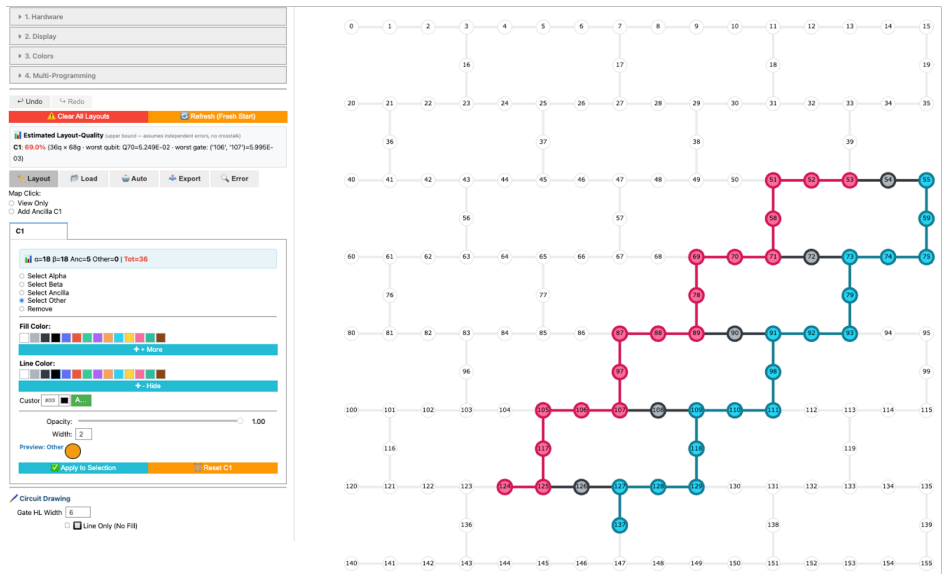
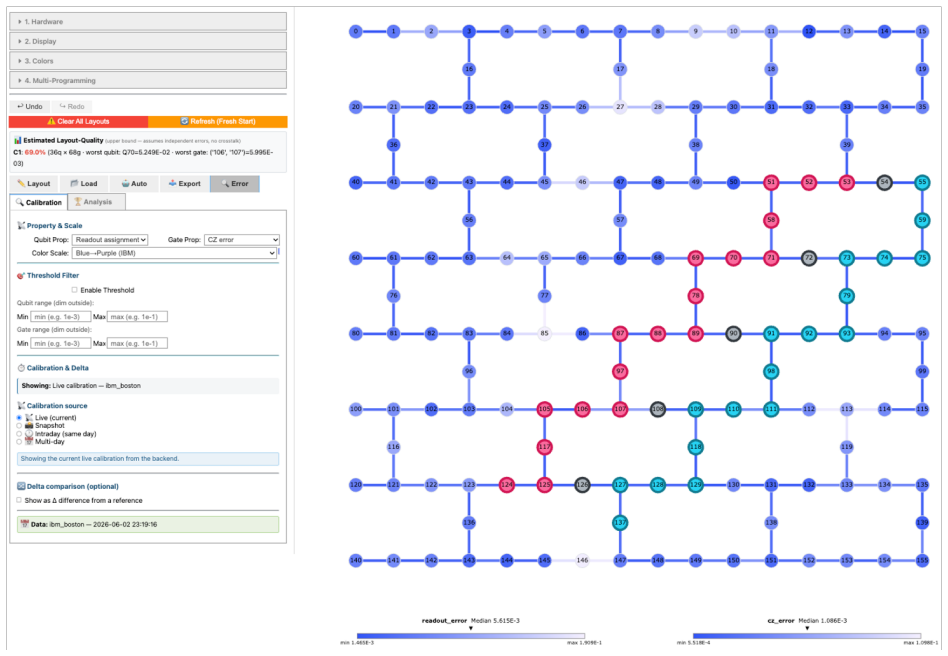
I-QMapper supplies an interactive Design panel for constructing layouts and an Error panel offering Live, Snapshot, Intraday, and Multi-day calibration views, threshold filtering, and delta-mode drift detection; every layout is scored by a Layout-Quality Score that aggregates its readout and two-qubit gate errors, and the same framework extends automatic LUCJ generation to multi-programming on a single QPU while allowing side-by-side backend visualization and session export.
What carries the argument
The Layout-Quality Score (LQS), which aggregates the readout and two-qubit gate errors of a chosen layout into one scalar quality value.
If this is right
- Users can rapidly prototype and compare multiple layouts while viewing live error trends.
- Multi-programming of several circuits on one QPU becomes straightforward for the LUCJ ansatz.
- Temporal modes and delta comparison make device drift visible during layout decisions.
- Side-by-side backend views and session export support reproducible noise-aware experiments.
Where Pith is reading between the lines
- An LQS-style scalar could be fed directly into automated compilers to bias mapping algorithms toward lower-error regions.
- The same interactive analytics might generalize beyond LUCJ to other variational ansatzes that require many two-qubit gates.
- Public release of such a tool could standardize how experimental groups document and share layout choices.
Load-bearing premise
The calibration data supplied by hardware providers is accurate and timely enough that the aggregated Layout-Quality Score actually predicts which physical layout will produce higher-fidelity results.
What would settle it
Execute identical circuits on layouts that receive distinctly different LQS values and check whether higher LQS reliably yields measurably higher fidelity; a null result would falsify the claim that LQS guides useful layout selection.
Figures
read the original abstract
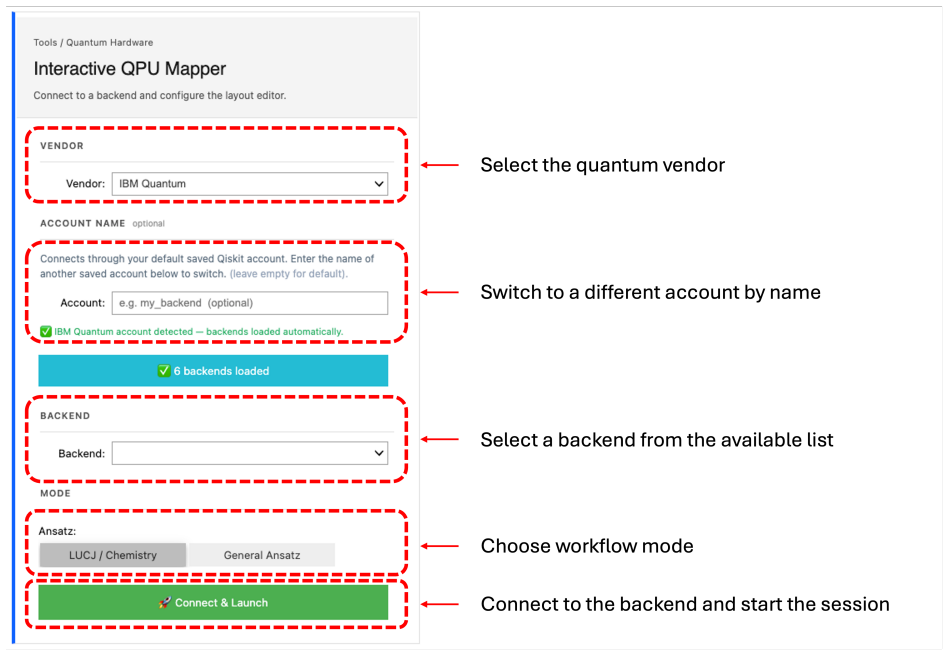
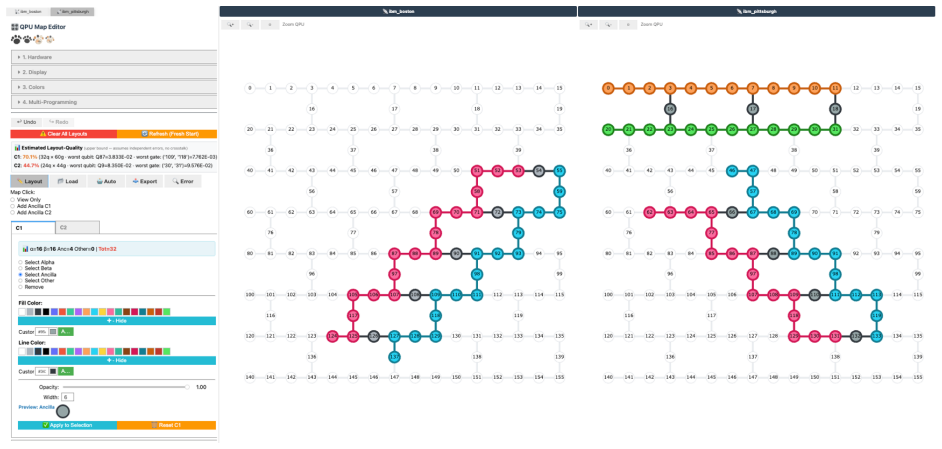
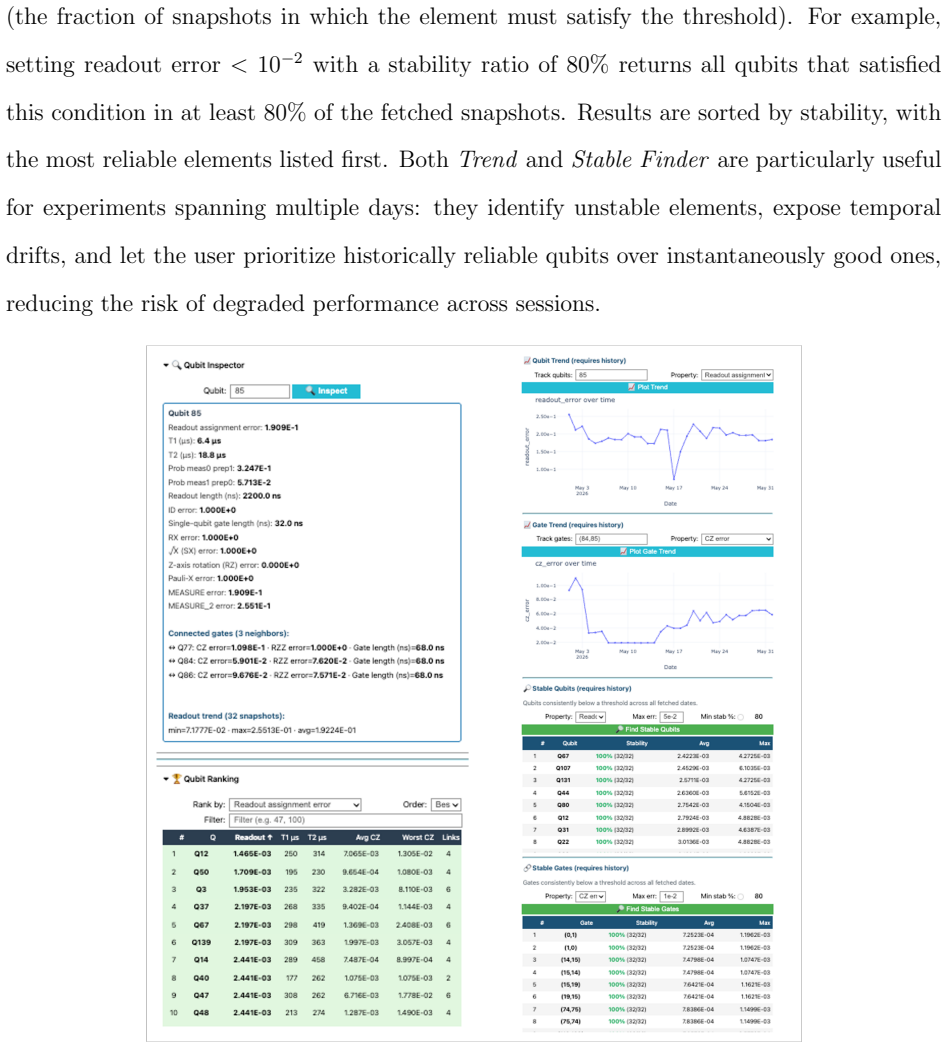
Achieving high-fidelity execution on noisy intermediate-scale quantum (NISQ) hardware requires careful selection of physical qubit layouts, as gate errors, readout errors, and coherence times vary across the device and drift over time. Currently, qubit mapping is performed either through manual inspection of device calibration data or through automated layout pipelines, neither of which provides integrated, interactive layout visualization combined with calibration analytics. In this work, we present the Interactive Quantum Mapper (I-QMapper), a Jupyter-based, open-source tool for noise-aware layout selection, visualization, and analysis on superconducting quantum hardware. I-QMapper offers two operating modes: a general-purpose mode for arbitrary circuits, and a dedicated mode for quantum-chemistry applications, specifically tailored to the Local Unitary Cluster Jastrow (LUCJ) ansatz. Within each mode, a Design panel supports interactive layout construction, while an Error panel provides calibration analytics through four temporal viewing modes (Live, Snapshot, Intraday, and Multi-day range) together with threshold filtering and delta-mode comparison for drift identification. Each layout receives a Layout-Quality Score (LQS) that aggregates the readout and two-qubit gate errors of the layout into a single quality value. Starting from the automatic LUCJ circuit-generation provided by IBM Quantum, we extend it to a multi-programming setting in which multiple circuits are mapped onto a single quantum processing unit (QPU). I-QMapper further supports side-by-side visualization of two quantum backends and layout comparison, and session export for experimental reproducibility. By combining interactive exploration with calibration analytics, I-QMapper aims to support both rapid layout prototyping and informed noise-aware experimental design on NISQ devices.
Editorial analysis
A structured set of objections, weighed in public.
Referee Report
Summary. The manuscript introduces I-QMapper, an open-source Jupyter-based tool for interactive noise-aware qubit layout selection and device diagnostics on superconducting NISQ hardware. It provides a general-purpose mode for arbitrary circuits and a dedicated mode for the LUCJ ansatz in quantum chemistry, including a Design panel for layout construction, an Error panel with four temporal calibration views (Live, Snapshot, Intraday, Multi-day), threshold filtering, delta-mode drift detection, a Layout-Quality Score (LQS) that aggregates readout and two-qubit gate errors, multi-programming support, side-by-side backend comparison, and session export for reproducibility.
Significance. If the tool's LQS and interactive features demonstrably improve layout quality, it could fill a practical gap between manual calibration inspection and fully automated mappers by enabling rapid prototyping and drift-aware decisions. The open-source release and explicit LUCJ multi-programming extension are constructive contributions for the NISQ community.
major comments (1)
- [Abstract] Abstract: The central utility claim that I-QMapper supports 'informed noise-aware experimental design' rests on the LQS aggregation meaningfully predicting execution fidelity, yet the manuscript supplies no hardware benchmarks, fidelity measurements, correlation studies, or statistical comparisons showing that LQS-selected layouts outperform default or random mappings on actual NISQ devices.
Simulated Author's Rebuttal
We thank the referee for the positive assessment of I-QMapper's features and potential contributions. We address the single major comment below.
read point-by-point responses
-
Referee: [Abstract] Abstract: The central utility claim that I-QMapper supports 'informed noise-aware experimental design' rests on the LQS aggregation meaningfully predicting execution fidelity, yet the manuscript supplies no hardware benchmarks, fidelity measurements, correlation studies, or statistical comparisons showing that LQS-selected layouts outperform default or random mappings on actual NISQ devices.
Authors: The referee is correct that the manuscript contains no hardware benchmarks, fidelity measurements, or statistical comparisons validating that LQS-selected layouts outperform alternatives. The paper is a tool-description manuscript whose primary contributions are the Jupyter-based interface, the four temporal calibration views, threshold and delta-mode analytics, multi-programming extension for LUCJ, and the definition of LQS as a simple aggregate of readout and two-qubit errors. The abstract deliberately uses 'aims to support' rather than asserting proven performance. Empirical validation of LQS would require a separate, resource-intensive experimental campaign across devices and circuit families, which lies outside the stated scope. We therefore do not intend to add such benchmarks; we can, however, revise the abstract and a new limitations paragraph to make the heuristic nature of LQS and the absence of validation explicit. revision: no
Circularity Check
No circularity: tool-description paper with no derivations or predictions
full rationale
The manuscript is a description of the I-QMapper software tool, its UI modes, visualization features, and the LQS heuristic that simply sums readout and two-qubit error rates supplied by the vendor. No equations, first-principles derivations, fitted parameters, or predictive claims appear in the provided text. Consequently there is no derivation chain that could reduce to its own inputs, no self-citation load-bearing on a uniqueness theorem, and no renaming of known results. The absence of any such structure makes circularity impossible; the work is self-contained as an engineering artifact.
Axiom & Free-Parameter Ledger
Reference graph
Works this paper leans on
-
[1]
, title =
Plotly Technologies Inc. , title =
-
[2]
2015 , note =
Jupyter widgets community , title =. 2015 , note =
2015
-
[3]
2025 , eprint=
From Promise to Practice: Benchmarking Quantum Chemistry on Quantum Hardware , author=. 2025 , eprint=
2025
-
[4]
Nature , volume =
Biamonte, Jacob and Wittek, Peter and Pancotti, Nicola and Rebentrost, Patrick and Wiebe, Nathan and Lloyd, Seth , title =. Nature , volume =. 2017 , doi =
2017
-
[5]
2024 , note =
Sample-based Quantum Diagonalization , author =. 2024 , note =
2024
-
[6]
Ash-Saki, Abdullah and Alam, Mahabubul and Ghosh, Swaroop , title =. 2020 , isbn =. doi:10.1145/3370748.3406570 , pages =
-
[7]
2025 , eprint=
Sample-based quantum diagonalization as parallel fragment solver for the localized active space self-consistent field method , author=. 2025 , eprint=
2025
-
[8]
Das, Poulami and Tannu, Swamit S. and Nair, Prashant J. and Qureshi, Moinuddin , title =. 2019 , isbn =. doi:10.1145/3352460.3358287 , booktitle =
-
[9]
Bravyi, Sergey and Sheldon, Sarah and Kandala, Abhinav and Mckay, David C. and Gambetta, Jay M. , year=. Mitigating measurement errors in multiqubit experiments , volume=. Physical Review A , publisher=. doi:10.1103/physreva.103.042605 , number=
-
[10]
Doubling the Size of Quantum Simulators by Entanglement Forging , author =. PRX Quantum , volume =. 2022 , month =. doi:10.1103/PRXQuantum.3.010309 , url =
-
[11]
QuCloud: A New Qubit Mapping Mechanism for Multi-programming Quantum Computing in Cloud Environment , year=
Liu, Lei and Dou, Xinglei , booktitle=. QuCloud: A New Qubit Mapping Mechanism for Multi-programming Quantum Computing in Cloud Environment , year=
-
[12]
Das, Poulami and Tannu, Swamit and Dangwal, Siddharth and Qureshi, Moinuddin , title =. 2021 , isbn =. doi:10.1145/3466752.3480059 , booktitle =
-
[13]
Quantum Crosstalk Analysis for Simultaneous Gate Operations on Superconducting Qubits , author =. PRX Quantum , volume =. 2022 , month =. doi:10.1103/PRXQuantum.3.020301 , url =
-
[14]
Experimental Characterization of Crosstalk Errors with Simultaneous Gate Set Tomography , author =. PRX Quantum , volume =. 2021 , month =. doi:10.1103/PRXQuantum.2.040338 , url =
-
[15]
2024 , eprint=
Crosstalk-induced Side Channel Threats in Multi-Tenant NISQ Computers , author=. 2024 , eprint=
2024
-
[16]
Detecting crosstalk errors in quantum information processors
Detecting crosstalk errors in quantum information processors , author =. doi:10.22331/q-2020-09-11-321 , url =
-
[17]
Quantum , volume =
Preskill, John , title =. Quantum , volume =. 2018 , doi =
2018
-
[18]
Noisy intermediate-scale quantum algorithms , author =. Rev. Mod. Phys. , volume =. 2022 , month =. doi:10.1103/RevModPhys.94.015004 , url =
-
[19]
Hassan and Peng, Lu , journal=
LeCompte, Travis and Qi, Fang and Yuan, Xu and Tzeng, Nian-Feng and Najafi, M. Hassan and Peng, Lu , journal=. Machine-Learning-Based Qubit Allocation for Error Reduction in Quantum Circuits , year=
-
[20]
Yang-Zhi Li and Wen Liu and Guo-Sheng Xu and Mao-Duo Li and Kai Chen and Shou-Li He , keywords =. Quantum circuit mapping based on discrete particle swarm optimization and deep reinforcement learning , journal =. 2025 , issn =. doi:https://doi.org/10.1016/j.swevo.2025.101923 , url =
-
[21]
Journal of Open Source Software , volume =
Qiskit Experiments: A Python package to characterize and calibrate quantum computers , author =. Journal of Open Source Software , volume =. 2023 , doi =
2023
-
[22]
Characterization of Addressability by Simultaneous Randomized Benchmarking , author =. Phys. Rev. Lett. , volume =. 2012 , month =. doi:10.1103/PhysRevLett.109.240504 , url =
-
[23]
Suppression of Qubit Crosstalk in a Tunable Coupling Superconducting Circuit , author =. Phys. Rev. Appl. , volume =. 2019 , month =. doi:10.1103/PhysRevApplied.12.054023 , url =
-
[24]
High-Contrast ZZ Interaction Using Superconducting Qubits with Opposite-Sign Anharmonicity , author =. Phys. Rev. Lett. , volume =. 2020 , month =. doi:10.1103/PhysRevLett.125.200503 , url =
-
[25]
Quantum , year=
Enabling Multi-programming Mechanism for Quantum Computing in the NISQ Era , author=. Quantum , year=
-
[26]
arXiv preprint arXiv:2001.02826 , year=
Software Mitigation of Crosstalk on Noisy Intermediate-Scale Quantum Computers , author=. arXiv preprint arXiv:2001.02826 , year=. doi:10.48550/arXiv.2001.02826 , url=
-
[27]
Advanced Quantum Technologies , volume =
Mao, Yikai and Shresthamali, Shaswot and Kondo, Masaaki , title =. Advanced Quantum Technologies , volume =. doi:https://doi.org/10.1002/qute.202500022 , url =. https://advanced.onlinelibrary.wiley.com/doi/pdf/10.1002/qute.202500022 , year =
-
[28]
2024 , eprint=
LightSABRE: A Lightweight and Enhanced SABRE Algorithm , author=. 2024 , eprint=
2024
-
[29]
Li, Gushu and Ding, Yufei and Xie, Yuan , title =. 2019 , isbn =. doi:10.1145/3297858.3304023 , pages =
-
[30]
2026 , eprint=
A Quantum Multi-Programming Framework to Maximize Quantum Resources for the LUCJ Ansatz , author=. 2026 , eprint=
2026
-
[31]
Matthew Treinish and Ivan Carvalho and Georgios Tsilimigkounakis and Nahum Sá , title =. 2022 , publisher =. doi:10.21105/joss.03968 , url =
-
[32]
Wille, Robert and Burgholzer, Lukas , title =. 2023 , isbn =. doi:10.1145/3569052.3578928 , booktitle =
-
[33]
Chemical Science , volume =
Bridging physical intuition and hardware efficiency for correlated electronic states: the local unitary cluster Jastrow ansatz for electronic structure , author =. Chemical Science , volume =. 2023 , doi =
2023
-
[34]
arXiv preprint arXiv:2506.20825 , year =
Quantum-Centric Alchemical Free Energy Calculations , author =. arXiv preprint arXiv:2506.20825 , year =
-
[35]
arXiv preprint arXiv:2512.17130 , year =
Molecular Quantum Computations on a Protein , author =. arXiv preprint arXiv:2512.17130 , year =. doi:10.48550/arXiv.2512.17130 , url =
-
[36]
arXiv preprint arXiv:2601.07872 , year =
Quantum Computing and Visualization Research Challenges and Opportunities , author =. arXiv preprint arXiv:2601.07872 , year =. doi:10.48550/arXiv.2601.07872 , url =
-
[37]
arXiv preprint arXiv:2306.12346 , year =
A Practical Overview of Quantum Computing: Is Exascale Possible? , author =. arXiv preprint arXiv:2306.12346 , year =
-
[38]
arXiv preprint arXiv:2112.07091 , year =
Simultaneous Quantum Circuits Execution on Current and Near-Future NISQ Systems , author =. arXiv preprint arXiv:2112.07091 , year =
-
[39]
arXiv preprint arXiv:2512.01055 , year =
Accelerating CCSD(T) on Graphical Processing Units (GPUs) , author =. arXiv preprint arXiv:2512.01055 , year =. doi:10.48550/arXiv.2512.01055 , url =
-
[40]
arXiv preprint arXiv:2411.15631 , year =
Understanding and Estimating the Execution Time of Quantum Programs , author =. arXiv preprint arXiv:2411.15631 , year =. doi:10.48550/arXiv.2411.15631 , url =
-
[41]
Doubling down on open-access quantum computing , howpublished =
-
[42]
Physical Review X , volume =
What Limits the Simulation of Quantum Computers? , author =. Physical Review X , volume =. 2020 , doi =
2020
-
[43]
Lin, Wen-Hao and Liang, Fang and Motta, Mario and Zhang, Hao and McClean, K. M. Jr. and Sung, K. J. , title =. 2511.22476 , journal =
-
[44]
and Lu, Peihuang and Nocedal, Jorge and Zhu, Ciyou , title =
Byrd, Richard H. and Lu, Peihuang and Nocedal, Jorge and Zhu, Ciyou , title =. SIAM Journal on Scientific Computing , volume =
-
[45]
and Wigner, E
Jordan, P. and Wigner, E. , title =. Zeitschrift f. 1928 , doi =
1928
-
[46]
and Haberland, Matt and Reddy, Tyler and Cournapeau, David and Burovski, Evgeni and Peterson, Pearu and Weckesser, Warren and Bright, Jonathan and van der Walt, St
Virtanen, Pauli and Gommers, Ralf and Oliphant, Travis E. and Haberland, Matt and Reddy, Tyler and Cournapeau, David and Burovski, Evgeni and Peterson, Pearu and Weckesser, Warren and Bright, Jonathan and van der Walt, St. SciPy 1.0: Fundamental Algorithms for Scientific Computing in Python , journal =
-
[47]
Saki, A. A. and Barison, S. and Fuller, B. and Garrison, J. R. and Glick, J. R. and Johnson, C. and Mezzacapo, A. and Robledo-Moreno, J. and Rossmannek, M. and Schweigert, P. and others , title =. 2024 , howpublished =
2024
-
[48]
doi:10.1021/acsomega.0c01148 , author =
A Simple Method for Including Polarization Effects in Solvation Free Energy Calculations When Using Fixed-Charge Force Fields: Alchemically Polarized Charges , journal =. doi:10.1021/acsomega.0c01148 , author =
-
[49]
doi:10.1021/acs.jcim.9b00962 , author =
Benchmarking Electronic Structure Methods for Accurate Fixed-Charge Electrostatic Models , journal =. doi:10.1021/acs.jcim.9b00962 , author =
-
[50]
and Evans, Alicia K
Pitman, Samuel J. and Evans, Alicia K. and Ireland, Robbie T. and Lempriere, Felix and McKemmish, Laura K. , title =. The Journal of Physical Chemistry A , volume =. 2023 , doi =
2023
-
[51]
2025 , doi =
Quantum-Centric Computational Study of Methylene Singlet and Triplet States , journal =. 2025 , doi =
2025
-
[52]
Journal of Computational Chemistry , volume =
Sun, Qiming , title =. Journal of Computational Chemistry , volume =. doi:https://doi.org/10.1002/jcc.23981 , url =. https://onlinelibrary.wiley.com/doi/pdf/10.1002/jcc.23981 , year =
-
[53]
Barison, Stefano and Robledo Moreno, Javier and Motta, Mario , title =. 2025 , month =. doi:10.1088/2058-9565/adb781 , url =
-
[54]
arXiv preprint arXiv:2503.10923 , year =
Surface Reaction Simulations for Battery Materials through Sample-Based Quantum Diagonalization and Local Embedding , author =. arXiv preprint arXiv:2503.10923 , year =. 2503.10923 , archivePrefix =
-
[55]
arXiv preprint arXiv:2501.09702 , year =
Quantum-Centric Algorithm for Sample-Based Krylov Diagonalization , author =. arXiv preprint arXiv:2501.09702 , year =. 2501.09702 , archivePrefix =
-
[56]
Analytic Gradients for Selected Configuration Interaction , journal =. 2023 , doi =. doi:10.1021/acs.jctc.2c01062 , author =
-
[57]
and Zhang, X
Li, G. and Zhang, X. and Cui, Q. , title =. J. Phys. Chem. B , year =
-
[58]
Hunt, John. Monkey Patching. A Beginners Guide to Python 3 Programming. 2023. doi:10.1007/978-3-031-35122-8_43
-
[59]
and Aktulga, H
Manathunga, M. and Aktulga, H. M. and Götz, A. W. and Merz, K. M. , title =. J. Chem. Inf. Model. , year =
-
[60]
Cruzeiro, V. W. D. and Manathunga, M. and Merz, K. M. and Götz, A. W. , title =. J. Chem. Inf. Model. , year =
-
[61]
Electron Correlation Effects in Molecules , journal =. 1996 , doi =. doi:10.1021/jp953749i , author =
-
[62]
Martin, Jan M. L. , title =. Israel Journal of Chemistry , volume =. doi:https://doi.org/10.1002/ijch.202100111 , eprint =
-
[63]
Molecular Simulation , volume =
Xiya Lu and Dong Fang and Shingo Ito and Yuko Okamoto and Victor Ovchinnikov and Qiang Cui and , title =. Molecular Simulation , volume =. 2016 , publisher =. doi:10.1080/08927022.2015.1132317 , note =
-
[64]
and Kelly, Casey P
Marenich, Aleksandr V. and Kelly, Casey P. and Thompson, Jason D. and Hawkins, Gregory D. and Chambers, Candee C. and Giesen, David J. and Winget, Paul and Cramer, Christopher J. and Truhlar, Donald G. , title =. 2020 , howpublished =
2020
-
[65]
Best Practices on QM/MM Simulations of Biological Systems , journal =. 2023 , doi =. doi:10.1021/acs.jcim.2c01522 , author =
-
[66]
Challenges for density functional theory,
Challenges for Density Functional Theory , journal =. 2012 , doi =. doi:10.1021/cr200107z , author =
-
[67]
Selected Configuration Interaction in a Basis of Cluster State Tensor Products , journal =. 2020 , doi =. doi:10.1021/acs.jctc.0c00141 , author =
-
[68]
Modern Alchemical Free Energy Methods for Drug Discovery Explained , journal =. 2023 , doi =. doi:10.1021/acsphyschemau.3c00033 , author =
-
[69]
Recent advances in QM/MM free energy calculations using reference potentials , journal =. 2015 , note =. doi:https://doi.org/10.1016/j.bbagen.2014.07.008 , url =
-
[70]
Benefits of hybrid QM/MM over traditional classical mechanics in pharmaceutical systems , journal =. 2023 , issn =. doi:https://doi.org/10.1016/j.drudis.2022.103374 , url =
-
[71]
and Warrensford, Luke and Boresch, Stefan and Woodcock, H
Kearns, Fiona L. and Warrensford, Luke and Boresch, Stefan and Woodcock, H. Lee , title =. Molecules , volume =. 2019 , number =
2019
-
[72]
Computer-aided drug design, quantum-mechanical methods for biological problems , journal =. 2022 , issn =. doi:https://doi.org/10.1016/j.sbi.2022.102417 , url =
-
[73]
Understanding Molecular Simulation (Second Edition) , publisher =
Daan Frenkel and Berend Smit , title =. Understanding Molecular Simulation (Second Edition) , publisher =. 2002 , isbn =. doi:https://doi.org/10.1016/B978-012267351-1/50021-3 , url =
-
[74]
Understanding Molecular Simulation (Second Edition) , publisher =
Daan Frenkel and Berend Smit , title =. Understanding Molecular Simulation (Second Edition) , publisher =. 2002 , isbn =. doi:https://doi.org/10.1016/B978-012267351-1/50025-0 , url =
-
[75]
Journal of Medicinal Chemistry , volume =
De Vivo, Marco and Masetti, Matteo and Bottegoni, Giovanni and Cavalli, Andrea , title =. Journal of Medicinal Chemistry , volume =. 2016 , doi =
2016
-
[76]
Shirts, Michael R. and Chodera, John D. , title =. The Journal of Chemical Physics , volume =. 2008 , issn =. doi:10.1063/1.2978177 , url =
-
[77]
William L. Jorgensen and Erin M. Duffy , abstract =. Prediction of drug solubility from Monte Carlo simulations , journal =. 2000 , issn =. doi:https://doi.org/10.1016/S0960-894X(00)00172-4 , url =
-
[78]
A hybrid quantum computing pipeline for real world drug discovery , volume=
Li, Weitang and Yin, Zhi and Li, Xiaoran and Ma, Dongqiang and Yi, Shuang and Zhang, Zhenxing and Zou, Chenji and Bu, Kunliang and Dai, Maochun and Yue, Jie and Chen, Yuzong and Zhang, Xiaojin and Zhang, Shengyu , year=. A hybrid quantum computing pipeline for real world drug discovery , volume=. Scientific Reports , publisher=. doi:10.1038/s41598-024-678...
-
[79]
Salo-Ahen, Outi M. H. and Alanko, Ida and Bhadane, Rajendra and Bonvin, Alexandre M. J. J. and Honorato, Rodrigo Vargas and Hossain, Shakhawath and Juffer, André H. and Kabedev, Aleksei and Lahtela-Kakkonen, Maija and Larsen, Anders Støttrup and Lescrinier, Eveline and Marimuthu, Parthiban and Mirza, Muhammad Usman and Mustafa, Ghulam and Nunes-Alves, Ari...
2021
-
[80]
A. Warshel and M. Levitt , abstract =. Theoretical studies of enzymic reactions: Dielectric, electrostatic and steric stabilization of the carbonium ion in the reaction of lysozyme , journal =. 1976 , issn =. doi:https://doi.org/10.1016/0022-2836(76)90311-9 , url =
discussion (0)
Sign in with ORCID, Apple, or X to comment. Anyone can read and Pith papers without signing in.