Developmental approach reveals the statistical learning of Neural Language Models: Transformers generalize from the most abstract statistical patterns
Pith reviewed 2026-06-29 02:11 UTC · model grok-4.3
The pith
Neural language models acquire the most abstract global statistical knowledge first, then the local dependencies.
A machine-rendered reading of the paper's core claim, the machinery that carries it, and where it could break.
Core claim
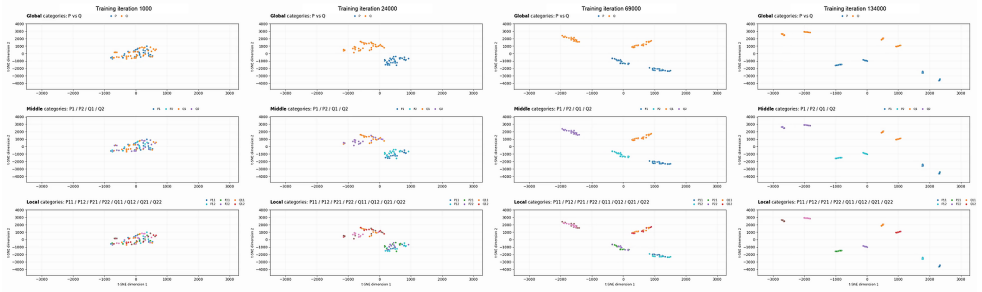
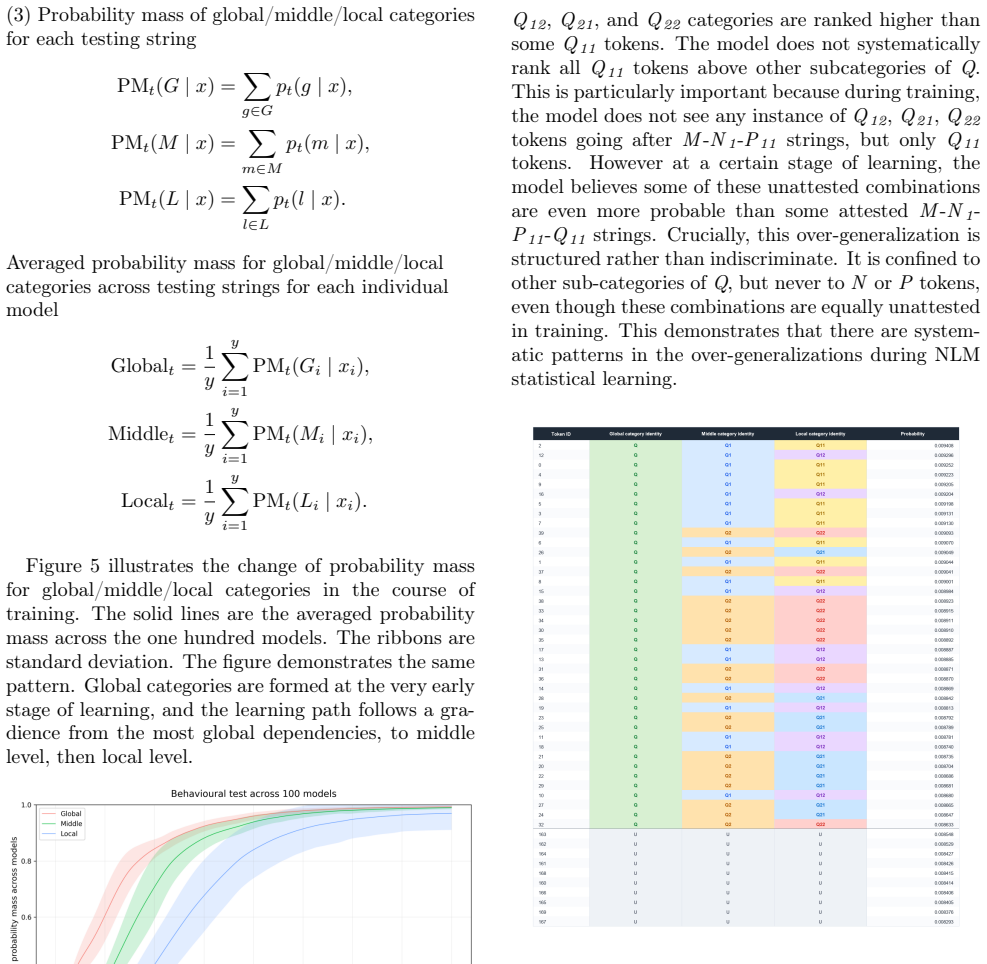
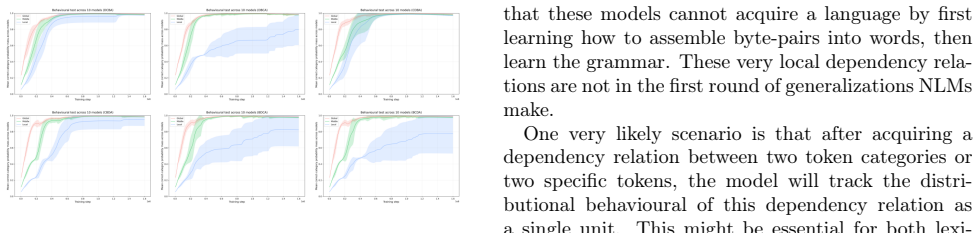
Through a developmental approach analyzing model states saved during training on a synthetic grammar, the models acquire the most abstract global statistical knowledge at the beginning of learning and later acquire the relatively local statistical dependencies. This learning path contains many over-generalizations from the very beginning and these over-generalizations are gradually constrained in the later stage of learning.
What carries the argument
Developmental tracking of internal representations saved at successive stages of training on a synthetic grammar.
If this is right
- Over-generalizations occur from the earliest stages and become constrained later.
- Abstract global statistical knowledge is acquired before relatively local dependencies.
- The developmental sequence itself constitutes the statistical learning process of the models.
- A new framework for statistical learning and language cognition in NLMs follows directly from the observed trajectory.
Where Pith is reading between the lines
- If the same early-to-late ordering appears when models are trained on natural-language corpora, the framework would extend beyond synthetic data.
- Intervening in training to supply local patterns earlier might alter the rate or final accuracy of acquiring abstract patterns.
- Comparing the saved states against human developmental data on similar artificial grammars could test whether the model path matches any observed child learning order.
Load-bearing premise
The synthetic grammar's statistical structure is representative of the patterns that matter for natural language, and the observed changes in model representations reflect genuine statistical learning rather than training artifacts or analysis choices.
What would settle it
Re-training the models on a synthetic grammar whose structure reverses the abstract-to-local order and finding that local dependencies still appear first would falsify the claimed learning path.
Figures
read the original abstract
In this study, we use a developmental approach to investigate the statistical learning and mental representation of neural language models (NLM). A series of Generative Transformer models are trained on a synthetic grammar. The model states are saved at multiple stages in the course of training. Through analyzing how the internal representations of these models change in the developmental path, we found that NLMs acquire the most abstract global statistical knowledge at the beginning of learning and later acquire the relatively local statistical dependencies. This learning path contains many over-generalizations from the very beginning and these over-generalizations are gradually constrained in the later stage of learning. Based on this observation, we propose a new framework to explain the statistical learning and language cognition of NLMs.
Editorial analysis
A structured set of objections, weighed in public.
Referee Report
Summary. The manuscript trains a series of Generative Transformer models on a synthetic grammar, saves internal states at multiple training stages, and analyzes representational changes to argue that NLMs first acquire the most abstract global statistical patterns and only later acquire local dependencies, with early over-generalizations that are gradually constrained; a new explanatory framework for NLM statistical learning is proposed on this basis.
Significance. If the developmental trajectory is shown to be robust and the synthetic grammar's statistics are representative of natural language, the work could contribute to understanding generalization dynamics in transformers and offer parallels to human language acquisition studies. The use of checkpointed model states across training is a methodological strength that supports tracking of representational shifts.
major comments (2)
- [Methods / synthetic grammar definition] The central claim that the observed global-to-local trajectory is a general property of NLM statistical learning rests on a single synthetic grammar (described in the methods); without evidence that its generative rules reproduce nested long-range dependencies or hierarchical structure typical of natural language, the trajectory may be an artifact of the grammar's inductive bias rather than a general finding.
- [Framework section (post-results)] The proposed framework (outlined after the empirical results) is constructed directly from the training-path observations on this grammar; it is unclear whether the framework supplies independent, falsifiable predictions or simply restates quantities already fitted to the same developmental data, creating a circularity risk for the explanatory claim.
minor comments (2)
- [Results / analysis] Add quantitative metrics, error bars, and statistical tests for the reported shifts in global vs. local knowledge and for the over-generalization counts across checkpoints.
- [Analysis methods] Clarify the precise operational definitions used to label a statistical pattern as 'abstract global' versus 'local' and how these labels are computed from model representations.
Simulated Author's Rebuttal
We thank the referee for the constructive comments. We address each major comment below and note planned revisions to strengthen the manuscript.
read point-by-point responses
-
Referee: [Methods / synthetic grammar definition] The central claim that the observed global-to-local trajectory is a general property of NLM statistical learning rests on a single synthetic grammar (described in the methods); without evidence that its generative rules reproduce nested long-range dependencies or hierarchical structure typical of natural language, the trajectory may be an artifact of the grammar's inductive bias rather than a general finding.
Authors: We appreciate the referee's point on the scope of generalization. The synthetic grammar was constructed with generative rules intended to produce both abstract global patterns and nested long-range dependencies (detailed in Methods). That said, we agree that evidence from only one grammar leaves open the possibility that the observed trajectory reflects grammar-specific biases. In revision we will expand the Methods with explicit examples and statistics showing how the grammar encodes hierarchical structure and long-range dependencies, and we will add a Limitations subsection in the Discussion that acknowledges the single-grammar design and calls for future multi-grammar validation. These changes will make the evidential basis and its boundaries clearer without overstating generality. revision: partial
-
Referee: [Framework section (post-results)] The proposed framework (outlined after the empirical results) is constructed directly from the training-path observations on this grammar; it is unclear whether the framework supplies independent, falsifiable predictions or simply restates quantities already fitted to the same developmental data, creating a circularity risk for the explanatory claim.
Authors: The framework is indeed derived from the developmental observations on this grammar and functions primarily as an organizing explanation of those data. We accept that, as currently presented, it risks appearing post-hoc. In the revised manuscript we will rewrite the Framework section to (a) explicitly state its empirical grounding, (b) separate descriptive summaries of the observed trajectory from the framework's interpretive claims, and (c) articulate concrete, testable predictions (e.g., how altering the ratio of global versus local statistics or changing model depth should shift the timing of over-generalization resolution). These additions will reduce circularity and position the framework as a source of future predictions rather than a restatement of the present results. revision: yes
Circularity Check
No significant circularity; empirical observations on synthetic grammar do not reduce to fitted inputs by construction
full rationale
The paper trains Generative Transformer models on a synthetic grammar, saves intermediate states, and reports observed changes in internal representations (abstract global statistics acquired first, followed by local dependencies and gradual constraint of over-generalizations). The proposed framework is explicitly based on this empirical observation rather than any mathematical derivation, uniqueness theorem, or parameter fit that is then relabeled as a prediction. No equations, self-citations, or ansatzes are invoked in the provided text that would create a self-definitional loop or force a result by construction. The work is self-contained as a developmental empirical study; external validity concerns (e.g., grammar representativeness) fall outside circularity analysis.
Axiom & Free-Parameter Ledger
Reference graph
Works this paper leans on
-
[1]
A., Goyal, N., & Tsvetkov, Y
Ahuja, K., Balachandran, V., Panwar, M., He, T., Smith, N. A., Goyal, N., & Tsvetkov, Y. (2024).Learning syntax without planting trees: Understanding when and why transformers generalize hierarchically
2024
-
[2]
Boas, H. C. (2011). Coercion and leaking argument structures in construction grammar.Linguistics, 49(6).https://doi.org/10.1515/ling.2011.036
-
[3]
Bowerman, M., & Croft, W. (2007). The acquisition of the english causative alternation. InCrosslinguistic Perspectives on Argument Structure. Routledge
2007
-
[4]
Brown, H., Smith, K., Samara, A., & Wonnacott, E. (2022). Semantic cues in language learning: An artificial language study with adult and child learners.Language, Cognition and Neuroscience, 37(4), 509–531. https://doi.org/10.1080/23273798.2021.1995612
-
[5]
(1995).The minimalist program
Chomsky, N. (1995).The minimalist program. MIT Press
1995
-
[6]
Croft, W. (2015). Force dynamics and directed change in event lexicalization and argument realization. In R. G. de Almeida & C. Manouilidou (Eds),Cognitive Science Perspectives on Verb Representation and Processing(pp. 103–129). Springer International Publishing. https://doi.org/10.1007/978-3-319-10112-5_5
-
[7]
Croft, W. A. (2003). Lexical rules vs. constructions: A false dichotomy. In H. Cuyckens, T. Berg, R. Dirven, & K.-U. Panther (Eds),Current Issues in Linguistic Theory(Vol. 243, pp. 49–68). John Benjamins Publishing Company. https://doi.org/10.1075/cilt.243.07cro
-
[8]
Croft, W., & Cruse, D. A. (2004).Cognitive Linguistics
2004
-
[9]
Futrell, R., & Mahowald, K. (2025). How linguistics learned to stop worrying and love the language models.Behavioral and Brain Sciences, 1–98. https://doi.org/10.1017/S0140525X2510112X
-
[10]
Neural Language Models as Psycholinguistic Subjects: Representations of Syntactic State
Futrell, R., Wilcox, E., Morita, T., Qian, P., Ballesteros, M., & Levy, R. (2019).Neural language models as psycholinguistic subjects: Representations of syntactic state(No. arXiv:1903.03260). arXiv. https://doi.org/10.48550/arXiv.1903.03260
work page internal anchor Pith review Pith/arXiv arXiv doi:10.48550/arxiv.1903.03260 2019
-
[11]
Goldberg, A. E. (1995).Constructions: A construction grammar approach to argument structure. University of Chicago Press.https://press.uchicago.edu/ ucp/books/book/chicago/C/bo3683810.html
1995
-
[12]
Goldberg, A. E. (2019, February 12).Explain me this: Creativity, competition, and the partial productivity of constructions. https://doi.org/10.2307/j.ctvc772nn
-
[13]
Hardy, M., Sucholutsky, I., Thompson, B., & Griffiths, T. (2023). Large language models meet cognitive science: LLMs as tools, models, and participants. Proceedings of the Annual Meeting of the Cognitive Science Society,45(45). https://escholarship.org/uc/item/6dp9k2gz
2023
-
[14]
Haspelmath, M. (2008). Parametric versus functional explanations of syntactic universals. In T. Biberauer (Ed.),Linguistik Aktuell/Linguistics Today(Vol. 132, pp. 75–107). John Benjamins Publishing Company. https://doi.org/10.1075/la.132.04has
-
[15]
Hewitt, J., & Manning, C. D. (2019). A structural probe for finding syntax in word representations. In J
2019
-
[16]
Burstein, C. Doran, & T. Solorio (Eds),Proceedings of the 2019 Conference of the North American Chapter of the Association for Computational Linguistics: Human Language Technologies, Volume 1 (long and Short Papers)(pp. 4129–4138). Association for Computational Linguistics. https://doi.org/10.18653/v1/N19-1419
-
[17]
(2019).Construction Grammar and its Application to English
Hilpert, M. (2019).Construction Grammar and its Application to English. Edinburgh University Press. https://doi.org/10.1515/9781474433624
-
[18]
R., Schütze, H., & Pierrehumbert, J
Hofmann, V., Weissweiler, L., Mortensen, D. R., Schütze, H., & Pierrehumbert, J. B. (2025). Derivational morphology reveals analogical generalization in large language models.Proceedings of the National Academy of Sciences,122(19), e2423232122. 8 https://doi.org/10.1073/pnas.2423232122
-
[19]
Isbilen, E. S., & Christiansen, M. H. (2022). Statistical learning of language: A meta-analysis into 25 years of research.Cognitive Science, 46(9), e13198. https://doi.org/10.1111/cogs.13198
-
[20]
Jackendoff, R. (1977). X syntax: A study of phrase structure. MIT Press
1977
-
[21]
Kallens, P., Kristensen-McLachlan, R. D., & Christiansen, M. H. (2023). Large Language Models Demonstrate the Potential of Statistical Learning in Language. Cognitive Science,47(3), e13256. https://doi.org/10.1111/cogs.13256
-
[22]
Kim, N., & Smolensky, P. (2021). Testing for grammatical category abstraction in neural language models. In A. Ettinger, E. Pavlick, & B. Prickett (Eds),Proceedings of the Society for Computation in Linguistics 2021(pp. 467–470). Association for Computational Linguistics. https://aclanthology.org/2021.scil-1.59/
2021
-
[23]
Kiparsky, P. (1997). Remarks on Denominal Verbs. In Alex A., Bresnan, J., & Sells. P(Eds.), Complex Predicates,The University of Chicago Press
1997
-
[24]
Baroni, M., & Dehaene, S. (2021). Mechanisms for handling nested dependencies in neural-network language models and humans.Cognition,213, 104699.https: //doi.org/10.1016/j.cognition.2021.104699
-
[25]
Langacker, R. W. (1987).Foundations of cognitive grammar: Volume I: theoretical prerequisites. Stanford University Press
1987
-
[26]
Langacker, R. W. (2009).Investigations in cognitive grammar. Walter de Gruyter
2009
-
[27]
Lany, J., & Saffran, J. R. (2010). From Statistics to Meaning: Infants Acquisition of Lexical Categories. Psychological Science,21(2), 284–291. https://doi.org/10.1177/0956797609358570
-
[28]
Lany, J., & Saffran, J. R. (2011). Interactions between statistical and semantic information in infant language development: Interactions between statistical and semantic information.Developmental Science,14(5), 1207–1219.https: //doi.org/10.1111/j.1467-7687.2011.01073.x
-
[29]
(1993).English verb classes and alternations: A preliminary investigation
Levin, B. (1993).English verb classes and alternations: A preliminary investigation. University of Chicago Press
1993
-
[30]
Levin, B., & Hovav, M. R. (1994).Unaccusativity: At the syntax-lexical semantics interface. MIT Press
1994
-
[31]
(1995).Unaccusativity
Levin, B & Rappaport Hovav, M. (1995).Unaccusativity. At the syntax-lexical semantics interface.MIT Press
1995
-
[32]
(2005).Argument realization.Cambridge University Press
Levin, B., & Rappaport Hovav, M. (2005).Argument realization.Cambridge University Press
2005
-
[33]
Levin, B. (2015). Semantics and pragmatics of argument alternations.Annual Review of Linguistics,1(Volume 1, 2015), 63–83.https://doi.org/10.1146/ annurev-linguist-030514-125141
2015
-
[34]
Li, B., Zhu, Z., Thomas, G., Rudzicz, F., & Xu, Y. (2022). Neural reality of argument structure constructions. In S. Muresan, P. Nakov, & A. Villavicencio (Eds), Proceedings of the 60th Annual Meeting of the Association for Computational Linguistics (volume 1: Long Papers)(pp. 7410–7423). Association for Computational Linguistics. https://doi.org/10.18653...
-
[35]
Li, J., & Liu, Y. (2025).An investigation of comparative correlative constructions in auto-regressive large language models: From construction grammar to computational understanding[Preprint]. Research Square. https://doi.org/10.21203/rs.3.rs-6702743/v1
-
[36]
Lieven, E. V. M., Pine, J. M., & Baldwin, G. (1997). Lexically-based learning and early grammatical development.Journal of Child Language,24(1), 187–219. https://doi.org/10.1017/S0305000996002930
-
[37]
Linzen, T., Dupoux, E., & Goldberg, Y. (2016). Assessing the Ability of LSTMs to Learn Syntax-Sensitive Dependencies.Transactions of the Association for Computational Linguistics,4, 521–535. https://doi.org/10.1162/tacl_a_00115
-
[38]
Mintz, T. H. (2002). Category induction from distributional cues in an artificial language.Memory & Cognition,30(5), 678–686. https://doi.org/10.3758/BF03196424
-
[39]
B., Christiansen, M
Misyak, J. B., Christiansen, M. H., & Tomblin, J. B. (2009). Statistical learning of nonadjacencies predicts on-line processing of long-distance dependencies in natural language.Proceedings of the Cognitive Science Society
2009
-
[40]
Morgan, J. L., & Newport, E. L. (1981). The role of constituent structure in the induction of an artificial language.Journal of Verbal Learning and Verbal Behavior,20(1), 67–85. https://doi.org/10.1016/S0022-5371(81)90312-1 Müller, S. (2017). Head-driven phrase structure grammar, sign-based construction grammar, and fluid construction grammar: Commonaliti...
-
[41]
Murty, S., Sharma, P., Andreas, J., & Manning, C. D. (2023).Grokking of hierarchical structure in vanilla transformers(No. arXiv:2305.18741). arXiv. https://doi.org/10.48550/arXiv.2305.18741
-
[42]
Pelucchi, B., Hay, J. F., & Saffran, J. R. (2009a). Learning in reverse: Eight-month-old infants track backward transitional probabilities.Cognition, 113(2), 244–247.https: //doi.org/10.1016/j.cognition.2009.07.011
-
[43]
Perek, F. (2015).Argument Structure in Usage-Based Construction Grammar: Experimental and corpus-based perspectives(Vol. 17). John Benjamins Publishing Company. https://doi.org/10.1075/cal.17
-
[44]
Perek, F., & Goldberg, A. E. (2015). Generalizing beyond the input: The functions of the constructions matter. Journal of Memory and Language,84, 108–127. https://doi.org/10.1016/j.jml.2015.04.006
-
[45]
Perek, F., & Goldberg, A. E. (2017). Linguistic generalization on the basis of function and constraints on the basis of statistical preemption. Cognition,168, 276–293.https: //doi.org/10.1016/j.cognition.2017.06.019
-
[46]
(1989).Learnability and cognition: The 9 acquisition of argument structure(pp
Pinker, S. (1989).Learnability and cognition: The 9 acquisition of argument structure(pp. xiv, 411). The MIT Press. Rappaport Hovav, M., & Levin, B. (1998). Building verb meanings.The projection of arguments: Lexical and compositional factors,97-134
1989
-
[47]
Reeder, P. A., Newport, E. L., & Aslin, R. N. (2013). From shared contexts to syntactic categories: The role of distributional information in learning linguistic form-classes.Cognitive Psychology,66(1), 30–54. https://doi.org/10.1016/j.cogpsych.2012.09.001
-
[48]
Reeder, P. A., Newport, E. L., & Aslin, R. N. (2017). Distributional learning of subcategories in an artificial grammar: Category generalization and subcategory restrictions.Journal of Memory and Language,97, 17–29. https://doi.org/10.1016/j.jml.2017.07.006
-
[49]
Romberg, A. R., & Saffran, J. R. (2010). Statistical learning and language acquisition.WIREs Cognitive Science,1(6), 906–914. https://doi.org/10.1002/wcs.78
-
[50]
Saffran, J. R. (2001). The Use of Predictive Dependencies in Language Learning.Journal of Memory and Language,44(4), 493–515. https://doi.org/10.1006/jmla.2000.2759
-
[51]
Saffran, J. R. (2020). Statistical Language Learning in Infancy.Child Development Perspectives,14(1), 49–54.https://doi.org/10.1111/cdep.12355
-
[52]
Saffran, J. R., Aslin, R. N., & Newport, E. L. (1996). Statistical learning by 8-month-old infants.Science, 274(5294), 1926–1928. https://doi.org/10.1126/science.274.5294.1926
-
[53]
Fazekas, J., & Ambridge, B. (2025). Learners restrict their linguistic generalizations using preemption but not entrenchment: Evidence from artificial-language-learning studies with adults and children.Psychological Review,132(1), 1–17. https://doi.org/10.1037/rev0000463
-
[54]
Smith, K. H. (1969). Learning Co-occurrence restrictions: Rule induction or rote learning?Journal of Verbal Learning and Verbal Behavior,8(2), 319–321. https://doi.org/10.1016/S0022-5371(69)80086-1
-
[55]
(2003).Constructing a language: A usage-based theory of language acquisition
Tomasello, M. (2003).Constructing a language: A usage-based theory of language acquisition. Harvard University Press. https://doi.org/10.2307/j.ctv26070v8
-
[56]
Tomasello, M. (2007). Acquiring Linguistic Constructions. In W. Damon & R. M. Lerner (Eds),Handbook of Child Psychology(1st edn). Wiley.https: //doi.org/10.1002/9780470147658.chpsy0206
-
[57]
P., & Newport, E
Thompson, S. P., & Newport, E. L. (2007). Statistical learning of syntax: The role of transitional probability. Language learning and development, 3(1), 1-42
2007
-
[58]
Wei, J., Garrette, D., Linzen, T., & Pavlick, E. (2021). Frequency effects on syntactic rule learning in transformers(No. arXiv:2109.07020). arXiv. https://doi.org/10.48550/arXiv.2109.07020
-
[59]
(2023a).Construction grammar provides unique insight into neural language models(No
Levin, L., & Schütze, H. (2023a).Construction grammar provides unique insight into neural language models(No. arXiv:2302.02178). arXiv. https://doi.org/10.48550/arXiv.2302.02178
-
[60]
Weissweiler, L., Hofmann, V., Köksal, A., & Schütze, H. (2023b). Explaining pretrained language models’ understanding of linguistic structures using construction grammar.Frontiers in Artificial Intelligence,6. https://doi.org/10.3389/frai.2023.1225791
-
[61]
Wonnacott, E. (2013). Learning: Statistical mechanisms in language acquisition. In P.-M. Binder & K. Smith (Eds),The Language Phenomenon(pp. 65–92). Springer Berlin Heidelberg. https://doi.org/10.1007/978-3-642-36086-2_4
-
[62]
Wonnacott, E., Brown, H., & Nation, K. (2017). Skewing the evidence: The effect of input structure on child and adult learning of lexically based patterns in an artificial language.Journal of Memory and Language, 95, 36–48. https://doi.org/10.1016/j.jml.2017.01.005 10
discussion (0)
Sign in with ORCID, Apple, or X to comment. Anyone can read and Pith papers without signing in.