Causal Gaussian Processes for Robust Treatment Effect Evaluation with Unobserved Confounding
Pith reviewed 2026-06-26 12:45 UTC · model grok-4.3
The pith
Causal Gaussian processes can approximate observational and interventional distributions of any causal model with unobserved confounding.
A machine-rendered reading of the paper's core claim, the machinery that carries it, and where it could break.
Core claim
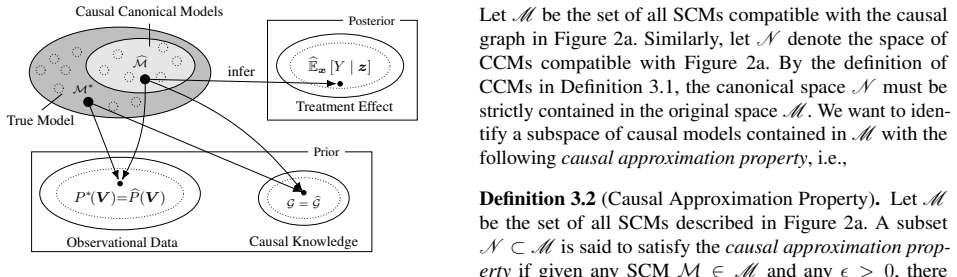
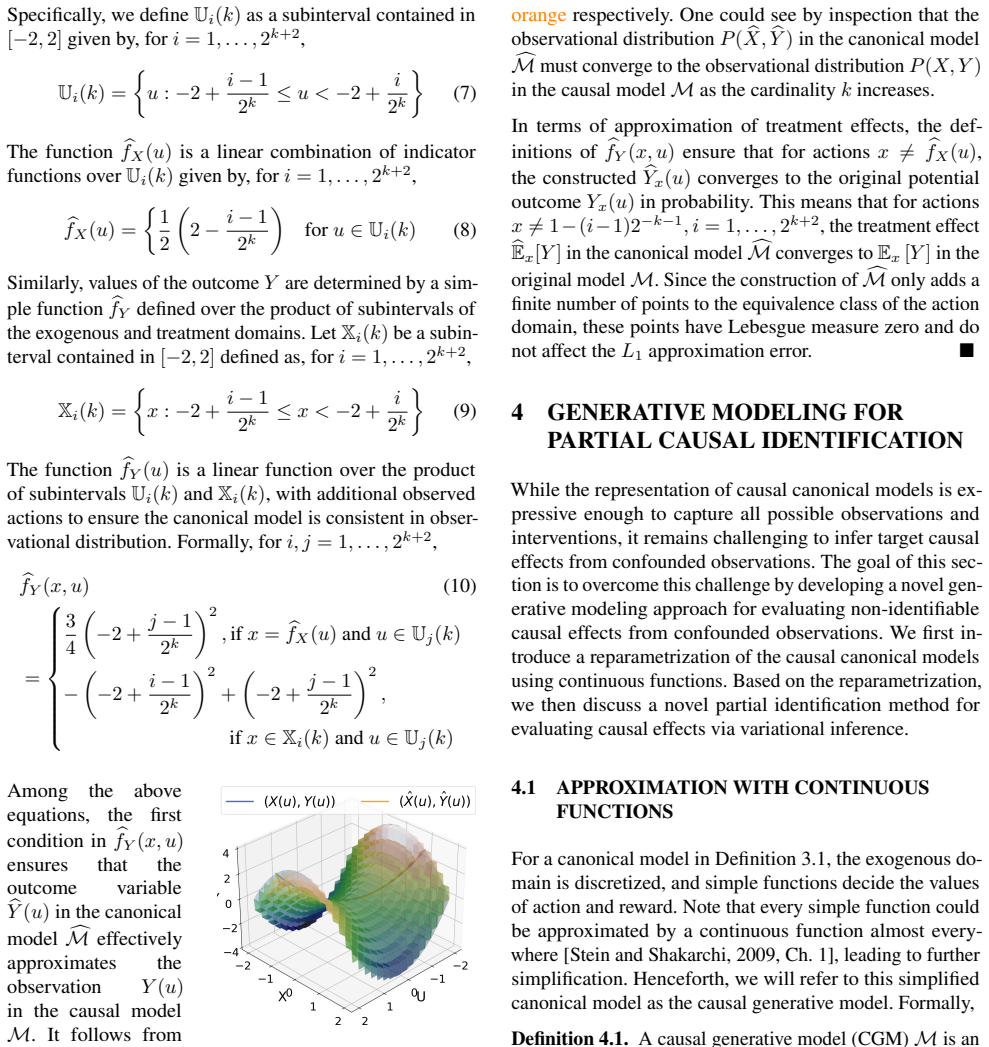
The authors introduce a universal discretization of the exogenous domains that approximates the observational and interventional distributions of any causal model with arbitrary accuracy using a finite number of latent states. Building on this newfound universal approximation property, they develop a novel family of Causal Gaussian process (CGP) models that effectively approximate the observational and interventional distributions of any causal model with confounded observations.
What carries the argument
universal discretization of the exogenous domains into a finite number of latent states, which enables Causal Gaussian process (CGP) models to approximate any causal model
If this is right
- Causal effect evaluation is possible over continuous domains from confounded observations.
- Only basic temporal ordering between treatment and outcome is needed.
- Any causal model can be approximated with arbitrary accuracy.
- Robust evaluation works without detailed prior knowledge of the environment.
Where Pith is reading between the lines
- The discretization approach could be combined with other function approximators beyond Gaussian processes for similar causal tasks.
- Practical tests could compare CGP-based estimates against ground-truth interventions in simulated continuous confounded systems.
- The method opens a route to handling mixed continuous-discrete variables by extending the same discretization idea.
Load-bearing premise
There exists a universal discretization of the exogenous domains that approximates the observational and interventional distributions of any causal model with arbitrary accuracy using a finite number of latent states.
What would settle it
A concrete causal model with continuous exogenous variables for which no finite discretization of those variables can make the induced observational and interventional distributions arbitrarily close to the true ones.
Figures

read the original abstract
The presence of confounding bias poses a key challenge in policy evaluation, as the target causal effects of actions are not identifiable (i.e., underdetermined) from observational data. On the other hand, existing confounding-robust evaluation strategies require detailed prior knowledge about the environment or apply only to discrete treatments and outcomes. This paper investigates causal effect evaluation over the continuous domain from confounded observations, while requiring only basic temporal ordering between the treatment and the outcome. We introduce a universal discretization of the exogenous domains that approximates the observational and interventional distributions of any causal model with arbitrary accuracy using a finite number of latent states. Building on this newfound universal approximation property, we develop a novel family of Causal Gaussian process (CGP) models that effectively approximate the observational and interventional distributions of any causal model with confounded observations.
Editorial analysis
A structured set of objections, weighed in public.
Referee Report
Summary. The manuscript claims to introduce a universal discretization of exogenous domains that approximates the observational and interventional distributions of any causal model to arbitrary accuracy using a finite number of latent states. It then develops a family of Causal Gaussian Process (CGP) models that leverage this property to approximate those distributions from confounded observations, enabling robust causal effect evaluation over continuous treatment and outcome domains while requiring only temporal ordering between treatment and outcome.
Significance. If the universal approximation property holds, the CGP framework would represent a notable contribution to causal inference by providing a nonparametric approach to continuous-domain treatment effect estimation under unobserved confounding, extending beyond existing methods limited to discrete variables or requiring strong prior knowledge. The approach could enable more flexible modeling in policy evaluation settings.
major comments (1)
- [Abstract] Abstract: The claim that there exists a 'universal discretization of the exogenous domains' that approximates 'the observational and interventional distributions of any causal model with arbitrary accuracy using a finite number of latent states' is load-bearing for the entire contribution. This property cannot hold for arbitrary causal models without additional uniformity conditions (e.g., compact support of all exogenous variables or uniform Lipschitz bounds on structural equations across the model class) that are not stated; without them the required resolution cannot be bounded independently of the specific model, as the discretization would need to adapt to arbitrarily differing noise supports or function moduli.
Simulated Author's Rebuttal
We thank the referee for their careful reading and valuable feedback. We address the single major comment below.
read point-by-point responses
-
Referee: [Abstract] Abstract: The claim that there exists a 'universal discretization of the exogenous domains' that approximates 'the observational and interventional distributions of any causal model with arbitrary accuracy using a finite number of latent states' is load-bearing for the entire contribution. This property cannot hold for arbitrary causal models without additional uniformity conditions (e.g., compact support of all exogenous variables or uniform Lipschitz bounds on structural equations across the model class) that are not stated; without them the required resolution cannot be bounded independently of the specific model, as the discretization would need to adapt to arbitrarily differing noise supports or function moduli.
Authors: We agree that the stated claim requires regularity conditions to hold uniformly. Our discretization construction relies on the exogenous variables having compact support and the structural equations satisfying a uniform Lipschitz bound over the model class; these ensure a finite partition suffices for arbitrary accuracy independent of any particular model. These conditions are standard for obtaining uniform approximation guarantees in nonparametric settings but were not explicitly listed in the abstract. In the revision we will update the abstract, the introduction, and the formal statement of the universal discretization result to make the assumptions explicit, thereby qualifying the claim to apply to causal models satisfying them. The remainder of the CGP development and the empirical results are unaffected, as they operate within this class. revision: yes
Circularity Check
No circularity: derivation introduces new discretization property and builds CGP models independently
full rationale
The paper states a universal discretization of exogenous domains as a new property that approximates any causal model's observational and interventional distributions to arbitrary accuracy with finite latent states, then develops CGP models on this property. No equations or text reduce a prediction or result to a fitted input, self-definition, or self-citation chain by construction. The central approximation claim is presented as a foundational result rather than derived from prior fitted parameters or renamed known results within the paper. The derivation chain remains self-contained against external benchmarks.
Axiom & Free-Parameter Ledger
axioms (1)
- domain assumption A universal discretization of the exogenous domains approximates the observational and interventional distributions of any causal model with arbitrary accuracy using a finite number of latent states.
invented entities (1)
-
Causal Gaussian Process (CGP) models
no independent evidence
Reference graph
Works this paper leans on
-
[1]
Pymc: a modern, and comprehensive probabilistic programming framework in python
Oriol Abril-Pla, Virgile Andreani, Colin Carroll, Larry Dong, Christopher J Fonnesbeck, Maxim Kochurov, Ravin Kumar, Junpeng Lao, Christian C Luhmann, Osvaldo A Martin, et al. Pymc: a modern, and comprehensive probabilistic programming framework in python. PeerJ Computer Science, 9: 0 e1516, 2023
2023
-
[2]
Angrist, G.W
J.D. Angrist, G.W. Imbens, and D.B. Rubin. Identification of causal effects using instrumental variables (with comments). Journal of the American Statistical Association, 91 0 (434): 0 444--472, 1996
1996
-
[3]
Measure, integration & real analysis
Sheldon Axler. Measure, integration & real analysis. Springer Nature, 2020
2020
-
[4]
Gaussian process linking functions for mind, brain, and behavior
Giwon Bahg, Daniel G Evans, Matthew Galdo, and Brandon M Turner. Gaussian process linking functions for mind, brain, and behavior. Proceedings of the National Academy of Sciences, 117 0 (47): 0 29398--29406, 2020
2020
-
[5]
Balke and J
A. Balke and J. Pearl. Counterfactual probabilities: Computational methods, bounds, and applications. In R. Lopez de Mantaras and D. Poole, editors, Uncertainty in Artificial Intelligence 10, pages 46--54. Morgan Kaufmann, San Mateo, CA, 1994
1994
-
[6]
Balke and J
A. Balke and J. Pearl. Bounds on treatment effects from studies with imperfect compliance. Journal of the American Statistical Association, 92 0 (439): 0 1172--1176, September 1997
1997
-
[7]
Doubly robust estimation in missing data and causal inference models
Heejung Bang and James M Robins. Doubly robust estimation in missing data and causal inference models. Biometrics, 61 0 (4): 0 962--973, 2005
2005
-
[8]
E.\ Bareinboim and J. Pearl. Causal inference and the data-fusion problem. Proceedings of the National Academy of Sciences, 113: 0 7345--7352, 2016
2016
-
[9]
On pearl’s hierarchy and the foundations of causal inference
E Bareinboim, JD Correa, D Ibeling, and T Icard. On pearl’s hierarchy and the foundations of causal inference. ACM Special Volume in Honor of Judea Pearl, 2020. forthcoming. Also, Technical Report R-60, Causal AI Lab, Columbia University, https://causalai.net/r60.pdf https://causalai.net/r60.pdf
2020
-
[10]
Variational inference: A review for statisticians
David M Blei, Alp Kucukelbir, and Jon D McAuliffe. Variational inference: A review for statisticians. Journal of the American statistical Association, 112 0 (518): 0 859--877, 2017
2017
-
[11]
The international stroke trial (ist): a randomized trial of aspirin, subcutaneous heparin, both, or neither among 19435 patients with acute ischaemic stroke
A Carolei et al. The international stroke trial (ist): a randomized trial of aspirin, subcutaneous heparin, both, or neither among 19435 patients with acute ischaemic stroke. The Lancet, 349: 0 1569--1581, 1997
1997
-
[12]
Gaussian process regression for materials and molecules
Volker L Deringer, Albert P Bart \'o k, Noam Bernstein, David M Wilkins, Michele Ceriotti, and G \'a bor Cs \'a nyi. Gaussian process regression for materials and molecules. Chemical Reviews, 121 0 (16): 0 10073--10141, 2021
2021
-
[13]
Doubly robust policy evaluation and learning
Miroslav Dud \' k, John Langford, and Lihong Li. Doubly robust policy evaluation and learning. In Proceedings of the 28th International Conference on International Conference on Machine Learning, pages 1097--1104. Omnipress, 2011
2011
-
[14]
Frangakis and D.B
C.E. Frangakis and D.B. Rubin. Principal stratification in causal inference. Biometrics, 1 0 (58): 0 21--29, 2002
2002
-
[15]
Galles and J
D. Galles and J. Pearl. Axioms of causal relevance. Artificial Intelligence, 97 0 (1-2): 0 9--43, 1997
1997
-
[16]
Stochastic relaxation, gibbs distributions, and the bayesian restoration of images
Stuart Geman and Donald Geman. Stochastic relaxation, gibbs distributions, and the bayesian restoration of images. IEEE Transactions on pattern analysis and machine intelligence, 0 (6): 0 721--741, 1984
1984
-
[17]
A tutorial on bayesian nonparametric models
Samuel J Gershman and David M Blei. A tutorial on bayesian nonparametric models. Journal of Mathematical Psychology, 56 0 (1): 0 1--12, 2012
2012
-
[18]
Huang and M
Y. Huang and M. Valtorta. Pearl's calculus of intervention is complete. In R. Dechter and T.S. Richardson, editors, Proceedings of the Twenty-Second Conference on Uncertainty in Artificial Intelligence, pages 217--224. AUAI Press, Corvallis, OR, 2006
2006
-
[19]
Confounding-robust policy improvement
Nathan Kallus and Angela Zhou. Confounding-robust policy improvement. In Advances in neural information processing systems, pages 9269--9279, 2018
2018
-
[20]
Auto-Encoding Variational Bayes
Diederik P Kingma and Max Welling. Auto-encoding variational bayes. arXiv preprint arXiv:1312.6114, 2013
work page internal anchor Pith review Pith/arXiv arXiv 2013
-
[21]
Causalgan: Learning causal implicit generative models with adversarial training
Murat Kocaoglu, Christopher Snyder, Alexandros G Dimakis, and Sriram Vishwanath. Causalgan: Learning causal implicit generative models with adversarial training. In International Conference on Learning Representations, 2018
2018
-
[22]
Automatic differentiation variational inference
Alp Kucukelbir, Dustin Tran, Rajesh Ranganath, Andrew Gelman, and David M Blei. Automatic differentiation variational inference. Journal of machine learning research, 18 0 (14): 0 1--45, 2017
2017
-
[23]
Toward minimax off-policy value estimation
Lihong Li, Remi Munos, and Csaba Szepesvari. Toward minimax off-policy value estimation. In Proceedings of the 18th International Conference on Artificial Intelligence and Statistics, May 2015. URL https://www.microsoft.com/en-us/research/publication/toward-minimax-off-policy-value-estimation/
2015
-
[24]
Stein variational gradient descent: A general purpose bayesian inference algorithm
Qiang Liu and Dilin Wang. Stein variational gradient descent: A general purpose bayesian inference algorithm. Advances in neural information processing systems, 29, 2016
2016
-
[25]
Monotone instrumental variables with an application to the returns to schooling, 1998
Charles F Manski and John V Pepper. Monotone instrumental variables with an application to the returns to schooling, 1998
1998
-
[26]
Clustering gene expression time series data using an infinite gaussian process mixture model
Ian C McDowell, Dinesh Manandhar, Christopher M Vockley, Amy K Schmid, Timothy E Reddy, and Barbara E Engelhardt. Clustering gene expression time series data using an infinite gaussian process mixture model. PLoS computational biology, 14 0 (1): 0 e1005896, 2018
2018
-
[27]
Universal kernels
Charles A Micchelli, Yuesheng Xu, and Haizhang Zhang. Universal kernels. Journal of Machine Learning Research, 7 0 (12), 2006
2006
-
[28]
Safe and efficient off-policy reinforcement learning
R \'e mi Munos, Tom Stepleton, Anna Harutyunyan, and Marc Bellemare. Safe and efficient off-policy reinforcement learning. In Advances in Neural Information Processing Systems, 2016
2016
-
[29]
Counterfactual identifiability of bijective causal models
Arash Nasr-Esfahany, Mohammad Alizadeh, and Devavrat Shah. Counterfactual identifiability of bijective causal models. In International Conference on Machine Learning, pages 25733--25754. PMLR, 2023
2023
-
[30]
J. Pearl. Causal diagrams for empirical research. Biometrika, 82 0 (4): 0 669--710, 1995
1995
-
[31]
J. Pearl. Causality: Models, Reasoning, and Inference. Cambridge University Press, NY, 2000. 2nd edition, 2009
2000
-
[32]
Sticking the landing: Simple, lower-variance gradient estimators for variational inference
Geoffrey Roeder, Yuhuai Wu, and David K Duvenaud. Sticking the landing: Simple, lower-variance gradient estimators for variational inference. Advances in Neural Information Processing Systems, 30, 2017
2017
-
[33]
Rosenbaum and D
P. Rosenbaum and D. Rubin. The central role of propensity score in observational studies for causal effects. Biometrika, 70: 0 41--55, 1983
1983
-
[34]
Estimating the dimension of a model
Gideon Schwarz. Estimating the dimension of a model. The annals of statistics, pages 461--464, 1978
1978
-
[35]
A constructive definition of dirichlet priors
Jayaram Sethuraman. A constructive definition of dirichlet priors. Statistica sinica, pages 639--650, 1994
1994
-
[36]
Gaussian process cosmography
Arman Shafieloo, Alex G Kim, and Eric V Linder. Gaussian process cosmography. Physical Review D—Particles, Fields, Gravitation, and Cosmology, 85 0 (12): 0 123530, 2012
2012
-
[37]
Shpitser and J
I. Shpitser and J. Pearl. Identification of joint interventional distributions in recursive semi- M arkovian causal models. In Proceedings of the Twenty-First National Conference on Artificial Intelligence, pages 1219--1226. 2006
2006
-
[38]
Spirtes, C.N
P. Spirtes, C.N. Glymour, and R. Scheines. Causation, Prediction, and Search. MIT Press, Cambridge, MA, 2nd edition, 2001
2001
-
[39]
Causation, prediction, and search
Peter Spirtes, Clark N Glymour, and Richard Scheines. Causation, prediction, and search. MIT press, 2000
2000
-
[40]
Real analysis
Elias M Stein and Rami Shakarchi. Real analysis. Princeton University Press, 2009
2009
-
[41]
Data-efficient off-policy policy evaluation for reinforcement learning
Philip Thomas and Emma Brunskill. Data-efficient off-policy policy evaluation for reinforcement learning. In International Conference on Machine Learning, pages 2139--2148, 2016
2016
-
[42]
A widely applicable bayesian information criterion
Sumio Watanabe. A widely applicable bayesian information criterion. The Journal of Machine Learning Research, 14 0 (1): 0 867--897, 2013
2013
-
[43]
Prediction with gaussian processes: From linear regression to linear prediction and beyond
Christopher KI Williams. Prediction with gaussian processes: From linear regression to linear prediction and beyond. In Learning in graphical models, pages 599--621. Springer, 1998
1998
-
[44]
P.G. Wright. The Tariff on Animal and Vegetable Oils. The MacMillan Company, New York, NY, 1928
1928
-
[45]
The method of path coefficients
Sewall Wright. The method of path coefficients. The annals of mathematical statistics, 5 0 (3): 0 161--215, 1934
1934
-
[46]
The causal-neural connection: Expressiveness, learnability, and inference
Kevin Xia, Kai-Zhan Lee, Yoshua Bengio, and Elias Bareinboim. The causal-neural connection: Expressiveness, learnability, and inference. Advances in Neural Information Processing Systems, 34: 0 10823--10836, 2021
2021
-
[47]
Neural causal models for counterfactual identification and estimation
Kevin Xia, Yushu Pan, and Elias Bareinboim. Neural causal models for counterfactual identification and estimation. In Proceedings of the 11th Eleventh International Conference on Learning Representations, 2022
2022
-
[48]
Bounding causal effects on continuous outcomes
Junzhe Zhang and Elias Bareinboim. Bounding causal effects on continuous outcomes. In Proceedings of the 35nd AAAI Conference on Artificial Intelligence, 2021
2021
-
[49]
Partial counterfactual identification from observational and experimental data
Junzhe Zhang, Jin Tian, and Elias Bareinboim. Partial counterfactual identification from observational and experimental data. In International Conference on Machine Learning, pages 26548--26558. PMLR, 2022
2022
discussion (0)
Sign in with ORCID, Apple, or X to comment. Anyone can read and Pith papers without signing in.