Borrowed Identities: Malleable Distillation Factories and a Unified Numerical Search
Pith reviewed 2026-06-30 01:07 UTC · model grok-4.3
The pith
Weaker borrowed-identity condition lets one numerical search recover all known distance-2 distillation factories
A machine-rendered reading of the paper's core claim, the machinery that carries it, and where it could break.
Core claim
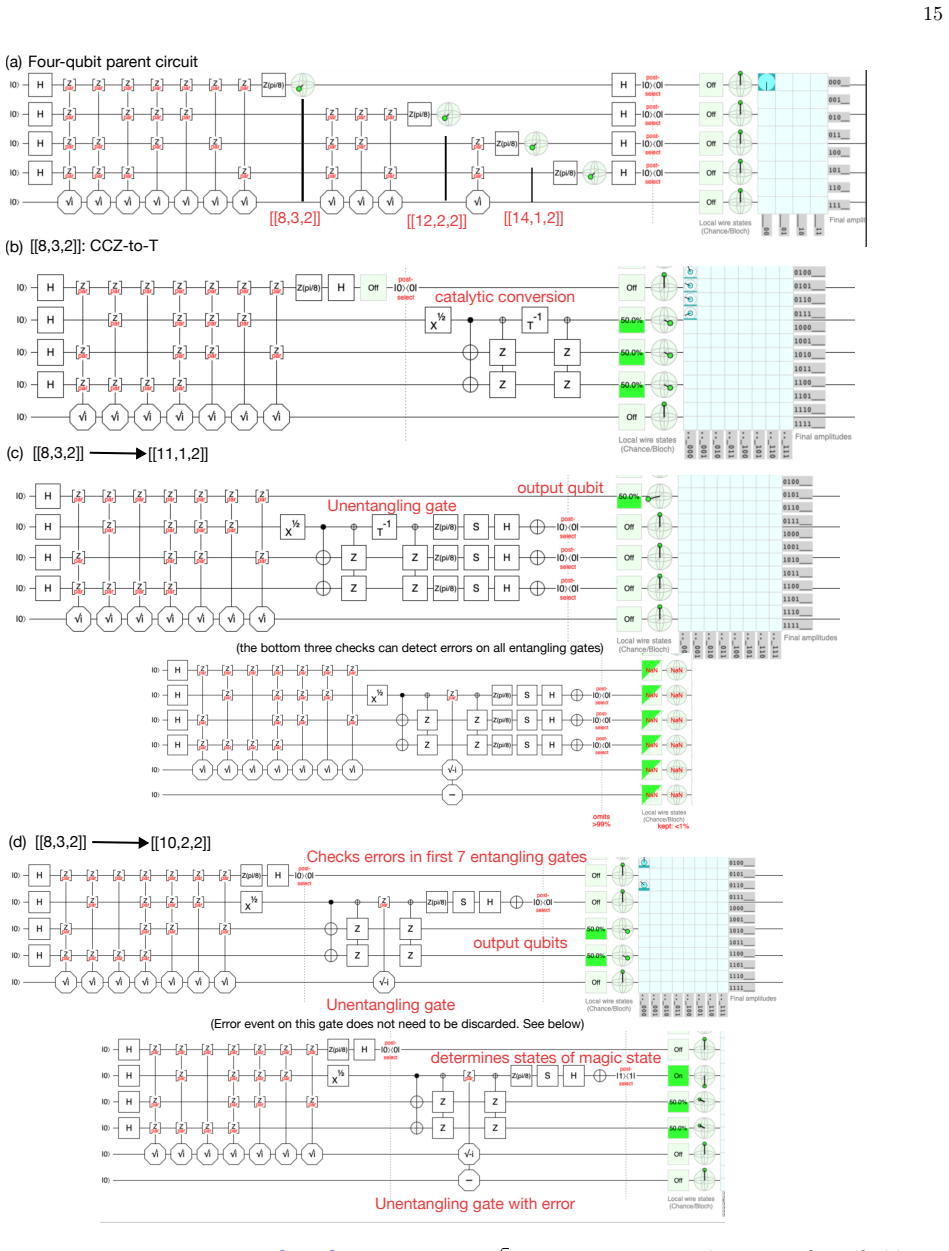
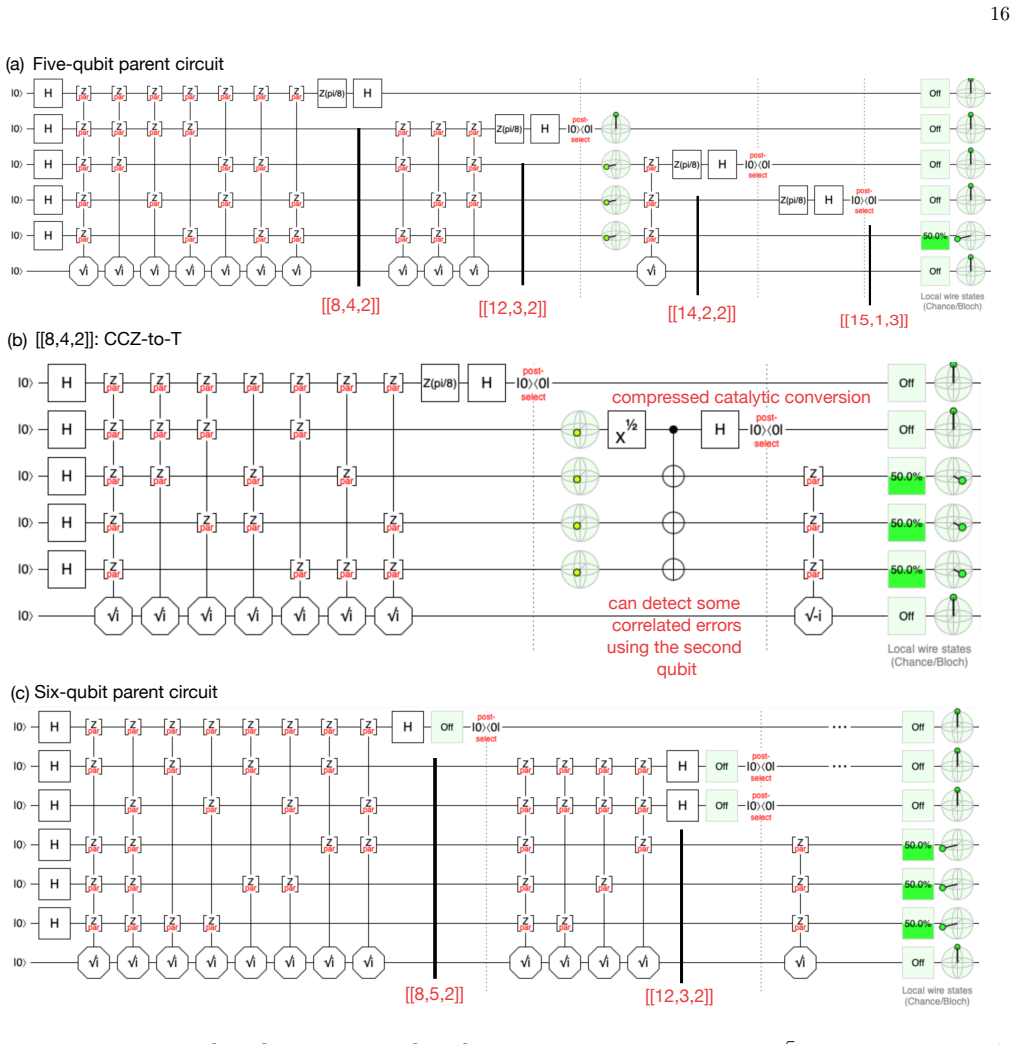
By requiring only that a circuit act as the identity on a single chosen input state, the borrowed-identity condition generates valid distillation factories at any level of the Clifford hierarchy. This condition unifies factories for different states such as |T>, |CS>, and |CCZ> within one search. Brute-force enumeration over circuits with two-group symmetry recovers all known distance-2 factories from code-based constructions, including previously hard-to-reach entangled-output and multi-output examples. The same parent circuits can be configured at compile time to distill any of the supported magic states.
What carries the argument
The borrowed-identity condition, which requires the circuit to implement the identity operation on one specific input state. It replaces the stricter requirement of a transversal gate acting correctly on the entire codespace, enabling broader and more efficient searches across magic states and code families.
If this is right
- All distance-2 factories from prior code-construction approaches are recovered by the single numerical search.
- Factories for |T>, |CS>, and |CCZ> states appear together inside the same search framework.
- Parent circuits support multiple output types that can be chosen at compile time rather than fixed by design.
- The method unifies constructions for non-CSS codes, synthillation, and catalytic factories under one condition.
Where Pith is reading between the lines
- The compile-time choice of output state in parent circuits could let compilers adapt distillation to available resources without new hardware.
- Relaxing the two-group symmetry assumption in future searches might locate additional factories beyond those already known.
- The borrowed-identity view may connect distillation to other fault-tolerant tasks that currently rely on partial logical identities rather than full transversal gates.
Load-bearing premise
Satisfying the borrowed-identity condition on a single input state is enough to guarantee that the circuit functions correctly as a distillation factory.
What would settle it
Running the brute-force search over borrowed-identity circuits with two-group symmetry and finding that it misses even one known distance-2 factory within the enumerated range would show the recovery claim does not hold.
Figures
read the original abstract
Magic-state distillation is one of the leading overheads in fault-tolerant quantum computation. Existing methods for finding distillation factories require a transversal gate to act correctly on the entire codespace, a constraint that limits both generality and search efficiency. We introduce a strictly weaker borrowed-identity condition, requiring only that the distillation circuit act as the identity on a single input state. It applies uniformly across all levels of the Clifford hierarchy and unifies, within a single level, factories that distill different magic states -- for example, the $|T\rangle$, $|CS\rangle$, and $|CCZ\rangle$ factories. A brute-force search over borrowed-identity circuits with two-group symmetry recovers, within the search range, all distance-2 factories known from code-construction approaches, including entangled-output and multi-output factories previously outside the scope of any single numerical search. This unification yields parent circuits that encode multiple factories, so the output magic-state type can be chosen at compile time rather than fixed by a hard-coded design. The framework also extends beyond CSS codes, unifying constructions, including synthillation and non-CSS catalytic factories, previously obtained by disparate approaches.
Editorial analysis
A structured set of objections, weighed in public.
Referee Report
Summary. The manuscript introduces a borrowed-identity condition requiring a distillation circuit to act as the identity only on a single chosen input state, as a strictly weaker alternative to requiring a transversal gate on the full codespace. It performs a brute-force search over such circuits with two-group symmetry and claims this recovers, within the search range, all known distance-2 factories for |T>, |CS>, and |CCZ> states (including entangled-output and multi-output variants previously outside any single numerical search), unifies constructions across Clifford hierarchy levels and CSS/non-CSS codes, and yields malleable parent circuits whose output magic-state type can be selected at compile time.
Significance. If the borrowed-identity condition suffices for valid distillation, the work would be significant for providing a unified numerical framework that recovers all known distance-2 factories in one search and extends to non-CSS catalytic and synthillation constructions. The explicit validation via recovery of known results from code-construction approaches is a clear strength, as is the demonstration of compile-time malleability.
major comments (1)
- [Definition of borrowed-identity condition] The section introducing the borrowed-identity condition asserts that the weaker condition (identity on one input state) is sufficient for the circuit to function as a valid distillation factory unifying |T>, |CS>, and |CCZ> cases. No explicit derivation is given showing how this condition propagates to correct distillation on the magic-state manifold or preserves the required commutation relations with stabilizers, which is load-bearing for the central unification and recovery claims.
Simulated Author's Rebuttal
We thank the referee for their careful reading and for recognizing the potential of the borrowed-identity framework to unify distillation searches. We respond to the major comment below.
read point-by-point responses
-
Referee: [Definition of borrowed-identity condition] The section introducing the borrowed-identity condition asserts that the weaker condition (identity on one input state) is sufficient for the circuit to function as a valid distillation factory unifying |T>, |CS>, and |CCZ> cases. No explicit derivation is given showing how this condition propagates to correct distillation on the magic-state manifold or preserves the required commutation relations with stabilizers, which is load-bearing for the central unification and recovery claims.
Authors: We agree that the manuscript does not contain an explicit derivation showing how the borrowed-identity condition propagates to valid distillation on the magic-state manifold or preserves commutation with stabilizers. The condition is motivated by the fact that distillation only requires the circuit to fix one chosen input state (the target magic state) while the two-group symmetry enforces the necessary error-detection properties on the orthogonal complement; the empirical recovery of all known distance-2 factories then serves as validation. To address the gap, we will insert a short derivation subsection (or expanded paragraph) in the revised manuscript that explicitly shows, for the two-group-symmetric circuits under consideration, how the borrowed-identity condition implies the output lies in the correct magic manifold and that stabilizer commutation is maintained via the symmetry. This addition will also clarify the unification mechanism across |T>, |CS>, and |CCZ>. revision: yes
Circularity Check
Numerical search over borrowed-identity circuits is self-contained with no definitional reduction
full rationale
The paper defines the borrowed-identity condition explicitly as acting as identity on one chosen input state, then performs an exhaustive brute-force enumeration of circuits satisfying that condition under two-group symmetry. The central result is the empirical recovery of all known distance-2 factories within the enumerated range; this recovery is a search outcome, not a quantity derived by algebraic construction from the same inputs. No equations reduce a fitted parameter to a renamed prediction, no uniqueness theorem is imported from self-citation as a load-bearing premise, and the unification across |T>, |CS>, |CCZ> and non-CSS cases follows directly from the uniform applicability of the single-state condition rather than from any prior ansatz smuggled in. The approach is therefore self-contained against external benchmarks (the known factories).
Axiom & Free-Parameter Ledger
Reference graph
Works this paper leans on
-
[1]
Bravyi and A
S. Bravyi and A. Kitaev, Phys. Rev. A71, 022316 (2005), introducesmagic-statedistillationandthe[[15 , 1, 3]]Reed– Muller protocol; also the[[5, 1, 3]] |T⟩-distillation routine
2005
-
[2]
Eastin and E
B. Eastin and E. Knill, Physical review letters102, 110502 (2009)
2009
-
[3]
Gottesman and I
D. Gottesman and I. L. Chuang, Nature402, 390 (1999)
1999
-
[4]
Sales Rodriguez, J
P. Sales Rodriguez, J. M. Robinson, P. N. Jepsen, Z. He, C. Duckering, C. Zhao, K.-H. Wu, J. Campo, K. Bagnall, M. Kwon,et al., Nature645, 620 (2025)
2025
-
[5]
A. G. Fowler, M. Mariantoni, J. M. Martinis, and A. N. Cleland, Phys. Rev. A86, 032324 (2012)
2012
- [6]
-
[7]
H. Zhou, C. Duckering, C. Zhao, D. Bluvstein, M. Cain, A.Kubica, S.-T.Wang,andM.D.Lukin,inProceedings of the 52nd Annual International Symposium on Computer Architecture(2025) pp. 1432–1448
2025
-
[8]
S. Bravyi and J. Haah, Phys. Rev. A86, 052329 (2012), triorthogonal codes; introduces the[[3k + 8, k, 2]]family. The k = 2instance is[[14 , 2, 2]]and the k = 4instance is [[20,4,2]]., 1209.2426
Pith/arXiv arXiv 2012
-
[9]
N. Rengaswamy, R. Calderbank, M. Newman, and H. D. Pfister, IEEE J. Sel. Areas Inf. Theory1, 499 (2020), 1910.09333
arXiv 2020
-
[10]
J. Haah and M. B. Hastings, Quantum2, 71 (2018), gen- eralised triorthogonal codes forT,CS,CCZdistillation., 1709.02832
Pith/arXiv arXiv 2018
-
[11]
H. Bombín and M. A. Martin-Delgado, Phys. Rev. B75, 075103 (2007), introduces the 3D color code; the smallest instance is the[[8, 3, 2]]code on the cube, with transversal Timplementing logicalCCZ., cond-mat/0607736
Pith/arXiv arXiv 2007
-
[12]
B. Eastin, Phys. Rev. A87, 032321 (2013), first8T→ CCZ (Toffoli) distillation factory using the[[8, 3, 2]]code of Ref. [11]., 1212.4872
Pith/arXiv arXiv 2013
-
[13]
A. Krishna and J.-P. Tillich, Phys. Rev. Lett.123, 070507 (2019), 1811.08461
arXiv 2019
- [14]
-
[15]
E. T. Campbell and M. Howard, Phys. Rev. A95, 022316 (2017), 1606.01904
Pith/arXiv arXiv 2017
-
[16]
A. M. Meier, B. Eastin, and E. Knill, Quantum Inf. Com- put.13, 195 (2013), the original[[10, 2, 2]](10 → 2) pro- tocol using the[[4,2,2]]code as inner block., 1204.4221
Pith/arXiv arXiv 2013
-
[17]
C. Jones, Phys. Rev. A87, 042305 (2013), introduces the[[ n, n− 4, 2]]“H-code” family of which[[6, 2, 2]]is the smallest member., 1210.3388
Pith/arXiv arXiv 2013
-
[18]
D. Litinski, Quantum3, 205 (2019), space-time-optimised distillation circuits including explicit15 → 1,20 → 4, 14 → 2, and8 →CCZ realisations on the surface code; the[[14 , 2, 2]]entry in our table is the small-footprint variant introduced here., 1905.06903
arXiv 2019
-
[19]
Gottesman, Phys
D. Gottesman, Phys. Rev. A54, 1862 (1996)
1996
- [20]
-
[21]
A. Barg, N. J. Coble, D. Hangleiter, and C. Kang, IEEE Transactions on Information Theory72, 415 (2026)
2026
-
[22]
M. A. Webster, B. J. Brown, and S. D. Bartlett, Quantum 6, 815 (2022)
2022
-
[23]
M. A. Webster, A. O. Quintavalle, and S. D. Bartlett, New Journal of Physics25, 103018 (2023)
2023
-
[24]
Gong, Magic state distillation via codes over binary extension fields, Oral presentation at the Quantum Error Correction 2026 conference (2026)
A. Gong, Magic state distillation via codes over binary extension fields, Oral presentation at the Quantum Error Correction 2026 conference (2026)
2026
-
[25]
This is the number of valid borrowed-identity solutions found, i.e. admissible (parameter-tuple, sign) configura- tions; it includes solutions with trivial (stabilizer) output and counts the same factory once for each(n, s)tuple realizing it, so it exceeds the number of distinct factories
- [26]
-
[27]
S. X. Cui, D. Gottesman, and A. Krishna, Phys. Rev. A 95, 012329 (2017), 1608.06596. [28]S n acts by relabeling qubit registers, not by physically permuting hardware: qubits with identical circuit con- nectivity are interchangeable for the borrowed-identity condition
Pith/arXiv arXiv 2017
-
[28]
Even weights cannot yieldk= 1factories
-
[29]
A. M. Steane, Phys. Rev. A54, 4741 (1996)
1996
-
[30]
Steane, Proceedings of the Royal Society of London
A. Steane, Proceedings of the Royal Society of London. Se- ries A: Mathematical, Physical and Engineering Sciences 452, 2551 (1996)
1996
-
[31]
A.GongandJ.M.Renes,arXivpreprintarXiv:2410.23263 (2024)
arXiv 2024
-
[32]
L. Luo, Z. Ma, D. Lin, and H. Wang, Quantum Science & Technology5, 045022 (2020)
2020
-
[33]
Kubica and M
A. Kubica and M. E. Beverland, Physical Review A91, 032330 (2015)
2015
-
[34]
E.g.[[8 , 4, 2]]at l = 3is a Clifford-padded version of the cube[[8 , 3, 2]]; it is retained as a distinct CCZ-class factory, since the extra qubit yields additional correlated-error detection (Fig. 6(b)). 7
-
[35]
Gidney, Quirk: A drag-and-drop quantum circuit sim- ulator
C. Gidney, Quirk: A drag-and-drop quantum circuit sim- ulator. (2016)
2016
-
[36]
C. Jones, Phys. Rev. A87, 052334 (2013), indepen- dent and concurrent8T→CCZ construction using the [[8, 3, 2]]code of Ref. [11]; refined two-round error detec- tion., 1303.6971
Pith/arXiv arXiv 2013
-
[37]
H. Jacinto, X. Valcarce, V. Barizien, É. Gouzien, and N. Sangouard, arXiv preprint arXiv:2606.07734 (2026)
Pith/arXiv arXiv 2026
-
[38]
mO + mS odd with mO ≤ 1, mS ≤0
S. Singh, Algebraic magic state factory search [GitHub] (2026). Appendix A: Schrödinger vs. Heisenberg picture: specialization to triorthogonality Proposition 7.Every transversal- T distillation cir- cuit on a CSS code is, under spacetime duality, a bor- rowed identity. The converse fails: the catalytic factories [[10, 2, 2]]and[[11 , 1, 2]]constructed in...
2026
-
[39]
The[[8,3,2]]factory (n= 4,k= 3,l= 3) The[[8 , 3, 2]]factory (Quirk) arises from the sequential construction at j = 1with W1 = {1, 2, 3, 4}, n = 4, θ=π/8. a. Borrowed-identity check.The Dicke-sector con- dition (Lemma 2) at i = 1requires P w∈W 3 w−1 ∈ 2l−i+1Z= 8Z: 3 0 + 3 1 + 3 2 + 3 3 = 1 + 3 + 3 + 1 = 8≡0 (mod 8).✓ (E1) Higher Dicke sectorsi∈ { 2, 3} giv...
-
[40]
The[[20,4,2]]factory (n= 7,k= 4,l= 3) We verify the asymmetric borrowed-identity condition at(l, n, k) = (3,7,4),θ=π/8,(s total, sO, sS) = (2,3,1). a. Gate set. Wtotal = {1, 3, 5, 7}, WO = {0, 1, 4}, WS = {0, 1, 2, 3}. The allowed pairs are W = {(0, 1), (0, 3), (1, 0), (1, 2), (4, 1), (4, 3)}. The borrowed- identity gate count is Ncircuit = 4 0 3 1 + 4 0 ...
-
[41]
For each parameter tuple( l, n, k, stotal, sO), the gate set W is determined by the three weight-separation setsWtotal, WO, WS as 10 described for asymmetric circuits
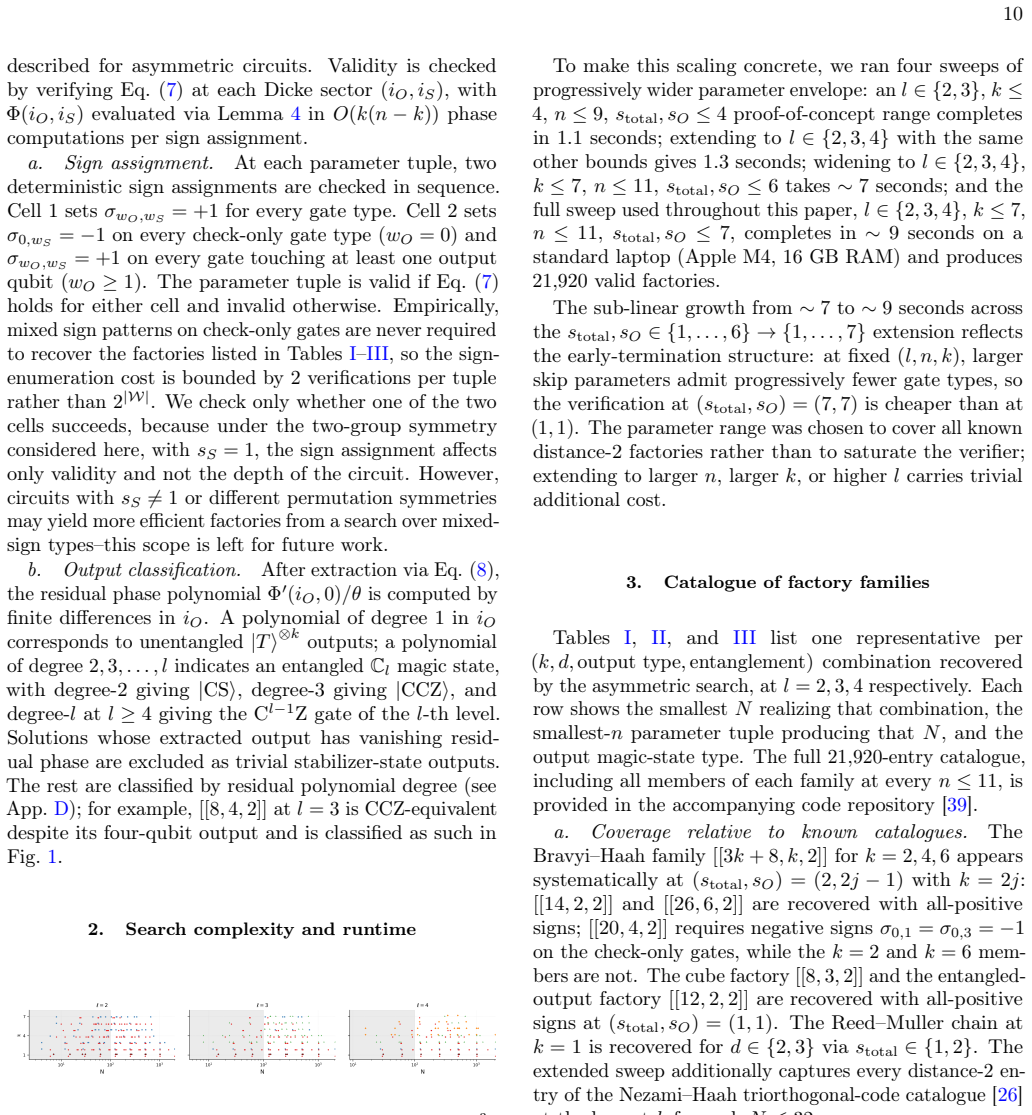
Search procedure The asymmetric search enumerates over the skip param- eters( stotal, sO)with sS = 1fixed. For each parameter tuple( l, n, k, stotal, sO), the gate set W is determined by the three weight-separation setsWtotal, WO, WS as 10 described for asymmetric circuits. Validity is checked by verifying Eq.(7) at each Dicke sector(iO, iS), with Φ(iO, i...
-
[42]
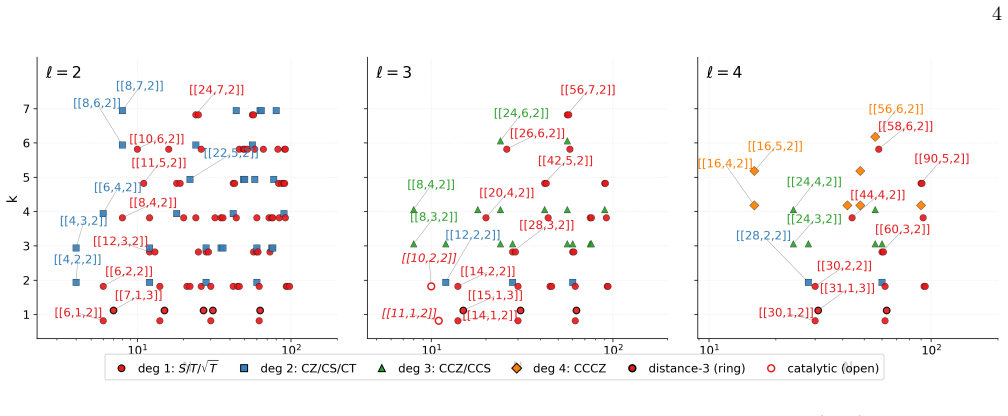
Search complexity and runtime FIG. 2. Full extent of the two-group catalogue (N up to∼103); the shaded band marks theN≤100region shown in Fig. 1. For each( l, n, k)triple, the number of( stotal, sO)pa- rameter tuples is|Stotal| × |SO|; per tuple, the determin- istic two-cell check requires at most2verifications. Each verification costs O(k(n−k ))phase com...
-
[43]
Each row shows the smallestN realizing that combination, the smallest-n parameter tuple producing thatN, and the output magic-state type
Catalogue of factory families Tables I, II, and III list one representative per (k, d,output type,entanglement)combination recovered by the asymmetric search, atl = 2, 3, 4respectively. Each row shows the smallestN realizing that combination, the smallest-n parameter tuple producing thatN, and the output magic-state type. The full21,920-entry catalogue, i...
2032
-
[44]
, qn−k} and output qubitsO = {qn−k+1,
Construction and phase condition Definition 9(Sequential borrowed identity).Let θ = π/2l and partition n qubits into check qubits S = {q1, . . . , qn−k} and output qubitsO = {qn−k+1, . . . , qn}. Asequential borrowed identityis constructed by fixing each qj in turn and applying all multi-weight phase rota- tion (Eq. 2) from{qj, . . . , qn} with support co...
-
[45]
The four-qubit parent (n = 4, Wj = {1,
Worked examples We verify Eq.(G2) explicitly for the four- and five- qubit malleable parent circuits discussed in the main text, working atl = 3( θ = π/8,2 π/θ = 16) with skip parameter s = 1unless otherwise stated. The four-qubit parent (n = 4, Wj = {1, . . . , n−j + 1}) produces a sequential chain[[8 , 3, 2]] → [[12, 2, 2]] → [[14, 1, 2]], and the five-...
-
[46]
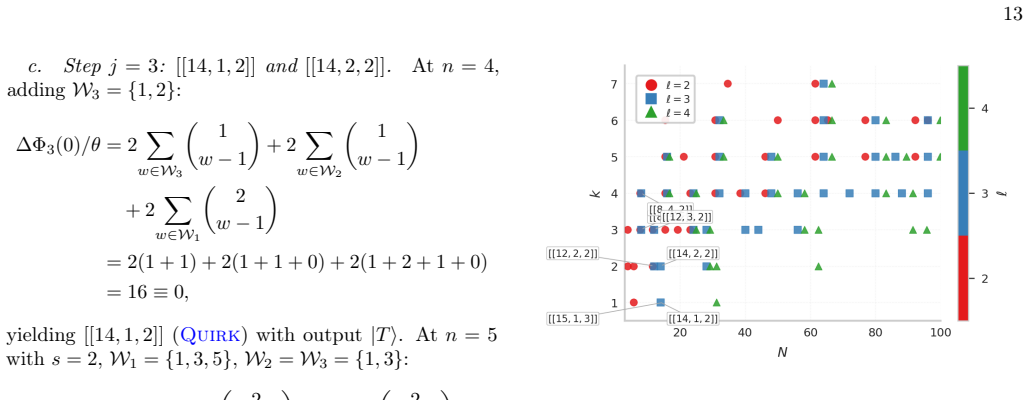
Results and qualitative features The sequential search results are shown in Fig. 3. For each( l, n)with l∈ { 2, 3, 4} and n≤ 6, we enumerate sequences( W1, . . . ,WJ)with J = n−k and each Wj = {w≡ 1 mods j : w≤n−j +1 } for sj ∈ {1, 2, 3, 4}, giving 4J candidate tuples per(n, J). Each candidate is verified in O(J2n)time by evaluating Eq.(G2) for all i at e...
discussion (0)
Sign in with ORCID, Apple, or X to comment. Anyone can read and Pith papers without signing in.