Surface thermodynamics, surface stress, equations at surfaces and triple lines for deformable bodies
Pith reviewed 2026-05-25 15:25 UTC · model grok-4.3
The pith
Surface strain as a thermodynamic variable yields new equilibrium equations at surfaces and a modified Young's law at triple lines.
A machine-rendered reading of the paper's core claim, the machinery that carries it, and where it could break.
Core claim
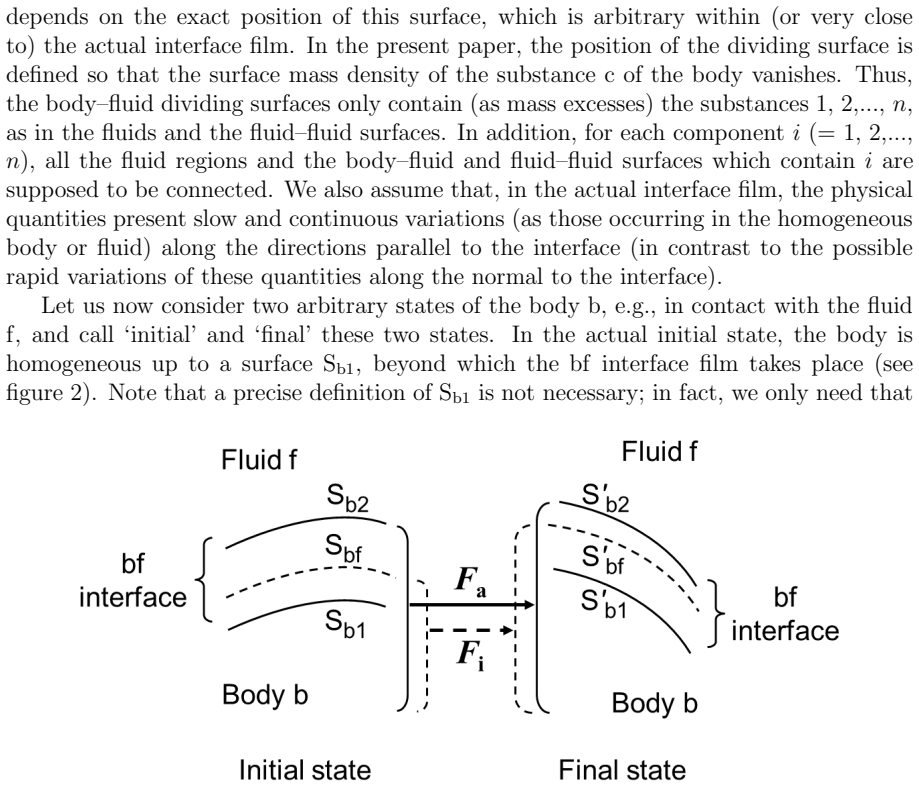
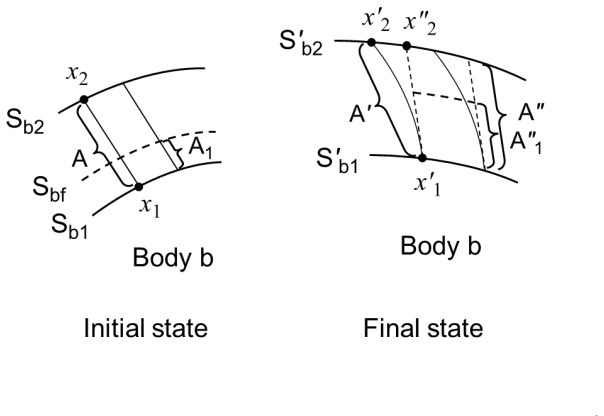
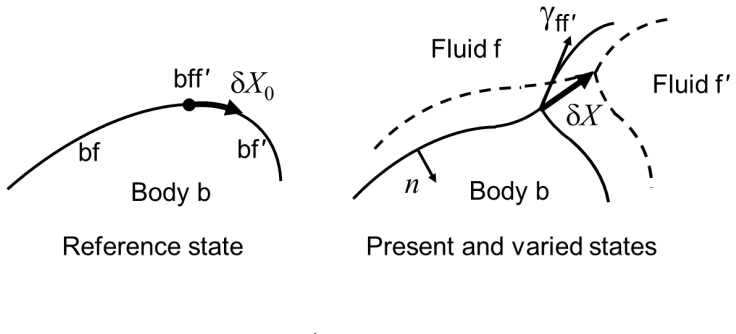
Following and refining Gibbs, the local thermodynamic variables of the surface are only temperature, chemical potentials, and the surface strain tensor. A new definition of surface stress is introduced and the corresponding thermodynamic equations are written. The mechanical equilibrium equation at the surface, involving this stress, is obtained and is analogous to the Cauchy equation in the volume; its normal component generalizes the Laplace equation. At a triple contact line two equations appear: force equilibrium for a line fixed on the body, and equilibrium relative to motion of the line with respect to the body. The latter strongly modifies Young's classical capillary equation.
What carries the argument
The surface strain tensor treated as a true thermodynamic variable that, together with temperature and chemical potentials, fixes the surface state and determines the surface stress.
If this is right
- The normal component of the surface equilibrium equation supplies a generalized Laplace relation for the pressure jump across a curved surface.
- Force balance at a fixed triple line is expressed directly in terms of the three surface stresses meeting at the line.
- A separate equation governs the equilibrium motion of the triple line relative to the underlying body and replaces the classical Young's angle condition.
- The same thermodynamic framework applies uniformly to viscoelastic solids and viscous fluids because both are described by the strain tensor as the relevant state variable.
Where Pith is reading between the lines
- Contact-angle data collected on soft or strained substrates would require reinterpretation once the strain dependence in the triple-line equation is included.
- The motion equation could be tested in dynamic-wetting experiments where the triple line advances across a pre-strained solid surface.
- The generalized Laplace relation suggests that curvature-induced pressure jumps should be re-measured on surfaces whose strain is independently controlled.
Load-bearing premise
The local thermodynamic variables of the state of the surface are only the temperature, the chemical potentials and the surface strain tensor.
What would settle it
Direct measurement of contact angles or force balance at a moving triple line on a deformable solid under controlled surface strain that fails to satisfy the derived motion equation would falsify the modification of Young's law.
Figures
read the original abstract
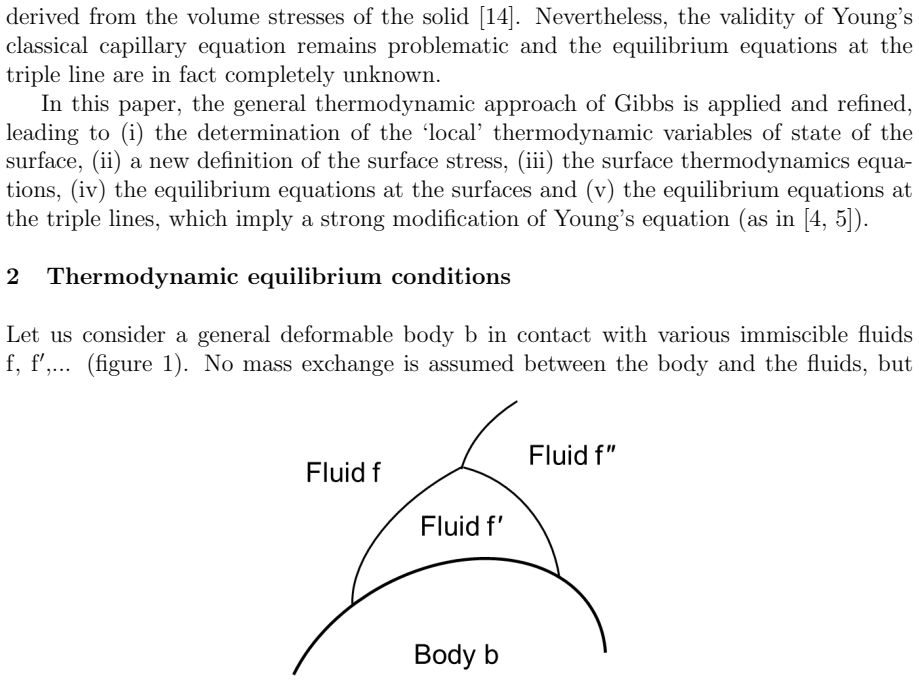
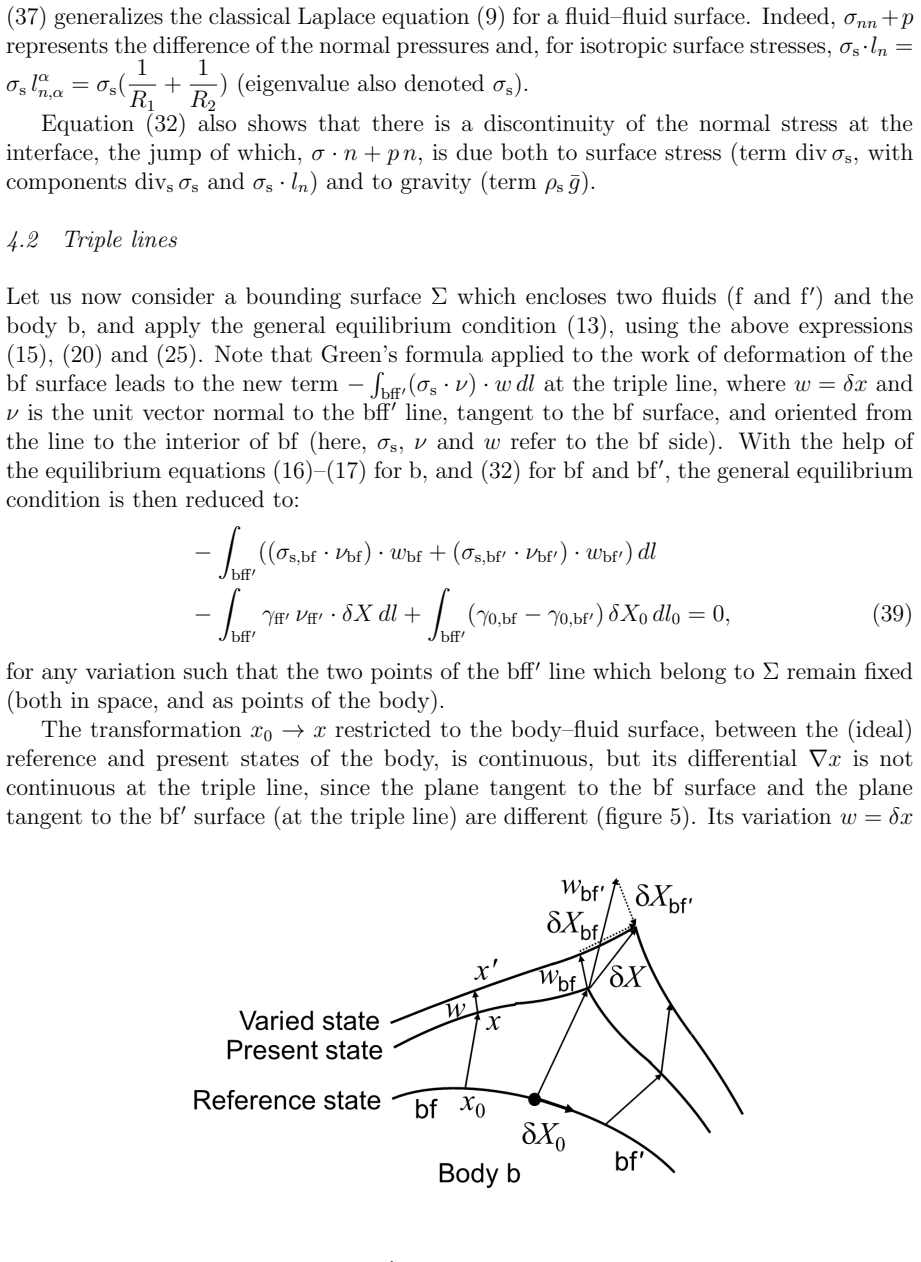
The thermodynamics and mechanics of the surface of a deformable body are studied here, following and refining the general approach of Gibbs. It is first shown that the 'local' thermodynamic variables of the state of the surface are only the temperature, the chemical potentials and the surface strain tensor (true thermodynamic variables, for a viscoelastic solid or a viscous fluid). A new definition of the surface stress is given and the corresponding surface thermodynamics equations are presented. The mechanical equilibrium equation at the surface is then obtained. It involves the surface stress and is similar to the Cauchy equation for the volume. Its normal component is a generalization of the Laplace equation. At a (body-fluid-fluid) triple contact line, two equations are obtained, which represent: (i) the equilibrium of the forces (surface stresses) for a triple line fixed on the body; (ii) the equilibrium relative to the motion of the line with respect to the body. This last equation leads to a strong modification of Young's classical capillary equation.
Editorial analysis
A structured set of objections, weighed in public.
Referee Report
Summary. The manuscript refines Gibbs' approach to surface thermodynamics for deformable bodies (viscoelastic solids or viscous fluids). It identifies the local thermodynamic state variables of the surface as temperature, chemical potentials, and the surface strain tensor; introduces a new definition of surface stress; derives the corresponding thermodynamic relations and the mechanical equilibrium equation at the surface (whose normal component generalizes the Laplace equation); and obtains two equilibrium conditions at a body-fluid-fluid triple line, one for fixed-line force balance and one for relative motion of the line, the latter yielding a modified form of Young's capillary equation.
Significance. If the derivations are correct, the work supplies a thermodynamically consistent, parameter-free framework for surface stress and mechanics that applies uniformly to solids and fluids. The explicit construction from the restricted variable set (T, μ_i, strain tensor) and the two equilibrium conditions at the triple line, without additional work terms, is a strength and could provide testable predictions for capillarity on soft or viscoelastic materials.
minor comments (2)
- [Abstract] Abstract: the phrase 'strong modification of Young's classical capillary equation' is used without stating the explicit form of the new equation or the key difference from the classical result; adding one sentence with the modified equation would improve accessibility.
- The manuscript refers to 'the initial section' that establishes the variable set, but the numbering or heading of that section is not indicated in the provided text; consistent section numbering would aid cross-referencing.
Simulated Author's Rebuttal
We thank the referee for the positive summary, significance assessment, and recommendation of minor revision. The report contains no specific major comments requiring point-by-point response.
Circularity Check
No significant circularity; derivation follows from stated thermodynamic variables
full rationale
The abstract and description establish the local thermodynamic variables (T, chemical potentials, surface strain tensor) as the starting point before presenting surface stress definitions and deriving equilibrium equations at surfaces and triple lines. No equations are provided that reduce a claimed result to a fitted parameter or self-referential definition by construction. No self-citations are invoked as load-bearing uniqueness theorems, and the modification to Young's equation is presented as following directly from force balance and relative motion equilibrium conditions. The paper is self-contained against external benchmarks with no evident circular steps.
Axiom & Free-Parameter Ledger
Reference graph
Works this paper leans on
-
[1]
Gibbs J W 1876 Trans. Conn. Acad. III 108–248 Gibbs J W 1878 Trans. Conn. Acad. III 343–524
-
[2]
Gurtin M E and Murdoch A I 1975 Arch. Ration. Mech. Anal. 57 291–323
work page 1975
-
[3]
Nozi` eres P and Wolf D E 1988Z. Phys. B 70 399–407
- [4]
-
[5]
Olives J 1996 SIAM J. Appl. Math. 56 480–93
work page 1996
-
[6]
Gurtin M E, Weissm¨ uller J and Larch´ e F 1998Phil. Mag. A 78 1093–109
- [7]
-
[8]
M¨ uller P and Sa´ ul A 2004Surf. Sci. Rep. 54 157–258
-
[9]
Rusanov A I 2005 Surf. Sci. Rep. 58 111–239
work page 2005
- [10]
- [11]
-
[12]
Shanahan M E R and de Gennes P-G 1986 C. R. Acad. Sci. Paris II 302 517–21
work page 1986
-
[13]
Shanahan M E R 1986 C. R. Acad. Sci. Paris II 303 1537–40
work page 1986
-
[14]
Madasu S and Cairncross R A 2004 Int. J. Num. Meth. Fluids 45 301–19
work page 2004
-
[15]
Shuttleworth R 1950 Proc. R. Soc. A 63 444–57
work page 1950
-
[16]
Olives J and Bronner G 1984 J. Struct. Geol. 6 599–601 22
work page 1984
discussion (0)
Sign in with ORCID, Apple, or X to comment. Anyone can read and Pith papers without signing in.