REVIEW 3 major objections 5 minor 84 references
Cooperative metabolic resource allocation in spatially-structured systems
T0 review · 3 major / 5 minor · reviewed 2026-08-14 · deepseek-v4-flash
Pith's one-line read A maximum-entropy control law using only a population-wide biomass measure determines when cells cooperate via cross-feeding.
desk verdict A clean mathematical extension of max-ent metabolic control to cooperative spatial populations, honest about its own limits, but the explanatory claim rests on a free parameter and an unverified global-sensing premise. read the letter →
The pith
A machine-rendered reading of the paper's core claim, the machinery that carries it, and where it could break.
The reading
What carries the argument
The central object is the generalized mean $M_p(x) = ((1/N)\sum_i x_i^p)^{1/p}$ of total catalytic biomass over the population network, which interpolates between utilitarian ($p=1$), Nash ($p\to 0$), egalitarian ($p\to -\infty$), and elitist ($p\to +\infty$) welfare functions. The argument runs through the greedy effective return-on-investment $R_{k,i}^0 = [x_i^p/(x_i^p + y^p)] M_p(x) R_k^0(m_i)$, where $y=(\sum_{j\ne i}x_j^p)^{1/p}$ measures the rest of the population. The sigmoid factor $x_i^p/(x_i^p + y^p)$ is the mechanism: it compares local biomass with the global ensemble and modulates the spread of resource across elementary flux modes, and the Boltzmann form of the control law is the maximum-entropy step that turns these returns into allocation fractions.
What would settle it
In a two-layer colony where only the lower layer receives glucose, measure the fermentation-product secretion rate of the glucose-fed layer while manipulating the biomass ratio between layers. The egalitarian control predicts that the glucose-fed node secretes more fermentation product when its biomass is above the global ensemble value and less when below; if secretion does not respond to the relative biomass signal, or responds identically when the global signal is blocked, the central claim is falsified.
Extended reading notes
Core claim
The paper claims that a cooperative maximum entropy control, Equation (7) with the greedy effective return-on-investment in Equation (8), describes when cells in a spatially structured population should allocate metabolic resources to cross-feeding pathways rather than to their own growth. The control law maximizes $M_p(x)$, a generalized mean of total catalytic biomass across the population network, and requires no detailed knowledge of other cells' states: the only global information is the ensemble measure $M_p(x)$ and the complementary sum $y$. For $p<0$ (egalitarian regime), cells that are large relative to the population spread resource more evenly across pathways, favoring export of metabolites, while cells that are small concentrate on growth, so the lowest-biomass node is lifted. For $p>0$ (elitist regime) the behavior reverses, favoring the dominant node, and at $p=0$ the Nash regime applies a uniform cooperative factor. The paper shows in a two-node model that these regimes change the growth of a glucose-deprived node in the predicted direction.
Load-bearing premise
The argument depends on cells having evolved to optimize a single community-wide measure of everyone's biomass, and on their being able to sense that measure; without that, the predicted cooperative behavior has no basis.
Editorial extensions
If this is right
- If the control law is right, metabolic cross-feeding is not a separate evolutionary invention but a bet-hedging response once the objective includes the community's welfare.
- It predicts that cross-feeding should increase when the producing node's biomass exceeds the rest of the population in egalitarian regimes, and decrease in elitist regimes.
- The theory unifies dynamic flux balance analysis, unregulated balanced-growth models, and proportional-law cybernetic models as limits of one control law, while adding cooperative behavior none of them exhibit.
- It explains why quorum sensing can regulate metabolism even when cells have no information about individuals elsewhere: the ensemble measure is sufficient.
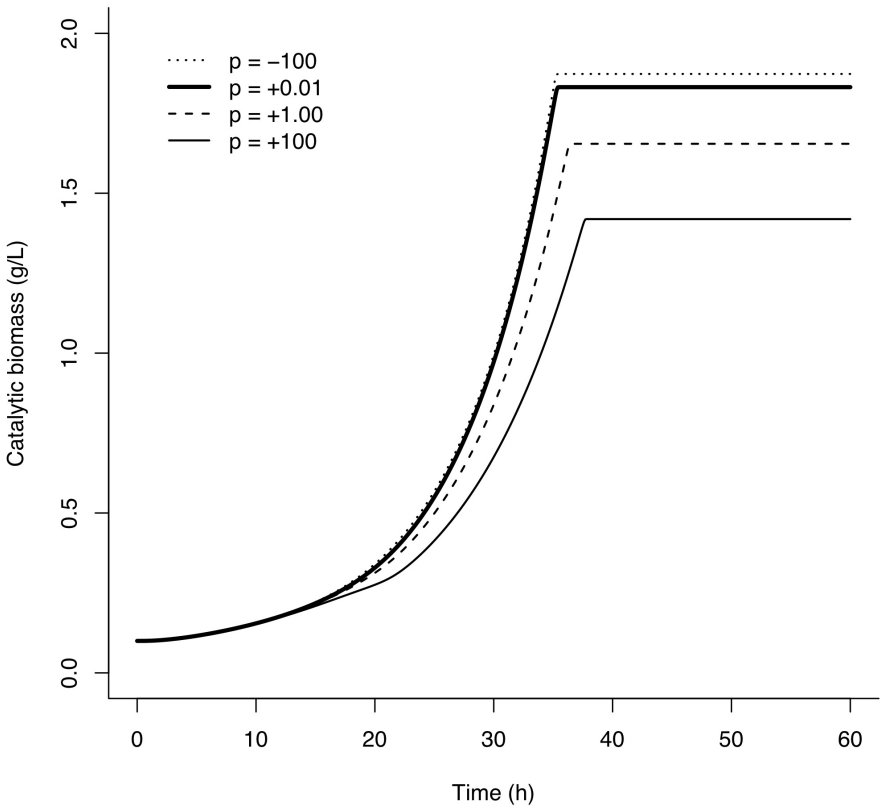
- It identifies the Nash geometric-mean objective as a plausible compromise point, and simulations show Nash and egalitarian trajectories nearly coincide in the two-node model.
Reading between the lines
- If $p$ is an evolutionarily adjustable trait, different species or environments should be classifiable by their inferred $p$: measuring cross-feeding fluxes under imposed biomass asymmetries could fit a value of $p$ for a given community.
- The same control law could be transferred to spatially organized eukaryotic systems such as tumor lactate shuttling, predicting that hypoxic subpopulations receive more cross-fed metabolite when the community objective is egalitarian; this is an extension the author notes is plausible but does not test.
- An experimental test could externally control the putative global signal, such as a quorum-sensing molecule, without changing local metabolism; the theory predicts allocation shifts along the sigmoid even if the local nutrient state is held fixed.
- The near-identity of Nash and egalitarian trajectories in the two-node model suggests the cooperative regime may be insensitive to the exact value of $p$ near zero, but whether this holds for larger networks is an open question that the paper does not address.
Signed reviews
Editorial analysis
A structured set of objections, weighed in public.
Referee Report
Summary. The manuscript extends the author's earlier maximum-entropy framework for dynamic metabolic resource allocation to spatially structured populations. It assumes a cooperative objective given by the generalized mean M_p(x) of total catalytic biomass across nodes, derives a greedy cooperative maximum-entropy control law (Eq. 7) whose effective return-on-investment (Eq. 8) contains a sigmoid factor x_i^p/(x_i^p+y^p), and shows how the sign of p interpolates between egalitarian, Nash, utilitarian, and elitist cross-feeding regimes. A two-node biofilm/colony model is simulated for representative p values, showing that egalitarian control increases the growth of a node lacking glucose while elitist control suppresses it. The appendix proves the p=1 limit recovers the individualistic control of [35].
Significance. If accepted, the paper would provide a parsimonious information-theoretic account of how a global population-level signal (e.g., quorum sensing) could locally regulate metabolic cross-feeding, unifying bet-hedging and cooperation under one maximum-entropy principle. The algebraic derivation is clean and the p=1 limit is correctly recovered. However, the explanatory claim rests on the unverified postulate that cells maximize M_p(x) with a single shared p; without independent justification or estimation of p, the model demonstrates consequences of an assumed objective rather than testing it. The paper's own 'purely qualitative' disclaimer in Section 4 appropriately limits the scope of the simulations. The theoretical framework is a useful contribution, but the central empirical/explanatory claim is not yet established.
major comments (3)
- [Section 2, Eq. (5)] The cooperative objective M_p(x) is introduced as a postulate, with no evolutionary argument for why natural selection would favor this particular generalized-mean welfare function or why a single exponent p should be shared across all nodes. Because p is a free parameter (Table 1; Figure 4 uses p=1, -100, 0.01, 100), the family (5) spans the utilitarian, egalitarian, Nash, and elitist regimes by construction. The abstract and Section 5 state that the theory 'explains why' cooperative cross-feeding can fulfil a community-wide objective; this goes beyond the conditional statement in the abstract ('if individuals take into consideration an ensemble measure'). Please either soften the explanatory claims to explicitly conditional predictions or provide an independent biological argument/empirical strategy for determining p.
- [Section 3, Eq. (8); Appendix A] The sigmoid factor x_i^p/(x_i^p+y^p) in the greedy effective return-on-investment (8) is exactly the derivative ∂M_p/∂x_i (up to the multiplicative x_i), as derived in Appendix A. Consequently, the directional cross-feeding behavior (egalitarian nodes with x_i<y receive more investment; elitist nodes with x_i>y receive more) is a mathematical restatement of the assumed objective, not an emergent prediction of the maximum-entropy principle. The derivation is internally consistent, but the claim that the framework 'explains' cross-feeding is circular unless the generalized-mean objective is justified independently of the behavior it is meant to explain. Please acknowledge this explicitly and distinguish modeled assumption from emergent prediction.
- [Section 4, Figure 4] The simulation study is explicitly qualitative: the text states that 'no attempt has been made to fit them to experimental data' and that predictions 'should be treated as purely qualitative.' Figure 4 sweeps the free parameter p over the four regimes rather than testing a falsifiable prediction. As a result, the qualitative contrast between individualistic, egalitarian, elitist, and Nash trajectories does not discriminate the proposed mechanism from alternative local-feedback or bet-hedging explanations. A falsifiable prediction—for example, a quantitative relationship between quorum-sensing signal strength and the fraction of resource allocated to cross-feeding, or an estimation of p from published data—is needed to support the claimed explanatory power.
minor comments (5)
- [Section 2, paragraph preceding Eq. (2)] The phrase 'conical combination combination of EFMs' contains a duplicated word; it should read 'conical combination of EFMs.'
- [Section 3, second paragraph] The sentence 'Evaluation of (7) depends on a choice of ∆ t = 0' appears to be incomplete; it should read 'depends on a choice of ∆t = 0 or ∆t > 0.'
- [Table 1] The units of kLa are listed as g·L^-1, but a volumetric mass transfer coefficient should have units of h^-1.
- [Section 3, Eq. (8)] The quantity y is defined as a generalized sum over j ≠ i, but the notation y does not carry a node index; since y differs from node to node, consider writing y_i to avoid ambiguity.
- [Figure 4 caption] The caption states that p=0.01 approximates the Nash regime (p→0); for consistency with p=-100 and p=100, consider explicitly noting that p=0.01 is used to approximate the p=0 limit.
Circularity Check
No significant circularity: the cooperative control is derived from an explicit objective, and the paper conditions its explanatory claim on that premise.
full rationale
The mathematical derivation chain is self-contained: Appendix A obtains the greedy cooperative control by differentiating the declared objective M_p(x), and the sigmoid factor in Eq. (8) is exactly x_i times the marginal contribution of x_i to M_p(x). This makes the directional cross-feeding behaviour for a given p a consequence of the assumed objective, but the paper does not disguise that assumption as an independent prediction: it scans p to represent different welfare regimes and explicitly states in Section 4 that parameter values are generic, no attempt was made to fit them, and predictions are 'purely qualitative'. The abstract's explanatory claim is also explicitly conditional ('if individuals take into consideration an ensemble measure'), so the central statement is a conditional optimality result rather than an unconditional empirical finding. The only substantive self-citation, to the author's prior framework [35], is not load-bearing because the needed maximum-entropy control derivation is reproduced in Appendix A, and the alternative-control comparison is based on the mathematics of the common factor in Eq. (8), not on an unverified uniqueness theorem. The unsupported biological premise that quorum sensing supplies M_p(x) and y is a correctness or empirical-validation concern, not a circularity. Accordingly, no specific circular step is identified.
Assumptions & free parameters
free parameters (3)
- p (generalized mean exponent) =
not fitted; simulated values p = -100, 0.01, 1, 100
- sigma (temperature/spread) =
1.0 (all simulations)
- Table 1 kinetic and diffusion parameters =
generic values, e.g., Vmax=1.0 h^-1, DG=0 h^-1
assumptions (6)
- domain assumption Maximum entropy is the correct optimality principle for metabolic resource allocation.
- domain assumption Quasi-steady state assumption and elementary flux mode representation v = sum_k r_k u_k Z_k.
- ad hoc to paper The cooperative metabolic objective is the generalized mean M_p(x) of total catalytic biomass.
- ad hoc to paper Cells have access to global ensemble measures M_p(x) and y via quorum sensing or hormones.
- domain assumption Greedy approximation Delta t = 0 captures the relevant control behavior.
- domain assumption A two-node population network with identical species captures the spatial cooperation phenomena.
Cite this review
Pith. "Pith review of Cooperative metabolic resource allocation in spatially-structured systems." pith.science (2026). https://pith.science/paper/55APYYAF
@misc{pith2026190805307,
  author       = {Pith},
  title        = {Pith review of: Cooperative metabolic resource allocation in spatially-structured systems},
  year         = {2026},
  howpublished = {\url{https://pith.science/paper/55APYYAF}},
  note         = {Machine review of arXiv:1908.05307}
}
read the original abstract
Natural selection has shaped the evolution of cells and multi-cellular organisms such that social cooperation can often be preferred over an individualistic approach to metabolic regulation. This paper extends a framework for dynamic metabolic resource allocation based on the maximum entropy principle to spatiotemporal models of metabolism with cooperation. Much like the maximum entropy principle encapsulates `bet-hedging' behaviour displayed by organisms dealing with future uncertainty in a fluctuating environment, its cooperative extension describes how individuals adapt their metabolic resource allocation strategy to further accommodate limited knowledge about the welfare of others within a community. The resulting theory explains why local regulation of metabolic cross-feeding can fulfil a community-wide metabolic objective if individuals take into consideration an ensemble measure of total population performance as the only form of global information. The latter is likely supplied by quorum sensing in microbial systems or signalling molecules such as hormones in multi-cellular eukaryotic organisms.
Figures

Reference graph
Works this paper leans on
-
[35]
Tourigny DS (2020) Dynamic metabolic resource allocation based on the maximum entropy principle. J. Math. Biol. 80: 2395-2430
work page 2020
-
[1]
Science 211: 1390-1396
Axelrod R, Hamilton WD (1981) The evolution of cooperation. Science 211: 1390-1396. 20
1981
-
[2]
Chao L, Levin BR (1981) Structured habitats and the evolution of anticompetitor toxins in bacteria. Proc. Natl. Acad. Sci. USA 78: 6324-6328
1981
-
[3]
Nature 359: 826- 829
Nowak MA, May RM (1992) Evolutionary games and spatial chaos. Nature 359: 826- 829
1992
-
[4]
Nature 445: 533-536
Hansen SK, Rainey PB, Haagensen JA, Molin S (2007) Evolution of species interactions in a biofilm community. Nature 445: 533-536
2007
-
[5]
Harcombe W (2010) Novel cooperation experimentally evolved between species. Evolu- tion 64: 2166-2172
work page 2010
-
[6]
Nadell CD, Foster KR, Xavier JB (2010) Emergence of spatial structure in cell groups and the evolution of cooperation. PLoS Comput. Biol. 6: e1000716
work page 2010
-
[7]
Hauert C, Doebeli M (2004) Spatial structure often inhibits the evolution of cooperation in the snowdrift game. Nature 428: 643-646
work page 2004
Show all 84 references
-
[8]
Oliveira NM, Niehus R, Foster KR (2014) Evolutionary limits to cooperation in micro- bial communities. Proc. Natl. Acad. Sci. USA 111: 17941-17946
2014
-
[9]
Science 292: 504-507
Pfeiffer T, Schuster S, Bonhoeffer S (2001) Cooperation and competition in the evolution of ATP-producing pathways. Science 292: 504-507
2001
-
[10]
Martin W (2010) Evolutionary origins of metabolic compartmentalization in eukaryotes. Philos. Trans. R. Soc. Lond. B Biol. Sci. 365: 847-855
2010
-
[11]
Nelson DL, Cox MM, Michael M (2005) Lehninger Principles of Biochemistry, 4th ed. W.H. Freeman and Company, New York. pp 543
2005
-
[12]
Cell Metab
B´ elanger M, Allaman I, Magistretti PJ (2011) Brain energy metabolism: focus on astrocyte-neuron metabolic cooperation. Cell Metab. 14: 724-738
2011
-
[13]
(2008) Targeting lactate-fueled respiration selectively kills hypoxic tumor cells in mice
Sonveaux P et al. (2008) Targeting lactate-fueled respiration selectively kills hypoxic tumor cells in mice. J. Clin. Invest. 118: 3930-3942
2008
-
[14]
Semenza GL (2008) Tumor metabolism: cancer cells give and take lactate. J. Clin. Invest. 118: 3835-3837
2008
-
[15]
Trends Cell Biol
Lyssiotis CA, Kimmelman AC (2017) Metabolic interactions in the tumor microenvi- ronment. Trends Cell Biol. 27: 863-875
2017
-
[16]
In: Ballows AT, HG, Dworkin M, Schleifer KH, eds
Schink B (1991) Syntrophism among prokaryotes. In: Ballows AT, HG, Dworkin M, Schleifer KH, eds. The prokaryotes. 2nd ed. Springer-Verlag, New York. pp 276-299
1991
-
[17]
Antonie Van Leeuwen- hoek 81: 257-261
Schink B (2002) Synergistic interactions in the microbial world. Antonie Van Leeuwen- hoek 81: 257-261
2002
-
[18]
FEMS Microbiol
Morris BE, Henneberger R, Huber H, Moissl-Eichinger C (2013) Microbial syntrophy: interaction for the common good. FEMS Microbiol. Rev. 37: 384-406. 21
2013
-
[19]
Processes 2: 711-752
Song H-S, Cannon WR, Beliaev AS, Konopka A (2014) Mathematical modeling of mi- crobial community dynamics: a methodological review. Processes 2: 711-752
2014
-
[20]
Cell Rep
Harcombe WR, Riehl WJ, Dukovski I, Granger BR, Betts A, Lang AH, Bonilla G, Kar A, Leiby N, Mehta P, Marx CJ, Segr` e D (2014) Metabolic resource allocation in individual microbes determines ecosystem interactions and spatial dynamics. Cell Rep. 7: 1104-1115
2014
-
[21]
Nat Rev Microbiol
Nadell CD, Drescher K, Foster KR (2016) Spatial structure, cooperation and competi- tion in biofilms. Nat Rev Microbiol. 14: 589-600
2016
-
[22]
D’Souza G, Shitut S, Preussger D, Yousif G, Waschina S, Kost C (2018) Ecology and evolution of metabolic cross-feeding interactions in bacteria. Nat. Prod. Rep. 35: 455- 488
2018
-
[23]
mBio 9:e00961-18
Lin YC, Cornell WC, Jo J, Price-Whelan A, Dietrich LEP (2018) The Pseudomonas aeruginosa complement of lactate dehydrogenases enables use of D- and L-lactate and metabolic cross-feeding. mBio 9:e00961-18
2018
-
[24]
Smith NW, Shorten PR, Altermann E, Roy NC, McNabb WC (2019) The classification and evolution of bacterial cross-feeding. Front. Ecol. Evol. 7: 153
2019
-
[25]
Trends Microbiol
Evans CR, Kempes CP, Price-Whelan A, Dietrich LEP (2020) Metabolic heterogeneity and cross-feeding in bacterial multicellular systems. Trends Microbiol. (in press) https: //doi.org/10.1016/j.tim.2020.03.008
2020 doi
-
[26]
Oxford University Press, Oxford
Seger J, Brockmann HJ (1987) What is bet-hedging? In Oxford Surveys in Evolutionary Biology, Harvey PH, Partridge L (eds). Oxford University Press, Oxford. pp 182-211
1987
-
[27]
Perkins TJ, Swain PS (2009) Strategies for cellular decision-making. Mol. Syst. Biol. 5: 326
2009
-
[28]
Ackermann M (2015) A functional perspective on phenotypic heterogeneity in microor- ganisms. Nat. Rev. Microbiol. 13: 497-508
2015
-
[29]
Elife 6: e21415
Granados AA, Crane MM, Montano-Gutierrez LF, Tanaka RJ, Voliotis M, Swain PS (2017) Distributing tasks via multiple input pathways increases cellular survival in stress. Elife 6: e21415
2017
-
[30]
Jaynes, ET (1957) Information theory and statistical mechanics. Phys. Rev. 106: 620- 630
1957
-
[31]
IEEE Trans
Shore JE, Johnson RW (1980) Axiomatic derivation of the principle of maximum entropy and the principle of minimum cross-entropy. IEEE Trans. Inf. Theory 26: 26-37
1980
-
[32]
Bell Syst
Shannon CE (1948) A mathematical theory of communication. Bell Syst. Tech J. 27: 379-423
1948
-
[33]
Trends Ecol
Harte J, Newman EA (2014) Maximum information entropy: a foundation for ecological theory. Trends Ecol. Evol. 29: 384-389. 22
2014
-
[34]
Ridden SJ, Chang HH, Zygalakis KC, MacArthur BD (2015) Entropy, ergodicity, and stem cell multipotency. Phys. Rev. Lett. 115: 208103
2015
-
[36]
De Martino D, Andersson AMC, Bergmiller B, Guet CC, Tka˘ cik G (2017) Statistical mechanics for metabolic networks during steady state growth. Nat. Commun. 9: 2988
2017
-
[37]
PLoS Comput
Fernandez-de-Cossio-Diaz J, Mulet R (2019) Maximum entropy and population hetero- geneity in continuous cell cultures. PLoS Comput. Biol. 15: e1006823
2019
-
[38]
Biotechnol
Young JD, Ramkrishna D (2007) On the matching and proportional laws of cybernetic models. Biotechnol. Prog. 23: 83-99
2007
-
[39]
Biotechnol
Young JD, Henne KL, Morgan JA, Konopka AE, Ramkrishna D (2008) Integrating cy- bernetic modeling with pathway analysis provides a dynamic, systems-level description of metabolic control. Biotechnol. Bioeng. 100: 542-559
2008
-
[40]
Mahadevan R, Edwards JS, Doyle FJ 3rd (2002) Dynamic flux balance analysis of diauxic growth in Escherichia coli. Biophys. J. 83: 1331-1340
2002
-
[41]
Provost A, Bastin, G (2004) Dynamic metabolic modelling under the balanced growth condition. J. Process Control 14: 717-728
2004
-
[42]
Bioprocess Biosyst
Provost A, Bastin G, Agathos SN, Schneider YJ (2006) Metabolic design of macroscopic bioreaction models: Application to Chinese hamster ovary cells. Bioprocess Biosyst. Eng. 29: 349-366
2006
-
[43]
Varma A, Palsson, BØ (1994) Metabolic flux balancing: basic concepts, scientific and practical use. Nat. Biotechnol. 12: 994-998
1994
-
[44]
Biotechnol
Orth JD, Thiele I, Palsson, BØ (2010) What is flux balance analysis? Nat. Biotechnol. 28: 245-248
2010
-
[45]
Schuster S, Hilgetag C (1994) On elementary flux modes in biochemical reaction systems at steady state. J. Biol. Syst. 2: 165-182
1994
-
[46]
Barrat A, Barth´ elemy M, Vespignani A (2008) Dynamical processes on complex net- works, Cambridge Univ. Press
2008
-
[47]
Othmer HG, Scriven LE (1971) Instability and dynamic pattern in cellular networks. J. Theor. Biol. 32: 507-537
1971
-
[48]
Othmer HG, Scriven LE (1974) Nonlinear aspects of dynamic pattern in cellular net- works. J. Theor. Biol. 43, 83-112
1974
-
[49]
Nature Phys
Nakao H, Mikhailov AS (2010) Turing patterns in network-organized activator-inhibitor networks. Nature Phys. 6: 544-550. 23
2010
-
[50]
PLoS One 4: e4115
Bull JJ, Harcombe WR (2009) Population dynamics constrain the cooperative evolution of cross-feeding. PLoS One 4: e4115
2009
-
[51]
PLoS Biol
Hoek TA, Axelrod K, Biancalani T, Yurtsev EA, Liu J, Gore J (2016) Resource avail- ability modulates the cooperative and competitive nature of a microbial cross-feeding mutualism. PLoS Biol. 14: e1002540
2016
-
[52]
PLoS Comput
Germerodt S, Bohl K, L¨ uck A, Pande S, Schr¨ oter A, Kaleta C, Schuster S, Kost C (2016) Pervasive selection for cooperative cross-feeding in bacterial communities. PLoS Comput. Biol. 12: e1004986
2016
-
[53]
Pacheco AR, Moel M, Segr´ e D (2019) Costless metabolic secretions as drivers of inter- species interactions in microbial ecosystems. Nat. Commun. 10: 103
2019
-
[54]
(eds.), The new Palgrave dictionary of economics (2nd ed.)
Pattanaik PK (2008), ”Social welfare function (definition)”, in Durlauf, Steven N.; Blume, Lawrence E. (eds.), The new Palgrave dictionary of economics (2nd ed.). Pal- grave Macmillan, Basingstoke, Hampshire New York
2008
-
[55]
Econometrica 18: 155-162
Nash J (1950) The bargaining problem. Econometrica 18: 155-162
1950
-
[56]
Miller MB, Bassler BL (2001) Quorum sensing in bacteria. Annu. Rev. Microbiol. 55: 165-199
2001
-
[57]
An JH, Goo E, Kim H, Seo YS, Hwang I (2014) Bacterial quorum sensing and metabolic slowing in a cooperative population. Proc. Natl. Acad. Sci. USA 111: 14912-14927
2014
-
[58]
Trends Microbiol
Goo E, An JH, Kang Y, Hwang I (2015) Control of bacterial metabolism by quorum sensing. Trends Microbiol. 23: 567-576
2015
-
[59]
Davenport PW, Griffin JL, Welch M (2015) Quorum sensing is accompanied by global metabolic changes in the opportunistic human pathogen Pseudomonas aeruginosa. J. Bacteriol. 197: 2072-2082
2015
-
[60]
PLoS Comput
Boyle KE, Monaco H, van Ditmarsch D, Deforet M, Xavier JB (2015) Integration of metabolic and quorum sensing signals governing the decision to cooperate in a bacterial social trait. PLoS Comput. Biol. 11: e1004279
2015
-
[61]
Boyle KE, Monaco HT, Deforet M, Yan J, Wang Z, Rhee K, Xavier JB (2017) Metabolism and the evolution of social behavior. Mol. Biol. Evol. 34: 2367-2379
2017
-
[62]
Grote J, Krysciak D, Streit WR (2015) Phenotypic heterogeneity, a phenomenon that may explain why quorum sensing does not always result in truly homogenous cell be- havior. Appl. Environ. Microbiol. 81: 5280-5289
2015
-
[63]
Popat R, Cornforth DM, McNally L, Brown SP (2015) Collective sensing and collective responses in quorum-sensing bacteria. J. R. Soc. Interface 12: 20140882
2015
-
[64]
Science 309: 2075-2078
Kussell E, Leibler S (2005) Phenotypic diversity, population growth, and information in fluctuating environments. Science 309: 2075-2078. 24
2005
-
[65]
coli proteome utilization and unused protein costs across environments.PLoS Comput
O’Brien EJ, Utrilla J, Palsson BØ (2016) Quantification and classification of E. coli proteome utilization and unused protein costs across environments.PLoS Comput. Biol. 12: e1004998
2016
-
[66]
Mori M, Schink S, Erickson DW, Gerland U, Hwa T (2017) Quantifying the benefit of a proteome reserve in fluctuating environments. Nat. Commun. 8: 1225
2017
-
[67]
Lille SH, Pringle JR (1980) Reserve carbohydrate metabolism in Saccharomyces cere- visiae: responses to nutrient limitation. J. Bacteriol. 143: 1384-1394
1980
-
[68]
FEMS Microbiol
Fran¸ cios J, Parrou JL (2001) Reserve carbohydrates metabolism in the yeast Saccha- romyces cerevisiae. FEMS Microbiol. Rev. 25: 125-145
2001
-
[69]
PLoS One 5: e14121
Estrela S, Gudelj I (2010) Evolution of cooperative cross-feeding could be less challeng- ing than originally thought. PLoS One 5: e14121
2010
-
[70]
Gardner A, West SA, Griffin AS (2007) Is bacterial persistence a social trait? PLoS One 2: e752
2007
-
[71]
Microb Ecol
Mulcahy LR, Isabella VM, Lewis K (2014) Pseudomonas aeruginosa biofilms in disease. Microb Ecol. 68: 1-12
2014
-
[72]
Biomed Res Int
Rasamiravaka T, Labtani Q, Duez P, El Jaziri M (2015) The formation of biofilms by Pseudomonas aeruginosa: a review of the natural and synthetic compounds interfering with control mechanisms. Biomed Res Int. 2015: 759348
2015
-
[73]
PLoS One 8: e78011
Biggs MB, Papin JA (2013) Novel multiscale modeling tool applied to Pseudomonas aeruginosa biofilm formation. PLoS One 8: e78011
2013
-
[74]
BMC Syst
Chen J, Gomez JA, H¨ offner K, Phalak P, Barton PI, Henson MA (2016) Spatiotemporal modeling of microbial metabolism. BMC Syst. Biol. 10: 21
2016
-
[75]
bioRxiv preprint doi:10.1101/441311
Zhang T, Parker A, Carlson RP, Stewart PS (2018) Flux-balance based modeling of biofilm communities. bioRxiv preprint doi:10.1101/441311
2018 doi
-
[76]
BMC Systems Biology 9: 15
Cole JA, Kohler L, Hedhli J, Luthey-Schulten Z (2015) Spatially-resolved metabolic cooperativity within dense bacterial colonies. BMC Systems Biology 9: 15
2015
-
[77]
PLoS One 12: e0182570
Peterson JR, Cole JA, Luthey-Schulten Z (2017) Parametric studies of metabolic co- operativity in Escherichia coli colonies: strain and geometric confinement effects. PLoS One 12: e0182570
2017
-
[78]
coli T grown on agar identifies two distinct cell pop- ulations with acetate cross-feeding
Wolfsberg E, Long CP, Antoniewicz MR (2018) Metabolism in dense microbial colonies: 13C metabolic flux analysis of E. coli T grown on agar identifies two distinct cell pop- ulations with acetate cross-feeding. Metab. Eng. 49: 242-247
2018
-
[79]
Cell 46: 436-448
ˇC´ ap M,ˇStˇ ep´ anek L, Harant K, V´ achov´ a L, Palkov´ a Z (2012) Cell differentiation within a yeast colony: metabolic and regulatory parallels with a tumor-affected organism Mol. Cell 46: 436-448. 25
2012
-
[80]
Elife 8: e46735
Varahan S, Walvekar A, Sinha V, Krishna S, Laxman S (2019) Metabolic constraints drive self-organization of specialized cell groups. Elife 8: e46735
2019
-
[81]
PLOS One 13: e0191803
M¨ oller P, Liu X, Schuster S, Boley D (2018) Linear programming model can explain respiration of fermentation products. PLOS One 13: e0191803
2018
-
[82]
ACM Trans
Hindmarsh AC, Brown PN, Grant KE, Lee SL, Serban R, Shumaker DE, Woodward CS (2005) SUNDIALS: Suite of Nonlinear and Differential/Algebraic Equation Solvers. ACM Trans. Math. Softw. 31: 363-396
2005
-
[83]
Jones KD, Kompala DS (1999) Cybernetic model of the growth dynamics of Saccha- romyces cerevisiae in batch and continuous cultures. J. Biotechnol. 71: 105-131
1999
-
[84]
Nature 528: 99-104
Basan M, Hui S, Okano H, Zhang Z, Shen Y, Williamson JR, Hwa T (2015) Overflow metabolism in Escherichia coli results from efficient proteome allocation. Nature 528: 99-104. 26
2015
Reviewed August 14, 2026 · model on record in the stance chip above.
Discussion (0). Continue with ORCID to comment.