REVIEW 5 major objections 5 minor 57 references
Neural Shell Texture Splatting: More Details and Fewer Primitives
T0 review · 5 major / 5 minor · reviewed 2026-08-06 · deepseek-v4-flash
Pith's one-line read Gaussian splatting can match its rendering quality with far fewer primitives when color is moved out of the primitives and into a shared neural shell texture.
desk verdict Solid global-shell-texture variant of 2DGS with convincing ablations; the headline claims outrun the tables and the outdoor limitation only appears in the supplement. read the letter →
The pith
A machine-rendered reading of the paper's core claim, the machinery that carries it, and where it could break.
The reading
What carries the argument
The load-bearing object is the neural shell texture: a global multi-resolution hash grid (Instant-NGP-style encoding) that maps any 3D position near the surface to a feature vector, combined with a small MLP decoder. Gaussians act as explicit geometry samplers and also as the integration domain: the optimizer first trains 2DGS for 10,000 iterations to initialize the surfels, then jointly optimizes splat parameters, hash features, and the MLP under the photometric loss, with a feature-level annealing schedule that activates hash levels coarse-to-fine and a gradient path that lets texture gradients refine Gaussian positions. This machinery transfers texture detail from the primitive count to the hash table, breaking the linear scaling between model size and primitive count.
What would settle it
Take a texture-heavy scene (for example a fine checkerboard or dense text) and train with a fixed hash resolution; if increasing the number of Gaussian primitives beyond the paper's reported counts fails to recover the pattern while per-primitive-SH baselines succeed, then the claim that texture capacity is fully decoupled from geometry is false.
Extended reading notes
Core claim
NeST-Splatting's central claim is that appearance in Gaussian splatting should be a continuous global field, not a per-primitive attribute. Each 2D Gaussian remains a geometric surfel with only 10 floating-point parameters (position, scale, orientation, opacity), and the color at any point is obtained by querying a multi-resolution hash-grid texture at the world-space position of the ray-splat intersection. These features are blended front-to-back into a feature image, then a tiny MLP converts the feature map into the final RGB image, a deferred-rendering step that keeps the MLP query count at one per pixel rather than one per sample. The paper reports that this fully disentangled representation achieves rendering quality comparable to 2DGS and 3DGS on standard benchmarks, improves LPIPS on texture-rich regions, reduces the proportion of needle-like primitives, and extracts textured meshes directly by unwrapping the recovered surface and baking the hash field into a UV texture map. The authors also note that on unbounded outdoor scenes the method's PSNR and SSIM fall below baselines because the background is under-constrained, even though LPIPS improves.
Load-bearing premise
The load-bearing premise is that jointly optimizing a single global, position-conditioned hash-grid appearance field together with the splat geometry, using only photometric supervision and the regularizers, can learn view-dependent appearance as faithfully as storing per-primitive colors does.
Editorial extensions
If this is right
- Model storage stops scaling linearly with scene texture: only the geometry footprint (10 floats per primitive) grows with primitive count, while appearance lives in a hash table whose size is set independently.
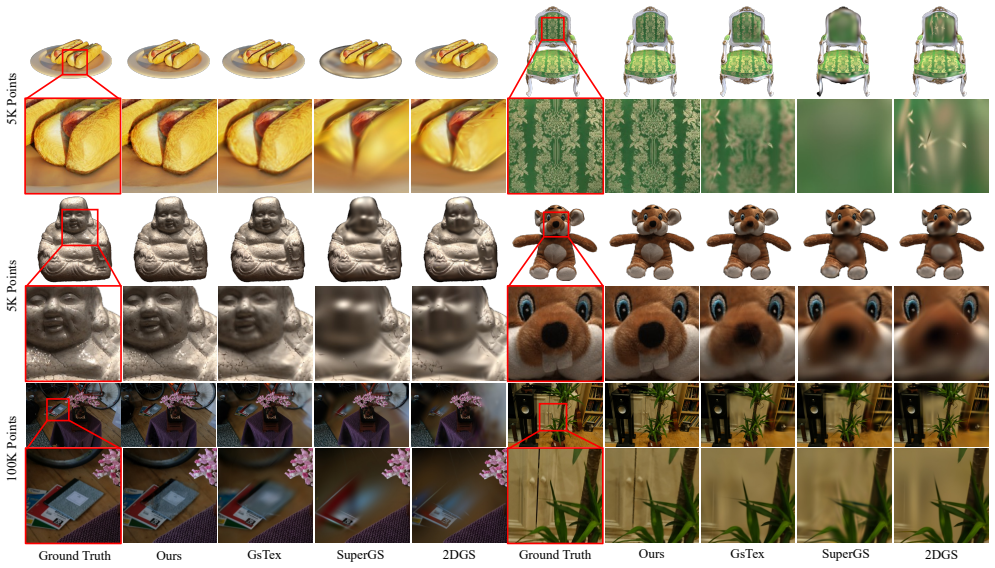
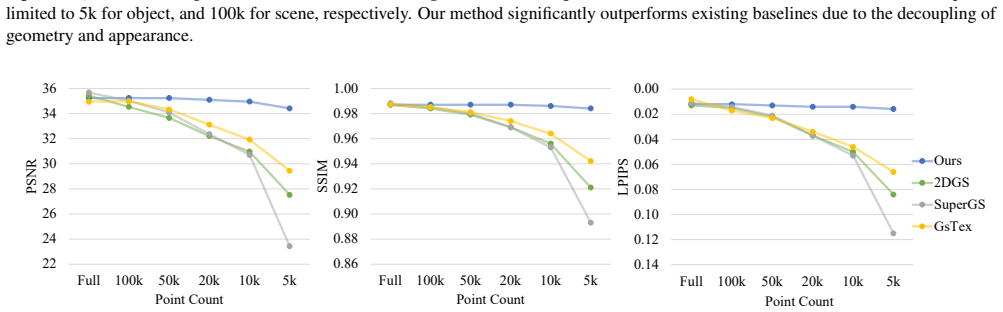
- Texture-rich regions can be rendered with far fewer Gaussians, because the optimizer no longer needs to clone primitives to encode color variation; the paper reports 73k versus 102k primitives on NeRFSyn, 80k versus 214k on DTU, and 356k versus 876k on MipNeRF360-indoor against 2DGS.
- Needle-like artifacts are reduced: the anisotropic scale ratio and the needle-like primitive proportion both improve without any shape regularization.
- A textured mesh can be produced directly by unwrapping the extracted 2DGS mesh and baking the hash field into a UV texture map, which prior splatting methods cannot do without extra machinery.
- Perceptual quality, measured by LPIPS, becomes the method's strongest metric, suggesting that the decoupling is particularly beneficial for natural textures and for texture-rich regions specifically.
Reading between the lines
- The paper does not test whether the advantage persists when the hash table is also shrunk aggressively; its own ablation shows PSNR saturating beyond table size $2^{19}$, hinting that the appearance model could be compressed further without hurting quality.
- Because appearance is a continuous global field keyed by world position, the representation should support direct re-texturing and appearance editing by swapping or interpolating hash features; the paper only demonstrates extraction, not editing.
- The outdoor overfitting suggests a testable modification: adding density-based regularization or a separate background model could close the PSNR gap on MipNeRF360-outdoors while keeping the detail gains.
- If the decoupling claim is fully correct, primitive counts could be pushed well below the 5k point tests shown in the paper, leaving only the question of whether the hash grid alone can represent all view-dependent appearance.
Editorial analysis
A structured set of objections, weighed in public.
Referee Report
Summary. The paper proposes NeST-Splatting, a variant of 2D Gaussian Splatting that replaces per-Gaussian spherical-harmonic colors with a global multi-resolution hash-grid feature field queried at ray-splat intersections and decoded by a small MLP in a deferred shading pass. The authors argue that this separates geometry from appearance, allowing the Gaussian primitives to act purely as geometric samplers and thereby reducing the number of primitives while preserving or improving texture detail. The method is evaluated on NeRFSyn, DTU, and MipNeRF360-indoor in the main text, with per-scene results, ablations over hash-grid parameters and design choices, geometry-reconstruction comparisons on DTU, and additional outdoor MipNeRF360 results in the supplementary material.
Significance. The conceptual direction is appealing: sharing an appearance field across many primitives, rather than storing per-Gaussian SH coefficients, is a plausible route to decoupling geometric complexity from texture complexity. The ablations give some support for the two central design choices (intersection-based feature querying and the coordinate-gradient term), and the supplementary material is transparent about the outdoor regression. However, the current evidence does not fully support the headline claims: the model-size advantage over the primary 2DGS baseline is not universal, the outdoor results show a clear failure mode, and the 'state-of-the-art' wording is stronger than the numbers justify. If the outdoor issue were understood and addressed, or if the claims were scoped to bounded object-centric and indoor scenes, this would be a solid contribution; in its present form the paper needs revision of both claims and evidence.
major comments (5)
- [Section 4.2, Table 1] The claim of a 'more compact model size' is contradicted on the NeRFSyn benchmark: the reported size for Ours is '2+28MB' (approximately 30MB), while 2DGS is 24MB. The paper states that the method requires 'much fewer Gaussian points and maintaining a more compact model size,' but on this dataset the total model is larger than the primary baseline. The size reporting should be made consistent and the compactness claim should be qualified to the datasets where it actually holds, or the discrepancy should be explained.
- [Appendix B, Table 7] The main text's Table 1 omits MipNeRF360-outdoor results, yet on those scenes Ours achieves PSNR 23.85 and SSIM 0.690 versus 2DGS 24.33 and 0.708. The supplement states that the method 'tends to overfit under-constrained background regions.' This is not a marginal gap; it is a systematic failure of the global hash-field assumption in the unbounded regime, and it undercuts the abstract's general claim of 'high parameter efficiency, fine texture detail reconstruction.' The outdoor results should be included in the main comparison and the paper should either demonstrate a remedy or explicitly scope the method's validity to bounded scenes.
- [Section 4.2] The 'state-of-the-art performance' claim is not supported by the reported numbers. On NeRFSyn, SuperGS achieves PSNR 33.71 and SSIM 0.970 versus Ours 33.50 and 0.967; on DTU the PSNR difference is 0.02 dB. Since no error bars, confidence intervals, or multiple-seed runs are provided, the paper cannot claim general superiority. The text should either present such variance information or replace 'state-of-the-art' with 'comparable,' except for the LPIPS metric, where Ours does show a consistent improvement.
- [Section 3.2] Despite the name 'shell texture,' the hash grid is queried over the full contracted 3D volume (Eq. 3 with world coordinates), with no constraint that queries lie near a surface. The field is therefore free to fit non-surface space, which plausibly explains the outdoor overfitting reported in Appendix B. This also makes the claimed 'fully disentangles geometry and appearance' stronger than what is demonstrated. The paper should clarify what makes the representation a 'shell' and provide evidence, such as visualizations of feature magnitudes along rays through empty space, that the learned field is actually surface-localized.
- [Section 1] The introduction claims the method reconstructs using '3x fewer primitives,' but Table 1 shows reductions relative to the 2DGS baseline of 1.4x on NeRFSyn, 2.7x on DTU, and 2.5x on MipNeRF360-indoor. The 3x figure only holds when comparing to 3DGS. The claim should be restated with the actual measured reductions to avoid overstating the primitive savings over the most relevant baseline.
minor comments (5)
- [Eq. (6)] The level-annealing weight w_i(λ) uses the condition 'i > λ,' and the text says λ is incremented every 3,000 iterations; please clarify whether λ is an integer or a continuous variable and how the comparison behaves at non-integer values.
- [Table 2] The definition of 'needle-like ratio' is ambiguous: the text says a Gaussian with anisotropic scale ratio below 0.1 is called needle-like, while the table reports values such as 0.156 and 0.230. Please state explicitly that these are the proportions of needle-like Gaussians in each method and that the first row is the mean anisotropic scale ratio.
- [Section 4.4] The texture-baking procedure depends on UV unwrapping of the extracted mesh, but the paper does not discuss how UV seams or hash-grid discontinuities near those seams are handled; a brief description would improve reproducibility.
- [References] The Mip-NeRF 360 paper appears twice as references [3] and [4], and the Instant-NGP paper appears twice as references [35] and [36]; these duplicates should be merged.
- [Section 3.2, Eq. (5)] The feature image dimension is written as (LF) × H × W, while the text earlier defines the concatenated feature as having dimension L × F; please align the notation, for example by writing (L·F) × H × W.
Circularity Check
No significant circularity: the paper's rendering-quality and primitive-reduction claims are validated against external benchmarks, with no reported quantity fixed by construction from fitted inputs.
full rationale
The paper's central claims—higher-quality appearance with significantly fewer Gaussian primitives via a global hash-grid texture field queried at ray-splat intersections—are empirically established against the external baselines 2DGS, 3DGS, SuperGS, and GsTex on held-out test views of NeRFSyn, DTU, and MipNeRF360. No equation defines a reported outcome in terms of the fitted parameters: PSNR, SSIM, and LPIPS are computed on unseen views, and the final primitive count is an emergent result of densification, not a constrained input that is later 'predicted.' Hash features (Eq. 3), deferred feature blending and decoding (Eq. 5), and the loss (Eq. 8) are optimized only on training views, so test-view metrics require genuine generalization. Author-overlapping citations (e.g., 2DGS [21], GaussianSurfel [13]) are externally published, code-available methods used as backbone and comparison baselines, not unverified premises bearing the argument. The pretraining-from-2DGS initialization is a standard warm-start shared with GsTex, and the textured-mesh baking in Sec. 4.4 merely evaluates the already-trained field at mesh coordinates—a rendering conversion, not a prediction. The supplement's disclosure of outdoor overfitting (Table 7, lower PSNR/SSIM) is a scope limitation, which if anything contradicts the generality of the head claim rather than circularly supporting it. I therefore cannot exhibit any step in which a claimed derivation reduces by construction to its inputs.
Assumptions & free parameters
free parameters (5)
- Hash grid levels L =
6 (ablation Table 6)
- Hash table size T =
2^19 (object), 2^21 (scene)
- Feature dimension F =
4
- Loss weights alpha, beta, gamma =
alpha=1000/100, beta=0.05, gamma=0.1
- Training schedule and density control =
10k 2DGS pretrain + 20k joint; opacity reset every 3k; grad threshold 4e-4
assumptions (4)
- domain assumption Multi-view photometric loss is sufficient to train the geometry-texture decomposition.
- domain assumption A multi-resolution hash grid with MLP decoder can approximate the scene's view-dependent appearance at ray-splat intersections.
- standard math 2DGS ray-splat intersection and alpha blending extend from color to feature blending.
- domain assumption The MipNeRF360 contraction function maps unbounded scenes into a bounded hash grid without losing appearance.
Cite this review
Pith. "Pith review of Neural Shell Texture Splatting: More Details and Fewer Primitives." pith.science (2026). https://pith.science/paper/55C4RVK2
@misc{pith2026250720200,
  author       = {Pith},
  title        = {Pith review of: Neural Shell Texture Splatting: More Details and Fewer Primitives},
  year         = {2026},
  howpublished = {\url{https://pith.science/paper/55C4RVK2}},
  note         = {Machine review of arXiv:2507.20200}
}
read the original abstract
Gaussian splatting techniques have shown promising results in novel view synthesis, achieving high fidelity and efficiency. However, their high reconstruction quality comes at the cost of requiring a large number of primitives. We identify this issue as stemming from the entanglement of geometry and appearance in Gaussian Splatting. To address this, we introduce a neural shell texture, a global representation that encodes texture information around the surface. We use Gaussian primitives as both a geometric representation and texture field samplers, efficiently splatting texture features into image space. Our evaluation demonstrates that this disentanglement enables high parameter efficiency, fine texture detail reconstruction, and easy textured mesh extraction, all while using significantly fewer primitives.
Figures


Figures from the paper (6 more)


Reference graph
Works this paper leans on
-
[1]
Large-scale data for multiple-view stereopsis
Henrik Aanæs, Rasmus Ramsbøl Jensen, George V ogiatzis, Engin Tola, and Anders Bjorholm Dahl. Large-scale data for multiple-view stereopsis. 2016. 5
work page 2016
-
[2]
Nerf-tex: Neural reflectance field textures
Hendrik Baatz, Jonathan Granskog, Marios Papas, Fabrice Rousselle, and Jan Nov´ak. Nerf-tex: Neural reflectance field textures. In CGF, 2022. 2
work page 2022
-
[3]
Barron, Ben Mildenhall, Matthew Tancik, Peter Hedman, Ricardo Martin-Brualla, and Pratul P
Jonathan T. Barron, Ben Mildenhall, Matthew Tancik, Peter Hedman, Ricardo Martin-Brualla, and Pratul P. Srinivasan. Mip-nerf: A multiscale representation for anti-aliasing neural radiance fields. ICCV, 2021. 5
work page 2021
-
[4]
Barron, Ben Mildenhall, Matthew Tancik, Peter Hedman, Ricardo Martin-Brualla, and Pratul P
Jonathan T. Barron, Ben Mildenhall, Matthew Tancik, Peter Hedman, Ricardo Martin-Brualla, and Pratul P. Srinivasan. Mip-nerf: A multiscale representation for anti-aliasing neural radiance fields. In Proc. of the IEEE International Conf. on Computer Vision (ICCV), 2021. 2
work page 2021
-
[5]
Barron, Ben Mildenhall, Dor Verbin, Pratul P
Jonathan T. Barron, Ben Mildenhall, Dor Verbin, Pratul P. Srinivasan, and Peter Hedman. Mip-nerf 360: Unbounded anti-aliased neural radiance fields. In Proc. IEEE Conf. on Computer Vision and Pattern Recognition (CVPR), 2022. 2
work page 2022
-
[6]
Barron, Ben Mildenhall, Dor Verbin, Pratul P
Jonathan T. Barron, Ben Mildenhall, Dor Verbin, Pratul P. Srinivasan, and Peter Hedman. Mip-nerf 360: Unbounded anti-aliased neural radiance fields. CVPR, 2022. 5
work page 2022
-
[7]
Geometric modeling based on triangle meshes
Mario Botsch, Mark Pauly, Christian Rossl, Stephan Bischoff, and Leif Kobbelt. Geometric modeling based on triangle meshes. In ACM SIGGRAPH 2006 Courses, 2006. 2
work page 2006
-
[8]
Unstructured lumigraph render- ing
Chris Buehler, Michael Bosse, Leonard McMillan, Steven Gortler, and Michael Cohen. Unstructured lumigraph render- ing. In ACM Trans. on Graphics, 2001. 2
work page 2001
Show all 57 references
-
[9]
Textured gaussians for enhanced 3d scene appearance modeling, 2024
Brian Chao, Hung-Yu Tseng, Lorenzo Porzi, Chen Gao, Tuo- tuo Li, Qinbo Li, Ayush Saraf, Jia-Bin Huang, Johannes Kopf, Gordon Wetzstein, and Changil Kim. Textured gaussians for enhanced 3d scene appearance modeling, 2024. 1, 2
2024
-
[10]
Deep surface light fields
Anpei Chen, Minye Wu, Yingliang Zhang, Nianyi Li, Jie Lu, Shenghua Gao, and Jingyi Yu. Deep surface light fields. Proc. ACM Comput. Graph. Interact. Tech., 2018. 2
2018
-
[11]
Tensorf: Tensorial radiance fields
Anpei Chen, Zexiang Xu, Andreas Geiger, Jingyi Yu, and Hao Su. Tensorf: Tensorial radiance fields. 2022. 2
2022
-
[12]
Hac: Hash-grid assisted context for 3d gaussian splatting compression
Yihang Chen, Qianyi Wu, Weiyao Lin, Mehrtash Harandi, and Jianfei Cai. Hac: Hash-grid assisted context for 3d gaussian splatting compression. In European Conference on Computer Vision, 2024. 2
2024
-
[13]
High-quality surface reconstruction using gaussian surfels
Pinxuan Dai, Jiamin Xu, Wenxiang Xie, Xinguo Liu, Huamin Wang, and Weiwei Xu. High-quality surface reconstruction using gaussian surfels. In ACM Trans. on Graphics, 2024. 2, 6
2024
-
[14]
Unstructured light fields
Abe Davis, Marc Levoy, and Fredo Durand. Unstructured light fields. Comput. Graph. Forum, 2012. 2
2012
-
[15]
V olumetric surfaces: Representing fuzzy geometries with multiple meshes
Stefano Esposito, Anpei Chen, Christian Reiser, Samuel Rota Bul`o, Lorenzo Porzi, Katja Schwarz, Christian Richardt, Michael Zollh¨ofer, Peter Kontschieder, and Andreas Geiger. V olumetric surfaces: Representing fuzzy geometries with multiple meshes. Proc. IEEE Conf. on Comput...
2025
-
[16]
Plenoxels: Radiance fields without neural networks
Fridovich-Keil and Yu, Matthew Tancik, Qinhong Chen, Ben- jamin Recht, and Angjoo Kanazawa. Plenoxels: Radiance fields without neural networks. In CVPR, 2022. 2
2022
-
[17]
Gortler, Radek Grzeszczuk, Richard Szeliski, and Michael F
Steven J. Gortler, Radek Grzeszczuk, Richard Szeliski, and Michael F. Cohen. The lumigraph. In SIGGRAPH, 1996. 2
1996
-
[18]
Scalable inside-out image-based rendering
Peter Hedman, Tobias Ritschel, George Drettakis, and Gabriel Brostow. Scalable inside-out image-based rendering. TOG, 2016
2016
-
[19]
Deep blending for free-viewpoint image-based rendering
Peter Hedman, Julien Philip, True Price, Jan-Michael Frahm, George Drettakis, and Gabriel Brostow. Deep blending for free-viewpoint image-based rendering. 2018. 2
2018
-
[20]
Learn- ing a neural 3d texture space from 2d exemplars
Philipp Henzler, Niloy J Mitra, , and Tobias Ritschel. Learn- ing a neural 3d texture space from 2d exemplars. In Proc. IEEE Conf. on Computer Vision and Pattern Recognition (CVPR), 2019. 2
2019
-
[21]
2d gaussian splatting for geometrically accu- rate radiance fields
Binbin Huang, Zehao Yu, Anpei Chen, Andreas Geiger, and Shenghua Gao. 2d gaussian splatting for geometrically accu- rate radiance fields. In SIGGRAPH. Association for Comput- ing Machinery, 2024. 1, 2, 3, 5, 6
2024
-
[22]
Nerf-texture: Texture synthesis with neural radiance fields
Yi-Hua Huang, Yan-Pei Cao, Yu-Kun Lai, Ying Shan, and Lin Gao. Nerf-texture: Texture synthesis with neural radiance fields. In SIGGRAPH, 2023. 2
2023
-
[23]
Deformable radial kernel splatting
Yi-Hua Huang, Ming-Xian Lin, Yang-Tian Sun, Ziyi Yang, Xiaoyang Lyu, Yan-Pei Cao, and Xiaojuan Qi. Deformable radial kernel splatting. arXiv preprint arXiv:2412.11752 ,
-
[24]
Textured-gs: Gaussian splatting with spatially defined color and opacity, 2024
Zhentao Huang and Minglun Gong. Textured-gs: Gaussian splatting with spatially defined color and opacity, 2024. 2
2024
-
[25]
J. T. Kajiya and T. L. Kay. Rendering fur with three dimen- sional textures. SIGGRAPH, 1989. 2
1989
-
[26]
3d gaussian splatting for real-time radiance field rendering
Bernhard Kerbl, Georgios Kopanas, Thomas Leimk¨uhler, and George Drettakis. 3d gaussian splatting for real-time radiance field rendering. ACM Trans. on Graphics, 2023. 1, 2, 3, 5, 6
2023
-
[27]
3d gaussian splat- ting with deferred reflection
Ye Keyang, Hou Qiming, and Zhou Kun. 3d gaussian splat- ting with deferred reflection. 2024. 2
2024
-
[28]
Compact 3d gaussian representation for radiance field
Joo Chan Lee, Daniel Rho, Xiangyu Sun, Jong Hwan Ko, and Eunbyung Park. Compact 3d gaussian representation for radiance field. In Proc. IEEE Conf. on Computer Vision and Pattern Recognition (CVPR), 2024. 2, 4
2024
-
[29]
Light Field Rendering
Marc Levoy and Pat Hanrahan. Light Field Rendering. Asso- ciation for Computing Machinery, 2023. 2
2023
-
[30]
Least squares conformal maps for automatic texture atlas generation
Bruno L´evy, Sylvain Petitjean, Nicolas Ray, and J´erome Mail- lot. Least squares conformal maps for automatic texture atlas generation. TOG, 2002. 2
2002
-
[31]
Neuralangelo: High-fidelity neural surface reconstruction
Zhaoshuo Li, Thomas M ¨uller, Alex Evans, Russell H Tay- lor, Mathias Unberath, Ming-Yu Liu, and Chen-Hsuan Lin. Neuralangelo: High-fidelity neural surface reconstruction. In Proc. IEEE Conf. on Computer Vision and Pattern Recogni- tion (CVPR), 2023. 4
2023
-
[32]
Scaffold-gs: Structured 3d gaus- sians for view-adaptive rendering
Tao Lu, Mulin Yu, Linning Xu, Yuanbo Xiangli, Limin Wang, Dahua Lin, and Bo Dai. Scaffold-gs: Structured 3d gaus- sians for view-adaptive rendering. In Proc. IEEE Conf. on Computer Vision and Pattern Recognition (CVPR), 2024. 2
2024
-
[33]
Taming 3dgs: High-quality radiance fields with limited resources
Saswat Subhajyoti Mallick, Rahul Goel, Bernhard Kerbl, Markus Steinberger, Francisco Vicente Carrasco, and Fer- nando De La Torre. Taming 3dgs: High-quality radiance fields with limited resources. In SIGGRAPH Asia 2024 Con- ference Papers, 2024. 2
2024
-
[34]
Srinivasan, Matthew Tancik, Jonathan T
Ben Mildenhall, Pratul P. Srinivasan, Matthew Tancik, Jonathan T. Barron, Ravi Ramamoorthi, and Ren Ng. Nerf: Representing scenes as neural radiance fields for view synthe- sis. In ECCV, 2020. 1, 2, 5
2020
-
[35]
Instant neural graphics primitives with a multires- olution hash encoding
Thomas M¨uller, Alex Evans, Christoph Schied, and Alexan- der Keller. Instant neural graphics primitives with a multires- olution hash encoding. TOG, 2022. 2
2022
-
[36]
Instant neural graphics primitives with a multires- olution hash encoding
Thomas M¨uller, Alex Evans, Christoph Schied, and Alexan- der Keller. Instant neural graphics primitives with a multires- olution hash encoding. ACM Trans. Graph., 41(4):102:1– 102:15, 2022. 2, 3
2022
-
[37]
Compgs: Smaller and faster gaussian splatting with vector quantization
KL Navaneet, Kossar Pourahmadi Meibodi, Soroush Abbasi Koohpayegani, and Hamed Pirsiavash. Compgs: Smaller and faster gaussian splatting with vector quantization. ECCV,
-
[38]
Modeling, animating, and rendering complex scenes using volumetric textures
Fabrice Neyret. Modeling, animating, and rendering complex scenes using volumetric textures. TVCG, 1998. 2
1998
-
[39]
Gstex: Per-primitive tex- turing of 2d gaussian splatting for decoupled appearance and geometry modeling
Victor Rong, Jingxiang Chen, Sherwin Bahmani, Kiriakos N Kutulakos, and David B Lindell. Gstex: Per-primitive tex- turing of 2d gaussian splatting for decoupled appearance and geometry modeling. arXiv preprint arXiv:2409.12954, 2024. 1, 2, 5
2024 arXiv
-
[40]
Direct voxel grid optimization: Super-fast convergence for radiance fields reconstruction
Cheng Sun, Min Sun, and Hwann-Tzong Chen. Direct voxel grid optimization: Super-fast convergence for radiance fields reconstruction. In Proc. IEEE Conf. on Computer Vision and Pattern Recognition (CVPR), 2022. 2
2022
-
[41]
Billboard splatting (bbsplat): Learnable textured primitives for novel view synthesis, 2025
David Svitov, Pietro Morerio, Lourdes Agapito, and Alessio Del Bue. Billboard splatting (bbsplat): Learnable textured primitives for novel view synthesis, 2025. 1, 2
2025
-
[42]
Compact neural graphics primitives with learned hash probing
Towaki Takikawa, Thomas M ¨uller, Merlin Nimier-David, Alex Evans, Sanja Fidler, Alec Jacobson, and Alexander Keller. Compact neural graphics primitives with learned hash probing. In SIGGRAPHASIA, 2023. 2
2023
-
[43]
Srinivasan, Jonathan T
Matthew Tancik, Vincent Casser, Xinchen Yan, Sabeek Prad- han, Ben Mildenhall, Pratul P. Srinivasan, Jonathan T. Barron, and Henrik Kretzschmar. Block-nerf: Scalable large scene neural view synthesis. In Proc. IEEE Conf. on Computer Vision and Pattern Recognition (CVPR), 2022. 2
2022
-
[44]
De- ferred neural rendering: image synthesis using neural textures
Justus Thies, Michael Zollh¨ofer, and Matthias Nießner. De- ferred neural rendering: image synthesis using neural textures. TOG, 2019. 2
2019
-
[45]
Mega-nerf: Scalable construction of large-scale nerfs for virtual fly-throughs
Haithem Turki, Deva Ramanan, and Mahadev Satya- narayanan. Mega-nerf: Scalable construction of large-scale nerfs for virtual fly-throughs. In Proc. IEEE Conf. on Com- puter Vision and Pattern Recognition (CVPR), 2022. 2
2022
-
[46]
Barron, and Pratul P
Dor Verbin, Peter Hedman, Ben Mildenhall, Todd Zickler, Jonathan T. Barron, and Pratul P. Srinivasan. Ref-NeRF: Structured view-dependent appearance for neural radiance fields. Proc. IEEE Conf. on Computer Vision and Pattern Recognition (CVPR), 2022. 2
2022
-
[47]
Neus: Learning neural implicit surfaces by volume rendering for multi-view reconstruction
Peng Wang, Lingjie Liu, Yuan Liu, Christian Theobalt, Taku Komura, and Wenping Wang. Neus: Learning neural implicit surfaces by volume rendering for multi-view reconstruction. NeurIPS, 2021. 5, 6
2021
-
[48]
Adaptive shells for efficient neural radiance field rendering
Zian Wang, Tianchang Shen, Merlin Nimier-David, Nicholas Sharp, Jun Gao, Alexander Keller, Sanja Fidler, Thomas M¨uller, and Zan Gojcic. Adaptive shells for efficient neural radiance field rendering. TOG, 2023. 2
2023
-
[49]
Deferredgs: Decoupled and editable gaussian splatting with deferred shading
Tong Wu, Jia-Mu Sun, Yu-Kun Lai, Yuewen Ma, Leif Kobbelt, and Lin Gao. Deferredgs: Decoupled and editable gaussian splatting with deferred shading. arXiv:10.48550, 2024. 2
2024
-
[50]
Scanerf: Scalable bundle-adjusting neural radiance fields for large- scale scene rendering
Xiuchao Wu, Jiamin Xu, Xin Zhang, Hujun Bao, Qixing Huang, Yujun Shen, James Tompkin, and Weiwei Xu. Scanerf: Scalable bundle-adjusting neural radiance fields for large- scale scene rendering. ACM Trans. on Graphics, 2023. 2
2023
-
[51]
NeuTex: Neural Texture Mapping for V olumetric Neural Rendering
Fanbo Xiang, Zexiang Xu, Milo ˇs Ha ˇsan, Yannick Hold- Geoffroy, Kalyan Sunkavalli, and Hao Su. NeuTex: Neural Texture Mapping for V olumetric Neural Rendering. InProc. IEEE Conf. on Computer Vision and Pattern Recognition (CVPR), 2021. 2
2021
-
[52]
Supergaussians: Enhancing gaussian splatting using primitives with spatially varying colors, 2024
Rui Xu, Wenyue Chen, Jiepeng Wang, Yuan Liu, Peng Wang, Lin Gao, Shiqing Xin, Taku Komura, Xin Li, and Wenping Wang. Supergaussians: Enhancing gaussian splatting using primitives with spatially varying colors, 2024. 1, 2, 5
2024
-
[53]
Texture-gs: Disentangling the geometry and texture for 3d gaussian splatting editing
Tian-Xing Xu, Wenbo Hu, Yu-Kun Lai, Ying Shan, and Song- Hai Zhang. Texture-gs: Disentangling the geometry and texture for 3d gaussian splatting editing. 2024. 2
2024
-
[54]
2dgh: 2d gaussian-hermite splatting for high-quality render- ing and better geometry reconstruction, 2024
Ruihan Yu, Tianyu Huang, Jingwang Ling, and Feng Xu. 2dgh: 2d gaussian-hermite splatting for high-quality render- ing and better geometry reconstruction, 2024. 2
2024
-
[55]
Mip-splatting: Alias-free 3d gaussian splat- ting
Zehao Yu, Anpei Chen, Binbin Huang, Torsten Sattler, and Andreas Geiger. Mip-splatting: Alias-free 3d gaussian splat- ting. 2024. 2
2024
-
[56]
Ref-gs: Directional factoriza- tion for 2d gaussian splatting
Youjia Zhang, Anpei Chen, Yumin Wan, Zikai Song, Junqing Yu, Yawei Luo, and Wei Yang. Ref-gs: Directional factoriza- tion for 2d gaussian splatting. Proc. IEEE Conf. on Computer Vision and Pattern Recognition (CVPR), 2025. 2
2025
-
[57]
Pixel-gs: Density control with pixel-aware gradient for 3d gaussian splatting
Zheng Zhang, Wenbo Hu, Yixing Lao, Tong He, and Heng- shuang Zhao. Pixel-gs: Density control with pixel-aware gradient for 3d gaussian splatting. In ECCV, 2024. 2 Neural Shell Texture Splatting: More Details and Fewer Primitives Supplementary Material A. Implementation Details...
2024
Reviewed August 6, 2026 · model on record in the stance chip above.
Discussion (0). Continue with ORCID to comment.