REVIEW 2 major objections 5 minor 49 references
Wall boundary conditions for Lattice Boltzmann simulations of turbulent flows with wall functions
T0 review · 2 major / 5 minor · reviewed 2026-08-07 · deepseek-v4-flash
Pith's one-line read A slip-velocity bounce-back rule is the more accurate and less mesh-sensitive LBM wall scheme for turbulent wall-function flows.
desk verdict A useful, honest numerical comparison showing slip-velocity bounce-back is more robust than regularized wall BCs for LBM-RANS with wall functions, but the theory behind the slip velocity is shakier than the numerics. read the letter →
The pith
A machine-rendered reading of the paper's core claim, the machinery that carries it, and where it could break.
The reading
What carries the argument
The load-bearing object is the macroscopic boundary condition that a half-way bounce-back rule actually imposes. Under a simplified second-order Chapman-Enskog expansion, the rule effectively yields $u_w = u_B - \tfrac{\Delta}{2}\,\partial_y u + \tfrac{\Delta^2}{3}E(\tau)\,\partial_y^2 u$, where the last term is the numerical slip with $E(\tau)\approx(\tau-\tfrac12)^2$. In the wall-function regime $E(\tau)$ is of order $10^{-8}$, so the paper drops that term and combines the gradient relation with the constant-shear-stress boundary equation $(\nu+\nu_t)_B\,\partial_y u = u_\tau^2$ to prescribe the slip velocity $u_w = u_B - \frac{u_\tau^2}{(\nu+\nu_t)_B}\Delta_w$. This single formula feeds the wall-function friction velocity into the lattice without any near-wall gradient reconstruction. The regularized scheme, by contrast, carries the same information through the strain-rate tensor $S_{\alpha\gamma}$ in the first-order non-equilibrium population $f_i^{(1)}\propto -\rho w_i Q_i S_{\alpha\gamma}/c_s^2$, so its accuracy is controlled by how $\partial_y u$ is reconstructed.
What would settle it
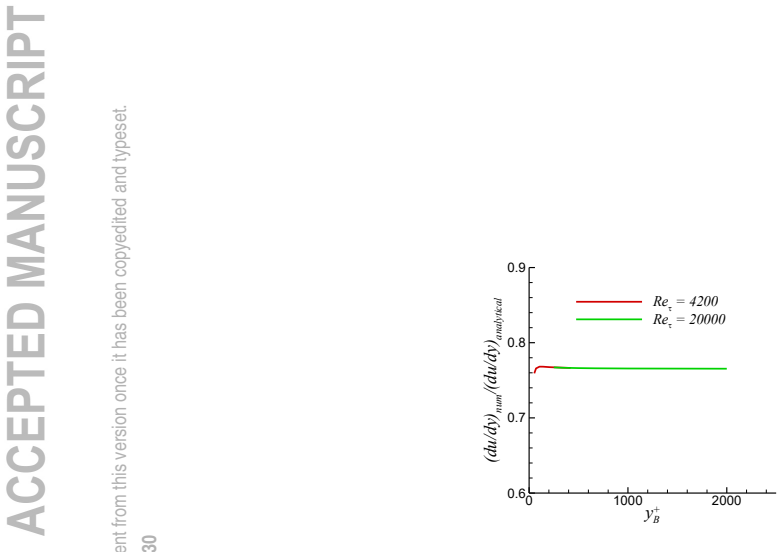
Run the actual solver's turbulent channel case at $\mathrm{Re}_\tau=4200$ with the slip-velocity bounce-back scheme and measure the realized near-wall relation: compute $(u_B-u_w)/\Delta_w$ from the solution and compare it with the actual $\partial_y u$ at node B and with $u_\tau^2/(\nu+\nu_t)_B$. If the realized gradient deviates by more than the size of the neglected numerical-slip term, then eq. (39) is not enforcing the constant-shear-stress condition and the source of the scheme's robustness lies elsewhere; a supplementary check is to repeat the test at a lower Reynolds number or coarser resolution where the numerical-slip coefficient $E(\tau)$ is not negligible.
Extended reading notes
Core claim
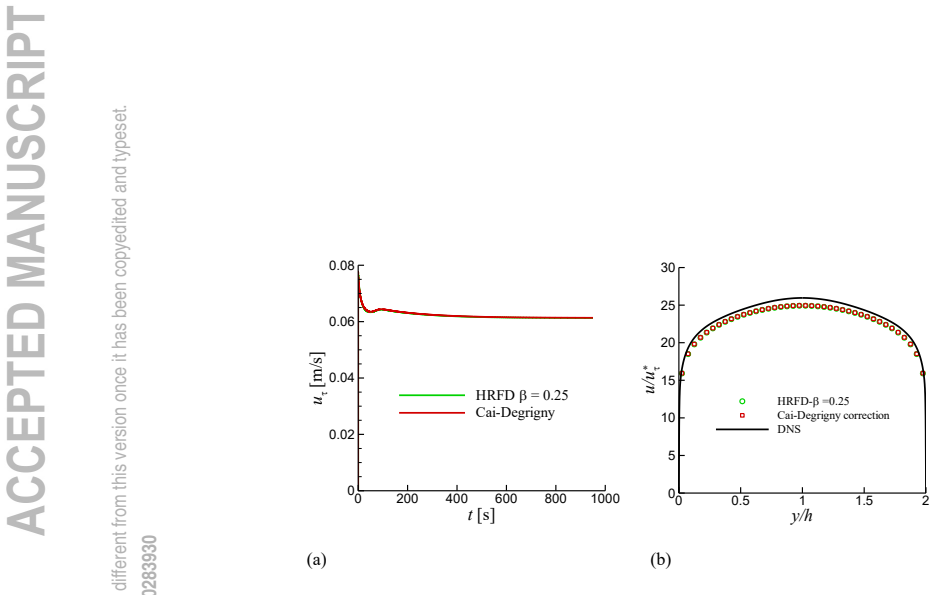
The paper's central discovery is that, in LBM-RANS computations with wall functions on flat walls, the boundary condition itself, not the turbulence model, dictates near-wall accuracy. The slip-velocity bounce-back rule, obtained by requiring the constant-total-shear-stress equation $(\nu+\nu_t)\,\partial_y u = u_\tau^2$ to hold at the first fluid node, produces accurate friction velocity and velocity profiles without calibration and with negligible sensitivity to grid spacing, down to five nodes per half-channel in the channel test. Regularized boundary conditions, which reconstruct all populations via a truncated Chapman-Enskog expansion, instead inherit their accuracy from the reconstructed wall-normal strain rate: pure finite-difference gradients underpredict the friction velocity, the raw analytical wall-function derivative overpredicts it, and only a tuned blend with $\beta^*=0.28$ or the third-order wall-function-difference correction restores agreement with DNS data. The practical conclusion is therefore a preference: for equilibrium flat-wall boundary layers, the slip-velocity bounce-back scheme is the more robust and simpler boundary treatment, while regularized schemes need ad-hoc gradient repair even when no interpolation is required.
Load-bearing premise
The slip-velocity formula used by the bounce-back scheme is derived from a simplified Chapman-Enskog analysis that assumes BGK collision, a linearized equilibrium, steady unidirectional flow, and a dropped numerical-slip term, while the actual solver uses a central-moment collision operator with external forcing; the scheme's robustness in these tests depends on that derivation describing the boundary condition the code really imposes.
Editorial extensions
If this is right
- In flat-wall equilibrium boundary layers, LBM-RANS users can replace gradient-calibrated regularized schemes with slip-velocity bounce-back and obtain accurate skin friction without calibration.
- The bounce-back scheme keeps flat-plate integrated skin-friction error below 5% on the coarsest mesh, with fewer than ten points inside the boundary layer.
- Regularized schemes on under-resolved grids inherit large errors from the wall-normal gradient estimate; neither pure flow finite differences nor the raw wall-function derivative is reliable.
- Because the slip-velocity bounce-back update is link-wise and compact, it is cheaper and better suited to massively parallel implementations than full population reconstruction.
- The conclusions are explicitly limited to flat, equilibrium boundary layers; the same comparison on curved walls with adverse pressure gradients is left as future work.
Reading between the lines
- The paper does not test curved walls; a natural next step would be to repeat the comparison on a curved or pressure-gradient geometry to see whether the bounce-back advantage survives the interpolation issues it flags.
- If the mechanism for the bounce-back's insensitivity is simply that no explicit wall-normal gradient is computed, the same construction should carry over to wall-modeled LES settings and to other collision operators, not just the central-moment solver used here.
- The order-of-magnitude justification for dropping the numerical-slip term assumes acoustic scaling with small Knudsen numbers; at lower Reynolds numbers or larger Knudsen numbers the neglected $E(\tau)$ term in eq. (37) would need to be retained.
- Because the calibrated blend $\beta^*=0.28$ closely reproduces the third-order wall-function-difference correction on the channel test, the two gradient-fixing strategies may be interchangeable in equilibrium boundary layers even though the paper does not claim this equivalence in general.
Editorial analysis
A structured set of objections, weighed in public.
Referee Report
Summary. The paper compares wall boundary condition treatments for LBM-RANS simulations with wall functions: a regularized boundary condition with various wall-normal gradient reconstructions (pure finite differences, analytical wall-function derivative, a calibrated hybrid HRFD blend, and the Cai-Degrigny correction) and a slip-velocity bounce-back scheme. The schemes are tested on fully developed turbulent channel flow at Re_tau = 4200 (with additional Reynolds-number sweeps) and on a zero-pressure-gradient flat-plate boundary layer, using the Spalart-Allmaras model and a model-consistent wall function. The central claim is that the slip-velocity bounce-back approach is accurate and nearly insensitive to mesh resolution, whereas regularized schemes are highly sensitive to the reconstruction of the wall-normal velocity gradient. The paper also introduces the HRFD method as a diagnostic tool to expose this sensitivity, with a blending parameter calibrated against DNS data.
Significance. If the central claim holds, the paper provides practically useful guidance for high-Reynolds-number LBM with wall functions: a simple slip-velocity bounce-back boundary condition can be robust on coarse, wall-function-resolved meshes without gradient reconstruction or tuning, while regularized schemes require careful gradient treatment. The study is carefully designed around two canonical equilibrium flat-wall cases, includes mesh-convergence studies, sensitivity to boundary-node placement, Reynolds-number sweeps, and direct comparison with DNS and CFL3D reference data. The authors are explicit about the limitations of their conclusions and about the calibrated nature of the HRFD parameter, which is a strength. The main significance is therefore conditional on the theoretical derivation of the slip-velocity condition being transferable to the actual solver, and on the flat-plate comparison being interpreted with the x-shift adjustment in mind.
major comments (2)
- [Section 3.2.1 and Appendix, Eqs. (37)-(39) and (44)-(52)] The slip-velocity bounce-back boundary condition (39) is derived from a Chapman-Enskog analysis that explicitly assumes BGK collision, a linearized equilibrium distribution, steady unidirectional flow, and no external forcing. The actual solver uses a central-moment collision operator with an external force term (Section 2.1, Eqs. (1)-(2)), and in the channel-flow case the flow is driven entirely by a body force. The order-of-magnitude estimate in Section 3.2.2 only justifies dropping the E(τ)Δ^2∂_yy u term in Eq. (37); it does not establish that Eq. (38), and hence Eq. (39), is the macroscopic condition actually realized by the implemented central-moment, forced LBM. Since Eq. (39) is the mechanism by which the paper claims bounce-back enforces the turbulent diffusion equation (36), this equivalence is load-bearing for the paper's main recommendation. Please either extend the analysis to the implemented collision operator including the forcing term, or provide a direct numerical check (for example, measuring the velocity gradient at node B and comparing it with Eq. (38)) to confirm that the realized wall condition matches Eq. (39).
- [Section 4.2.1 and Figures 18-19] The flat-plate LBM results are shifted in x so that the boundary-layer thickness and momentum thickness match CFL3D at x/L = 0.97 before the skin-friction distributions are compared. Because this shift is different for each boundary scheme and each mesh, the integrated-error comparison in Figure 19 and the mesh-convergence conclusions for the flat plate partly reflect the shifting convention rather than the raw behavior of the wall boundary condition. The authors should report the magnitudes of the applied shifts, justify the alignment as a matched-Re_theta comparison, and show the unshifted skin-friction distributions for at least one mesh so that the reader can assess how much of the reported accuracy of bounce-back is inherited from the alignment procedure.
minor comments (5)
- [Section 3.1, Eq. (22)] The formula for the velocity at node F appears to have unbalanced parentheses and an unclear treatment of the forcing term; as typeset, it is difficult to verify the exact implementation of the half-force correction.
- [Section 4.2.1, Table 4] For the CFL3D row, 'By+ < 0.1 at the wall' should be 'By+ < 0.1 at the first cell off the wall' to avoid implying that the wall itself has a nonzero y+ value.
- [Introduction, Section 2.2] There is a typo 'Discontinuous Garlerkin' in the Introduction, and the statement in Section 2.2 that the discretization is 'second-order accurate in practice' because convective terms are negligible would benefit from a supporting reference or a quantitative demonstration.
- [Section 4.1.2.2 and Figure 8] The conjecture that the Cai-Degrigny prescription 'has been possibly inferred through numerical experimentation' is speculative and not supported by the presented evidence; either provide supporting information or remove the conjecture.
- [Section 3.2.2, Eq. (40)] The relation τ = 1/2 + 3M/(√(Re_L) Kn) is not dimensionally transparent, and the acoustic-scaling convention behind it is introduced only in words; please define all quantities and the time-step relationship explicitly.
Circularity Check
Core comparison is self-contained; only the HRFD blending parameter is calibrated to the DNS target it later reports, a disclosed and largely non-load-bearing fit.
-
fitted input called prediction
[Section 4.1.2.1, Eq. (29) and Figure 6]
"By performing a parametric sweep over the blending parameter in eq. (29), a specific value, β*=0.28 was determined for which the resulting computed friction velocity closely matches the prescribed target value (see Figure 6(a)). When employing this value, the resulting velocity profile exhibits strong agreement with the DNS reference results, both when normalized by the input friction velocity and by the computed one, both of which are effectively identical in this case (Figure 6(b)-(c))."
β is the only free weight in the blended gradient reconstruction (29). It is selected by requiring the computed friction velocity to equal the target u_τ from DNS at Re_τ=4200 on the N=20 grid. Therefore the matching u_τ at that calibration point is enforced by construction, and the velocity-profile agreement in Figure 6 is not an independent confirmation at that same operating point. The subsequent use of β=0.28 on the flat plate is a transfer of a fitted constant to a similar equilibrium wall-bounded flow, so it does not provide independent evidence for the regularized scheme's general accuracy. The paper openly labels the calibration ('requires calibration') and the central bounce-back vs. regularized comparison does not depend on this fitted value.
full rationale
No load-bearing self-citation was found: the authors cite external references for the wall function, the Chapman-Enskog analysis, and the boundary schemes, and none of the central claims rests on a uniqueness theorem or prior result by the same authors. The slip-velocity bounce-back boundary condition is derived as an explicit construction: equation (39) is obtained by substituting the bounce-back slip relation (38) into the intended turbulent-diffusion condition (36), so its behavior is a designed enforcement rather than a circular prediction. The comparison between bounce-back and the uncalibrated regularized variants (Cai-Degrigny and β=0) is validated against external DNS and CFL3D data and is self-contained. The only reduction-by-construction step is the HRFD blending-parameter calibration in Section 4.1.2.1, where β is fitted to the DNS friction-velocity target and the same target is then reported as agreement; this is disclosed and explicitly acknowledged as a limitation in the conclusions, and it does not bear the paper's main comparative conclusion. The mismatch between the BGK/no-force assumptions used to derive equation (37) and the actual central-moment/forcing solver is a correctness risk rather than circularity, since the paper does not claim the derivation is exact for its collision model. Given that the core benchmark comparisons are independent, the appropriate circularity score is low.
Assumptions & free parameters
free parameters (1)
- beta (HRFD blending parameter) =
0.28
assumptions (6)
- standard math Chapman-Enskog expansion truncated after the first non-equilibrium term describes the boundary populations and lets the strain rate tensor be reconstructed mesoscopically.
- domain assumption The SA-consistent wall function of Allmaras et al. [38], eqs. (16) and (17), is an accurate description of the near-wall mean velocity and its gradient for the equilibrium turbulent boundary layers considered.
- domain assumption The turbulent diffusion equation ((nu+nu_t) du/dy)_y = u_tau^2 holds at the boundary node and supports the constant-total-shear-stress condition.
- ad hoc to paper The macroscopic boundary condition derived from a simplified BGK Chapman-Enskog analysis (eq. 37) remains valid for the implemented central-moments LBM with forcing and acoustic scaling.
- ad hoc to paper The numerical-slip term proportional to (tau-1/2)^2 in eq. (37) is negligible for the simulated regimes, so eq. (38) and hence eq. (39) hold.
- ad hoc to paper Shifting the flat plate LBM solutions in x so that boundary layer thickness matches CFL3D at x/L=0.97 makes the skin friction comparison meaningful.
Cite this review
Pith. "Pith review of Wall boundary conditions for Lattice Boltzmann simulations of turbulent flows with wall functions." pith.science (2026). https://pith.science/paper/55IK44TV
@misc{pith2026250603905,
  author       = {Pith},
  title        = {Pith review of: Wall boundary conditions for Lattice Boltzmann simulations of turbulent flows with wall functions},
  year         = {2026},
  howpublished = {\url{https://pith.science/paper/55IK44TV}},
  note         = {Machine review of arXiv:2506.03905}
}
read the original abstract
This paper investigates wall boundary condition schemes for the simulation of turbulent flows using the Lattice Boltzmann method (LBM) coupled to turbulence models with wall functions. The analysis focuses on two schemes: a regularized boundary scheme with third-order reconstruction of the velocity gradients using wall function data and a slip-velocity bounce-back scheme. The LBM solver is coupled to the Spalart-Allmaras turbulence model and uses a model consistent wall function. The performance of the wall boundary schemes is assessed in two canonical turbulent flow cases, a fully developed channel flow and a zero-pressure-gradient flat plate boundary layer (BL), selected specifically to isolate and analyze the impact of wall boundary treatments on turbulence modeling. The analysis shows that, for the selected test cases, the slip-velocity bounce-back approach, which has received relatively little attention within the context of LBM coupled to Reynolds-Averaged Navier-Stokes (RANS) turbulence models with wall functions, behaves fairly consistently in terms of both accuracy and mesh convergence. The regularized-based approach, on the other hand, appears to be highly sensitive to the reconstruction of the wall-normal velocity gradient, even in simple geometries such as flat walls where no interpolation is required. This dependency of the regularized boundary schemes on near-wall gradients, which had been noted before in the literature, requires the use of ad-hoc gradient reconstruction techniques, requirements that are not present in the slip-velocity bounce-back method. A hybrid regularized boundary scheme that blends two different gradient reconstruction techniques but requires calibration is introduced as a tool to investigate this effect.
Figures


Figures from the paper (6 more)


Reference graph
Works this paper leans on
-
[1]
C. C. Kiris, A. S. Ghate, O. M. F. Browne, J. Slotnick and J. Larsson, "HLPW-4: Wall- modeled Large Eddy Simulation and Lattice-Boltzmann technology focus group workshop summary," Journal of Aircraft, vol. 60, no. 4, pp. 1118-1140, 2023
work page 2023
-
[2]
Prediction of trailing edge separation on the NASA juncture flow using Wall Modeled-LES,
A. Lozano-Duran, S. T. Bose and P. Moin, "Prediction of trailing edge separation on the NASA juncture flow using Wall Modeled-LES," AIAA paper 2020-1776, 2020
work page 2020
-
[3]
Predicting Transonic Buffet Onset for the Boeing Transonic Truss-Braced Wing Aircraft,
O. M. F. Browne, D. Maldonado, J. A. Housman, J. C. Duensing and W. E. Milholen, "Predicting Transonic Buffet Onset for the Boeing Transonic Truss-Braced Wing Aircraft," Journal of Aircraft, vol. 62, no. 1, pp. 62-80, 2025. https://doi.org/10.2514/1.C037981
-
[4]
Tandem cylinder flow and noise predictions using a hybrid RANS/LES approach,
M. Weinmann, R. Sandberg and C. Doolan, "Tandem cylinder flow and noise predictions using a hybrid RANS/LES approach," International Journal of Heat and Fluid Flow, vol. 50, pp. 263-270, 2014
work page 2014
-
[5]
LES/RANS Methods for simulation of turbulence flows,
J. Fröhlich and D. von Terzi, "LES/RANS Methods for simulation of turbulence flows," Progress in Aerospace Sciences, vol. 44, pp. 349-377, 2008
work page 2008
-
[6]
P. Spalart, "Detached-eddy simulation," Annual Review of Fluid Mechanics, vol. 41, pp. 181-202, 2009
work page 2009
-
[7]
On the simulation of trailing edge noise with a hybrid LES/APE method,
R. Ewert and W. Schröder, "On the simulation of trailing edge noise with a hybrid LES/APE method," Journal of Sound and Vibration, vol. 270, no. 3, pp. 509-524, 2004. https://doi.org/10.1016/j.jsv.2003.09.047
-
[8]
Overset DNS with Application to Sound Source Prediction,
R. Akkermans, R. Ewert, S. Moghadam, J. Dierke and N. Buchmann, "Overset DNS with Application to Sound Source Prediction," in Girimaji, S., Haase, W., Peng, SH., Schwamborn, D. (eds) Progress in Hybrid RANS-LES Modelling. Notes on Numerical Fluid Mechanics and Multidisciplinary Design, vol 130. Springer, Cham. https://doi.org/10.1007/978-3-319-15141-0_4, ...
Show all 49 references
-
[9]
Zonal Overset-LES with stochastic volume forcing,
R. Akkermans, P. Bernicke, R. Ewert and J. Dierke, "Zonal Overset-LES with stochastic volume forcing," International Journal of Heat and Fluid Flow, vol. 70, pp. 336-347, 2018
2018
-
[10]
Large eddy simulation with modeled wall-stress: Recent progress and future directions,
J. Larsson, S. Kawai, J. Bodart and L. Bermejo Moreno, "Large eddy simulation with modeled wall-stress: Recent progress and future directions," Mechanical Engineering Reviews, vol. 3, no. 1, 2016, pages 15-00418
2016
-
[11]
Application of Lattice Boltzmann and Navier-Stokes methods to NASA's wall mounted hump,
C. C. Kiris, D. Stich, J. A. Housman, J. G. Kocheemoolayil, M. F. Barad and F. Cadieux, "Application of Lattice Boltzmann and Navier-Stokes methods to NASA's wall mounted hump," AIAA 2018-3855, AIAA Aviation 2018 Forum
2018
-
[12]
Toward noise certification during design: airframe noise simulations for full-scale, complete aircraft,
M. Khorrami and E. Fares, "Toward noise certification during design: airframe noise simulations for full-scale, complete aircraft," CEAS Aeronaut J, vol. 10, p. 31 –67,
-
[13]
Exa PowerFLOW simulations for the sixth AIAA Drag Prediction Workshop,
B. König and E. Fares, "Exa PowerFLOW simulations for the sixth AIAA Drag Prediction Workshop," Journal of Aircraft, vol. 55, no. 4, pp. 1482-1490, 2018. https://doi.org/10.2514/1.C034480
2018 doi
-
[14]
Scale-resolving simulations using a lattice Boltzmann-based approach,
E. Fares, B. Duda, A. Ribeiro and B. König, "Scale-resolving simulations using a lattice Boltzmann-based approach," CEAS Aeronaut J, vol. 9, p. 721 –733, 2018. https://doi.org/10.1007/s13272-018-0317-0
2018 doi
-
[15]
Numerical simulations of particulate suspensions via discretized Boltzmann equation I. Theoretical foundation,
A. J. Ladd, "Numerical simulations of particulate suspensions via discretized Boltzmann equation I. Theoretical foundation," Journal of Fluid Mechanics, vol. 271, pp. 285 - 309, 1994
1994
-
[16]
Straight velocity boundaries in lattice Boltzmann method,
J. Latt and B. Chopard, "Straight velocity boundaries in lattice Boltzmann method," Phys. Rev. E, Vol. 77, Iss. 5, May 2008, 056703
2008
-
[17]
Solid wall and open boundary conditions in hybrid recursive regularized lattice Boltzmann method for compressible flows,
Y.-L. Feng, S. Guo, J. Jacob and P. Sagaut, "Solid wall and open boundary conditions in hybrid recursive regularized lattice Boltzmann method for compressible flows," Physics of Fluids, vol. 31, 2019, 126103
2019
-
[18]
Wall model for large-eddy simulation based on the lattice Boltzmann method,
O. Malaspinas and P. Sagaut, "Wall model for large-eddy simulation based on the lattice Boltzmann method," Journal of Computational Physics, vol. 275, pp. 25-40, 2014
2014
-
[20]
Coupling of wall models and immersed boundaries on Cartesian grids,
S.-H. Cai, J. Degrigny, J.-F. Boussuge and P. Sagaut, "Coupling of wall models and immersed boundaries on Cartesian grids," Journal of Computational Physics, vol. 429, 2021, 109995
2021
-
[21]
Improved wall model treatment for aerodynamic flows in LBM,
J. Degrigny, S.-H. Cai, J.-F. Boussuge and P. Sagaut, "Improved wall model treatment for aerodynamic flows in LBM," Computers and Fluids, Volume 227, 15 September 2021, 105041
2021
-
[22]
Large- eddy simulation coupled with wall models for turbulent channel flows at high Reynolds numbers with a lattice Boltzmann method - Application to Coriolis mass flowmeter,
M. Haussmann, A. Claro, G. Lipeme, N. Rivière, H. Nirsch and M. J. Krause, "Large- eddy simulation coupled with wall models for turbulent channel flows at high Reynolds numbers with a lattice Boltzmann method - Application to Coriolis mass flowmeter," Computers and Mathematics...
2019
-
[23]
Krüger, H
T. Krüger, H. Kasumaatmaja, A. Kuzmin, O. Shardt, G. Silva and E. Viggen, The Lattice Boltzmann method, Springer, 2017
2017
-
[24]
Analytic Solutions of simple flows and analysis of nonslip boundary conditions for the lattice Boltzmann BGK model,
X. He, Q. Zou, L.-S. Luo and M. Dembo, "Analytic Solutions of simple flows and analysis of nonslip boundary conditions for the lattice Boltzmann BGK model," J.Stat. phys, no. 87, pp. 115-136, 1997
1997
-
[25]
Momentum transfer of a Boltzmann- lattice fluid with boundaries,
M. Bouzidi, M. Firdaouss and P. Lallemand, "Momentum transfer of a Boltzmann- lattice fluid with boundaries," Physics of Fluids, vol. 13, p. 3452–3459, 2001
2001
-
[26]
A unified boundary treatment in Lattice Boltzmann method,
D. Yu, R. Mei and W. Shyy, "A unified boundary treatment in Lattice Boltzmann method," AIAA paper 2003-0953, 2003 AIAA Aerospace Sciences meeting and exhibit
2003
-
[27]
Near-wall treatment for the simulation of turbulent flow by the cumulant lattice Boltzmann method,
A. Pasquali, M. Geier and M. Krafczyk, "Near-wall treatment for the simulation of turbulent flow by the cumulant lattice Boltzmann method," Computers and Mathematics with Applications, vol. 79, pp. 195-212, 2020
2020
-
[28]
Implicit Large-Eddy Simulation of rotating and non-rotating machinery with Cumulant Lattice Boltzmann method aiming for industrial applications,
N. Nishimura, K. Hayashi, S. Nakaye, M. Yoshimoto, K. Suga and T. Inamuro, "Implicit Large-Eddy Simulation of rotating and non-rotating machinery with Cumulant Lattice Boltzmann method aiming for industrial applications," AIAA paper 2019-3526, AIAA Aviation 2019 Forum
2019
-
[29]
A curved no-slip boundary condition for the lattice Boltzmann Method,
C. Verschaeve and B. Muller, "A curved no-slip boundary condition for the lattice Boltzmann Method," Journal of Computational Physics, vol. 229, no. 19, pp. 6781- 6803, 2010
2010
-
[30]
A new explicit algebraic wall model for LES of turbulent flows under adverse pressure gradient,
S. Wilhelm, J. Jacob and P. Sagaut, "A new explicit algebraic wall model for LES of turbulent flows under adverse pressure gradient," Flow, turbulence and Combustion, vol. 106, pp. 1-35, 2021. https://doi.org/10.1007/s10494-020-00181-7. This is the author’s peer reviewed, acce...
2021 doi
-
[31]
Hybrid method for wall local refinement in lattice Boltzmann method simulation,
C. Lyu, P. Liu, T. Hu, X. Geng, Q. Qu, T. Sun and R. A. D. Akkermans, "Hybrid method for wall local refinement in lattice Boltzmann method simulation," Physics of Fluids, vol. 35, no. 1, 2023, 017103
2023
-
[32]
Evaluation of Near-wall- modeled Large Eddy lattice Boltzmann method for the analysis of complex flows relevant to IC engines,
M. Haussmann, F. Ries, J. Jeppener-Haltenhoff, Y. Li, M.Schmidt, C. Welch, L. Illmann, B. Böhm, H.Nirschl, M. Krause and A. Sadiki, "Evaluation of Near-wall- modeled Large Eddy lattice Boltzmann method for the analysis of complex flows relevant to IC engines," Computation, vol...
2020
-
[33]
Non-equilibrium extrapolation method for velocity and boundary conditions in the lattice Boltzmann method,
Z. Guo, C. Zheng and B. Shi, "Non-equilibrium extrapolation method for velocity and boundary conditions in the lattice Boltzmann method," Chinese Physics, vol. 11, no. 4, pp. 366-374, 2002
2002
-
[34]
An implementation of the Spalart-Allmaras turbulence model in a multi-domain lattice Boltzmann method for solving turbulent airfoil flows,
N. Pellerin, S. Leclaire and M. Reggio, "An implementation of the Spalart-Allmaras turbulence model in a multi-domain lattice Boltzmann method for solving turbulent airfoil flows," Computers and Methematics with Applications, vol. 70, pp. 3001-3018, 2015
2015
-
[35]
Realization of fluid boundary conditions via discrete Boltzmann dynamics,
H. Chen, C. Teixeira and K. Molvig, "Realization of fluid boundary conditions via discrete Boltzmann dynamics," International Journal of Modern Physics C, vol. 9, no. 8, pp. 1281-1292, 1998
1998
-
[36]
Universal formulation of central moments based method with external forcing for simulation of multiphysics phenomena,
A. De Rosis, R. Huang and C. Coreixas, "Universal formulation of central moments based method with external forcing for simulation of multiphysics phenomena," Physics of Fluids, 31, 2019, 117102
2019
-
[37]
A One-Equation Turbulence Model for Aerodynamic Flows,
P. R. Spalart and S. R. Allmaras, "A One-Equation Turbulence Model for Aerodynamic Flows," Recherche Aerospatiale, vol. 1, pp. 5-21 , 1994
1994
-
[38]
Modifications and Clarifications for the implementation of the Spalart-Allmaras turbulence model,
S. Allmaras, F. Johnson and P. Spalart, "Modifications and Clarifications for the implementation of the Spalart-Allmaras turbulence model," paper ICCFD7-1902, Seventh International Conference on Computational Fluid Dynamics (ICCFD7), 2012
1902
-
[39]
Turbulence Modeling Resource: SA Expected Results - 2D Zero Pressure Gradient Flat Plate,
"Turbulence Modeling Resource: SA Expected Results - 2D Zero Pressure Gradient Flat Plate," NASA Langley, [Online]. Available: https://turbmodels.larc.nasa.gov/flatplate_sa.html. [Accessed 20 May 2024]
2024
-
[40]
A systematic study of hidden errors in the bounce-back scheme and their various effects in the lattice Boltzmann simulation of viscous flows,
Z.-Q. Dong, L.-P. Wang and C. Peng, "A systematic study of hidden errors in the bounce-back scheme and their various effects in the lattice Boltzmann simulation of viscous flows," Physics of Fluids, vol. 34, no. 093608, 2022
2022
-
[41]
S. B. Pope, Turbulent Flows, Cambridge University Press, 2000. This is the author’s peer reviewed, accepted manuscript. However, the online version of record will be different from this version once it has been copyedited and typeset. PLEASE CITE THIS ARTICLE AS DOI: 10.1063/5...
2000 doi
-
[42]
Reynolds number dependence of skin friction and other bulk flow variables in two-dimensional rectangular duct flow,
R.-B. Dean, "Reynolds number dependence of skin friction and other bulk flow variables in two-dimensional rectangular duct flow," Journal of Fluids Engineering, no. 100, pp. 215-223, 1978
1978
-
[43]
Effect of the computational domain on direct simulations of turbulent channels up to Re_tau =4200,
J. Jiménez and A. Lozano-Duran, "Effect of the computational domain on direct simulations of turbulent channels up to Re_tau =4200," Physics of Fluids, 26, 2014, 011702
2014
-
[44]
Heat Transfer and Friction in Turbulent Pipe Flow with Variable Physical Properties,
B. S. Petukhov, "Heat Transfer and Friction in Turbulent Pipe Flow with Variable Physical Properties," in Advances in Heat Transfer, Vol. 6, 1st edition (T. F. Irvine and J. P. Hartnett, Eds.), New York, Academic Press, 1970, pp. 503-564
1970
-
[45]
CFL3D Contribution to the AIAA Supersonic Shock Boundary Layer Interaction Workshop,
C. L. Rumsey, "CFL3D Contribution to the AIAA Supersonic Shock Boundary Layer Interaction Workshop," NASA/TM 2010-216858
2010
-
[46]
On pressure and velocity boundary conditions for the lattice Boltzmann BGK model,
Q. Zhou and X. He, "On pressure and velocity boundary conditions for the lattice Boltzmann BGK model," Physics of Fluids, vol. 9, pp. 1591-1598, 1997
1997
-
[47]
Improved treatment of the open boundary in the method of lattice Boltzmann Equation,
D. Yu, "Improved treatment of the open boundary in the method of lattice Boltzmann Equation," Progress in Computational Fluid Dynamics, vol. 5, pp. 3-12, 2005
2005
-
[48]
Active flow control for external aerodynamics: from micro air vehicles to a full aircraft in stall,
O. Lehmkuhl, A. Lozano-Durán and I. Rodriguez, "Active flow control for external aerodynamics: from micro air vehicles to a full aircraft in stall," Journal of Physics: Conf. ser. , 1522, 2020, 012017. DOI: 10.1088/1742-6596/1522/1/012017
2020 doi
-
[49]
Cross-platform programming model for many-core lattice Boltzmann simulations,
J. Latt, C. Coreixas and J. Beny, "Cross-platform programming model for many-core lattice Boltzmann simulations," PLoS One, 16(4), 2022, e0250306. https://doi.org/10.1371/journal.pone.0250306. This is the author’s peer reviewed, accepted manuscript. However, the online version...
2022 doi
-
[2019]
https://doi.org/10.1007/s13272-019-00378-1
Reviewed August 7, 2026 · model on record in the stance chip above.
Discussion (0). Sign in to comment.