REVIEW 3 major objections 4 minor 62 references
Quantum Critical Higgs: From AdS$_5$ to Colliders
T0 review · 3 major / 4 minor · reviewed 2026-08-14 · deepseek-v4-flash
Pith's one-line read This paper shows that in Quantum Critical Higgs models, gg→ZZ stays Standard-Model-like while gg→HZ is the promising discovery channel.
desk verdict A careful, self-correcting paper that kills the old gg->ZZ QCH signal and points to gg->HZ instead, but the new search channel rests on a flat-profile vertex that has not been checked against the 5D integral in the HZ regime. read the letter →
The pith
A machine-rendered reading of the paper's core claim, the machinery that carries it, and where it could break.
The reading
What carries the argument
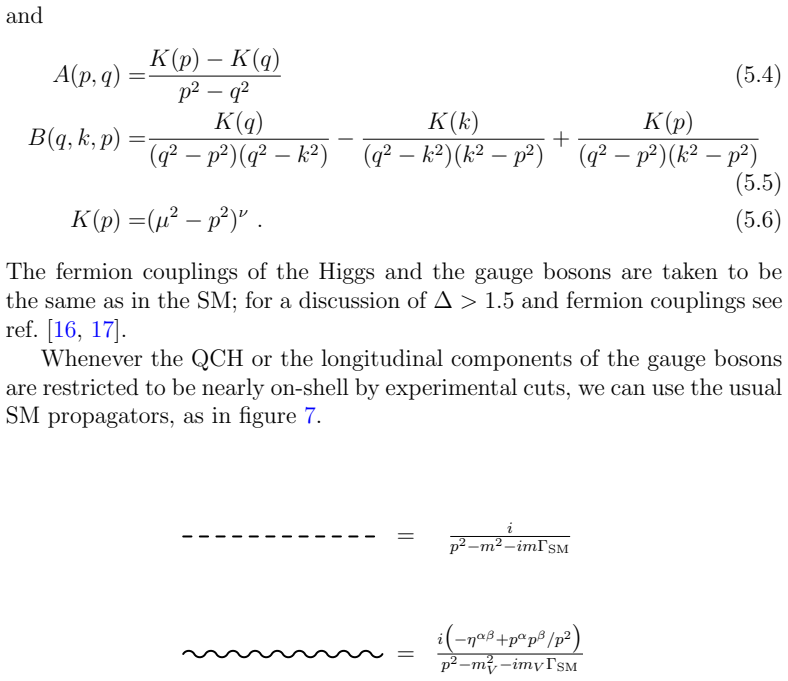
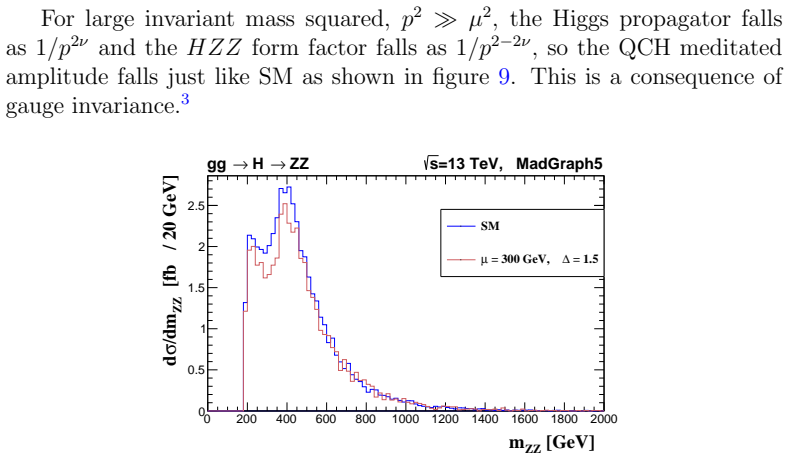
The load-bearing object is the momentum-dependent function $K(p)=(\mu^2-p^2)^\nu$ (with $\nu=2-\Delta$) that appears in the Higgs inverse propagator and, through gauge invariance, in the Higgs coupling to gauge bosons. In the simpler 5D model the bulk-to-boundary propagator is a modified Bessel function and the holographic reduction yields the quadratic term $\Sigma(p^2) = -(\mu^2-p^2)^\nu + (\mu^2-m_h^2)^\nu$. Gauge invariance forces the $HZZ$ form factor to be a combination of differences of $K$ evaluated at the external momenta, so that the product of the propagator and the vertex has the same high-energy falloff as the Standard Model. The choice of the $i\epsilon$ branch at the threshold $p^2=\mu^2$ is the detail that converts the originally claimed constructive interference in $gg\to ZZ$ into the Standard-Model-like destructive interference.
What would settle it
A measurement of the $gg\to HZ$ invariant-mass spectrum at a 13 TeV hadron collider: the paper predicts a clear excess over the Standard Model at $m_{HZ}$ values above roughly $\mu$ when $\mu \approx 300$ GeV and $\Delta \approx 1.5$; the absence of such an excess would falsify the central claim.
Extended reading notes
Core claim
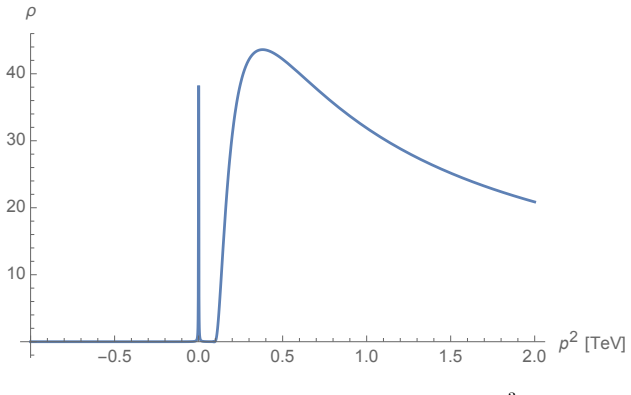
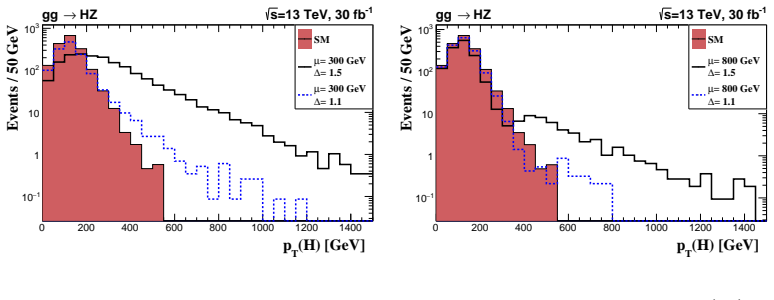
The core claim is a quantitative prediction for QCH collider signatures. In the minimal 5D model, the holographic Higgs inverse propagator takes the form $\Sigma(p^2) = -(\mu^2-p^2)^\nu + (\mu^2-m_h^2)^\nu$, producing a continuum spectral density above the threshold $\mu$. Gauge invariance, implemented by gauging the non-local kinetic term, fixes the $HZZ$ vertex in terms of the same function $K(p)=(\mu^2-p^2)^\nu$. Consequently, at high $p^2$ the propagator (falling as $1/p^{2\nu}$) and the vertex (falling as $1/p^{2-2\nu}$) multiply to reproduce Standard Model behaviour once the correct $i\epsilon$ branch is chosen, so the previously claimed large $gg\to ZZ$ enhancement was an artefact of the wrong branch. The $HZ$ production amplitude, however, involves the vertex in a different combination and is predicted to show relative growth, with clear excesses in the $m_{HZ}$ and transverse-momentum distributions.
Load-bearing premise
The predicted HZ enhancement assumes that the Higgs–Z vertex takes the minimal-coupling form derived from the non-local Higgs kinetic term, a formula the paper does not derive directly from its full 5D model with realistic non-flat gauge profiles.
Editorial extensions
If this is right
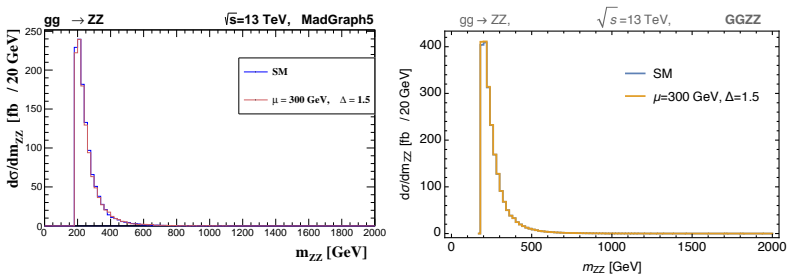
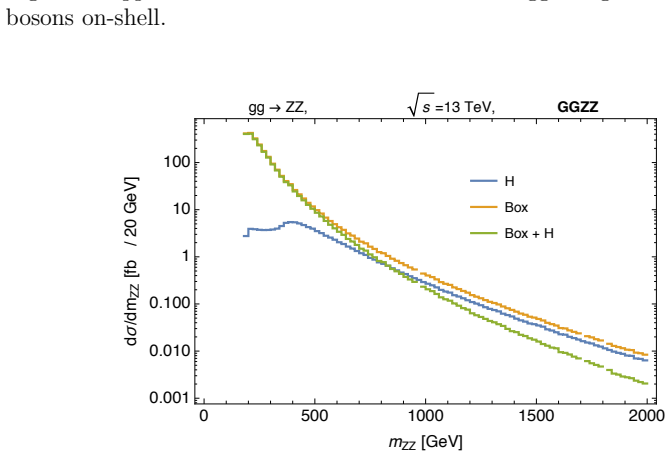
- The off-shell $gg\to ZZ$ cross section in QCH models closely tracks the Standard Model once the $i\epsilon$ branch is chosen correctly, so earlier claims of a large enhancement in this channel are not viable.
- The $gg\to HZ$ channel offers a clean, observable QCH signal at the LHC: for a threshold around 300 GeV and scaling dimension around 1.5, the $m_{HZ}$ distribution shows a large excess over the Standard Model even with 30 fb$^{-1}$.
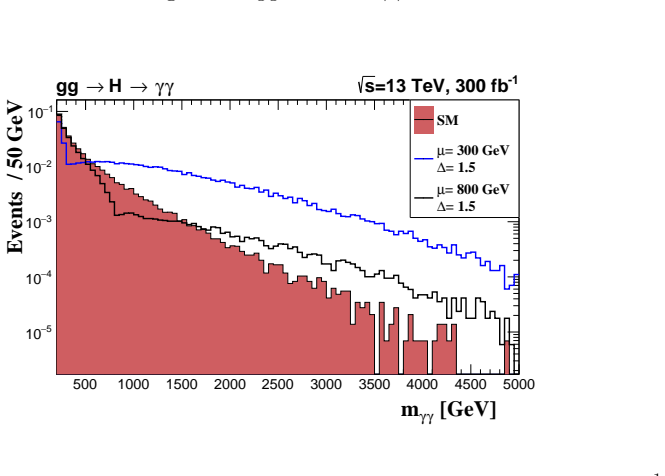
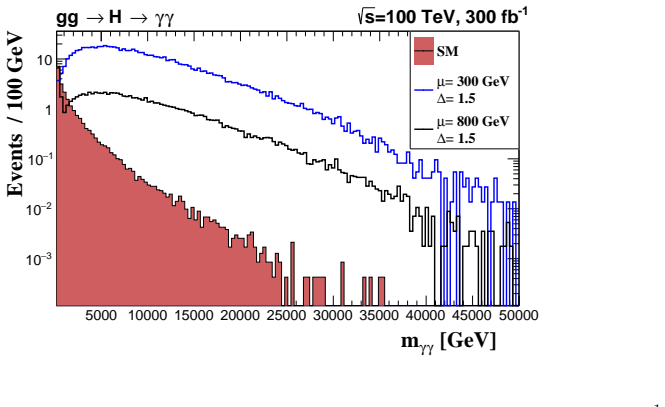
- The $gg\to \gamma\gamma$ channel probes the Higgs propagator directly and would show an energy-growing excess, but the rate at the 13 TeV LHC is too small to explain observed events; a 100 TeV collider would make it visible.
- Because the cancellation in $gg\to ZZ$ is enforced by gauge invariance, searches for QCH should focus on associated Higgs production and di-photon tails rather than on off-shell four-lepton final states.
- The model requires the would-be Kaluza-Klein mass splitting to be below the Higgs width, a tuning of the AdS curvature radius, for the continuum description to hold.
Reading between the lines
- We infer that the same cancellation mechanism should make off-shell $gg\to W^+W^-$ Standard-Model-like when the longitudinal $W$ threshold is high, so diboson tails are a less promising probe than the $HZ$ channel.
- The analytic-continuation subtlety implies that other unparticle-like models with fractional-power propagators should be audited: advertised enhancements that depend on the branch choice of a non-integer power may be artefacts.
- A future high-energy $e^+e^-$ collider could measure the $HZ$ form factor directly in $e^+e^- \to HZ$ with an off-shell Higgs, testing the minimal-coupling vertex assumed here in a cleaner environment than gluon fusion.
Editorial analysis
A structured set of objections, weighed in public.
Referee Report
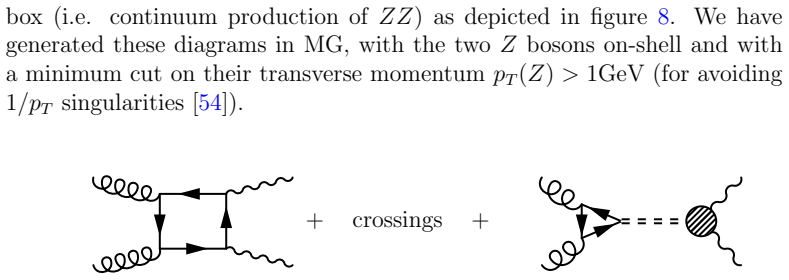
Summary. The paper studies Quantum Critical Higgs (QCH) models, in which the Higgs is part of a strongly coupled conformal sector broken by a threshold scale, and uses AdS/CFT duals with soft walls to compute Higgs propagators and form factors. Two five-dimensional models are presented: a soft-wall model and a more minimal model with analytic form factors. The authors implement the minimal model in MadGraph5 and study gg→H→ZZ, gg→H→γγ, and gg→Z→HZ at the LHC and a 100 TeV collider. The main positive claim is that gg→HZ has a large enhancement in the high-invariant-mass tail, while the apparent enhancement in gg→ZZ is cancelled by the combination of the Higgs propagator and the HZZ form factor once the correct iε prescription is used. The paper also provides details of the MadGraph implementation and compares the ZZ channel against the GGZZ code.
Significance. If the central HZ prediction holds, the paper identifies an experimentally actionable LHC signature for QCH models and corrects an earlier claim of a large enhancement in gg→ZZ. The ZZ cancellation is explained as a consequence of gauge invariance and is properly credited to Ref. [55]; the iε/branch-cut discussion is a useful clarification. The paper also ships a MadGraph implementation and validates it against GGZZ, which is a strength. The work is phenomenological and parameter-dependent, with benchmark choices for Δ and μ, but it does not fit any data, so the predictions are falsifiable. The main limitation is that the advertised HZ signature is computed from the Mandelstam form factor rather than from a direct evaluation of the 5D bulk vertex, leaving the new cross-section prediction not fully tied to the 5D construction.
major comments (3)
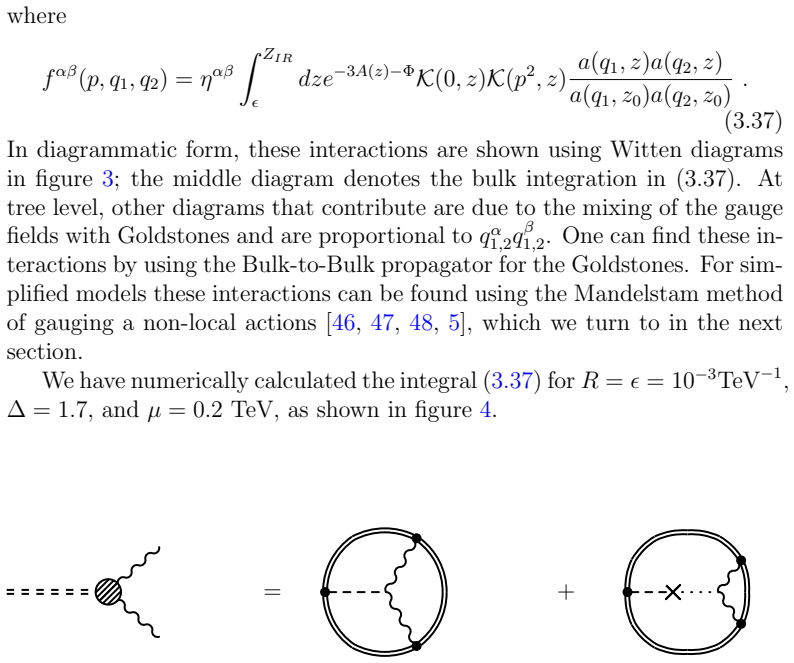
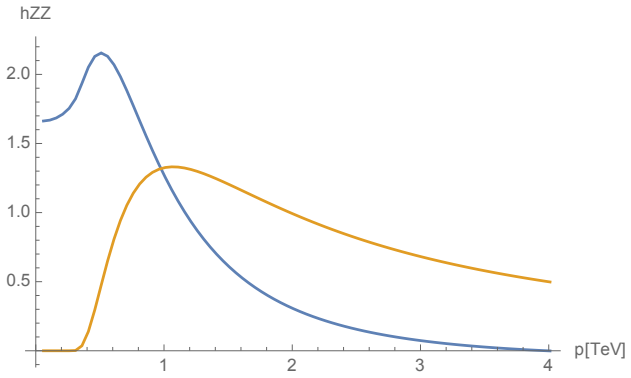
- [§4, Eq. (4.7) and §5.3, Eq. (5.3)] The HZ enhancement shown in Figs. 18–20 is computed with the Mandelstam form factor (5.3), which follows from the non-local Higgs kinetic term after treating the electroweak gauge profiles as flat and assuming the transverse gauge threshold is far above the energies probed. In the HZ process the off-shell Z leg carries q^2=m_HZ^2 up to roughly (1.4 TeV)^2, a range in which the gauge profile a(q,z) from Eq. (3.30) and the longitudinal-sector mixing (4.6) are not demonstrated to be flat. The paper asserts in §4 that deviations from (4.7) are small because the warp factor suppresses the integrand, but no numerical comparison between the bulk integral (3.37) and the flat-profile expressions (4.7)/(5.3) is shown for this kinematic range. If the true 5D vertex falls differently in p^2, the advertised gg→HZ excess is not a prediction of the 5D model; this is the load-bearing step for the main LHC signature.
- [§5.3 and Appendix C] The MadGraph implementation is described in Appendix C, but it is not stated whether the off-shell Z* propagator in gg→Z→HZ is the SM propagator or the modified longitudinal propagator (4.6). The production amplitude depends on this choice, and the longitudinal-sector continuum is one of the places where QCH effects could appear. The authors should specify exactly which propagator is used for the Z* line in the HZ calculation and, ideally, compare results with and without the longitudinal modification.
- [Appendix B] The claim that the backreacted metric of the minimal model still yields an effective continuum relies on tuning the AdS radius R such that the would-be KK mass splitting is below the Higgs width. The appendix gives zs but does not provide the numerical values of R/M5 needed to achieve Δm_KK≤Γ_H, nor does it demonstrate that this tuning leaves the computed spectral densities and form factors unaffected. Since the continuum interpretation underpins the propagators used in the collider analysis, this point should be quantified or explicitly stated as a parameter choice rather than left as an implicit tunable assumption.
minor comments (4)
- [Page 3, footnote 1] There is a typo: 'hierarcy' should be 'hierarchy'.
- [§5.2] The sentence 'there is no new form factor for Hγγ interactions' is imprecise; the vertex has no QCH form factor in the model, but the energy dependence in the gg→γγ channel comes from the modified Higgs propagator, so the phrase could be clarified.
- [Eqs. (3.22), (4.4)] The normalization constants after the field redefinitions are dimensionful; please specify the mass dimension of h_QCH and state explicitly how the normalization is fixed in the MadGraph implementation so that the reported cross sections are reproducible.
- [Figs. 15 and 16] The vertical axes appear to show negative event counts on a logarithmic scale, which is not meaningful as printed; please check the figure rendering and clarify whether the plotted quantity is the event count or the difference from the Standard Model.
Circularity Check
No significant circularity: the predictions follow from the stated 5D ansatz plus gauge invariance, with no fitted observable; self-citations are not load-bearing.
full rationale
The paper's derivation chain is self-contained in the relevant sense. The central inputs are the 5D soft-wall actions (3.6)/(4.1) and the generalized-free-field spectral ansatz Σ(p²) = -(μ²-p²)^ν + (μ²-m_h²)^ν. The Higgs propagator, the longitudinal gauge propagator (4.6), and the HZZ vertex (5.3) are all derived from this single K(p) by the Mandelstam gauging procedure, and the Ward identity relating them is stated explicitly. The gg→ZZ cancellation is therefore a consistency check of that gauge-invariant construction, not a fitted parameter renamed as a prediction; the paper credits ref. [55] for the general cancellation and uses it to correct the earlier sign error in ref. [2]. The gg→HZ tail is likewise a direct consequence of the same vertex and propagator, evaluated at benchmark μ and Δ values; no cross-section is used to define the model parameters. The MadGraph implementation is checked against the independent GGZZ code, and the 5D bulk integral (3.37) is numerically computed for the first model, though the collider analysis adopts the flat-profile approximation of Eq. (4.7) for gauge bosons, as stated in the text. Self-citations to [2], [40], [48], and [50] are present, but the relevant equations are re-derived in the paper (e.g., Eqs. (4.3)–(4.5), (5.3)–(5.6)), so they are not load-bearing in a circular way. The reviewer's concern that (3.37) and (5.3) may differ for off-shell Z kinematics is a robustness and correctness issue—an unverified approximation—not circularity, because the approximation is announced rather than hidden. No circular step can be exhibited by the paper's own equations.
Assumptions & free parameters
free parameters (4)
- Scaling dimension Delta (or nu=2-Delta) =
Scanned values: 1.1, 1.3, 1.5, 1.7 (nu=0.9, 0.7, 0.5, 0.3)
- Threshold scale mu =
Scanned values: 0.2, 0.3, 0.8 TeV
- Gauge-sector threshold mu_V =
Not specified; taken much larger than the available energy
- AdS radius R and UV cutoff epsilon =
R=epsilon=10^-3 TeV^-1 (in plots)
assumptions (6)
- domain assumption AdS/CFT correspondence with a soft-wall dilaton dual to a strongly coupled CFT softly broken at scale mu.
- domain assumption The Higgs is a generalized free field in the CFT, so the 1PI action is weakly coupled in terms of these fields.
- domain assumption For 1<Delta<2 the correct AdS/CFT prescription is the Legendre-transformed solution with Delta=2-nu, promoting the boundary value to a dynamical field.
- domain assumption The H*HZ and HZZ vertices are fully determined by gauge invariance (Mandelstam method) from the non-local Higgs kinetic term.
- ad hoc to paper In the minimal model, the backreaction of the z-dependent scalar VEV on the metric either does not break the continuum or does so with a splitting below the Higgs width.
- domain assumption The i epsilon prescription for (mu^2-p^2)^nu selects the branch (-1-i epsilon)^nu = e^(i pi nu), yielding positive spectral density and outgoing IR waves.
invented entities (1)
-
The QCH continuum: the Higgs is a superposition of a continuum of states above the threshold mu (the unparticle-like continuum).
independent evidence
Cite this review
Pith. "Pith review of Quantum Critical Higgs: From AdS$_5$ to Colliders." pith.science (2026). https://pith.science/paper/55KXGOCQ
@misc{pith2026190806186,
  author       = {Pith},
  title        = {Pith review of: Quantum Critical Higgs: From AdS$_5$ to Colliders},
  year         = {2026},
  howpublished = {\url{https://pith.science/paper/55KXGOCQ}},
  note         = {Machine review of arXiv:1908.06186}
}
abstract
We examine distinctive signatures of Quantum Critical Higgs models at the LHC and future higher energy colliders. In these models the Higgs boson is part of a conformal sector that is softly broken at a threshold scale, and generically the scaling dimension of the Higgs is larger than in the Standard Model. In particular we examine the $gg\to H \to ZZ$, $gg\to H\to \gamma\gamma$, and $gg\to Z\to HZ$ channels to see how the cross sections deviate from the Standard Model in the high invariant mass region. In order to perform the calculations we use 5D duals of Quantum Critical Higgs models using the AdS/CFT correspondence, with a soft wall to break the conformal symmetry.
Figures

Figures from the paper (17 more)








Reference graph
Works this paper leans on
-
[55]
The ˆH- Parameter: An Oblique Higgs View,
C. Englert, G. F. Giudice, A. Greljo and M. Mccullough, “The ˆH- Parameter: An Oblique Higgs View,” hep-ph/1903.07725. 35
arXiv 1903
-
[1]
S. Sachdev, “Quantum Phase Transitions,” (2011, Cambridge University Press)
work page 2011
-
[2]
B. Bellazzini, C. Cs´ aki, J. Hubisz, S. J. Lee, J. Serra and J. Terning, “The Quantum Critical Higgs,” hep-ph/1511.08218
-
[3]
H. Georgi, “Unparticle physics,” Phys. Rev. Lett. 98, 221601 (2007) hep-ph/0703260; H. Georgi, “Another Odd Thing About Unparticle Physics,” Phys. Lett. B650 (2007) 275 hep-ph/0704.2457. 31
arXiv 2007
-
[4]
Bounds on Unparticles from the Higgs Sector,
P. J. Fox, A. Rajaraman and Y. Shirman, “Bounds on Unparticles from the Higgs Sector,” Phys. Rev. D 76, 075004 (2007) hep-ph/0705.3092
arXiv 2007
-
[5]
G. Cacciapaglia, G. Marandella and J. Terning, “Colored Unparticles,” JHEP 0801, 070 (2008) hep-ph/0708.0005
arXiv 2008
-
[6]
A. Delgado, J. R. Espinosa and M. Quiros, “Unparticles Higgs Inter- play,” JHEP 0710 (2007) 094 hep-ph/0707.4309
work page Pith review arXiv 2007
-
[7]
Unparticle physics and Higgs phenomenology
T. Kikuchi and N. Okada, “Unparticle physics and Higgs phenomenol- ogy,” Phys. Lett. B 661 (2008) 360 hep-ph/0707.0893
work page Pith review arXiv 2008
Show all 62 references
-
[8]
The Higgs as a Portal to Plasmon-like Unparticle Excitations,
A. Delgado, J. R. Espinosa, J. M. No and M. Quiros, “The Higgs as a Portal to Plasmon-like Unparticle Excitations,” JHEP 0804 (2008) 028 hep-ph/0802.2680
2008 arXiv
-
[9]
Phantom Higgs from Unparticles,
A. Delgado, J. R. Espinosa, J. M. No and M. Quiros, “Phantom Higgs from Unparticles,” JHEP 0811 (2008) 071 hep-ph/0804.4574
2008 arXiv
-
[10]
Electroweak symmetry breaking from unparticles,
J. P. Lee, “Electroweak symmetry breaking from unparticles,” hep-ph/0803.0833
-
[11]
A No lose theorem for Higgs searches at a future linear collider,
J. R. Espinosa and J. F. Gunion, “A No lose theorem for Higgs searches at a future linear collider,” Phys. Rev. Lett. 82 (1999) 1084 hep-ph/980727
1999
-
[12]
HEIDI and the unparticle,
J. J. van der Bij and S. Dilcher, “HEIDI and the unparticle,” Phys. Lett. B 655 (2007) 183 hep-ph/0707.1817
2007 arXiv
-
[13]
The Unhiggs,
D. Stancato and J. Terning, “The Unhiggs,” JHEP 0911 (2009) 101 hep-ph/0807.3961
2009 arXiv
-
[14]
Constraints on the Unhiggs Model from Top Quark Decay,
D. Stancato and J. Terning, “Constraints on the Unhiggs Model from Top Quark Decay,” Phys. Rev. D81, 115012 (2010) hep-ph/1002.1694
2010 arXiv
-
[15]
Holographic Unhiggs,
A. Falkowski and M. Perez-Victoria, “Holographic Unhiggs,” Phys. Rev. D 79 (2009) 035005 hep-ph/0810.4940
2009 arXiv
-
[16]
Unconstrain- ing the Unhiggs,
C. Englert, M. Spannowsky, D. Stancato and J. Terning, “Unconstrain- ing the Unhiggs,” Phys. Rev. D 85 (2012) 095003 hep-ph/1203.0312 32
2012 arXiv
-
[17]
Constrain- ing the Unhiggs with LHC data,
C. Englert, D. G. Netto, M. Spannowsky and J. Terning, “Constrain- ing the Unhiggs with LHC data,” Phys. Rev. D 86 (2012) 035010 hep-ph/1205.0836
2012 arXiv
-
[18]
Higgs Couplings at High Scales,
D. Gon¸ calves, T. Han and S. Mukhopadhyay, “Higgs Couplings at High Scales,” Phys. Rev. D 98 (2018) 015023 hep-ph/1803.09751
2018 arXiv
-
[19]
Continuum Naturalness,
C. Cs´ aki, G. Lee, S. J. Lee, S. Lombardo and O. Telem, “Continuum Naturalness,” JHEP 1903 (2019) 142 hep-ph/1811.06019
2019 arXiv
-
[20]
Probing New Physics by the Tail of the Off-shell Higgs in VLVL Mode,
S. J. Lee, M. Park and Z. Qian, “Probing New Physics by the Tail of the Off-shell Higgs in VLVL Mode,” hep-ph/1812.02679
-
[21]
Gapped Continuum Kaluza-Klein spectrum,
E. Meg´ ıas and M. Quir´ os, “Gapped Continuum Kaluza-Klein spectrum,” hep-ph/1905.07364
1905 arXiv
-
[22]
A large mass hierarchy from a small extra dimension,
L. Randall and R. Sundrum, “A large mass hierarchy from a small extra dimension,” Phys. Rev. Lett. 83, 3370 (1999) hep-ph/9905221
1999 arXiv
-
[23]
Raising the Sideways Scale,
B. Holdom, “Raising the Sideways Scale,” Phys. Rev. D 24 (1981) 1441
1981
-
[24]
Scale Invariant Techni- color Model and a Technidilaton,
K. Yamawaki, M. Bando and K. i. Matumoto, “Scale Invariant Techni- color Model and a Technidilaton,” Phys. Rev. Lett. 56, 1335 (1986)
1986
-
[25]
The Minimal composite Higgs model,
K. Agashe, R. Contino and A. Pomarol, “The Minimal composite Higgs model,” Nucl. Phys. B 719 (2005) 165 hep-ph/0412089
2005 arXiv
-
[26]
Generalized Free Fields and Models of Local Field Theory,
O. W. Greenberg, “Generalized Free Fields and Models of Local Field Theory,” Annals Phys. 16 (1961) 158
1961
-
[27]
All unitary ray representations of the conformal group SU (2, 2) with positive energy
G. Mack, “All unitary ray representations of the conformal group SU (2, 2) with positive energy” Comm. Math. Phys. 55 (1977) 1
1977
-
[28]
Modern supersymmetry: Dynamics and Duality,
J. Terning, “Modern supersymmetry: Dynamics and Duality,” (2006, Oxford University Press) p 128
2006
-
[29]
Conformal Field Theory,
P. Di Francesco, P. Mathieu and D. Senechal, “Conformal Field Theory,” (1996, Springer)
1996
-
[30]
On the definition of the Renormalization Constants in Quan- tum Electrodynamics,
G. Kallen, “On the definition of the Renormalization Constants in Quan- tum Electrodynamics,” Helv. Phys. Acta 25 (1952) 417 33
1952
-
[31]
On the Properties of propagation functions and renor- malization contants of quantized fields,
H. Lehmann, “On the Properties of propagation functions and renor- malization contants of quantized fields,” Nuovo Cim. 11 (1954) 342
1954
-
[32]
The Large N limit of superconformal field theories and supergravity,
J. M. Maldacena, “The Large N limit of superconformal field theories and supergravity,” Int. J. Theor. Phys. 38, 1113 (1999) [Adv. Theor. Math. Phys. 2, 231 (1998)] hep-th/9711200
1999 arXiv
-
[33]
Holography and phe- nomenology,
N. Arkani-Hamed, M. Porrati and L. Randall, “Holography and phe- nomenology,” JHEP 0108, 017 (2001) hep-th/0012148
2001 arXiv
-
[34]
Comments on the holographic pic- ture of the Randall-Sundrum model,
R. Rattazzi and A. Zaffaroni, “Comments on the holographic pic- ture of the Randall-Sundrum model,” JHEP 0104, 021 (2001) hep-th/0012248
2001 arXiv
-
[35]
Anti-de Sitter space and holography,
E. Witten, “Anti-de Sitter space and holography,” Adv. Theor. Math. Phys. 2, 253 (1998) hep-th/9802150
1998 arXiv
-
[36]
Gauge theory cor- relators from noncritical string theory,
S. S. Gubser, I. R. Klebanov and A. M. Polyakov, “Gauge theory cor- relators from noncritical string theory,” Phys. Lett. B 428 (1998) 105 hep-th/9802109
1998 arXiv
-
[37]
Introduction to the AdS-CFT correspondence,
A. Zaffaroni, “Introduction to the AdS-CFT correspondence,” Class. Quant. Grav. 17 (2000) 3571
2000
-
[38]
AdS / CFT correspondence and sym- metry breaking,
I. R. Klebanov and E. Witten, “AdS / CFT correspondence and sym- metry breaking,” Nucl. Phys. B 556 (1999) 89 hep-th/9905104
1999 arXiv
-
[39]
The Soft-Wall Standard Model,
B. Batell, T. Gherghetta and D. Sword, “The Soft-Wall Standard Model,” Phys. Rev. D 78 (2008) 116011 hep-ph/0808.3977
2008 arXiv
-
[40]
The AdS/CFT/Unparticle Correspondence,
G. Cacciapaglia, G. Marandella and J. Terning, “The AdS/CFT/Unparticle Correspondence,” JHEP 0902 (2009) 049 hep-ph/0804.0424
2009 arXiv
-
[41]
String theory. Vol. 1: An introduction to the bosonic string,
J. Polchinski, “String theory. Vol. 1: An introduction to the bosonic string,” (2011, Cambridge University Press)
2011
-
[42]
Linear confinement and AdS/QCD,
A. Karch, E. Katz, D. T. Son and M. A. Stephanov, “Linear confinement and AdS/QCD,” Phys. Rev. D 74 (2006) 015005 hep-ph/0602229
2006 arXiv
-
[43]
RS1, custodial isospin and precision tests,
K. Agashe, A. Delgado, M. J. May and R. Sundrum, “RS1, custodial isospin and precision tests,” JHEP 0308 (2003) 050 hep-ph/0308036. 34
2003 arXiv
-
[44]
Abramowitz and I
M. Abramowitz and I. A. Stegun, ”Handbook of Mathematical Func- tions”, F. W. J. Olver et al. , eds., NIST Digital Library of Mathematical Functions, https://dlmf.nist.gov/5.15
-
[45]
Quantum field theory and unification in AdS5,
L. Randall and M. D. Schwartz, “Quantum field theory and unification in AdS5,” JHEP 0111, 003 (2001) hep-th/0108114
2001 arXiv
-
[46]
Quantum Electrodynamics Without Potentials,
S. Mandelstam, “Quantum Electrodynamics Without Potentials,” An- nals Phys. 19 (1962) 1
1962
-
[47]
A study of gauge-invariant non-local interactions,
M. Chretien and R. E. Peierls, “A study of gauge-invariant non-local interactions,” Proc. Roy. Soc. Lond. A 223 (1954) 468
1954
-
[48]
Gauging nonlocal Lagrangians,
J. Terning, “Gauging nonlocal Lagrangians,” Phys. Rev. D 44 (1991) 887
1991
-
[49]
The automated computation of tree-level and next-to- leading order differential cross sections, and their matching to parton shower simulations,
J. Alwall et al., “The automated computation of tree-level and next-to- leading order differential cross sections, and their matching to parton shower simulations,” JHEP 1407 (2014) 079 hep-ph/1405.0301
2014 arXiv
-
[50]
The Unhiggs: electroweak symmetry breaking via an unparticle,
D. A. Stancato, Ph.D. Thesis, “The Unhiggs: electroweak symmetry breaking via an unparticle,” UC Davis (2011)
2011
-
[51]
Constraining the Higgs boson width with ZZ production at the LHC,
F. Caola and K. Melnikov, “Constraining the Higgs boson width with ZZ production at the LHC,” Phys. Rev. D 88 (2013) 054024 hep-ph/1307.4935
2013 arXiv
-
[52]
Production of two Z-bosons in gluon fusion in the heavy top quark approximation,
K. Melnikov and M. Dowling, “Production of two Z-bosons in gluon fusion in the heavy top quark approximation,” Phys. Lett. B 744 (2015) 43 hep-ph/1503.01274
2015 arXiv
-
[53]
Constraints on off-shell Higgs boson production and the Higgs boson total width in ZZ → 4𝓁 and ZZ→ 2𝓁2ν final states with the ATLAS detector,
M. Aaboud et al. [ATLAS Collaboration], “Constraints on off-shell Higgs boson production and the Higgs boson total width in ZZ → 4𝓁 and ZZ→ 2𝓁2ν final states with the ATLAS detector,” Phys. Lett. B 786 (2018) 223 hep-ex/1808.01191
2018 arXiv
-
[54]
Bounding the Higgs width at the LHC using full analytic results for gg− > e−e+µ−µ+,
J. M. Campbell, R. K. Ellis and C. Williams, “Bounding the Higgs width at the LHC using full analytic results for gg− > e−e+µ−µ+,” JHEP 1404 (2014) 060 hep-ph/1311.3589
2014 arXiv
-
[56]
Z Boson Pair Production Via Gluon Fusion,
E. W. N. Glover and J. J. van der Bij, “ Z Boson Pair Production Via Gluon Fusion,” Nucl. Phys. B 321, 561 (1989)
1989
-
[57]
Z Boson Production and Decay via Gluons,
J. J. van der Bij and E. W. N. Glover, “ Z Boson Production and Decay via Gluons,” Nucl. Phys. B 313 (1989) 237
1989
-
[58]
Search for new phenomena in high-mass diphoton final states using 37 fb−1 of proton–proton collisions collected at√s = 13 TeV with the ATLAS detector,
M. Aaboud et al. [ATLAS Collaboration], “Search for new phenomena in high-mass diphoton final states using 37 fb−1 of proton–proton collisions collected at√s = 13 TeV with the ATLAS detector,” Phys. Lett. B775 (2017) 105 hep-ex/1707.04147
2017 arXiv
-
[59]
Combined search for anomalous pseudoscalar HVV couplings in VH(H→b¯b) production and H→ VV decay,
V. Khachatryan et al. [CMS Collaboration], “Combined search for anomalous pseudoscalar HVV couplings in VH(H→b¯b) production and H→ VV decay,” Phys. Lett. B 759 (2016) 672 hep-ex/1602.04305
2016 arXiv
-
[60]
An Alternative to compactification,
L. Randall and R. Sundrum, “An Alternative to compactification,” Phys. Rev. Lett. 83 (1999) 4690 hep-th/990606
1999
-
[61]
Continuum Su- perpartners from Supersymmetric Unparticles,
H. Cai, H. C. Cheng, A. D. Medina and J. Terning, “Continuum Su- perpartners from Supersymmetric Unparticles,” Phys. Rev. D 80 (2009) 115009 hep-ph/0910.3925
2009 arXiv
-
[62]
Unparticle signals with a few particles,
M. Perez-Victoria, “Unparticle signals with a few particles,” JHEP0901 (2009) 011 hep-ph/0808.4075. 36
2009 arXiv
Reviewed August 14, 2026 · model on record in the stance chip above.
Discussion (0). Continue with ORCID to comment.