Context-Verified, Error-Budget-Aware Decomposition Selection for Toffoli Networks
Pith reviewed 2026-07-01 05:28 UTC · model grok-4.3
The pith
A compiler pass safely selects context-dependent Toffoli decompositions to minimize two-qubit infidelity using per-instance verification.
A machine-rendered reading of the paper's core claim, the machinery that carries it, and where it could break.
Core claim
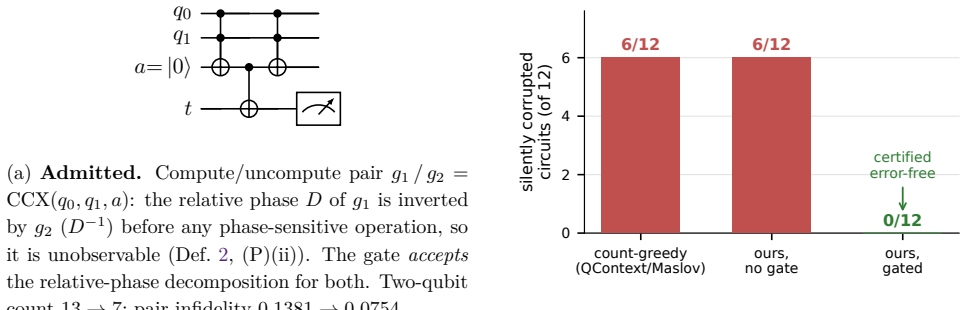
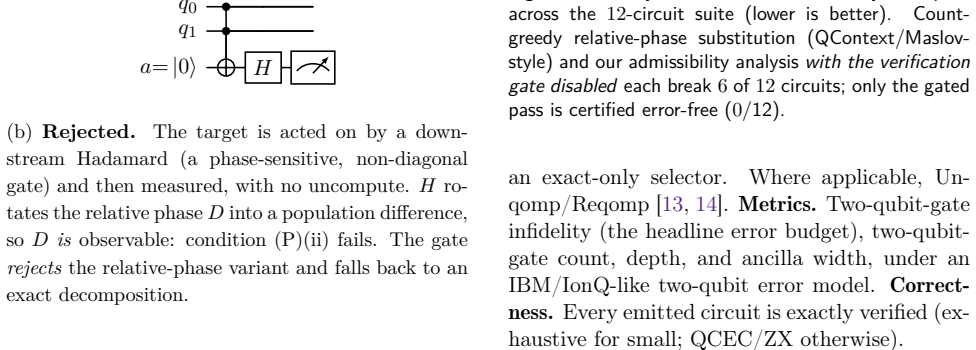
By coupling an error-budget objective with per-instance decision-diagram verification, the approach certifies that pattern-matched relative-phase substitutions are often incorrect, flags 66 invalid rewrites in a library, prevents corruption in benchmarks, and achieves up to 39.5% fewer two-qubit gates and 36.7% lower infidelity while certifying zero errors.
What carries the argument
The context-verified error-budget-aware decomposition selector for Toffoli networks, which uses decision-diagram equivalence checking to validate each substitution before inclusion in the minimized error budget.
If this is right
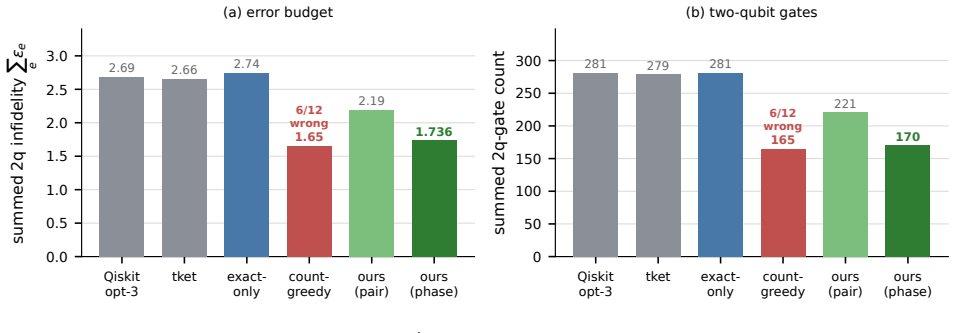
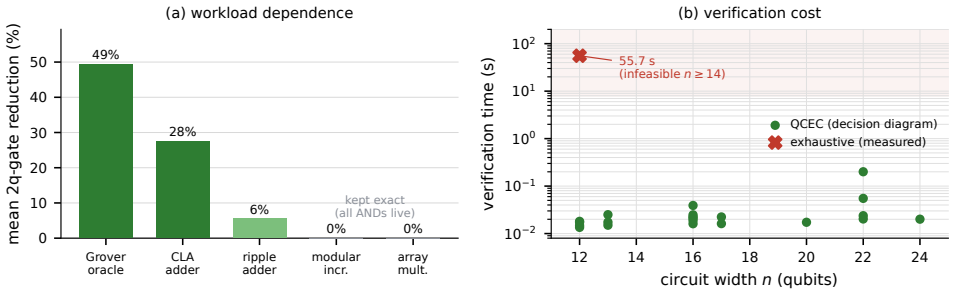
- Up to 39.5 percent fewer two-qubit gates on compute/uncompute-heavy workloads
- 36.7 percent lower infidelity compared to exact-only decompositions
- 15.6 percent aggregate reduction on a 12-24 qubit suite
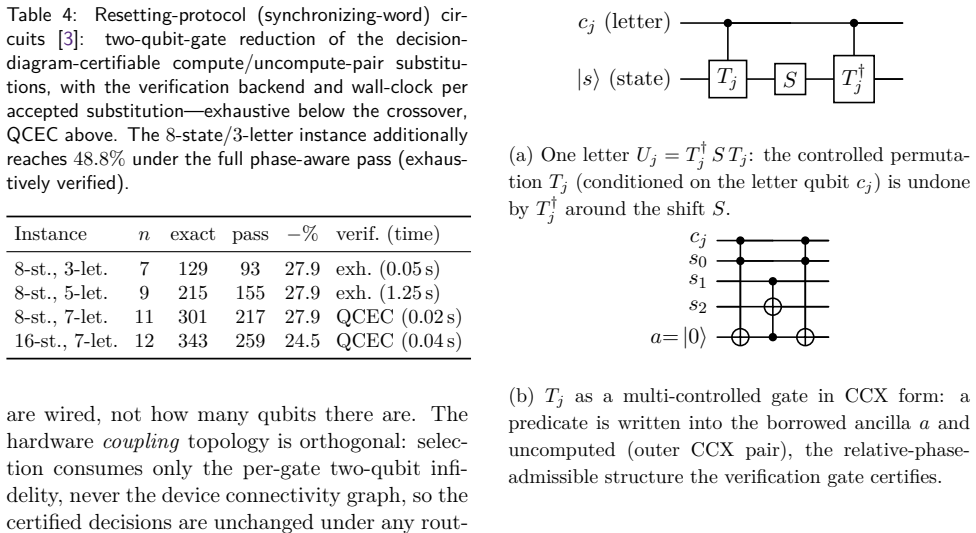
- 48.8 percent removal of native two-qubit gates on a state-resetting circuit, all verified
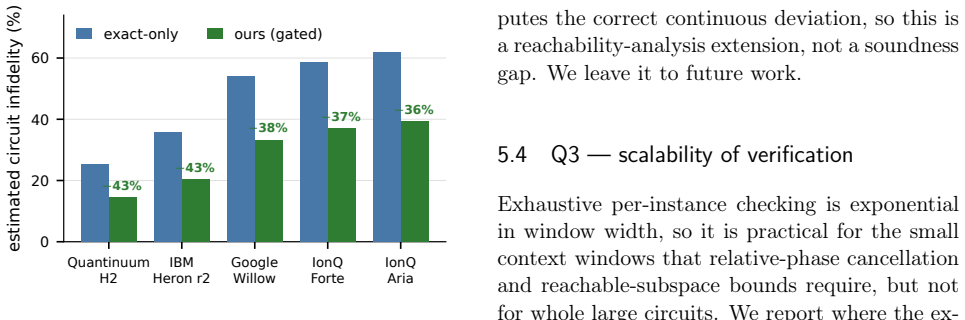
- Estimated circuit infidelity lowered by 36-43 percent at current hardware error rates
Where Pith is reading between the lines
- The method could be applied to optimize other context-sensitive gates like controlled-SWAP or multi-controlled gates.
- Decision-diagram verification might enable safer use of approximate methods in larger quantum algorithms.
- Workload-dependent gains suggest tailoring the pass to specific application domains like quantum error correction circuits.
Load-bearing premise
The decision-diagram equivalence checker is sound and complete with no false negatives for valid substitutions in the benchmark circuits.
What would settle it
A concrete counterexample where the verifier accepts a decomposition as equivalent but the resulting circuit produces a measurably different output distribution from the original on the same input state.
Figures
read the original abstract
Two-qubit-gate error dominates the failure budget of near-term quantum circuits, so the decomposition chosen for each Toffoli (CCX) gate should minimize hardware two-qubit infidelity, not gate count. The cheapest decompositions - relative-phase and approximate Toffolis - are only correct in context: their residual phase or bounded error must be cancelled or absorbed downstream. We present the first compiler pass that selects a per-Toffoli decomposition to minimize a two-qubit-infidelity error budget. It admits each context-dependent decomposition only when an exact, instance-specific equivalence check certifies its validity in that circuit context, coupling an error-budget objective with per-instance verification and closing the gap between context-aware-but-unverified and verified-but-context-free optimizers. The central result is a safety one: pattern-matched relative-phase substitution is silently incorrect. Our verifier flags 66 library rewrites of a deployed open optimizer as non-equivalent without a context check, and count-greedy substitution silently corrupts 6 of 12 benchmark circuits; the verification gate certifies 0 errors while still applying every valid decomposition. The two-qubit-gate reduction is real but workload-dependent: up to 39.5% fewer two-qubit gates and 36.7% lower infidelity over exact-only on a compute/uncompute-heavy suite (approx. 39%/35% versus Qiskit opt-3 and tket), and 15.6% aggregate on a larger 12-24-qubit suite, with decision-diagram checking certifying every substitution past the exhaustive-verification limit. At current superconducting and trapped-ion error rates, the certified substitutions lower estimated circuit infidelity by 36-43%, and on a quantum state-resetting circuit, the pass removes 48.8% of the native two-qubit gates, every substitution verified.
Editorial analysis
A structured set of objections, weighed in public.
Referee Report
Summary. The paper introduces a compiler pass for Toffoli (CCX) decomposition selection that minimizes two-qubit infidelity by admitting context-dependent (relative-phase or approximate) decompositions only when an instance-specific decision-diagram equivalence check certifies validity in the surrounding circuit. It reports that existing pattern-matched rewrites from a deployed optimizer are non-equivalent in 66 cases without context, that count-greedy substitution corrupts 6 of 12 benchmarks, and that the verified pass achieves up to 39.5% two-qubit gate reduction and 36-43% infidelity reduction on superconducting/trapped-ion error rates while certifying zero errors on the evaluated suites.
Significance. If the per-instance verification is sound, the work supplies the first practical coupling of error-budget optimization with context-aware verification for a common multi-qubit primitive, directly addressing a known safety gap in current quantum compilers. The concrete benchmark numbers (66 flagged rewrites, 6 corrupted circuits, 39.5% gate reduction, 36.7% infidelity drop) and the demonstration that verification can be applied past exhaustive limits provide measurable evidence of both the problem and a workable mitigation.
major comments (2)
- [Verification / Methods] Verification / Methods: The central safety claim (66 non-equivalent rewrites flagged, 0 errors certified on all substitutions) rests on the decision-diagram equivalence checker being sound and complete for every relative-phase and approximate-Toffoli context arising in the 12- and 24-qubit suites. No independent cross-validation (exhaustive unitary comparison on small instances, ZX-diagram equivalence, or false-negative analysis on residual-phase circuits) is reported; this assumption is load-bearing for the "certifies 0 errors" result.
- [Results] Results, paragraph on 12-24-qubit suite: The 15.6% aggregate two-qubit reduction and 36-43% infidelity improvement are stated without per-circuit error bars or explicit breakdown of how the infidelity budget is computed from the chosen decompositions; because the error-budget objective is the primary optimization target, the quantitative claims require the underlying fidelity model and its sensitivity to be shown.
minor comments (2)
- [Abstract] Abstract: "approx. 39%/35% versus Qiskit opt-3 and tket" is ambiguous; clarify whether these are two separate comparisons or a single paired figure.
- [Abstract] Abstract and Results: The phrase "past the exhaustive-verification limit" is used without stating what that limit is (qubit count, gate depth, or DD node count) or how soundness is preserved under the fallback heuristic.
Simulated Author's Rebuttal
We thank the referee for the careful and constructive review. The comments highlight important aspects of verification soundness and quantitative presentation that we will address in revision.
read point-by-point responses
-
Referee: [Verification / Methods] Verification / Methods: The central safety claim (66 non-equivalent rewrites flagged, 0 errors certified on all substitutions) rests on the decision-diagram equivalence checker being sound and complete for every relative-phase and approximate-Toffoli context arising in the 12- and 24-qubit suites. No independent cross-validation (exhaustive unitary comparison on small instances, ZX-diagram equivalence, or false-negative analysis on residual-phase circuits) is reported; this assumption is load-bearing for the "certifies 0 errors" result.
Authors: The decision-diagram equivalence procedure we employ is a standard, sound and complete method for checking unitary equivalence (including relative phases) that has been validated in prior literature on quantum circuit equivalence. We agree that reporting independent cross-validation would strengthen the central safety claim. In the revised manuscript we will add a Methods subsection that (i) details the DD checker implementation, (ii) presents exhaustive unitary-matrix comparisons for all instances with ≤4 qubits, and (iii) includes a targeted false-negative analysis on residual-phase circuits drawn from the benchmark suites. These additions directly address the load-bearing assumption. revision: yes
-
Referee: [Results] Results, paragraph on 12-24-qubit suite: The 15.6% aggregate two-qubit reduction and 36-43% infidelity improvement are stated without per-circuit error bars or explicit breakdown of how the infidelity budget is computed from the chosen decompositions; because the error-budget objective is the primary optimization target, the quantitative claims require the underlying fidelity model and its sensitivity to be shown.
Authors: We concur that the primary optimization target requires an explicit fidelity model and per-circuit detail. The infidelity budget is computed as the sum of per-gate two-qubit infidelities using published hardware error rates (superconducting ≈0.5 %, trapped-ion ≈0.1 %). In the revision we will (i) expand the Results section with a table listing per-circuit two-qubit gate counts and estimated infidelities for the full 12-24-qubit suite, (ii) state the exact infidelity formula and the two hardware models used, and (iii) add a sensitivity analysis showing how the reported 36-43 % improvement varies with the assumed error rates. Because the selection is deterministic, conventional statistical error bars are not applicable; we will instead report the range across the two hardware models. revision: yes
Circularity Check
No circularity; results are empirical benchmark measurements with independent verification
full rationale
The paper's central claims (66 non-equivalent rewrites flagged, 0 errors on benchmarks, workload-dependent gate reductions) are obtained by executing the described pass and decision-diagram checker on concrete circuits. No equations, parameters, or derivations are shown that reduce by construction to fitted inputs or self-definitions. The verification gate is presented as an independent soundness check decoupled from the error-budget objective. Self-citations, if present for the DD checker, are not load-bearing for the reported safety or reduction numbers, which rest on external benchmark execution rather than internal redefinition.
Axiom & Free-Parameter Ledger
Reference graph
Works this paper leans on
-
[1]
Quantum Computing in the NISQ era and beyond
John Preskill. “Quantum Computing in the NISQ era and beyond”. Quantum2, 79 (2018)
2018
-
[2]
Quantum synchroniz- ing words
Andrzej Grudka, Marcin Karczewski, Paweł Kurzyński, Jędrzej Stempin, Jan Wójcik, and Antoni Wójcik. “Quantum synchroniz- ing words”. New Journal of Physics27, 114504 (2025)
2025
-
[3]
Quantum resetting protocols based on synchronizing words
Jędrzej Stempin, Jan Wójcik, Andrzej Grudka, Marcin Karczewski, Paweł Kurzyński, and Antoni Wójcik. “Quantum resetting protocols based on synchronizing words” (2025). arXiv:2504.01106
-
[4]
Advantages of using relative-phase toffoli gates with an applica- tion to multiple control toffoli optimization
Dmitri Maslov. “Advantages of using relative-phase toffoli gates with an applica- tion to multiple control toffoli optimization”. Phys. Rev. A93, 022311 (2016)
2016
-
[5]
Best approximate quantum compiling problems
Liam Madden and Andrea Simonetto. “Best approximate quantum compiling problems”. ACM Transactions on Quantum Comput- ing3(2022)
2022
-
[6]
Qcontext: Context-aware decomposition for quantum gates
Ji Liu, Max Bowman, Pranav Gokhale, Sid- dharth Dangwal, Jeffrey Larson, Frederic T. Chong, and Paul D. Hovland. “Qcontext: Context-aware decomposition for quantum gates”. In 2023 IEEE International Sym- posium on Circuits and Systems (ISCAS). Pages 1–5. (2023)
2023
-
[7]
A verified optimizer for quantum circuits
Kesha Hietala, Robert Rand, Shih-Han Hung, Xiaodi Wu, and Michael Hicks. “A verified optimizer for quantum circuits”. Proc. ACM Program. Lang.5(2021)
2021
-
[8]
Quartz: superop- timization of quantum circuits
Mingkuan Xu, Zikun Li, Oded Padon, Sina Lin, Jessica Pointing, Auguste Hirth, Henry Ma, Jens Palsberg, Alex Aiken, Umut A. Acar, and Zhihao Jia. “Quartz: superop- timization of quantum circuits”. In Pro- ceedings of the 43rd ACM SIGPLAN Inter- national Conference on Programming Lan- guage Design and Implementation. Page 625–640. PLDI 2022New York, NY, USA...
2022
-
[9]
Op- timization of quantum Boolean circuits by relative-phase Toffoli gates
Shohei Kuroda and Shigeru Yamashita. “Op- timization of quantum Boolean circuits by relative-phase Toffoli gates”. In Reversible Computation (RC 2022). Volume 13354 of Lecture Notes in Computer Science, pages 20–27. Springer (2022)
2022
-
[10]
Ad- vanced equivalence checking for quantum 15 circuits
Lukas Burgholzer and Robert Wille. “Ad- vanced equivalence checking for quantum 15 circuits”. IEEE Transactions on Computer- Aided Design of Integrated Circuits and Sys- tems40, 1810–1824 (2021)
2021
-
[11]
t|ket〉: a retargetable com- piler for nisq devices
Seyon Sivarajah, Silas Dilkes, Alexander Cowtan, WillSimmons, AlecEdgington, and Ross Duncan. “t|ket〉: a retargetable com- piler for nisq devices”. Quantum Science and Technology6, 014003 (2020)
2020
-
[12]
Pyzx: Large scale automated dia- grammatic reasoning
Aleks Kissinger and John van de Weter- ing. “Pyzx: Large scale automated dia- grammatic reasoning”. Electronic Proceed- ings in Theoretical Computer Science318, 229–241 (2020)
2020
-
[13]
Unqomp: syn- thesizing uncomputation in quantum cir- cuits
Anouk Paradis, Benjamin Bichsel, Samuel Steffen, and Martin Vechev. “Unqomp: syn- thesizing uncomputation in quantum cir- cuits”. In Proceedings of the 42nd ACM SIGPLAN International Conference on Pro- gramming Language Design and Implemen- tation. Page 222–236. PLDI 2021New York, NY, USA (2021). Association for Computing Machinery
2021
-
[14]
Reqomp: Space-constrained Uncomputation for Quantum Circuits
Anouk Paradis, Benjamin Bichsel, and Mar- tin Vechev. “Reqomp: Space-constrained Uncomputation for Quantum Circuits”. Quantum8, 1258 (2024)
2024
-
[15]
Silq: a high- level quantum language with safe uncompu- tation and intuitive semantics
Benjamin Bichsel, Maximilian Baader, Ti- mon Gehr, and Martin Vechev. “Silq: a high- level quantum language with safe uncompu- tation and intuitive semantics”. In Proceed- ings of the 41st ACM SIGPLAN Conference on Programming Language Design and Im- plementation. Page286–300. PLDI2020New York, NY,USA(2020).AssociationforCom- puting Machinery
2020
-
[16]
Modular syn- thesis of efficient quantum uncomputation
Hristo Venev, Timon Gehr, Dimitar Dim- itrov, and Martin Vechev. “Modular syn- thesis of efficient quantum uncomputation”. Proc. ACM Program. Lang.8(2024)
2024
-
[17]
Halving the cost of quantum addition
Craig Gidney. “Halving the cost of quantum addition”. Quantum2, 74 (2018)
2018
-
[18]
Rise of conditionally clean ancillae for efficient quantum circuit constructions
Tanuj Khattar and Craig Gidney. “Rise of conditionally clean ancillae for efficient quantum circuit constructions”. Quantum9, 1752 (2025)
2025
-
[19]
A meet- in-the-middle algorithm for fast synthesis of depth-optimal quantum circuits
Matthew Amy, Dmitri Maslov, Michele Mosca, and Martin Roetteler. “A meet- in-the-middle algorithm for fast synthesis of depth-optimal quantum circuits”. IEEE Transactions on Computer-Aided Design of Integrated Circuits and Systems32, 818– 830 (2013)
2013
-
[20]
Demonstration of logical qubits and repeated error correction with better-than-physical error rates
A. Paetznick, M. P. da Silva, C. Ryan- Anderson, J. M. Bello-Rivas, J. P. Cam- pora III, A. Chernoguzov, J. M. Dreiling, C. Foltz, F. Frachon, J. P. Gaebler, T. M. Gatterman, L. Grans-Samuelsson, D. Gresh, D. Hayes, N. Hewitt, C. Holliman, C. V. Horst, J. Johansen, D. Lucchetti, Y. Mat- suoka, M. Mills, S. A. Moses, B. Neyen- huis, A. Paz, J. Pino, P. Sie...
work page internal anchor Pith review Pith/arXiv arXiv 2024
-
[21]
IBM Quantum platform: Backend calibration data (ibm_marrakesh, heron r2)
IBM Quantum. “IBM Quantum platform: Backend calibration data (ibm_marrakesh, heron r2)”.https://quantum.ibm.co m(2025). Per-device median two-qubit (CZ) gateerror; valuesvarywithdailycalibration
2025
-
[22]
Quantum error correction below the sur- face code threshold
Google Quantum AI and Collaborators. “Quantum error correction below the sur- face code threshold”. Nature638, 920– 926 (2025)
2025
-
[23]
Benchmarking a trapped-ion quan- tum computer with 30 qubits
Jwo-Sy Chen, Erik Nielsen, Matthew Ebert, Volkan Inlek, Kenneth Wright, Vandiver Chaplin, Andrii Maksymov, Eduardo Páez, Amrit Poudel, Peter Maunz, and John Gam- ble. “Benchmarking a trapped-ion quan- tum computer with 30 qubits”. Quantum8, 1516 (2024)
2024
-
[24]
IonQ Aria: Practical performance
IonQ. “IonQ Aria: Practical performance”. https://www.ionq.com/resources/ion q-aria-practical-performance(2025). Two-qubit error 0.4%, single-qubit error 0.05%. 16
2025
discussion (0)
Sign in with ORCID, Apple, or X to comment. Anyone can read and Pith papers without signing in.