REVIEW 3 major objections 5 minor 1 cited by
Visible blue-to-red 10 GHz frequency comb via on-chip triple-sum frequency generation
T0 review · 3 major / 5 minor · reviewed 2026-08-14 · deepseek-v4-flash
Pith's one-line read A silicon nitride waveguide converts a 10 GHz telecom comb into a visible comb spanning 400–600 nm (more than 250 THz) by triple-sum frequency generation.
desk verdict A solid on-chip 10 GHz visible comb demonstration, but the full 400-600 nm comb coherence rests on inference from a blue-only beatnote. read the letter →
The pith
A machine-rendered reading of the paper's core claim, the machinery that carries it, and where it could break.
The reading
What carries the argument
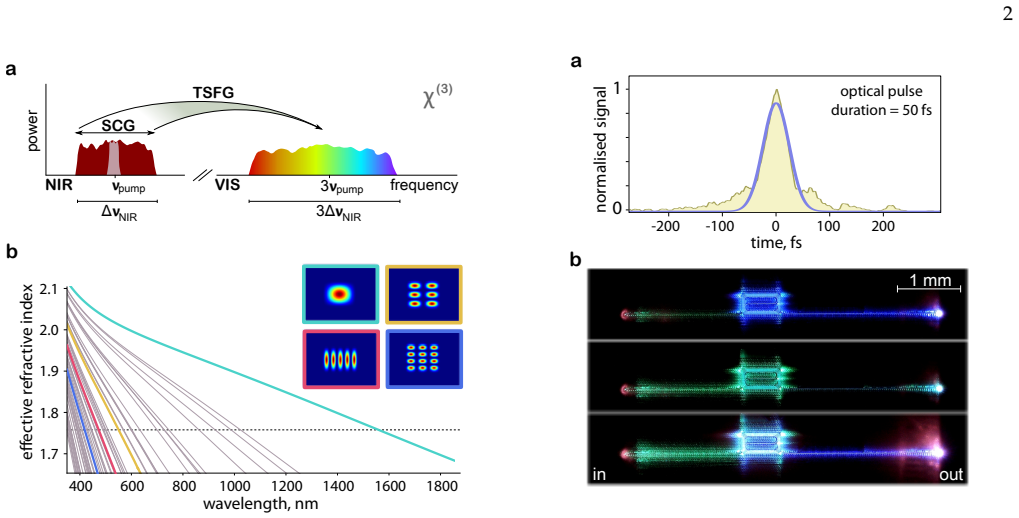
The load-bearing mechanism is modal phase matching in a multimode silicon nitride waveguide, used for triple-sum frequency generation (TSFG), the $\chi^{(3)}$ process $\omega_{\rm vis} = \omega_1 + \omega_2 + \omega_3$. In modal phase matching, a visible wavelength is carried by a higher-order waveguide mode whose effective refractive index matches that of the near-infrared pump mode, satisfying $\sum_i \mathbf{k}_i = 0$ even though the waveguide cannot group-velocity-match the two bands. Finite-element simulations of effective refractive indices identify these matching modes and guided the choice of a 1000 nm by 800 nm cross-section for near-zero dispersion at 1560 nm. TSFG preserves the radio-frequency comb spacing and makes the visible spectrum approximately three times as wide in frequency as the near-infrared supercontinuum that feeds it.
What would settle it
Resolve the visible spectrum at high resolution at several wavelengths between 400 and 600 nm and check whether each line sits at the expected sum of three near-infrared comb lines with 10 GHz spacing; any wavelength region where the expected grid is absent or shifted would show that the visible light is not one coherent comb.
Extended reading notes
Core claim
The central discovery is that a single silicon nitride waveguide can both broaden a 10 GHz, 150-pJ pulse train from a 1560 nm electro-optic comb into a near-infrared supercontinuum and, through the third-order nonlinearity, add three near-infrared frequencies to produce visible light: $\omega_{\rm vis} = \omega_1 + \omega_2 + \omega_3$. Because the waveguide is multimode in the visible, every visible wavelength can be assigned a higher-order mode whose effective refractive index is close to the pump mode's effective index, so the wave-vector matching condition holds across the whole range. The authors observe a visible spectrum from below 400 nm to above 600 nm, more than 250 THz wide, at 10 GHz repetition rate with on average 0.4 nW per mode, and they confirm the comb character by measuring a 10 GHz beatnote with 50 dB signal-to-noise in the 400–450 nm band. Triple-sum generation preserves the comb spacing ($\Delta\nu_{\rm vis} = \Delta\nu_{\rm NIR}$), and the visible lines inherit the phase coherence of the near-infrared comb.
Load-bearing premise
The claim rests on the assumption that phase matching holds coherently across the whole visible range, so every visible line is the sum of three near-infrared comb lines; the beatnote was measured only in the blue window from 400 to 450 nm, not across the full spectrum.
Editorial extensions
If this is right
- The 10 GHz visible comb is usable for astronomical spectrograph calibration and for referencing continuous-wave lasers, the applications named in the paper.
- Because the drive source is an electro-optic comb built from standard telecom components, the scheme can be adapted to other repetition rates in the 5–15 GHz range the source supports.
- The visible comb inherits the near-infrared comb's exact 10 GHz spacing, so radio-frequency control methods developed for telecom combs transfer directly to the visible.
- With the measured ~0.4 nW per mode, some comb lines already sit above the 0.1 nW level the authors identify as sufficient for calibration and laser referencing; the paper expects further efficiency gains from lower losses, better visible output couplers, resonant enhancement, and dispersion engineering.
Reading between the lines
- The paper does not directly verify comb line positions across the full 400–600 nm range; if triple-sum conversion is coherent over the whole band, the visible comb's carrier-envelope offset should be three times the near-infrared offset, a factor any visible-comb metrology would need to handle.
- Because the conversion relies on modal phase matching rather than group-velocity matching, pushing the same waveguide concept to shorter ultraviolet wavelengths by scaling the geometry is a natural, testable extension.
- The two bright features in the blue spectrum suggest conversion efficiency is locally enhanced where mode overlap is strongest, implying that modal-overlap engineering rather than raw pump power will determine how flat the visible comb can be made.
Signed reviews
Editorial analysis
A structured set of objections, weighed in public.
Referee Report
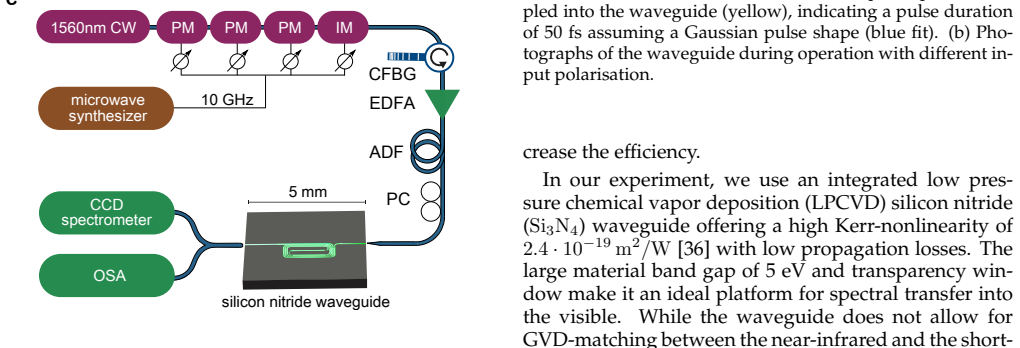
Summary. The paper reports the generation of a visible frequency comb with a repetition rate of 10 GHz spanning from below 400 nm to above 600 nm. A 1560 nm continuous-wave laser is converted into 50 fs, 150 pJ pulses via an electro-optic pulse generator and then coupled into a silicon nitride waveguide. The waveguide produces a near-infrared supercontinuum and, by the claimed triple-sum frequency generation (TSFG) under modal phase matching, a visible spectrum extending over more than 250 THz. A beatnote measured in the 400–450 nm band with 50 dB signal-to-noise ratio is used to support the comb nature of the visible emission. The authors propose applications in astronomical spectrograph calibration and continuous-wave laser referencing.
Significance. If the entire 400–600 nm spectrum is indeed a single coherent 10 GHz frequency comb, this is a significant experimental advance: it would provide a chip-based, telecom-band-pumped visible comb source with a repetition rate and power per mode suitable for astro-comb and metrology applications. The combination of electro-optic pulse generation, supercontinuum generation, and on-chip TSFG is a credible and practical route to access the blue-to-red visible range. The paper is clearly written and the main experimental observation—a broad visible spectrum with a strong beatnote in the blue—is valuable in itself. However, the coherence of the full visible bandwidth and the consistency of the power-per-mode numbers must be established before the central claim can be fully accepted.
major comments (3)
- [Fig. 4 and corresponding text (p. 3–4)] The claim that the entire 400–600 nm spectrum forms a single coherent 10 GHz comb is not directly supported by the measurements. The beatnote is recorded only after a 400–450 nm bandpass filter, and the CCD spectrometer used for the visible spectrum cannot resolve the comb lines. The red portion (450–600 nm) could in principle arise from different mode families, partially phase-matched processes, or cascaded nonlinear interactions that are not coherently linked to the blue comb. Please provide a direct verification that the red wavelengths belong to the same comb, for example a beatnote measurement in the red, a heterodyne measurement against a reference comb, or high-resolution spectroscopy resolving the 10 GHz spacing across the visible range. If such a measurement is not yet available, the title and abstract should be qualified to state that comb coherence is verified in the blue and inferred for the rest of the spectrum.
- [Abstract and Fig. 3 (p. 1 and p. 3)] There is an unexplained inconsistency in the reported power per mode: the abstract states 'on average 0.4 nW per mode' while the main text and Fig. 3 indicate '0.1 nW per comb line'. Please clarify which value is correct, specify the spectral range over which the average is taken, and state the calibration uncertainty. This is load-bearing for the claimed application in astronomical spectrograph calibration and laser referencing.
- [Fig. 3 and Fig. 1b (p. 3–4)] The attribution of the visible spectrum to triple-sum frequency generation via modal phase matching is inferred from the spectral span and from finite-element mode simulations, but no quantitative comparison is made between the simulated phase-matching conditions and the measured spectral intensity distribution. In particular, the two high-intensity blue features are said to be 'likely associated with' strong mode overlap, but no calculation of expected conversion efficiency or mode-overlap integrals is provided. A quantitative comparison—or at least a qualitative statement about which mode combinations correspond to the observed spectral features—would substantially strengthen the mechanistic claim.
minor comments (5)
- [Fig. 3b caption] The caption reads '0.1 nm per comb mode'; this should be '0.1 nW per comb mode'.
- [Fig. 3a and Fig. 1] The frequency axes in Fig. 3a and the effective-index plot in Fig. 1b are difficult to read in the current rendering; please use larger fonts and clearer axis labels.
- [Phase-matching discussion (p. 2)] The phase-matching condition is described in words; providing an explicit equation with wave vectors and effective indices would improve precision and reproducibility.
- [Fig. 4 and text (p. 4)] Please state explicitly in the text that the observed beatnote is at 10 GHz (the frequency is only visible in the figure axis), and give the measurement conditions (optical power, detector, resolution bandwidth) in the caption or text.
- [Coupling efficiency and power calibration] The power per mode is estimated from the fiber-to-waveguide coupling efficiency; please add a brief statement about the uncertainty in this calibration and in the absolute spectral intensity measurement.
Circularity Check
No significant circularity: the result is an experimental demonstration with no fitted-input prediction or load-bearing self-citation.
full rationale
The paper reports an experimental demonstration of a visible frequency comb generated by supercontinuum broadening and triple-sum frequency generation in a silicon nitride waveguide. The central claims are based on measured spectra (Fig. 3), a measured beatnote (Fig. 4), and finite-element simulations of effective refractive indices (Fig. 1b). No parameter is fitted to a subset of the data and then renamed as a prediction; the visible spectrum is measured directly with a CCD spectrometer, and the near-infrared supercontinuum is measured with optical spectrum analyzers. The finite-element simulation is used to illustrate that modal phase matching is possible near the pump index, not to reproduce or fit the measured visible spectrum. The beatnote measurement, although limited to 400–450 nm, is an experimental confirmation of the comb spacing in that range; extending the claim to the full visible range is an inference based on the TSFG process, but this is an evidentiary limitation rather than a circular step. Self-citations to the authors' prior electro-optic comb source [41] and resonant up/down-conversion work [44] are upstream support and forward-looking suggestions, respectively; neither is used as the justification for the central visible-comb claim. Therefore the derivation chain is self-contained and no circularity is found.
Assumptions & free parameters
assumptions (4)
- standard math Maxwell's equations and the nonlinear Schrodinger equation govern pulse propagation and frequency conversion in the waveguide.
- domain assumption The Kerr nonlinearity of silicon nitride is 2.4e-19 m^2/W as taken from ref. [36].
- domain assumption The finite-element simulation of effective refractive indices accurately represents the actual waveguide modes.
- domain assumption The electro-optic pulse train is a coherent frequency comb with 10 GHz spacing, and this coherence is preserved through supercontinuum generation and TSFG.
Cite this review
Pith. "Pith review of Visible blue-to-red 10 GHz frequency comb via on-chip triple-sum frequency generation." pith.science (2026). https://pith.science/paper/56SFO2BR
@misc{pith2026190805152,
  author       = {Pith},
  title        = {Pith review of: Visible blue-to-red 10 GHz frequency comb via on-chip triple-sum frequency generation},
  year         = {2026},
  howpublished = {\url{https://pith.science/paper/56SFO2BR}},
  note         = {Machine review of arXiv:1908.05152}
}
read the original abstract
A broadband visible blue-to-red, 10 GHz repetition rate frequency comb is generated by combined spectral broadening and triple-sum frequency generation in an on-chip silicon nitride waveguide. Ultra-short pulses of 150 pJ pulse energy, generated via electro-optic modulation of a 1560 nm continuous-wave laser, are coupled to a silicon nitride waveguide giving rise to a broadband near-infrared supercontinuum. Modal phase matching inside the waveguide allows direct triple-sum frequency transfer of the near-infrared supercontinuum into the visible wavelength range covering more than 250 THz from below 400 nm to above 600 nm wavelength. This scheme directly links the mature optical telecommunication band technology to the visible wavelength band and can find application in astronomical spectrograph calibration as well as referencing of continuous-wave lasers.
Figures

Figures from the paper (1 more)

Forward citations
Cited by 1 Pith paper
-
NuAncestor: an artificial satellite-borne star for accurate frequency calibration of ground-based EPRV spectrographs
A concept for a satellite-borne optical frequency comb that would provide a universal absolute calibration source for precision radial-velocity spectrographs worldwide.
Reference graph
Works this paper leans on
-
[1]
Steven T. Cundiff and Jun Ye. Colloquium: Femtosecond optical frequency combs. Rev. Mod. Phys., 75:325–342, Mar 2003
work page 2003
-
[2]
M. T. Murphy, T. Udem, R. Holzwarth, A. Sizmann, L. Pasquini, C. Araujo-Hauck, H. Dekker, S. D’Odorico, M. Fischer, T. W. Hänsch, and A. Manescau. High- precision wavelength calibration of astronomical spectro- graphs with laser frequency combs. MNRAS, 380:839– 847, September 2007
work page 2007
-
[3]
T. Steinmetz, T. Wilken, C. Araujo-Hauck, R. Holzwarth, T. W. Hänsch, L. Pasquini, A. Manescau, S. D’Odorico, M. T. Murphy, T. Kentischer, W. Schmidt, and T. Udem. Laser Frequency Combs for Astronomical Observations. Science, 321:1335, September 2008
work page 2008
-
[4]
C.-H. Li, A. J. Benedick, P . Fendel, A. G. Glenday, F. X. Kärtner, D. F. Phillips, D. Sasselov, A. Szentgyorgyi, and R. L. Walsworth. A laser frequency comb that enables radial velocity measurements with a precision of 1cms−1. Nature, 452:610–612, April 2008
work page 2008
-
[5]
D. A. Braje, M. S. Kirchner, S. Osterman, T. Fortier, and S. A. Diddams. Astronomical spectrograph calibration with broad-spectrum frequency combs. The European Physical Journal D, 48(1):57–66, jun 2008
work page 2008
-
[6]
R. A. McCracken, J. M. Charsley, and D. T. Reid. Decade of astrocombs: recent advances in frequency combs for astronomy. Optics Express, 25:15058, June 2017
work page 2017
-
[7]
An atomic clock with 10(-18) instability.Science (New Y ork, N.Y.), 341(6151):1215–8, sep 2013
N Hinkley, J A Sherman, N B Phillips, M Schioppo, N D Lemke, K Beloy, M Pizzocaro, C W Oates, and A D Lud- low. An atomic clock with 10(-18) instability.Science (New Y ork, N.Y.), 341(6151):1215–8, sep 2013
work page 2013
-
[8]
J. M. Dudley, G. Genty, and S. Coen. Supercontinuum generation in photonic crystal fiber. Reviews of Modern Physics, 78:1135–1184, October 2006
work page 2006
Show all 45 references
-
[9]
Molecular finger- printing with the resolved modes of a femtosecond laser frequency comb
S A Diddams, L Hollberg, and V Mbele. Molecular finger- printing with the resolved modes of a femtosecond laser frequency comb. Nature, 445:627–630, 2007
2007
-
[10]
Optical arbitrary waveform processing of more than 100 spectral comb lines
Z Jiang, C B Huang, D E Leaird, and A M Weiner. Optical arbitrary waveform processing of more than 100 spectral comb lines. Nature Photonics, 1(8):463–467, aug 2007
2007
-
[11]
Probst, Gaspare Lo Curto, Gerardo Ávila, Anna Brucalassi, Bruno L
Rafael A. Probst, Gaspare Lo Curto, Gerardo Ávila, Anna Brucalassi, Bruno L. Canto Martins, Izan de Castro Leão, Massimiliano Esposito, Jonay I. González Hernández, Frank Grupp, Theodor W. Hänsch, Ronald Holzwarth, Hanna Kellermann, Florian Kerber, Olaf Mandel, Antonio Manesca...
2016
-
[12]
Glenday, C.-H
A.G. Glenday, C.-H. Li, N. Langellier, G. CHang, L. Chen, G. Furesz, A. Zibrov, F.X. Kärtner, D. Phillips, D. Sas- selov, A. Szentgyorgyi, and R. Walsworth. Operation of a broadband visible-wavelength astro-comb with a high- resolution astrophysical spectrograph. Optics Expres...
2015
-
[13]
R. A. McCracken, É. Depagne, R. B. Kuhn, N. Erasmus, L. A. Crause, and D. T. Reid. Wavelength calibration of a high resolution spectrograph with a partially stabilized 15-GHz astrocomb from 550 to 890 nm. Optics Express , 25:6450, March 2017
2017
-
[14]
A. J. Metcalf, C. D. Fredrick, R. C. Terrien, S. B. Papp, and S. A. Diddams. 30 GHz electro-optic frequency comb 5 spanning 300 THz in the near infrared and visible. Optics Letters, 44:2673, June 2019
2019
-
[15]
Leuthold, C
J. Leuthold, C. Koos, and W. Freude. Nonlinear silicon photonics. Nature Photonics, 4(8):535–544, aug 2010
2010
-
[16]
D. J. Moss, R. Morandotti, A. L. Gaeta, and M. Lipson. New CMOS-compatible platforms based on silicon ni- tride and Hydex for nonlinear optics. Nature Photonics , 7:597–607, August 2013
2013
-
[17]
Jung and H
H. Jung and H. X. Tang. Aluminum nitride as nonlinear optical material for on-chip frequency comb generation and frequency conversion. Nanophotonics, 5:20, June 2016
2016
-
[18]
Monolithic ultra-high- q lithium niobate microring resonator
Mian Zhang, Cheng Wang, Rebecca Cheng, Amirhassan Shams-Ansari, and Marko Lonˇ car. Monolithic ultra-high- q lithium niobate microring resonator. Optica, 4(12):1536– 1537, Dec 2017
2017
-
[19]
A. S. Mayer, A. Klenner, A. R. Johnson, K. Luke, M. R. E. Lamont, Y. Okawachi, M. Lipson, A. L. Gaeta, and U. Keller. Frequency comb offset detection using super- continuum generation in silicon nitride waveguides. Op- tics Express, 23(12):15440, Jun 2015
2015
-
[20]
Marco A. G. Porcel, Florian Schepers, Jörn P . Epping, Tim Hellwig, Marcel Hoekman, René G. Heideman, Pe- ter J. M. van der Slot, Chris J. Lee, Robert Schmidt, Rudolf Bratschitsch, Carsten Fallnich, and Klaus-J. Boller. Two- octave spanning supercontinuum generation in stoichi...
2017
-
[21]
Yoon Oh, K
D. Yoon Oh, K. Y. Yang, C. Fredrick, G. Ycas, S. A. Did- dams, and K. J. Vahala. Coherent ultra-violet to near- infrared generation in silica ridge waveguides. Nature Communications, 8:13922, January 2017
2017
-
[22]
Okawachi, M
Y. Okawachi, M. Yu, J. Cardenas, X. Ji, A. Klenner, M. Lip- son, and A. L. Gaeta. Carrier envelope offset detection via simultaneous supercontinuum and second-harmonic generation in a silicon nitride waveguide. Optics Letters, 43:4627, October 2018
2018
-
[23]
Carsten Langrock, M. M. Fejer, I. Hartl, and Mar- tin E. Fermann. Generation of octave-spanning spec- tra inside reverse-photon-exchanged periodically poled lithium niobate waveguides. Optics Letters , 32(17):2478, Jan 2007
2007
-
[24]
C. R. Phillips, Carsten Langrock, J. S. Pelc, M. M. Fejer, J. Jiang, Martin E. Fermann, and I. Hartl. Supercontinuum generation in quasi-phase-matched LiNbO_3 waveguide pumped by a Tm-doped fiber laser system. Optics Letters, 36(19):3912, Oct 2011
2011
-
[25]
Iwakuni, S
K. Iwakuni, S. Okubo, O. Tadanaga, H. Inaba, A. Onae, F.- L. Hong, and H. Sasada. Generation of a frequency comb spanning more than 36 octaves from ultraviolet to mid infrared. Optics Letters, 41:3980, September 2016
2016
-
[26]
D. D. Hickstein, H. Jung, D. R. Carlson, A. Lind, I. Cod- dington, K. Srinivasan, G. G. Ycas, D. C. Cole, A. Kowligy, C. Fredrick, S. Droste, E. S. Lamb, N. R. Newbury, H. X. Tang, S. A. Diddams, and S. B. Papp. Ultrabroadband Supercontinuum Generation and Frequency-Comb Sta- ...
2017
-
[27]
D. R. Carlson, D. D. Hickstein, A. Lind, S. Droste, D. Westly, N. Nader, I. Coddington, N. R. Newbury, K. Srinivasan, S. A. Diddams, and S. B. Papp. Self- referenced frequency combs using high-efficiency silicon- nitride waveguides. Optics Letters, 42:2314, June 2017
2017
-
[28]
Optical Frequency Metrology Study on Nonlinear Processes in a Waveguide Device for Ultrabroadband Comb Generation
Kazumichi Yoshii, Junia Nomura, Kaho Taguchi, Yusuke Hisai, and Feng-Lei Hong. Optical Frequency Metrology Study on Nonlinear Processes in a Waveguide Device for Ultrabroadband Comb Generation. Physical Review Ap- plied, 11(5):054031, May 2019
2019
-
[29]
X. Liu, A. W. Bruch, J. Lu, Z. Gong, J. B. Surya, L. Zhang, J. Wang, J. Yan, and H. X. Tang. Beyond 100 THz-spanning ultraviolet frequency combs in a non-centrosymmetric crystalline waveguide. arXiv e-prints, June 2019
2019
-
[30]
Vasilyev, I
S. Vasilyev, I. Moskalev, V . Smolski, J. Peppers, M. Mirov, A. Muraviev, K. Vodopyanov, S. Mirov, and V . Gapontsev. Multi-octave visible to long-wave IR femtosecond contin- uum generated in Cr:ZnS-GaSe tandem. Optics Express , 27:16405, May 2019
2019
-
[31]
Vinod, Houqiang Fu, Xuanqi Huang, Tsung- Han Yang, Jossue A
Hong Chen, Jingan Zhou, Dongying Li, Dongyu Chen, Abhinav K. Vinod, Houqiang Fu, Xuanqi Huang, Tsung- Han Yang, Jossue A. Montes, Kai Fu, Chen Yang, Cun- Zheng Ning, Chee Wei Wong, Andrea M. Armani, and Yuji Zhao. On-chip directional octave-spanning super- continuum generation...
1908 arXiv
-
[32]
Gaeta, and Marko Lonˇ car
Mengjie Yu, Boris Desiatov, Yoshitomo Okawachi, Alexander L. Gaeta, and Marko Lonˇ car. Coherent two- octave-spanning supercontinuum generation in lithium- niobate waveguides. Optics Letters, 44(5):1222, mar 2019
2019
-
[33]
D. D. Hickstein, D. R. Carlson, H. Mundoor, J. B. Khur- gin, K. Srinivasan, D. Westly, A. Kowligy, I. I. Smalyukh, S. A. Diddams, and S. B. Papp. Self-organized nonlin- ear gratings for ultrafast nanophotonics. Nature Photonics, 13:494–499, June 2019
2019
-
[34]
Nonlinear frequency conversion in semiconductor optical waveguides using birefringent, modal and quasi-phase- matching techniques
S Venugopal Rao, K Moutzouris, and M Ebrahimzadeh. Nonlinear frequency conversion in semiconductor optical waveguides using birefringent, modal and quasi-phase- matching techniques. Journal of Optics A: Pure and Applied Optics, 6(6):569–584, apr 2004
2004
-
[35]
Foster, Amy C
Mark A. Foster, Amy C. Turner, Jay E. Sharping, Bradley S. Schmidt, Michal Lipson, and Alexander L. Gaeta. Broad-band optical parametric gain on a silicon photonic chip. Nature, 441(7096):960–963, Jun 2006
2006
-
[36]
Ikeda, R
K. Ikeda, R. E. Saperstein, N. Alic, and Y. Fainman. Ther- mal and Kerr nonlinear properties of plasma-deposited silicon nitride/ silicon dioxide waveguides. Optics Ex- press, 16:12987, August 2008
2008
-
[37]
Kobayashi, H
T. Kobayashi, H. Yao, K. Amano, Y. Fukushima, and A. Morimoto. Optical pulse compression using high- frequency electrooptic phase modulation. IEEE Journal of Quantum Electronics, 24:382–387, February 1988
1988
-
[38]
Victor Torres-Company and Andrew M. Weiner. Optical frequency comb technology for ultra-broadband radio- frequency photonics. Laser & Photonics Reviews , 8(3):368– 393, may 2014
2014
-
[39]
K. Beha, D. C. Cole, P . Del’Haye, A. Coillet, S. A. Did- dams, and S. B. Papp. Electronic synthesis of light.Optica, 4:406–411, 2017
2017
-
[40]
Erbium-fiber- based visible astro-comb with 42-ghz mode spacing
Sho Okubo, Keisuke Nakamura, Malte Schramm, Hiroki Yamamoto, Jun Ishikawa, Feng-Lei Hong, Ken Kashi- wagi, Kaoru Minoshima, Hironori Tsutsui, Eiji Kambe, Hideyuki Izumiura, and Hajime Inaba. Erbium-fiber- based visible astro-comb with 42-ghz mode spacing. In Conference on Laser...
2018
-
[41]
Obrzud, M
E. Obrzud, M. Rainer, A. Harutyunyan, B. Chazelas, M. Cecconi, A. Ghedina, E. Molinari, S. Kundermann, 6 S. Lecomte, F. Pepe, F. Wildi, F. Bouchy, and T. Herr. Broadband near-infrared astronomical spectrometer cal- ibration and on-sky validation with an electro-optic laser fre...
2018
-
[42]
Broad visible frequency comb with 24-ghz mode-spacing based on mode-locked erbium-fiber laser
Keisuke Nakamura, Sho Okubo, Ken Kashiwagi, and Ha- jime Inaba. Broad visible frequency comb with 24-ghz mode-spacing based on mode-locked erbium-fiber laser. In Conference on Lasers and Electro-Optics , page SW3G.3. Optical Society of America, 2019
2019
-
[43]
High repetition rate visible frequency comb generation from electro-optic modulation in the 1550 nm region
Ken Kashiwagi, Sho Okubo, and Hajime Inaba. High repetition rate visible frequency comb generation from electro-optic modulation in the 1550 nm region. In Con- ference on Lasers and Electro-Optics , page JW2A.97. Optical Society of America, 2019
2019
-
[44]
Herr, Victor Brasch, Jan Szabados, Ewelina Obrzud, Yuechen Jia, Steve Lecomte, Karsten Buse, Ingo Breunig, and Tobias Herr
Simon J. Herr, Victor Brasch, Jan Szabados, Ewelina Obrzud, Yuechen Jia, Steve Lecomte, Karsten Buse, Ingo Breunig, and Tobias Herr. Frequency comb up- and down-conversion in synchronously driven χ <sup>(2)</sup> optical microresonators. Optics Letters , 43(23):5745, dec 2018
2018
-
[45]
Kippenberg
Hairun Guo, Wenle Weng, Junqiu Liu, Fan Yang, Wolf- gang Hansel, Camille Sophie Bres, Luc Thevenaz, Ronald Holzwarth, and Tobias J. Kippenberg. Nanophotonic supercontinuum based mid-infrared dual-comb spec- troscopy. arxiv, 1908.00871, aug 2019
1908 arXiv
Reviewed August 14, 2026 · model on record in the stance chip above.
Discussion (0). Continue with ORCID to comment.