REVIEW 3 major objections 6 minor 2 cited by
MUSE: Model-Agnostic Tabular Watermarking via Multi-Sample Selection
T0 review · 3 major / 6 minor · reviewed 2026-08-07 · deepseek-v4-flash
Pith's one-line read The paper claims MUSE embeds a tabular watermark by generating m candidate rows per row and keeping the one with the highest secret-key hash score, without any inversion of the generative model.
desk verdict A pragmatic, well-executed tabular watermarking method whose empirical results are strong, but the theoretical FPR calibration is mislabeled and unsupported for the actual z-test. read the letter →
The pith
A machine-rendered reading of the paper's core claim, the machinery that carries it, and where it could break.
The reading
What carries the argument
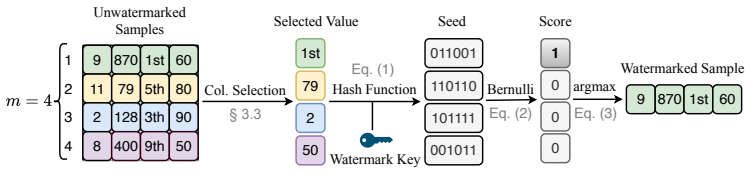
The load-bearing device is the max-of-$m$ selection statistic. For a fixed key $k$, a hash over the values of three adaptively chosen columns seeds a Bernoulli(0.5) score; generating $m$ candidates and keeping the maximum turns the expected score from $0.5$ into $1-0.5^m$. Hoeffding's inequality on the difference between watermarked and unwatermarked table means yields the FPR bound $\exp(-\frac{N}{2}(0.5-0.5^m)^2)$, and Equation (7) inverts that bound to calibrate $m$ from table size $N$ and target FPR $\alpha$. Adaptive column selection based on empirical quantile ranks and repeated-column masking keep the hash inputs diverse so the scores behave like fair coin flips.
What would settle it
Compute the empirical mean of $s_k(x_i)$ over a large unwatermarked table for a fixed key $k$; if it visibly differs from $0.5$, then the detection gap shrinks and the FPR bound in Theorem 3.3 no longer holds. Directly measuring the FPR at the calibrated $m$ on many unwatermarked tables would settle whether the guarantee is met.
Extended reading notes
Core claim
The central claim is that a tabular watermark can be made model-agnostic and nearly distortion-free by replacing inversion with multi-sample selection. Given a secret key $k$, MUSE computes a deterministic score $s_k(x)\sim\text{Bernoulli}(0.5)$ from a hash of $k$ and values in three adaptively selected columns, draws $m$ candidate rows per table row, and keeps the candidate with the maximum score. A watermarked table therefore has mean score $1-0.5^m$ instead of $0.5$, and Hoeffding's inequality gives the FPR bound in Theorem 3.3; Equation (7) then picks the smallest $m$ that meets a target FPR. In experiments on six datasets, this yields $1.0$ TPR at $0.1\%$ FPR while reducing fidelity distortion by $81\text{--}89\%$ relative to inversion-based baselines, and it remains effective across diffusion, autoregressive, and masked tabular generators.
Load-bearing premise
The false-positive guarantee assumes that, for a fixed secret key, the score of any row is as unpredictable as a fair coin flip, even though the implementation uses a deterministic hash and never checks that the hash is balanced on the actual data.
Editorial extensions
If this is right
- Any tabular generator that can sample repeatedly—diffusion, autoregressive, masked, or even a pre-existing table—can be watermarked without changing model internals.
- A provider can compute $m$ from $N$ and a target FPR, so watermark strength is calibrated instead of heuristic.
- Detection is just averaging hash scores over rows, so it is fast enough for large published tables.
- The watermark survives row shuffling, row deletion, cell deletion, and value alteration at high attack strengths; column deletion is the reported vulnerability.
- Watermarked tables keep downstream utility close to unwatermarked generations, with fidelity gaps near the unwatermarked model's own noise.
Reading between the lines
- Because the watermark lives entirely in which sample is released, the method should transfer to any cheap repeated-sampling setting with independently sampled outputs, such as other synthetic structured data, provided the scoring hash is balanced on that data.
- The paper does not analyze privacy: releasing the max-scoring of $m$ samples changes the sampling distribution slightly, so the interaction with differential privacy of the generator is an open question.
- A practical safeguard would be an empirical calibration step: before trusting Equation (7), measure the score mean on unwatermarked data for the chosen key and reject keys that are visibly unbalanced.
- An adversary aware of the adaptive column-selection rule knows that deleting selected columns destroys the signal, which the paper already identifies as the weakest attack.
Editorial analysis
A structured set of objections, weighed in public.
Referee Report
Summary. The paper proposes MUSE, a watermarking method for tabular generative models. Instead of relying on DDIM inversion, MUSE generates m candidate rows from the model, computes a key-dependent hash-based score on selected columns for each candidate, and selects the highest-scoring row. Repeating this over N rows embeds a watermark that is detected by comparing the mean score, or a one-tailed z-test, against the unwatermarked expectation. The authors provide a theoretical analysis (Lemma 3.1, Lemma 3.2, Theorem 3.3) claiming precise calibration of the false positive rate via the choice of m, and support the method with experiments on six tabular datasets, reporting near-perfect TPR@0.1%FPR, low fidelity distortion relative to TabWak, robustness to several attacks, and applicability across three model families.
Significance. The high-level idea is attractive and the empirical work is substantial: MUSE is model-agnostic, avoids the computationally costly and error-prone inversion pipeline, and appears from Tables 1 and 2 to preserve data quality much better than inversion-based baselines while retaining very high detectability. The paper also ships a public implementation and includes component-wise ablations (Section 4.3) and attack curves (Figure 4). If the advertised FPR calibration were correct, the method would be a practical and easily deployable contribution to tabular data watermarking. However, the theoretical guarantee as stated does not currently support the abstract's claim of 'precise calibration': the bound proved is not on the false positive rate of the actual detection test, and the Bernoulli(0.5) assumption on the fixed-key hash scores is unverified. The empirical detection numbers do not resolve this issue because they are not reported as unwatermarked false positive rates under the same protocol. The central empirical findings are plausible, but the paper's main formal claim needs to be reworked before publication.
major comments (3)
- [Section 3.4, Lemma 3.1, Appendix C.4] The quantity bounded in Eq. (5), Pr(S(T_no-wm) > S(T_wm)), is not the false positive rate of the watermark detection test used in the paper. The detector in Appendix C.4 is a one-tailed z-test on the count of score-1 rows under H0, and its FPR is controlled by the critical value z_alpha; Eq. (5) instead bounds the probability that an unwatermarked table outscores a watermarked table, which is a miss/ordering probability for a paired comparison. Consequently, Eq. (6) and the calibration formula Eq. (7) do not, as written, guarantee an FPR below alpha. The authors should re-derive the result for the actual test: specify a decision rule (e.g., reject when the test statistic exceeds a threshold), and bound Pr(reject | H0) and ideally Pr(accept | H1) under the true null and alternative distributions.
- [Section 3.2, Eqs. (1)-(2); Theorem 3.3] Theorem 3.3 assumes that s_k(x) ~ Bernoulli(0.5) for a fixed key k when x is drawn from the data distribution, but this is not established. In the implementation, H is a deterministic hash, so for a fixed k the score of a given row is fixed; the paper does not prove that P_{x~p}[H(pi(x),k)=1] is close to 0.5 on the actual support of the generative model. If the hash is imbalanced for the chosen key, the null mean under H0 is not 0.5, the z-test in Appendix C.4 is miscentered, and the detection gap in Eq. (6) becomes E[max_j s_k(x_j)] - mu rather than 0.5 - 0.5^m. The large z-statistics in Table 2 do not distinguish a genuine watermark from a shifted null, since the reported z-statistic is computed assuming mu = 0.5. The repeated column masking heuristic in Section 3.3 is not incorporated into Theorem 3.3. To fix this, the authors should either prove a balance property for the hash over the data distribution for every key (e.g., via a universal family and an explicit key-selection procedure), or add an empirical calibration step that measures the null distribution for the chosen key and reports unwatermarked FPRs.
- [Section 4.3, 'Distortion-Free Watermarking'] The claim that the repeated column masking procedure makes the selected row 'effectively random' and thereby approximately unbiased is not formally justified. Choosing the maximum of m hash-based scores still induces a conditional bias on the selected row through the selected columns, and masking only skips previously seen values; it does not remove the dependence between the score and the row value. Since Section 3.1 advertises MUSE as 'distribution-preserving' and Section 4.3 uses this argument to explain the improved fidelity numbers, the authors should either prove an unbiasedness statement under explicit conditions or explicitly present the distortion-free behavior as an empirical property rather than a theoretical guarantee.
minor comments (6)
- [Appendix D, Eq. (14)] In the proof of Lemma 3.1, S(T_no-wm) and S(T_wm) are defined as sums of N i.i.d. scores, whereas Eq. (4) defines S(T) as the mean score; align the notation to avoid a factor-of-N inconsistency in the presentation.
- [Algorithm 1] The algorithm splits the table into N/m groups, but N/m may not be an integer for the m computed from Eq. (7); specify how the final partial group is handled.
- [Eq. (2)] The notation 'f ~ Bernoulli(0.5)' is confusing because f is described as a mapping from hash h to a score; clarify whether f is a deterministic pseudorandom function whose output distribution over the input distribution is meant, rather than a random variable drawn per row.
- [Section 3.3 and Section 3.4] The adaptive column selection in Eq. (3) requires access to the training data T or its empirical marginal distributions, but the threat model in Section 2 only states that the provider shares the key with the detector; state explicitly what auxiliary information (e.g., training data or a fitted quantile function) the detector needs to compute pi(x) for a submitted table.
- [Table 1] The column header 'Num. Training Rows 100 500' is misleading; these are the sizes of the generated/watermarked tables N, not training rows, and should be relabeled (e.g., 'Table size N').
- [Figure 5] The statement that MUSE's generation time is lower than the inversion baselines 'despite using multi-sample generation (m=2)' should be accompanied by the caveat that generation time scales linearly with m, so the comparison depends on the operating point chosen by Eq. (7).
Circularity Check
No significant circularity: Theorem 3.3's FPR bound is a parameter-free Hoeffding derivation conditional on a stated Bernoulli(0.5) hash-balance assumption; the unverified fixed-key hash balance and the mislabeled FPR quantity are correctness risks, not circular reductions.
full rationale
The derivation chain is not circular. The central claim, Theorem 3.3 Eq. (6), upper-bounds Pr(S(Tno-wm) > S(Twm)) by exp(-N/2 (0.5 - 0.5^m)^2). This follows by Hoeffding's inequality (Lemma 3.1) together with the exact expectation E[max of m i.i.d. Bernoulli(0.5) draws] = 1 - 0.5^m; neither step uses a fitted constant, and m in Eq. (7) is computed from N and the target alpha rather than tuned to match the reported TPR@0.1%FPR values. The closest candidate for circularity would be the claim that the Bernoulli(0.5) hypothesis of Theorem 3.3 is guaranteed by the Eq. (2) construction, making the 'prediction' a restatement of the definition. That is not what the paper shows: Eq. (2) defines a deterministic hash-seeded score, while the theorem hypothesizes s_k(x) ~ Bernoulli(0.5) over the data distribution for a fixed key, which is strictly stronger and unproven, with no balance test or key-selection mechanism supplied. The gap runs opposite to circularity: the construction under-delivers relative to the theorem's hypothesis rather than trivially satisfying it. An imbalanced hash on the actual data support would shift the null mean away from 0.5, so m from Eq. (7) would not deliver the advertised 0.1% FPR; this is a soundness gap, not an equivalence by construction. Likewise, Eq. (5) bounds the probability that an unwatermarked mean exceeds a watermarked mean, which is not the threshold-based FPR used in the detection protocol, and the z-test in Appendix C.4 assumes the very Binomial(N, 0.5) null that the theorem merely hypothesizes; these are mislabeling and proof-gap issues rather than circular reductions. Self-citations (TabSyn [Zhang et al., 2024c], TabGen-ICL [Fang et al., 2025], the survey [Liu et al., 2024], TabDAR [Zhang et al., 2024a]) appear only as testbed models, baselines, or background; none carries the load of the FPR derivation, no uniqueness theorem is imported from the authors, and no ansatz is smuggled via citation. The 1.0 TPR@0.1%FPR and Table 2 z-statistics are empirical measurements of the implemented scheme, not outputs of the theorem. The paper is therefore close to self-contained, with the main weaknesses being unverified modeling assumptions rather than circularity.
Assumptions & free parameters
free parameters (4)
- number of selected columns (n) =
3
- candidate count (m) =
2 for N=500, 4 for N=100 (Figure 3)
- significance level alpha =
not explicitly reported; experiments report TPR@0.1%FPR, implying alpha=0.001
- repeated column masking =
enabled in main experiments
assumptions (5)
- domain assumption For a fixed key, hash-seeded scores s_k(x) are independent Bernoulli(0.5) random variables across rows and candidates
- ad hoc to paper The misordering probability Pr(S(T_no-wm)>S(T_wm)) is the false positive rate of detection
- domain assumption Candidate rows are i.i.d. draws from the generative model's distribution p(x)
- domain assumption H is balanced on the tabular data support for each fixed key, so P_x(s_k(x)=1) approximately equals 0.5
- ad hoc to paper Repeated column masking makes the selected row distribution approximately unbiased
Cite this review
Pith. "Pith review of MUSE: Model-Agnostic Tabular Watermarking via Multi-Sample Selection." pith.science (2026). https://pith.science/paper/56SPFVZ2
@misc{pith2026250524267,
  author       = {Pith},
  title        = {Pith review of: MUSE: Model-Agnostic Tabular Watermarking via Multi-Sample Selection},
  year         = {2026},
  howpublished = {\url{https://pith.science/paper/56SPFVZ2}},
  note         = {Machine review of arXiv:2505.24267}
}
read the original abstract
We introduce MUSE, a watermarking algorithm for tabular generative models. Previous approaches typically leverage DDIM invertibility to watermark tabular diffusion models, but tabular diffusion models exhibit significantly poorer invertibility compared to other modalities, compromising performance. Simultaneously, tabular diffusion models require substantially less computation than other modalities, enabling a multi-sample selection approach to tabular generative model watermarking. MUSE embeds watermarks by generating multiple candidate samples and selecting one based on a specialized scoring function, without relying on model invertibility. Our theoretical analysis establishes the relationship between watermark detectability, candidate count, and dataset size, allowing precise calibration of watermarking strength. Extensive experiments demonstrate that MUSE achieves state-of-the-art watermark detectability and robustness against various attacks while maintaining data quality, and remains compatible with any tabular generative model supporting repeated sampling, effectively addressing key challenges in tabular data watermarking. Specifically, it reduces the distortion rates on fidelity metrics by 81-89%, while achieving a 1.0 TPR@0.1%FPR detection rate. Implementation of MUSE can be found at https://github.com/fangliancheng/MUSE.
Figures


Figures from the paper (5 more)


Forward citations
Cited by 2 Pith papers
-
RaMark: Radioactive Watermarking for Generated Tabular Data
A sinusoidal dependency embedded as part of the tabular distribution remains detectable after generative retraining and data-modification attacks while utility is preserved.
-
Observation-Level Watermarking and Detection for Tabular Data
STAMP embeds Laplace keys via refined empirical CDFs so watermarked tabular rows keep the original law asymptotically and remain detectable from a single observation.
Reference graph
Works this paper leans on
-
[1]
Scott Aaronson and Hendrik Kirchner. Watermarking gpt outputs. https://www.scottaaronson.com/talks/watermark.ppt, 2022. Presentation
work page 2022
-
[2]
Generating synthetic data in finance: opportunities, challenges and pitfalls
Samuel A Assefa, Danial Dervovic, Mahmoud Mahfouz, Robert E Tillman, Prashant Reddy, and Manuela Veloso. Generating synthetic data in finance: opportunities, challenges and pitfalls. In Proceedings of the First ACM International Conference on AI in Finance, pages 1--8, 2020
work page 2020
-
[3]
Stable video diffusion: Scaling latent video diffusion models to large datasets
Andreas Blattmann, Tim Dockhorn, Sumith Kulal, Daniel Mendelevitch, Maciej Kilian, Dominik Lorenz, Yam Levi, Zion English, Vikram Voleti, Adam Letts, et al. Stable video diffusion: Scaling latent video diffusion models to large datasets. arXiv preprint arXiv:2311.15127, 2023
arXiv 2023
-
[4]
Adversarial attacks for tabular data: Application to fraud detection and imbalanced data
Francesco Cartella, Orlando Anunciacao, Yuki Funabiki, Daisuke Yamaguchi, Toru Akishita, and Olivier Elshocht. Adversarial attacks for tabular data: Application to fraud detection and imbalanced data. arXiv preprint arXiv:2101.08030, 2021
arXiv 2021
-
[5]
Rodrigo Castellon, Achintya Gopal, Brian Bloniarz, and David Rosenberg. Dp-tbart: A transformer-based autoregressive model for differentially private tabular data generation. arXiv preprint arXiv:2307.10430, 2023
work page Pith review arXiv 2023
-
[6]
Undetectable watermarks for language models
Miranda Christ, Sam Gunn, and Or Zamir. Undetectable watermarks for language models. In The Thirty Seventh Annual Conference on Learning Theory, pages 1125--1139. PMLR, 2024
work page 2024
-
[7]
Scalable watermarking for identifying large language model outputs
Sumanth Dathathri, Abigail See, Sumedh Ghaisas, Po-Sen Huang, Rob McAdam, Johannes Welbl, Vandana Bachani, Alex Kaskasoli, Robert Stanforth, Tatiana Matejovicova, Jamie Hayes, Nidhi Vyas, Majd Al Merey, Jonah Brown-Cohen, Rudy Bunel, Borja Balle, Taylan Cemgil, Zahra Ahmed, Kitty Stacpoole, Ilia Shumailov, Ciprian Baetu, Sven Gowal, Demis Hassabis, and Pu...
2024
-
[8]
Diffusion models beat gans on image synthesis
Prafulla Dhariwal and Alexander Nichol. Diffusion models beat gans on image synthesis. Advances in neural information processing systems, 34: 0 8780--8794, 2021
2021
Show all 43 references
-
[9]
Tabgen-icl: Residual-aware in-context example selection for tabular data generation
Liancheng Fang, Aiwei Liu, Hengrui Zhang, Henry Peng Zou, Weizhi Zhang, and Philip S Yu. Tabgen-icl: Residual-aware in-context example selection for tabular data generation. arXiv preprint arXiv:2502.16414, 2025
2025 arXiv
-
[10]
Tabular and latent space synthetic data generation: a literature review
Joao Fonseca and Fernando Bacao. Tabular and latent space synthetic data generation: a literature review. Journal of Big Data, 10 0 (1): 0 115, 2023
2023
-
[11]
Watermax: breaking the llm watermark detectability-robustness-quality trade-off
Eva Giboulot and Teddy Furon. Watermax: breaking the llm watermark detectability-robustness-quality trade-off. arXiv preprint arXiv:2403.04808, 2024
2024 arXiv
-
[12]
Tabmt: Generating tabular data with masked transformers
Manbir Gulati and Paul Roysdon. Tabmt: Generating tabular data with masked transformers. Advances in Neural Information Processing Systems, 36, 2024
2024
-
[13]
Watermarking generative tabular data
Hengzhi He, Peiyu Yu, Junpeng Ren, Ying Nian Wu, and Guang Cheng. Watermarking generative tabular data. arXiv preprint arXiv:2405.14018, 2024
2024 arXiv
-
[14]
Synthetic data generation for tabular health records: A systematic review
Mikel Hernandez, Gorka Epelde, Ane Alberdi, Rodrigo Cilla, and Debbie Rankin. Synthetic data generation for tabular health records: A systematic review. Neurocomputing, 493: 0 28--45, 2022
2022
-
[15]
On exact inversion of dpm-solvers
Seongmin Hong, Kyeonghyun Lee, Suh Yoon Jeon, Hyewon Bae, and Se Young Chun. On exact inversion of dpm-solvers. In Proceedings of the IEEE/CVF Conference on Computer Vision and Pattern Recognition, pages 7069--7078, 2024
2024
-
[17]
Unbiased watermark for large language models
Zhengmian Hu, Lichang Chen, Xidong Wu, Yihan Wu, Hongyang Zhang, and Heng Huang. Unbiased watermark for large language models. arXiv preprint arXiv:2310.10669, 2023
2023 arXiv
-
[18]
Robin: Robust and invisible watermarks for diffusion models with adversarial optimization
Huayang Huang, Yu Wu, and Qian Wang. Robin: Robust and invisible watermarks for diffusion models with adversarial optimization. Advances in Neural Information Processing Systems, 37: 0 3937--3963, 2024
2024
-
[19]
Elucidating the design space of diffusion-based generative models
Tero Karras, Miika Aittala, Timo Aila, and Samuli Laine. Elucidating the design space of diffusion-based generative models. Advances in neural information processing systems, 35: 0 26565--26577, 2022
2022
-
[20]
Auto-encoding variational bayes
Diederik P Kingma and Max Welling. Auto-encoding variational bayes. arXiv preprint arXiv:1312.6114, 2013
2013 arXiv
-
[21]
A watermark for large language models
John Kirchenbauer, Jonas Geiping, Yuxin Wen, Jonathan Katz, Ian Miers, and Tom Goldstein. A watermark for large language models. In International Conference on Machine Learning, pages 17061--17084. PMLR, 2023
2023
-
[22]
Tabddpm: Modelling tabular data with diffusion models
Akim Kotelnikov, Dmitry Baranchuk, Ivan Rubachev, and Artem Babenko. Tabddpm: Modelling tabular data with diffusion models. In International Conference on Machine Learning, pages 17564--17579. PMLR, 2023
2023
-
[23]
Robust distortion-free watermarks for language models
Rohith Kuditipudi, John Thickstun, Tatsunori Hashimoto, and Percy Liang. Robust distortion-free watermarks for language models. arXiv preprint arXiv:2307.15593, 2023
2023 arXiv
-
[24]
A semantic invariant robust watermark for large language models
Aiwei Liu, Leyi Pan, Xuming Hu, Shiao Meng, and Lijie Wen. A semantic invariant robust watermark for large language models. ArXiv, abs/2310.06356, 2023
2023 arXiv
-
[25]
A survey of text watermarking in the era of large language models
Aiwei Liu, Leyi Pan, Yijian Lu, Jingjing Li, Xuming Hu, Xi Zhang, Lijie Wen, Irwin King, Hui Xiong, and Philip Yu. A survey of text watermarking in the era of large language models. ACM Computing Surveys, 57 0 (2): 0 1--36, 2024
2024
-
[26]
Tabular transformers for modeling multivariate time series
Inkit Padhi, Yair Schiff, Igor Melnyk, Mattia Rigotti, Youssef Mroueh, Pierre Dognin, Jerret Ross, Ravi Nair, and Erik Altman. Tabular transformers for modeling multivariate time series. In ICASSP 2021-2021 IEEE International Conference on Acoustics, Speech and Signal Processi...
2021
-
[27]
Markllm: An open-source toolkit for llm watermarking
Leyi Pan, Aiwei Liu, Zhiwei He, Zitian Gao, Xuandong Zhao, Yijian Lu, Binglin Zhou, Shuliang Liu, Xuming Hu, Lijie Wen, et al. Markllm: An open-source toolkit for llm watermarking. arXiv preprint arXiv:2405.10051, 2024
2024 arXiv
-
[28]
Effective real image editing with accelerated iterative diffusion inversion
Zhihong Pan, Riccardo Gherardi, Xiufeng Xie, and Stephen Huang. Effective real image editing with accelerated iterative diffusion inversion. In Proceedings of the IEEE/CVF International Conference on Computer Vision, pages 15912--15921, 2023
2023
-
[29]
High-resolution image synthesis with latent diffusion models
Robin Rombach, Andreas Blattmann, Dominik Lorenz, Patrick Esser, and Bj \"o rn Ommer. High-resolution image synthesis with latent diffusion models. In Proceedings of the IEEE/CVF conference on computer vision and pattern recognition, pages 10684--10695, 2022
2022
-
[30]
Tabdiff: a unified diffusion model for multi-modal tabular data generation
Juntong Shi, Minkai Xu, Harper Hua, Hengrui Zhang, Stefano Ermon, and Jure Leskovec. Tabdiff: a unified diffusion model for multi-modal tabular data generation. In NeurIPS 2024 Third Table Representation Learning Workshop, 2024
2024
-
[31]
Denoising diffusion implicit models
Jiaming Song, Chenlin Meng, and Stefano Ermon. Denoising diffusion implicit models. arXiv preprint arXiv:2010.02502, 2020
2010 arXiv
-
[32]
Tree-ring watermarks: Fingerprints for diffusion images that are invisible and robust
Yuxin Wen, John Kirchenbauer, Jonas Geiping, and Tom Goldstein. Tree-ring watermarks: Fingerprints for diffusion images that are invisible and robust. arXiv preprint arXiv:2305.20030, 2023
2023 arXiv
-
[33]
Quantile normalization -- Wikipedia , the free encyclopedia
Wikipedia contributors . Quantile normalization -- Wikipedia , the free encyclopedia. https://en.wikipedia.org/wiki/Quantile_normalization, 2025. Accessed: 2025-05-11
2025
-
[34]
A survey on llm-generated text detection: Necessity, methods, and future directions
Junchao Wu, Shu Yang, Runzhe Zhan, Yulin Yuan, Lidia Sam Chao, and Derek Fai Wong. A survey on llm-generated text detection: Necessity, methods, and future directions. Computational Linguistics, pages 1--66, 2025
2025
-
[35]
Gaussian shading: Provable performance-lossless image watermarking for diffusion models
Zijin Yang, Kai Zeng, Kejiang Chen, Han Fang, Weiming Zhang, and Nenghai Yu. Gaussian shading: Provable performance-lossless image watermarking for diffusion models. In Proceedings of the IEEE/CVF Conference on Computer Vision and Pattern Recognition, pages 12162--12171, 2024
2024
-
[36]
Diffusion-nested auto-regressive synthesis of heterogeneous tabular data
Hengrui Zhang, Liancheng Fang, Qitian Wu, and Philip S Yu. Diffusion-nested auto-regressive synthesis of heterogeneous tabular data. arXiv preprint arXiv:2410.21523, 2024 a
2024 arXiv
-
[37]
Unleashing the potential of diffusion models for incomplete data imputation
Hengrui Zhang, Liancheng Fang, and Philip S Yu. Unleashing the potential of diffusion models for incomplete data imputation. arXiv preprint arXiv:2405.20690, 2024 b
2024 arXiv
-
[38]
Mixed-type tabular data synthesis with score-based diffusion in latent space
Hengrui Zhang, Jiani Zhang, Balasubramaniam Srinivasan, Zhengyuan Shen, Xiao Qin, Christos Faloutsos, Huzefa Rangwala, and George Karypis. Mixed-type tabular data synthesis with score-based diffusion in latent space. In The twelfth International Conference on Learning Represen...
2024
-
[39]
Provable robust watermarking for ai-generated text
Xuandong Zhao, Prabhanjan Ananth, Lei Li, and Yu-Xiang Wang. Provable robust watermarking for ai-generated text. arXiv preprint arXiv:2306.17439, 2023
2023 arXiv
-
[40]
Tabularmark: Watermarking tabular datasets for machine learning
Yihao Zheng, Haocheng Xia, Junyuan Pang, Jinfei Liu, Kui Ren, Lingyang Chu, Yang Cao, and Li Xiong. Tabularmark: Watermarking tabular datasets for machine learning. In Proceedings of the 2024 on ACM SIGSAC Conference on Computer and Communications Security, pages 3570--3584, 2024
2024
-
[41]
Galjaard, Pin-Yu Chen, Robert Birke, Cornelis Bos, and Lydia Y
Chaoyi Zhu, Jiayi Tang, Jeroen M. Galjaard, Pin-Yu Chen, Robert Birke, Cornelis Bos, and Lydia Y. Chen. Tabwak: A watermark for tabular diffusion models. In The Thirteenth International Conference on Learning Representations, 2025. URL https://openreview.net/forum?id=71pur4y8gs
2025
-
[42]
@esa (Ref
\@ifxundefined[1] #1\@undefined \@firstoftwo \@secondoftwo \@ifnum[1] #1 \@firstoftwo \@secondoftwo \@ifx[1] #1 \@firstoftwo \@secondoftwo [2] @ #1 \@temptokena #2 #1 @ \@temptokena \@ifclassloaded agu2001 natbib The agu2001 class already includes natbib coding, so you should ...
-
[43]
\@lbibitem[] @bibitem@first@sw\@secondoftwo \@lbibitem[#1]#2 \@extra@b@citeb \@ifundefined br@#2\@extra@b@citeb \@namedef br@#2 \@nameuse br@#2\@extra@b@citeb \@ifundefined b@#2\@extra@b@citeb @num @parse #2 @tmp #1 NAT@b@open@#2 NAT@b@shut@#2 \@ifnum @merge>\@ne @bibitem@firs...
-
[44]
@open @close @open @close and [1] URL: #1 \@ifundefined chapter * \@mkboth \@ifxundefined @sectionbib * \@mkboth * \@mkboth\@gobbletwo \@ifclassloaded amsart * \@ifclassloaded amsbook * \@ifxundefined @heading @heading NAT@ctr thebibliography [1] @ \@biblabel @NAT@ctr \@bibset...
2025 arXiv
Reviewed August 7, 2026 · model on record in the stance chip above.
Discussion (0). Sign in to comment.