REVIEW 4 major objections 8 minor 30 references
RAIL: Region-Aware Instructive Learning for Semi-Supervised Tooth Segmentation in CBCT
T0 review · 4 major / 8 minor · reviewed 2026-08-15 · deepseek-v4-flash
Pith's one-line read This paper claims that region-aware instructive losses in a four-student Mean Teacher framework make semi-supervised CBCT tooth segmentation substantially more label-efficient, reporting a Dice of 89.55 with only 9% labeled scans on FDDI+.
desk verdict A potentially useful dual-student SSL framework for CBCT tooth segmentation, but the headline gain is confounded by a four-student inference ensemble that baselines don't get. read the letter →
The pith
A machine-rendered reading of the paper's core claim, the machinery that carries it, and where it could break.
The reading
What carries the argument
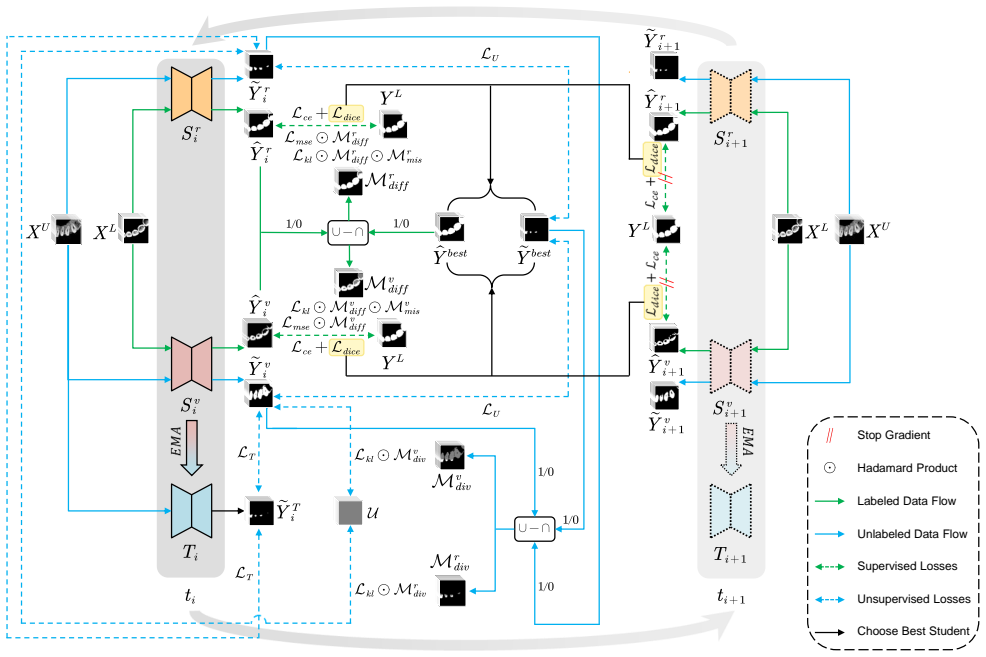
The load-bearing machinery is a pair of masks on top of a progressive Mean Teacher baseline. The disagreement mask $M_{\mathrm{diff}}$ is the symmetric difference between the argmax of a student output and the argmax of the best-performing student's output; the mislabel mask $M_{\mathrm{mis}}$ is the symmetric difference between student output and ground truth; their Hadamard product $M_{\mathrm{diff\_mis}} = M_{\mathrm{diff}} \odot M_{\mathrm{mis}}$ selects voxels that are both contested and wrong, and the DFS loss $L_{\mathrm{DFS}} = \mathrm{KL}(\hat{Y}, Y) \odot M_{\mathrm{diff\_mis}}$ concentrates supervision there. On unlabeled volumes, the CAL modulator forms $M_{\mathrm{div}}$ from disagreement between the student pseudo-label and the best student pseudo-label and adds $L_{\mathrm{CAL}} = \mathrm{KL}(\tilde{Y}\,\|\,U) \odot M_{\mathrm{div}}$, pushing low-confidence regions toward an uncertain uniform distribution. The dual-group, dual-student arrangement trains VNet and ResVNet students alternately so each group receives knowledge from the other, with an exponential moving average updating the shared teacher.
What would settle it
Run RAIL's training recipe with the DFS and CAL losses removed but keep the four-student ensemble and alternating-group schedule; if Dice stays near 89.55 on FDDI+ at 9% labeled, the region-aware modules are not doing the work. Conversely, run RAIL with a single student at inference and compare with single-model progressive mean teacher; if the margin collapses, the ensemble is the main driver.
Extended reading notes
Core claim
RAIL's central claim is that the two persistent weaknesses of semi-supervised CBCT tooth segmentation—lack of corrective supervision inside ambiguous or mislabeled regions, and unreliable pseudo-labels—can be addressed together by region-aware instructive losses in a four-student collaborative framework. The DFS Controller computes a mask from the intersection of two disagreements: where a student differs from the current best student, and where it differs from ground truth, and applies a KL-divergence loss only inside that mask. The CAL Modulator, on unlabeled data, computes a divergence mask between student pseudo-labels and the best student's pseudo-label, and uses it to scale a KL term toward a uniform distribution, effectively suppressing low-confidence predictions. Trained with the progressive mean teacher schedule and aggregating the four students at inference, the framework reports improvements over all compared baselines on FDDI+, FDDI-E, 3D CBCT Tooth, and CTooth, including a Dice gain from 84.91 to 89.55 at 9% labeled on FDDI+.
Load-bearing premise
The gains are measured by comparing a four-model ensemble against single-model baselines, so the new region-aware losses may not be the source of the improvement.
Editorial extensions
If this is right
- On FDDI+, using 9% labeled scans, RAIL reports Dice 89.55 compared with 84.91 for the strongest compared baseline, a margin that suggests large label savings for tooth segmentation.
- On the 3D CBCT Tooth dataset at 10% labeled, RAIL reaches Dice 94.09, nearly matching the fully supervised V-Net's 94.55 with 120 labeled scans, implying near-parity at roughly one-tenth of the labels.
- On CTooth, where annotation quality is limited, RAIL still improves over baselines while additional labeled data does not help, suggesting the masks also dampen the effect of label noise.
- Because both new losses are defined purely from student outputs and masks, the framework is transferable to other volumetric segmentation tasks with sparse labels.
Reading between the lines
- A missing control leaves attribution open: final predictions aggregate four students, while every baseline is a single model. An ensemble of four progressive mean teacher students would test whether DFS and CAL contribute beyond averaging.
- The 'best student' is chosen per batch by supervised Dice; a smoother choice, such as a confidence-weighted blend of all students, could make the masks more stable and deserves testing.
- The DFS mislabel mask depends on ground truth, so on clean-data regimes its benefit might shrink; comparing RAIL with a version using only the disagreement mask would isolate the noise-robustness component.
Signed reviews
Editorial analysis
A structured set of objections, weighed in public.
Referee Report
Summary. The paper proposes RAIL, a dual-group dual-student Mean Teacher framework for semi-supervised 3D tooth segmentation in CBCT. It introduces two region-aware mechanisms: a Disagreement-Focused Supervision (DFS) controller, which reweights the supervised loss toward voxels where students disagree with each other and with ground truth, and a Confidence-Aware Learning (CAL) modulator, which adds a KL-based term on divergence regions in the unsupervised loss. Experiments on four CBCT datasets (FDDI+, FDDI-E, 3D CBCT Tooth, CTooth) report consistent improvements over PMT and other SSL baselines at 5-20% labeled data, with the largest gain on FDDI+ at 9% labeled data (+4.64 Dice). The code is promised but the FDDI+ extension data is not publicly released.
Significance. If the reported gains are attributable to the proposed DFS and CAL mechanisms, RAIL would provide a practically useful label-efficiency improvement for a clinically relevant task, and the region-aware formulation is a reasonable extension of discrepancy-based semi-supervised learning. The paper's strength is its multi-dataset evaluation and the clear application motivation. However, the current evidence is undermined by an uncontrolled inference-time ensemble, an internal contradiction in the best-student selection rule, and several implausible baseline numbers. These issues prevent the manuscript from supporting its central attribution claim, so a major revision is required.
major comments (4)
- [Section 4.2 and Tables 2-5] The final prediction aggregates outputs from four student models, but all comparisons in Tables 2-5 compare this four-model aggregate with single-model baselines, and the ablation in Table 1 holds the four-model inference scheme fixed while varying only loss terms. The largest reported gain (+4.64 Dice on FDDI+ at 9%) therefore cannot be attributed to DFS and CAL without controlling for ensemble size. Please report (i) RAIL with a single student at inference, (ii) the strongest baseline (PMT) with the same four-model aggregation and identical inference protocol, and (iii) per-student performance. Without these controls, the headline claim that the region-aware mechanisms deliver the improvement is unsupported.
- [Section 3.3 vs Algorithm 1] Section 3.3 states that the best student is chosen as the one with the highest DICE loss, while Algorithm 1 line 13 selects Sbest by argmin of the DICE loss. These rules are opposites and produce different M_diff masks and pseudo-labels. Please correct the inconsistency and state explicitly which rule was used in the reported experiments, since this directly affects the DFS and CAL losses.
- [Section 3.4 and Eq. (8)] The CAL loss is defined as D_KL(ŷ || U) ⊙ M_div. Maximizing this term, as stated in Sec. 3.4 ('maximize the uncertainty in regions of divergence'), would push predictions away from the uniform distribution and toward more confident predictions, whereas the abstract and Sec. 3.4 claim that the module reduces the effect of low-confidence predictions. The direction of the optimization and its connection to the stated goal need to be reconciled; otherwise the unsupervised update may amplify errors in disagreement regions instead of down-weighting them.
- [Tables 2-5] Several baseline numbers are implausibly low relative to published results (e.g., DTC Dice of 37.62 and BCP Dice of 19.86 on FDDI+ at 9%; BCP Dice of 71.10 with ASD of 4.19 on FDDI-E at 10%), and some metric combinations are suspicious (e.g., TTMC Dice 80.34 with ASD 0.69 on 3D CBCT Tooth at 5%, or BCP Dice 84.29 with ASD 0.64). Such numbers suggest possible implementation or configuration issues rather than genuine method behavior, and they directly inflate the reported relative gains. Please verify the baselines using official code and hyperparameters where available, report standard deviations over multiple runs, and reconcile or explain the ASD/Dice combinations.
minor comments (8)
- [Section 1] The word 'Instuctive' in the introduction should be 'Instructive'.
- [Section 2.1] In the second paragraph, the sentence beginning 'Introduced an end-to-end artificial intelligence solution...' is missing a subject; this appears to be a citation artifact and should be rewritten.
- [Eq. (2) and Section 4.2] The text after Eq. (2) states β = 0.5, while Section 4.2 states α = 0.5 and β = 0.05. Please clarify the correct value of β.
- [Table 1] The component columns 'LKL', 'Mmis', and 'Mdiv' are not defined in the table caption; please define them and explicitly map them to the DFS and CAL modules.
- [Section 3.1.2 and Fig. 1] The framework is described as 'dual-group dual-student' but contains four students total; please state this explicitly in the method overview to avoid confusion.
- [Fig. 2 and Fig. 3] The order of methods in the subfigure labels appears to differ from the order in the captions; please verify the alignment.
- [Section 4.4.4 and Table 5] The text reports 1.54% Dice gain and 2.48% Jaccard gain for CTooth at 10% labeled data, but Table 5 shows a 0.6% Dice gain and 0.98% Jaccard gain. This appears to be a copy-paste error from the 3D CBCT Tooth section; please correct.
- [Data availability] The FDDI+ dataset includes 14 supplementary scans collected by the authors, but no data availability statement is provided; please clarify whether these scans will be released to support reproducibility.
Circularity Check
No significant circularity; the derivation is self-contained, but the four-student inference ensemble is an uncontrolled confound in the comparisons.
full rationale
The paper's core derivation is self-contained: the DFS and CAL losses are explicitly defined by Eqs. (5)-(7) and Algorithm 1 in terms of student outputs, ground truth, teacher EMA predictions, and disagreement masks, and no target metric is used to define a fitted parameter that is then reported as a prediction. The best-student self-training is a standard self-ensembling mechanism rather than a self-definitional loop. The only load-bearing supports that touch the authors' prior work are the FDDI/FDDI-E datasets [28] and the related-work reference [15]; these are empirical benchmarks and prior art, not derivation steps, and the paper still evaluates on the external 3D CBCT Tooth and CTooth datasets, so no argument reduces to a self-citation. I therefore find no circularity. Two non-circular weaknesses should be noted: Section 4.2 states that 'The final prediction aggregates outputs from four student models,' with no single-student RAIL evaluation or four-student ensembled baseline control, so the headline margins in Tables 2-5 may conflate the proposed region-aware mechanisms with an uncontrolled ensemble effect; and Section 3.3's text ('the student network with the highest DICE loss') is inconsistent with Algorithm 1 line 13 ('arg min_S L_dice'), which affects reproducibility of the disagreement masks. These are fairness/reproducibility concerns, not circular derivation.
Assumptions & free parameters
free parameters (5)
- alpha (EMA momentum) =
0.5
- beta (MSE weight in supervised loss) =
0.5 in Eq. 2, 0.05 in Sec. 4.2
- gamma (DFS weight) =
0.05
- mu (CAL weight) =
0.1
- lambda1 and lambda2 (PMT warm-up weights) =
20.0 and 10.0
assumptions (4)
- domain assumption Pseudo-labels from the EMA teacher are reliable enough to train students.
- ad hoc to paper The symmetric difference of argmax predictions identifies structurally ambiguous or mislabeled voxels.
- ad hoc to paper Maximizing KL divergence to a uniform distribution in disagreement regions reduces the influence of low-confidence pseudo-labels.
- domain assumption The four datasets are representative of CBCT tooth segmentation and the train-test splits are unbiased.
Cite this review
Pith. "Pith review of RAIL: Region-Aware Instructive Learning for Semi-Supervised Tooth Segmentation in CBCT." pith.science (2026). https://pith.science/paper/56ZI57ZS
@misc{pith2026250503538,
  author       = {Pith},
  title        = {Pith review of: RAIL: Region-Aware Instructive Learning for Semi-Supervised Tooth Segmentation in CBCT},
  year         = {2026},
  howpublished = {\url{https://pith.science/paper/56ZI57ZS}},
  note         = {Machine review of arXiv:2505.03538}
}
read the original abstract
Semi-supervised learning has become a compelling approach for 3D tooth segmentation from CBCT scans, where labeled data is minimal. However, existing methods still face two persistent challenges: limited corrective supervision in structurally ambiguous or mislabeled regions during supervised training and performance degradation caused by unreliable pseudo-labels on unlabeled data. To address these problems, we propose Region-Aware Instructive Learning (RAIL), a dual-group dual-student, semi-supervised framework. Each group contains two student models guided by a shared teacher network. By alternating training between the two groups, RAIL promotes intergroup knowledge transfer and collaborative region-aware instruction while reducing overfitting to the characteristics of any single model. Specifically, RAIL introduces two instructive mechanisms. Disagreement-Focused Supervision (DFS) Controller improves supervised learning by instructing predictions only within areas where student outputs diverge from both ground truth and the best student, thereby concentrating supervision on structurally ambiguous or mislabeled areas. In the unsupervised phase, Confidence-Aware Learning (CAL) Modulator reinforces agreement in regions with high model certainty while reducing the effect of low-confidence predictions during training. This helps prevent our model from learning unstable patterns and improves the overall reliability of pseudo-labels. Extensive experiments on four CBCT tooth segmentation datasets show that RAIL surpasses state-of-the-art methods under limited annotation. Our code will be available at https://github.com/Tournesol-Saturday/RAIL.
Figures


Reference graph
Works this paper leans on
-
[1]
Bidirectional copy-paste for semi-supervised medical image segmentation
Yunhao Bai, Duowen Chen, Qingli Li, Wei Shen, and Yan Wang. Bidirectional copy-paste for semi-supervised medical image segmentation. In Proceedings of the IEEE/CVF con- ference on computer vision and pattern recognition , pages 11514–11524, 2023. 1, 3, 6, 7, 8, 9, 10
work page 2023
-
[2]
Soufiane Belharbi, J ´erˆome Rony, Jose Dolz, Ismail Ben Ayed, Luke McCaffrey, and Eric Granger. Deep interpretable classification and weakly-supervised segmentation of histol- ogy images via max-min uncertainty. IEEE Transactions on Medical Imaging, 41(3):702–714, 2021. 5
work page 2021
-
[3]
Semi-supervised semantic segmentation with cross pseudo supervision
Xiaokang Chen, Yuhui Yuan, Gang Zeng, and Jingdong Wang. Semi-supervised semantic segmentation with cross pseudo supervision. In Proceedings of the IEEE/CVF Conference on Computer Vision and Pattern Recognition (CVPR), pages 2613–2622, 2021. 1, 4
work page 2021
-
[4]
Triple-task mutual consistency for semi-supervised 3d medical image segmentation
Yantao Chen, Yong Ma, Xiaoguang Mei, Lin Zhang, Zhi- gang Fu, and Jiayi Ma. Triple-task mutual consistency for semi-supervised 3d medical image segmentation. Comput- ers in Biology and Medicine , 175:108506, 2024. 1, 3, 6, 7, 9, 10
work page 2024
-
[5]
Veronika Cheplygina, Marleen de Bruijne, and Josien P. W. Pluim. Not-so-supervised: A survey of semi-supervised, multi-instance, and transfer learning in medical image anal- ysis. Medical Image Analysis, 54:280–296, 2019. 1, 2
work page 2019
-
[6]
Weiwei Cui, Yaqi Wang, Qianni Zhang, Huiyu Zhou, Dan Song, Xingyong Zuo, Gangyong Jia, and Liaoyuan Zeng. Ctooth: a fully annotated 3d dataset and benchmark for tooth volume segmentation on cone beam computed tomography images. In International Conference on Intelligent Robotics and Applications, pages 191–200. Springer, 2022. 7, 8
work page 2022
-
[7]
Toothnet: Automatic tooth instance segmentation and identification from cone beam ct images
Zhiming Cui, Changjian Li, and Wenping Wang. Toothnet: Automatic tooth instance segmentation and identification from cone beam ct images. In Proceedings of the IEEE/CVF Conference on Computer Vision and Pattern Recognition (CVPR), 2019. 1, 2
work page 2019
-
[8]
A fully automatic ai system for tooth and alve- olar bone segmentation from cone-beam ct images
Zhiming Cui, Yu Fang, Lanzhuju Mei, Bojun Zhang, Bo Yu, Jiameng Liu, Caiwen Jiang, Yuhang Sun, Lei Ma, Jiawei Huang, et al. A fully automatic ai system for tooth and alve- olar bone segmentation from cone-beam ct images. Nature communications, 13(1):2096, 2022. 1, 7, 8
work page 2022
Show all 30 references
-
[9]
Detection of breast cancer with ultrasound tomography: First results with the computed ultrasound risk evaluation (cure) prototype
Neb Duric, Peter Littrup, Libero Poulo, Alex Babkin, Roman Pevzner, Eric Holsapple, Ogonna Rama, and Cheryl Glide. Detection of breast cancer with ultrasound tomography: First results with the computed ultrasound risk evaluation (cure) prototype. Medical Physics, 34(2):773–785...
2007
-
[10]
Toward accurate tooth segmentation from computed tomography images using a hybrid level set model
Yangzhou Gan, Zeyang Xia, Jing Xiong, Qunfei Zhao, Ying Hu, and Jianwei Zhang. Toward accurate tooth segmentation from computed tomography images using a hybrid level set model. Medical Physics, 42(1):14–27, 2015. 1, 2
2015
-
[11]
Individual tooth segmentation from ct images using level set method with shape and inten- sity prior
Hui Gao and Oksam Chae. Individual tooth segmentation from ct images using level set method with shape and inten- sity prior. Pattern Recognition, 43(7):2406–2417, 2010. 1, 2
2010
-
[12]
Pmt: Progressive mean teacher via exploring temporal con- sistency for semi-supervised medical image segmentation
Ning Gao, Sanping Zhou, Le Wang, and Nanning Zheng. Pmt: Progressive mean teacher via exploring temporal con- sistency for semi-supervised medical image segmentation. In European Conference on Computer Vision, pages 144–160. Springer, 2024. 1, 3, 4, 6, 7, 9, 10
2024
-
[13]
Label propagation for deep semi-supervised learn- ing
Ahmet Iscen, Giorgos Tolias, Yannis Avrithis, and Ondrej Chum. Label propagation for deep semi-supervised learn- ing. Proceedings of the IEEE/CVF Conference on Computer Vision and Pattern Recognition (CVPR) , pages 5070–5079,
-
[14]
A level-set based approach for anterior teeth segmen- tation in cone beam computed tomography images
Dong Xu Ji, Sim Heng Ong, and Kelvin Weng Chiong Foong. A level-set based approach for anterior teeth segmen- tation in cone beam computed tomography images. Comput- ers in Biology and Medicine, 50:116–128, 2014. 1, 2
2014
-
[15]
Usct: Uncertainty-regularized sym- metric consistency learning for semi-supervised teeth seg- mentation in cbct
Yixin Jing, Jie Liu, Weifan Liu, Zhicheng Yang, ZhongWei Zhou, and Zekuan Yu. Usct: Uncertainty-regularized sym- metric consistency learning for semi-supervised teeth seg- mentation in cbct. Biomedical Signal Processing and Con- trol, 91:106032, 2024. 1, 2
2024
-
[16]
Integrating statistical shape models into a graph cut framework for tooth segmentation
Johannes Keustermans, Dirk Vandermeulen, and Paul Suetens. Integrating statistical shape models into a graph cut framework for tooth segmentation. In Machine Learning in Medical Imaging, pages 242–249, Berlin, Heidelberg, 2012. Springer Berlin Heidelberg. 1, 2
2012
-
[17]
Shape-aware semi-supervised 3d semantic segmentation for medical im- ages
Shuailin Li, Chuyu Zhang, and Xuming He. Shape-aware semi-supervised 3d semantic segmentation for medical im- ages. In Medical Image Computing and Computer Assisted Intervention–MICCAI 2020: 23rd International Conference, Lima, Peru, October 4–8, 2020, Proceedings, Part I 23 ,...
2020
-
[18]
Sgdr: Stochas- tic gradient descent with warm restarts
Ilya Loshchilov and Frank Hutter. Sgdr: Stochas- tic gradient descent with warm restarts. arXiv preprint arXiv:1608.03983, 2016. 9
2016 arXiv
-
[19]
Semi-supervised medical image segmentation through dual- task consistency
Xiangde Luo, Jieneng Chen, Tao Song, and Guotai Wang. Semi-supervised medical image segmentation through dual- task consistency. In Proceedings of the AAAI conference on artificial intelligence, pages 8801–8809, 2021. 1, 2, 4, 6, 7, 8, 9, 10
2021
-
[20]
V-net: Fully convolutional neural networks for volumetric medical image segmentation
Fausto Milletari, Nassir Navab, and Seyed-Ahmad Ahmadi. V-net: Fully convolutional neural networks for volumetric medical image segmentation. In Fourth International Con- ference on 3D Vision, 3DV 2016, pages 565–571. IEEE Com- puter Society, 2016. 6, 7, 9, 10
2016
-
[21]
Switching temporary teachers for semi-supervised semantic segmentation
Jaemin Na, Jung-Woo Ha, Hyung Jin Chang, Dongyoon Han, and Wonjun Hwang. Switching temporary teachers for semi-supervised semantic segmentation. In Advances in Neural Information Processing Systems , pages 40367– 40380. Curran Associates, Inc., 2023. 1, 4
2023
-
[22]
SDCL: Stu- dents Discrepancy-Informed Correction Learning for Semi- supervised Medical Image Segmentation
Bentao Song and Qingfeng Wang. SDCL: Stu- dents Discrepancy-Informed Correction Learning for Semi- supervised Medical Image Segmentation . In proceedings of Medical Image Computing and Computer Assisted Interven- tion – MICCAI 2024. Springer Nature Switzerland, 2024. 1, 3, 6, 7, 9, 10
2024
-
[23]
Chi- ang, Zhiwei Wu, and Xiaowei Ding
Nima Tajbakhsh, Latha Jeyaseelan, Qian Li, Jeffrey N. Chi- ang, Zhiwei Wu, and Xiaowei Ding. Embracing imperfect datasets: A review of deep learning solutions for medical image segmentation. Medical Image Analysis , 63:101693,
-
[24]
Mcf: Mutual correction framework for semi- supervised medical image segmentation
Yuyin Wang, Biao Xiao, Xiang Bi, Wen Li, and Xin- jian Gao. Mcf: Mutual correction framework for semi- supervised medical image segmentation. In Proceedings of the IEEE/CVF Conference on Computer Vision and Pattern Recognition, pages 15651–15660, 2023. 1, 4, 6, 7, 8, 9, 10
2023
-
[25]
Semi-supervised left atrium segmentation with mutual consistency training
Yicheng Wu, Minfeng Xu, Zongyuan Ge, Jianfei Cai, and Lei Zhang. Semi-supervised left atrium segmentation with mutual consistency training. In Medical Image Comput- ing and Computer Assisted Intervention - MICCAI 2021: 24th international conference, Strasbourg, France, Septem-...
2021
-
[26]
Z. Xu, Y . Wang, D. Lu, L. Yu, J. Yan, J. Luo, K. Ma, Y . Zheng, and R. K. Y . Tong. All-around real label supervision: Cyclic prototype consistency learning for semi-supervised medical image segmentation. IEEE Journal of Biomedical and Health Informatics, 26(7):3174–3184, 2022. 8, 9
2022
-
[27]
Uncertainty-aware self-ensembling model for semi-supervised 3d left atrium segmentation
Lequan Yu, Shujun Wang, Xiaomeng Li, Chi-Wing Fu, and Pheng-Ann Heng. Uncertainty-aware self-ensembling model for semi-supervised 3d left atrium segmentation. In Med- ical image computing and computer assisted intervention– MICCAI 2019: 22nd international conference, Shenzhen,...
2019
-
[28]
A benchmark dual-modality dental imaging dataset and a novel cognitively inspired pipeline for high-resolution dental point cloud syn- thesis
Zekuan Yu, Meijia Li, Jiacheng Yang, Zilong Chen, Huixian Zhang, Weifan Liu, Fang Kai Han, and Jie Liu. A benchmark dual-modality dental imaging dataset and a novel cognitively inspired pipeline for high-resolution dental point cloud syn- thesis. Cognitive Computation, 15(6):1...
1922
-
[29]
Pmfsnet: Polarized multi- scale feature self-attention network for lightweight medical image segmentation
Jiahui Zhong, Wenhong Tian, Yuanlun Xie, Zhijia Liu, Jie Ou, Taoran Tian, and Lei Zhang. Pmfsnet: Polarized multi- scale feature self-attention network for lightweight medical image segmentation. Computer Methods and Programs in Biomedicine, 261:108611, 2025. 1, 2
2025
-
[306]
1, 3, 6, 7, 9, 10
Springer, 2021. 1, 3, 6, 7, 9, 10
2021
Reviewed August 15, 2026 · model on record in the stance chip above.
Discussion (0). Continue with ORCID to comment.